Liberated Wanderers

<><><><><><><><><><><><><><><><><><><><><><><><><><><><><><><><>

Liberated Wanderers

We all have our allegiances: to the approval pyramids we seek attention-status in, and to the idea-bubble herds (choirs, churches, clubs) we seek safety in, and are terrified to wander from as loners no longer shielded by anonymity.

The borders between these pyramids and herds form the fracture lines of human society, and exert repulsive forces between them that are steadily destroying all-life.

To be a true loner is to have dropped all wants and hopes and so be unhindered in setting a personal direction of drift through the chaos, and thus capable of gainless clarity of thought and indiscriminate compassion.

The best hope for the continuation of humanity into the deep future is that it find a unity of purpose, and the best ground from which that unifying impulse can germinate to then send out its unifying roots, is our constellation of liberated wanderers.

<><><><><><><>

Snyder versus the Campists

When forming one’s political orientation, a consistency of human solidarity and to fundamental morality is more important than any inflexible scheme of ideological consistency, purity and rigidity.

Albert Camus urged us (in Howard Zinn’s words):

“In such a world of conflict, a world of victims and executioners, it is the job of thinking people not to be on the side of the executioners.”

This last quote is an abstraction by Howard Zinn of Albert Camus’s following concluding statement from his 1940s article ‘Toward Dialogue: Neither Victims nor Executioners’:

“Now I can end. What I think needs to be done at the present time is simply this: in the midst of a murderous world, we must decide to reflect on murder and choose. If we can do this, then we will divide ourselves into two groups: those who, if need be, would be willing to commit murder or become accomplices to murder, and those who would refuse to do so with every fiber of their being. Since this awful division exists, we would be making some progress, at least, if we were clear about it. Across five continents, an endless struggle between violence and preaching will rage in the years to come. And it is true that the former is a thousand times more likely to succeed than the latter. But I have always believed that if people who placed their hope in the human condition were mad, those who despaired of events were cowards. Henceforth there will be only one honorable choice: to wager everything on the belief that in the end words will prove stronger than bullets.”
— [Albert Camus, an English translation, as shown at the end in https://adamgomez.files.wordpress.com/2011/01/camus-neither-victims-nor-executioners.pdf]

Writing in the postwar France of 1955, on the theme of ‘the responsibility of the intellectuals’ as regards Stalinism, Raymond Aron wrote:

“I had had occasion… to write a number of articles directed not so much against the Communists [like the French Resistance, who shed blood in WWII to liberate people from fascist tyranny, — MG,Jr.] as against the communisants, those who do not belong to the party but whose sympathies are with the Soviet world… Seeking to explain the attitude of intellectuals, merciless toward the failings of the democracies but ready to tolerate the worst crimes as long as they are committed in the name of the proper doctrines, I soon came across the sacred words, Left, Revolution, Proletariat.”
— [Raymond Aron, ’The Opium of the Intellectuals,’ 1955]

In the 1966, Noam Chomsky wrote his own famous essay ’The Responsibility of Intellectuals,’ which was about the complicity of the American intelligentsia with pro Vietnam War propaganda. Chomsky keyed his 1966 article off the late 1940s writings of Dwight Macdonald, who was “concerned with the question of war guilt”:

“He asks… to what extent were the German or Japanese people responsible for the atrocities committed by their governments? And, quite properly, he turns the question back to us: to what extent are the British and American people responsible for the vicious terror bombings of civilians, perfected as a technique of warfare by the western democracies [in the 1940s, though pioneered by the Nazis at Guernica in 1937 and Warsaw in 1939, — MG,Jr.] and reaching their culmination in Hiroshima and Nagasaki, surely among the most unspeakable crimes in history? To an undergraduate in 1945-1946 — to anyone whose political and moral consciousness had been formed by the horrors of the 1930s, by the war in Ethiopia, the Russian purge, the ‘China Incident,’ the Spanish Civil War, the Nazi atrocities, the Western reaction to these events and, in part, complicity in them — these questions had particular significance and poignancy.”
— [Noam Chomsky, ’The Responsibility of Intellectuals,’ 1966]

The forerunner to Albert Camus, Dwight Macdonald, Raymond Aron and Noam Chomsky on the subject of ‘the responsibility of intellectuals’ was Julien Benda, whose 1927 book ‘La Trahison des clercs’ (The Treason of the Intellectuals or The Betrayal by the Intellectuals) “argued that European intellectuals in the 19th and 20th centuries had often lost the ability to reason dispassionately about political and military matters, instead becoming apologists for crass nationalism, warmongering, and racism.”
— [https://en.wikipedia.org/wiki/Julien_Benda]

This brings me to current heated polemics about the Russian invasion of Ukraine on 21 February 2022 (or for that matter in 2014).

I have learned a new label, “campists,” for a peculiar subset of polemicists who insist that all the current war troubles (and accumulating war crimes) in Ukraine are entirely the fault of a relentless NATO (and thus U.S.) campaign of eastward expansion for the express purpose of forming an “encirclement” of Russia. What they refuse to accept about Ukraine in 2022 is this:

“[Timothy] Snyder says the focus on NATO ignores the agency of leaders in Ukraine and elsewhere who have the right to seek their own arrangements. ‘It’s very important to remember that the world isn’t just about Washington and Moscow. It’s also about other sovereign states and other peoples who can express their desires and have their own foreign policies,’ says Snyder.” — from:

Journalist Andrew Cockburn & Historian Timothy Snyder on Ukraine, Russia, NATO Expansion & Sanctions
1 March 2022
https://youtu.be/-Y8ny69uU3g

In this ‘Democracy Now’ video, Snyder has all the facts, states the reality about “Ukraine” and the international situation clearly, and has the real and useful (and morally correct) insights.

The reason the countries between Berlin and Moscow (Baltic States and the former East Bloc) have clambered to become members of NATO since 1989, despite a lack of enthusiasm by the original Anglo-American and Western European NATO members (the WWII democratic “Allies”) for such inclusion, is that those Eastern European states all too painfully remember the hell they went through under Nazi and USSR occupations, between 1933 and 1945, and their Iron Curtain experiences from 1946 to 1989-1991.

In the 1980s I learned about the “govnoed,” by reading Western-published books by dissident Soviet authors writing about the Nomenklatura: the USSR’s Communist Party power elite and patronage pyramid. The “govnoed” of the 20th century are now in an expanded category call “campists.”

I see the ~100 year genealogy of this hypocritical ideological tendency this way:

Stalinists
(Comintern aligned Communists >1924):

  • Stalinists labeled leftist anti-Stalinists like: Trotsky, Orwell, Louis Proyect(!), as “Trotskyists” —>

Communisants
(French “anti Atlanticists” like J.P.Sartre >1945):

  • Communisants labeled anti-Stalinists like: Camus, Koestler, Arendt, Aron as “Atlanticists” —>

Govnoed
(>1953):

  • “shit eaters,” the Soviet label for uncritically loyal Western Stalinists during the Soviet era after Stalin’s death —>

Tankies
(>1956) —>

  • Western Stalinists cheering Soviet tanks crushing popular revolutions, 1953, 1956, 1968, etc. —>

New Leftists/Maoists
(>1966):

  • Western only-anti-Western-imperialism leftists —>

Campists
(>1991)

  • “Campists” = Leftists who claim that all popular insurgencies against leaders who pretend to be “socialist” (and are faux anti-capitalist) and seem to oppose U.S. imperialism (e.g., Gaddafi, Bashar al-Assad, Vladimir Putin, etc.), are incited, manipulated, or controlled by Washington. Basically, campists inflexibly favor the presumably socialist and anti-capitalist “Red Camp” of international politics in any contentious situation, without regard to the factual data about it.

“The Democratic Socialists of America’s International Committee has issued a statement on Ukraine that fails to adhere to basic socialist principles. [that statement is ‘DSA IC opposes US militarization and interventionism in Ukraine and Eastern Europe and calls for an end to NATO expansionism’, January 31, 2022, https://international.dsausa.org/statements/no-war-with-russia/]…

“The DSA-IC dismisses the Maidan Protest of 2014 as the ‘U.S. backed Maidan coup.’ It thus associates itself with others on the left – we call them ‘campists’ – who claim that all popular insurgencies against leaders who seem to oppose U.S. imperialism are incited, manipulated, or controlled by Washington. There is a degree of condescension and even racism in the notion that movements from below of ordinary Ukrainian, Chinese, Iranian, or Nicaraguan working people are U.S. puppets.

“These people are perfectly capable of standing up for themselves and fighting back, even if they do so against overwhelming odds. Do the U.S. State Department and the CIA and NATO attempt to influence and, when they can, direct such movements? Of course. It is clear, however, that the Orange Revolution of 2004 and the Maidan uprising were fundamentally expressions of the democratic aspirations of the Ukrainian people – fed up with the brutality of their government’s treatment of protesters – and their wish for self-determination, and not because they were being directed by Washington or by neo-Nazis. The Ukrainian people seek their independence, and we should stand with them against both the United States and NATO and against the immediate threat from Russia.”
— [above 3 paragraphs from]:

What the DSA International Committee’s Ukraine Statement Gets Wrong
By: Stephen R. Shalom, Dan La Botz, Thomas Harrison
February 9, 2022
https://newpol.org/what-the-dsa-international-committees-ukraine-statement-gets-wrong/

And this all brings me back to my fundamental point: form your political orientation on a basis of consistency in human solidarity and to fundamental morality, regardless of whatever ideological inconsistencies, impurities and pragmatic flexibility you must accept during the specific applications of your political attitudes, and in your actions, in the real world. The well-being of human beings anywhere is always more important than maintaining the rigidity of your abstract general ideas about society and its politics. Routinely reevaluate your political biases by applying indiscriminate compassion focused by intellectual rigor based on factual data.

I recommend you listen to all of Timothy Snyder’s comments in the ‘Democracy Now’ video cited above.

<><><><><><><>
The Thermonuclear Melian Debate Over Ukraine

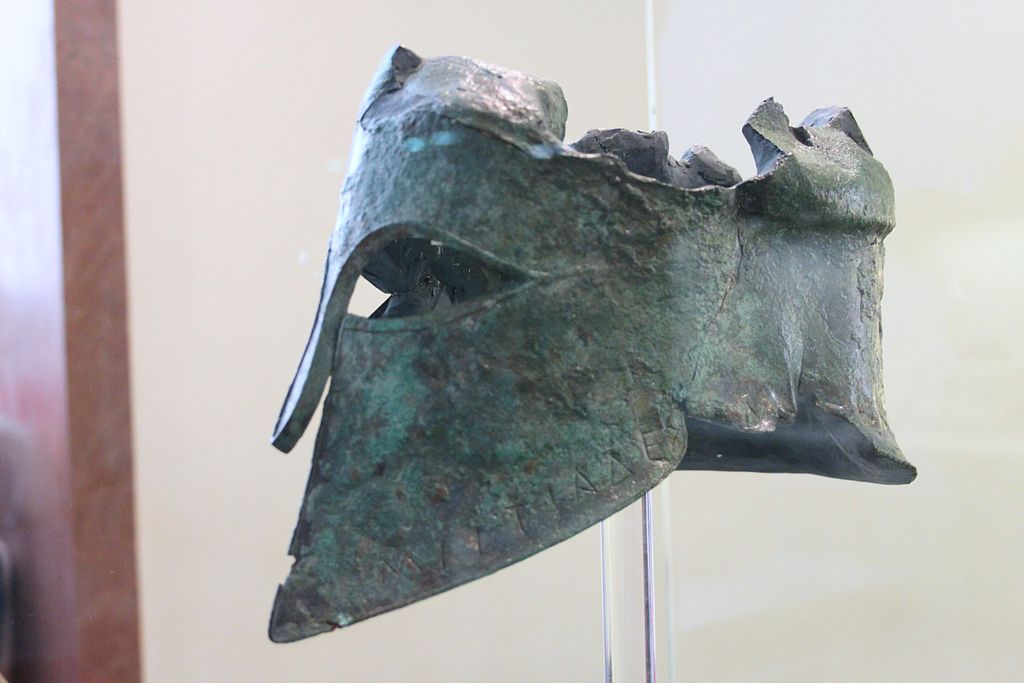
“Helmet of Miltiades.” The helmet was given as an offering to the temple of Zeus at Olympia by Miltiades. Inscription on the helmet: ΜΙΛΤΙΑΔΕΣ ΑΝΕ[Θ]ΕΚΕΝ [Τ]ΟΙ ΔΙ (“Miltiades dedicates this helmet to Zeus”). [Archaeological Museum of Olympia] (wikipedia). Miltiades was the Greek general who devised the strategy and commanded the Greek troops that won the Battle of Marathon (against the invading Persians) in 490 B.C. The account of this is one of the most stirring sections of Herodotus’s history book.

<><><><><><><><><><><><><><><><><><><><><><><><><><><><><><><><>

The Thermonuclear Melian Debate Over Ukraine

It is true that Neville Chamberlain’s appeasement policy (1938) held off WWII for a year — for Poland (1 September 1939) — and maybe a bit more for Norway, Denmark, and the Low Countries, and then France (May-June 1940); and then maybe up to two years for Britain directly if you count in the Phony War (1939 to before May 1940), and then close to three years for Russia/USSR when Hitler tore up the Molotov-Ribbentrop alliance (22 June 1941) that had initiated the joint German-Russian invasions of Poland in 1939.

Each of those time gaps allowed the countries enjoying them, before being swallowed up into military hostilities, to safely arm or rearm as they could in anticipation of the worst, which soon came to all of them. So it is easy to see some short-term tactical advantage to an appeasement policy prior to experiencing a military invasion.

This was certainly Hitler’s and Stalin’s view when each chose to enter into their Molotov-Ribbentrop alliance to carve up Poland (seen by both Hitler and Stalin then as Putin sees Ukraine today), and to keep from warring against each other (in the inevitable Fascist-Communist 1940s superpower war), and in Stalin’s case to appease Hitler’s eastward expansion without the USSR having been able to gain any Western European allies against Hitler/fascism and Japanese militarism.

The essence of the various interrelated appeasement policies of Chamberlain, Stalin and Hitler (the MB Pact being in part Hitler’s appeasement to USSR westward expansion) all shared one fundamental principle: the independence of or submission (even to the point of nonexistence) by smaller weaker countries was for the major powers to dispose of as they saw fit, and as served their plans for protecting their own political domains (empires) and for imposing their geopolitical/territorial schemes (colonization) beyond their existing borders. So, Czechoslovakia and Poland got “tossed under the bus” in 1938-1939 so the British Empire, the Third Reich, and the USSR could continue to have their pieces of the European and World pies. This reality of international relations is doubtless as old as humanity itself:

“…the standard of justice depends on the equality of power to compel, and that in fact the strong do what they have the power to do, and the weak accept what they have to accept.”
— [Thucydides, 416 BC].

This was how Thucydides wrote about it, in his account of the “Melian Debate” between the Athenian Empire and the leaders of the small Aegean island of Melos that Athens (the Delian League) wanted to occupy as a forward naval base against any invading Spartan (and Persian sponsored) fleet during the Peloponnesian War (431-404 BC). Ultimately, the Athenians assaulted Melos, defeating it, killing the men and enslaving the women and their children. The lands between Berlin and Moscow suffered similar fates between 1933 and 1945.

The idea of appeasing Putin’s imperialistic ambitions, as regards Ukraine, arises naturally when he threatens to resort to nuclear weapons if thwarted in his expansionist military operations. By the same logic it seems reasonable for public safety in the United States, the European Union, Russia, and even beyond as far as China, if the 194 recognized countries of the world would accept the power principle articulated by Thucydides and let the nuclear superpowers to dispose of everyone’s national independence or dependence, submission or nonexistence, as those superpowers — empires all — saw most convenient for themselves: better that the people in the smaller weaker and poorer countries suffer and die by imperial conquest than that the people in the larger stronger richer and “safer” countries expose themselves to hazards — from the inconveniences of slowed supply chains, up to the terrors of thermonuclear face-offs — by coming to the defense of the invaded “weaklings.”

This dilemma was addressed in 1945 with the formation of the United Nations (and a subsequent variety of treaties) — a far from perfect organization but a positive step to address the problem — and the formation of NATO, also far from perfect but even so a membership in which has been avidly sought by every country occupied by Nazi Germany and/or the USSR between 1939 and 1991.

The whole point of these organizations is to prevent a reoccurrence of the political-military escalations that unleashed WWII (and similarly for WWI, earlier). By that logic the UN ‘world alliance,’ the EU economic-military alliance, and the NATO military alliance exist to resolve outbreaks of destabilizing world disorder like the Russian war in Ukraine, without sacrificing the population under assault, because by sacrificing them (again; as in 1935, and 1936-1939) the glue of trust needed to maintain such structures of mutual security dissolves and they fall apart, and we are back to Melian Sacrifices before all subsequent superpower expansions: unchecked imperialism.

“The fate of Russia’s invasion of Ukraine will determine the propensity of all other countries for aggression. If it fails in turn, the effect on all global and regional powers will be one of powerful deterrence. If it succeeds, that is if Russia manages to ‘pacify’ Ukraine under Russian boots, the effect will be a major slide of the global situation toward unrestrained law of the jungle, emboldening US imperialism itself and its allies to resume their own aggressive stances.”
— [Gilbert Achcar, “A memorandum on the radical anti-imperialist position regarding the war in Ukraine,” Sunday 27 February 2022, http://www.europe-solidaire.org/spip.php?article61309]

So, in February 2022, it is time for our many political, government, parliamentary, diplomatic, military and economic leaders and officials to earn their pay by coordinating their actions to reign in the aggression into Ukraine by the Putin government of Russia, without being so clumsy as to set off a nuclear war. From their reported and escalating actions this week (21-28 February 2022) it seems quite clear that they are well aware of what is required, and even such rigidly neutral countries like Sweden and Switzerland have joined in that effort: an economic throttling of Russia’s money flows coupled with increasing amounts of sophisticated weaponry delivered to Ukrainians so they become more effective in fighting their defensive hot war against the invading Russian military (and maybe if Lukashenko is stupid, an invading Belarusian military as well).

Recall that in the multipolar nuclear weapons era (>1949) that both the USSR and China dampened US war-making campaigns in Korea (1950-1953) and Vietnam (1965-1975) by supplying North Korea and North Vietnam with advanced weapons (small arms like AK47 rifles and ammunition, artillery, fighter jets, anti-aircraft missile and radar systems), and by merely existing as nuclear weapons ’superpowers’ allied with the Communist forces in Korea and Vietnam. The US had wanted to use nuclear weapons (MacArthur in Korea, Westmoreland and LeMay in Vietnam), but Korea and Vietnam were politically and territorially too close to China and the USSR for the U.S. to take that kind of risk. So despite the awesome military might and malice of the United States, the Koreans and the Vietnamese bled profusely to fight through their anti-US wars but they managed to survive them as three independent states (a unified Vietnam and two Koreas).

Given the ongoing antiwar protests in Russia and even Belarus, where such protests are heavily penalized by their laws (no 1st Amendment there, 20 years in jail threatened), rather than the Russian and Belarusian people expressing obvious commitments to all fight and die for their leaders’s Ukrainian war aims, it seems reasonable to anticipate that the Putin and Lukashenko governments could be brought down by popular revolts (and military mutinies) if enough of those people became sufficiently distraught at the losses of their boys in the snows, mud and streets of Ukraine, and terrified at the possibility of themselves being subjected to American, British and French nuclear bombardment in retaliation to Putin’s most extreme possible action.

At present, I think it most likely that Putin (and Lukashenko) will be reigned in without any nuclear weapons having been used, and his ultimate military defeat will cause, or be caused by, the fall of his regime. What is to be wished is that that happen as soon as possible so as to minimize the pain, suffering, death and destruction in Ukraine. And it is important to remember that the Russian and Belarusian people are not the enemies, but the Putin (plus loyal oligarchs, and Lukashenko client regime) are.

So I do not favor an appeasement policy with regards to Putin (and too bad he was not stopped sooner as with Syria in 2014), and I also realize that the management of an internationally coordinated counter-Putin-aggression economic-military policy is a delicate matter in our nuclear superpower era of the ‘World Order.’

I think the hazy idea of a “lasting peace” in world affairs is an ‘unobtainium’ at our current level of human and societal development (unchanged for millennia, as the late -5th century Melians would no doubt say if they could see us now), and that we should see the management of “peace” as a never-ending and always imperfect effort of pragmatic political improvisations; and that we should pick as our leaders people who are honorable and astute at doing that management without sacrificing human solidarity.

<><><><><><><>