
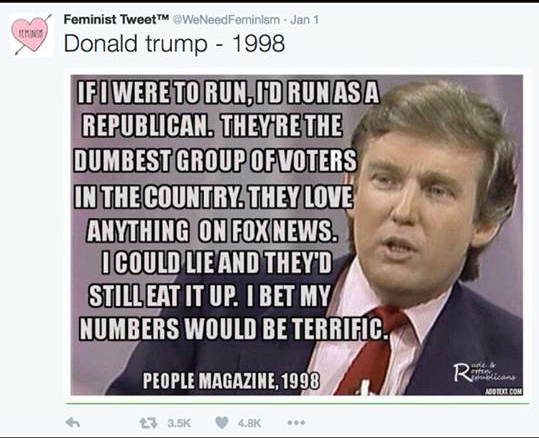
About Trump’s 1998 Quote

Trump 1998

[This is not an actual Trump quote, but someone’s characterization of Trump-speak. Still, I think my response remains a valid explanation of Trump’s popularity with his supporters.]

MG,Jr. (on Trump 1998, see picture): Probably 1/3 of the people voting for him think precisely the same thing.

Ella Garcia (on above comment): That doesn’t make sense. Are you saying there are Democrats that are voting for Trump?

MG,Jr response:

There are blue collar (craft & trade laborers, and non-professional workers, non-college types) and rural workers (wage earners [poorer], rather than dividend-earning [richer] investors), who can be:

1, anti-immigrant because they fear labor competition (that lowers wages offered for jobs that become harder to get), and

2, racially bigoted (which is often how poor people convince themselves they are intrinsically superior, and “deserving”),

3, who can also be religious (Christian) fundamentalists, and so also

4, often sexist (women are 2nd class people and need to be controlled by men, so abortion is “immoral,” and “murder” punishable by government)

who are ALWAYS suckered to vote for the Republican Party, which is controlled by very savvy college-educated Big Business/Wall Street types (bankers, financiers, defense industry executives, major media owners), who play on the fears and biases of these “hicks” and “rubes” and “white trash,” (which is how these Republican Party insiders think of their “voter base”) to get their Big Business-owned candidates elected (like Ronald Reagan [1981-1988], George H. W. Bush [1989-1992], George W. Bush from 2001-2008).

These “populist” Republican Party voters have been called the “Tea Party” in recent years, and they have come to HATE the rich snobs who play them for votes (for Republicans), and then never work to make an economy that provides them with decent jobs. Also, the Tea Party people HATE the rich/corporate R.P. snobs for never following through on any of the “punishments” the Tea Party people want to see inflicted on the “inferior” and “threatening” people Tea Partiers want to be “protected” and “distanced” from, and who “should” be prevented from competing with them economically (in the labor market): blacks, Mexicans, Muslims, “uppity” women.

The smarter and/or more thoughtful of these Tea Party Republicans (right-wing populists) want to up-end the Republican Party, and that is why they are so enthused about Donald Trump: someone who spouts their views and is NOT owned and controlled by the Big Business “East Coast Establishment” that has owned the Republican Party since the Civil War [since Abraham Lincoln, from 1859].

In that 1998 quote, “Donald Trump” said aloud what the Republican Party Establishment thinks but does not say aloud (to not anger “the base” and then have a mutiny), and many in that base now know this, and are voting for Trump PRECISELY because he is what the Republican Party Establishment DOES NOT WANT. Hillary Clinton is the most favorable (and widely popular) candidate today for the interests of the Big Business establishment (whether under the “Democratic” or “Republican” labels). So, right-wing populist Tea Party “disrupters” are voting for Trump to vote AGAINST the continued control of the Republican Party by the Big Business interests.

This is quite similar to Bernie Sanders’ voters, who are supporting Bernie (and hating Hillary) because they want to wrest control of the Democratic Party from the Big Business interests (called the Democratic National Council = DNC, a Big Business-financed party-control group founded by Bill and Hillary Clinton).

So, YES, there are plenty of grassroots Republicans who are voting for Trump because HE IS NOT A HYPOCRITE; he has “outed” the R.P. establishment (by saying aloud what they think in secret but deny publicly), which demonstrates he is not controlled by them, and that is a rebellion that the populist Tea Party people are excited to join.

What the candidates represent are the following:

Donald Trump — bigots in rebellion against control and exploitation of the (“superior” and “deserving”) working people, by Big Business (i.e., the East Coast Republican Party establishment);

Hillary Clinton — Big Business in a fool-and-control-the-public campaign to maintain the corrupt system they now have (of payoffs to politicians) for freedom to manipulate the national economy for their benefit (e.g., shamelessly exploiting labor), by ownership/control of the government;

Bernie Sanders — an inclusive (non-bigoted) rebellion against control and exploitation of all the people, by Big Business (i.e., the DNC/Wall Street establishment in the Democratic Party, as well as the long-standing Big Business establishment in the Republican Party).

When Bernie Sanders said that the national election he is hoping for is between him and Donald Trump, he meant that such an election would be the result of the first part of his revolution having occurred: the Big Business controllers of BOTH the Democratic and Republican parties would have lost the the allegiance of the people (the majority). In that case, the national election (between Sanders and Trump) would be a contest to determine what kind of populist administration we would inaugurate in 2017: Trump’s right-wing nationalism (like early Mussolini, with some crudeness similar to that of Berlusconi), or Sanders’ all-inclusive democratic socialism (like the best of European systems).

Today’s View of Campaign 2016

To refresh your memory about the status of Campaign 2016: Hillary Clinton is the Democratic Party’s Nixon, and is the opponent that the Confederacy prefers Donald Trump to beat in the general election. Bernie Sanders is the candidate that the American people prefer to be the next American President.

Even though Hillary Clinton is the donna of an organized crime syndicate known as the DNC-controlled Democratic Party, many Americans are keen to vote for her.

What do I say to “proud Hillary Clinton voters” who protest over my characterizations of their candidate and their voting choice: if you know what your are doing, it’s criminal, and if you don’t know what you are doing, it’s stupid.

The criminals-for-Hillary are simply cold calculating careerists, logically pursuing self aggrandizement. For them the vote is an investment. The muddled-brained-for Hillary are “I will make history by voting for the first American woman president” cultists. For them the vote is a pathetic grasp at self-importance by association.

Why else join the parasites whose career hopes cling to the Tammany Hall DNC-Clintonite Democratic Party, and cling to the establishment’s duopoly in general? Why else vote for a continuation of the Wall Street owned, duopoly-fronted, Citizens United underwritten, American economic plantation?

Trump is leading a bigot’s liberation insurgency in a Pickett’s Charge against the right flank of the duopoly: the Republicans, and seeking to separate the “wheat” from the “chaff” — as he sees it — in the many-flavored mix of the American people. Sanders is leading a workers’ (wage earners’) insurgency in a broad assault on the duopoly across its entire line, and seeking to harmonize the many personal bubbles of self-centered world view within the American popular mix, with a unifying democratic-socialist vision.

If Donald Trump wins the presidency, The Wall Street ownership club will restructure a Republican Party around him, and through it slowly reabsorb him into control, like a Venus Flytrap gradually digesting a captive insect.

If Hillary Clinton wins the presidency, nothing changes. We will all continue to pick Wall Street’s cotton with Scarlett O’Hara Clinton (whip in hand) benevolently smiling down upon us.

If Bernie Sanders wins the presidency, the rebels in the Democratic Party will have won, or at least gained the upper hand, in the intra-party civil war between the socialist reformers and the corporate kleptocrats, and Bernie will carry on with the reform movement on a national scale.

Choices 2016

Trump versus Clinton,
bigotry versus corruption.

Clinton versus Sanders,
corruption versus liberation.

Sanders versus Trump,
liberation versus bigotry.

Trump versus Clinton,
disgrace versus defeat.

Clinton versus Sanders,
defeat versus renewal.

Sanders versus Trump,
renewal versus disgrace.

We are what we choose,
“character is fate.”

We Don’t Have To Be A Sow’s Ear

There is an old saying: “you can’t make a silk purse out of a sow’s ear.” After the primary elections of March 15, I see the American electorate as a sow’s ear, and I’m hoping the primaries between now and July change that view. Here is what I mean:

After the primaries of March 15, a friend observed: “Rubio and Kasich have both indicated that if Trump is the nominee of the Republican party, they may not be willing to support him, a dramatic break from tradition and previous pledges to do so. Presidential campaigns cost almost a billion dollars these days and many of the establishment Republican donors and PACs are starting to indicate that they may not be donating money to a Trump presidential bid. Trump may have to make good on his boast that he is self-funded. So far, he has been spending mostly other people’s money on his campaign, only about $250,000 of his own. It would be such sweet justice if he wound up bankrupting himself and lost to boot.”

Getting Hillary as president is no consolation for me. I’ll never vote for Hillary, and if the result is Trump, so be it. I will not be manipulated into voting for the oligarchy/plutocracy. Given a choice between voting for corruption (Hillary) or accepting chaos (not voting for Hillary, and Trump winning), I choose chaos. If America is not ready to reform itself yet, then maybe a few years of Trumpian political chaos will dispel some illusions and stiffen some spines in favor of renewed revolution.

If it is Hillary that wins this November, then the Wall Street plantation will have weathered the storm of 2016 and Hillary will get a few years of cracking the whip — like Scarlett O’Hara — to keep most Americans picking cotton for Wall Street. I wonder what’s in those $225,000 speeches Hillary gave to Goldman Sachs, privatize Social Security?

However, Bernie Sanders has led a young generation to see the light, and they will persist against America’s corrupt gerontocracy beyond Bernie’s time in public life.

Trump is an American Mussolini, a blowhard who surfs high on the wavecrest of the accumulated frustrations of legions of underachieving less-educated white males (and females!) who are envious of wealth, impatient with critical thought, and who gain emotional uplift venting their noise in Trump’s bigots’ liberation movement. Trump is a branding expert who knows how to get maximum attention with minimum cost, he won’t have to spend much for a continuing campaign. The media will cover Trump religiously because he is total entertainment, brings in mega-viewership, and thus maximizes the networks’ ability to charge and get top dollar for advertising that frames the video clips of his antics. You have to think of capitalism as a disease, a virus of the mind that reprograms the body into an obsessive compulsive behavior of blind accumulation: zombies, the living dead of thoughtless grab.

For the general election campaign, Trump’s legion of fanatics will pony up if need be, especially if they are told it is to ward off the evil Hillary (and she is evil). Also, numerous of the Republican moneybags will want to put some of their chips in with Trump’s campaign stakes on the political poker table, because they will want to buy into some access in case Trump actually pulls it off and then has real power to grant favors. Remember: mental disease.

What I get out of the less-than-desired vote for Bernie in the primaries of March 15 — assuming that this is the trend from here on out — is the following.

1. The American political system is completely corrupt, which is a natural consequence of it being entirely in the service of a thoroughly corrupt economic system (of slavery, basically).

2. A majority of Americans — male, female, white, black, other — support that system, and are voting to keep it.

3. A majority of Americans — male, female, white, black, other — are not willing to vote for (support) a movement to reform America’s political and economic system, as is clearly shown by their unwillingness to vote (in majorities) for the Bernie Sanders campaign.

4. You can’t vote for the system and then whine about being a victim of it, and justifiably expect any sympathy.

That the electorate’s preference against reform (and redistribution) is entirely against its interests is obvious to all, and negates any justification to feel pity for this electorate. Spartacus gained history’s everlasting respect because he revolted against his slavery and lead a multitude of other slaves in a war to free themselves. Slaves who vote for their slavery gain neither pity nor respect, and their subsequent pleas for more scraps from master’s table will fall on deaf ears.

5. If you support the system, you share its characteristics.

Based on the primary returns to date, a majority of Americans — male, female, white, black, other — are corrupt, that is to say morally weak. They are not innocent and undeserving victims of capitalist exploitation (which they yowl about when it’s their turn to get screwed), they are enablers, the lowest grade of perpetrators but perpetrators nonetheless.

In this sense our democracy is working, the ruling class, which is selected by: acclaim, popular votes through consumption dollar choices, and ballot box choices, does in fact reflect the character of the electorate. If that character is one of corrupted morals and ethics, small-minded selfishness and intellectual mediocrity, then the ruling class distilled from the popular stew will also be a morally bankrupt mediocrity, and obsessively compulsive about self aggrandizement.

If we get Trump as president it will be undeniably horrible, where that “horrible” is in comparison to what could have been (what we could have been). A Trump presidency would be honestly bad.

If we get Hillary as president it will be a horribleness in denial of its true nature. A Hillary Clinton presidency would be dishonestly bad.

I would prefer not to believe what I have written above about the majority of the American electorate. So, I hope that voting in favor of Bernie Sanders increases significantly in the primaries to be held between now and July.

Yvette Carnell, Jane Elliott and Race in America

I am a Latino and was an experimental physicist at the Lawrence Livermore National Laboratory. During the 1990s, I was put in the position of being an “affirmative action coordinator” (AAC) for my physics division (an administrative unit) at the Lab. The Lab is a good-old-boys club, and being an affirmative action coordinator was one way for an ethnic minority individual to demonstrate their acceptability (submissiveness) and reliability (obedience and loyalty) to upper management, in the hopes of gaining future advancement (getting more pay) by an appointment to one of the few showcase token jobs.

There were certainly sincere trainers of AACs at the Lab, people who believed in the mission of creating greater opportunities for advancement by minorities and women, and I followed through on that training by advocating for such advancements, within the framework of the AAC role. The actual task of the AAC was to assist their management in compiling the annual report (to the Office of Equal Opportunity, OEO) on the ethnic-racial composition of their administrative unit, and the year’s progress or regress regarding the hiring and advancement of minorities and women.

My management quickly discovered that as the OEO mandate was for “minorities and women” they could get just as much OEO credit for advancing white women as anyone of a darker shade of pale. As this was far preferable on the tribal level the Lab embarked on a campaign of major pay raises and promotions for white women, allowing it to continue their traditional neglect of minorities with a sense of relief. To pass the first of my token acceptability tests, my job as an AAC was to go along with these reports submitted to the OEO.

This job experience was my personal introduction to the role of the “comprador” in the colonial administrations of all empires. I describe the comprador, or the native buyer of native labor for the colonial masters, in my article (linked down below) “Blacks, Hispanics and Immigrant Bashing for Colonial Control.” I did not last long as an AAC after my realization of its purpose in the eyes of the management.

The combination of my experiences growing up in white-dominant America and trying to make my career as a scientist, of mentoring minority physics students, and of “failing” my token acceptability test resulted in the formation of my more-or-less unified ideas about “race in America.” However, this is not a topic I wanted to explore, I preferred to think about physics, energy and nature instead of small-minded tribalism and bigotry in the service of careerism. But the course of life insisted on presenting me with “race in America” and I eventually had to “figure it out,” primarily to dispel my confusion and to get beyond my personal frustrations related to it. So, while I have my own synthesis of “race in America,” I have no pretensions to expertise on this topic, nor originality about it. Basically, I have fairly clear ideas about what pisses me off about “race”: I hate to see wasted human potential, and shuttered human minds.

<><><><><><><><><><><><><><><><><><><><><><><><><><><><><><><><>
Note added on 4 August 2019

For me, Yvette Carnell has moved from raging insight, in 2016, to delusional irrelevance in 2019. I can’t recommend her to anyone anymore. Jane Elliot, however, remains stellar.

The late Bruce A Dixon (1951-2019, managing editor of Black Agenda Report) was absolutely on target with his commentary on Carnell (27 April 2019), here:
https://blackagendareport.com/why-ados-reparationists-oppose-free-tuition-and-student-debt-forgiveness

About Bruce A. Dixon:
http://flcourier.com/bruce-a-dixon-dies/

<><><><><><><><><><><><><><><><><><><><><><><><><><><><><><><><>

In searching the Internet for more Bernie Sanders videos to enjoy, I came across some by Yvette Carnell, and thus became aware of her work on politics from the Afro-American perspective. I was very impressed by what I saw and heard. I find Yvette Carnell’s commentary to be very sharp, insightful, erudite, and informed about current events and popular culture, and her delivery to be very spontaneous, fluid, lucid, articulate and witty. It is because of the experiences I mentioned earlier — combined with my enthusiasm for Bernie Sanders — that has made finding Yvette Carnell’s videos such a positive delight.

I love Cuban music, and this last year read a magnificent history on the subject, Cuba and its Music, by Ned Sublette. I recommend this book highly, and have written about it in previous blog entries (Chuck Berry’s “Louis, Louis” is a cha-cha-cha). The history of Cuban music is coincident with the history of African slavery in the Caribbean and the Americas. Sublette’s book opened my eyes about many aspects of my own birth cultures.

The Afro-Cuban experience has been one of interactions (as in the 30 year war for independence) and tensions (as in slavery) between Spanish-speaking Whites, and Blacks and Mulattos who also spoke Spanish yet retained some of their African languages. The Afro-American experience has been largely one of tension (slavery, Civil War, Reconstruction, Jim Crow, Civil Rights, Affirmative Action, neo-liberal economics) between English-speaking Blacks and Whites, and between English-speaking Blacks and Spanish-speaking Latinos.

In the same year I read Sublette’s book, which deepened my understanding of the Afro-Cuban experience, I discovered the work of Jane Elliott, which deepened my understanding of the Afro-American experience. If you are not familiar with Jane Elliott, the videos linked below will quickly enlighten you about her work and insights. Note that Yvette Carnell is a political scientist and black woman, and that Jane Elliott is a professional educator (originally 3rd grade) and white women; very morally lucid and intellectually powerful women.

Below, I list web-links to videos of commentary by Yvette Carnell, videos about Jane Elliott, and web-links to most of my writing on “race in America.” Some of my recent articles on “Campaign 2016” (Bernie, Hillary, Donald) are also listed because economic disparity is the driving dynamic of this electoral season, and the point of bigotry and racial discrimination is to maintain vast economic disparity.

<><><><><>

Yvette Carnell videos:

Bernie Sanders Is Right: Black People ARE Poor
7 March 2016
https://www.youtube.com/watch?v=sk7M_YDTmQ0

Here’s How Black Clinton Supporters Are Just Like Tea Partiers
24 February 2016
https://www.youtube.com/watch?v=J-5sqbElf7Y

Civil Rights Icon John Lewis Wants Them Scraps From Ms. Hillary’s Table
11 February 2016
https://www.youtube.com/watch?v=NiAy2v4qAzM

Black People Obsess Over Black Culture Out of a Desperate Need for Validation
15 December 2015
https://www.youtube.com/watch?v=Q7yOaVjwbLc

“Pigment politics doesn’t get you (us) anywhere.”

Crabs in a Barrel Isn’t the Problem. This is.
22 October 2015
https://www.youtube.com/watch?v=RMjZQ-hjyMM

<><><><><>

Jane Elliott videos:

The Anti-Racism Experiment That Transformed an Oprah Show Audience
Where Are They Now? | OWN (2015)
(5:13)
https://www.youtube.com/watch?v=5NHeFgaVWs8

Jane Elliott: “How can we not be racist?” (1992 Oprah TV)
(20:21)
https://www.youtube.com/watch?v=z8ZC5JaK0dA

Being Black, by Jane Elliott
(0:59) (~1990s – 2000s)
https://youtu.be/4yrg7vV4a5o

Blue Eyed TRAILER – Jane Elliott
(7:03) (~1990s – 2000s)
https://www.youtube.com/watch?v=gtx0yzFxp_0

Jane Elliott “The White Fear” (2016)
(2:35)
https://www.youtube.com/watch?v=0k3yCG7PHzg

A deeper look: The psychology of racism (Jane Elliot on TV, 2015)
(5:56)
https://www.youtube.com/watch?v=I1hC_z2mHTg

Epigenetics of Racism, with Jane Elliott
(Interview of Jane Elliott by Philippe Matthews on 4 November 2015)
(51:50) [Excellent – MG,Jr.]
https://www.youtube.com/watch?v=BepjO6PmNWU

“Prejudice is an emotional commitment to ignorance.”

<><><><><>

MG,Jr. (2006-2008):

Obama and the Psychic Auto-Shrink-Wrapping Called Race in America
20 March 2008
http://www.counterpunch.org/2008/03/20/obama-and-the-psychic-auto-shrink-wrapping-called-race-in-america/

The Heart of Whiteness
21 April 2007
http://www.counterpunch.org/2007/04/21/the-heart-of-whiteness/

Blacks, Hispanics and Immigrant Bashing for Colonial Control
31 May 2006
http://www.counterpunch.org/2006/05/31/blacks-hispanics-and-immigrant-bashing-for-colonial-control/

<><><><><>

MG,Jr. (2015-2016)

Between Slavery and Socialism in America Today
10 November 2015
http://www.counterpunch.org/2015/11/10/between-slavery-and-socialism-in-america-today/

Red Badge of Bigotry
26 June 2016
http://www.counterpunch.org/2015/06/26/the-red-badge-of-bigotry/

The Cult of Hillary, the Ultimate Junk Bond
29 February 2016
http://www.counterpunch.org/2016/02/29/the-cult-of-hillary-the-ultimate-junk-bond/

Convenient Privileges vs Classified Trust (Hillary’s e-mails)
4 March 2016
http://www.counterpunch.org/2016/03/04/hillarys-emails-convenient-privileges-vs-classified-trust/

Godzilla Breath Flames Naked Crooks (Campaign 2016)
11 March 2016
http://www.counterpunch.org/2016/03/11/godzilla-breath-flames-naked-crooks-campaign-2016/

<><><><><>

Enjoy!

and, Be kind.

<><><><><>

Update, 2 August 2017

During 2017, I read numerous comments (on Facebook) posted by Yvette Carnell, on the subject of immigration (which she is hostile to, particularly the illegal kind), and the presumably increased labor competition Black Americans (the “descendants of slaves,” not the later free African immigrants) face from immigrants generally and Mexicans – Spanish speakers – in particular. The following conclusion is what I consider the significant insight I have gained from a distillation of Yvette Carnell’s commentary:

Black Americans resent White Americans for not loving them, and they resent all immigrants and their American-born descendants for getting in the way of that yearned-for love.

<><><><><>

The Bayesian Sandernista

The best thing that could happen to the U.S.A. this year would be for Bernie Sanders to become the Democratic Party’s nominee for the presidency, and then for Sanders to win the general election in November. The Republican Party’s nominee will most certainly be Donald Trump. However, the possibility exists that due to means mostly foul that Bernie Sanders would not be the Democratic Party nominee. If this disappointment materializes in July, then you may find yourself harangued by rabidly passionate partisans telling you how to vote based on their preferences. So, in this essay I present a tool — Bayesian analysis — that can help you to clarify your own thoughts about how to proceed in a period of uncertainty, and to strengthen your convictions in a logical manner. This will be easy reading, stick with it.

The purpose of Bayesian analysis is to logically select the best course of action from a set of available options, despite uncertainties about the probabilities of the outcomes that may occur, and where the decision-making process takes into account your own personal preferences regarding those outcomes. You can easily learn the mechanics of basic Bayesian analysis by looking up articles on the Prisoner’s Paradox. I will proceed directly to our model “general election” problem:

Should “I” (a given Sandernista and/or Democratic Party voter) vote for Hillary Clinton, or not-vote for Hillary Clinton, if the general election is a Clinton versus Trump race?

A “not vote” means to instead vote for a third party candidate, or write in a candidate on your ballot, or abstain from voting for the presidency.

We identify two mutually exclusive actions: vote for Hillary Clinton (vote-H), and not-vote for Hillary Clinton (vote-not-H).

There are two mutually exclusive general (national) outcomes: Hillary wins (H-win) or Trump wins (T-win).

The probability of an H-win is designated by the letter p. The quantity p is an as yet uncertain number whose magnitude lies between zero (a certainty of a T-win) and one (a certainty of an H-win).

Because the probabilities of an H-win and T-win must add up to unity, the uncertain probability of a T-win is the quantity (1-p).

Since we have two actions (vote-H, vote-not-H) and two general outcomes (H-win, T-win) there are four possible specific (or personal) outcomes:
D1: vote-H, and H-win,
D2: vote-H, and T-win,
D3: vote-not-H, and H-win,
D4: vote-not-H, and T-win.

I, the voter, have very personal preferences, or desirabilities (D1, D2, D3, D4) regarding each of these outcomes.

For example, I might decide that voting H and having a T-win would rate on my personal desirability scale at -1000! You can use any numbers (positive or negative) you like for your personal subjective values D1, D2, D3 and D4 for the four objective outcomes.

Recall that specific probabilities for vote-H are: p (for an H-win), and (1-p) (for a T-win).
Recall that specific probabilities for vote-not-H are: p (H-win), and (1-p) (T-win).

My actions in a voting booth will not alter the actions of millions of other voters in their voting booths, so p is independent of what I (or any other single voter) does.

Recall that the desirabilities for the action vote-H are: D1 (H-win), and D2 (T-win).
Recall that the desirabilities for the action vote-not-H are: D3 (H-win), and D4 (T-win).

The expected value to me of any of the four outcomes is the quantity gotten by multiplying the probability of that specific outcome with the desirability I assigned to that outcome. So the four expectation values are:

For the action vote-H expectation values are: p*D1, and (1-p)*D2.
For the action vote-not-H expectation values are: p*D3, and (1-p)*D4.

The best action for me to take (in this model problem there is only a choice between two) is the one which has the highest utility value. The utility for an action is the sum of the expectation values of its consequences.

The utility value for vote-H is UH:

UH = p*D1 + (1-p)*D2.

The utility value for vote-not-H is Unot-H:

Unot-H = p*D3 + (1-p)*D4.

When UH is greater than Unot-H, vote Hillary (hang on, we’re still just talking math).

When UH is less than Unot-H, vote Not-Hillary.

I have taken the definitions and formulas described above, and worked out the general problem for any set of numbers D1, D2, D3, D4, and p (enough has been said that the mathematically inclined can easily duplicate this work). Now, I will lay out the algorithm for decision-making (picking an action) and show specific numerical examples, which you can use as templates to work out your own personal cases.

Define:
x = D2 – D4
y = D1 – D3

The extremes of x and y can be characterized as follows:
At large positive y (y >> 0): H-loyalty, happy to vote-H for an H-win.
At large negative y (y << 0): H-antipathy, unhappy to vote-H for an H-win.
At large positive x (x >> 0): H-guilt, at a failure to vote-H given a T-win.
At large negative x (x << 0): H-disgust, at a wasted H-vote with a T-win.

There are four possible classes of voters for this problem:
H-regardless
Bernie-or-Bust
Between guilt and disgust (over H)
Between anger and happiness (over H).

H-regardless voters are defined by:
x > 0, and y > 0,
and they will be most satisfied to vote-H regardless of any estimate they may make of p (the probability of an H-win). These are the “Hillary or bust” voters.

Example #1 (H-regardless):
D1 = 10 (H-win is good),
D2 = 0 (T-win is not good),
D3 = 0 (I let the H-team down, but at least they didn’t lose),
D4 = -10 (shame! I didn’t support the H-team and result is a T-win).
Thus x = 10, and y = 10.
Analysis indicates they should vote-H regardless of any estimate of p, if they are to be most satisfied.

Bernie-or-Bust voters are defined by:
x < 0, and y < 0,
and they will be most satisfied to vote-not-H regardless of any estimate they may make of p (the probability of an H-win).

Example #2 (Bernie-or-Bust):
D1 = -5 (I hate the idea of vote-H to stop a T-win),
D2 = -10 (damn! I did a vote-H and still got the T-win),
D3 = 5 (an H-win is better than a T-win, and, yea!, I didn’t have to vote-H!),
D4 = 0 (if T-win was destined at least I didn’t waste my vote on the loser H-team).
Thus x = -10, and y = -10.
Analysis indicates they should vote-not-H regardless of any estimate of p, if they are to be most satisfied.

The other two classes require the calculation of the critical probability, q, defined as:
q = -x/(y-x),
which is equivalent to
q = x/(x-y).

Between guilt and disgust voters are defined by:
x > 0, and y < 0,
and they will be most satisfied to:
vote-H if p < q,
vote-not-H if p > q.

Example #3 (Between guilt and disgust):
D1 = -5 (H-win is better than a T-win, but I didn’t want to vote-H),
D2 = 0 (no guilt for the T-win, I did a vote-H),
D3 = 5 (H-win, which I didn’t have to vote for),
D4 = -10 (guilt over the T-win since I didn’t do a vote-H).
Thus x = 10, and y = -10, and q = 50%.
These people will be most satisfied if they:
vote-H if p < q = 50%
vote-not-H if p > q = 50%.

In the above example the voter only feels safe to vote their preference of vote-not-H (and avoid feeling guilt if the result is a T-win) if H is more than q = 50% likely to win the election.

Between anger and happiness voters are defined by:
x < 0, and y > 0,
and they will be most satisfied to:
vote-H if p > q,
vote-not-H if p < q.

Example #4 (Between anger and happiness):
D1 = 10 (happy to vote for an H-win),
D2 = -10 (unhappy with a T-win since I did a vote-H),
D3 = 0 (I didn’t vote-H, it doesn’t much matter),
D4 = 0 (I didn’t vote-H, it doesn’t much matter).
Thus x = -10, and y = 10, and q = 50%.
These people will be most satisfied if they:
vote-H if p > q = 50%
vote-not-H if p < q = 50%.

In the above example the voter only feels satisfied voting for the H-team if it is a sure winner, so they should vote-H only if they estimate that the probability of H-team success, p, is greater than the q (critical probability based on desirabilities) for this case, which is 50%.

Two more examples follow.

Example #5 (Between disgust and guilt, with a lot of guilt-fear):
D1 = 100 (H-win, okay I guess),
D2 = -100 (sad if a T-win, but no guilt as I did a vote-H),
D3 = 200 (I’d rather vote Bernie or Jill Stein if H-win is destined),
D4 = -1100 (lots of guilt over my vote-not-H with a T-win).
Thus x = 1000, and y = -100, q = 0.90909.
This guilt-fearing voter should only vote their not-H preference if they believe an H-win is over 91% likely! Specifically:
vote-H if p < q = 90.909%
vote-not-H if p > q = 90.909%

It would be so much better to jettison the guilt.

Example #6 (Between anger and happiness, with a lot of anger):
D1 = 10 (guess I had to vote-H to prevent a T-win),
D2 = -1100 (damn!, I vote-H and get a T-win),
D3 = 0 (H-win, and I didn’t have to use up my vote for it),
D4 = -100 (T-win anyway, glad mine wasn’t a loser vote-H).
Thus x = -1000, and y = 10, q = 0.99009.
This person is angry about the idea of “having to” vote-H to prevent a T-win, and then that vote-H being for a loser. They should:
vote-H if p > q = 99.009%
vote-not-H if p < q = 99.9909%

In the above example the voter only feels satisfied voting for the H-team if it is a sure winner. If T-team is destined to win, then they want to use their vote elsewhere instead of on vote-H.

Why don’t you try making up some examples by choosing D1, D2, D3, D4 and p? The value in actually working out numerical examples based on your own preferences (desirabilities) is that it helps to clarify your mind about all the possible choices and outcomes you may be faced with. That can improve your self-confidence and sense of calmness about the whole electoral spectacle. Also, it may give you ideas about other types of choices to play Bayesian games with. Enjoy.