Snyder versus the Campists

When forming one’s political orientation, a consistency of human solidarity and to fundamental morality is more important than any inflexible scheme of ideological consistency, purity and rigidity.

Albert Camus urged us (in Howard Zinn’s words):

“In such a world of conflict, a world of victims and executioners, it is the job of thinking people not to be on the side of the executioners.”

This last quote is an abstraction by Howard Zinn of Albert Camus’s following concluding statement from his 1940s article ‘Toward Dialogue: Neither Victims nor Executioners’:

“Now I can end. What I think needs to be done at the present time is simply this: in the midst of a murderous world, we must decide to reflect on murder and choose. If we can do this, then we will divide ourselves into two groups: those who, if need be, would be willing to commit murder or become accomplices to murder, and those who would refuse to do so with every fiber of their being. Since this awful division exists, we would be making some progress, at least, if we were clear about it. Across five continents, an endless struggle between violence and preaching will rage in the years to come. And it is true that the former is a thousand times more likely to succeed than the latter. But I have always believed that if people who placed their hope in the human condition were mad, those who despaired of events were cowards. Henceforth there will be only one honorable choice: to wager everything on the belief that in the end words will prove stronger than bullets.”
— [Albert Camus, an English translation, as shown at the end in https://adamgomez.files.wordpress.com/2011/01/camus-neither-victims-nor-executioners.pdf]

Writing in the postwar France of 1955, on the theme of ‘the responsibility of the intellectuals’ as regards Stalinism, Raymond Aron wrote:

“I had had occasion… to write a number of articles directed not so much against the Communists [like the French Resistance, who shed blood in WWII to liberate people from fascist tyranny, — MG,Jr.] as against the communisants, those who do not belong to the party but whose sympathies are with the Soviet world… Seeking to explain the attitude of intellectuals, merciless toward the failings of the democracies but ready to tolerate the worst crimes as long as they are committed in the name of the proper doctrines, I soon came across the sacred words, Left, Revolution, Proletariat.”
— [Raymond Aron, ’The Opium of the Intellectuals,’ 1955]

In the 1966, Noam Chomsky wrote his own famous essay ’The Responsibility of Intellectuals,’ which was about the complicity of the American intelligentsia with pro Vietnam War propaganda. Chomsky keyed his 1966 article off the late 1940s writings of Dwight Macdonald, who was “concerned with the question of war guilt”:

“He asks… to what extent were the German or Japanese people responsible for the atrocities committed by their governments? And, quite properly, he turns the question back to us: to what extent are the British and American people responsible for the vicious terror bombings of civilians, perfected as a technique of warfare by the western democracies [in the 1940s, though pioneered by the Nazis at Guernica in 1937 and Warsaw in 1939, — MG,Jr.] and reaching their culmination in Hiroshima and Nagasaki, surely among the most unspeakable crimes in history? To an undergraduate in 1945-1946 — to anyone whose political and moral consciousness had been formed by the horrors of the 1930s, by the war in Ethiopia, the Russian purge, the ‘China Incident,’ the Spanish Civil War, the Nazi atrocities, the Western reaction to these events and, in part, complicity in them — these questions had particular significance and poignancy.”
— [Noam Chomsky, ’The Responsibility of Intellectuals,’ 1966]

The forerunner to Albert Camus, Dwight Macdonald, Raymond Aron and Noam Chomsky on the subject of ‘the responsibility of intellectuals’ was Julien Benda, whose 1927 book ‘La Trahison des clercs’ (The Treason of the Intellectuals or The Betrayal by the Intellectuals) “argued that European intellectuals in the 19th and 20th centuries had often lost the ability to reason dispassionately about political and military matters, instead becoming apologists for crass nationalism, warmongering, and racism.”
— [https://en.wikipedia.org/wiki/Julien_Benda]

This brings me to current heated polemics about the Russian invasion of Ukraine on 21 February 2022 (or for that matter in 2014).

I have learned a new label, “campists,” for a peculiar subset of polemicists who insist that all the current war troubles (and accumulating war crimes) in Ukraine are entirely the fault of a relentless NATO (and thus U.S.) campaign of eastward expansion for the express purpose of forming an “encirclement” of Russia. What they refuse to accept about Ukraine in 2022 is this:

“[Timothy] Snyder says the focus on NATO ignores the agency of leaders in Ukraine and elsewhere who have the right to seek their own arrangements. ‘It’s very important to remember that the world isn’t just about Washington and Moscow. It’s also about other sovereign states and other peoples who can express their desires and have their own foreign policies,’ says Snyder.” — from:

Journalist Andrew Cockburn & Historian Timothy Snyder on Ukraine, Russia, NATO Expansion & Sanctions
1 March 2022
https://youtu.be/-Y8ny69uU3g

In this ‘Democracy Now’ video, Snyder has all the facts, states the reality about “Ukraine” and the international situation clearly, and has the real and useful (and morally correct) insights.

The reason the countries between Berlin and Moscow (Baltic States and the former East Bloc) have clambered to become members of NATO since 1989, despite a lack of enthusiasm by the original Anglo-American and Western European NATO members (the WWII democratic “Allies”) for such inclusion, is that those Eastern European states all too painfully remember the hell they went through under Nazi and USSR occupations, between 1933 and 1945, and their Iron Curtain experiences from 1946 to 1989-1991.

In the 1980s I learned about the “govnoed,” by reading Western-published books by dissident Soviet authors writing about the Nomenklatura: the USSR’s Communist Party power elite and patronage pyramid. The “govnoed” of the 20th century are now in an expanded category call “campists.”

I see the ~100 year genealogy of this hypocritical ideological tendency this way:

Stalinists
(Comintern aligned Communists >1924):

  • Stalinists labeled leftist anti-Stalinists like: Trotsky, Orwell, Louis Proyect(!), as “Trotskyists” —>

Communisants
(French “anti Atlanticists” like J.P.Sartre >1945):

  • Communisants labeled anti-Stalinists like: Camus, Koestler, Arendt, Aron as “Atlanticists” —>

Govnoed
(>1953):

  • “shit eaters,” the Soviet label for uncritically loyal Western Stalinists during the Soviet era after Stalin’s death —>

Tankies
(>1956) —>

  • Western Stalinists cheering Soviet tanks crushing popular revolutions, 1953, 1956, 1968, etc. —>

New Leftists/Maoists
(>1966):

  • Western only-anti-Western-imperialism leftists —>

Campists
(>1991)

  • “Campists” = Leftists who claim that all popular insurgencies against leaders who pretend to be “socialist” (and are faux anti-capitalist) and seem to oppose U.S. imperialism (e.g., Gaddafi, Bashar al-Assad, Vladimir Putin, etc.), are incited, manipulated, or controlled by Washington. Basically, campists inflexibly favor the presumably socialist and anti-capitalist “Red Camp” of international politics in any contentious situation, without regard to the factual data about it.

“The Democratic Socialists of America’s International Committee has issued a statement on Ukraine that fails to adhere to basic socialist principles. [that statement is ‘DSA IC opposes US militarization and interventionism in Ukraine and Eastern Europe and calls for an end to NATO expansionism’, January 31, 2022, https://international.dsausa.org/statements/no-war-with-russia/]…

“The DSA-IC dismisses the Maidan Protest of 2014 as the ‘U.S. backed Maidan coup.’ It thus associates itself with others on the left – we call them ‘campists’ – who claim that all popular insurgencies against leaders who seem to oppose U.S. imperialism are incited, manipulated, or controlled by Washington. There is a degree of condescension and even racism in the notion that movements from below of ordinary Ukrainian, Chinese, Iranian, or Nicaraguan working people are U.S. puppets.

“These people are perfectly capable of standing up for themselves and fighting back, even if they do so against overwhelming odds. Do the U.S. State Department and the CIA and NATO attempt to influence and, when they can, direct such movements? Of course. It is clear, however, that the Orange Revolution of 2004 and the Maidan uprising were fundamentally expressions of the democratic aspirations of the Ukrainian people – fed up with the brutality of their government’s treatment of protesters – and their wish for self-determination, and not because they were being directed by Washington or by neo-Nazis. The Ukrainian people seek their independence, and we should stand with them against both the United States and NATO and against the immediate threat from Russia.”
— [above 3 paragraphs from]:

What the DSA International Committee’s Ukraine Statement Gets Wrong
By: Stephen R. Shalom, Dan La Botz, Thomas Harrison
February 9, 2022
https://newpol.org/what-the-dsa-international-committees-ukraine-statement-gets-wrong/

And this all brings me back to my fundamental point: form your political orientation on a basis of consistency in human solidarity and to fundamental morality, regardless of whatever ideological inconsistencies, impurities and pragmatic flexibility you must accept during the specific applications of your political attitudes, and in your actions, in the real world. The well-being of human beings anywhere is always more important than maintaining the rigidity of your abstract general ideas about society and its politics. Routinely reevaluate your political biases by applying indiscriminate compassion focused by intellectual rigor based on factual data.

I recommend you listen to all of Timothy Snyder’s comments in the ‘Democracy Now’ video cited above.

<><><><><><><>

The Thermonuclear Melian Debate Over Ukraine

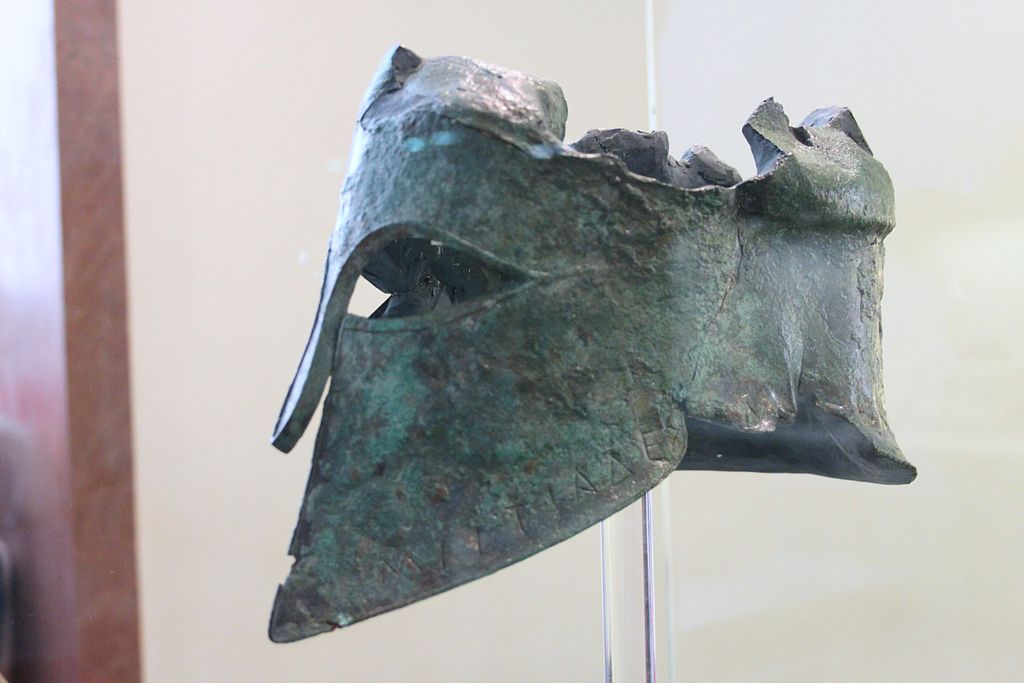
“Helmet of Miltiades.” The helmet was given as an offering to the temple of Zeus at Olympia by Miltiades. Inscription on the helmet: ΜΙΛΤΙΑΔΕΣ ΑΝΕ[Θ]ΕΚΕΝ [Τ]ΟΙ ΔΙ (“Miltiades dedicates this helmet to Zeus”). [Archaeological Museum of Olympia] (wikipedia). Miltiades was the Greek general who devised the strategy and commanded the Greek troops that won the Battle of Marathon (against the invading Persians) in 490 B.C. The account of this is one of the most stirring sections of Herodotus’s history book.

<><><><><><><><><><><><><><><><><><><><><><><><><><><><><><><><>

The Thermonuclear Melian Debate Over Ukraine

It is true that Neville Chamberlain’s appeasement policy (1938) held off WWII for a year — for Poland (1 September 1939) — and maybe a bit more for Norway, Denmark, and the Low Countries, and then France (May-June 1940); and then maybe up to two years for Britain directly if you count in the Phony War (1939 to before May 1940), and then close to three years for Russia/USSR when Hitler tore up the Molotov-Ribbentrop alliance (22 June 1941) that had initiated the joint German-Russian invasions of Poland in 1939.

Each of those time gaps allowed the countries enjoying them, before being swallowed up into military hostilities, to safely arm or rearm as they could in anticipation of the worst, which soon came to all of them. So it is easy to see some short-term tactical advantage to an appeasement policy prior to experiencing a military invasion.

This was certainly Hitler’s and Stalin’s view when each chose to enter into their Molotov-Ribbentrop alliance to carve up Poland (seen by both Hitler and Stalin then as Putin sees Ukraine today), and to keep from warring against each other (in the inevitable Fascist-Communist 1940s superpower war), and in Stalin’s case to appease Hitler’s eastward expansion without the USSR having been able to gain any Western European allies against Hitler/fascism and Japanese militarism.

The essence of the various interrelated appeasement policies of Chamberlain, Stalin and Hitler (the MB Pact being in part Hitler’s appeasement to USSR westward expansion) all shared one fundamental principle: the independence of or submission (even to the point of nonexistence) by smaller weaker countries was for the major powers to dispose of as they saw fit, and as served their plans for protecting their own political domains (empires) and for imposing their geopolitical/territorial schemes (colonization) beyond their existing borders. So, Czechoslovakia and Poland got “tossed under the bus” in 1938-1939 so the British Empire, the Third Reich, and the USSR could continue to have their pieces of the European and World pies. This reality of international relations is doubtless as old as humanity itself:

“…the standard of justice depends on the equality of power to compel, and that in fact the strong do what they have the power to do, and the weak accept what they have to accept.”
— [Thucydides, 416 BC].

This was how Thucydides wrote about it, in his account of the “Melian Debate” between the Athenian Empire and the leaders of the small Aegean island of Melos that Athens (the Delian League) wanted to occupy as a forward naval base against any invading Spartan (and Persian sponsored) fleet during the Peloponnesian War (431-404 BC). Ultimately, the Athenians assaulted Melos, defeating it, killing the men and enslaving the women and their children. The lands between Berlin and Moscow suffered similar fates between 1933 and 1945.

The idea of appeasing Putin’s imperialistic ambitions, as regards Ukraine, arises naturally when he threatens to resort to nuclear weapons if thwarted in his expansionist military operations. By the same logic it seems reasonable for public safety in the United States, the European Union, Russia, and even beyond as far as China, if the 194 recognized countries of the world would accept the power principle articulated by Thucydides and let the nuclear superpowers to dispose of everyone’s national independence or dependence, submission or nonexistence, as those superpowers — empires all — saw most convenient for themselves: better that the people in the smaller weaker and poorer countries suffer and die by imperial conquest than that the people in the larger stronger richer and “safer” countries expose themselves to hazards — from the inconveniences of slowed supply chains, up to the terrors of thermonuclear face-offs — by coming to the defense of the invaded “weaklings.”

This dilemma was addressed in 1945 with the formation of the United Nations (and a subsequent variety of treaties) — a far from perfect organization but a positive step to address the problem — and the formation of NATO, also far from perfect but even so a membership in which has been avidly sought by every country occupied by Nazi Germany and/or the USSR between 1939 and 1991.

The whole point of these organizations is to prevent a reoccurrence of the political-military escalations that unleashed WWII (and similarly for WWI, earlier). By that logic the UN ‘world alliance,’ the EU economic-military alliance, and the NATO military alliance exist to resolve outbreaks of destabilizing world disorder like the Russian war in Ukraine, without sacrificing the population under assault, because by sacrificing them (again; as in 1935, and 1936-1939) the glue of trust needed to maintain such structures of mutual security dissolves and they fall apart, and we are back to Melian Sacrifices before all subsequent superpower expansions: unchecked imperialism.

“The fate of Russia’s invasion of Ukraine will determine the propensity of all other countries for aggression. If it fails in turn, the effect on all global and regional powers will be one of powerful deterrence. If it succeeds, that is if Russia manages to ‘pacify’ Ukraine under Russian boots, the effect will be a major slide of the global situation toward unrestrained law of the jungle, emboldening US imperialism itself and its allies to resume their own aggressive stances.”
— [Gilbert Achcar, “A memorandum on the radical anti-imperialist position regarding the war in Ukraine,” Sunday 27 February 2022, http://www.europe-solidaire.org/spip.php?article61309]

So, in February 2022, it is time for our many political, government, parliamentary, diplomatic, military and economic leaders and officials to earn their pay by coordinating their actions to reign in the aggression into Ukraine by the Putin government of Russia, without being so clumsy as to set off a nuclear war. From their reported and escalating actions this week (21-28 February 2022) it seems quite clear that they are well aware of what is required, and even such rigidly neutral countries like Sweden and Switzerland have joined in that effort: an economic throttling of Russia’s money flows coupled with increasing amounts of sophisticated weaponry delivered to Ukrainians so they become more effective in fighting their defensive hot war against the invading Russian military (and maybe if Lukashenko is stupid, an invading Belarusian military as well).

Recall that in the multipolar nuclear weapons era (>1949) that both the USSR and China dampened US war-making campaigns in Korea (1950-1953) and Vietnam (1965-1975) by supplying North Korea and North Vietnam with advanced weapons (small arms like AK47 rifles and ammunition, artillery, fighter jets, anti-aircraft missile and radar systems), and by merely existing as nuclear weapons ’superpowers’ allied with the Communist forces in Korea and Vietnam. The US had wanted to use nuclear weapons (MacArthur in Korea, Westmoreland and LeMay in Vietnam), but Korea and Vietnam were politically and territorially too close to China and the USSR for the U.S. to take that kind of risk. So despite the awesome military might and malice of the United States, the Koreans and the Vietnamese bled profusely to fight through their anti-US wars but they managed to survive them as three independent states (a unified Vietnam and two Koreas).

Given the ongoing antiwar protests in Russia and even Belarus, where such protests are heavily penalized by their laws (no 1st Amendment there, 20 years in jail threatened), rather than the Russian and Belarusian people expressing obvious commitments to all fight and die for their leaders’s Ukrainian war aims, it seems reasonable to anticipate that the Putin and Lukashenko governments could be brought down by popular revolts (and military mutinies) if enough of those people became sufficiently distraught at the losses of their boys in the snows, mud and streets of Ukraine, and terrified at the possibility of themselves being subjected to American, British and French nuclear bombardment in retaliation to Putin’s most extreme possible action.

At present, I think it most likely that Putin (and Lukashenko) will be reigned in without any nuclear weapons having been used, and his ultimate military defeat will cause, or be caused by, the fall of his regime. What is to be wished is that that happen as soon as possible so as to minimize the pain, suffering, death and destruction in Ukraine. And it is important to remember that the Russian and Belarusian people are not the enemies, but the Putin (plus loyal oligarchs, and Lukashenko client regime) are.

So I do not favor an appeasement policy with regards to Putin (and too bad he was not stopped sooner as with Syria in 2014), and I also realize that the management of an internationally coordinated counter-Putin-aggression economic-military policy is a delicate matter in our nuclear superpower era of the ‘World Order.’

I think the hazy idea of a “lasting peace” in world affairs is an ‘unobtainium’ at our current level of human and societal development (unchanged for millennia, as the late -5th century Melians would no doubt say if they could see us now), and that we should see the management of “peace” as a never-ending and always imperfect effort of pragmatic political improvisations; and that we should pick as our leaders people who are honorable and astute at doing that management without sacrificing human solidarity.

<><><><><><><>

STOP BEING A USEFUL IDIOT

<><><><><><><><><><><><><><><><><><><><><><><><><><><><><><><><>

STOP BEING A USEFUL IDIOT

Read Timothy Snyder’s ‘BLOODLANDS’ because:

It is essential reading to understand what is going on today — everywhere but especially in Eastern Europe (and Ukraine in late February 2022). Also essential to help one overcome the tendency to become a robotic mindless “anti American imperialist” who is quite happy to “virtue signal” their ideological purity and supposedly higher moral standards (from the comfort and safety of our First World ‘homelands’) by acceding to the sacrifice of any victim population (Ukrainians, Syrians, Palestinians, Libyans, Uyghurs…) that any tin pot dictator, autocrat or “power pentagon,” who promotes himself/itself as “socialist” and a stalwart fighting against “American imperialism,” wants to conquer, crush, displace and enslave economically (and even worse).

Certainly being against imperialism — American or otherwise — is to the good, but we Western safely anti-imperialists must absolutely never accept the sacrifice of another people’s right to safe national independence, in order to signal our anti-imperialist “moral purity.” NATO has expanded into Eastern Europe precisely because Eastern Europeans vividly remember how much their nations suffered under the Russians (for about a century most recently), and they want insurance policies against such catastrophes in the future, even if the insurance company selling those policies — NATO — is itself far from perfect, or “socialist” or “enlightened.”

The essential and fundamental point is to honor and protect the right of all people to safe lives within independent states of THEIR OWN choosing.

“The lands of today’s Ukraine were the center of both Stalinist and Nazi killing policies throughout the era of mass killings. Some 3.5 million people fell victim to Stalinist killing policies between 1933 and 1938, and then another 3.5 million to German killing policies between 1941 and 1944. Perhaps three million more inhabitants of Soviet Ukraine died in combat or as an indirect consequence of the war.”
— [Timothy Snyder, ‘Bloodlands’, p404]
— The 1939 population of the Ukraine was 32,425,000 [total morality over 11 years = 31%].

The biggest neo-nazi center in Eastern Europe today is actually Putin and his band of oligarchs, who want to recreate the Tsarist/Stalinist Russian Empire. Don’t let yourself become a useful idiot to them and others like them because you want to unintelligently and reflexively preen your “leftist” anti-capitalist, anti-imperialism-by-the-U.S., and anti-NATOism ideological purity for your own self-satisfaction. Camus said to identify with the victims, not the perpetrators, and that is the best guide to your allegiances with humanity.

<><><><><><><>

27 February 2022

ON DELUSIONAL “LEFTISTS”
(not the real ones like Louis Proyect):

“I really don’t understand ‘leftists’ who dance around the fact that Putin is a dangerous kleptocratic goon. Makes no sense to me. They act like what he’s doing isn’t equivalent to other imperialistic incursions.” — [my friend E.]

They are stuck in their self-regard as “anti-imperialists”, and feel “brave” because they oppose US war-making and imperialism (as am I: opposed not brave), and so reflexively “pro-Russian” (pro-Soviet) as a mental inertia from the glory days of the Russian Revolution (1917-1922, the euphoria of John Reed’s ‘Ten Days That Shook The World’ — a great book), and for the worst of them (the most pathetic) as a lingering unthinking indoctrination to Stalinism.

“To believe that great suffering must be associated with great progress is to accept a kind of hermetic masochism: the presence of pain is a sign of some immanent or emergent good. To advance this sort of reasoning oneself is hermetic sadism: if I caused pain, it was because there was a higher purpose, known to me. Because Stalin represented the politburo which represented the central committee which represented the party which represented the working class which represented history, he had a special claim to speak for what was historically necessary. Such a claim allowed him to absolve himself of all responsibility, and to place the blame for his failings upon others.”
— [Snyder, ‘BLOODLANDS’, p401]

The “most pathetic” include the lunkheads who gained instantaneous engineering-physics PhD’s watching the flaming NYC Twin Towers collapse on TV (11 September 2001) and within milliseconds knew that G.W.Bush and Dick Cheney had tiptoed up and down staircases in the World Trade Center buildings the weekend before, planting cakes of C4 timed to go off (forget the planes) and let them go on to conquer the world. The “most pathetic” also include the equally turgid-minded pseudo leftists who, in the comfort of their own safe First World consumerist-internet lives, swell with righteous pride by thrilling to the rush of their inner Stalin, as above, in accepting the pain of remote anonymous “others” because there is a higher purpose known to them as vanguards of the working class, which represents history, so these cadres have a special claim (within their own minds) “to speak for what was historically necessary” and absolve themselves of all responsibility, placing the blame for the obvious failings of their delusions upon others.

In pointing all this out I am sincerely trying to be a good friend (like when calling a cab at 1 AM to prevent a buddy from driving home drunk from the bar you both favor). But, I am forthright about stating what I see as true, because otherwise I would not be a good friend. Since that independence is important to me, I accept becoming friendless, and being “unfriended.” Substance over superficiality, always.

<><><><><><><>

The Power Pentagon Redux

<><><><><><><><><><><><><><><><><><><><><><><><><><><><><><><><>

The Power Pentagon Redux

P. Cockburn (lead foreign correspondent at Counter Punch) says Putin into Donbas is like Saddam into Kuwait (https://www.counterpunch.org/2022/02/23/putins-advance-into-ukraine-compares-with-saddam-husseins-invasion-of-kuwait-a-disaster-for-russia/). I think it more like Hitler into the Rhineland in 1936, both as re-occupation or “recovery” of “homeland” territory, and for coal, minerals and industry (I spell it out in ’The Power Pentagon’, below).

I expect the EU and NATO Allies will do as much for Ukraine (regarding Russia) as their predecessors did for Poland in 1939-1945. I’m sure Putin thinks the same. Stalin starved Ukrainians to death (~3M) between 1932-1933. Hitler, between 1941-1944, shot (mainly) and gassed (also) Ukrainian Jews (mainly), many civilians (in reprisals, or just to clear territory, often herded onto buildings set on fire with escapees machine gunned, see the movie ‘Come and See’), antifascist partisans (shot on capture), and starved Soviet war prisoners to death, for a total of at least 1.6M (battle field deaths of soldiers not included).

So neither the German Nazis nor the Communist Russians are remembered too fondly as “liberators” (the Nazis in 1941, from the Russians/NKVD; the Red Army in 1943-1945, from the Nazi SS and Order Police and Ukrainian fascist partisans). Only for Jews were the Soviets better than the Nazi’s in the Ukraine, but still far from “good” (especially if they were suspected by the NKVD of being Polish intelligentsia or having any “political” past; and some of those Ukrainian Jews of 1945+ had somehow survived both the Holodomor as well as the Holocaust-by-bullets, but there weren’t too many Jews left in Ukraine).

Since German Fascism and militarism seem to have been stamped out long ago, and Stalin/USSR ruled Ukraine from !945 to 1991, and few Ukrainian Jews remained after 1945, I suspect most Ukrainians (Orthodox Christians) “remember” their last century of history with a jaundiced eye to the USSR and now Putin’s Russia, and the most extreme of such attitudes is held by the “Ukrainian Nazis” (a legacy of the antisemitic Ukrainian collaborationists with Nazis 1941-1945), but I can’t imagine theirs is a majority bias in today’s Ukraine, who I’m guessing would have liked to be part of NATO as “insurance” against Russia, but would be happy to settle into a stance like that of Finland or Switzerland: independent and yet “safe”.

At the moment I am in the last pages of Timothy Snyder’s 2010 book, ‘Bloodlands, Europe Between Hitler and Stalin’. The history of Poland, Belarus, Ukraine between 1932 and 1945 form a very large part of this book. It was in these three countries that the overlap in mass killings by the Nazis and Stalin was most intense and massive and prolonged; between 1939 and 1941 it was cooperative (Molotov-Ribbentrop Poland), from 1941 to 1945 it was antagonistic in separate zones of control that shifted back and forth (1941-1943 Nazi advance from MB Line in Poland to Stalingrad, 1943-1945 Red Army and NKVD advance from Stalingrad-Moscow line to Berlin).

Prior to 1939, the Soviets had perpetrated the Holodomor starvation (forced collectivization of agriculture, 1932-1933) that was mostly focused in the Ukraine, and then the Great Terror purges of 1937-1938 in the USSR, which also had many Ukrainian victims.

The Baltic States (Estonia, Latvia, Lithuania) were also in the center of these “bloodlands” (like Poland, Belarus and Ukraine), and suffered relatively equally, but total numbers of victims for them were smaller because they had smaller populations.

People in those countries today are quite aware of this history, and it is not difficult to understand their politics and foreign relations as regards the West (Poland’s allies: England, France, and later the U.S., did NOT send troops into Poland and the “bloodlands” during 1939-1945), and NATO (whose nations have pledged NOT to send troops into the Ukraine), and as regards Russia. The Melian Debate (in Thucydides) remains our template of international relations and “solidarity.”

Putin, as a child of the USSR who was well placed to cash in when the game changed in 1991 (and making money and becoming a capitalist oligarch was the rage, which it still is for some), has nevertheless retained the 1930s Stalinist memory of fear of encirclement and invasion; in the 1930s by Germany, Poland and Japan, now updated by Putin to NATO and the U.S. In both cases a fear of the Soviet/Russian sphere of influence and state and economic system collapsing.

The modern “Russian” fear of encirclement and invasion has some validity in that the US-led NATO along with the EU have been moving “in” and absorbing former EAST BLOC states, which “Russia” had sought control of since the 1930s (and had from 1945 to 1989-1991) and those former satellites, borderlands, and buffer zone states have little reason to retain warm memories of the years “behind the Iron Curtain,” so might not be entirely benign neighbors so close to Moscow, as NATO states; the “buffer” would be entirely gone.

I wrote the ’The Power Pentagon’ on 22 February 2022, before the shooting stated in Ukraine itself (beyond Donbas), and I still think the analysis of Putin’s motives is accurate and useful. But, I was also aiming at other global concerns.

The Power Pentagon

Yesterday (21 February 2022), Vladimir Putin, the Russian Premier, recognized the separatist Donbas regions of Ukraine as independent states, and ordered Russian troops into them to forestall a Ukrainian invasion to reassert its sovereignty there.

Why? Putin’s action is a defensive threat display to resist the steady encroachment by the US-dominated NATO political alliance into, and diminution of, Russia’s western sphere of influence in the external borderlands and historically sought-after buffer zones against German invasions (and now “German” equates to Western European and Anglo-American); and it is a reaction driven by the fear of ultimate inaccessibility to the Baltic Sea for Russian naval forces, in the north, and the Azov Sea and Black Sea (and from there to the Mediterranean and the Levant) in the south.

The Donbas is comprised of the Luhansk and Donetsk regions of Ukraine and is the very easternmost tip of that country, lying just above the Azov Sea, which sea is to the northeast of the Crimean Peninsula that juts south into the Black Sea. The Donbas has a rich coal basin that has supported the development of heavy industry such as coal mining and metallurgy since the 19th century (the word Donbas is a portmanteau formed from Donets Basin, an abbreviation of Donets Coal Basin).

Crimea was taken from the Ottoman Empire in 1783 and annexed to the Russian Empire, later being attached to the Ukrainian Soviet Socialist Republic during the existence of the U.S.S.R (1917-1991), and continuing as a region of independent Ukraine from 1991 to 2014, until Russia occupied and then annexed Crimea during the Ukrainian Revolution of 2014.

Both the Donbas and Crimea have large ethnic Russian and Russian-speaking populations, and those people favor annexation with the Russian state. Donbas has 57% ethnic Ukrainian and 38% ethnic Russian people, but with ~72% of them identifying as Russian-speaking. The proportion of native Russian-speakers is higher than ethnic Russians in Donbas because some ethnic Ukrainians and other nationalities also indicate Russian as their mother tongue. Crimea had 77% Russian native speakers according to a 2001 Ukrainian census, and 84% Russian native speakers according to a 2014 Russian census.

The Donbas and Crimea were major targets of sought-for permanent conquest by Hitler’s invasion of Russia (launched on 22 June 1941) precisely for their fossil fuel mineral wealth and heavy industrial infrastructure, and their maritime avenues of accessibility southwest to the Mediterranean and the Levant, and land avenues of accessibility east and southeast to the Caucasus, Central Asia, and the Persian Gulf.

What I see in Putin’s action of 21 February is another example of the geo-politics (or imperialism) that I call the Power Pentagon. A Power Pentagon is the following closed cycle of ego-driven ambition for personal power:

fossil fuel —> economic power —> military power —> political power —> war power —> fossil fuel.

The continuing existence of Power Pentagons as the foundation of our international relations is the reason that we are not making, nor will make, the socio-economic alterations to our civilization needed to effectively slow the advance of Global Warming Climate Change (GWCC), and to arrive at a stable balance between the workings of our industrialized civilization with the cycles of Nature.

Fossil fuels enable combustion-based energy-intensive industrialization that creates economic power (“prosperity,” convenience, things, “wealth”) that in turn can build up military technology and military forces, whose threat potential creates political power and thus foreign political influence, which in its sharpest form is formidable war-making capability that can be used to acquire more energy resources for its own cyclic enlargement as well as to deny access to fossil fuel and mineral resources to rival Power Pentagons, which are thus diminished and dominated.

This is the story of the rise and fall of empires old and new, and of the inflation and bursting collapse of the egos of potentates and ruling classes.

Because GWCC is a planetary complex of geo-physical phenomena it will require a globally cooperative, integrated and permanently sustained response from humanity, if it is actually to be slowed and eventually stabilized. The obvious image for this desired future state of human affairs would be World Eco-Socialism: a world socialism powered with “green” energy (infrastructure not emitting greenhouse gases, toxic wastes, and pollutants), and with both poverty and extreme wealth made history.

For any such green utopian reformulation of human civilization to occur, it will be necessary for us humans to remove the limitations we place on our own species’s societal development by remaining mired in the fractious international politics of the clashes of Power Pentagons — “the Great Game” — which has been the case since long before the days of Lawrence of Arabia.

I have no idea how the grand consensus needed for joining together globally to make that civilizational advancement can be achieved contemporaneously in the minds of “all” people worldwide. But without it I see no effective action being taken in response to GWCC, and hence a steady decay of planetary habitability and environmental purity, of international political stability, and of personal quality of life.

A first tiny step in the direction of that grand consensus would be not seeing yourself as a partisan for “our good” Power Pentagon at war with “their bad” ones, however you define “us” and “them.” All these cycles of ambition for personal power and for exclusionary economic domination are bad because they are exploitative political machinations that multiply and destructively divide human society while unavoidably merging into that one vast thermodynamic catastrophe we call Global Warming Climate Change.

It is easy to see the problem as I have stated it here to be so infinitely multi-faceted with human concerns and conflicts and obduracy, that it is insurmountable and our human species is “doomed.” But that is no excuse for stopping any of the myriad of individual efforts people are making for improving human society. Calling things by their proper names — our tiny first step — may lead to some justifiable pessimism, but more importantly it anchors the mind in realistic critical thinking, which is essential for any worthwhile human endeavor to proceed with the best chance of success.

Today it is the Donbas, perhaps next time it will be the South China Sea, or back again to the Middle East, or regions of Africa or South America, but in any case all our conflicts are rooted in our contentious joint tenancy of this single beautiful planet. We have to overcome always forgetting about the long-term essential that unites us, by continuously being distracted by the serial immediate that divides us. Willful unforced unity as our best selves, however impossible and ridiculously utopian that idea may seem, is the world paradigm we need to ensure our enduring and fulfilling survival.

<><><><><><><>

Action and Non-action at a Distance, versus Moral Magnetism

Americans are fascinated by and obsessed with guns because they give the illusion of allowing one to work one’s will by action at a distance.

Americans are mesmerized by and obsessed with handheld ‘telinternet’ electronics because they give the tenuous illusion of shielding one’s non-action, and of being insulting, from a distance.

Both of these fetishes are indictors of the lack of social cohesiveness among Americans. We separate ourselves by fear and shame. Hence, our society is fractious, disunited, weak. Our politics fully conforms to Ambrose Bierce’s definition of that word: “A strife of interests masquerading as a contest of principles. The conduct of public affairs for private advantage.”

It is then no mystery why, as Daniel Warner bemoans (https://www.counterpunch.org/2021/10/25/collective-responsibility-and-our-moral-compass/), random collections of Americans are consistently morally irresponsible by failing to stop injustices occurring right before their eyes.

Behind the belief in an ability for action or non-action at a distance rests the illusion of having a store of personal power: each of us a little Zeus with a quiver of thunderbolts to hurl at offenders from our safe remote clouds. We cherish this illusion because it is how we stifle the voice of gnawing fear at the root of our behavior: in truth we are powerless individuals among uncaring people in an uncaring world.

While it is comforting to complain about being in a “99%” victimized by the leading actors in our national political stage play, the soap opera they put on accurately reflects our consensus about what kind of society we are willing to accept, and what kind of individuals we allow ourselves to be. While American democracy is blocked from implementing the populist socialist aspirations of the American public, by the Fort Apache attitude of our political advantage-takers, it is still true that American government reflects the general character of that American public. In this regard our government remains representative. So, we both are and are not victims of our political managers.

Individual reactions to our societal mediocrity can include: charitable action intended to ameliorate suffering and inspire wider imitation; activism intended to promote greater justice and inspire others to similar activism; a disdainful loss of pity for the crowd because its individuals are seen as too easily and ignorantly allowing themselves to be exploited and enslaved by their political gullibility and lack of social solidarity.

Fortunately, there remains a portion of the population that is clear-eyed about our fractious social reality and yet makes the individual effort not to acquiesce to it but instead “do the right thing” as a matter of principle, and of personal pride, even if convinced that life is intrinsically absurd and the idea of any future “triumph of good” is an illusion. Probably most of us think we are in this group, but of course most of us are not (as our society shows). Probably all of us can recall some instance in our lives (and perhaps many) when we have been lovingly and generously touched by the consequences of kind acts by people, known or unknown, who were trying to inject goodness for others into our times.

In his article, Daniel Warner repeats the falsehood (widely publicized by the New York Times in 1964) that the assault on and murder of Kitty Genovese proceeded without anyone seeking to stop that crime while it was in progress. From wikipedia (https://en.wikipedia.org/wiki/Murder_of_Kitty_Genovese):

“In the early hours of March 13, 1964, Kitty Genovese, a 28-year-old bartender, was stabbed outside the apartment building where she lived in the Kew Gardens neighborhood of Queens in New York City, New York, United States. Two weeks after the murder, The New York Times published an article erroneously claiming that 38 witnesses saw or heard the attack, and that none of them called the police or came to her aid.”

For the full story about the tragedy of Kitty Genovese, the responses of neighbors who tried to help, and the disgusting duplicity of the newspaper writers who jumped with alacrity to social criticism — “the bystander effect” — while ignoring investigation of the facts, see ‘The Witness’, the 2016 riveting documentary movie produced by Kitty Genovese’s younger brother, William (http://www.thewitness-film.com/).

I lived in Jamaica, Queens, just east past Kew Gardens until 1962 and then further east in Suffolk County into the late 1960s. I remember the shock, dread and sadness of the Kitty Genovese murder as a local current event, and always thought about it when the Long Island Railroad train I was taking to or from Manhattan would stop at the quaint Kew Gardens station whose small parking lot was where Kitty Genovese had left her little FIAT sports car, which she never returned to after the early hours of 13 March 1964. Kitty Genovese bled her life out in the arms of a neighbor woman who rushed to her aid while waiting for emergency services to arrive.

While I believe that American society is corrupt, and perhaps even irredeemably so, I also believe we will always have individuals who will instinctively embody goodness and selflessness for the sake of others overwhelmed in crises of pain and sorrow. This is taking action at hand, of human connection and of solidarity, without concern for feeling powerful.

The natures of our national and world societies are reflections of the (deficient) proportions of their populations who take the risk of adopting that altruistic attitude. The “risk” to the individual, of trying to live by some standard of communal altruism, is of failure at advantage-taking, as evidenced by the counterexamples of “the winners” in our world, who achieve their “successes” (money, status, de facto legal immunity, the envy from the multitudes) by taking the exact opposite attitude: being parasites.

Daniel Warner quotes Virginia Held, that “a random collection of individuals may be held responsible for not taking collective action,” and he concludes that “a universally accepted institutional moral magnet no longer exists” for remagnetizing the failed moral compasses of a people who in random groupings fail (or will fail) to take collective action to stop moral outrages that erupt directly in front of them.

I see the failure to ‘take collective action’ against the moral outrages of the obvious victimization of others, and the evasion of responsibility to do so, as the unspoken design criterion of American society. It is a labyrinth of advantage-taking designed by and for moral evasion. My attitude here is like that of Jonathan Swift: I can condemn human society as a whole, as a fractious collection of competing parasites, while simultaneously prizing those many individuals — few of whom I can ever know — who contribute what goodness and beauty and compassion and connection are available for experiencing when we need them.

Also, a ‘universally accepted moral compass remagnetizer’ does exists. Put yourself in the place of the victim you see before you and ask: minimally, how would I want those who see me in this crisis, to help get me out of it? That then is the personal remagnetization challenge. It is for me, too.

<><><><><><><>

Political Belief And Self Image: Aron, OWS, And Libya

What are your political beliefs, and why do you hold them? Is it because by objective analysis you see them as most beneficial to the public good, and you are motivated by solidarity and patriotism to promote them? Is it because they help preserve a traditional way of life or culture, perhaps of a minority population, which you were born into or to which you have become devoted? Or, is it because your stated political views are part of a facade, which shields your actual motives and agenda from public view?


What we say we believe emanates from who we think we are. Dialog on political issues can often degenerate into ritual displays in defense of egos, and detached from the realities of the nominal issues. The more conscious we are about the roots of stated political beliefs, the easier we will find political debate arriving at a clear understanding of reality, and functional consensus for action on matters of mutual concern.
 
Raymond Aron and the Paris Intellectuals of the 1950s
 
The Opium of the Intellectuals, by Raymond Aron, was published in France in 1955. This book is a sociological study of the mid 20th century intelligentsia, and a polemic against ideological fanaticism. Aron opposed the pro-Soviet views of the French intelligentsia, as exhibited by prominent personalities like Jean-Paul Sartre and Maurice Merleau-Ponty. The crux of Aron’s argument was that Soviet-style communism was not in the interests of the French public because as a 19th century conception of the organization of an industrial society it was outmoded for 20th century France, and as a political system it was devoid of the personal liberties, especially of political free speech, prized by the fractious French.


Aron advocated “politics” in place of “revolution” as the means of changing French society, arguing that a modern industrialized state would progress toward a more just political economy, more swiftly and with far fewer personal tragedies, through reformism rather than violent revolution. Aron illustrated this by comparing the lag in socioeconomic development and the achievement of political stability in France in comparison to that of England during the century from 1789 (the French Revolution to the Third Republic).


Aron’s criticism of the legitimacy of the pro-communist belief of his contemporaries was not aimed at members of the Communist Parties in Europe (the true believers), but at the “communisants,” the French fellow-travelers who did not join the Communist Party in France, nor relocate to Communist countries, but condemned post-war American influence in Europe (“Atlanticism”), praised Marxist ideology, and never criticized the Soviet Union nor its actions in Eastern Europe.


“Seeking to explain the attitude of the intellectuals, merciless toward the failings of the democracies but ready to tolerate the worst crimes as long as they were committed in the name of the proper doctrines, I soon came across the sacred words Left, Revolution, Proletariat.” (The Opium of the Intellectuals)


It is possible to interpret the communisant attitude, which Aron criticized, as a defense of wounded pride. The Fall of France (1940) was not just a national catastrophe along the material dimensions of military and economic power, political independence, and social cohesion, but a psychological catastrophe as well. The humiliation imposed on the German people by the Treaty of Versailles (1919) was avenged twenty-one years later when France was placed under the control of a German Occupation and a collaborationist Vichy Government for over four years, a period we can bracket from the occupation of Paris to its liberation: June 14, 1940, to August 25, 1944.


The liberation of France began with the invasion of Europe by Allied forces, landing on the beaches of Normandy on June 6, 1944, and was completed by the end of World War II in Europe on May 8, 1945. Resistance organizations had formed themselves in every occupied country, and many of these irregular anti-Nazi fighters and agents were Communists. Immediately after WWII, the Communist parties of Western Europe had a well-deserved prestige because of the many risks taken and sacrifices made by Communist members of the Resistance.


Anyone from a country that had been occupied by the Germans, seeking some source of national pride to counter the humiliation of the occupation years, could at least look back and point to his country’s partisans.


The physical and economic ruin of Europe after WWII left the United States as the leading world power, and it applied its wealth to the rebuilding of Western Europe out of a mixture of motives: sympathy and goodwill, commercial self-interest, and a competition with the Soviet Union for political power: anti-communism. A major effort combining all these motivations was the Marshall Plan, which cycled $13B though Europe during the four years beginning in April 1948 (the U.S. had already contributed $12B in aid to Europe between the end of WWII and 1948).


Anyone who has suffered a calamity and then receives charity (which often has strings attached) can feel grateful up to the point where relief becomes overshadowed by resentment because of a growing sense of humiliation over one’s dependency. So it was with some Europeans in the early 1950s, when the United States and the Soviet Union locked horns in their Cold War and used Europe, Germany in particular, as their field of contention.


The Greek Civil War between the US-backed government and the Greek Communist Party lasted from March 1946 to October 1949. This was the beginning of US military assistance applied against the anti-Nazi partisans of the Occupation years. The Berlin Blockade, which was relieved by a NATO airlift, occurred between June 24, 1948, and May 12, 1949. Stalin died on March 5, 1953, and thwarted proletarian expectations erupted as the Uprising in East Germany on June 17, 1953. The Western European Union was founded on October 23, 1954, with the first inclusion of an independent West German state (the Federal Republic of Germany) into an economic and defense association of Atlantic Alliance (NATO) European nations, and which allowed the FRG to industrialize without restriction, and rearm. The Hungarian Uprising occurred during October 23 to November 10, 1956. Both the East German and Hungarian uprisings were ruthlessly suppressed by the Red Army and local paramilitary police troops.


In societies where there is wide public appreciation of their men and women of letters, the intellectuals belong to the elite class that interprets the nation to itself. The French intellectuals of the immediate postwar period were sensitive to the popular desire for a recovery of national pride, and also very sensitive to their own loss of importance in shaping the political narrative of their time. The centers of power affecting daily life throughout Europe were no longer Paris, London, and Berlin, but Moscow and Washington, D.C.


That the relatively unsophisticated Americans should have such wealth that they could act like a Salvation Army for derelict Western European nations; that they should have such military power that they could align their propped-up European charity cases like pawns in a geostrategic chess game with the Soviet Union; that America would gleefully spin the gears and pull the levers of politics in Western Europe and around the globe without the least thought to the wounded self-regard of France, or to the interpretations of history-in-the-making from one of the most brilliant sources of such narration in Western Civilization since the Enlightenment — the French intelligentsia — was galling to distraction, and shaped the pro-Soviet anti-Atlanticist orientation of a French intelligentsia seeking redemption and relevance.
 
Occupy Wall Street: The Face of American Deindustrialization
 
In the first decade or two after WWII, the Europeans could still easily recall many instances of the pre-war exploitation of working people, along with the more recent memories of the many hardships of the war years and the early postwar years (the latter with many high-casualty refugee movements). In his book about his flight from France in June 1940, Strictly Personal, W. Somerset Maugham describes the changed attitude of non-collaborationist French industrialists and military leaders regarding the French working class. Since the eventual liberation of France would be a painful labor largely carried out by working people, that future free France would necessarily be a nation whose industrially-generated wealth would be extensively socialized, as a simple matter of gratitude and justice. There would be no going back to the class relationships of the Third Republic. With this background in mind, the political builders of postwar Western Europe fashioned states that generally aimed at meeting Aron’s ideal: “An economy, liberal in its functioning, social in its goals, holds the most promise.” (Politics and History)


With the growing prosperity of Western Europe, working life was transformed from a proletarian to a bourgeois experience: “Wherever democratic socialism has been successful, the factory workers, having become petty bourgeois, no longer interest the intellectuals and are themselves no longer interested in ideologies. The improvement of their lot has both deprived them of the prestige of misfortune and withdrawn them from the temptation of violence.” (The Opium of the Intellectuals)


So, the heated existentialist-political debate between Atlanticism and Marxism in early 1950s France faded with the rising prosperity of the nation, driven by technological development. “The major fact of our age is neither socialism, nor capitalism, nor the intervention of the state, nor free enterprise: it is the monstrous development of technology and industry, of which the massive concentrations of workers in Detroit, Billancourt, Moscow, and Coventry are the consequence and symbol. Industrial society is the genus of which Soviet and Western societies are the species.” (Fanaticism, Prudence, and Faith)


Half a century later, we are witnessing a deindustrialization of the United States, slight deindustrialization in parts of Europe, and an accompanying industrialization of China, India, Malaysia, Thailand, the Philippines, South Africa, Turkey, Brazil, and Mexico. Once again, technology (electronics, robotics, telecommunications) facilitates the geographic shift of production to lower cost and more easily exploited labor pools, and the resulting changes to national prosperity produce public reactions that are controlled or distorted by local political factors.


The Occupy Wall Street (OWS) protest that has been in progress since September 17 in New York City, along with the many allied Occupy protests throughout the United States, have arisen in large part because of deindustrialization. Increasing redundancies in the American petty bourgeois workforce, at all levels of occupational skill, have forced many people to abandon previous career assumptions, and to question their own self images, because they are confronted by economic conditions that will not support making their original expectations real. Casting off an outmoded self image and then fashioning a new one can be a difficult and depressing task, to lose a dream is to lose a child of your mind. After that grief is finished, it can be liberating to successfully re-imagine yourself.


We can be sure that today millions of Americans are in a volatile psychological state, somewhere between realizing their original self image has become outmoded, and completing a robust reintegration of their psyche. They are awakening to new or reinforced political beliefs that will focus their subsequent social interactions in response to the changed economic realities in which they find themselves. The diversity and number of human beings that have been so callously shunted aside by the expatriation of the financialization-bewitched US economy is so great that no single mode of thought nor technically specific political demand can be expected to characterize the conclusions arrived at by Occupy Wall Street protesters and pilgrims and their sympathizers.


The appearance of the OWS movement in 2011 is obviously a direct result of the economic collapse of 2007-2008, but both the collapse and OWS are the fruits of Reaganomics: the divergence of the US economy from Aron’s economic ideal, since the Reagan Administration (1981-1988). We can anticipate that the many minds drawn into OWS will gravitate toward a thematic center-of-interest that we can label “economic fairness,” and which probably subdivides into five categories:


(1) personal debt relief,

(2) banking reform and financial market taxes,

(3) wide availability of diverse skilled employment,

(4) universal health and social security, a 35-hour work week,

(5) clean government: end corporate “personhood,” close tax loopholes, schedule equitable income and corporate taxes.


Marxism is an ideology originally developed to raise the expectations of a proletarian workforce in 19th century industrializing states. The growth of productivity during the 20th century, driven by “the monstrous development of technology and industry,” has elevated proletarian expectations by transforming the proletarians into petty bourgeois: they now have wealth beyond just their potential for manual labor, and their children. Ardor for revolution and enthusiasm for ideology have largely been lost during this transformation of the conditions of wage-earning life.


After thirty years of Reaganomics and “outsourcing,” or deindustrialization, and four years after the collapse of the financial bubble, the American workforce is suddenly confronted by economic conditions that undermine their now naturally petty bourgeois expectations. The prospect of having to downsize their dreams back to proletarian minimalism is clearly understood to be the foisting on them of the costs of the mismanagement of the US economy. Certainly, a wealthy class of politically well-connected speculators profited from the financial spectacle of the last decade, but their gains will cost the wider society far more than it could ever recover as a benefit because these speculators are richer.


The OWS movement is the face of petty bourgeois protest at the prospect of being pushed back into proletarian austerity. I do not anticipate a resurgence of Marxism in the near future because I cannot imagine American petty bourgeois people, however economically restricted, allowing themselves to assume a proletarian self image. It will be interesting to see how the OWS awakening expresses itself politically.
 
The Libyan Revolution and Progressivist Self Image
 
I began my investigation into the relationship between political belief and self image because of the forceful and emotional rejection of my views in support of the Libyan Revolution by progressive-minded correspondents in the left-wing Internet forums I frequented.
 
A Sketch of the Libyan Revolution


The Libyan Revolution broke out on February 15, 2011, and deposed Muammar Gaddafi, Libya’s dictator during the previous 42 years, who fled his compound in Tripoli and went into hiding on August 22, 2011, as National Transition Council (NTC, rebel) forces gained control of most of the capitol, and the country. Aside from scattered remnants of Gaddafi’s forces in Tripoli, the remaining loyalists still fighting were penned into five cities: Tarhuna, Sirte, Sabha, Bani Walid, and Hun. By late September, only Sirte and Bani Walid remained occupied by loyalists. Bani Walid fell to the NTC on October 17; and the loyalists in Sirte, Gaddafi’s birthplace, were concentrated into a narrow two-block area, with their arsenal reduced to machine guns and rocket-propelled grenades.


NTC fighters overran the last loyalist stronghold in Sirte on October 20, capturing a wounded Muammar Gaddafi who was apparently hiding in a storm drain, hustling him through the streets of a ruined Sirte amid a throng of ecstatic NTC fighters, and later delivering his body to a local hospital. It had two bullet wounds, in the head and chest. As I write on the 20th, fighting has ceased and the NTC is expected to declare Libya liberated, which then sets the date for democratic elections eight months later, to constitute the permanent successor government.


From its outbreak in the eastern city of Benghazi, the Libyan Revolution spread quickly through the country so that by the 25th of February most of Libya was under rebel control. Gaddafi controlled the cities of Tripoli, on the Mediterranean coast near the western border, as well as Sirte and Sabha. The revolution was a popular uprising; its fighters were civilians who had taken up arms and were joined by government troops who deserted. Gaddafi commanded the majority of the nation’s military forces, and thousands of mercenaries, primarily from African nations.


Because Libyan troops were reluctant to kill their own people, Gaddafi continually recruited mercenaries. Hundreds of Europeans were hired for specialized technical roles, such as pilots and military tacticians. Most of these fled by August. Thousands of black Africans were hired, like Tuaregs from Mali. The inducement of high pay to often impoverished men, and their lack of identification with the Arab and Berber culture of Libya, made the African mercenaries from the nations of the Sahel (the bio-geographic and climatic zone between the Sahara to the north and the savannas to the south) the most reliable killers at Gaddafi’s command.


In a televised address on the 23rd of February, Gaddafi stated that “Those who do not love me do not deserve to live.” During the 20 days between February 23 and March 15, Gaddafi’s forces recaptured most of the rebellious territory in the west and south, a particular exception being the coastal city of Misrata, east of Tripoli and west of Sirte.


On March 15, Gaddafi’s forces captured Brega and advanced east, beginning their assault on Ajdabiya, the last city along the road before Benghazi. In another public address, Gaddafi vowed to “bury” the rebels. Ajdabiya had been subjected to bombardment by Gaddafi’s air force since March 12, and on the 15th land and naval artillery barrages were added as well.


On March 17, Gaddafi’s forces captured Ajdabiya, about 120 km from Benghazi, and the United Nations Security Council adopted UN Resolution 1973 (2011), which authorized member states “to take all necessary measures… to protect civilians and civilian populated areas under threat of attack in the Libyan Arab Jamhariya, including Benghazi, while excluding an occupation force.” NATO military forces were set to intervene.


On March 18, Gaddafi’s forces captured Zuwetina, about 100 km from Benghazi, and continued their drive until within 50 km of Benghazi.


On March 19, Gaddafi’s troops and tanks entered the suburbs of Benghazi, while Gaddafi’s artillery and mortars shelled the city from about 20 km away. The first shots of the NATO military intervention were fired by French aircraft, and destroyed a convoy of 14 of Gaddafi’s tanks accompanied by several ammunition trucks.


With the NATO intervention now underway, and with increasing diplomatic recognition of, financial assistance for, and military equipment supplied to the three-week-old political organization of the revolution, the NTC, the rebel forces advanced from Benghazi toward Ajdabiya on the 20th of March, and this new rebel offensive began the five month push west to Tripoli.
 
The Human Right to Political Freedom


My support for the Libyan Revolution was a reflex based on the belief that freedom from dictatorship is a human right. I explained how I came to this belief in an article called “Libya 2011: The Human Right to Political Freedom,” which grew out of the despairing notes I wrote during Gaddafi’s offensive toward Benghazi. I anticipated a bloody purge of revolutionary sentiment in Libya after Gaddafi’s forces captured Benghazi. I recalled how Franco cemented his dictatorship and suppressed Republicans in Spain after the Civil War, between 1939 and 1942. I distributed a first draft of this article as an e-mail broadcast on March 30, and its final form was eventually posted on the Internet by Dissident Voice on May 3, 2011, accompanied by an editorial criticizing it.


In 1978, Raymond Aron explained his guiding political compass this way: “Of the two values invoked by our times, equality and freedom, I give first place to the second — not for intellectual comfort but as a result of historical experience.” (Politics and History)


I feel the same alignment, and in my article put the question to the left-wing world this way:


“So let me ask you, is it possible to have a bias for freedom, an opposition to dictatorship anywhere, and also oppose the capitalistimperialist consensus that dominates US and European foreign policymaking? Is it possible to support popular revolutions against tyrants and dictators — no matter how doctrinally appealing certain of them might be for some of us — even to the point of arming popular revolts so they can credibly match the firepower of their oppressors? In short, can anti-imperialists elevate freedom to a guiding principle?”


“Rules of Rebellion” is my second article about the Libyan Revolution, and was provoked by the largely negative reception to my first one (i.e., e-mailed criticisms, and publication rejections). “Rules of Rebellion” was written in the spirit of Jonathan Swift’s “A Modest Proposal,” and, because irony is unknown today, it was taken at face value and published on the Internet on April 6, 2011. “Rules of Rebellion” is presented as advice from the progressive “contented spectators” of the West, to would-be revolutionaries contemplating overthrowing their dictators:


“A revolution that fails to recognize the primacy of the anti-imperialist outcome, by either undermining an authoritarian anti-imperialist stalwart or failing to replace him with an untainted government of equal or greater anti-imperialist vigor, within a matter of days, does not deserve the support and respect of the enlightened and progressive world community.”


Revolutionaries around the world are urged, in the article, to realize that having their governments oppose US imperialism is an ideological mandate that outweighs the political freedom of their nation’s people, and even the lives of the revolutionaries. After the article appeared, I received letters asserting its overt argument as sincere belief.


On the day Gaddafi’s regime fell, I reflected on the doctrinairism that could be blind to the purges necessary to maintain its view of the world. Louis Proyect published my letter of August 22, 2011, “The Libyan Revolution and the Opium of the Intellectuals,” at his Web site, The Unrepentant Marxist. I recollected my clash with doctrine this way:


As I mentioned in my articles on Libya, the first priority was gaining the political freedom of the Libyan people, and preventing them from being massacred by their vengeful dictator. The blunt and inelegant instrument of a NATO intervention was the only means at hand capable of preventing a detestable outcome; capable of saving the lives of people who did not deserve to die. Whether or not the European and American governments, and corporations, were gaining economic and political advantages (the “humanitarian intervention” complex of modern left orthodoxy…) were unimportant considerations in comparison. Now that Libya is entering its liberated postwar period of political reconstruction, these considerations can be addressed, and by those who would be most affected by them, the Libyans themselves. It is so sad that so many leftists are so wrapped up in their politicized heads that they could obsess about “saving Libya from its Western saviors” to the complete disregard of the life-and-death struggle for political freedom by the Libyan people, the defeat of dictatorship. These political theorists must be relieved that the Syrian government has been untrammeled by Western interference in its rejection of its people’s rejection.
 
Anti-Imperialist Doctrinairism: Libya as Bosnia


“By doctrinairism I mean the attribution of universal value to a particular doctrine.” (Fanaticism, Prudence, and Faith)


A popular leftist doctrine today is opposition to “humanitarian interventions,” the use of Western military forces to control political outcomes in Third World (undeveloped and developing) and Second World (moderately developed) nations that are in distress, often with a civil conflict compounded by a humanitarian crisis. The doctrine congealed out of the many arguments over Western involvement (“interference,” interventions) in the wars that erupted during the breakup of Yugoslavia (1991-1995, 1998-1999), and in particular from the outcry against the NATO bombardment of Serbia (1999) during the UN military intervention in the Kosovo War (1998-1999).


From the leftist perspective, “humanitarian intervention” is a disingenuous label for imperialism carried out militarily for Washington-consensus capitalism by the United States leading its mainly Western European NATO allies.


This analysis justifies skepticism about the officially expressed motives for the use of US and NATO military power in any foreign conflict, as a third party. Proponents of an intervention can always find some iota of humanitarian need in the host nation to justify their case, and opponents can always find some suspicion of interventionist self-interest to justify non-intervention. The morally correct course of action for third parties should be indicated by which of these two poles lies closer to the public interest in the host nation, given its current specific conditions.


Interventionist self-interest actually has two classes: the leading economic and political class that directs foreign policy (or imperialism), and the general public whose labor, consumerism, taxes, and soldiering support the domestic basis of their nation’s foreign policy (or empire). Non-intervention is usually in the interest of the general public in the interventionist nation, from considerations of cost.


A third-party intervention is morally justified when conditions in the host nation indicate that it would be in their public interest, and when the public in the intervening nations willingly support the costs of the action. It is recognized that making such a determination is a matter of degree, there can never be a guarantee that a morally justified intervention will be completely free of any self-interest on the part of those intervening, nor be carried out without some errors and casualties. The need must be sufficiently dire, and the hazards sufficiently clear, that the responsible actors in both the host and third-party nations can see the potential benefits — to the host public — of the proposed intervention as far outweighing the unavoidable negative side effects.


From the above, it is evident that clear cases for morally justified interventions are rare. I believe Libya was one of those cases. Every case must be judged on its merits, on the specifics of the situation. We can be constant in our application of the principles outlined above to help us judge, but we should not close our minds to the plight of others because we have blinkered our thinking and walled off our empathy behind an absolutist doctrine that always equates third-party interventions to imperialism, and by a moralistic associative rule rejects all third-party interventions because of a self image as an anti-imperialist.


Libya is not Bosnia, Libya is not Kosovo; Libya is Libya.
 
Identify: Friend of Foe?


Are you a Democrat or a Republican?
I must know if you are friend or foe.

Are you a Marxist or bourgeois?
I must find if you’re my kind.

Are you populist or an elitist?
I must feel if you are real.

Are you a worker or are you an owner?
I must determine if you are vermin.

Are you a capitalist or anti-imperialist?
I must decide what you should abide.

Are you a militarist or are you a pacifist?
I must tell if you are well.

Are you a patriot or are you a dissident?
I must judge if you should trudge.

Are you progressive or are you conservative?
I must infer if you can concur.

Are you a believer or are you a skeptic?
I must learn if you should burn.

Are you right or are you left?
I must know if you are friend or foe.

I am right and I am left,
I am friend and you are foe.


One of the sadder realizations I gained from the negative responses to my articles in support of the Libyan Revolution was that some people with progressive political attitudes, being against war, racism, and violence, and believing in the entire complex of humanistic “peace and justice” values, examples of which easily come to mind with the use of that phrase, could express angry disapproval of me approaching hate in some instances, for essentially blaspheming against their doctrinal code. It was this that made me understand how deeply rooted in self image our political beliefs are.


We are emotionally invested in what we think of ourselves. For example, an anti-imperialist political belief can be rooted in a self image as a “good” person who is morally opposed to war, exploitative capitalism and the many forms of intolerance (e.g., racism). Perhaps these beliefs are applied in a rigid or fanatical manner because this person is uneducated, or irredeemably indoctrinated, or intellectually lazy, and so interprets and labels reality on the basis of a doctrinal code.


The doctrinal set is sacrosanct because it is rooted deep in the ego or self image of the person. The doctrinal set is expressed as a list of commandments; rules to be applied in the external world and that are actually extensions of the inner core of a person’s being. These doctrines are expressed as simplified ideas and phrases, code words that are, if you will, linguistic objects of depersonalized aspect for safe use in the world exterior to our persons (the exosomatic realm), but which actually encase tender parts of our spirit, emotionally charged aspects of our self definition.


For such a person, the defense of a doctrinally-held political belief is in reality a defense of their ego. To dispute another’s doctrinally-held belief is to attack the religion of a true believer.


The defense of the ego knows no barriers of courtesy, or logic, or truth. So, when I asked doctrinaire anti-interventionists how they could stand by and let Gaddafi’s forces take Benghazi, and then “bury” those who didn’t love him and so “deserved to die,” taking Gaddafi at his word as seemed reasonable given his history, I was told:


The rebels were Islamicists and Al Qaida (ergo, they deserved to die);

The rebels were against Pan-Africanism, and massacred blacks whenever possible (deserved to die);

The rebels were Libyan agents of Western-directed destabilization groups exploiting the mood of Arab Spring (deserved to die),

There really weren’t many rebels (too few to worry about dying),

Most of the Libyan people supported Gaddafi (then why was there a rebellion?).
The ego defense against sympathy for the rebels was quite simple: they don’t deserve to live, and there aren’t many of them. Even the most skeptical viewing of televised reporting from Libya put the lie to these assertions.


Other ego defenses were aimed at interventionist motives: the intervention was an oil grab, it was to depose a defender of Africa from US and European imperialism. Clearly, NATO countries that participated in the intervention will hope the successor government in Libya will remember them favorably when considering future business partners.


But the Europeans and Americans were already doing great business with Gaddafi’s Libya, that being the quid pro quo for his cooperation on nuclear disarmament, suppressing al Qaeda and withdrawing support from terrorist and/or insurgent organizations, restricting black African migration to Europe, and producing oil for the world market. The NATO countries did not need to incur the expense of their Libyan intervention in order to create commercial opportunities for themselves in Libya.


The final defense of doctrinally-held belief was an attack on the character of the blasphemer. How could I possibly agree to the NATO intervention when it was responsible for the slaughter of innocent men, women, and children? This made me equally guilty of the killing of babies in Tripoli. Did I want to personally plunge a knife into Aisha Gaddafi to stop her from rallying the people of Tripoli to her father’s cause?, because that was equivalent to my accepting a NATO intervention that rained bombs down on Tripoli.


It is pointless to respond to character attacks like this — they really have nothing to do with the person being attacked but instead show the desperation of an ego defending its doctrinally-held beliefs against the sense that they are unsupported by reality.


Muammar Gaddafi’s opposition to the Arab Spring-inspired popular protest movement in Libya degenerated into a war between a ruthless dictator with command of most of the nation’s military, and the lightly armed civilian population of the country. Given this balance of power and the history of Libya’s dictator, the world at large was faced with the choice of: acquiescing to a bloody suppression of the revolt, and probable purge of thousands of Libyans, by not intervening; or making a purge impossible by helping the revolt succeed, by intervening with decisive military force.


I think the second choice was by far the right one, as a matter of human decency for the greatest number of people, and because of that I accept that its implementation could never be “perfect” from every ethical and political perspective. It was the best course of action that circumstances allowed.


“In politics the choice is never between good and evil, but between the preferable and the detestable.” — Raymond Aron
 
Bibliography

Raymond Aron: The Opium of the Intellectuals, Transaction Publishers, 2001, (reprint of 1957 English language edition),

Raymond Aron: Politics and History, Transaction Publishers, 1984, (reprint of 1978 edition),

Raymond Aron: Fanaticism, Prudence, and Faith, (1956 essay revised, now an appendix in the reprinted The Opium of the Intellectuals).

W. Somerset Maugham: Strictly Personal, 1941.

Tony Judt: Postwar, A History of Europe Since 1945, Penguin Books, 2005.

Articles:

“Rules of Rebellion”
6 April 2011
http://dissidentvoice.org/2011/04/rules-of-rebellion/

“Libya 2011: The Human Right to Political Freedom”
3 May 2011
http://dissidentvoice.org/2011/05/libya-2011-the-human-right-to-political-freedom/

“The Libyan Revolution and the Opium of the Intellectuals”
22 August 2011
http://louisproyect.wordpress.com/2011/08/24/the-libyan-revolution-and-the-opium-of-the-intellectuals/

<><><><><><><>
Political Belief And Self Image: Aron, OWS, And Libya
7 November 2011
http://www.swans.com/library/art17/mgarci31.html

<><><><><><><>

Chemical Warfare In Syria, and Its Corrosiveness Beyond

Syria is at the center of a geo-political vortex of conflict that has suctioned the petroleum-fueled ambitions of the three international powers of our day — the United States, Russia and China — into an interlaced complex of bitter regional wars within the oil-rich highly fragmented and excessively inequitable Islamic and Israeli Middle East.

The Syrian Civil War broke out on 15 March 2011 as one of the numerous Arab Spring revolts and revolutions of that year. The initially peaceful and nonviolent demonstrations by the Syrian people against oppression by the state and in favor of democracy were brutally suppressed by the Al-Assad regime and thus engendered a violent defensive reaction. The ensuing Syrian Civil War quickly devolved into a power vacuum within which swirled a chaotic and inhuman multi-party scramble for political control through armed conflict.

The Shia-based affinity between the Alawite-centered Al-Assad family dictatorship in Syria with the Hezbollah Political Party in Lebanon and with the Iranian theocracy bonded these last two into arrangements and intrigues of military assistance to the Al-Assad regime.

The Sunni-based oil-rich Gulf States, which are aligned with the Washington Consensus, pursued their ideological and regional ambitions by supplying military aid to sub-state factions and terrorist groups combatting the Shia-allied forces in Syria. Israel and Turkey each also continued to pursue their own regional ambitions with a similar perspective relative to Syria.

In September 2015 the Russian government, under the direction of Vladimir Putin, intervened massively in the Syrian Civil War, conducting airstrikes and other military operations for the defense of its long time client, the Al-Assad regime, thus boosting it to a military victory in its civil war, which has been and continues to be a humanitarian catastrophe for the Syrian people. Syria hosts one of the three Russian foreign military bases outside the confines of the former Soviet Union and the former East Bloc (out of a total of 21 military bases outside of Russia proper).

That Syrian-hosted Russian military presence is actually sited at two bases: a naval facility in Tartus, and the Khmeimim Air Base. From its Syrian military base complex, Russia can project military power westward from the eastern shore of the Mediterranean Sea, northward to Turkey and beyond that to the Black Sea and Crimea, eastward into the Levant, and southward into Egypt and the Arabian Peninsula.

Russia’s purpose in maintaining such wide-ranging possibilities of power projection from its Syrian bases are diplomatic, they are not preparations for invasive war. They are what in the animal world is known as a threat display, a broadcast signal — mainly directed at the Washington Consensus — saying: do not think to attack our nation because we can reach far out to claw your eyes out, and rip open your petrol-carrying veins. Russian history easily justifies such a defensive posture.

What all three world powers understand is that their degree of control of world affairs rests on the extent of their control over the world’s fossil fuel commerce. The national ambitions of lesser states are easily throttled by the squeezing of the control hands wrapped around the petroleum arteries of world economics. Japan launched its Pacific War of 1941-1945 because of just this fear, sparked by the U.S. embargo of petroleum to Japan on 26 July 1941 in response to Japan’s 1937 invasion of China and its ensuing Sino-Japanese War, which then merged into World War II as one of its theaters of conflict.

Radiating out of this collective understanding of world power are: Washington’s lavish patronage and protection of the Gulf States in its orbit, Russia’s zeal at piping its abundant geological hydrocarbon bounty to Europe, and China’s unquenchable thirst for Iranian, Central Asian, and any other petroleum to help fuel the continuing expansion of the world’s largest national-regional economy.

And Syria is the stinging nettle at the center of this turbulent geo-political swirl.

With malicious desperation during its multi-faceted war against the aspirations of the Syrian people, and against the infiltrating sub-state and ideologically fanatical militias seeking control of the Syrian state, as well as against militias acting as proxy forces of foreign intervention (sometimes the same for these last two), the Al-Assad regime deployed chemical weapons on many occasions: chlorine and sarin gas aerial bombs and artillery shells. “The deadliest attacks were the August 2013 sarin attack in Ghouta (killing between 281 and 1,729 people) and the April 2017 sarin attack in Khan Shaykhun (killing at least 89 people)… The most common agent used was chlorine, with sarin and sulphur mustard also reported.” [1]

In prior decades from the 1970s, Syria had built up an arsenal of chemical weapons, with the technological help of Russia and Egypt, as its weapons-of-mass-destruction shield against external threats to the continuation of the Al-Assad regime as the Syrian state. This Syrian chemical “doomsday machine” was intended as its ultimate defense against Israeli aggression, in the same way that the nuclear powers present their arsenals of nuclear-tipped rockets as shields against existential threats to their national sovereignty. [2]

The worldwide abhorrence against the use of chemical weapons acted as a diplomatic pressure against this tactic by the Al-Assad regime domestically, and was also used as an excuse by the Washington Consensus to justify its various forms of demi-covert intervention in the Syrian Civil War. There has been much propaganda, anti-propaganda, dissimulation, lying and cover-up associated with the reality of chemical warfare in Syria, the slants and biases in the reporting and commentary of which depend on the ideological allegiances of their sources, every faction trying to muddy the waters of public perception in its favor.

In 2013, under intense international pressure against its chemical warfare and fearing a Libya-style NATO intervention, the Al-Assad regime with Russian encouragement acceded to the Chemical Weapons Convention. It agreed to eliminate its arsenal of chemical weapons under the supervision (and protection) of Russia. But the complete elimination of that arsenal did not occur, as witnessed by subsequent chemical attacks by the forces of the Syrian regime.

In 2014, the Organization for the Prohibition of Chemical Weapons (OPCW) Fact Finding Mission in Syria concluded that the use of chlorine was systematic and widespread. The following year, the OPCW-UN Joint Investigative Mechanism (OPCW-UN JIM) was established to identify the perpetrators of chemical attacks in Syria. The OPCW-UN JIM blamed the Syrian government of Bashar al-Assad for the sarin attack in Khan Shaykhun, as well as three chlorine attacks. They also concluded ISIL militants used sulphur mustard. According to the Independent International Commission of Inquiry on the Syrian Arab Republic, the Syrian government carried out 33 chemical attacks between 2013 and September 2018. A further six attacks were documented by the Commission, but the perpetrators were not sufficiently identified. According to Human Rights Watch (HRW), 85 confirmed chemical attacks occurred between 21 August 2013 and 25 February 2018, and the Syrian government was responsible for the majority of the attacks. HRW said the actual number of attacks was likely higher than 85. According to a Global Public Policy Institute study, at least 336 attacks have occurred. The report said 98% of these attacks were carried out by Assad’s forces and 2% by ISIL. [3]

In October 2019, former OPCW employee Brendan Whelan acted as a whistleblower codenamed ‘Alex’, teaming “up with Wikileaks, to expose what appeared to be a major scandal with global implications – the Organisation for the Prohibition of Chemical Weapons (OPCW), had ‘doctored’ a report in order to fabricate a chlorine attack in Syria when no such event had actually occurred… [Brendan Whelan] had been part of the team that investigated the chemical attack in the Syrian town of Douma on April 7, 2018 in which at least 41 civilians were killed. This was done, insinuated ‘Alex’, in order to frame the Syrian government and justify the missile strikes launched by the US, UK and France against forces loyal to the government of Bashar al-Assad in the days following the attack on the town of Douma in April 2018.” [4]

Russian state media and the Assad regime seized upon these leaks to claim that the chemical attack was staged and the Organisation for the Prohibition of Chemical Weapons (OPCW) had been hijacked by Western nations and was no longer fit for its intended purpose.

“A draft version of a letter seen by Bellingcat and not publicly released by either ‘Alex’, Wikileaks or any of the journalists who have covered the so-called scandal, proves that a chemical attack did occur. It shows that any notion of a cover-up at the OPCW is false and confirms that the organisation acted exactly as it was mandated to. Further, it also reveals that at a diplomatic level behind closed doors, the Russian and Syrian governments have both agreed with the conclusions of the OPCW report. Yet in public – and with the help of a number of Western journalists and academics – Russia has launched a widespread and concerted effort to undermine both the OPCW and the conclusions of its report on Douma.” [5]

The unreleased letter referred to above (the relevant portions of which can be seen in [5]) was drafted by several members of the OPCW in June 2019 and then sent by the director general of the organisation, Fernando Arias, in reply to a letter from Whelan where he claimed there was no evidence of chlorine being used as a weapon in Douma, and traces of chlorine that were found were not consistent with the release of chlorine gas. In his reply Arias explains why Whelan’s assumptions are wrong – he simply wasn’t aware of the latest scientific techniques used by the OPCW because they were developed after Whelan had left the organisation. It was these techniques that allowed the OPCW to conclude chlorine gas had been released in the building in which the Syrian civilians died.

Arias wrote: “Your letter further refers to 2,4,6-trichlorophenol as being used erroneously as an indicator of chlorine exposure, and you rightly point out that this chemical can be present for a variety of reasons that do not require chlorine gas exposure. However, there were additional chlorine-containing chemicals found in samples taken from Douma, and in particular, chlorinated pinene compounds that have been shown to form in certain types of wood that have been exposed to chlorine gas. One of the Designated Laboratories that analysed samples after you completed your tenure has developed methods of analysing wood exposed to chlorine gas that can distinguish between different types of wood in the signatures of chlorinated compounds produced. This laboratory’s analysis of wood samples taken from Douma indicated that the wood indeed had been exposed to chlorine gas.” [6]

In short, the OPCW did exactly as mandated and established that a chemical weapon had been used at Douma; the OPCW had not falsified evidence nor fabricated a fictitious (false flag) chemical attack.

Arias also wrote that: “I would further like to point out that the conclusion of the final Douma report is not in question. No State Party has questioned the conclusion that there are reasonable grounds to believe that a toxic chemical was used as a weapon in Douma. This includes the Syrian Arab Republic and the Russian Federation, which in recent weeks have each sent us comments and questions on the final Douma report in notes verbale in which they themselves have indicated their agreement with the conclusion of the final report. These notes verbale, as well as our replies to them, have been made available to State Parties.” [7]

A July/August 2021 news brief by the Arms Control Association states:

“An investigation into 77 allegations of chemical weapons use by Syria has concluded that chemical weapons were likely or definitely used in 17 cases, the Organisation for the Prohibition of Chemical Weapons (OPCW) reported to the UN Security Council on June 3 [2021]…

“OPCW Director-General Fernando Arias announced that the world’s chemical weapons watchdog will be addressing new issues during future consultations with Syria, including ‘the presence of a new chemical weapons agent found in samples collected in large storage containers in September 2020.’ He said that the organization had notified Syria of its intention to conduct on-site inspections and requested visas for its expert team, but never received a response…

“That is not the first time that Syria has declined to cooperate. In April 2020, the OPCW Executive Council demanded further information regarding three alleged chemical weapons attacks that took place in 2017. Syria declined, and in response, the organization in April suspended Syria’s ‘rights and privileges,’ marking the first time that the OPCW had taken such action since its formation in 1997…

“Russia has consistently defended Syria and criticized the OPCW and its investigators. In response to Arias’ report, Russia’s UN ambassador, Vassily Nebenzia, accused the OPCW of exclusively using information ‘from biased sources opposed to the Syrian government’ and of relying on ‘pseudo witnesses,’ according to media reports. He also claimed the OPCW ‘was established illegitimately’ and that therefore it is unfair to expect Syria to comply with its regulations. Russia joined 14 other states, including China, in voting against the measure to restrict Syria’s rights within the multilateral organization…

“Despite Syria’s accession to the Chemical Weapons Convention in 2013 under heavy international pressure, questions remain about the validity of the country’s chemical weapons declarations. Arias reported that one of the deadliest attacks took place in 2017, three years after Syrian President Bashar al-Assad declared that the destruction of the country’s chemical weapons program was complete.” [8]

So as of mid 2021: the Al-Assad regime remains in control of the Syrian state; there is no convincing evidence that its entire stockpile of chemical weapons has been destroyed and that it no longer has a chemical weapons production capability; there is no guarantee that Syrian military forces will never again deploy chemical weapons against Syrians opposed to the Al-Assad regime; Russian military forces in Syria, along with Russia’s diplomatic clout internationally, continue to protect the Al-Assad regime, as well as maintain Russian foreign-based military power in Syria.

Over the ten years and four months of the Syrian Civil War (so far) over 606,000 people have been killed, 6.7 million Syrians are internally displaced, and 6.6 million Syrians are refugees. The pre-war population of the Syrian Arab Republic was estimated to be 22 million. [9]

The elimination worldwide of both chemical and nuclear weapons from military arsenals — and threat display diplomacy — remain as yet unfulfilled dreams for a more peaceful and secure world.

Notes

[1], [3] Use of chemical weapons in the Syrian Civil War
https://en.wikipedia.org/wiki/Use_of_chemical_weapons_in_the_Syrian_civil_war

[2] Syria chemical weapons program
https://en.wikipedia.org/wiki/Syria_chemical_weapons_program

[4], [5], [6], [7] Unpublished OPCW Douma Correspondence Casts Further Doubt on Claims of ‘Doctored’ Report,
(Bellingcat, 26 October 2020) 
https://www.bellingcat.com/news/mena/2020/10/26/unpublished-opcw-douma-correspondence-raises-doubts-about-transparency-of-opcw-leaks-promoters/

[8] OPCW Confirms Chemical Weapons Use in Syria,
Arms Control Today, (Arms Control Association, July/August 2021)
https://www.armscontrol.org/act/2021-07/news-briefs/opcw-confirms-chemical-weapons-use-syria

[9] Syrian Civil War
https://en.wikipedia.org/wiki/Syrian_civil_war

<><><><><><><>

For Palestine, in May 2021

“Indeed, I tremble for my country
when I reflect that God is just:
that his justice cannot sleep forever.”

— Thomas Jefferson,
unrepentant slaveowner, in 1781,
80 years later came the Civil War.

May 2021:
In Sheikh Jarrah, East Jerusalem,
Israeli mobs shielded by Israeli soldiers
expropriate Palestinian homes:
more living room for Greater Israel.

Israeli airplanes, unopposed,
bomb Gaza
84 years after Guernica,
retaliating for Palestine’s right to exist:
infants, children, women, men die,
civilians all:
blown up,
buried in the rubble of their homes,
bleeding away in hospitals
denied pandemic vaccines:
all eyed hungrily by bulldozer blades
eager to raze
more living room for Greater Israel.

Triumphally
does America’s largess to Zionism
clear out another Western Expansion
to echoes of Crazy Horse:
“My lands are where my people lie buried”;
raining hellfire on infidels to White Supremacy.
USS Liberty continues to sink:
the Associated Press Building is bombed;
Americans, too, like Abraham of yore,
must be willing to offer blood sacrifices
on the altar of Biblical Glory:
more living room for Greater Israel.

The Conquest continues
because empty souls with blank hearts
cling to tribal hate with loaded guns.

When will “God’s justice” rain down on us
in retribution for our lush sponsorship
of Zionist war crimes?

We have forgotten Nuremberg,
and “never again,”
only 76 years ago:
so I tremble for my country.

May 2021:
These are our crimes: tremble.

15 May 2021

<><><><><><><>

A Reflection on Zionism’s Ethnic Cleansing in Palestine

For Americans, Stan Goff perfectly summarized the situation in the Sheikh Jarrah neighborhood of East Jerusalem today, and in Palestine generally for the last 54 years:

“Establishment Democrats support ethnic cleansing… There is no Israeli-Palestinian ‘conflict.’ It’s the decades-long military occupation and ethnic cleansing of Palestine. I know I sound like a broken record, but my [social media] feed keeps filling up with this weasel worded bullshit that assigns some utterly bullshit equivalency between occupier and occupied. No reasonable and honest person who is even superficially familiar with this issue can describe Israel as anything but an Apartheid state. An Apartheid state that is sustained and protected in its racist aggressions by the United States government with your taxes. Democrats and Republicans. Heretofore I will unfollow anyone who posts this kind of sly ‘moral equivalency’ trash. And no, it is not fucking ‘complicated’; it’s ignorance or cowardice, and it is objectively lending support to this lawless fascist state. That is all.”

The American “political class” runs a white supremacy state; to them, a threat to white supremacy anywhere is a threat to white supremacy everywhere. Hence the knee-jerk fealty to ethnic cleansing in Palestine by Zionists.

This is as it has always been and remains regarding “others” in the territory of the United States and the Western Hemisphere, with: the Amerindians, Blacks (long held in slavery, and ever discriminated against), Mexicans (the American West north of the Rio Grande is Occupied Mexico), and many other designated apart-from-white people.

With the growth since the 19th century of the fossil-fueled industrial power of American white supremacy came the global reach of its campaign of conquest: the Caribbean (1898, and 1959+), Central and South America (from Smedley Butler to Kennedy-Johnson, and Reagan, et al.), Southeast Asia (Vietnam+), South Africa (Kissinger, Reagan, the 1980s for Angola, Namibia, the U.S. support for South African apartheid — I knew a “jackal”: a retired unacknowledged U.S. mercenary-assassin who worked for S.A. in those years).

The World is “the enemy” of American white supremacy, just as Palestine is “the enemy” of Zionism. And Zionists have paid their way into being “honorary white people” — an apt Goffism characterizing our apart-from-white-Christian domestic compradores serving our domestic white supremacy settler colonialism — who are part of that American white supremacy establishment; and have financially metastasized themselves into the careerism of that narcissistic and intrinsically racist political class.

“Indeed I tremble for my country when [I] reflect that God is just: that his justice cannot sleep for ever: that considering numbers, nature and natural means only, a revolution of the wheel of fortune, an exchange of situation, is among possible events: that it may become probable by supernatural interference!” — Thomas Jefferson (Notes on the State of Virginia).

But he still kept his slaves to the bitter end, banking on God’s justice continuing to sleep. And such is the attitude of the anguished self-absolved collectively guiltless perpetrators of today, and which drives their hypocritical equivocations and torturously convoluted hyperbole in defense of continuing with the slow-motion genocide in Palestine (as in Xinjiang, as in…) of the “others” to be dispossessed and discarded as fast as the marketplace of world public moral consciousness will bear.

For me it all begs the question: when do we reach the point where we deserve our own destruction?

The phrase “never again” should have been emblazoned on human memory many times in the past, for example searingly by Guernica in 1937, but tragically it never seems to fully catch hold as a guiding principle for human beings.

To my mind, one significant impetus to the eruption of World War II in Europe in 1939 was the failure of the Democracies including the United States to defend the Spanish Republic and stamp out fascism in Spain during 1936-1939. The retreat into nationalist comfort (as today with vaccine nationalism) and ‘the Democracies’ not-so-covert anti-socialist collaboration with the fascists in Spain, Italy and Germany during the 1930s, doomed them to be sucked into the genocidal maelström of 1939-1945. And we are yet not free of that poison. [1]

While “collective guilt” of the German people for the crimes of the Nazis was officially disavowed by the triumphant United Nations, after 8 May 1945, in the vital interests of pacifying, stabilizing and rebuilding Germany and the rest of devastated Europe without a resurgence of fascism — which itself was first sparked by the draconian punishment of Germany after World War I — it nevertheless was a moral truth. That the German people of the 1930s and 1940s (with the exception of an incredibly brave and noble minority) overwhelmingly supported the Nazi regime, is plain fact. [2]

But such collective guilt cannot be assigned to the children of those times, who have strived so vigorously to create a socially enlightened postwar Germany, a nation that is far more forthright in acting to compensate for the wrongs of its past than the United States has ever been about its Amerindian Genocide or its Black Slavery and Jim Crow (which latter was so instructive to the Nazis fashioning their race laws of 1933).

But such collective guilt can be assigned today to the self-styled Jeffersonians who are the adult perpetrators, enablers, and equivalents of 1930s “good Germans” in Israel and America (and China, etc.) acquiescing to the slo-mo genocides of the moment, like the vividly repulsive violent expropriations in Sheikh Jarrah, East Jerusalem, and the aerial bombings in Gaza (84 years after the bombing of Guernica).

Can we be so sure that “God’s justice” will conveniently continue to sleep for us, as the Jeffersonian white supremacists hoped in the 18th and 19th centuries, and our American exceptionalists and Zionists hope today? Can we be so sure that our white supremacist equivocations today will escape retribution as was visited upon the European and American democracies, and on perfidious Russian Communism [3], after their failures to support the obvious moral imperatives of defending designated outcast “others” from persecution: European Jews (1933), Ethiopia (1935), Spain (1936), China (1937), Czechoslovakia (1938), and Poland (1939)?

In fact, “God’s justice” looms before us and without pity on even our children, in the forms of the climate crisis and the crisis of the destruction of Nature and habitability on Planet Earth. Today’s children have no share in the collective guilt of their parents and grandparents for creating and expanding that planetary crisis — by the decades-long fossil-fueled orgy of exclusionary industrialized capitalism in all its forms — yet those children are facing the brunt of these accelerating catastrophes. That bald fact is pointedly stated by Greta Thunberg, voicing the judgment by humanity’s robbed future on its greedy present that is also its future discredited past.

To extract ourselves from the climate crisis would require widespread cooperative altruistic action over the long term. None of those four qualities: “widespread,” “cooperative,” “altruistic,” “long-term,” have been exhibited simultaneously by human civilization in the past. The most accurate guesses about humanity’s future are likely to be arrived at by using the imagination without invoking any of those four qualities.

To salvage optimism in these times it is necessary to realize that there are no physical barriers nor prohibitive scientific “laws” preventing humanity from exhibiting “widespread cooperative altruistic action over the long term,” even starting tomorrow, to effectively and justly stop the slo-mo genocides underway now and the crisis of accelerating bio-inhospitality, and to compensate for the wrongs of the past. Such optimism, though logically limited by “realistic” thinking, is essential for heartening and motivating the people seeking to expand the scope of those collective altruistic actions. Greta and her generation deserve our best efforts — for life.

Even without possessing any political power or impressive wealth, we ‘ordinary, everyday adult people’ can individually add our mite to such good collective action by disavowing collaborationist lies (say it: the Israeli occupation of Palestine is apartheid, and ethnic cleansing), by speaking the truth plainly and without fear (“You say that you love your children above everything else. And yet you are stealing their future”) [4], by being honest witnesses (#SayHerName, Breonna Taylor and at least 103 others) [5], and by not allowing our words to be self-censored nor our attitudes to be submissively polite so as to cloak the repulsive moral nakedness of “our” political leaders, emperors and parasites.

[My thanks to Kathryn Morse, Stan Goff, and Louis Proyect.]

Notes:

[1]
“The Silence of Others” is an intense (especially for me) documentary about the efforts of the survivors of torture and persecution by Franco’s fascistic dictatorship in Spain (1939-1975), to gain justice.

The Spanish state, with many Francoists still ensconced in positions of authority and power, and shielded by the Amnesty law of 1977, resist tooth and nail all judicial efforts to provide such justice for the victims of these crimes, via the internationally recognized (and very little adhered to) judicial principle of universal jurisdiction for war crimes and crimes against humanity, and there being no statute of limitations for prosecuting them.

My father (a Spaniard born in Cuba) had an uncle, a violinist in a symphony, jailed by the Franco regime after the Civil War (he had regained his liberty by the late 1960s).

The Spanish Civil War continues to cast a long, long shadow on the character of Spaniards, and on the character of humanity. And there are too many new reflections of that cancerous fascism flickering on today around the world.

The Silence of Others
https://thesilenceofothers.com/

[2]
The Accountant of Auschwitz
http://www.accountantofauschwitz.com/

Prosecuting Evil: The Extraordinary World of Ben Ferencz
https://www.netflix.com/title/81070008

Benjamin Ferencz
https://benferencz.org/

[3]
The Nazi-Soviet Pact: A Betrayal of Communists by Communists
[An excerpt from Bini Adamczak’s book “Yesterday’s Tomorrow: On the Loneliness of Communist Specters and the Reconstruction of the Future.”]
https://thereader.mitpress.mit.edu/the-nazi-soviet-pact-a-betrayal-of-communists-by-communists/

Intense. In the 1980s I read about the prisoner exchanges in 1939 of escaped German communists (antifascists) — and veterans of the Republican (socialist) side in the 1936-1939 Spanish Civil War — pulled out of asylum in Russia and given back to the Gestapo, and escaped Russian anticommunists (czarists and fascists) pulled out of asylum in Germany and given back to the NKVD. According to books by Michael Voslensky (Nomenklatura: The Soviet Ruling Class), Roy Medvedev (Let History Judge) and other similar authors whom I have now forgotten: the NKVD took the Communist Party membership cards away from their communist now-prisoners, and then with a Gestapo officer present verified the identity of each individual to check them off a Gestapo ‘shopping list,’ while similarly verifying the identity of an anticommunist prisoner being given to the NKVD in exchange. Then both the Gestapo and the NKVD led their repatriated prisoners away for executions in private.

The reason that Communist Party membership cards were removed by the NKVD, excommunicating those individuals from the CP, was so that the Gestapo would not be shooting “communists”: those in good standing with the Stalinist party of that time.

Very large gears turn in the machinery of power, indeed, and are lubricated with the blood of many lives whose identities have been erased from memory.

In the 2000s I met a woman who is a Spaniard born in Arkhangelsk (in West Arctic Russia), as her parents were Spanish communists who escaped Franco’s fascist Spain on the defeat of the Spanish Republicans in 1939. Her daughter and my youngest were friends in a girls chorus in San Francisco. She said that Stalin wanted the Spanish Communists as far from Europe (western, southern, central) as possible. She is a survivor (and very Russian), and obviously did not believe in any ideology. She made it real for me, without having to say very much.

All of this literature about the largely unnamed and long forgotten victims of betrayed better futures, is also about the historical achievements of the successful practitioners of the Arthashastra, The Prince, The Pentagon Papers, and the more recent derivatives of such manuals of “statecraft.”

[4]
Greta Thunberg speaks
https://www.goodreads.com/author/quotes/18804443.Greta_Thunberg

[5]
SayHerName
https://en.wikipedia.org/wiki/SayHerName

<><><><><><><>

Kill for Peace, Bomb for Justice, Behead for Nookie

<><><><><><><><><><><><><><><><><><><><><><><><><><><><><><>

Kill for Peace, Bomb for Justice, Behead for Nookie

Whenever you want to do something cruel, blame the necessity of it on God: Like the Allah-blamed wannabe caliphate of female sex slavery between Syria and Iraq, even between Arabia and Afghanistan; and the blue-eyed Christ-blamed same in Bible-thumping America.

Right now there is a contest between superpowers, mini-superpowers, micro-superpowers, and proxy wannabe powers to see who can kill the most Muslim civilians from Yemen through Palestine, Syria through Afghanistan, and even out to Burma, but mostly in the Levant.

Just yesterday (14 April 2018) Trump’s America threw in over $200M of ante-in poker chips (i.e., 112 Tomahawk cruise missiles bombing in) to the Syria gaming table of the Levant poker game, in league with returning players England and France, and all three are now mixing it up with new player China and always-in players: Israel, Syria, Russia, Iran, Turkey, shadow-player Arabia, and the usual regional proxy penny-ante bit players.

America must bomb the Syrian military because it kills masses of trapped innocent unarmed civilians, with poison gas and aerial bombs, and we want it to stop. America must not bomb the Israeli military because it kills masses of trapped innocent unarmed civilians, with hails of bullets and aerial bombs, and “we” don’t want it to stop. Nuance is important here, for statesmen-like conscience-free immorality.

Imagine if the Syrian and Israeli ghetto-blasting militaries could 69 their injustices for justice: The Syrian military poison-gas missile-bombing the Israeli military to distract it from killing Palestinian civilians, and the Israeli military retaliating by jet fighter airplane fire-bombing the Syrian military to stop it from killing Syrian civilians, who along with the Palestinians during the welcomed confusion would break out of their respective corralled ghettos to stampede free across the land from the Jordan and Euphrates to the sea, inundating the rabid remnants of the Syrian, Israeli, and Levant-stationed Iranian, Russian, etc., militaries biting each other’s asses in a range war of attrition, as a tsunami of popular revolution sweeping the land clean of authoritarian fundamentalism and imperial capitalism’s Sodom and Gomorrah colonies and Fort Apache military bases.

Such a World War 2-and-Three-Quarters could be a good reality if it didn’t result in a power vacuum that sucked back in new hordes of political opportunists crazed to kill for piece, bomb for “justice” and behead for nookie. To prevent that, we would need a whole series of simultaneous tsunami wave-trains of popular socialist revolution sweeping lands clean worldwide, to bust us all free of capitalism’s ghettos and eradicate the neo-feudalism of stifling authoritarian fundamentalism. That would be World War 3, a long shot last hope for popular liberation that would be increasingly beautiful as it was decreasingly bloody. Nuance is unnecessary for popularly obvious conscience-rooted compassionate morality.

<><><><><><><>

Kill For Peace, Bomb For Justice, Behead For Nookie
16 April 2018
https://www.counterpunch.org/2018/04/16/kill-for-peace-bomb-for-justice-behead-for-nookie/

<><><><><><><>