 Don’t we all like to hear the music of those early years when we were young, beautiful and fancy free? I was born in the upper West Side of Manhattan, New York City, and lived just uphill from Riverside Drive, on 136th Street. As a child, I used to love putting my parents’ 78 rpm and 45 rpm records of Cuban music onto the Victrola, and listen to the music my mother and father had gone dancing to before live bands in the 1940s. One of my first and everlasting memories is of “El Agua Del Pon Pon.”
El Agua Del Pon Pon
(Tito Gomez y La Orquesta Riverside)
https://www.youtube.com/watch?v=AGyv17hkukw
Another one of my favorites from those times is “La Bola y La Pelota”
Mi mamá — no quiere — que yo vaya — a la pelota.
Mi mamá — no quiere — que yo vaya — a la pelota.
La Bola y La Pelota
(Conjunto Casino)
https://www.youtube.com/watch?v=JZWlk72UKng
The tightest bands I have ever heard, with the punchiest horn parts and most infectious driving rhythms, are Cuban and Latin dance bands.
 Another song I first heard in my earliest days and which continues to fascinate me still is “Lágrimas Negras,” composed by Miguel Matamoros (1894-1971) in 1929 and recorded by the Trio Matamoros in 1931. I wrote about this song in a earlier post.
Lágrimas Negras — Español-English
14 November 2013
https://manuelgarciajr.com/2013/11/14/lagrimas-negras-black-tears/
A nice web page (in Spanish) about Miguel Matamoros is hosted by EcuRed.
Miguel Matamoros
http://www.ecured.cu/index.php/Miguel_Matamoros
Miguel Matamoros had a high, penetrating tenor voice, and wrote many songs with elegantly clever phrasing of knowing, witty and warmly human-hearted lyrics. He knew how to turn a phrase, pun and joke, wail broken-hearted with tongue-in-cheek, and sling the slang. He was a voice of the Cuban soul.
Matamoros was intuitively musical, and taught himself guitar, as well as harmonica and “corneta china” (Chinese cornet, a short oboe type woodwind that looks like a recorder with a trumpet flare at its end). He was composing music by the age of 16 (in 1910) and performing publicly by the age of 18 (in 1912). In 1925 he formed the Trio Matamoros, with Rafael Cueto (1900-1991) playing the second guitar, and Siro Rodríguez (1899-1981) as the second voice (baritone) who also played the maracas. Both Rafael Cueto and Siro Rodríguez also composed, and Cueto added his voice to the choruses of songs, or the occasional third vocal part, as needed. Matamoros, Cueto and Rodríguez formed a very tight musical unit that remained together and active for 35 years.
During their long career the Trio Matamoros travelled beyond Cuba to perform in Europe and Latin America, and for some tours would add musicians to perform as a sextet or septet (Conjunto Matamoros). One lovely example of the Trio Matamoros playing, with three extra hands (Los Guaracheros de Oriente), is this version [the link below the lyrics] of “Mi Veneración,” a song written by Miguel Matamoros in 1929 and gifted to Noemí Matos (the wife of Rafael Cueto) as the designated author who would collect the royalties. La Virgen de la Caridad del Cobre is the patron saint of Cuba.
For more about this song see the blog site (in Spanish) by Brismaida Morfitis.
http://originalescancionesyletras.blogspot.com/2013/07/mi-veneracion-virgen-de-la-caridadtrio.html
“Miguel 11/04/2014” presents the most accurate lyrics I found, at
http://lateclaconcafe.blogia.com/2011/051605-la-cancion-mas-popular-a-la-virgen-de-los-cubanos.php
“Cachita” is to “Caridad” as “Chuck” is to “Charles”
[from: Ushuaia “castellano rioplatense,” in Buenos Aires]
http://forum.wordreference.com/threads/cachita-nickname.2012650/
<><><><>
MI VENERACIÓN.
Autor e Intérprete: Miguel Matamoros.
Cuando tú vayas a Oriente
Mi legendaria región
Tierra que tiembla caliente
Cuna del sabroso son
Llégate al Puerto Boniato
Mira la loma San Juan
Vete al Caney por un rato
Y prueba las frutas que allí dulce están.
Cuando tú vayas a Oriente
Mi legendaria región
Tierra que tiembla caliente
Cuna del sabroso son
Llégate al Puerto Boniato
Mira la loma San Juan
Vete al Caney por un rato
Y prueba las frutas que allí dulce están.
Y si vas al Cobre (¡Ay!)
Quiero que me traigas
Una Virgencita de la Caridad.
Y si vas allá, donde está Cachita
traeme una estampita para mi mamá
Y si vas al Cobre
Quiero que me traigas
Una Virgencita de la Caridad.
Y si vas al Cobre
Traeme una estampita
Que sea bendita de la Caridad.
Y si vas al Cobre
Quiero que me traigas
Una Virgencita de la Caridad.
(¡Ay!) Y si vas a Oriente, traeme de allá
algo reluciente de la Caridad.
Y si vas al Cobre
Quiero que me traigas
Una Virgencita de la Caridad.
Y si vas al Cobre
Busca a mi negrita
Que es mi Virgencita de la Caridad.
Y si vas al Cobre
Quiero que me traigas
Una Virgencita de la Caridad.
Cuando pienso en mi morena
Que se llama Caridad
Rezo como alma buena
Por toda la humanidad
Virgencita tú eres buena
Hazme un milagro de amor
Mira que muero de pena
si tú no mitigas a mi cruel dolor.
<><><><>
Mi Veneración
https://www.youtube.com/watch?v=S0v-nl8DSpM
<><><><>
Here is a description of the Trio Matamoros, lifted from Wikipedia (https://en.wikipedia.org/wiki/Trio_Matamoros):
<>
The Trio Matamoros was one of the most popular Cuban trova [Cuban troubadour] groups. It was formed in 1925 by Miguel Matamoros, Rafael Cueto and Siro Rodriguez. All three were singers and composers. The Trio Matamoros played boleros and son. They toured all Latin America and Europe and recorded in New York. In 1940 Guillermo Portabales performed with the trio. Matamoros expanded the trio into a conjunto for a trip to Mexico and hired the young Benny Moré as singer from 1945 to 1947. They recorded many 78rpm records and LPs; some of their output is available on CDs. The group were renowned for the harmony of their voices, and the quality of the lyrics. Miguel Matamoros was one of the greatest and most prolific composers of Cuban son. His first hit was “El que siembra su maíz”, followed by classics such as “Lágrimas negras” and “Mamá, son de la loma” (a.k.a. “Son de la loma”).
<>
As a noun in Spanish the word “son” refers to a harmonic rhythmic form of Cuban music. As a verb in Spanish “son” is a plural form of “am,” thus used in the sense of “they are” or “they are from.” The tale (an admixture of myth and fact) behind Matamoros’ song “Mamá, son de la loma” is that a young girl was so taken with the performances of an early Matamoros-led trio in a hotel lobby that she asked aloud where the musicians were from, and immediately reported to her mother Matamoros’ answer: “mamá, son de la loma,” “mommy, they are from the hill.” The reference to “la loma,” “the hill” (a variant being “el monte,” “the mountain”) is simply an idiomatic phrase for the rural mountainous back country, basically “they’re hillbillies.” The members of Trio Matamoros were from Santiago de Cuba, in Oriente province at the far eastern end of the island. An idiomatic reference to La Habana, that vibrant urban center on a coastal plain in northwestern Cuba, is “el llano,” “the plain.” So “Mamá, son de la loma” can be taken as both a statement of the band’s geographic and cultural origins, and as an exclamation of delight on coming upon the sound of their music and recognizing its form “mommy!, son (music) from the hill!”
Mamá, son de la loma
Miguel Matamoros, 1922
Mamá, yo quiero saber
de donde son los cantante’,
que lo encuentro muy galante
y los quiero conocer,
con su trova fascinante
que me la quiero aprender.
Mamá, yo quiero saber
de donde son los cantante’,
que lo encuentro muy galante
y los quiero conocer,
con su trova fascinante
que me la quiero aprender.
¿De dónde serán? (Aye mamá)
¿serán de La Habana?
¿serán de Santiago? tierra soberana.
Son de la loma, y cantan en ‘llano.
Ya verá’, tú verá’.
Mamá, ello’ son de la loma,
mamá, ello’ canta en ‘llano.
Mamá, ello’ son de la loma,
mira mamá, ello’ canta en ‘llano.
Mamá, ello’ son de la loma.
¿De donde serán? (Aye mamá)
¿serán de La Habana?
¿serán de Santiago? tierra soberana.
Son de la loma, y cantan en ‘llano.
Ya verá’, tú verá’.
¿De donde serán? (Aye mamá)
¿serán de La Habana?
¿serán de Santiago? tierra soberana.
Son de la loma, y cantan en ‘llano.
Ya verá’, tu verá’.
The instrumentation in Trio Matamoros (and Conjunto Matamoros) was simple: guitars, maracas, hand-drumming on guitar bodies (as in flamenco); and maybe some acoustic bass, bongo drum and clave accompaniment. Trio Matamoros also recorded as part of an Orquesta Matamoros in the 1930s, and this could include wind instruments and trumpet. BennyG commented on Trio Matamoros sound production as follows.
<>
In the early days, son was roughly divided into two categories, the big band conjunto format performed by groups like Sexteto Habanero, and the more guitar-based trio format of which Trio Matamoros were the greatest exponents. The typical Matamoros arrangement has two guitars, maracas, and of course the three voices. ‘Trio’ really refers to these three voices — many ‘Trio’ Matamoros recordings also have acoustic bass, bongo, and clave — some even have a trumpet. Matamoros’ style of singing ranges from a more trova or bolero-son style on songs like “Mariposita de Primavera” and “Juramento,” to the upbeat call and response of “Hojas para baño” or “Alegre Conga.” Their most pervasive style is the bolero-son, which usually opens with a melodic, slow tempo, romantic bolero style with rich vocal harmonies, but after two verses transitions into an up-tempo call and response between the lead voice and the chorus. The guitar and voice on this [and every Trio Matamoros] album are raw and soulful. Trio Matamoros [recorded] a natural flowing sound that is intensely musical. In comparison, music being made today sounds much more choreographed [‘auto-tuned’].
BennyG, 4 March 2005
http://www.amazon.com/China-En-Rumba-Trio-Matamoros/dp/B000027WME
<>
A more detailed description of how Trio Matamoros produced their sound follows (in Spanish then English).
<><><><><><>
Trío Matamoros.
http://www.vintagemusic.es/biografias/330/trio-matamoros/
mostly copied from:
http://www.ecured.cu/index.php/Tr%C3%ADo_Matamoros
Fundado en Santiago de Cuba, Oriente, el 8 de mayo de 1925. Este trío legó, en infinidad de grabaciones, un singular panorama de sones, boleros y otros géneros de la música popular, que se difundieron casi a escala planetaria. Agrupación de este tipo que alcanzó tal nivel de popularidad e influencia en los más diversos estratos sociales. Hicieron que su música fuera y siga siendo una de las más genuinamente populares síntesis de cubanía
Miguel, director, voz y guitarra primas, empleaba de un modo libre la sustancia rítmica y melódica de la lírica popular. No hacía armonías rebuscadas; su música era eminentemente tonal; en sus acompañamientos no empleaba disonancias ni otras asperezas armónicas, y algunos críticos de la época lo tildaron de tradicionalista y anticuado. No obstante, Miguel, compositor de ideas frescas, ritmo elocuente, buen gusto y acento profundamente cubanos, hizo que su música —interpretada magistralmente por su trío— fuera genuinamente popular.
Cueto, guitarrista acompañante, no hacía, como Miguel, el típico rayado característico de la mayoría de los trovadores orientales, sino un movimiento melódico-armónico que realizaba en los bajos de su guitarra, que es lo que comúnmente se conoce como «tumbao», al que Cueto le añadía algunos elementos de percusión en la tapa de su instrumento, que se yuxtaponía al rayado hecho por Miguel en la guitarra prima. De este modo evitaba la cacofonía, tanto rítmica como armónica, muy común en otros intérpretes de la época. Esta fue la clave de Cueto como guitarrista acompañante de Miguel y parte del éxito del Trío Matamoros.
En este ejemplo, las figuras tipo romboide significan los golpes que deben producirse en las inmediaciones de la tapa de la guitarra. Este efecto se logra utilizando los dedos de la mano derecha completamente abierta. La línea ondulada representa el glisado, pero realizado en forma inversa a la normal o natural. En este caso debe deslizarse el dedo índice de la mano derecha desde la primera cuerda hasta la tercera o la cuarta. El pequeño ángulo colocado sobre la línea ondulada, indica que el glisado se realizará desde los sonidos agudos hacia los graves. Obsérvese que la línea ondulada que aparece en el acorde de este ejemplo, no tiene ningún señalamiento, por tratarse del glisado natural que siempre se ha producido en la técnica guitarrística del grave hacia el agudo.
Siro, voz segunda y maracas, poseía un intuitivo concepto armónico que le permitía confeccionar una armonía correcta que yuxtaponía al canto protagonista que hacía Miguel. Asimismo, eran sobresalientes algunas figuraciones melódicas que «inventaba» para «florear» la armonía de la segunda voz; todos estos elementos los empleaba con gran fluidez, gracia rítmica y sandunga, y los enriquecía con el accionar rítmico de sus maracas.
El trío viajó por vez primera a Estados Unidos en 1928, donde realizó sus primeras grabaciones; en 1929 va a México; en 1930 a Santo Domingo, República Dominicana, y en 1933 realiza una gira por Venezuela, Panamá, Curazao, Puerto Rico y Colombia, y en 1960 se presenta por última vez en Estados Unidos. A su regreso a Cuba, después de 35 años de intensa vida artística, el Trío Matamoros se desintegra.
El impar éxito alcanzado por el trío, es debido al carácter de gran innovador que todos le conceden a Matamoros, cosa que logró al crear el bolero-son, es decir que al tema lírico que viene expresado en todo bolero el le añadió el montuno (parte final del son), haciendo del bolero un género bailable. Conciencia, Mata y Beby, y Santiaguera son tres buenos ejemplos.
Sobre estas bases se afianzó la preferencia de que gozaron los Matamoros. El resto fue ”coser y cantar”, sobre todo esto último, ya que lo hicieron por más de treinta y cinco años, durante los que tuvieron numerosas presentaciones en el extranjero.
Actuaron por última vez para el pueblo cubano en el Teatro Chaplin a principios de marzo de 1960. En ese mismo mes viajaron a los Estados Unidos, regresando poco tiempo después, acogiéndose de inmediato al retiro.
<><><>
[Translating, editing and paraphrasing the above.]
Founded in Santiago de Cuba, Oriente province, on 8 May 1925 [Miguel Matamoros’ 31st birthday], this trio bequeathed in countless recordings a unique panorama of ‘sons,’ boleros and other genres of Cuban popular music, which spread in popularity on an almost planetary scale. Musical groups of this kind reached a high level of recognition and musical influence in all social strata during the 1930s. The type of music Trio Matamoros produced was popular then, and it remains so today as one of the most genuinely appreciated syntheses of the Cuban idiom to a world audience.
Miguel Matamoros, the trio’s director, lead singer and lead guitarist, used his instrument in a free-flowing manner to sustain the rhythm and melody of popular yet sophisticated lyrics. He did not make gimmicky harmonies nor songs, his was essentially tonal music. Trio Matamoros guitar accompaniments did not have harmonic dissonances nor other harmonic asperities, and some critics of the time called Miguel Matamoros a traditionalist and outdated. However, Miguel was a composer of fresh ideas, eloquent rhythm, good taste, and all with deeply Cuban accents, who made music that was masterfully played by his Trio, and that became hugely popular.
Rafael Cueto, the accompanying guitarist, did not use the typical strum that was characteristic of most of the troubadours of eastern Cuba, as Miguel did, but instead performed a melodic-harmonic movement in the bass strings of his guitar, which is what is commonly known as “tumbao,” and to which he added some elements of percussion by finger and hand tapping on the top of his instrument, which composite sound was juxtaposed to Miguel’s strumming and finger-picking. Thus, Cueto avoided creating a cacophony, both rhythmically and harmonically, which was very common in other performing groups of the time. This is how Cueto was able to add the effect of a clave [percussion sticks] into his guitar-bass accompaniment to Miguel, and part of what made the sound of Trio Matamoros so successful. [The three musicians produced a total of four instrumental parts — treble and bass guitar, clave, maracas — and three voice parts — lead tenor, harmony baritone, and the third voice for chorus parts.]
In this example [of a sheet of Trio Matamoros music, which is not shown], the rhomboid type figures mean the taps that must be produced in the vicinity of the top of the guitar. This effect is achieved by using the fingers of the right hand wide open. This wavy line (with an additional angular marking) in the sheet music represents the glissando, but made inversely to the normal or natural one. In this case the guitarist should slide the index finger of the right hand from the first string [highest] to the third or fourth [bass]. The small angle placed on the wavy line indicates that the glissando should be stroked from treble [acute sound] to bass [deep sound]. Note that the wavy line in this other example does not have any other mark because it is for the natural glissando that occurs in guitar technique, from the bass [deep sound] to the treble [acute sound].
Siro Rodríguez, who was the second voice [baritone] and played maracas, had an intuitive harmonic sense that allowed him to properly juxtapose his voice to Miguel’s singing. Also outstanding were some of the melodic figurations that Siro “invented” to “embellish” the harmony of the second voice. Siro used these elements with great fluency, rhythmic grace and joyful acuity, and they were enriched by the rhythmic drive of his maracas.
The trio first travelled to the United States in 1928, where they made their first recordings; in 1929 they travelled to Mexico; in 1930 to the Dominican Republic on the island of Santo Domingo; in 1933 they toured Venezuela, Panama, Curacao, Puerto Rico and Colombia; and in 1960 a final trip to the United States [they had also travelled to Europe before that]. Upon their return to Cuba, after 35 years of intense artistic life, the Trio Matamoros disbanded.
All agree that the unmatched success of the trio was due to the innovative Matamoros, who created the bolero-son, which is the combination of a lyrical theme as it is expressed in all boleros, with the addition of a montuno (the ending section of a son), and this innovation produced a ‘dance-able’ [rhythmic] form of bolero. “Conciencia,” “Mata y Beby” and “Santiaguera” are three good examples.
The popularity that Trio Matamoros long enjoyed first took hold on the basis of these elements [described above]. After that “it was a breeze,” and they continued for thirty-five years, during which they gave many performances abroad.
Their final concert performance for the Cuban people was in the Chaplin Theater in early March 1960. Later that month they travelled to the United States, and on returning shortly afterwards immediately withdrew into retirement. [Their last performance was on a Cuban TV special on 10 May 1960.]

Trio Matamoros — Pobre Bohemia
(from VintageMusic.es; good sound, and a single color graphic)
https://www.youtube.com/watch?v=rBoEPow_r7g
Trio Matamoros — Pobre Bohemia
(from VintageMusic.es; as above, with muted video of the Trio’s 1960 TV appearance)
https://www.youtube.com/watch?v=yimJXKetADA
<><><><><><>
Pobre Bohemia
(Miguel Matamoros)
Pobre Bohemia que sola vaga
por esos mundos sin compasion,
llego en el alma cual una que-te-haga
por tu martirio, por tu aflicción.
No vez, Bohemia, que yo te quiero
con todo el alma, mi dulce bien.
Ven a mis brazos que ya me muero
por tu evasiones, por tu desdén.
No llores tanto mujer querida,
por esa senda, senda tan cruel.
Ven a mis brazos, ven enseguida,
quiero salvarte, por Dios mujér.
Yo tengo una mujér que echa candela
cuando me voy a parrandear,
yo tengo una mujér que echa candela
cuando me voy a parrandear.
Ella me plancha la ropa
y luego la quiere mojár
entonces yo le digo no (¡que va!)
y ella me dice que sí.
Mi ropa, mi ropa, ¿porque no me da mi ropa?
Mi ropa, mi ropa, ¿porque no me da mi ropa?
Demonio de esa mujér como me moja la ropa
mi ropa, mi ropa —
[Miguel]
Por poquito se rayo mujér, como me ha mojado todo la ropa —
[Rafael]
Y tanto cuento con tu mujér, entra la a palos para que tu vea como se acaba todo eso —
[Siro]
O acusa la, Miguel, acusa la, muchacho —
[Miguel]
Mira chico, ni la acusa ni la entra a palos.
Ustedes son muy criminales.
Esa es mi mujér y yo la quiero mucho,
y además — está parida.
[Siro]
P-a-r-i-d-a — ¡Ay!
[Todos]
Mi ropa, mi ropa, ¿porque no me da mi ropa?
Mi ropa, mi ropa, ¿porque no me da mi ropa?
Demonio de esa mujér como me moja la ropa.
~~~~~~~~~~~~~~~~~~~~~~~~~~~~~~~~~
Poor Bohemia
(an English translation)
My poor Bohemia who wanders vaguely
in lonely worlds with no compassion,
a soul arriving to one that’s ready
for being martyred, for affliction.
You see, Bohemia, it’s you I’m loving
with all my being, my dear sweetness.
Come into my arms for I am dying
from your evasions, your separateness.
Please stop your crying, woman you’re so loved,
don’t take that pathway, so cruel a plan.
Come into my arms, come into my hug
I want to save you, for God’s sake woman.
I’ve got myself a woman that spits fire
whenever I party and carouse.
I’ve got myself a woman that spits fire
whenever I party and carouse.
She’ll iron all of my clothing
and later wants to splash it again
so then – I say no (come on!)
and she – will tell me yes.
My clothing, my clothing, why won’t she give me my clothing?
My clothing, my clothing, why won’t she give me my clothing?
Damn it all, that woman, she splashes all my clothing.
My clothing, my clothing —
[Miguel]
I’m just about to blow a fuse woman, you’ve soaked all my clothing —
[Rafael]
Too many excuses from your woman, give her a few smacks and you’ll see all that come to an end —
[Siro]
Come on man, accuse her, Miguel, come on accuse her —
[Miguel]
Look boys, I’ll neither accuse her nor smack her.
You two are complete crimminals.
She is my woman and I love her very much,
and besides — she’s calved.
[Siro]
She’s – calved – , — ooh!
[All]
My clothing, my clothing, why won’t she give me my clothing?
My clothing, my clothing, why won’t she give me my clothing?
Damn it all, that woman, she splashes all my clothing.
<><><><><><>
Since I mentioned Los Guaracheros de Oriente earlier above, I think it would be nice to take a little diversion to hear them in the following selection, with: voices, guitar, bongo, clave and acoustic bass. The particular YouTube video that accompanies this song is sweetly amusing but it can also be distracting. Make sure you hear the song again later with your eyes closed, or perhaps in the dark at night, so you can just soak in the music. Enjoy!
La Cumbancha — Los Guaracheros de Oriente
[composed by Agustín Lara]
https://www.youtube.com/watch?v=L0TP67idHLM
LA CUMBANCHA
[Agustín Lara]
Oiga usted, como suena la clave.
Mire usted, como suena el bongo.
Dígame, si las maracas tienen
El ritmo que nos mueve el corazón.
Oiga usted, como suena la clave.
Mire usted, como suena el bongo.
Dígame, si las maracas tienen
El ritmo que nos mueve el corazón.
Ultima carcajada de la Cumbancha
Llévale tus tristezas y mis cantares.
Tú que sabes reír,
Tú que sabes soñar,
Tú que puedes decir como tengo el alma de tanto amar.
Ultima carcajada de la Cumbancha
Llévale tus tristezas y mis cantares.
Tú que sabes reír,
Tú que sabes soñar,
Tú que puedes decir como tengo el alma de tanto amar.
Ultima carcajada de la Cumbancha
Llévale tus tristezas y mis cantares.
Tú que sabes reír,
Tú que sabes soñar,
Tú que puedes decir como tengo el alma de tanto amar.
<><><><>
La Cumbancha
[Intérprete: Los Guaracheros de Oriente]
Oiga usted, como suena la clave.
Oiga usted, como suena el bongo.
Diga usted, si las maracas tienen
El ritmo que conmueve el corazón.
Oiga usted, como suena la clave.
Oiga usted, como suena el bongo.
Diga usted, si las maracas tienen
El ritmo que conmueve el corazón.
La ultima carcajada de la Cumbancha
Llévate mis tristezas y mis pesares.
Tú que sabes reír (tú que sabes reír),
Tú que sabes llorar (tú que sabes llorar),
Tú que puedes decir como tengo el alma de tanto amar.
La ultima carcajada de la Cumbancha
Llévate mis tristezas y mis pesares.
Tú que sabes reír (tú que sabes reír),
Tú que sabes llorar (tú que sabes llorar),
Tú que puedes decir como tengo el alma de tanto amar.
La ultima carcajada de la Cumbancha
Llévate mis tristezas y mis pesares.
Tú que sabes reír (tú que sabes reír),
Tú que sabes llorar (tú que sabes llorar),
Tú que puedes decir como tengo el alma de tanto amar.
<><><><>
The music of Trio Matamoros is “folk” or “country” music, without horns, woodwinds, pianos and keyboards, trap drums, or bowed strings. But this was very lyrically sophisticated and harmonically elegant Cuban country music. I find it spellbinding to listen to, and burst out laughing every now and then when I finally realize the meaning of some previously unnoticed phrase of the Afro-Cuban-idiom Spanish lyrics.
In this Cuban-idiom Spanish, the endings of many words are simply left off. For example “pa’ na’” has it formal Spanish equivalent as “para nada,” which means “for nothing.” The “s” of words like “vamos” (let’s go) and “Matamoros” could be left off, so one would hear “vamo” and “Matamoro.” A similar linguistic tail-chopping happens in the idiomatic speech of American urban and Afro-American communities, and is used lyrically in popular music (“gangsta” versus “gangster”). You may have noticed quite a bit of tail-chopping and clipping (dropping the ending s, swallowing the “el” before “llano”) in the lyrics of “Mamá, son de la loma,” above.
The song “Conciencia,” written by Miguel Matamoros around 1934, is a blues-son (Cuban blues) in which Matamoros sings of himself as “washed up,” as is so typical of many good blues songs. In “Conciencia” Matamoros sings (with Rodríguez harmonizing):
Ya Matamoro’, ay Matamoro’, ya Matamoro’ no sirve pa’ na’
con su guitara, y su’ maraca’, aun que quisiera ya no suena ma’
Ya Matamoro’, ay Matamoro’, ya Matamoro’ no sirve pa’ na’
que no es mentira, que si es verda’, que Matamoro’ no sirve pa’ na’
[Chorus] pa’ na’ — pa’ na’ — pa’ na’ — …
Now Matamoro’, yeah Matamoro’, Matamoro’ good fo’ nothin’ no mo’
with his guitar(s), and his maraca(s), though he wants to he’ll sound off no mo’
Now Matamoro’, yeah Matamoro’, Matamoro’ good fo’ nothin’ no mo’
and that’s no lie, and that’s the truth, that Matamoro’ good fo’ nothin’ no mo’
[Chorus] no mo’ — no mo’ — no mo’ — …
Notice the clipped endings:
Matamoro’ -> Matamoros
pa’ -> para (“for”)
na’ -> nada (“nothing”)
su’ -> sus (plural form of “his”)
maraca’ -> maracas (plural form of “maraca,” instruments usually spoken of as a pair)
ma’ -> mas (“more”)
verda’ -> verdad (“true”).
Conciencia – Orquesta Matamoros
(blues son) M. Matamoros / 30 Julio 1934
https://www.youtube.com/watch?v=jD4tN6nnbFY
Conciencia – Trio Matamoros
https://www.youtube.com/watch?v=5baTpr5RNWU
Los Cubanos Miguel Matamoros, Siro Rodríguez y Rafael Cueto, gestores del Trio Matamoros y denominadores comunes de esa agrupacion que llegó a ser conjunto, sexteto, septeto y hasta orquesta, protagonizaron uno de los fenomenos mas influyentes en el despunte inicial del son como ritmo armonico y el bolero como melodia capaz de incluir cadencia. Su fórmula del bolero-son impactó el desarrollo de la musica afrocaribeña en las decadas de 1920 y 1930 principalmente.
The Cubans Miguel Matamoros, Siro Rodríguez and Rafael Cueto, the members of Trio Matamoros and common denominators in musical groupings that went from trio to conjunto, sextet, septet, and up to orchestra, were the protagonists of a (musical) phenomenon that was one of the greatest influences in the initial blending of son as harmonic rhythm, with bolero as melody capable of including cadences. Their formula of bolero-son impacted the development of Afro-Caribbean music, principally in the decades of the 1920s and 1930s.
Today, there are numerous CDs available of Trio Matamoros music (and one can also buy it electronically). It is clear that the recorded sounds of Trio Matamoros that one hears today have been electronically filtered or “cleaned up” or “enhanced” or “changed beyond recognition,” depending on your age, taste, and degree of prior exposure to their music from old records (pre 1980s). In this regard, comparing the numerous postings on YouTube of Trio Matamoros songs — from the transcriptions of muffled low-bandwidth sound from scratchy 78s, all the way to filter-equalizer computer processed “clean” bright deep echo-chamber maraca-less sound — is most helpful to gaining a sense of what must have been the true Trio Matamoros sound. Thinking about how so much popular music is artificially produced today, it is amazing to remember that Matamoros, Cueto and Rodríguez performed (and recorded) all their songs live and whole: three musicians performing three (to four) instrumental parts and two to three voice parts all at once. It must have been such a joy for them to perform together and share in a resonant and harmonic mutuality of sensation and emotion.
Of the CDs of Trio Matamoros music that I have bought, the following ones issued by YOYO, EGREM and TUMBAO are the best.
 “Serie Inmortales, Trio Matamoros, Todos sus Éxitos,” issued by YOYO (from Colombia) in 2002, has 15 of the most popular songs (“all their hits”) by Trio Matamoros, with a clean fresh sound that has been very nicely processed and thankfully not over-processed. You hear the words, you hear the instruments, even the sound of the maracas is crisp, and there is no noticeable background noise (even with headphones, but playing through actual speakers into an actual room always makes for warmer sound with less noticeable background noise from: needle drag, tape hiss, and electronic hum). I rate this CD five stars (*****). The cover photo of the Trio shows, left-to-right, Siro Rodríguez, Miguel Matamoros and Rafael Cueto in casual white outfits and hats. The notes (2 pages) accompanying the CD are good and in Spanish, though the song type and the composer of each selection are not shown (“El Fiel Enamorado” was written by Paquito Portela, not Miguel Matamoros as implied).
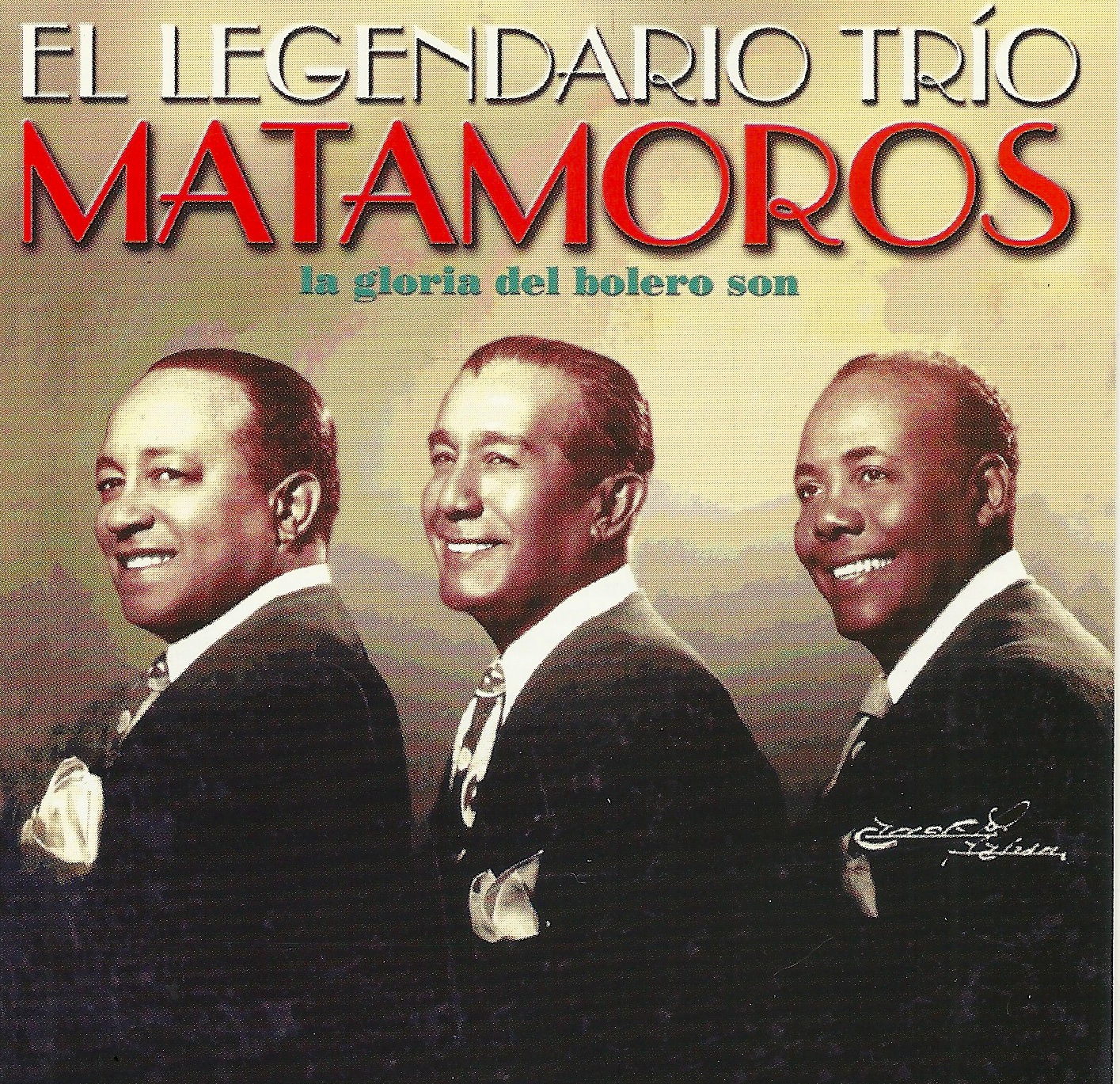
 “Legendario Trio Matamoros, La gloria del bolero son,” issued by EGREM (from Cuba) in 2000, has 21 songs by Trio Matamoros, and is also rated by this reviewer at five stars (*****). The songs on this CD were recorded in Cuba between 1928 and 1951. To my ear the processing by EGREM was a bit more conservative than that by YOYO, but the difference between the two is slight; the YOYO selections seem a bit brighter and louder, while the EGREM selections seem a bit warmer and perhaps to more mature ears burnished and perhaps thus “more authentic.” However, a slight twist of the volume knob (or, alas, fingertip slide to the right) and the EGREM recording fills the room (or your headphones) just as abundantly as the YOYO recording did. The cover photo of the Trio shows, left-to-right, Rafael Cueto, Miguel Matamoros and Siro Rodríguez in elegant dark suits. The five pages of notes (in Spanish) accompanying the CD are superb, and include four photographs of the group, in 1926, 1929, ~1954 and 1961; also, the song type and composer of each selection are noted.
 “Trio Matamoros, La China en la Rumba,” issued by TUMBAO (from Spain), has 24 songs by Trio Matamoros, and is rated by this reviewer at five stars (*****). This compilation was made in 1994, and the sound quality is very close to that of the EGREM recording (above). I am sure many of these songs were transcribed from old platter records (78 rpm) that were in very good condition, or perhaps even copied from the original master recordings. To my ear this TUMBAO compilation sounds like the result of excellent analog sound engineering from the old sources. At some of the quiet intervals I hear old-record needle-drag hiss, faintly. What I do not hear — most gratefully — is any indication of excessive and all-too-modern electronic filter-equalizer computer processing, those ultra-clean silences and liquid-like moldings of the sound that make you think you are listening while floating in an immense amniotic sac. To some older ears this CD may seem to have “the most authentic” Trio Matamoros sound, that which one could have heard from the old records when they were new if the turntables, phonograph needles and audio amplifiers of the 1990s had been available in the 1920s. Again, with adjustment of the volume knob and projection via speakers into a room, the sound from this CD can be experienced in a most satisfying way. It can also be quite lovely through headphones. The five pages of notes, in Spanish and English, are very good, and the song type and composer of each selection are noted.
These three CDs, as listed here, range from brighter sound with fewer songs to softer sound with more songs. However, the variation from bright to soft here is small (and can be offset by hearing the softer sounding CDs at slightly higher volume). Despite their differences they all earn my five star rating because each is a well-rounded whole of: song selection, quantity of music (playing time) and sound quality. There is some overlap in song selections between the three CDs, but not enough to make any one of these CDs redundant. With a computer and applications such as iTunes, one can reshuffle the individual songs from these CDs into longer playlists.
I do not care for the 2 CD, 24 song compilation called “Trio Matamoros,” issued by OK Records in 2011. The song selection is excellent, but the sound has been over-processed to the point of distortion, vocals accompanied by a liquidy-spacey maraca-less instrumental sound. How can you strip off the sound of Siro Rodríguez’s maracas, as if it were part of 78 rpm scratchiness and needle drag noise, and still call the result the sound of Trio Matamoros? The cover graphic of this dual-CD is a largely black field with white dotted curved lines (suggesting a close-up view of the grooves of an old platter record), with two red stars, and a small photo of the Trio Matamoros in their later years, with Rodríguez, Matamoros and Cueto (left-to-right). Young ears that had never heard the original muffled sound of Trio Matamoros from scratchy recordings, or the later nicely processed sound (as described above), might find the “noise free” (and maraca-free) clear vocals and sometimes viscous-spacey sounding instruments of the OK recordings an enjoyable addition to the popular recorded music soundscape of today. I am sure that if Matamoros, Rodríguez and Cueto would have heard themselves as portrayed in the OK Records compilation they would have laughed, imagining they were hearing Martians who had eavesdropped on the Cuban music of the 1920s to the 1950s via Martian short-wave radio; and then they would have written a parody. At most this rates 2 stars (**), for song selection and availability (at a price), but I don’t listen to it at all now, and can’t recommend it given the CD and YouTube alternatives.
 “The Legendary Trio Matamoros 1928-1937,” issued by TUMBAO in 1992, has 20 songs recorded in New York City between 1928 and 1937. “Legendary” is the operative word here, the repertoire is that of Trio Matamoros’ first decade of phenomenal impact as both musical innovators and popular entertainers. The stocks of this CD have been depleted, and only used copies are available now, and for “legendary” prices. The 1931 recording of “Lágrimas negras,” which was indelibly imprinted on my mind as a toddler over 60 years ago, is on this CD. However loving and intelligent and technically masterful the sound processing by TUMBAO was to produce this compilation, it is inevitable that the selections will have an antique sound because the original recording technology just did not have the wide bandwidth (“high fidelity”) to capture fuller, clearer sound; hi-fi technology would increasingly become available from 1941. This collector’s item rates 5 stars (*****). The photograph of Trio Matamoros on the CD case dates from 1926, and shows Cueto, Matamoros and Rodríguez (left-to-right):
Vestidos de <<cubanos>>, con polainas, guayaberas blancas y pañoletas rojas, están armados de guitarras, maracas y machetes. Todo muy típico.
Dressed as “Cubanos,” [rural men] with chaps, white “guayabera” jacket-shirts and red kerchiefs, they are armed with guitars, maracas and machetes. All very typical.
Lágrimas negras — Trio Matamoros, 1931
https://www.youtube.com/watch?v=B-HNOcWWzLg
Let me say “thank you” to all the kind souls who have posted songs on the internet like “Lágrimas negras” with good sound, tasteful accompanying video and/or photos and graphics, and from hard-to-get albums. All we have left today of the Trio Matamoros is their recorded music, and by now that is a treasure that belongs to the world.
I am also grateful that TUMBAO and EGREM in particular, and now also YOYO have done such good jobs of maintaining and carefully polishing the sound quality of Trio Matamoros recordings, and presenting them to the world at affordable prices.
It is interesting and enjoyable to find young musicians of today who perform Trio Matamoros songs with fresh and artistically engaging interpretations. Perhaps you will be one of them.
Enjoy!
<><><><><><><>
Lágrimas Negras 7X
https://youtu.be/_uWjeLLiO2o
<><><><><><><>
Cuban troubadour Miguel Matamoros wrote “Juramento,” back in the 1920s, a song with words about ‘dragging chains is deep oceans of sorrow.’ There is no greater poetry. https://youtu.be/H0kecq3u4Rg
Trio Matamoros y Miguel Matamoros: Documental Son Cubano
Aug 9, 2017
https://youtu.be/WpuVn9DhKHE
Miguel Matamoros nacio en Cuba y solo alli pudo haber nacido. Alli y solo alli, un conjunto unico de condiciones sociales, economicas e intelectuales le permitieron echar raices y crecer. La Trova no fue un accidente, aparecio en su momento en virtud de lo que ecistia y se difundio en la vida cultural con sorprendente celeridad, pues los cubanos estaban preparados para ella. No se puede entender la Trova cabalmente en abstracto, aislada del mundo que la rodea. La Trova y los trovadores son parte de la historia social de Cuba. Los testimonios que aparecen en este documental han sido recopilados con entrevistas aparecidas en archivos filmicos que fueron realizadas entre 1971 y 1981.
La leyenda del Trío Matamoros
Apr 10, 2016
https://youtu.be/QHup2ZRW1LY
EL TRIO MATAMOROS DE CUBA EN VIVO
[1960]
https://youtu.be/-KZn6B66i6w
<><><><><><><>



 manuelgarciajr