Our lives are eternal when we are aware,
and our histories are less than dust when we are not.
Bite into a nectarine
and feel the sweet, fragrant juice
run down the sides of your mouth,
the soft flesh yielding to your tongue,
your fingers and lips
sticky
with the sweet kiss of succulent gratitude
from the orchards of late summer,
sending their seeds into the world –
blindly –
wrapped in enticing nourishment.
Leaves quiver like petals of light,
a flickering translucence in the breeze,
like a cloud of butterflies
scintillating as a breath of sun.
Close your eyes,
run your tongue along your syrupy lips,
and inhale the sweet swollen fragrance released.
Breathe it deep, into your lungs, into your blood, into your mind,
and feel the sunlight sinking through your skin,
the faintest brush of air gliding over the back of your hand –
isn’t everything here?,
completion,
eternity,
peace?
Who is it that is unable to find this?,
why is it necessary to search?
Is not God’s mercy great,
that in the farthest reaches
and briefest instants
even the least among us can find
the great bliss, the transforming grace?
Knowing what is right is embedded,
doing what is right is the test.
In the stilled mind
with no thought,
you know at any instant
what is right.
That is where God is.
For each, there comes a time to run,
a time to fight,
a time to stand,
and a time to abide.
When you release your desires, you lose your fear,
and find your self:
you awaken,
you live,
you transcend concepts and conventions,
you are released from your history,
and now, you are able to face death.
That is freedom in this world.
Once freed, your compassion is able to affect the lives of others.
This is peace.
March 14 is given the name “Pi Day” by many mathematics enthusiasts because the numerical calendar label “3/14,” for the month (March) then day (the 14th), coincides with the first three digits of the irrational number Pi, 3.14159…
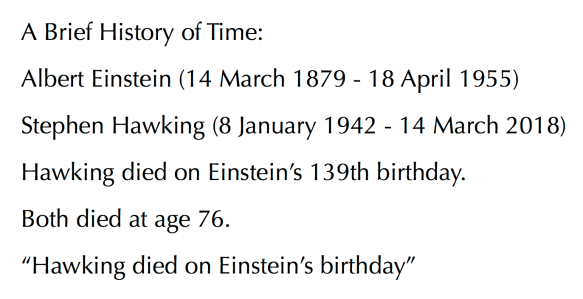
I have called today, the 14th of March, 2018, “Einstein-Hawking-Pi Day #1” because it is the first instance of the triple ‘resonance’ of: an anniversary of Albert Einstein’s birthday, the actual date of Stephen Hawking’s death, and a Pi Day.
I commemorated the day by taking photographs of living eternity, that is to say eternal (so far as we are concerned) principles expressing themselves in radiant instants of life-giving beauty.
I added 10 of these photos (at maximum resolution) to my Flickr site, for display. They are the first ten scenics “from top down” at the following webpage. You can view them, and get technical details there.
Imagine,
a man who does not have to protect his cool — that is power!
He could look a child straight in the eye
and speak slowly, gently,
with utter respect,
acknowledging the God within,
the intelligence before him.
He stood tall —
without apology, without embarrassment, without fear —
for compassion,
indiscriminate compassion.
What man alive dares be so reckless?
The second coming —
all look for a Jesus to come back and save them,
something more than just the three days of Easter,
and yet, that second coming is here now,
every time a person becomes infused with the spirit of Jesus —
awakens, becomes a bodhisattva —
and walks among us
manifesting the eternally animating principles
that walked in the footsteps of Buddha,
that walked in the footsteps of Jesus,
that walked in the footsteps of Dorothy Day,
that walked in the footsteps of countless others –
known and unknown –
that walked in the footsteps of Mister Rogers,
that could walk in your footsteps,
and mine,
but for a dose of courage,
a courage that seems to come easily
once belief permeates into experience.
Love and compassion and power and peace
must be breathed into life.
“It’s such a good feeling to know you’re alive.”
2 March 2003
<><><><><><><>
In 1969, President Nixon wanted to cut Public Television funding in half. Fred Rogers had 6 minutes to try to convince the Senate otherwise.
May 1, 1969: Fred Rogers testifies before the Senate Subcommittee on Communications https://youtu.be/fKy7ljRr0AA
Whether an artist will have enough means to buy the next meal, and subsequent meals, depends on how much editing and limitation of his artistry he is willing to accept. If your aim is to produce the greatest and most refined art you are capable of, then you cannot expect to capture a sufficient audience to meet your ego’s hopes for approval and enriching rewards, nor your metabolism’s need for its necessary nourishment. This is the eternal conflict between art and commerce, between fulfillment and popularity. Committed genius is more likely to die of an empty stomach, than a reliable hack is to want for a full belly. A happy artistic life is one that strikes a balance between the extremes of: an isolating commitment to the compulsion for creating excellence, versus the popular mediocrity of a comfortable prosperity.
Anti-War and Socialist Psychology Books and Movies
On 24 November 2017, Amanda Almanac McIllmurry posted a request for: “Any suggestions for ‘socialist’ psychology books that are easily digestible [for a young student interested in becoming a psychology major]? Also, any suggestions for books with a leftist analysis of the military, which a teenage boy that’s super into the idea of joining the Army could read” [and reconsider such a choice.]?
Here, I have pasted together my various answers (from 27 November 2017 and 22 January 2018) to Amanda’s query (which I think is very important).
ANTI-WAR:
“Dispatches” (1977) by Michael Herr. This book was called the best “to have been written about the Vietnam War” by The New York Times Book Review; novelist John le Carré called it “the best book I have ever read on men and war in our time.” Michael Herr co-wrote the screenplay to the movie “Full Metal Jacket” (1987) by Stanley Kubrick. (See the wikipedia article on “Michael Herr”). I would also recommend the movie “Sir, No Sir!” (2005) about the anti-war movement (resistance!) within the armed forces during Vietnam War. You can find it on-line. The ultimate anti-war movie of my lifetime is “Hearts and Minds,” (1974), which is a masterpiece by Peter Davis (and won an Academy Award in 1975!). You could ramble through my huge web-page called “Haunted by the Vietnam War,” which is on my blog (manuelgarciajr.com), and which lists many links to books and videos (and probably gives links to the movies mentioned here).
“All Quiet On The Western Front,” a classic of 20th century world literature, and also made into a great movie, starring Lew Ayres (a pacifist). Another world-treasure movie to put you off war is Jean Renoir’s “Grand Illusion.” Both these movies are from the 1930s, when the bitter memories of WWI were still very fresh. Since both are masterpieces, they have been restored in recent times, and look and sound good (and on DVD). Modern movies that could put you off war are MASH (1970), but it has so much humor that some might miss the anti-war basis of the film (I sure didn’t in 1970!); and “Full Metal Jacket” by Stanley Kubrick (about the Vietnam War), but the violence in it might be a bit too much for the young. For Americans today, I think the all-time best anti-war film is the documentary “Hearts and Minds.” It is THE BEST film about the Vietnam War, and was released in 1974, while the war was still in progress. I just saw it again a few weeks ago; incredible. What is so compelling about it is that almost all of it is the telling of first hand experiences of soldiers who survived (not always intact). It just so happens I took a Vietnam Vet friend of mine to the V.A. hospital today, for a pre-op medical visit. There were numerous patched-up survivors of military “service” (use) in the hallways. For a combination of humanizing psychology and overt anti-war basis, see the movie “Captain Newman, M.D.,” (1962) which stars Gregory Peck, Angie Dickinson, Eddie Albert, Tony Curtis, and Bobby Darin (in an amazing performance). Capt. Newman tries to heal soldiers from PTSD, and he hears about what gave them PTSD. Once “cured,” they’re shipped back out into action. This is a great film, a total anti-Rambo.
<><><><><><><>
SOCIALIST-PSYCHOLOGY (E-Z):
This is harder for me to find. Reading numerous titles by Chomsky, Balzac, Alan Watts, Hannah Arendt and C. G. Jung would be a bit much for a teenager or young college student. I would suggest “Man’s Search For Meaning” (1946) by Viktor E. Frankl, one of the supremely inspiring books of the 20th century – easy to read, yet causes much thinking; written by a psychiatrist based on his personal experiences in survival. I wrote an essay on this idea of “socialist psychology” and survival, called “Epiphany On The Glacier,” which is also posted on my blog. I give references to a number of books (including Frankl’s) that helped me present the main concept. My essay is presented as an adventure story of survival in the snowy wild.
The psychology book I enjoyed most is more of a philosophy-autobiography book, “Memories, Dreams, Reflections,” by Carl Gustav Jung. It’s not hard to read, nor too long, nor preachy nor text-booky, and it has the virtue of being quite different than the usual orthodox psychology books. But I can’t say it’s overtly leftist, though it is intended to be very humanizing. I, personally, found it fascinating and have read it several times. With Jung, it helps a lot if you also have a very strong interest in Taoism and Buddhism (and Asian philosophies, generally).
<><><><><><><>
The photo is of John F. Kennedy’s grave in 1964. I took this photo while on a class (school) trip.
<><><><><><><>
ADDENDUM (17 June 2018):
ANTI-WAR FILMS:
What are your favorite anti-war films? Such movies are focused on showing the harm, damage (physical and psychological) and stupidity of war, and are intent to deglorify war, and turn the audience against blind patriotism and war-making as “solutions” to political and international conflicts.
Anti-war movies are NOT movies that use war situations JUST TO:
(1) present stories of adventure and heroic personal actions (almost exclusively of violence) by attractive, sympathetic and “patriotic” characters;
(2) show dramatic and exciting stories of admirable personal endurance, survival and self-sacrifice by individuals trapped in situations of overwhelming danger (though this particular variety of war movie can approach being fully and openly anti-war);
(3) be patriotic morale-boosters for “your side” during a war (or before an anticipated war);
(4) entirely be comedies that use war situations as the settings and backdrop.
Anti-war movies CAN have elements of: adventure, heroism, “exciting’ violence, stories of personal endurance and self-sacrifice, and comedy, but they cannot be conventionally patriotic, and the center-of-gravity of these films must be fully and overtly the anti-war intent. All war films use war in an effort to make commercially successful mass entertainment, but true anti-war films are intentionally using film-making art to motivate a mass audience to be deeply anti-war, anti-violence, pro-peace, pro-diplomacy, and to divorce patriotism from unthinking jingoism, belligerence, violence and obedience to militarism.
The following is a list of movies I see as anti-war (18+, listed chronologically). They vary, some being very grim while others are very comedic, yet all are full-fledged anti-war films (to my way of thinking). I recommend them all and would be interested in your comments about them, and also about other films you would nominate as committed anti-war movies.
All Quiet On The Western Front (1930)
La Grande Illusion (1937)
Lost Horizon (1937)
The Day The Earth Stood Still (1951)
Paths Of Glory (1957)
The Bridge On The River Kwai (1957)
On The Beach (1959)
Captain Newman, M.D. (1962)
The Americanization of Emily (1964)
Dr. Strangelove or: How I Learned to Stop Worrying and Love the Bomb (1964)
The Russians Are Coming! The Russians Are Coming! (1966)
Catch-22 (1970)
MASH (1970)
Slaughterhouse-Five (1972)
Hearts And Minds (1974)
Apocalypse Now (1979)
Apocalypse Now Redux (2001)
[“Redux” is an expanded version, and I prefer it.]
Full Metal Jacket (1987)
Sir, No Sir! (2005)
<><><>
“On The Beach” is a post-apocalyptic (nuclear war), end-of-the-world novel written by British-Australian author Nevil Shute after he emigrated to Australia. It was published in 1957. The novel was adapted for the screenplay of this 1959 film featuring Gregory Peck, Ava Gardner, Anthony Perkins, and Fred Astaire.
The “answer” for the best way to face certain doom is the same answer for how to gain a fulfilling life and create a good society: helping and comforting one another, and having compassion for all. Because this movie shows this clearly, it has not aged even by 1 second – we could learn from it now. SEE IT!!
https: // www. youtube. com / watch? v= EMzEWpKKOZs
[close the spaces to spell out the functional web-link]
It is so sad to see karma’s futile attempts to purge some lives of their stubborn insistent ignorance, and to have your sympathetic efforts to help resented as annoying interference and hurtful contradiction, thus reducing your possibilities for compassionate action to silent compliance while absorbing repetitive litanies of self-pitying complaints. And, how enervating to remain tethered to another’s self-wounding, because of your guilt against abandoning a human bond you want to value. Many kind hearts harden over time simply from a need for self-preservation, and much love erodes over time by straining to withstand ceaseless withering rains of impervious self-defeating inertia.
If I told you the truth
you would be unhappy.
If I lied
you might later find out
and then be unhappy;
or you might never find out
and then I’d be unhappy.
A child’s best gift to a father
is to accept his wisdom.
A child’s best gift to a mother
is to reassure her love.
Parents’ best gift to their children
is to let them live their lives,
and let them see you live
being happy without being afraid.

 <><><><><><><><><><><><><><><><><><><><><><><><><><><><><><><><>






 manuelgarciajr