Snyder versus the Campists

When forming one’s political orientation, a consistency of human solidarity and to fundamental morality is more important than any inflexible scheme of ideological consistency, purity and rigidity.

Albert Camus urged us (in Howard Zinn’s words):

“In such a world of conflict, a world of victims and executioners, it is the job of thinking people not to be on the side of the executioners.”

This last quote is an abstraction by Howard Zinn of Albert Camus’s following concluding statement from his 1940s article ‘Toward Dialogue: Neither Victims nor Executioners’:

“Now I can end. What I think needs to be done at the present time is simply this: in the midst of a murderous world, we must decide to reflect on murder and choose. If we can do this, then we will divide ourselves into two groups: those who, if need be, would be willing to commit murder or become accomplices to murder, and those who would refuse to do so with every fiber of their being. Since this awful division exists, we would be making some progress, at least, if we were clear about it. Across five continents, an endless struggle between violence and preaching will rage in the years to come. And it is true that the former is a thousand times more likely to succeed than the latter. But I have always believed that if people who placed their hope in the human condition were mad, those who despaired of events were cowards. Henceforth there will be only one honorable choice: to wager everything on the belief that in the end words will prove stronger than bullets.”
— [Albert Camus, an English translation, as shown at the end in https://adamgomez.files.wordpress.com/2011/01/camus-neither-victims-nor-executioners.pdf]

Writing in the postwar France of 1955, on the theme of ‘the responsibility of the intellectuals’ as regards Stalinism, Raymond Aron wrote:

“I had had occasion… to write a number of articles directed not so much against the Communists [like the French Resistance, who shed blood in WWII to liberate people from fascist tyranny, — MG,Jr.] as against the communisants, those who do not belong to the party but whose sympathies are with the Soviet world… Seeking to explain the attitude of intellectuals, merciless toward the failings of the democracies but ready to tolerate the worst crimes as long as they are committed in the name of the proper doctrines, I soon came across the sacred words, Left, Revolution, Proletariat.”
— [Raymond Aron, ’The Opium of the Intellectuals,’ 1955]

In the 1966, Noam Chomsky wrote his own famous essay ’The Responsibility of Intellectuals,’ which was about the complicity of the American intelligentsia with pro Vietnam War propaganda. Chomsky keyed his 1966 article off the late 1940s writings of Dwight Macdonald, who was “concerned with the question of war guilt”:

“He asks… to what extent were the German or Japanese people responsible for the atrocities committed by their governments? And, quite properly, he turns the question back to us: to what extent are the British and American people responsible for the vicious terror bombings of civilians, perfected as a technique of warfare by the western democracies [in the 1940s, though pioneered by the Nazis at Guernica in 1937 and Warsaw in 1939, — MG,Jr.] and reaching their culmination in Hiroshima and Nagasaki, surely among the most unspeakable crimes in history? To an undergraduate in 1945-1946 — to anyone whose political and moral consciousness had been formed by the horrors of the 1930s, by the war in Ethiopia, the Russian purge, the ‘China Incident,’ the Spanish Civil War, the Nazi atrocities, the Western reaction to these events and, in part, complicity in them — these questions had particular significance and poignancy.”
— [Noam Chomsky, ’The Responsibility of Intellectuals,’ 1966]

The forerunner to Albert Camus, Dwight Macdonald, Raymond Aron and Noam Chomsky on the subject of ‘the responsibility of intellectuals’ was Julien Benda, whose 1927 book ‘La Trahison des clercs’ (The Treason of the Intellectuals or The Betrayal by the Intellectuals) “argued that European intellectuals in the 19th and 20th centuries had often lost the ability to reason dispassionately about political and military matters, instead becoming apologists for crass nationalism, warmongering, and racism.”
— [https://en.wikipedia.org/wiki/Julien_Benda]

This brings me to current heated polemics about the Russian invasion of Ukraine on 21 February 2022 (or for that matter in 2014).

I have learned a new label, “campists,” for a peculiar subset of polemicists who insist that all the current war troubles (and accumulating war crimes) in Ukraine are entirely the fault of a relentless NATO (and thus U.S.) campaign of eastward expansion for the express purpose of forming an “encirclement” of Russia. What they refuse to accept about Ukraine in 2022 is this:

“[Timothy] Snyder says the focus on NATO ignores the agency of leaders in Ukraine and elsewhere who have the right to seek their own arrangements. ‘It’s very important to remember that the world isn’t just about Washington and Moscow. It’s also about other sovereign states and other peoples who can express their desires and have their own foreign policies,’ says Snyder.” — from:

Journalist Andrew Cockburn & Historian Timothy Snyder on Ukraine, Russia, NATO Expansion & Sanctions
1 March 2022
https://youtu.be/-Y8ny69uU3g

In this ‘Democracy Now’ video, Snyder has all the facts, states the reality about “Ukraine” and the international situation clearly, and has the real and useful (and morally correct) insights.

The reason the countries between Berlin and Moscow (Baltic States and the former East Bloc) have clambered to become members of NATO since 1989, despite a lack of enthusiasm by the original Anglo-American and Western European NATO members (the WWII democratic “Allies”) for such inclusion, is that those Eastern European states all too painfully remember the hell they went through under Nazi and USSR occupations, between 1933 and 1945, and their Iron Curtain experiences from 1946 to 1989-1991.

In the 1980s I learned about the “govnoed,” by reading Western-published books by dissident Soviet authors writing about the Nomenklatura: the USSR’s Communist Party power elite and patronage pyramid. The “govnoed” of the 20th century are now in an expanded category call “campists.”

I see the ~100 year genealogy of this hypocritical ideological tendency this way:

Stalinists
(Comintern aligned Communists >1924):

  • Stalinists labeled leftist anti-Stalinists like: Trotsky, Orwell, Louis Proyect(!), as “Trotskyists” —>

Communisants
(French “anti Atlanticists” like J.P.Sartre >1945):

  • Communisants labeled anti-Stalinists like: Camus, Koestler, Arendt, Aron as “Atlanticists” —>

Govnoed
(>1953):

  • “shit eaters,” the Soviet label for uncritically loyal Western Stalinists during the Soviet era after Stalin’s death —>

Tankies
(>1956) —>

  • Western Stalinists cheering Soviet tanks crushing popular revolutions, 1953, 1956, 1968, etc. —>

New Leftists/Maoists
(>1966):

  • Western only-anti-Western-imperialism leftists —>

Campists
(>1991)

  • “Campists” = Leftists who claim that all popular insurgencies against leaders who pretend to be “socialist” (and are faux anti-capitalist) and seem to oppose U.S. imperialism (e.g., Gaddafi, Bashar al-Assad, Vladimir Putin, etc.), are incited, manipulated, or controlled by Washington. Basically, campists inflexibly favor the presumably socialist and anti-capitalist “Red Camp” of international politics in any contentious situation, without regard to the factual data about it.

“The Democratic Socialists of America’s International Committee has issued a statement on Ukraine that fails to adhere to basic socialist principles. [that statement is ‘DSA IC opposes US militarization and interventionism in Ukraine and Eastern Europe and calls for an end to NATO expansionism’, January 31, 2022, https://international.dsausa.org/statements/no-war-with-russia/]…

“The DSA-IC dismisses the Maidan Protest of 2014 as the ‘U.S. backed Maidan coup.’ It thus associates itself with others on the left – we call them ‘campists’ – who claim that all popular insurgencies against leaders who seem to oppose U.S. imperialism are incited, manipulated, or controlled by Washington. There is a degree of condescension and even racism in the notion that movements from below of ordinary Ukrainian, Chinese, Iranian, or Nicaraguan working people are U.S. puppets.

“These people are perfectly capable of standing up for themselves and fighting back, even if they do so against overwhelming odds. Do the U.S. State Department and the CIA and NATO attempt to influence and, when they can, direct such movements? Of course. It is clear, however, that the Orange Revolution of 2004 and the Maidan uprising were fundamentally expressions of the democratic aspirations of the Ukrainian people – fed up with the brutality of their government’s treatment of protesters – and their wish for self-determination, and not because they were being directed by Washington or by neo-Nazis. The Ukrainian people seek their independence, and we should stand with them against both the United States and NATO and against the immediate threat from Russia.”
— [above 3 paragraphs from]:

What the DSA International Committee’s Ukraine Statement Gets Wrong
By: Stephen R. Shalom, Dan La Botz, Thomas Harrison
February 9, 2022
https://newpol.org/what-the-dsa-international-committees-ukraine-statement-gets-wrong/

And this all brings me back to my fundamental point: form your political orientation on a basis of consistency in human solidarity and to fundamental morality, regardless of whatever ideological inconsistencies, impurities and pragmatic flexibility you must accept during the specific applications of your political attitudes, and in your actions, in the real world. The well-being of human beings anywhere is always more important than maintaining the rigidity of your abstract general ideas about society and its politics. Routinely reevaluate your political biases by applying indiscriminate compassion focused by intellectual rigor based on factual data.

I recommend you listen to all of Timothy Snyder’s comments in the ‘Democracy Now’ video cited above.

<><><><><><><>
The Thermonuclear Melian Debate Over Ukraine

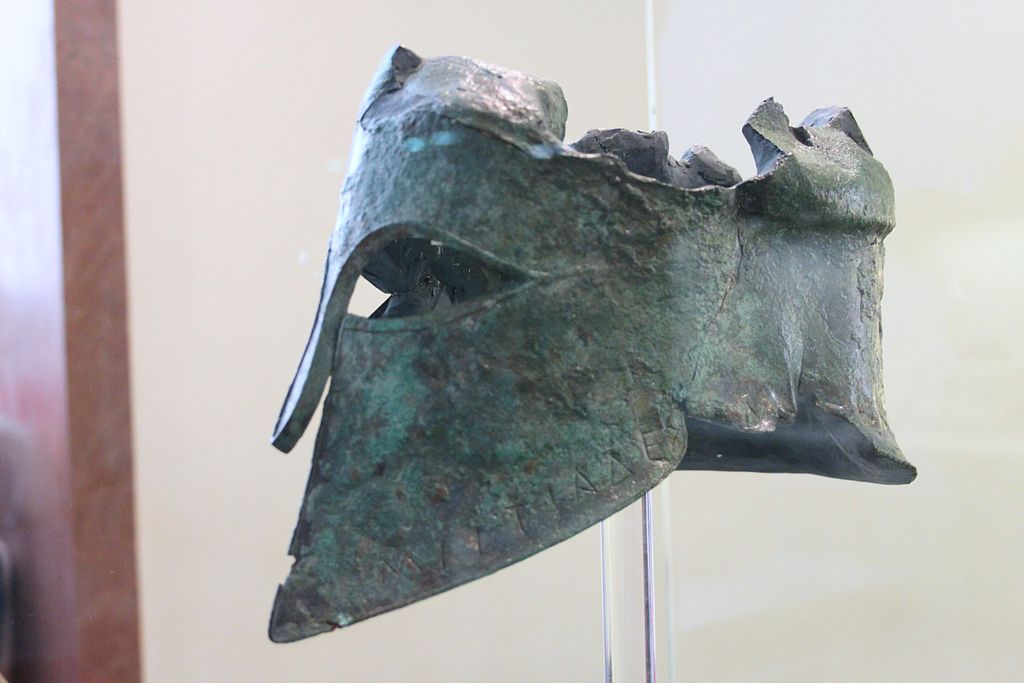
“Helmet of Miltiades.” The helmet was given as an offering to the temple of Zeus at Olympia by Miltiades. Inscription on the helmet: ΜΙΛΤΙΑΔΕΣ ΑΝΕ[Θ]ΕΚΕΝ [Τ]ΟΙ ΔΙ (“Miltiades dedicates this helmet to Zeus”). [Archaeological Museum of Olympia] (wikipedia). Miltiades was the Greek general who devised the strategy and commanded the Greek troops that won the Battle of Marathon (against the invading Persians) in 490 B.C. The account of this is one of the most stirring sections of Herodotus’s history book.

<><><><><><><><><><><><><><><><><><><><><><><><><><><><><><><><>

The Thermonuclear Melian Debate Over Ukraine

It is true that Neville Chamberlain’s appeasement policy (1938) held off WWII for a year — for Poland (1 September 1939) — and maybe a bit more for Norway, Denmark, and the Low Countries, and then France (May-June 1940); and then maybe up to two years for Britain directly if you count in the Phony War (1939 to before May 1940), and then close to three years for Russia/USSR when Hitler tore up the Molotov-Ribbentrop alliance (22 June 1941) that had initiated the joint German-Russian invasions of Poland in 1939.

Each of those time gaps allowed the countries enjoying them, before being swallowed up into military hostilities, to safely arm or rearm as they could in anticipation of the worst, which soon came to all of them. So it is easy to see some short-term tactical advantage to an appeasement policy prior to experiencing a military invasion.

This was certainly Hitler’s and Stalin’s view when each chose to enter into their Molotov-Ribbentrop alliance to carve up Poland (seen by both Hitler and Stalin then as Putin sees Ukraine today), and to keep from warring against each other (in the inevitable Fascist-Communist 1940s superpower war), and in Stalin’s case to appease Hitler’s eastward expansion without the USSR having been able to gain any Western European allies against Hitler/fascism and Japanese militarism.

The essence of the various interrelated appeasement policies of Chamberlain, Stalin and Hitler (the MB Pact being in part Hitler’s appeasement to USSR westward expansion) all shared one fundamental principle: the independence of or submission (even to the point of nonexistence) by smaller weaker countries was for the major powers to dispose of as they saw fit, and as served their plans for protecting their own political domains (empires) and for imposing their geopolitical/territorial schemes (colonization) beyond their existing borders. So, Czechoslovakia and Poland got “tossed under the bus” in 1938-1939 so the British Empire, the Third Reich, and the USSR could continue to have their pieces of the European and World pies. This reality of international relations is doubtless as old as humanity itself:

“…the standard of justice depends on the equality of power to compel, and that in fact the strong do what they have the power to do, and the weak accept what they have to accept.”
— [Thucydides, 416 BC].

This was how Thucydides wrote about it, in his account of the “Melian Debate” between the Athenian Empire and the leaders of the small Aegean island of Melos that Athens (the Delian League) wanted to occupy as a forward naval base against any invading Spartan (and Persian sponsored) fleet during the Peloponnesian War (431-404 BC). Ultimately, the Athenians assaulted Melos, defeating it, killing the men and enslaving the women and their children. The lands between Berlin and Moscow suffered similar fates between 1933 and 1945.

The idea of appeasing Putin’s imperialistic ambitions, as regards Ukraine, arises naturally when he threatens to resort to nuclear weapons if thwarted in his expansionist military operations. By the same logic it seems reasonable for public safety in the United States, the European Union, Russia, and even beyond as far as China, if the 194 recognized countries of the world would accept the power principle articulated by Thucydides and let the nuclear superpowers to dispose of everyone’s national independence or dependence, submission or nonexistence, as those superpowers — empires all — saw most convenient for themselves: better that the people in the smaller weaker and poorer countries suffer and die by imperial conquest than that the people in the larger stronger richer and “safer” countries expose themselves to hazards — from the inconveniences of slowed supply chains, up to the terrors of thermonuclear face-offs — by coming to the defense of the invaded “weaklings.”

This dilemma was addressed in 1945 with the formation of the United Nations (and a subsequent variety of treaties) — a far from perfect organization but a positive step to address the problem — and the formation of NATO, also far from perfect but even so a membership in which has been avidly sought by every country occupied by Nazi Germany and/or the USSR between 1939 and 1991.

The whole point of these organizations is to prevent a reoccurrence of the political-military escalations that unleashed WWII (and similarly for WWI, earlier). By that logic the UN ‘world alliance,’ the EU economic-military alliance, and the NATO military alliance exist to resolve outbreaks of destabilizing world disorder like the Russian war in Ukraine, without sacrificing the population under assault, because by sacrificing them (again; as in 1935, and 1936-1939) the glue of trust needed to maintain such structures of mutual security dissolves and they fall apart, and we are back to Melian Sacrifices before all subsequent superpower expansions: unchecked imperialism.

“The fate of Russia’s invasion of Ukraine will determine the propensity of all other countries for aggression. If it fails in turn, the effect on all global and regional powers will be one of powerful deterrence. If it succeeds, that is if Russia manages to ‘pacify’ Ukraine under Russian boots, the effect will be a major slide of the global situation toward unrestrained law of the jungle, emboldening US imperialism itself and its allies to resume their own aggressive stances.”
— [Gilbert Achcar, “A memorandum on the radical anti-imperialist position regarding the war in Ukraine,” Sunday 27 February 2022, http://www.europe-solidaire.org/spip.php?article61309]

So, in February 2022, it is time for our many political, government, parliamentary, diplomatic, military and economic leaders and officials to earn their pay by coordinating their actions to reign in the aggression into Ukraine by the Putin government of Russia, without being so clumsy as to set off a nuclear war. From their reported and escalating actions this week (21-28 February 2022) it seems quite clear that they are well aware of what is required, and even such rigidly neutral countries like Sweden and Switzerland have joined in that effort: an economic throttling of Russia’s money flows coupled with increasing amounts of sophisticated weaponry delivered to Ukrainians so they become more effective in fighting their defensive hot war against the invading Russian military (and maybe if Lukashenko is stupid, an invading Belarusian military as well).

Recall that in the multipolar nuclear weapons era (>1949) that both the USSR and China dampened US war-making campaigns in Korea (1950-1953) and Vietnam (1965-1975) by supplying North Korea and North Vietnam with advanced weapons (small arms like AK47 rifles and ammunition, artillery, fighter jets, anti-aircraft missile and radar systems), and by merely existing as nuclear weapons ’superpowers’ allied with the Communist forces in Korea and Vietnam. The US had wanted to use nuclear weapons (MacArthur in Korea, Westmoreland and LeMay in Vietnam), but Korea and Vietnam were politically and territorially too close to China and the USSR for the U.S. to take that kind of risk. So despite the awesome military might and malice of the United States, the Koreans and the Vietnamese bled profusely to fight through their anti-US wars but they managed to survive them as three independent states (a unified Vietnam and two Koreas).

Given the ongoing antiwar protests in Russia and even Belarus, where such protests are heavily penalized by their laws (no 1st Amendment there, 20 years in jail threatened), rather than the Russian and Belarusian people expressing obvious commitments to all fight and die for their leaders’s Ukrainian war aims, it seems reasonable to anticipate that the Putin and Lukashenko governments could be brought down by popular revolts (and military mutinies) if enough of those people became sufficiently distraught at the losses of their boys in the snows, mud and streets of Ukraine, and terrified at the possibility of themselves being subjected to American, British and French nuclear bombardment in retaliation to Putin’s most extreme possible action.

At present, I think it most likely that Putin (and Lukashenko) will be reigned in without any nuclear weapons having been used, and his ultimate military defeat will cause, or be caused by, the fall of his regime. What is to be wished is that that happen as soon as possible so as to minimize the pain, suffering, death and destruction in Ukraine. And it is important to remember that the Russian and Belarusian people are not the enemies, but the Putin (plus loyal oligarchs, and Lukashenko client regime) are.

So I do not favor an appeasement policy with regards to Putin (and too bad he was not stopped sooner as with Syria in 2014), and I also realize that the management of an internationally coordinated counter-Putin-aggression economic-military policy is a delicate matter in our nuclear superpower era of the ‘World Order.’

I think the hazy idea of a “lasting peace” in world affairs is an ‘unobtainium’ at our current level of human and societal development (unchanged for millennia, as the late -5th century Melians would no doubt say if they could see us now), and that we should see the management of “peace” as a never-ending and always imperfect effort of pragmatic political improvisations; and that we should pick as our leaders people who are honorable and astute at doing that management without sacrificing human solidarity.

<><><><><><><>

STOP BEING A USEFUL IDIOT

<><><><><><><><><><><><><><><><><><><><><><><><><><><><><><><><>

STOP BEING A USEFUL IDIOT

Read Timothy Snyder’s ‘BLOODLANDS’ because:

It is essential reading to understand what is going on today — everywhere but especially in Eastern Europe (and Ukraine in late February 2022). Also essential to help one overcome the tendency to become a robotic mindless “anti American imperialist” who is quite happy to “virtue signal” their ideological purity and supposedly higher moral standards (from the comfort and safety of our First World ‘homelands’) by acceding to the sacrifice of any victim population (Ukrainians, Syrians, Palestinians, Libyans, Uyghurs…) that any tin pot dictator, autocrat or “power pentagon,” who promotes himself/itself as “socialist” and a stalwart fighting against “American imperialism,” wants to conquer, crush, displace and enslave economically (and even worse).

Certainly being against imperialism — American or otherwise — is to the good, but we Western safely anti-imperialists must absolutely never accept the sacrifice of another people’s right to safe national independence, in order to signal our anti-imperialist “moral purity.” NATO has expanded into Eastern Europe precisely because Eastern Europeans vividly remember how much their nations suffered under the Russians (for about a century most recently), and they want insurance policies against such catastrophes in the future, even if the insurance company selling those policies — NATO — is itself far from perfect, or “socialist” or “enlightened.”

The essential and fundamental point is to honor and protect the right of all people to safe lives within independent states of THEIR OWN choosing.

“The lands of today’s Ukraine were the center of both Stalinist and Nazi killing policies throughout the era of mass killings. Some 3.5 million people fell victim to Stalinist killing policies between 1933 and 1938, and then another 3.5 million to German killing policies between 1941 and 1944. Perhaps three million more inhabitants of Soviet Ukraine died in combat or as an indirect consequence of the war.”
— [Timothy Snyder, ‘Bloodlands’, p404]
— The 1939 population of the Ukraine was 32,425,000 [total morality over 11 years = 31%].

The biggest neo-nazi center in Eastern Europe today is actually Putin and his band of oligarchs, who want to recreate the Tsarist/Stalinist Russian Empire. Don’t let yourself become a useful idiot to them and others like them because you want to unintelligently and reflexively preen your “leftist” anti-capitalist, anti-imperialism-by-the-U.S., and anti-NATOism ideological purity for your own self-satisfaction. Camus said to identify with the victims, not the perpetrators, and that is the best guide to your allegiances with humanity.

<><><><><><><>

27 February 2022

ON DELUSIONAL “LEFTISTS”
(not the real ones like Louis Proyect):

“I really don’t understand ‘leftists’ who dance around the fact that Putin is a dangerous kleptocratic goon. Makes no sense to me. They act like what he’s doing isn’t equivalent to other imperialistic incursions.” — [my friend E.]

They are stuck in their self-regard as “anti-imperialists”, and feel “brave” because they oppose US war-making and imperialism (as am I: opposed not brave), and so reflexively “pro-Russian” (pro-Soviet) as a mental inertia from the glory days of the Russian Revolution (1917-1922, the euphoria of John Reed’s ‘Ten Days That Shook The World’ — a great book), and for the worst of them (the most pathetic) as a lingering unthinking indoctrination to Stalinism.

“To believe that great suffering must be associated with great progress is to accept a kind of hermetic masochism: the presence of pain is a sign of some immanent or emergent good. To advance this sort of reasoning oneself is hermetic sadism: if I caused pain, it was because there was a higher purpose, known to me. Because Stalin represented the politburo which represented the central committee which represented the party which represented the working class which represented history, he had a special claim to speak for what was historically necessary. Such a claim allowed him to absolve himself of all responsibility, and to place the blame for his failings upon others.”
— [Snyder, ‘BLOODLANDS’, p401]

The “most pathetic” include the lunkheads who gained instantaneous engineering-physics PhD’s watching the flaming NYC Twin Towers collapse on TV (11 September 2001) and within milliseconds knew that G.W.Bush and Dick Cheney had tiptoed up and down staircases in the World Trade Center buildings the weekend before, planting cakes of C4 timed to go off (forget the planes) and let them go on to conquer the world. The “most pathetic” also include the equally turgid-minded pseudo leftists who, in the comfort of their own safe First World consumerist-internet lives, swell with righteous pride by thrilling to the rush of their inner Stalin, as above, in accepting the pain of remote anonymous “others” because there is a higher purpose known to them as vanguards of the working class, which represents history, so these cadres have a special claim (within their own minds) “to speak for what was historically necessary” and absolve themselves of all responsibility, placing the blame for the obvious failings of their delusions upon others.

In pointing all this out I am sincerely trying to be a good friend (like when calling a cab at 1 AM to prevent a buddy from driving home drunk from the bar you both favor). But, I am forthright about stating what I see as true, because otherwise I would not be a good friend. Since that independence is important to me, I accept becoming friendless, and being “unfriended.” Substance over superficiality, always.

<><><><><><><>

The Power Pentagon Redux

<><><><><><><><><><><><><><><><><><><><><><><><><><><><><><><><>

The Power Pentagon Redux

P. Cockburn (lead foreign correspondent at Counter Punch) says Putin into Donbas is like Saddam into Kuwait (https://www.counterpunch.org/2022/02/23/putins-advance-into-ukraine-compares-with-saddam-husseins-invasion-of-kuwait-a-disaster-for-russia/). I think it more like Hitler into the Rhineland in 1936, both as re-occupation or “recovery” of “homeland” territory, and for coal, minerals and industry (I spell it out in ’The Power Pentagon’, below).

I expect the EU and NATO Allies will do as much for Ukraine (regarding Russia) as their predecessors did for Poland in 1939-1945. I’m sure Putin thinks the same. Stalin starved Ukrainians to death (~3M) between 1932-1933. Hitler, between 1941-1944, shot (mainly) and gassed (also) Ukrainian Jews (mainly), many civilians (in reprisals, or just to clear territory, often herded onto buildings set on fire with escapees machine gunned, see the movie ‘Come and See’), antifascist partisans (shot on capture), and starved Soviet war prisoners to death, for a total of at least 1.6M (battle field deaths of soldiers not included).

So neither the German Nazis nor the Communist Russians are remembered too fondly as “liberators” (the Nazis in 1941, from the Russians/NKVD; the Red Army in 1943-1945, from the Nazi SS and Order Police and Ukrainian fascist partisans). Only for Jews were the Soviets better than the Nazi’s in the Ukraine, but still far from “good” (especially if they were suspected by the NKVD of being Polish intelligentsia or having any “political” past; and some of those Ukrainian Jews of 1945+ had somehow survived both the Holodomor as well as the Holocaust-by-bullets, but there weren’t too many Jews left in Ukraine).

Since German Fascism and militarism seem to have been stamped out long ago, and Stalin/USSR ruled Ukraine from !945 to 1991, and few Ukrainian Jews remained after 1945, I suspect most Ukrainians (Orthodox Christians) “remember” their last century of history with a jaundiced eye to the USSR and now Putin’s Russia, and the most extreme of such attitudes is held by the “Ukrainian Nazis” (a legacy of the antisemitic Ukrainian collaborationists with Nazis 1941-1945), but I can’t imagine theirs is a majority bias in today’s Ukraine, who I’m guessing would have liked to be part of NATO as “insurance” against Russia, but would be happy to settle into a stance like that of Finland or Switzerland: independent and yet “safe”.

At the moment I am in the last pages of Timothy Snyder’s 2010 book, ‘Bloodlands, Europe Between Hitler and Stalin’. The history of Poland, Belarus, Ukraine between 1932 and 1945 form a very large part of this book. It was in these three countries that the overlap in mass killings by the Nazis and Stalin was most intense and massive and prolonged; between 1939 and 1941 it was cooperative (Molotov-Ribbentrop Poland), from 1941 to 1945 it was antagonistic in separate zones of control that shifted back and forth (1941-1943 Nazi advance from MB Line in Poland to Stalingrad, 1943-1945 Red Army and NKVD advance from Stalingrad-Moscow line to Berlin).

Prior to 1939, the Soviets had perpetrated the Holodomor starvation (forced collectivization of agriculture, 1932-1933) that was mostly focused in the Ukraine, and then the Great Terror purges of 1937-1938 in the USSR, which also had many Ukrainian victims.

The Baltic States (Estonia, Latvia, Lithuania) were also in the center of these “bloodlands” (like Poland, Belarus and Ukraine), and suffered relatively equally, but total numbers of victims for them were smaller because they had smaller populations.

People in those countries today are quite aware of this history, and it is not difficult to understand their politics and foreign relations as regards the West (Poland’s allies: England, France, and later the U.S., did NOT send troops into Poland and the “bloodlands” during 1939-1945), and NATO (whose nations have pledged NOT to send troops into the Ukraine), and as regards Russia. The Melian Debate (in Thucydides) remains our template of international relations and “solidarity.”

Putin, as a child of the USSR who was well placed to cash in when the game changed in 1991 (and making money and becoming a capitalist oligarch was the rage, which it still is for some), has nevertheless retained the 1930s Stalinist memory of fear of encirclement and invasion; in the 1930s by Germany, Poland and Japan, now updated by Putin to NATO and the U.S. In both cases a fear of the Soviet/Russian sphere of influence and state and economic system collapsing.

The modern “Russian” fear of encirclement and invasion has some validity in that the US-led NATO along with the EU have been moving “in” and absorbing former EAST BLOC states, which “Russia” had sought control of since the 1930s (and had from 1945 to 1989-1991) and those former satellites, borderlands, and buffer zone states have little reason to retain warm memories of the years “behind the Iron Curtain,” so might not be entirely benign neighbors so close to Moscow, as NATO states; the “buffer” would be entirely gone.

I wrote the ’The Power Pentagon’ on 22 February 2022, before the shooting stated in Ukraine itself (beyond Donbas), and I still think the analysis of Putin’s motives is accurate and useful. But, I was also aiming at other global concerns.

The Power Pentagon

Yesterday (21 February 2022), Vladimir Putin, the Russian Premier, recognized the separatist Donbas regions of Ukraine as independent states, and ordered Russian troops into them to forestall a Ukrainian invasion to reassert its sovereignty there.

Why? Putin’s action is a defensive threat display to resist the steady encroachment by the US-dominated NATO political alliance into, and diminution of, Russia’s western sphere of influence in the external borderlands and historically sought-after buffer zones against German invasions (and now “German” equates to Western European and Anglo-American); and it is a reaction driven by the fear of ultimate inaccessibility to the Baltic Sea for Russian naval forces, in the north, and the Azov Sea and Black Sea (and from there to the Mediterranean and the Levant) in the south.

The Donbas is comprised of the Luhansk and Donetsk regions of Ukraine and is the very easternmost tip of that country, lying just above the Azov Sea, which sea is to the northeast of the Crimean Peninsula that juts south into the Black Sea. The Donbas has a rich coal basin that has supported the development of heavy industry such as coal mining and metallurgy since the 19th century (the word Donbas is a portmanteau formed from Donets Basin, an abbreviation of Donets Coal Basin).

Crimea was taken from the Ottoman Empire in 1783 and annexed to the Russian Empire, later being attached to the Ukrainian Soviet Socialist Republic during the existence of the U.S.S.R (1917-1991), and continuing as a region of independent Ukraine from 1991 to 2014, until Russia occupied and then annexed Crimea during the Ukrainian Revolution of 2014.

Both the Donbas and Crimea have large ethnic Russian and Russian-speaking populations, and those people favor annexation with the Russian state. Donbas has 57% ethnic Ukrainian and 38% ethnic Russian people, but with ~72% of them identifying as Russian-speaking. The proportion of native Russian-speakers is higher than ethnic Russians in Donbas because some ethnic Ukrainians and other nationalities also indicate Russian as their mother tongue. Crimea had 77% Russian native speakers according to a 2001 Ukrainian census, and 84% Russian native speakers according to a 2014 Russian census.

The Donbas and Crimea were major targets of sought-for permanent conquest by Hitler’s invasion of Russia (launched on 22 June 1941) precisely for their fossil fuel mineral wealth and heavy industrial infrastructure, and their maritime avenues of accessibility southwest to the Mediterranean and the Levant, and land avenues of accessibility east and southeast to the Caucasus, Central Asia, and the Persian Gulf.

What I see in Putin’s action of 21 February is another example of the geo-politics (or imperialism) that I call the Power Pentagon. A Power Pentagon is the following closed cycle of ego-driven ambition for personal power:

fossil fuel —> economic power —> military power —> political power —> war power —> fossil fuel.

The continuing existence of Power Pentagons as the foundation of our international relations is the reason that we are not making, nor will make, the socio-economic alterations to our civilization needed to effectively slow the advance of Global Warming Climate Change (GWCC), and to arrive at a stable balance between the workings of our industrialized civilization with the cycles of Nature.

Fossil fuels enable combustion-based energy-intensive industrialization that creates economic power (“prosperity,” convenience, things, “wealth”) that in turn can build up military technology and military forces, whose threat potential creates political power and thus foreign political influence, which in its sharpest form is formidable war-making capability that can be used to acquire more energy resources for its own cyclic enlargement as well as to deny access to fossil fuel and mineral resources to rival Power Pentagons, which are thus diminished and dominated.

This is the story of the rise and fall of empires old and new, and of the inflation and bursting collapse of the egos of potentates and ruling classes.

Because GWCC is a planetary complex of geo-physical phenomena it will require a globally cooperative, integrated and permanently sustained response from humanity, if it is actually to be slowed and eventually stabilized. The obvious image for this desired future state of human affairs would be World Eco-Socialism: a world socialism powered with “green” energy (infrastructure not emitting greenhouse gases, toxic wastes, and pollutants), and with both poverty and extreme wealth made history.

For any such green utopian reformulation of human civilization to occur, it will be necessary for us humans to remove the limitations we place on our own species’s societal development by remaining mired in the fractious international politics of the clashes of Power Pentagons — “the Great Game” — which has been the case since long before the days of Lawrence of Arabia.

I have no idea how the grand consensus needed for joining together globally to make that civilizational advancement can be achieved contemporaneously in the minds of “all” people worldwide. But without it I see no effective action being taken in response to GWCC, and hence a steady decay of planetary habitability and environmental purity, of international political stability, and of personal quality of life.

A first tiny step in the direction of that grand consensus would be not seeing yourself as a partisan for “our good” Power Pentagon at war with “their bad” ones, however you define “us” and “them.” All these cycles of ambition for personal power and for exclusionary economic domination are bad because they are exploitative political machinations that multiply and destructively divide human society while unavoidably merging into that one vast thermodynamic catastrophe we call Global Warming Climate Change.

It is easy to see the problem as I have stated it here to be so infinitely multi-faceted with human concerns and conflicts and obduracy, that it is insurmountable and our human species is “doomed.” But that is no excuse for stopping any of the myriad of individual efforts people are making for improving human society. Calling things by their proper names — our tiny first step — may lead to some justifiable pessimism, but more importantly it anchors the mind in realistic critical thinking, which is essential for any worthwhile human endeavor to proceed with the best chance of success.

Today it is the Donbas, perhaps next time it will be the South China Sea, or back again to the Middle East, or regions of Africa or South America, but in any case all our conflicts are rooted in our contentious joint tenancy of this single beautiful planet. We have to overcome always forgetting about the long-term essential that unites us, by continuously being distracted by the serial immediate that divides us. Willful unforced unity as our best selves, however impossible and ridiculously utopian that idea may seem, is the world paradigm we need to ensure our enduring and fulfilling survival.

<><><><><><><>

The Power Pentagon

<><><><><><><><><><><><><><><><><><><><><><><><><><><><><><><><>

The Power Pentagon

Yesterday (21 February 2022), Vladimir Putin, the Russian Premier, recognized the separatist Donbas regions of Ukraine as independent states, and ordered Russian troops into them to forestall a Ukrainian invasion to reassert its sovereignty there.

Why? Putin’s action is a defensive threat display to resist the steady encroachment by the US-dominated NATO political alliance into, and diminution of, Russia’s western sphere of influence in the external borderlands and historically sought-after buffer zones against German invasions (and now “German” equates to Western European and Anglo-American); and it is a reaction driven by the fear of ultimate inaccessibility to the Baltic Sea for Russian naval forces, in the north, and the Azov Sea and Black Sea (and from there to the Mediterranean and the Levant) in the south.

The Donbas is comprised of the Luhansk and Donetsk regions of Ukraine and is the very easternmost tip of that country, lying just above the Azov Sea, which sea is to the northeast of the Crimean Peninsula that juts south into the Black Sea. The Donbas has a rich coal basin that has supported the development of heavy industry such as coal mining and metallurgy since the 19th century (the word Donbas is a portmanteau formed from Donets Basin, an abbreviation of Donets Coal Basin).

Crimea was taken from the Ottoman Empire in 1783 and annexed to the Russian Empire, later being attached to the Ukrainian Soviet Socialist Republic during the existence of the U.S.S.R (1917-1991), and continuing as a region of independent Ukraine from 1991 to 2014, until Russia occupied and then annexed Crimea during the Ukrainian Revolution of 2014.

Both the Donbas and Crimea have large ethnic Russian and Russian-speaking populations, and those people favor annexation with the Russian state. Donbas has 57% ethnic Ukrainian and 38% ethnic Russian people, but with ~72% of them identifying as Russian-speaking. The proportion of native Russian-speakers is higher than ethnic Russians in Donbas because some ethnic Ukrainians and other nationalities also indicate Russian as their mother tongue. Crimea had 77% Russian native speakers according to a 2001 Ukrainian census, and 84% Russian native speakers according to a 2014 Russian census.

The Donbas and Crimea were major targets of sought-for permanent conquest by Hitler’s invasion of Russia (launched on 22 June 1941) precisely for their fossil fuel mineral wealth and heavy industrial infrastructure, and their maritime avenues of accessibility southwest to the Mediterranean and the Levant, and land avenues of accessibility east and southeast to the Caucasus, Central Asia, and the Persian Gulf.

What I see in Putin’s action of 21 February is another example of the geo-politics (or imperialism) that I call the Power Pentagon. A Power Pentagon is the following closed cycle of ego-driven ambition for personal power:

fossil fuel —> economic power —> military power —> political power —> war power —> fossil fuel.

The continuing existence of Power Pentagons as the foundation of our international relations is the reason that we are not making, nor will make, the socio-economic alterations to our civilization needed to effectively slow the advance of Global Warming Climate Change (GWCC), and to arrive at a stable balance between the workings of our industrialized civilization with the cycles of Nature.

Fossil fuels enable combustion-based energy-intensive industrialization that creates economic power (“prosperity,” convenience, things, “wealth”) that in turn can build up military technology and military forces, whose threat potential creates political power and thus foreign political influence, which in its sharpest form is formidable war-making capability that can be used to acquire more energy resources for its own cyclic enlargement as well as to deny access to fossil fuel and mineral resources to rival Power Pentagons, which are thus diminished and dominated.

This is the story of the rise and fall of empires old and new, and of the inflation and bursting collapse of the egos of potentates and ruling classes.

Because GWCC is a planetary complex of geo-physical phenomena it will require a globally cooperative, integrated and permanently sustained response from humanity, if it is actually to be slowed and eventually stabilized. The obvious image for this desired future state of human affairs would be World Eco-Socialism: a world socialism powered with “green” energy (infrastructure not emitting greenhouse gases, toxic wastes, and pollutants), and with both poverty and extreme wealth made history.

For any such green utopian reformulation of human civilization to occur, it will be necessary for us humans to remove the limitations we place on our own species’s societal development by remaining mired in the fractious international politics of the clashes of Power Pentagons — “the Great Game” — which has been the case since long before the days of Lawrence of Arabia.

I have no idea how the grand consensus needed for joining together globally to make that civilizational advancement can be achieved contemporaneously in the minds of “all” people worldwide. But without it I see no effective action being taken in response to GWCC, and hence a steady decay of planetary habitability and environmental purity, of international political stability, and of personal quality of life.

A first tiny step in the direction of that grand consensus would be not seeing yourself as a partisan for “our good” Power Pentagon at war with “their bad” ones, however you define “us” and “them.” All these cycles of ambition for personal power and for exclusionary economic domination are bad because they are exploitative political machinations that multiply and destructively divide human society while unavoidably merging into that one vast thermodynamic catastrophe we call Global Warming Climate Change.

It is easy to see the problem as I have stated it here to be so infinitely multi-faceted with human concerns and conflicts and obduracy, that it is insurmountable and our human species is “doomed.” But that is no excuse for stopping any of the myriad of individual efforts people are making for improving human society. Calling things by their proper names — our tiny first step — may lead to some justifiable pessimism, but more importantly it anchors the mind in realistic critical thinking, which is essential for any worthwhile human endeavor to proceed with the best chance of success.

Today it is the Donbas, perhaps next time it will be the South China Sea, or back again to the Middle East, or regions of Africa or South America, but in any case all our conflicts are rooted in our contentious joint tenancy of this single beautiful planet. We have to overcome always forgetting about the long-term essential that unites us, by continuously being distracted by the serial immediate that divides us. Willful unforced unity as our best selves, however impossible and ridiculously utopian that idea may seem, is the world paradigm we need to ensure our enduring and fulfilling survival.

<><><><><><><>

An Open Letter to Bernie Sanders

<><><><><><><><><><><><><><><><><><><><><><><><><><><><><><><><>

An Open Letter to Bernie Sanders

“Writing today to ask you to share your thoughts on what our progressive movement should be doing to address the many crises we face as a country. I would very much appreciate hearing from you, so please, add your comments today.”

— Bernie Sanders, broadcast e-mail, 12 February 2022
(213th birthday of both Charles Darwin and Abraham Lincoln)

Dear Bernie (and my fellow Americans, and World):

Issues raised in Bernie’s letter (in my words):

  • Pandemic: 900,000 Americans dead, 14-24 million dead worldwide in less than 3 years.
  • Jobs: lost, not found, given up, poorly paid.
  • Education: disrupted and unaffordable at all levels.
  • Seniors isolated by COVID-19, abandoned by neoliberal economics.
  • Desperation, loss of control: mental illness, drug addiction, alcoholism, domestic violence.
  • Democracy fails, media lies, science disbelieved, paranoia rising, factuality vanishing, irrationality.
  • Bigotry enables Authoritarianism: White Supremacy, vote suppression, racism, xenophobia, fascism.
  • Plutocracy: enrichment of the already wealthy few by further impoverishment of the desperate many.
  • Corruption of government by accumulated and incorporated wealth, to enhance plutocracy.
  • Impoverishment of the wage-slave masses to lard the Military Industrial Complex.
  • Fossil-fueled Capitalism and its international military power forever overriding Climate Change.
  • Ukraine: one focal point of competitive imperialist adventurism today, February 2022.

Bernie’s Questions:

— 1. “What is the best way forward?”

— 2. “What should the President be doing?”

— 3. “What should Congress be doing?”

— 4. “What should the progressive community be doing?”

1:

Bring the maximally socialist program advocated by Alexandria Ocasio-Cortez, Ilhan Omar, Rashida Tlaib, Ayanna Pressley, Bernie Sanders and their associated Progressive legislators, to the House and Senate for votes (ASAP). Let the chips fall where they may, and let the American people see those facts.

2:

President Biden should:
— give full-throated support to the above and direct the Democratic Party to vigorously enact as much of it (originally Franklin Roosevelt’s 1944 proposed “Second Bill of Rights”) as possible as soon as possible without making any concessions to Republicans and Copperhead Democrats;
— push vigorously to raise taxes on the wealthy to pre-Reaganite (and ideally Eisenhower) levels;
— enact a transaction tax on Wall Street trades;
— cease all provocations of Russia over Ukraine and accept Western European energy commerce with Russia;
— stop nuclear weapons production and deployments immediately;
— end the Cuban Economic Blockade and relinquish its Guantanamo base-and-prison;
— stop CIA destabilization of foreign governments;
— direct the Justice Department to vigorously prosecute January 6 insurrectionists and bar those who were elected or appointed officials from ever holding public office again;
— direct the Justice Department and the Treasury Department to investigate and prosecute perpetrators of the 2008 Financial Crash, and current inside traders and stock market and banking manipulators, and bar all government officials from all such trading and activity;
— stop subsidizing Israel, an apartheid state;
— support the U.N resolutions demanding cessation of Israel’s occupation of Palestine;
— appoint pro-union judges to Federal and Supreme courts,
— cut military spending and close many foreign military bases (as at Okinawa);
— stop all arms sales to Saudi Arabia and Gulf states at war with Yemen;
— release Afghanistan’s foreign bank accounts so it can fund its famine, drought and natural disaster relief;
— reign in, even stop, drone warfare: stop killing foreign civilians!
— vastly expand pandemic preparedness and mass vaccination programs (COVID-19, influenza, measles, polio, etc.);
— inoculate (flu, COVID) all migrants and refugees crossing US borders;
— ban family separations of undocumented migrants, and reunite those separated;
— forgive/cancel ALL student debt;
— direct the National Academy of Sciences to formulate a plan to transform US energy production to 100% green/solar, and US food production to 100% Regenerative Agriculture within 5 years, and all Cabinet Departments to support (not contradict) those efforts;
— ban the use of coal for energy production;
— ban fracking nationally;
— prosecute fossil fuel companies for manslaughter (minimally) because of knowingly adding to climate change, which is known to kill people;
— enact federal legislation banning state restrictions on solar home systems, as a restraint of trade;
— ban all hunting and killing of wolves and other animal predators, nationally;
— ban clear-cutting for timber, nationally;
— end the criminalization of drug addiction, nationally, (replace with M4A treatment);
— direct the Justice Department and the NLRB to prosecute corporate anti-union activities;
— seek out progressive Democrats to primary and displace Copperhead Democrats and Republicans;
— enact strict campaign finance laws, ideally with only public funded elections at all levels;
— declare war on the “democratic deficit” and corruption of government by billionaire capitalism;
— advocate seriously, loudly and often for all the above positions;
— obviously champion the aspirations of the overwhelming majority of Americans — not corporations!

3:

Congress should support all the above, vigorously, immediately and continuously:
— Work for us (the 99%), not them (the 1%) — now and always;
— Work to eliminate White Supremacy, not support it;
— Work to expand Social Security and Medicare for All, not exclusionary private equity;
— enact national Gun Control legislation, and ban retail sales of automatic weapons;
— end prisoner slavery (now a 13th Amendment exception) and the death penalty;
— Work to reform the Judiciary and all Police Forces (largely replaced by expanded Emergency Services) to serve public social needs, not to protect and shield accumulated capital from public social responsibility.

4:

Progressive Democrats should:
— displace the corporate-controlled DNC for leadership of the Democratic Party;
— lead as much of Congress as they can ally to pursue all the above;
— and not stop nor flag their efforts regardless: lead if you want people to follow.

Also:

  • antitrust prosecutions to break up media, internet and other monopolies and cartels;
  • ensure 100% internet neutrality;
  • reestablish the 1949 FTC Fairness Doctrine for broadcast news media;
  • cancel pharmaceutical patents based on any federally funded scientific research;
  • immigration reform with a path toward citizenship (especially for already long-term residents).

And more, as you can imagine in line with the above.

<><><><><><><>

On Ukraine, today in February 2022:

“For both Hitler and Stalin, Ukraine was more than a source of food. It was the place that would enable them to break the rules of traditional economics, rescue their countries from poverty and isolation, and remake the continent in their own image. Their programs and their power all depended upon their control of Ukraine’s fertile soil and its millions of agricultural laborers. In 1933, Ukrainians would die in the millions, in the greatest artificial famine in the history of the world. This was the beginning of the special history of Ukraine, but not the end. In 1941 Hitler would seize Ukraine from Stalin, and attempt to realize his own colonial vision beginning with the shooting of Jews and the starvation of Soviet prisoners of war. The Stalinists colonized their own country, and the Nazis colonized occupied Soviet Ukraine: and the inhabitants of Ukraine suffered and suffered. During the years that both Stalin and Hitler were in power, more people were killed in Ukraine than anywhere else in the bloodlands, or in Europe, or in the world.”

— Timothy Snyder, ‘Bloodlands, Europe Between Hitler and Stalin’ (2010, Basic Books).

To understand the attitude of Ukrainians today (2022), and the attitudes toward the Ukraine by the successors of Hitler’s Fascism (Neoliberal Anglo-American Capitalism) and Stalin’s Communism (Putin’s Oligarchic Russian Nationalism) — even with the differences between those successor powers from the 1940s powers they replaced, and the differences between the early 21st century “World Order” from that of the mid 20th Century — it is necessary to understand “the special history of Ukraine” as well as that of “the bloodlands” between Berlin and Moscow from 1914 to 1945, and particularly from 1933 to 1945 during which 14 million non-combatant civilians were intentionally murdered by government policies of territorial conquest and control, and the expansion and consolidation of political power.

The ultimate state of human society if the devolution of today’s politics is not checked:

Borowski’s Inferno
28 January 2022
https://manuelgarciajr.com/2022/01/28/borowskis-inferno/

<><><><><><><>

Borowski’s Inferno

<><><><><><><><><><><><><><><><><><><><><><><><><><><><><><><><>

Borowski’s Inferno

“And this is the dearest thing that we can share: survival!” — Tadeusz Borowski.

Poverty, privation and suffering are not ennobling. The Nazi concentration camps had extensive and elaborate social pyramids and cliques in every way comparable to those in normal life, and the imprisoned and condemned in those camps were not at all immune from striving to improve their individual lives by rising to higher levels in those pyramids, by stepping on others of their kind as necessary and by working to speed along the conveyance of other unknowingly (or disbelievingly) condemned people to their deaths, and by asset-stripping the remains and leavings of those gassed and incinerated others, to seek promotional approval from the camp superiors they kept supplied with labor and with the scavenged treasures from the diverted inheritances of those ushered to the gas and crematoria.

After experiencing Stalinist repression in the Soviet Union prior to World War II, then being an inmate at Auschwitz-Birkenau during World War II, and then suffering under Stalinist repression in Poland after World War II, the Polish poet, writer and journalist, Tadeusz Borowski (1922-1951), came to realize that all survivors are guilty because securing personal survival as a morally principled innocent is impossible — then and now.

“Yes, but I think there’ll be a ghetto on the Aryan side, too” she said, casting a sideways glance at Maria. “Only there will be no way out of it.” — Tadeusz Borowski.

Borowski came to see the world as nested rings of concentration camps, like a Dante’s Inferno, with the smaller rings (of electrified barbed wire) further in and to which you might be outside of, being more and more depraved as they were more tightly concentrated; and the outer larger rings, all of which you are within, being increasingly livable as they receded from the ring of barbed and arbitrary injustices confining you.

So, how do you work for your survival? Not by selfless altruism to be sure, you work to speed along the programs of the higher powers, and you weasel, scheme with or against, steal and barter for what you need and want and to satisfy your appetites on occasion, or you fall away in a totally dispirited, catatonic depression and perish surrendered to whatever death first comes. Even when you bob and weave with the circumstances and accede to your labor being extracted for the purposes of the camp masters, you are more than likely to also be funneled into the trains to oblivion sooner of later.

That realization purges all sense of pity because pity comes out of a superior sense of security with an excess store of personal resources from which a fraction could painlessly be charitably dispensed to those being pitied. With pity purged, one easily dispatches the other condemned, in your place, without a thought and with barely even a look, whether it be directly as in pulling a tuft of bread out the feeble hand of a dying person you are stronger than, or deviously as in sabotaging a colleague’s project aimed at seeking approval from higher-ups, so you can steal their job or promotion to a more “livable” situation. Just look at the politics of your workplace, it’s all there. Survival in a demanding world is the trudging over the bodies of others thinking of them as already corpses.

In our Dante’s Inferno Concentration Camp World, or Borowski’s Inferno, that self-focussed trudging seems less and less depraved and more and more civilized the further out it occurs among the concentric concentration camp rings. But anyone can suddenly be deported inward to a deeper desperation by drawing the disfavor of the higher authorities or having the simple bad luck of sinking out of sight because of personal failures or tragedies to which society is indifferent.

“Man has a narrow range of reactions to great emotions and violent passions. He expresses them with the same ordinary, tiny responses. He uses the same simple words.” — Tadeusz Borowski.

In that way we are all prisoners forever, never to escape outside “the wire” and get past the machine gun towers, because those barriers of confinement are all projections of our attitudes, and will stand as long as human minds remain captivated by the obsessions enforcing Concentration Camp World. No one alive is innocent beyond childhood.

Dante’s Inferno was conceived of as a structure designed by an Almighty God as an organized system of punishments to be administered to the varieties of offenders against the will of the Christian God. Borowski’s Inferno is a world structured as an organized system of nested privations and punishments administered on very flawed humans (as they have always been) driven to desperation or fatalistic acceptance, by competing hierarchies of power. Borowski’s Inferno is a world distorted so the wealthy few can be further enriched by the sufferings and impoverishment of the precarious many.

The opposite of Borowski’s Inferno is a world in which governments are designed entirely for the relief of human suffering, and the elimination of poverty and desperation. Such governments would also be a nested set of units of increasing scale, from the neighborhood to the national, and then integrated internationally. The function of such governments would be to administer an equitable socialism, both as to the benefits and services provided, and to the wide distribution and popular dilution of the maintenance costs for the entire system. This would be a world of convivial equity, and without either the garishly wealthy or the desperately poor. Let’s call it Illich’s World, or Pala, or simply “Home.”

Personal survival in this world would be assured by the very structure and purposes of government, and “making a living” would be engaging in work and art that gives one personal fulfillment and whose social impact makes a contribution to interpersonal mutual support locally, and to the overall cooperative continuation of the world society.

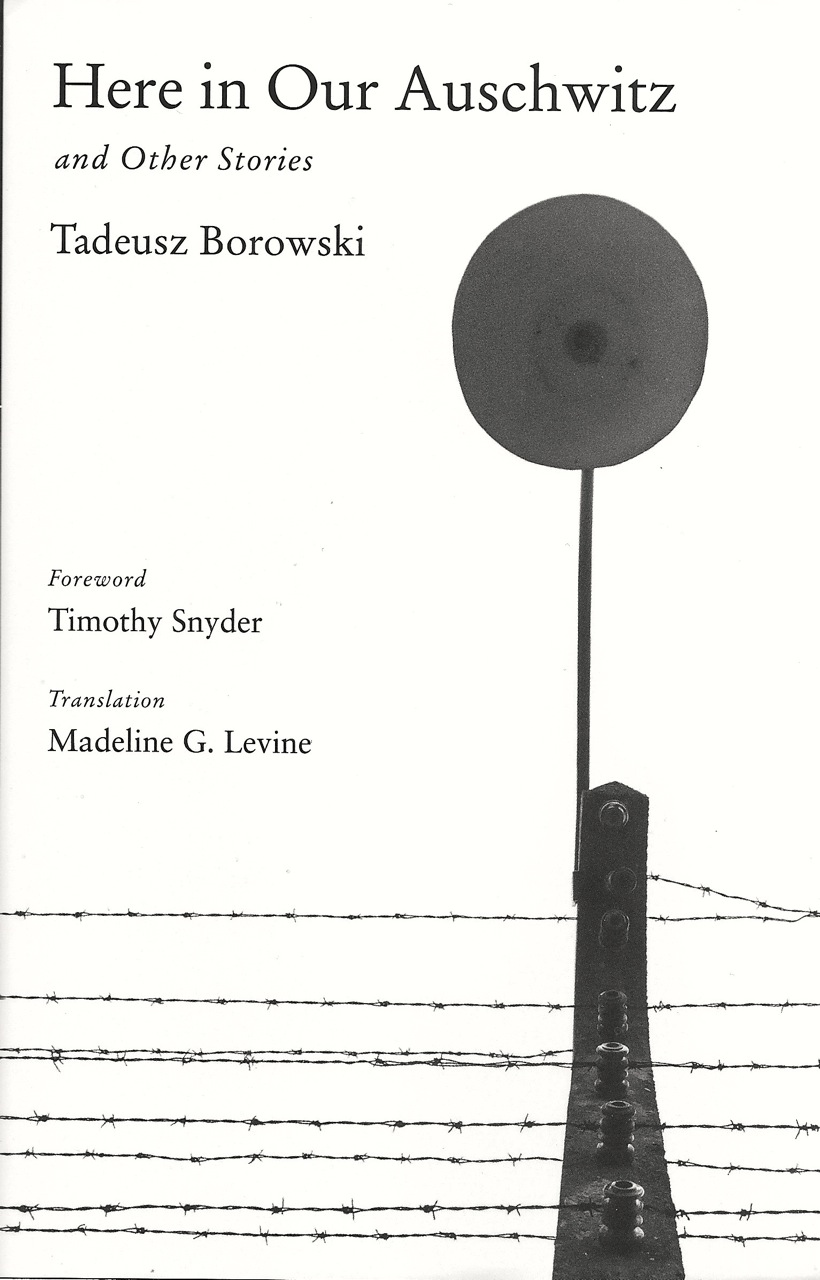
I was brought to these thoughts by reading a new collection of Borowski stories newly translated by Madeline G. Levine, and given a historical context in an extensive Forward written by Timothy Snyder. This new book (‘Here in Our Auschwitz, and Other Stories’) is published by Yale University Press.

Borowski’s tales are the most terrifying on concentration camp life because instead of just recounting the odd incidents of uplifting honor, rebellion and self-sacrifice, or of focusing dramatically on the horrible details of tortures and abuses, so as to elicit condemnation of perpetrators and sympathy for victims, he very casually and sardonically factually describes the typical attitudes and behaviors of the inmates, and the routine incidents of camp life.

Such incidents might include a work detail (a kommando) of prisoners putting on roofing tar over unfinished women’s barracks while other men on break played soccer on the field below, and some men prisoners and some outside masons and carpenters were in those barracks having hidden trysts bought from the women with gifts of smuggled (and stolen) blankets, coffee, cigarettes, eggs or honey, and none of all these people giving much of a look beyond the inner wire confining them, to the railroad stop just beyond with trains unloading thousands of people who were marched down a road from the railroad, and past a hill and forest over which a little while later smoke rose from unseen crematoria and pyres, and then back down that road came troops of sonderkommandos (kommandos manned exclusively by Jews, but the kommando supervisor was always an SS man), with their clothes coated in soot and dripping with fat, hauling carts of clothes and other treasures (the gold jewelry and teeth being the most desirable for stealing by the kommando workers, but also what the SS masters most wanted).

In describing the routines of “normal” camp life in a matter-of-fact, nonchalant, sardonic and even at times blasé way (like de Maupassant, perhaps), Borowski illustrated the depravity of the whole system as being in its entirety an expression of universal human nature when stripped of its veneer of civilization: moral restraints and all the supports — physical, psychological, emotional — to human experience for survival, normally provided by culture, custom and civil society.

Tadeusz Borowski (1922-1951) a Polish poet and participant in Warsaw’s underground resistance to German occupation, was arrested and sent to Auschwitz in 1942. He emerged after the war as a writer of short stories that portray the concentration camp social order and, later, stories about the postwar world he reentered through a Displaced Persons camp near Munich. Borowski’s Auschwitz stories, translated from Polish into many languages, have long been recognized as literary classics.

Madeline G. Levine is Professor Emerita of Slavic Literatures at the University of North Carolina-Chapel Hill.

Timothy Snyder is the Richard C. Levin Professor of History at Yale University.

Sophie Scholl, then and now:

In the summer of 1940, Sophie Scholl, a young German woman living in the throes of Hitler’s insanity, wrote:

“People should not be ambivalent themselves just because everything else is, yet one constantly meets the view that, because we’ve been born into a world of contradictions, we must defer to it. Oddly enough, this thoroughly un-Christian attitude is especially common among self-styled Christians. If it were so, how could one expect fate to make a just cause prevail when so few people unwaveringly sacrifice themselves for a just cause?” — Sophie Scholl.

Sophie Scholl and her brother, Hans, were two of the three principles in the anti-nazi White Rose Movement, and were subsequently executed by guillotines in 1943, at ages 21 and 24, respectively.

When we are young and childless we can be so incandescently idealistic, committed and even self-sacrificing (like Japan’s teenage Kamikaze pilots). But once with family: wife/husband and children, you live with fear for their safety, and you are so much more easily manipulated by that fear. Deep down in our innate psychology this is so because it is DNA programmed behavior for the propagation of the species, and we human are first and foremost primate animals, and our base programming will easily overpower abstract learned ideas about ourselves, that is to say “morals”, stored in our frontal lobes of our cerebral cortexes.

Innate altruism does exist but it is felt for those we “instinctively” feel connected to, and family comes first there, then “monkey troop” or “tribal” members next. “Society” beyond those close networks is a pure abstraction, and abstraction is easily sacrificed when “blood” is threatened and needs defending.

That “we” can feel for unknown others in “society”, as so many people throughout history have done (and many famously so), does show the emotional power that our abstract thinking can accrue, but overall I think it remains weaker — in our species as a whole — against the emotional power of fear for “family” safety.

I see the need for a growth of the emotional power of extra-familiar altruism in our species as a whole, as being essential for ever coming to grips with Climate Change (a global problem inequitably caused) and “ending war”, both of which mean actually achieving world socialism. We can only get there consciously (via John Lennon’s “Imagine” mode) because time is short and Darwinian (DNA) evolution is too slow a process to transform “us” (the human primate species) with an adaptation giving us socially-integrated instincts for the long term survival of our species (and collaterally many others).

We “all” need to wake up and realize to “live for the cause” instead of hoping to be saved by a few selfless heroes “dying for the cause.” Until then most of us fearful family people will compromise with our learned abstract “principles” when threading the needle of life with our families in mind and heart. Mea culpa, mea culpa, mea maxima culpa.

Other Books on the 20th Century

Viktor Frankl (‘Man’s Search for Meaning’) and Primo Levi (’The Periodic Table’, and ’The Drowned and the Saved’) were concentration camp survivors who also wrote great books on their experiences, and thus about the realities of human nature and societal death.

For the chemical scientist, Levi, survival involved the chance workings of “the grey zone,” where individuals in evil positions might behave ambiguously at times, even bordering on sympathetically helpful, to a prisoner’s survival advantage.

For the psychiatrist, Frankl, the key personal force for survival was in having some great goal — a meaning (logos) — beyond oneself, perhaps a love for someone far off, or as in his case a deep desire to write out his psychological theory (logotherapy) and see it published and used to help psychiatric patients (which he did do after the war). But Frankl also noted that regardless, the chances against surviving the camps were over 90%.

Tony Judt’s book, ‘Postwar: a History of Europe Since 1945’ is the definitive history text with which to understand how that exhausted postwar Europe of 1945 evolved over the next 60 years: through the enormous and high fatality refugee flows of the late 1940s, the emergence of Democratic Socialism in Western Europe, the descent of the Iron Curtain confining Eastern Europe within the control of Stalin’s Soviet Union, the Cold War and American “superpower” internationalism, the East German Uprising of 1952 (suppressed), the Hungarian Revolution of 1956 (suppressed), the Prague Spring of 1968 (suppressed), the Fall of the Berlin Wall and the revolutions of 1989 and the fall of Soviet Communism by 1991, and the reunification of Germany and the subsequent realignments of the former East Bloc nations.

Tony Judt’s book, ‘Reappraisals, Reflections on the Forgotten Twentieth Century’, is another classic on 20th century history. It is a series of essays on people and ideas of significance, in terms of society and of survival through 20th century fascism and Soviet-supervised communism. Among the people (intellectuals) discussed are: Arthur Koestler, Primo Levi, Manès Sperber, Hannah Arendt, Albert Camus, Eric Hobsbawm, Leszek Kołakowski, and Edward Said. The individual essays on these people are only eight of the twenty-four chapters in the book.

Tony Judt (1948-2010) was the Erich Maria Remarque Professor in European Studies at New York University and director of NYU’s Erich Maria Remarque Institute. In September 2008, Judt was diagnosed with amyotrophic lateral sclerosis (ALS), also known as Lou Gehrig’s Disease. From October 2009, he was paralyzed from the neck down. With Timothy Snyder as both interviewer and transcriber, Tony Judt completed three more books before he died.

Among Judt’s many other books, which I have read, are: ‘The Burden of Responsibility: Blum, Camus, Aron, and the French Twentieth Century’ (1998), ‘Ill Fares the Land’ (2010), and ‘Thinking the Twentieth Century’ (2012, with co-author Timothy Snyder). All are excellent.

Acknowledgments: Thanks to Alexander Pademelon Johnson and Jerry Steele for pointers.

<><><><><><><>

Freedom versus Slave Mind

Mejor morir a pie que vivir en rodillas

<><><><><><><><><><><><><><><><><><><><><><><><><><><><><><><><>

Freedom versus Slave Mind

White Supremacy will end with human extinction. The angry rage of conservatives and fundamentalists, in the face of godless skepticism, is really an anguished cry of: “don’t make us question our bigotry!” For working class people who can’t think better, White Supremacy is a psychological compensation for an inferiority complex. That complex is learned from infected parents, and indoctrinated into one by a capitalist class society intent to exploit and enslave people by controlling their minds with a programming for obedience to higher authority, a sense of inadequacy and neediness, and with race- and ethnicity-based prejudice, to cause disunity among the great mass of the working class. Working class white supremacists are simply abused children passing on their abuse to younger generations and lower seniority workers and employees: ignorant slaves seeking to compensate for their hidden lack of self-respect by trying to depreciate and enslave others “below them”. The capitalist upper class propagates this mass psychology illness of low self-esteem, neediness and bigotry, because it is the method by which the union of the rich few control the disunion of the poor many. “Divide and conquer” was how the Roman Empire was ruled, and so with America today. Ending White Supremacy before human extinction occurs would require a Marxist Revolution to full Communism. A first step to that political goal is Labor Union organizing so the Labor Union Movement expands to the point of controlling the national economy. Then a Social Revolution can occur, which ends all interpersonal prejudices. Such a political-social progression is the only way militarism-imperialism can be overcome, and Climate Change finally seriously confronted. Such a Paradigm Shift is deemed “impossible” by capitalist indoctrination in the Slave Mind. And it may be unlikely in your lifetime, but that does not prevent you from working toward that Paradigm Shift — The Revolution — beginning with your own transformation out of Slave Mind, and then with the activism and organizing you may choose to do. The Revolution is not merely a desired socio-political event at some time in the future during the course of human history, it is a living process carried within the individual lives of people who have freed themselves from Slave Mind, and by their living examples push back against the oppressors’s imposition of Slave Mind and its White Supremacy illness, even onto the last day of human existence if that is to be our collective fate. Be joyful in your freedom.

<><><><><><><>

José Mujica, Leadership by Example

What kind of World Leader do we need today? Prominent examples offered by a variety of nations include: Joe Biden (U.S. president, 2021-), Angela Merkel (chancellor of Germany, 2005-present), Emmanuel Macron (French president since 2017), Fumio Kishida (Prime Minister of Japan, 2021-), Boris Johnson (UK Prime Minister since 2019), Xi Jingping (President of the People’s Republic of China since 2013), Vladimir Putin (Russian president from 1999-2008 and 2012-present), and Bahsar al-Assad (Syrian president since 2000 and until human extinction).

Each of these leaders personifies a particular kind of socio-political regime, which variously you might be favorably disposed to or disapprove of depending on your own political and moral values. To my tastes, the absolute best national and world leader we could possibly have would be José Alberto “Pepe” Mujica Cordano, who was president of Uruguay during 2010 to 2015, or an individual just like him.

I was brought to this thought by recently seeing a number of movies and documentaries about Mujica, and the Tupamaros urban guerrilla group in which he got his start.

Tupamaros (https://en.wikipedia.org/wiki/Tupamaros), also known as the MLN-T (Movimiento de Liberación Nacional – Tupamaros, or Tupamaros – National Liberation Movement), was a left-wing urban guerrilla group in Uruguay in the 1960s and early 1970s. The Tupamaros started as a youthful group of students and professionals, and attracted trade union members and people of poor socio-economic status from rural areas. They formed in the 1960s during a time of instability in Uruguay caused by low food prices in Europe and Asia decreasing the value of exports from Uruguay and resulting in lower wages for unionized workers, fewer social services, and increased national tension accompanied by a diminishment of constitutional guarantees by an increasingly authoritarian government. In their low-level insurgency against the Uruguayan government, the Tupamaros killed 50 soldiers, policemen and also civilians. 300 Tupamaros died either in action or in prisons (mostly in 1972), and about 3,000 Tupamaros were also imprisoned.

In their early years, the Tupamaros avoided political violence, but increasingly violent pressure by the government’s military forces pushed them into low intensity guerrilla warfare in 1970, which continued until they were forcefully neutralized in 1972 by the Uruguayan army. ‘State of Siege’ (Etat de Siege) (https://youtu.be/rjv36b99JXk) is a 1972 film by Costa-Gavras about the 1970 kidnap-capture by the Tupamaros of Dan Mitrione, the American torture instructor to the militarized police forces of Uruguay. The Tupamaros’s aim in kidnapping Mitrione was to ransom him in exchange for imprisoned Tupamaros. Such a prisoner exchange was denied by Uruguay and the U.S. (during the Nixon-Kissinger regime), and Mitrione was later executed. [1]

The 2018 film ‘A Twelve Year Night’ (La Noche de 12 Años) (https://youtu.be/y97o1phiyRY) is about the capture, along with with murders, of Tupamaros urban socialist-communist guerrillas in 1972, with subsequent tortures and long brutal imprisonment in solitary confinement of nine specially selected and still surviving Tupamaros leaders, from 1973 to 1985. The last vestiges of Uruguayan democracy were removed in 1973 when the right-wing authoritarian government became a pure dictatorship. For more about this excellent movie, see [2].

What struck me as I watched ‘A Twelve Year Night’ was that it was more than just a searing Uruguayan story of personal struggles for survival by prisoners of conscience (between 1972 and 1985) within the larger context of the national struggle for political liberation and social transformation in Uruguay between 1967 and 1985, but by analogy it is also the more general story of the struggles for personal survival by prisoners of conscience worldwide, and of the many heartbreaking struggles of oppressed national-identity populations to gain their political liberation and decent and secure socio-economic lives. I also thought that if ever accurate movies were made about the US prisons at Abu Ghraib, Iraq, and at Guantanamo, Cuba, they would look much like ‘A Twelve Year Night’.

‘A Twelve-Year Night’ focussed on three of the nine ’special’ Tupamaros held and abused by the Uruguayan military for 13 years, with José Mujica being one of them. Mujica is an amazing individual. After his release from prison in 1985 and with the restoration of Uruguayan democracy and a new amnesty law, Mujica went on to reenter politics in 1989, become an deputy in the general elections of 1994, a senator in the elections of 1999, appointed Minister of Livestock, Agriculture and Fisheries in 2005, and was elected the 40th president of Uruguay in 2009, occupying that office from 2010 until 2015.

In his first speech as president-elect before a crowd of supporters, Mujica acknowledged his political adversaries and called for unity, stating that there would be no winners nor losers (“Ni vencidos, ni vencedores”). He added that “it is a mistake to think that power comes from above, when it comes from within the hearts of the masses… it has taken me a lifetime to learn this”. (https://en.wikipedia.org/wiki/Jos%C3%A9_Mujica)

During Mujica’s term as president: state-controlled sales of marijuana were legalized in order to fight drug-related crimes and address related health issues; laws were passed for same-sex marriage and legalized abortion; in a speech to the UN General Assembly in 2013, he “called on the international community to strengthen efforts to preserve the planet for future generations and highlighted the power of the financial systems and the impact of economic fallout on ordinary people. He urged a return to simplicity, with lives founded on human relationships, love, friendship, adventure, solidarity and family, instead of lives shackled to the economy and the markets.”

Between 2004 and 2014: the share of public expenditures in Uruguay for social needs rose from 60.9% to 75.5%, the national poverty rate was reduced from 18% to 9.7%, the minimum wage was raised from UYU$4,800 to UYU$10,000, and Uruguay became the most advanced country in the Americas in terms of respect for “fundamental labor rights, in particular freedom of association, the right to collective bargaining and the right to strike.” According to BBC correspondent Wyre Davies, “Mujica left office with a relatively healthy economy and with social stability those bigger neighbors could only dream of.”

As president, Mujica chose not to live in the presidential palace (as a waste of money) but on his wife’s farm outside Montevideo, and the presidential limousine during his term was his own blue 1987 Volkswagen Beetle, which he drives himself. That VW was valued at $1,800 in 2010 and was listed as the entirety of his personal wealth in the mandatory annual personal wealth declaration he filed that year. Because of his great popularity and admiration for him, in 2014 he was offered $1M for that car. He said that if he did get that $1M in exchange for his car that the money would be donated to house the homeless through a program that he supports. Mujica donated around 90% of his $12,000 monthly salary to charities that benefit poor people and small entrepreneurs. Mujica and his wife (since 2005, longtime partner Lucía Topolansky, a fellow former Tupamaros member, senator and former vice-president) have no children, live simply (with a three-legged dog), and continue making significant charitable donations to this day.

‘El Pepe, Una Vida Suprema’ is a wonderful documentary about and with Mujica, made in 2018 by Emir Kusturica (https://youtu.be/BsKVKgKuzHY). One of the most delightful scenes in this documentary is of Mujica driving himself from his farm to the transfer-of-presidential-power ceremony in Montevideo in 2015, with the entire route lined by cheering people, and the ceremony itself taking place before a massive throng of jubilant people celebrating him, and with a huge parade float in the shape of his blue VW on display. One point of access to this documentary is given at [3].

One of the most endearing portrayals of Mujica is that which he gives himself by speaking directly to the viewer, in a 10 minute excerpt from documentary ‘Human’ made by Yann Arthus-Bertrand in 2015 (https://youtu.be/4GX6a2WEA1Q). Of all the web-linked videos I have given in this article, at a minimum see this one. It should make it obvious why I would wish Mujica and people like him to be our political leaders.

NOTES

[1] ’State of Siege’ (trailer, en Français)

[2] ‘A Twelve Year Night’ (more about this movie)

https://en.wikipedia.org/wiki/A_Twelve-Year_Night

https://www.imdb.com/title/tt6792282/

https://www.netflix.com/title/80185375

[3] El Pepe, A Supreme Life (documentary)

https://www.netflix.com/title/81094074

<><><><><><><>

The Nature of Sadness

“All jealousy is lack of love.”
All envy is lack of self-worth.

“Everyone has damage,” she said. And from all I have seen these many years, I know that is true. It is the source of our self-absorption, and the cause of our judging.

Deep down, I think that all my politics and all my moralizing come out of one simple idea — really a feeling — that: no person should ever have to live with desperation.

I think that all my socialism and all my schemes of social engineering come out of an intuitive response to that realization, simply that: human civilization should be a network of person-to-person interactions of appreciation and mutual help, with everything else being incidental.

Each of us should have our quiet, comfortable refuges of solitude, without ever being shunned into lonely abandonment.

Our civilization is very incomplete and wounded. It remains an idea orphaned by neglect. And that is the nature of sadness in our world.

<><><><><><><>