MGjr Climate 2012-2013

<><><><><><><><><><><><><><><><><><><><><><><><><><><><><><><><>

MGjr Climate 2012-2013

Just because it is all hopeless
does not mean that you give up.
You go on —
to save your honor —
so to keep your self-respect.

Everything that I believe about humans facing Climate Change is stated here.

Earth’s climate was sacrificed in the 40 years from 1973 to 2013,
thereafter was the Kali Yuga.

Honor:
“By protecting others, you save yourself.”

<><><><><><><>

The Righteous And The Heathens Of Climate And Capitalism
[Swans.com – March 12, 2012] 

Can humanity unite to stop Climate Change?

No, and it is too late. The time to have changed industrialization to halt global warming was 1973 in response to the first Arab oil embargo, but that opportunity was spurned. (1)

There is a thirty-year lag between the emission of carbon dioxide into the atmosphere and its effect on climate dynamics. Today’s climate is being affected by 1980s emissions. Today’s emissions will alter the climate of the decade of the 2040s. The climate system is a myriad of interwoven processes described by nonlinear differential equations; so, the evolution of climate could have a sudden shift from its current global pattern of stability to another as yet unknown and possibly quite undesirable pattern of stability, when the concentration of atmospheric carbon dioxide rises above an as yet unknown triggering threshold. (2)

Humanity will not alter course. You can bank on every graspable barrel of oil, and every accessible cubic meter of natural gas being burned. There will always be someone somewhere who will not want to miss out on the advantages of possessing and using fossil fuel immediately to increase their power and wealth (in all the forms in which those two temporal quantities can be accumulated). The impossibility of global cooperation to arrest the anthropogenic emission of heat-trapping gases and vapors is the psychology described by the Prisoner’s Dilemma. (3)

We do not have a Climate Change problem, nor even an unregulated capitalism problem. We have a human development problem. Humanity is insufficiently developed to conduct itself equitably and in harmony with nature. Species come and go, and humanity’s prospects of long-term survival are as uncertain as its likelihood of developing the advanced social behavior needed to adapt to an emerging new climate. Nature will continue.

Just as the dinosaurs of the Cretaceous were insufficiently developed to anticipate the arrival of extraterrestrial rocks, and to devise rocket-borne interceptors to destroy the 10-km-wide bolide that would fall to earth creating the Chicxulub Crater and an environmental catastrophe lasting years, which caused their extinction 65 million years ago, (4) so humanity today is psychologically underdeveloped to anticipate the emergence of a new equilibrium state of earth’s climate, which will result from shifts of atmospheric and ocean currents, the quantity and distribution of ice, the degree of humidity, and the abundance of liquid water. This climate shift will be (is being) caused by the accommodation of excess heat trapped in vaporous organic compounds and molecular gases released into the atmosphere primarily during the 20th century as waste products of industrialization and as a consequence of natural outgassing from warming oceans, tundras, and land masses. (5)

Our problem is one of revising an entire system — industrialization — by which modern human society exploits exosomatic energy. Industrialization may seem as complex and convoluted a system in the realm of human affairs as the earth’s climate is in the natural realm (to which humanity also belongs, though it usually forgets this). It is the sophistication and extent of our exploitation of exosomatic energy (i.e., energy from outside the human body), rather than our use of tools, that distinguishes humankind from the other forms of life on earth.

We know humanity has a direct impact on climate — industrialization heats the biosphere — but our quantitative knowledge of the sensitivity of climate dynamics to anthropogenic inputs is never exact, though it is extensive, highly detailed, of increasing precision, and compellingly persuasive. It is beyond a reasonable doubt. (6)

New knowledge always confronts psychological resistance to altering human inertia: we resist thinking and behaving differently, especially religiously, politically, and economically.

People are accustomed to assuming that climate and weather are constants, that environmental conditions have long-term stability with known regional variations, known seasonal cycles, and which occur within known short-term fluctuations. Our economic activity is based on a traditional and limited set of expectations about local weather and climate, in the same way as we walk with unthinking assuredness on ground we always expect to solidly support us. We do not wish to change our industrialized economic behaviors to “pay more,” or even “pay for” the consequences of our many forms of self absorption called “business,” until forced by external conditions that no longer support our preferred assumptions.

There is a certain moralistic resentment here. Those who are willing to sacrifice “pleasure” today in order to contribute to the “good of society” resent those who remain profligate and “liberal.”

Climate moralists resent the selfish capitalists, the Republican climate-change deniers and the modern “drill baby, drill!” neoliberals. These latter in turn hate the climate evangelists for trying to force their climate religion down neoliberal throats, and for calling to cut off capitalism’s rapturous resource exploitation orgies.

The resentment of climate missionaries by heathen capitalists is mirrored by the resentment of religious fundamentalists and political reactionaries, who seek to forcibly evangelize the atheist and “liberal” masses to “conservative” psychological repressions and monetary obsessions, instead of having their orgies of free sex, free thought, free drugs, free abortions, and socialist politics. Like an American Taliban, these atavistic fundamentalists resent missing out on all the good fun the unrepressed leftist sinners are having; they can only find satisfaction by shutting down the good times for everybody.

I believe a transition to a post-coal and post-nuclear future could be a very exiting and rewarding national effort, one that would offer many young engineers (as I can remember being) fulfilling lifetime careers, and energize the unfolding of a new Renaissance. (7)

However, for minds mired in reactionary and regressive attitudes, either because of religion, or an attachment to money, or xenophobic fear born of willful ignorance, the entire discussion triggers instant panic, as in an earthquake with the ground giving way beneath them. So, I am pessimistic humanity will anticipate climate change, though I expect it will try to adapt after the fact.

Science has given us enough information to “verify” the anthropogenic climate effect; yes, we can always add more data and make our simulations more precise, but we already have more than enough information. Our globalized problem now is simply to arrive at a decision: either act to modify our climate karma, or consciously accept becoming the victims of nature’s future circumstances. At the typical level of current public discussion about climate change politics, the question “what are we going to do about it?” boils down to “who is going to pay for what has to happen, and how do I get out of it, or make money from it?”

All of the “controversy” today about climate change is just the verbalization of the psychological resistance of human inertia: “I don’t want my world to change,” “I don’t want to miss out,” “I don’t want to pay,” and “I don’t want to stop what I like doing.” All these are expressed in class- and group-specific ways, disguised in terms of economic harm and scientific doubt.

And so, like a dinosaur chewing its cud on a lazy humid summer day on the savannas by the Tethys Sea, we may sense a momentary chill as the shadow of a doubt about a dark future lurking unseen among the clouds crosses over us like a bolide streaking across the face of the sun, but that apprehension instantly evaporates as the warmth of our sunny expectations returns to flood our consciousness once again. What we can’t imagine can only erupt as surprise.

The best way to face an uncertain future is joyously, wide-eyed with enthusiasm, like seven samurai united for battle: “This is the nature of war. By protecting others, you save yourself.”

The real challenge for us, humanity, is learning how to consciously evolve.

Notes

1.  “1973 Oil Crisis,”
http://en.wikipedia.org/wiki/1973_oil_crisis

2.  “Carbon Dioxide In Earth’s Atmosphere,”
http://en.wikipedia.org/wiki/Carbon_dioxide_in_Earth’s_atmosphere

3.  M. García, Jr., “Bayesian Bargains: Jail, Shopping, Debt, And Voting,” 30 January 2012,
http://swans.com/library/art18/mgarci39.html

4.  “Chicxulub Crater,”
http://en.wikipedia.org/wiki/Chicxulub_crater

5.  “Huge Methane Leak In Arctic Ocean: Study,” 4 March 2010, Agence France Presse,
http://www.google.com/hostednews/afp/article/ALeqM5g6NkTJSt40nZs4lXD-gLdCZdSndQ

6.  M. García, Jr., “Climate and Carbon, Consensus and Contention,” 4 June 2007,
http://www.dissidentvoice.org/2007/06/climate-and-carbon-consensus-and-contention

7.  M. García, Jr., “The Economic Function Of Energy,” 27 February 2012,
http://swans.com/library/art18/mgarci41.html

The Righteous And The Heathens Of Climate And Capitalism
12 March 2012
http://www.swans.com/library/art18/mgarci43.html

<><><><><><><>

Changing Climate For Unchanging People
[Swans.com – January 28, 2013]

Climate Change is the entropy of industrialized civilization. It is Nature’s fever from its infection by viral capitalism.

In early January 2013, the National Climatic Data Center in the National Oceanic and Atmospheric Administration (NOAA) announced that 2012 was the hottest year ever recorded in the contiguous United States, with a mean temperature of 12.9º C (55.3º F). The average for the 20th century was 11.2º C (52.1º F), and the scatter of the yearly data points about that century average lies within the band defined by 10º C (50º F) and 12.2º C (54º F).

The globally averaged temperature during 2012 was described as follows in the National Climatic Data Center’s “State of the Climate” announcement:

“The globally-averaged temperature for 2012 marked the 10th warmest year since record keeping began in 1880. It also marked the 36th consecutive year with a global temperature above the 20th century average. The last below-average annual temperature was 1976. Including 2012, all 12 years to date in the 21st century (2001-2012) rank among the 14 warmest in the 133-year period of record. Only one year during the 20th century — 1998 — was warmer than 2012.”

NOAA also estimated that there were eleven extreme weather and climate events in the U.S. during 2012 that caused losses of more than one billion dollars each. Extreme weather events included the drought extending over 61% of the nation (the Great Plains and Hawaii), the heat waves in the Northeast, the extensive wildfires in the Southwest, and the storms along the Gulf and East Coasts: Hurricane Isaac and Post-Tropical Cyclone Sandy.

At the same time as NOAA was issuing its “State of the Climate” announcement, a bushfire catastrophe was declared by the Australian government. In December 2012 and early January 2013, during an austral summer with unprecedented high temperatures, fires raged across so much of the states of New South Wales (in which the cities of Sydney and Canberra are situated) and the island state of Tasmania that the smoke plumes massed into a blanket obscuring daylight at ground level, and the view of the landmass beneath it to astronauts orbiting above.

Also appearing in early January 2013 was a massive draft report on climate change in the United States, by the National Climate Assessment and Development Advisory Committee (NCADAC) of the US Global Change Research Program. After a three-month period of public review and comment (ending April 12, 2013), and review by the National Academies of Sciences, NCADAC will revise its draft report and submit it to the Federal Government for approval as the Third National Climate Assessment Report. The previous NCA Reports were issued in 2000 and 2009.

The draft NCADAC report is detailed and unequivocal about the many specific manifestations of ongoing climate change occurring within the territory of the United States. The purpose of the NCA Report “is to establish a scientific and credible foundation of information that is useful for a variety of science and policy applications related to managing risk and maximizing opportunities in a changing climate.”

The atmosphere today holds more moisture because it is warmer than in previous centuries. That enhanced fluid mass can be cycled with greater intensity because of the added heat energy, as storms and floods, or withheld with more enduring pitilessness as drought. As global warming continues, we can expect a higher frequency of droughts, heat waves, wildfires, downpours, and tropical storms like those of 2012, and of greater intensity.

Despite the stark assessment of ongoing climate change in the new US Government reports, a multitude of fresh memories of extreme weather events and associated personal tragedies in 2012, and the greater publicity about climate change in mass media today, the issue of implementing a broad and immediate national response to climate change, and then an international response, neither dominates the attention of the American public nor perceptibly impacts the formation and conduct of national policy. Why is that?

Many concerned with the ominous potentialities of climate change believe that the corporate stranglehold on mass media throttles the flow of information to the public about the links between climate change and political economy, as part of a management of the public mind by a national elite so as to preserve popular attitudes of consumption that continue to support, acquiesce to, or be fooled by profitable schemes of finance, commercialism and resource exploitation. To some of the people deeply concerned about climate change, it may seem as if censorship is being practiced out of elite fears of awakening the public and then overturning the economic order.

It is not a matter of censorship, but of mental inertia. For most people, behavior is habitual, ingrained by training through indoctrination (TV, advertising, peer pressure; thought molded by an external agency), and thinking is fashioned after the fact to align with behavior (“I’m cool because I own this desirable stuff,” or “I have substance and status because I am recognized by this class of better people”).

Changes to behavior are fiercely resisted by any person who takes the pattern and style of their learned and imprinted behaviors to define them, to be their self-image. To “force” someone to change their behavior is to force them to re-think who they are, and that is nearly always experienced as a demotion, a degradation: psychological death.

Confronting people with your anxiety about Climate Change as an emergency they must respond to immediately and irrevocably can be received as a demand that they commit psychological suicide: Climate Change means that all your implicit assumptions about the world on which you base your life and self-image are wrong, you must kill your present psychological self (your idea of who you are and how you should live) and accept a new one that fits in with the new climate-change-altered reality coming into being.

One segment of the population will flat out deny the existence of the threat to its psychological continuity, and this is simple climate change denial.

The more liberal resistant people will accept the logic describing Climate Change as a physical reality, but see it as external to their lives. They will block the Climate Change imperative to live differently, to exist differently, by moving the issue of Climate Change far away from their immediate spheres of thought and action, and onto remote domains controlled by forces and institutions they hope will save them. So, they will look to cap-and-trade economic schemes, geo-engineering schemes, anticipated “new” and “hybrid” and “carbon-free” technologies, so they can continue with existing behaviors despite the changing externality of climate, and continue to believe they will be shielded from Climate Change harm. This is why so many affluent people drive the Toyota Prius automobile, with a hybrid electric-combustion propulsion system. The sought-for mental oasis is: “It will cocoon me from the external threat to my inflexible behavior.”

To be clear-eyed about Climate Change requires accepting three facts:

[1] Human-caused Climate Change is real, accelerating rapidly, and inevitable; human restraint on greenhouse gas emissions can only make it “less bad” in the future.

[2] People who are fully prepared to alter their ambitions and their conceptions of how to live, to both adapt to ongoing Climate Change and to mitigate its future development, will be in the minority.

[3] The climate-change-accepting minority will be condemned to live in a world, and in most nations, in which the change-resistant majority will determine the economic, industrial, energy-use and environmental exploitation practices.

The idea that we can globalize a climate-change-accepting mentality into species-wide group-think, and species-wide equitable group response, is illusory. What is real is that indeed psychological globalization has occurred, in that sense our world is smaller, or perhaps more accurately, “condensed,” but the controlling character of humanity’s globalized mind is the simple and primitive brain-fever of self-centeredness, the clutching of acquisitiveness and for control.

Climate will change; people won’t.

Changing Climate For Unchanging People
28 January 2013
http://www.swans.com/library/art19/mgarci61.html

<><><><><><><>
A Review of ‘DON’T LOOK UP’

<><><><><><><><><><><><><><><><><><><><><><><><><><><><><><><><>

A Review of ‘DON’T LOOK UP’

‘DON’T LOOK UP’ is a 2021 deadpan movie satire on human stupidity in ignoring Climate Change by the popular obsession with social media and “fake news,” and by the extreme narcissism of government leaders and their billionaire patrons. This movie is in the same spirit as Stanley Kubrick’s ‘Dr. Strangelove, or How I Learned to Stop Worrying and Love the Bomb’ was about human stupidity regarding nuclear war.

However, since the full arc of the Climate Change story is several decades long, for dramatic punch DON’T LOOK UP has compressed that timeline down to six months — from first detection to final impact — by being an allegorical satire where the real problem of Climate Change has been substituted for in the movie’s story by a planet-killing comet larger than the Chicxulub bolide of 66Mya heading straight toward Earth.

Mass media, Trump-style American government, Gates-Zuckerberg tech fantasy grandiosity and Bezos-Musk-Branson billionaire space privatization fantasy (the last two types of fantasts being wrapped up in one character), are all deliciously eviscerated in this movie.

The serious message at the heart of this movie is quite simple: pay attention to reality. That was also the same message in ‘On The Beach’ (1959) and ‘Dr. Strangelove…’ (1964). The cast is made up of A-list players, with Leonardo DiCaprio and Jennifer Lawrence playing the scientists who discover “the problem” and try to alert the public, and the government to take action. But, the tech billionaire and the bought politicians see a potential profit-making opportunity instead. The character of Milo Minderbinder embodied the same idea of greed blinding the perception of reality in the struggle for and precariousness of survival, in the novel ‘Catch-22’ (1962) and its great film version (1970). The satire in DON’T LOOK UP is exquisite right up past the credits (hint, hint). Enjoy it.

There are so many inside and throwaway jokes in DON’T LOOK UP (many about Trump and trumpians) that I even thought of seeing it again for a 3rd time, in stop motion, to be able to catch them all and write them all down (at least the one’s I can recognize) for cataloguing in a subsequent encyclopedic “like and subscribe” article of my own, as a do-it-yourself-without-tuition-payments master’s thesis in film studies. But I decided to leave that huge task to the future alien archeologists who will land on Earth to sift through the ruins of our so-called civilization, and decipher our remaining media recordings like today’s Mayanologists have deciphered the glyphs inscribed at Tikal, Uxmal, Chichen Itza and many other Central American archeological sites.

So then, here is just one example. Leonardo DiCaprio’s character — the astronomy professor whose student played by Jennifer Lawrence has discovered the comet — is called “Randall Mindy”. In 2004 during the G. W. Bush Administration there was a big scandal because while Bush and his people (Republicans) and their allied media were all saying that Global Warming Climate Change did not exist, the Pentagon had commissioned a secret study of its worst possibilities — which potential consequences turned out to be something approaching the story used in the 2004 movie “The Day After Tomorrow”: the Gulf Stream Atlantic Current could shut down because of the Greenland icecap melting and flooding into the North Atlantic, diluting the salinity of the cold North Atlantic waters thus preventing the conveyance of Caribbean heat to Western Europe, which in turn could result in an Ice Age type of rebound globally (I’ve described the physics of all this elsewhere: trust me, I’m a scientist).

The Pentagon had commissioned this report in 2004 because they wanted to plan ahead “for the worst”, which is always what they use to get them the most money from Congress (also, there is another sly joke in the movie about a money shystering Pentagon general). Word of that secret Pentagon report leaked out quickly in 2004 and there was a public furor, so the Pentagon declassified it and made it public (you can find it online somewhere). That report was call the “Schwartz-Randall Report”, after the surnames of the author-researchers contracted to produce it. RANDALL = warning the world despite official efforts of being muffled.

Maybe “Randall” is just a coincidence, but I’m inclined to think that the writers of the movie’s story and screenplay, David Sirota and Adam McKay, are much more crafty than just simply haphazardly lucky.

For me another chuckle is the whole idea of framing the social phenomenon of Climate Change denial as if we are all like the dinosaurs 66Mya not looking up at their extinction triggering comet/meteor streaking in, to plunge into the Yucatan then and into the Pacific in the movie.

I wrote that exact idea (climate change = our extinction meteor, ignored) explicitly in an article in 2012, and implicitly in 2013 (they were published at Swans.com). So I figure Sirota, McKay and Leonardo all owe me BIG — but I won’t get paid because that’s not how success works among humankind. And — I admit — it’s even possible that somebody else might have had the same idea before me. But remember, when you do know of a prior statement of “your” idea, that never giving credit for it and successfully disguised plagiarism of it are the essence of career advancement in “the intelligentsia” of our advanced society. (I may be using a little bit of irony here.)

So for sure I love the movie, everyone in it did an absolutely superb job, and I can see every actor got a kick playing their characters, and played them to the hilt. I particularly like the Jennifer Lawrence character, not because of the young cutie pie factor the movie marketeers undoubtedly wanted her to bring into the picture, but because she spits flaming bullets at all the usual culprits, shredding those assholes, and she does right by her portrayal of Millennials, who are always being dumped on with betrayals by media depictions of them, and by the “old fuck” financial string-pullers vampiring off them.

My wife says I am like the “Randall Mindy” astronomy science guy (I do have an expired science Ph.D., from Princeton no less, and a Millennial kid), but I’m not such a nebbish, I don’t need mood pills, and there’s no way some Cate Blanchett type (the old people’s cutie pie for this movie) is going to gush on me, as shown humorously in the movie with Leonardo and Cate (I most definitely am not gush-worthy).

So all in all, a great great movie (because I agree with it), worthy of a Stanley Kubrick had he’d been alive to make it (call this one Dr. Strangelove II), a credit to all the multimillionaires and Oscarites who acted out the parts with verve in front of the cameras, and will get to crow about it in their charity foundation websites or hit songs, later — not a tax writeoff I can get, but oh well — and there is even a self-parody joke about this movie within this movie! DON’T LOOK UP is especially a credit to the story and screen writers, however-much they stole ideas from others or thought them up all on their very own (as if we all really lived in an intellectual vacuum).

So, great film, and great that we’ve at least gotten this far in really doing something “actual” on climate change. The sky’s the limit and we’ve now finally almost gotten to liftoff. The alien archeologists will really love this show.

DON’T LOOK UP (trailers)
https://www.netflix.com/title/81252357

<><><><><><><>

Anthropocene Joyride

National Research Council, 2011: ‘Understanding Earth’s Deep Past: Lessons for Our Climate Future.’

<><><><><><><><><><><><><><><><><><><><><><><><><><><><><><><><>

Anthropocene Joyride

The Anthropocene geological epoch began when human activity first had a GLOBAL impact on the planet’s environments. That was in late 1965, when the first evidence of a human-caused effect was detected EVERYWHERE, indicating a simultaneous global impact by human activity.

That evidence was the signature of radioactivity (Carbon-14) from nuclear bomb test fallout incorporated into tree rings for the year 1965 (within October to December) at all latitudes and longitudes. Atmospheric nuclear bomb explosions were set off from 1945 to, primarily, 1963. The peak of such activity was an orgy of bomb tests by the U.S. and USSR in 1962. [1]

Prior to 1965 many species had had geographically limited impact on altering environments, like pre-columbian humans in North America making pastures out of forests in Appalachian valleys, herd animals making permanent migration trails, and grazing animals nibbling bush down to grasslands.

But all previous geological epochs were set by planetary geophysics, such as with the coalescing of continents into the supercontinent Pangaea (335Mya) and then its breakup (from 175Mya), and the comings and goings of the Ice Ages, the last one starting 2.58Mya, and ending 11,700 years ago.

While we now know that human activity can have a simultaneous global impact for setting off a planetary geophysical process — global warming climate change with biodiversity losses — we do not yet know if human activity can set off a different planetary geophysical process to counter global warming climate change and biodiversity losses.

It is obvious that the only credible global climate stabilizing process available is the socio-economic revolution of abandoning nationalistic fossil-fueled capitalism, and replacing it with an international democratic socialism whose industrial and technological elements are powered by renewable energy, which does not emit greenhouse gases. [2]

Such a necessary transformation of organized human society is most definitely a challenge to the political processes of Earth’s 193-odd nations, and to the ambitions and prejudices of their political classes, their wealth elites, and their general populations. The practical problem facing climate stabilization activists is to overcome these political difficulties as soon as possible. Admittedly, this is a monumental task, and some fear it impossible. Even so, defeatism here is ignominious while engagement in this cause will at a minimum salvage personal honor, and most optimistically secure humanity’s long-term future.

So for now it is best to think of humans as in the driver’s seat of the Anthropocene Earth Car with the foot mashed down on the gas pedal connected to a powerful fuel-injected engine, but with the brake lines cut. Time of impact is unknown, but terminal speed will be high.

Notes

[1] The Anthropocene’s Birthday
https://manuelgarciajr.com/2018/02/23/the-anthropocenes-birthday/

[2] The Improbability of CO2 Removal from the Atmosphere
https://manuelgarciajr.com/2020/08/09/the-improbability-of-co2-removal-from-the-atmosphere/

<><><><><><><>

Acclimation and Heat Stress of Plants, and Future Crop Failures

A field of sweet corn, Flat Rock, Indiana. Photo: Jeffrey St. Clair.

One of the most popular ideas that springs into people’s minds when mulling over remedies for slowing the advance of climate change because of the ever increasing accumulation of carbon dioxide in the atmosphere, is to plant more trees, bushes and grasses. Let a greater quantity of plant photosynthesis filter our atmosphere of excess CO2.

This is not an entirely bad idea — especially in its more nuanced formulation as multi-crop regenerative agriculture coupled with wildland, wetland and forest conservation and reforestation, ending industrialized chemical pesticide monoculture farming and drastically reducing the entire meat industry, along with a popular shift to plant-based diets — though it is an entirely inadequate tactic for absorbing the ever increasing load of CO2 in the atmosphere being fed by gargantuan torrents of anthropogenic CO2 emissions exhausted as waste products from the fossil fueled engines powering today’s capitalism and militarism, which remain requirements by our capitalists and militarists for the continuation of our present civilizational paradigm.

So, planting trees is being done and will continue because it is something that many people can do to try to help, and because it poses no real threats to capitalism or militarism. But one of the cruelties of global warming is that high concentrations of CO2 combined with elevated global temperatures reduce the rate of photosynthesis and plant growth. These effects are called “acclimation” and “heat stress” of plants, respectively (https://www.bbc.co.uk/bitesize/guides/z8c6gdm/revision/3).

Acclimation is either an enhancing or inhibiting effect on photosynthesis by high CO2 concentrations. Generally, photosynthesis is enhanced as CO2 concentration is increased from a low level. Then above an elevated threshold concentration, the rate of photosynthesis saturates and can even be reduced. The mechanism of the effect is involved and has been the subject of research for many years by agricultural scientists interested in maximizing crop yields (for example in greenhouses).

Elevated temperatures can cause heat stress in growing plants by dehydrating them: as in their fatally drying out in a drought. However, a growth inhibiting (and even growth killing) heat stress can also occur to well-watered plants by the high temperature “denaturing” of the enzymes that control the reaction rates (the chemical reactions) of the photosynthesis process within plant leaves.

Current research on plant growth under the combined effects of elevated temperature and high CO2 concentration shows that “in heat-stressed plants at normal or warmer growth temperatures, high CO2 may often decrease, or not benefit as expected, tolerance of photosynthesis to acute heat stress. Therefore, interactive effects of elevated CO2 and warmer growth temperatures on acute heat tolerance may contribute to future changes in plant productivity, distribution, and diversity.” (https://pubmed.ncbi.nlm.nih.gov/19017125/)

There are now scientific projections of crop yield reductions for several agricultural regions, due to anticipated rises of CO2 concentrations and their related elevated regional temperatures. A report issued by Chatham House (https://www.chathamhouse.org/2021/09/climate-change-risk-assessment-2021) on 14 September 2021 describes the following:

“The planet could be struck by a wave of ‘unprecedented’ crop failures in the next 20 years if global greenhouse gas emissions continue as usual… researchers detailed a litany of risks that climate change could pose to [food security]… global agriculture will need to produce nearly 50 percent more food by 2050 to feed a growing population. But as global demand increases, crop yields could drop by 30 percent as farmers contend with a hotter and more volatile planet… By 2050, an anticipated 40 percent of the planet’s cropland will be exposed to severe drought for at least three months per year, and the breadbaskets of the United States and southern Russia could be among the regions most affected. Europe, the report said, is likely to experience the largest increase in agricultural drought, ‘with the central estimate indicating that nearly half the cropland area will experience severe periods of drought by 2050’… By the 2040s, the United States, China, Brazil and Argentina, which grow 87 percent of the world’s maize, could suffer a steep drop in their maize production — all at the same time. ‘The probability of a synchronous crop failure of this order during the decade of the 2040s is just less than 50 percent.’… Farmers will also have to contend with a decline in the length of crop seasons and long stretches of water scarcity… East and South Asia will be particularly hard hit, with 230 million people subjected to prolonged drought by 2040. Outside of Asia, Africa will likely have the greatest number of people facing drought, exceeding 180 million by 2050. Many regions also will have to manage coastal and river flooding. By 2100… 75 million people in East, South, and Southeast Asia will face coastal flooding every year. ‘Across these three regions around 11 times more people will be impacted by coastal flooding than under a scenario in which climate change is averted.’” (https://thefern.org/ag_insider/crop-yields-seen-falling-without-climate-action-report/)

This all leads to a bleak vision of our planet’s future, where lives are shorter, food is more scarce, and 3.9 billion people “are likely to experience major heat waves.”

My purpose in describing all this is not to feed into more self-indulgent wallowing in depression and flaccid fatalism over the anticipated ‘collapse of civilization’ and ‘human extinction,’ but to show how elevated CO2 concentrations along with elevated global-regional temperatures will physically reduce our food security — crop yields — and in that way very directly shorten human life globally. This is intended to prod the public mind to get on with the job of effectively responding to global warming climate change, by cutting through the many excuses for continuing to cling to the dysfunctional behaviors (fossil fueled capitalism and militarism) driving the planetary crisis, and to change those behaviors to ensure we all have sufficient good food and clean water in an enduring future.

[Thanks to Peter Carter for pointing me to the Chatham House report.]

<><><><><><><>

Notes on Carbon Dioxide in Global Warming, Acidified Oceans, and Weathered Rocks

Notes on Carbon Dioxide in Global Warming, Acidified Oceans, and Weathered Rocks

Like CO2 (carbon dioxide), H2O (water vapor) is a strongly heteropolar molecule — having one end with a positive electrical charge, and another end with a negative electrical charge — and absorbs outgoing Infrared Radiation (IR) from Earth’s surface, thus capturing heat in the atmosphere. Homopolar molecules like N2 (nitrogen) and O2 (oxygen) are transparent to IR. Inelastic molecular collisions redistribute that heat (as kinetic energy) to other atmospheric molecules (N2, O2, mainly) and atoms (Ar, He, trace components).

Most of Earth’s surface heat eventually diffuses into the oceans. Heat flows along the heat gradient in the negative direction from warmer air to colder water. The heat capacity (storage ability) of the oceans is IMMENSE (this is where ‘global warming’ ends up), and their heat content takes centuries to diffuse into a stable stratified distribution, rearranged by thermo-haline currents (a solar forcing effect) and by geometry (oceans as a spherical shell with warm equator and cold poles, so ocean heat diffuses poleward).

The fundamental problem of global warming is the ‘excess’ capture of outgoing IR (infrared radiation), reducing the rejection of Earth heat (originally delivered by incoming LIGHT radiation) into space: causing an imbalance between incoming energy (in the form of light to which atmospheric molecules are almost completely transparent) and outgoing energy (IR, to which heteropolar molecules, like CO2, H2O, CH4, NOx, are all quite opaque — absorbing).

Water vapor is by far the ‘greenhouse gas’ (IR absorber) with the highest concentration in the atmosphere at any time (immensely larger than that of CO2). It has been found by a combination of climate modeling calculations coordinated with field measurements in many global environments, that though the whiteness of clouds reflects sunlight back toward space (a global cooling effect), their IR absorptivity overwhelms that cooling, so that water vapor has a net global warming effect. As the average global temperature increases there is more water vapor in the atmosphere and this mode for global warming grows in magnitude — this is a self-amplifying or positive feedback effect.

CH4 (methane) and NOx are ‘short lived’ because they are eventually oxidized (by O, OH, formed by UV breaking up O2 and H20, and by other chemical reactions), whereas CO2 is very long lived because it is an endpoint product/species of chemical reaction chains that oxidize carbon compounds in oxygen-containing mixtures. CO2 has a low “chemical potential” and is known as a “chemical thermodynamic sink”. CH4 is eventually converted to CO2 and H2O. NOx is eventually converted to HNO3, nitric acid, which attaches itself to water droplets, so it has an aqueous form and rains out.

The long-term ‘chemical sink’ nature of CO2 is why science focuses on it as the leading culprit in the long-term trends of global warming. With greater warming of the ocean surface, more H2O vapor rises and releases its latent heat when it condenses into droplets (liquid) and ice crystals, and that ‘extra’ heat adds power to storms (winds, hurricanes: mass motion), and ultimately that ‘extra’ heat energy finds its way back into the oceans (for the portion of atmospheric heat that does not escape as IR into space).

When analyzing global warming, it all comes back to CO2. I highly recommend the book ‘Thermodynamics’ by Enrico Fermi (available in a budget-priced Dover edition): a slim volume that is a classic on the topic of chemical thermodynamics, and one of the best books on science of any kind that I have ever read.

My highly detailed outline of the chemical thermodynamics of atmospheric global warming is ‘Closing The Cycle: Energy and Climate Change’ at https://manuelgarciajr.com/2014/01/25/closing-the-cycle-energy-and-climate-change/.

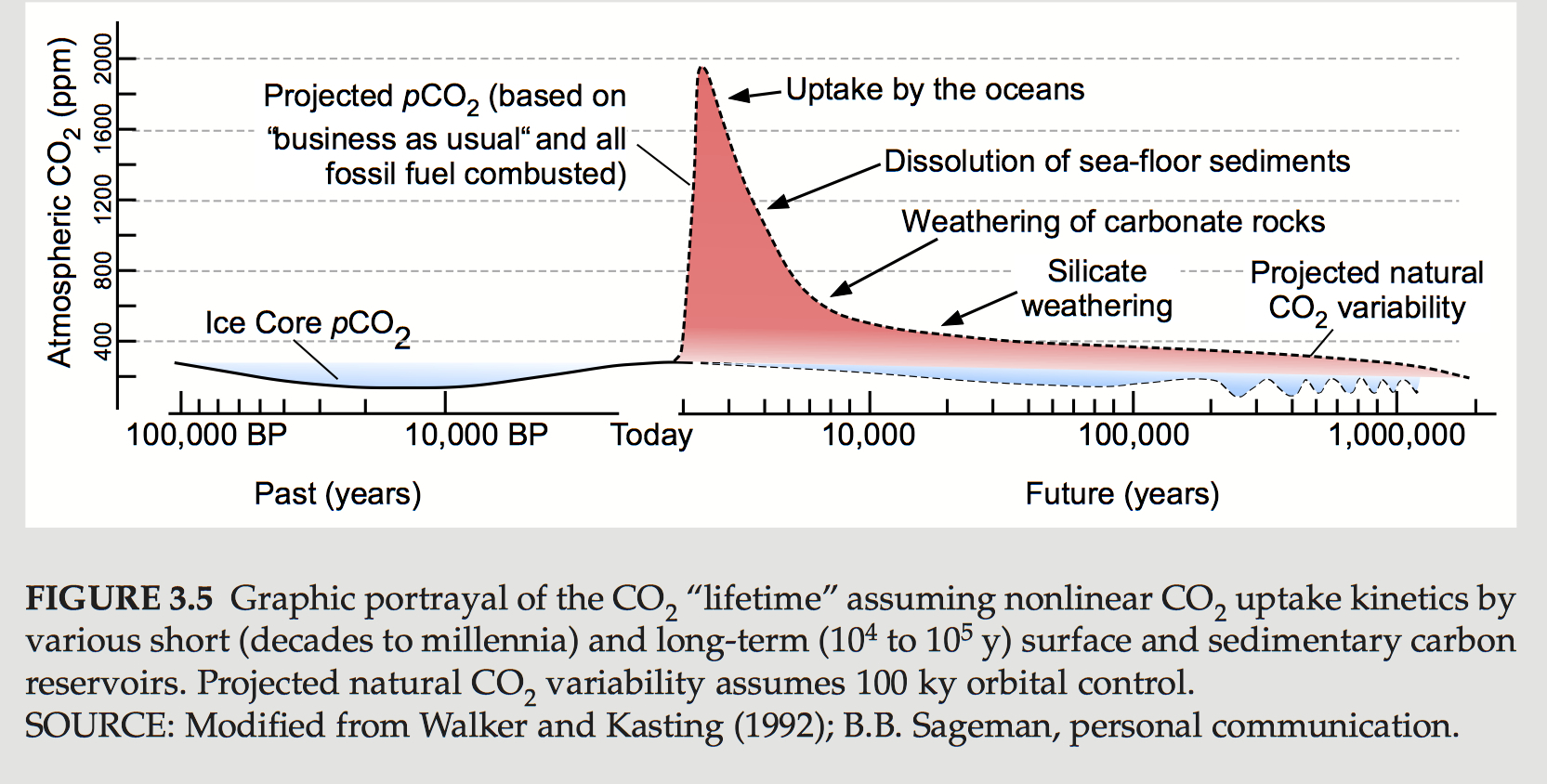
The process of capturing atmospheric CO2 with rocks on the ground is one of rock weathering. CO2 in the air that brushes against the surface of carbonate and silicate rocks has a finite (and very low) probability of undergoing a chemical reaction with the rock surface, fixing the airborne CO2 onto a solid substrate. This is the longest term natural process of capturing CO2 from the atmosphere (10s to 100s of millennia).

A shorter term process is capture by the surface waters of the oceans, and that aqueous CO2 then combining with water molecules and already existing carbonate ions (CO3-2) in the water to form carbonic acid (H2CO3), which is weakly bound and both acidifies the oceans and scarfs up free floating carbonate ions to both starve mollusks, corals and foraminifera of the easiest chemical species from which to grow their shells (CO3-2), and even dissolving such shells of existing organisms (most being part of the masses of plankton, the base of the oceanic food chain).

The surface (not too deep) load of absorbed acidifying CO2 is then slowly cycled to the ocean floor by the ~1,000 year vertical currents, and at the bottom it dissolves the chalk deposited as the calcium carbonate (CaCO3) remnants of dead sea life, basically bone, shell and foraminifera casing ‘fossils’ — an ocean acidifying effect. So ocean capture of CO2 happens all the time, but the intake rate can saturate as the ocean becomes more acidified; eventually this intake process could shut off, coral reefs being a long lost memory by then.

Loss of “excess” ocean CO2 requires a low CO2 concentration atmosphere that can accept the gaseous release (is not saturated with CO2) of ocean CO2 that slowly diffuses out on mainly kilo-year timescales. A technically accurate description of ‘the carbonate system in seawater’ is given at https://sundoc.bibliothek.uni-halle.de/diss-online/04/04H141/t5.pdf. My more formal article than the discussion here, ‘Global Warming and Ocean Acidification Accelerate,’ is at https://manuelgarciajr.com/2020/07/18/global-warming-and-ocean-acidification-accelerate/.

The next quicker process of fixing atmospheric CO2 is photosynthesis, and this is done both by plants on land and in the oceans, like: seaweed, giant kelp, and many small plankton-sized organisms; ocean based photosynthesis is a huge component. This happens all the time and fixes CO2 at the rate of plant growth. At a high enough CO2 concentration this process saturates, too.

What is not commonly appreciated is that there is an unbelievably gargantuan amount of fungal and bacterial ‘biome’ in the soil worldwide (as well as inside each of us in our intestines and colon) that interconnects plant roots and actually makes possible the fixing of CO2, by breaking down organics and minerals in the soil enabling plant roots to absorb nutrients they need to complete their growth cycles, which result in carbon being fixed into plant cellulose, and into soil carbonates. The TV show ‘Fantastic Fungi’ gives a visually stunning explanation of this, and is available here, https://www.netflix.com/title/81183477, and here https://fantasticfungi.com/. This plant-based natural process of “carbon capture” is disrupted and destroyed by chemical pesticide dependent industrialized monoculture farming.

I know it is a bitter pill to swallow, but the only real way to slow global warming in any noticeable way is to stop anthropogenic CO2 emissions FOREVER. There are no post-facto technological ‘capture’ or ‘remediation’ techniques that exist now or “could be developed” that would actually work as “silver bullets” of salvation; they would only ‘work’ as money making scams with which to gull those despairing of the ‘loss of easy living.’

Our best response to climate change is to change ourselves in every way possible and without ever looking back, like a butterfly emerging from its chrysalis — and to have fun doing so together. This has to be a willed conscious process because we do not have the luxury of a long timescale in a slowly changing world to allow the transformation of humanity to happen naturally through the unconscious genetically paced process of evolution.

But, with the right shared attitude, that much shorter timescale consciously willed personal and societal transformation could be more magical and take us to more wondrous new worlds than any fantasy of intra-galactic space travel at Warp Speed on the Starship Enterprise.

<><><><><><><>

’Stateless’, an Australian Television Drama about Refugee Detention

’The Trojan Women,’ a play by Euripides, was first performed in Athens 2,436 years ago at the height of the disastrous Peloponnesian War. It is considered a commentary on the capture of the Aegean island of Melos and the subsequent slaughter of its men and the enslavement of its women by the Athenians earlier that year, 415 BCE.

This play focuses on four women awaiting their fates after the fall of Troy (~1,200 BCE, in northwest Turkey near the Dardanelles): Hecuba (the wife of the slain king, Priam), Cassandra (the beautiful virginal daughter of Priam and Hecuba, who was blessed and then cursed by a lustful Apollo, with having a gift of prophesy none would listen to), Andromache (the wife of the great Trojan hero, Hector, who was slain by Achilles), and Helen (the Achaean queen and wife of King Menelaus of Sparta, who ran off with Paris to Troy, and which elopement was the purported cause for the Achaeans’s war against Troy).

The three Trojan women would all be made concubines and slaves by the Achaeans (mainland Greeks), and Helen returned to Menelaus. Because the Greeks wanted to ensure there would be no surviving male heir to the Trojan throne, they took Astyanax, the infant son of Hector and Andromache and the grandson of Priam and Hecuba, up to the high parapet of Troy and tossed him down to his death on the rocks below.

In 5th and 4th Century BCE Athens, the playwrights were known as poets and called teachers, and in ’The Trojan Woman’ Euripides was desperately and dramatically striving to teach the Athenians that the horrors of the Peloponnesian War were destroying the soul of their society, and that they should find ways of extricating their city-state from the war. His vehicle to convey that larger message to the Athenians was this dramatization of the final days in the death of the Trojan city-state eight centuries earlier (if in fact it was a single real historical event), as told in Greek myths recounted by legendary poets like Homer and his many forgotten colleagues.

’Stateless’, an Australian 6-part television series that was launched in 2020, is about a refugee and ‘illegal immigrant’ detention center, and strikes me as being similar to ‘The Trojan Woman’ as a societal teaching drama. It is both a searing depiction full of human and political insights about the current refugee crisis in Australia, as well as a close analogy for similar tragic realities along the US-Mexican border, in Libya and southern Italy, in Syria and the Greek Islands; and in other places where minorities and disfavored ‘others’ live precariously without stable statehood and are internally displaced or incarcerated, as in Syria, ‘Kurdistan’, Palestine, and the Xinjiang Uyghur Autonomous Region. The writers of ’Stateless’, Elise McCredie and Belinda Chayko have done a magnificent job. The directors, Emma Freeman and Jocelyn Moorhouse have made an absorbing and compelling visual work (https://www.netflix.com/title/81206211).

How many refugees are there around the world? The UN Refugee Agency, UNHCR (https://www.unhcr.org/figures-at-a-glance.html) states that: “At least 82.4 million people around the world have been forced to flee their homes. Among them are nearly 26.4 million refugees, around half of whom are under the age of 18. There are also millions of stateless people, who have been denied a nationality and lack access to basic rights such as education, health care, employment and freedom of movement. At [this] time 1 in every 95 people on earth has fled their home as a result of conflict or persecution.”

We must add that the deleterious effects of climate change — crop failures and lack of drinking water from extended droughts, and the loss of land, housing and employment due to violent weather and flooding — has also spurred refugee streams.

Those refugee streams flow out of the tropical and sub-tropical latitudes: from Africa northward across the Mediterranean Sea to Europe, up from Central America and Mexico and across the Caribbean Sea to North America, southward from Eastern Asia to Australia, and from the arid interior of the Middle East westward toward the Mediterranean Sea and Europe.

Americans, Europeans and Australians see these refugee streams as incoming waves of impoverished humanity comprised of dark-skinned people with cultures, mind frames and languages vastly different from their own, and thus a threat to American, European and Australian prosperity, and their existing ethnic balances, if too large an influx. We must realize that these refugee streams course back up along the gradients of wealth leading from the Global South to the Global North (and Australia), propelled by the pent up pressure of economic disparity created by over half a millennium of conquest and imperialism with over three centuries of slavery, by the White people of the north: the Europeans and the descendants of their American and other colonists.

The Australian television series ’Stateless’ is composed of a weave of four sub-plots, each about a person caught up in and then piteously twisted to the breaking point by the day-to-day reality of escalating crisis in the asylum-seeker Braxton Detention Center. All these stories are based on actual case histories. Threatened men and women become refugees and are driven to acts of desperation, they are victimized, families are torn apart, some eventually find sanctuary while many others languish indefinitely or perish. Low-level workers in the host countries looking to hang onto paychecks are shoved by higher level bureaucrats and policy-makers to go in and do the dirty work of “keeping a lid on” and also “making it look good for the public.” And the sanctimonious of all stripes on the outside are more often than not “virtue signaling” for their own ego boosts, than having any useful empathy for all the individuals mired in the toxic tangle of “the system.”

One story in ‘Stateless’ is based on the real case of Cornelia Rau, an Australian woman citizen who was emotionally disturbed at the time and who was inadvertently — and unlawfully — incarcerated by the Australian government’s Department of Immigration and Multicultural and Indigenous Affairs (DIMIA), and held for 10 months during 2004-2005 under the country’s mandatory detention policy for refugees, until Cornelia was traced to Braxton by a relative, and correctly identified and released to a hospital.

Another sub-plot focuses on an Afghani family fleeing the Taliban, being cheated and robbed by criminal human traffickers in Pakistan, being separated while attempting to make the perilous sea voyage to Australia in rickety boats, with the survivors eventually finding each other at Braxton. But the effort of the Afghani father to gain entry visas for his surviving family proves to be a very heartbreaking and essentially impossible effort. Despite some commendable humanitarian impulses by Australian workers tasked with maintaining the day-to-day operations of the center, and of some right-minded procedures embedded in the immigration policy, that policy is nevertheless largely fueled by a great deal of officially mandated bigotry and prejudice.

The conflict between offering a welcoming humanitarian response to the desperation of the trapped refugees terrified of being deported back to certain death, and the politically motivated mandates from the central government to maintain this bureaucratic structure for continuing exclusion, and without arousing public attention to it, is personified by the story of the woman appointed as the new director of the center. She is emotionally torn apart by the inherent cruelty of the job, and her political expendability to the remote higher-ups.

The last of the four sub-plots in ‘Stateless’ centers on a local rural freelance mechanic who seeks to leave precarity behind and support his young family with a steady paycheck earned working as a ‘prison’ guard at the detention center — though he is instructed that it is a refugee center and not a prison since its residents, despite having no freedom of motion, have not been placed there for the commission of crimes. This individual is a good-hearted fellow who quickly comes under unrelenting strain because of his repulsion at the cruelty toward unruly refugees by a sadistic guard, and because of the numerous requirements for him to perform rough enforcement actions on people exhibiting outbursts of anger, fear and madness. Both the emotional and physical traumas sustained in doing his job while trying to thread the needle between the frayed edges of UNHCR compassionate supervision of a precarious population, and the barbed razor sharp edges of bureaucratically enforced nationalism, nearly deaden his heart and rip apart his family.

Each of the four sub-plots in ‘Stateless’ is populated with many supporting characters who enrich the presentation, and the entire ensemble presents the full spectrum of human experiences that take place in the turbulent focal point of mixing-nonmixing between Australian society and Asian refugees at the Braxton Detention Center.

The ultimate solution to the world’s refugee crisis is so far out of view: ending all wars to establish a lasting world peace, and ensuring intelligent economic development up to decent standards everywhere so that people can remain in their countries with their families experiencing physical and economic security and good health down through the generations. Achieving these conditions would obviate the need for anyone to become a refugee and seek foreign asylum.

Yes, this is idealistic (naïvely so?, impossibly?), like wanting equitable worldwide cooperation to stop anthropogenic greenhouse gas emissions so as to tamp down the acceleration of global warming. But neither of these ideals is intrinsically impossible to actualize, and that is why the continuation of the refugee and climate crises are such tragedies: they are fundamentally unnecessary sorrows, open and festering wounds on the body of humanity.

What we have today is a compounded system of exploitation through tiered victimhood, a system commanded by über capitalists and nationalistic warlords living luxuriant lives, and served by hierarchical cascades of lower level petty boss bureaucrats, their functionaries, and in turn their laborers and armed enforcers. This system is so abhorrent that Nature itself has abandoned us, and is trying to burn us off the land and wash us away into the seas and oceans we have thoughtlessly poisoned with our wastes. An added cruelty to this accelerating rejection of humanity by Nature is that those who are suffering now, and first, and will suffer the most from the increasing hostility of Earth’s climatic conditions to human life are the people of the Global South (the Third World), the regions from which today’s refugee streams emerge, the poorest of Earth’s people, those who lead the most precarious lives, and those who contributed the least to the creation of the global climate crisis.

Coda: a Meditation on ’Stateless’

Must I have a stone heart to preserve a sane mind in a world of pure suffering I am luckily insulated from — for now? How does one combat compassion fatigue and empathy burnout? Does one sink into survivor’s guilt for blamelessly being born lucky?; for living in a bubble of comfort, freedom and justice that is much rarer than one had previously imagined?; and that seems to be diminishing by national policy out of view of its lucky inhabitants confident in their unawareness? But of those lucky people who do become aware, how do they survive and stay human without deadening their souls? We have become a race of monomaniacal blind cyclopses raging about our freedoms because we cannot conceive of anything beyond our own frustrated infantile selfishness. Becoming aware of the sufferings of others is the first step in the very long journey of personal redemption. That journey has many perils, and no one completes it unscathed.

<><><><><><><>

Time To Saw Through Our Ankle

Image from Near Term Human Extinction Evidence Group

Jeffrey St. Clair writes, on 9 August 2021:

“How is the new IPCC report substantially different from any of the other IPCC reports? The planet is warming. Human activity caused it. There is only a limited amount of time to take action in order to forestall the most extreme outcome. The report is a prelude to yet another global climate conference, where more non-biding, incremental measures will be agreed upon by the very leaders who profit from inaction, amid much self-congratulatory backslapping about how fraught the process was. Meanwhile, the forests burn, the permafrost melts, the methane percolates, the droughts deepen, the seas rise, the rivers flood, and the hurricanes line up in the Atlantic basin like jetliners over O’Hare.”

That prompted me to this:

At the end of the Mad Max movie (the very first one), Max cuffs, by the ankle, one of the psychopaths that killed his family, to an overturned car whose ruptured gas tank is leaking, dripping. He props a lit cigarette lighter near the drip, and tosses the prisoner a hacksaw. Max says: “Those cuffs are made of high tensile steel, it takes about 10 minutes to saw through them, the gas should explode by then. It only takes about 5 minutes to saw through your ankle.” He then drives away slowly. In the distance through his rearview mirror he sees a big explosion, the prisoner never emerged.
https://youtu.be/XHQA3DeBO40

That’s the situation of our Status Quo: it doesn’t want to saw through its ankle, cuffed to the gas.

My friend Sergio Romero reacted to the above as follows:

“Nowhere have I read or heard in relation to this IPCC report any criticism of capitalism, or even reforms of it that might slow or alter its extractive processes for profit.”

And so I went on as follows:

Because the IPCC is in reality a grouping of government agencies (the individuals are appointed by their governments), all grouped under one umbrella as a UN project/committees, its charter is very strictly limited as to what areas it can study, report on and comment/recommend about. They can talk about the “science,” and to a lesser extent about “remediation” strategies. But they can’t out-and-out criticize the world economic and political order explicitly.

Back during Bush II the head of the IPCC was removed and replaced by Bush-led political pressure because he was seen as too critical in those forbidden areas. The best the IPCC can do is to frame its reports so that the obvious, though unstated, conclusion is that capitalism kills and must be ended, or the Planet will end for us. The IPCC alone cannot save us.

Greta Thunberg has it right: taking it to the streets by massive popular protests to ultimately compel governments to shift their allegiances to the people instead of capital and corporations, because otherwise those governments themselves will perish, be overturned: revolution; this is what is needed.

In one way or another, we’ll have to saw our ankle, and it will hurt all the way through and feel like it’s taking forever “to escape.” For energy gluttons, a post-carbon world will seem like sore one-legged limping compared to the easy-for-the-wealthier high-emissions ante-carbon good-life. Otherwise, it will be more and more of what we are seeing now — drought, fire, hurricane, flood — as time progresses.

The Science-Guy part of me knows that if we all embraced the change, we could have an amazingly exhilarating and fulfilling time (of decades) creating a truly wonderful world for all. The Dark-Poet part of me has little faith that people in general are up to the task. The Craggy and Sentimental parts of me combine to keep pushing for the vision of the Science-Guy, because I don’t want to give up and make it easier (by one) for the dickhead fuckers to have it all their way in ruining the Planet (and vampiring on human society); and because I am a self-realized Don Quixote who can at least keep making his puny farcical efforts to maintain a tattered self-respect.

“Anyone who ever had a heart” would think of the kids and their world to come.

<><><><><><><>

Even Noah Would Be Amazed

A extensive televised BBC News story of 16 July 2021, titled “Catastrophic flooding across western Europe as politicians blame climate change,” showed the devastation caused by the rapid massive flooding in the region of Western Europe at the confluence of the borders of Germany, Belgium, France and Luxembourg during the third week of July 2021, when three times the monthly average of rainfall was dumped in only a day or two. In that report, the likely next Prime Minister of Germany forthrightly assigned blame for the catastrophe to global warming climate change, and urged serious and immediate national, European and world action to counter it by reducing anthropogenic emissions of carbon dioxide. (https://youtu.be/8A65JzDltY4)

If this flooding in Germany and Belgium this last week, and the vast fires and massively deadly heat in Northwestern USA and Canada, and Siberia the previous week, can cause such devastation despite occurring in the most technologically sophisticated and economically advanced and developed countries on Earth, how do you think such similarly “natural catastrophes,” amplified and accelerated by global warming, would affect (and are affecting) the hundreds of millions — even billions — of the Earth’s poorest and most vulnerable people — as in Sub-Sahara Africa, Amazonia, India, Pakistan, Nepal, Bangladesh, and the Pacific Islands?

This is real life Apocalypse Now. It will continue to “explode” much more slowly than the pacing within our very short attention spans — of seconds to maybe as long as months — and that explosion of catastrophe will continue for decades and even centuries if humanity continues to remain inert before this planetary reality.

The problem — that millions and billions more people have not yet been spurred into action by the all-too-obvious degradation of the climate-weather-biosphere interlocking systems — is far beyond the simple confusion of a deer-in-the-headlights problem. Fundamentally, it is the human inertia of the retreat into reassuring habit to mask the denial of existential fear, rather than a forthright confrontation of it with intelligent action.

Our destiny has been handed to us: either we exhibit triumphs of the human spirit by acting vigorously and cooperatively to counteract global warming, or we perish ignominiously in a degrading piecemeal fashion as willfully ignorant victims of our own stupidity, narcissism and witless folly.

What amazes me is how, in the face so such evident and advancing climate catastrophes, so many can be so enveloped in their illusion bubbles and remain completely blind to the ongoing collapse of the world, both natural and human: bubbles of greed illusions in desperation to acquire more exclusive corporate and “insider” subsidies in order to “compete”; bubbles of bigotry illusions ever in search of public affirmation and normalization of their favored brand of supremacist apartheid; bubbles of fear illusions ever in search of more armed protection from other “types” and “classes” and “foreigners”; pathetic bubbles of self illusions ever in search of “power” by phishing telemarketing of fake automobile warranties and “free money,” and hacking websites large and small and Facebook pages; and the narcissistic illusion bubbles of billionaire boys trying to explode mass media paroxysms of stupidity by ejaculating their ego rockets into space; and the hubristic bubbles of unmoored superpower illusions ever seeking to project power “geo-strategically”, to monopolize hydrocarbon deposits and trade, and to stifle small countries with marginal economies, as with Cuban socialism just south over the Caribbean horizon from a sinking, collapsing and sea-level-rise-flooding Miami.

In that BBC report, Britt Blom, a café owner helping to clear the masses of debris clogging her village streets after the flood waters had receded, said: “We need to stay positive, we can cry all day but this will not help anything. So, better smiling and keep working.”

And for the rest of us in this ever shrinking wide world, that “working” means: to help clean up after the tragedies “here,” to help other victims of tragedy both near and far, and to face up to global warming climate change and biodiversity collapse, with real and cooperative action to help slow the pace of our expanding planetary catastrophe.

Wake up, people.

<><><><><><><>

House Upon The Sand

This is my two-part rant of 30 June 2021.

Andrew Bacevich writes:
https://www.counterpunch.org/2021/06/29/the-passing-of-the-present-and-the-decline-of-america/

This is the kind of commentary, and commentator that pisses me off. Yes, an honorable, intelligent, patriotic former career soldier, and highly respected military-political commentator comes to forthrightly state that the war-crazed dysfunction of the American state now seems fatally terminal, and one might have found glimmers of that realization as far back as 1969, such as in Kurt Vonnegut’s new book that year Slaughterhouse 5, though Bacevich finally acceded to it in mid-Trump Administration.

WOW! I fucking knew this in 1968 as an 18 year old! I read SH5 in 1969, and Catch-22 in ’68, and had read Helen Hunt Jackson somewhere between 1963-1967 (which was before Dee Brown’s “Bury My Heart At Wounded Knee” was published).

Okay, so now the old West-Pointer Bacevich has finally read SH5, and published his erudite books on the stupidity of American militarism, and been forthright about his previous white American exceptionalism careerist wrong illusions, and made sincere and public efforts to advocate for an inclusive, just, “progressive” America, and write as here about the complete toxicity of Trumpianism and the Republicans, and the pathetic flaccidity of the less than B-minus grade Bidenites — great, all welcome and good (and Stan Goff would tell me to be accepting of anyone’s personal redemption — okay), but DAMN! it took long enough!

The whole damn Vietnam War genocidal catastrophe wasn’t enough to wake you up by 1975? by Reagan-time? by Bush II time and the Iraq War? How come so many of us dumber unimportant people can figure this stuff out decades before you super-informed, super-plugged-in brainiacs and lever-pullers?

Well, okay, you’re good now Bacevich, and thanks for the accurate insights about today. I’m guessing that just as (some) serious people like Bacevich have woken up to the evils of American militarism 50 years after the Vietnam War, that equally in 50 years time we’ll see a heartening swelling in the ranks of today’s serious lever-pulling people who have woken up to the Planetary Crisis encompassing global warming climate change, collapsing biodiversity and its attendant social inequities. And then (forgetting about all the bodies buried since then) they’ll want to do something about it. By then palm trees might sprout in Greenland, and we may even have a smaller world population (involuntarily).

Okay, rant, part 1, is over. Now for part 2.

From Wikipedia: The Oklahoma City bombing was a domestic terrorist truck bombing of the Alfred P. Murrah Federal Building in Oklahoma City, Oklahoma, United States, on Wednesday, April 19, 1995. Perpetrated by anti-government extremists Timothy McVeigh and Terry Nichols, the bombing happened at 9:02 am and killed at least 168 people, injured more than 680 others, and destroyed more than one-third of the building, which had to be demolished.

From Wikipedia: On June 24, 2021, at approximately 1:30 a.m. EDT, Champlain Towers South, a 12-story beachfront condominium building in the Miami suburb of Surfside, Florida, experienced a sudden partial collapse. At least 12 people died, and 11 others were injured.[as of 30 June 2021] About 35 people were rescued from the uncollapsed portion of the building, 2 people have been rescued from the rubble, and 149 people remain missing as rescue operations continue… As of June 28, 2021, 12 people are known to have died during the collapse, and 11 more have been injured. 11 of the 12 fatalities have been publicly identified, including two Venezuelan nationals and two Cubans. Up to 149 people remain unaccounted for.

So, it looks like the Champlain Towers South will have snuffed out 162 lives. “Missing” and “unaccounted for” are the terms used to describe people that have been killed but whose bodies have yet to be recovered, and for whom, illogically, their loved ones hope (and who can blame them!) that they will miraculously return alive.

So this building collapse — in all probability — nearly equals the death toll of the Oklahoma City terrorist bombing of 1995, though it did not cause any noticeable number of other injured. But the Oklahoma tragedy was “terrorism” and required a swift and vigorous government response, both to care for the victims and to apprehend and punish the perpetrators. But the Surfside (Miami) building collapse tragedy is not “terrorism” by rising seawater intrusion climate change undermining heedless shoreline real estate development, so: hold your horses!, let’s not rush to judgment!, let’s not act hastily — meaning at all — about that uncertain “climate change” scare tactic. Yeah, sure Gomer.

The mainstream finger of blame is pointing to faulty building construction and maintenance — which is undeniable — but that mainstream public consent-directing ministry (“of Truth”) has a massively pregnant silence about (the unthinkable!, the unmentionable!, don’t “politicize” tragedies!) CLIMATE CHANGE! But, well, “the possible excessive ingress of salt water” MIGHT have also been involved.

The bottom fell out and has been falling out not only of the Champlain Towers South, but of the whole damn Idiocracy clinging to and dangling from their high hopes of exponential prosperity for the ‘serious’ and ‘worthy’ (a.k.a. “exceptionalist”) denizens of the United States of Amnesia. Victims R Us.

“And every one that heareth these sayings of mine, and doeth them not, shall be likened unto a foolish man, which built his house upon the sand.” — Matthew 7:26, King James Bible.

<><><><><><><>

Deadly Collapse Of Illusions In Miami

Here is video of the Miami beachside condominium that collapsed at ~1 AM on 24 June 2021 (https://youtu.be/KR29pLccutY). There are many news stories about this now.

An engineering professor at Florida International University has used satellite data on ground elevation (a measurement technique used since at least the late 1970s) to write about the steady sinking of land in Miami, including the site of the condo, since 1990. There is a lot of beachside construction in Florida on landfill. This condo was actually built on sturdier ground (I’m guessing an ancient barrier island), but landfill is right next to it on the west side, where other similar buildings are located (and thus a bit further from the shoreline).

In 2018, a building inspector engineer issued a warning that there was serious damage to the building stemming from an inadequacy of foundation integrity. Nothing was done. In another report, I read that the development-friendly local and state authorities had freed the Miami real estate industry from “excessive” regulations by only requiring building inspections every 40 years! (I find this hard to believe, but it was a news report posted on the internet).

By now it is clear that the cause of the collapse was the softening of the ground under the building by the infiltration of seawater over the years since the building’s construction. Because such a large building is very heavy, especially in comparison to a simple beachside bungalow, the weight of the structure put tremendously higher downward pressure on the ground below its foundation, diminishing the integrity of the increasingly soaked soil, and thus speeding its ultimate loss of cohesion.

Now, some words about structural stability in a gravitational field. Earth’s gravity arises from its huge mass (compared to anything else humans are used to) and it points toward the Earth’s center, which means “down.”

Buildings, bridges and many other structures erected by humans on the surface of the Earth are designed to remain stable by having rigid vertical structural members (i.e., columns) to transmit the weight of the structure into the ideally “solid” ground below, which in turn distributes the pressure of the building’s weight (as mechanical stress) into the body of Planet Earth. The contact zone between the building and the Earth is usually a cross-braced foundation structure.

Those weight-bearing vertical supports are cross-braced by horizontal rigid structural members (i.e., beams, and in stronger designs by triangular frames: trusses). This way the entire building has the structural integrity of a “block”: the Earth holds it up, and its cross-bracing holds it together.

Essential to the building’s stability is the integrity of the earth below it: its solidity. When that solidity is lost, such as by water infiltration softening, and becomes nonuniform, then the building can begin to sink in a lopsided manner. Such tilting means that now gravitation forces no longer align perfectly with “vertical” columns (since they are tilted) but also has “lateral” components of force directed along the cross-bracing (which is also tilted).

Such new lateral forces transmitted by the cross members against the sides of the columns add a sideways momentum now pushing to tilt the building over, and are also forces working to tear the building apart from top to bottom.

At some point of building tilt, such unevenness of the distribution of gravitation stress throughout the structure, now no longer strictly vertical, puts more tensile or compressive stress (depending on the orientation of the member) than one or more of the structural members can sustain without buckling; or some of the bolted, riveted or welded joints between members can sustain to keep from ripping open.

Such structural failures remove pathways for the building’s gravitational stress to find its way to ground. So the structural members of the building’s frame that are still connected see an increase in the stress they must contain and transmit to Earth to hold up the building.

This takes those still intact members and joints more quickly toward their failure points, and the weakest among them give way. In this way an accelerating cascade of structural failures occurs, and the entire building can seem to suddenly “deflate” and collapse.

Such a collapse will be seen to propagate through the building as a wave of “deflation” from the regions of first failures to last failures, which, depending on the configuration of the undermining forces, can be left-to-right or vice-versa, and bottom-to-top or vice-versa.

The World Trade Center Towers building collapses of 11 September 2001 occurred from the top down: the dynamic force of collapsing mass above any given floor (the conversion of gravitational potential energy into mass acceleration) being beyond the yield strength of the vertical columns and cross-bracing joints at each floor-level, which were only designed — with a significant safety factor — to withstand the static stress imposed by gravity. The collapse of the smaller World Trade Center Building 7 proceeded from the left to the right because of a buckling of a column weakened by fire softening.

The Miami condominium collapse of 24 June 2021 progressed from bottom to top, first on the “left” side, and then on the now laterally unsupported “right” side (as seen in the video captured by a surveillance camera).

I would guess that what is happening now in Miami — and elsewhere — is a scramble to point fingers assigning blame and to evade responsibility; people seeking to sue somebody for losses of relatives, property and illusions; to get insurance payments, or to avoid paying them; to protect their money, investments, property and advantages of location; and to run away from their fears and hide from facing up to the realities of implacable Climate Change (in the form of sea level rise for Miami) plowing steadily into the American “good life.”

Climate Change is like an enormous steamroller that is inching slowly but implacably along the open road of our projected expectations, to roll over and flatten our comfortable situations.

Since we are all “cemented in place” in those personal comfort situations, that steamroller is bit by bit squashing us: first ‘here’ then ‘there’; some by sea level rise; some by hurricanes razing all; some by wildfire; some by deepening and eternal heat and drought; some by waves of disease pathogens sprung from out of formerly deep recesses in the wild; some by the increasing withdrawal of food availability; and some by the infighting all this sparks among us and that causes casualties from our war with ourselves.

First we lose our illusions, then we lose our money, and finally we lose our lives.

Those who refuse to face reality and relinquish their illusions will cause the most damage to their fellow human beings, by being rabidly competitive, as they slide down the cascade of suffering longer and ever obsessed to the death with their unrelieved anxieties of avoiding losses and pain. Those who jettison their illusions and face reality will a least gain the comfort of finding the company of similar people.

Even as the steamroller inches forward toward us, for everyone “the future is uncertain, and the end is always near.” One can pin oneself to an obsession with “the end,” and its avoidance; or one can open oneself to an appreciation for the processes of life, and to the sharing of such appreciation.

Climate Change is now our great teacher, and its lessons range from stark terror to transcendence. We have no choice but to live out those lessons, but we do have some choice in which of those coming experiences we can aim our personal selves to.

<><><><><><><>

Photos from the news story (series) linked in two comments, below:

<><><><><><><>

The beachfront looks like an ancient barrier island to me (my guess). The “flats” behind it look like landfill (“reclaimed land”). I suspect all this land is “wet” below a shallow depth from the surface. I also suspect that depth has been decreasing with the sea level rise over previous decades, and which continues.

<><><><><><><>

27 June 2021, using Picture #1 for reference:

The surveillance camera that took the video of the collapse is located at the left-most, furthest ‘up’ seaward-side corner of the blue pool seen to the left in this photo, just below the large area of greenery. The camera was pointed diagonally across that pool, straight at the central portion of the building that collapsed. That central portion collapsed first, from the side closer to the surveillance camera and then dragging its backside (the side furthest from the surveillance camera) down. To me it seems that “the bottom dropped out” and not that the roof collapsed and pancaked down pulverizing the building. After that central section was all down, the squarish tower portion closest to the beach tottered, twisted ‘slightly’ clockwise as viewed in this picture, and then also collapsed by “the bottom dropping out.” You can see the higher pile of rubble left by that tower section collapse. I would guess that the section of ground (subsurface) between that outer tower section and the part of the building still standing, and aligned parallel to the shoreline, is the area of greatest weakness and loss of integrity. It is also possible (as others are commenting) that there had been a weakening of the reinforcing steel inside the concrete columns of the building because of the corrosive action of salty sea air and underground flooding since 1981 when the building was constructed. The conclusions of the forensic engineering reports, which will doubtless take many months to finally arrive at, will be interesting — if they are not distorted by CYA.

<><><><><><><>