The Canyon Green

The Canyon Green

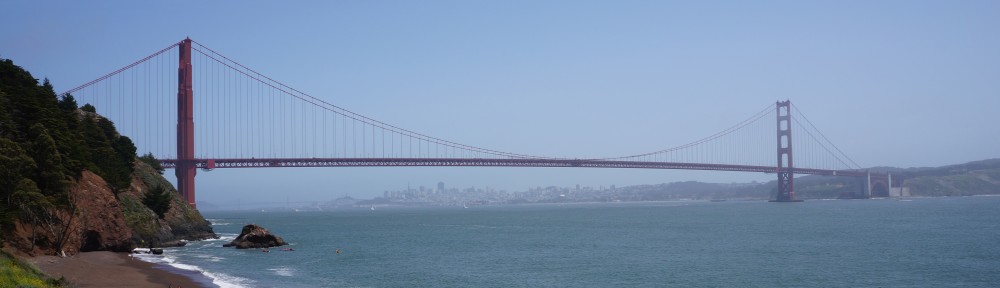
Today, on my hill, it is sunny
and nearly still
warm light, cool shadows,
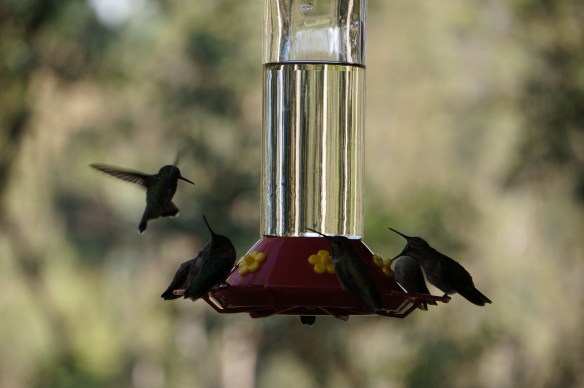
many birds
darting flights, unseen songs,
the canyon green.
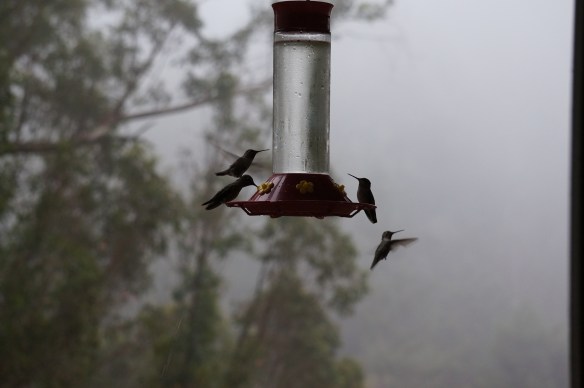
Yesterday, all mist and fog
rolling up from the sea
over mountains
absorbing silence
drinking into leaves
and blades of grass
above dry ground,
many birds
darting flights, unseen songs,
the canyon green.
My daughter calls,
I see her cute ski-jump nose
again
a wind blows from Greece
across a wine dark sea
the sun melts
under a starry blue
far beyond the Umbrian hills
where there are many birds
darting flights, unseen songs,
the canyon green.

Canyon Green 1

Canyon Green 5

Canyon Green 2

Canyon Green 6

Canyon Green 05

Canyon Green 06

Canyon Green 07

Canyon Green 08

<><><><><><><><>

El Que Siembra Su Maíz — Español-English

“El Que Siembra Su Maíz” is a Cuban country-troubadour (trova) song from 1925, composed by Miguel Matamoros, and first recorded by the Trio Matamoros. It was a hit, and remains a perennial classic. For much more about Trio Matamoros, see https://manuelgarciajr.com/2015/10/04/trio-matamoros-old-and-new/

The chorus of this song: “el que siembra su maíz, que se coma su pinol,” might have a very rough Old English equivalent of “the man who plants his corn gets to sit and drink his mead,” or a very rough Tennessee equivalent of “the man who plants his corn gets to sit and drink his bourbon,” since bourbon is a corn-mash alcoholic beverage.

Pinol: maíz molido con azúcar y un poquito de canela.
Pinol: corn, ground with sugar and a little bit of cinnamon.

Pinol, in:
1. Costa Rica, Cuba, Ecuador, Honduras and Nicaragua: toasted corn flour.
2. Costa Rico and Nicaragua: “pinolillo” is pinol with cacao (chocolate).
3. Ecuador and Guatemala: sweetened corn flour.
4. Bolivia, Ecuador, Peru: pinol as “máchica,” flour made from ground toasted barley or other toasted grains.

“Mead is an alcoholic beverage created by fermenting honey with water, sometimes with various fruits, spices, grains, or hops. The alcoholic content ranges from about 8% to more than 20%. The defining characteristic of mead is that the majority of the beverage’s fermentable sugar is derived from honey. It may be still, carbonated, or naturally sparkling; dry, semi-sweet, or sweet.” https://en.wikipedia.org/wiki/Mead

With all their sugar cane, I find it impossible to imagine the Cubans not having had a mead-like equivalent made from pinol and rum, or pinol and fermented guarapo (sugar cane juice).

Pinol would certainly be used to make all the cornbread, corn cakes, hushpuppy and corn mush equivalents familiar to Americans from their southern states. Now, to the song.

El que siembra su maíz
[Miguel Matamoros, 1925]

Huye, huye
dónde está Mayor?
dónde está?

Ya no vende por las calles
ya no pregona en la esquina
ya no quiere trabajar.

Huye, huye
dónde está Mayor?
dónde está?

Ya no vende por las calles
ya no pregona en la esquina
ya no quiere trabajar

El que siembra su maíz
(que se coma su pinol)
que siembra su maíz
(que se coma su pinol)
el que siembra su maíz
(que se coma su pinol)

La mujer en el amor (¡sí señor!)
se parece a la gallina (¡como no!)
la mujer en el amor (¡sí señor!)
se parece a la gallina (¡como no!)
que cuando se muere el gallo (¡sí señor!)
a cualquier pollo se arrima (¡como no!)

El que siembra su maíz
(que se coma su pinol)
el que siembra su maíz
(que se coma su pinol)
que siembra su maíz
(que se coma su pinol)
el que siembra su maíz
(que se coma su pinol)

Muchacha, dice tu abuela (¡sí señor!)
que te mete en la cocina (¡como no!)
muchacha, dice tu abuela (¡sí señor!)
que te mete en la cocina (¡como no!)
que el que tiene gasolina (¡sí señor!)
no ha de jugar con candela (¡como no!)

El que siembra su maíz
(que se coma su pinol)
el que siembra su maíz
(que se coma su pinol)
que siembra su maíz
(que se coma su pinol)
el que siembra su maíz
(que se coma su pinol)

No te parece Rufina (¡sí señor!)
mirar en el farallón, (¡como no!)
no te parece Rufina (¡sí señor!)
mirar en el farallón, (¡como no!) (1)
ni ver redundar el trombón (¡sí señor!)
hasta que se desafina (¡como no!)

El que siembra su maíz
(que se coma su pinol)
el que siembra su maíz
(que se coma su pinol)
que siembra su maíz
(que se coma su pinol)
el que siembra su maíz
(que se coma su pinol)…
(El) que siembra su maíz…

<><><><><><><>

The One Who Plants Her Corn
[Miguel Matamoros, 1925; translation-paraphrase by Manuel García, Jr.]

Gone now, gone now
Where has Mayór gone?
Where’s she gone?

She’s not selling in the streets now,
she’s not hawking at the corner,
she no longer wants to work.

Gone now, gone now
Where has Mayór gone?
Where’s she gone?

She’s not selling in the streets now,
she’s not hawking at the corner,
she no longer wants to work.

The one who plants her corn
(gets to eat up her pinol)
the one who plants her corn
(gets to eat up her pinol)
The one who plants her corn
(gets to eat up her pinol).

A woman who’s in love (oh yeah!)
is just like a barnyard chicken (you bet!)
a woman who’s in love (oh yeah!)
is just like a barnyard chicken (you bet!)
when old red rooster croaks (oh yeah!)
next to any old hen she’s nuzzlin’ (you bet!).

The one who plants her corn
(gets to eat up her pinol)
the one who plants her corn
(gets to eat up her pinol)
The one who plants her corn
(gets to eat up her pinol).
The one who plants her corn
(gets to eat up her pinol).

Honey, your grandma says (oh yeah!)
get yourself into the kitchen (you bet!)
honey, your grandma says (oh yeah!)
get yourself into the kitchen (you bet!)
for who lugs cans of gasoline ‘round (oh yeah!)
shouldn’t play at flaming things now (you bet!).

The one who plants her corn
(gets to eat up her pinol)
the one who plants her corn
(gets to eat up her pinol)
The one who plants her corn
(gets to eat up her pinol).
The one who plants her corn
(gets to eat up her pinol).

Don’t even try, Rufína (oh yeah!)
staring in the lighthouse beam (you bet!)
Don’t even try, Rufína (oh yeah!)
staring in the lighthouse beam (you bet!) (1)
Nor look in the trombone’s bell (oh yeah!)
until it shakes itself off key (you bet!).

The one who plants her corn
(gets to eat up her pinol)
the one who plants her corn
(gets to eat up her pinol)
The one who plants her corn
(gets to eat up her pinol).
The one who plants her corn
(gets to eat up her pinol).
The one who pants her corn…

(1) farallón = cliff, farol = lantern, faro = lighthouse. I chose to use the lighthouse image (faro -> lighthouse) instead of using the cliff image (farallón -> cliff, Matamoros’ actual word), because I thought it more vivid, for my English version, as something fatiguing to stare uselessly into.

<><><><><><><>

A much looser variation of the lyrics, in American English, is as follows.

The Girl Who Plants Her Corn
[a paraphrase of El Que Siembra Su Maíz, in American English, by MG,Jr.]

Gone now, gone now
Margie’s cart is gone.
Where’s she gone?

She’s not selling in the streets now,
she’s not hawking at the corner,
she no longer wants to work.

Gone now, gone now
Margie’s cart is gone.
Where’s she gone?

She’s not selling in the streets now,
she’s not hawking at the corner,
she no longer wants to work.

The one who plants her corn
(drinks her bourbon eats her grits)
the one who plants her corn
(drinks her bourbon eats her grits)
The one who plants her corn
(drinks her bourbon eats her grits).

A woman who’s in love (oh yeah!)
is just like a barnyard chicken (you bet!)
a woman who’s in love (oh yeah!)
is just like a barnyard chicken (you bet!)
when old red rooster croaks (oh yeah!)
nuzzled up to any ol’ hen she’s sticking (you bet!).

The one who plants her corn
(drinks her bourbon eats her grits)
The one who plants her corn
(drinks her bourbon eats her grits)
The one who plants her corn
(drinks her bourbon eats her grits)
The one who plants her corn
(drinks her bourbon eats her grits).

Honey, your grandma says (oh yeah!)
get yourself into the kitchen (you bet!)
Honey, your grandma says (oh yeah!)
get yourself into the kitchen (you bet!)
for who lugs gasoline up ’n down (oh yeah!)
with flames shouldn’t be playin’ around (you bet!)

The one who plants her corn
(drinks her bourbon eats her grits)
The one who plants her corn
(drinks her bourbon eats her grits)
The one who plants her corn
(drinks her bourbon eats her grits)
The one who plants her corn
(drinks her bourbon eats her grits).

Don’t even try, Rufeena (oh yeah!)
staring through a cliff to see (you bet!)
Don’t even try, Rufeena (oh yeah!)
staring through a cliff to see (you bet!)
Nor in the trombone’s bell (oh yeah!)
till it shakes itself off key (you bet!).

The one who plants her corn
(drinks her bourbon eats her grits)
The one who plants her corn
(drinks her bourbon eats her grits)
The one who plants her corn
(drinks her bourbon eats her grits)
The one who plants her corn
(drinks her bourbon eats her grits).
The one – who – plants – her – c-o-r-n…

<><><><><><><>

El Que Siembra Su Maíz
[Trio Matamoros, with (I think) Los Guaracheros de Oriente (my favorites). Matamoros sings.]
https://www.youtube.com/watch?v=zV5QRjmfqcI

Trio Matamoros – El que siembra su maíz
(2nd original recording – unequaled)
[2:55]
https://www.youtube.com/watch?v=KVU5ThBYe5w

Trio Matamoros – El que siembra su maíz
https://www.youtube.com/watch?v=7on8TFN0Hxs
[1931, from collector’s CD, 1st original recording]

El que siembra su maiz (el montuno) – Oscar D´Leon, Hector Lavoe y Lalo Rodriguez
(Tres grandes de la salsa juntos en una presentación en New York para que lo disfruten; el audio no es muy bueno pero igual se goza)
https://www.youtube.com/watch?v=5TmcVMvfv9M
[Salsa jam (1982) on “El Que Siembra Su Maíz” (the montuno part, 11 minutes out of 15) by Miguel Matamoros (Cubano), who wrote the orignal song in 1925! Héctor Lavoe (Puerto Rico), Oscar D’Leon (Venezuela), Lalo Rodríguez (Puerto Rico) sing.]

El que siembra su maíz — Trio Matamoros
https://www.youtube.com/watch?v=2wi-XnsQWso
[Trio Matamors, old, rough and beautiful; just themselves live and free.]

El que siembra su maíz — Los Guaracheros de Oriente
https://www.youtube.com/watch?v=pImyQwLZ16s
[such crisp and polished performers]

El que siembra su maíz — Gema 4 
https://www.youtube.com/watch?v=tfVDEAOOKco
[female a cappella quartet]

<><><><><><><>

Queen Hillary Faces the California Primary

Queen Hillary Faces the California Primary:
Mirror, Mirror on the wall,
Who’ll be President of them all?
It must be me, I say it must!
For who but Hillary can Wall Street trust?
You must rig all those voting machines
To prevent democracy from going to extremes.
For I must guide, control and shape it
With greater wisdom than any voters’ edict.
I’ve got the spinsters all, and childless biddies,
And the scared suburban mommies with all their kiddies.
Thank God for those old trusting Blacks,
With Scarlett O’Hara’s luck, they have my back.
On their sacrifices I can always call,
So endearing seeing them on their swords fall.
It’s great to know I have my people
Ready to stay behind and raise my steeple.
For I am a Goddess and this is my Church,
To lead an American incremental rightward lurch.
Hail!, hail!, obey and revere!,
For I am Hillary and this is my year!
But that white-haired man is such a problem,
Waking up the nation to all the swag I’ve been grabbin’.
And how annoying those damned Millennials
Who can’t see past their fairness ideals,
Who think being shackled to their school debts
Gives them excuse to question Wall Street’s bets.
Why don’t they just join the military?
I’ll see they get enough comes time for them to bury.
If only they could see obeying me
Will let then share in my glorious history.
The first American woman President
Able to make privatizing Social Security permanent.
Honestly, with America I’m so disgusted
That I’m not more widely loved and trusted.
Trump’s a fool, I’ll beat him, I hope,
Or else America is really on dope.
Trump’s a sexist, but Bernie’s worse
Convincing young women pay imbalance he’ll reverse.
The majority commits Lèse-majesté
Against their natural given leader: Hillary!
Mirror, Mirror on the wall,
Who’ll be President of them all?
Tell me now and tell me quick
Or I’ll hit you with my girl-flogging Billy stick!
Tell me now and tell me right
Or my hissy fit will be a dreadful fright!
And the Mirror replied:
Oh great Queen!, on June 7 you’ll receive my answer,
Whether for America it’s bright future or disaster.

13 American Truths

13 American Truths:

Ignorance is Strength.
War is Peace.
Freedom is Slavery.
Capitalism is Theft.
God is Murder.
Property is Racism.
Suburbia is Segregation.
Vanity is Greed.
Greed is Sacred.
Love is Weakness.
Hate is Power.
Power is Justice.
Conversation is Dead.

Variation of Parameters

My beautiful picture

Perhaps it was a change in the weather
that caused things to happen.
I remember warm winds
blowing up from the south in early spring,
and yellow moons in blue glazed nights.
The melting of the cell phones was first.
Overnight,
they were just frozen puddles of plastic and metal,
nothing seen, no heat felt,
just stone-cold carbonized slag heaps
in their hundred millions.
None have been made since –
they all dissolve –
as if the very form, even the concept
had been banished by some capricious god.
Soon after, every fifth spark plug failed,
crankshafts and turbine blades
inexplicably disintegrate.
No cause can be found, no process observed,
large gasoline motors rarely run, now,
there was much fearful whispering about gremlins.
Still, we all adjusted reasonably soon,
and then the great shock arrived –
all the money disappeared.
One morning,
no account could be found with a balance,
all bills showed zero totals,
all currency had vanished.
Everyone is penniless and free of debt,
work has no pay, selling has no buyers –
no obligations, no inducements.
At first, there was chaos, riots, death,
many went insane or took their lives,
“He’s gone back to look for his money,”
we say now –
our phrase for the departed.
Yet, soon enough, most people found occupations,
either from habit, inclination,
or simply to shake off boredom,
like a group of children
picking through a pile of costumes
to take on roles in a game.
In this game, we trade
for food, for our chores, for our entertainment.
With so much use of time,
and no easy accounting,
no one can accumulate
beyond the stores for a winter.
Our leaders bemoan the fall of civilization,
and, as they are ignored,
it must be so.
Our evangelicals howl in ecstasy,
dancing naked around bonfires through the night.
The children are delighted,
now, with so many schools close by,
and always elders, and relatives in attendance
along with their teachers,
so joyous, compared to what now seems imprisonment
in the old moneyed days.
I think it is the learning joy of children everywhere
that makes one feel as if always walking in a village,
even as it stretches between the oceans.
The young easily try on any role,
experimenting with great fervor,
adding such sparkle to the daily routines,
and reminding us to keep our perspective,
for they can leave without notice
for vacations of unknown length,
to satisfy the needs of the spirit.
Yet, in this ebb and flow,
all social needs are filled,
like the hollows children dig out at the beach;
our social lives are smoothed
by the washing of tides from an unseen ocean.
While the fortunes of many have tumbled,
most have tasted liberation, by now,
and those who have lost are left to their own devices.
Shortly after the money left,
the wars erupted – somebody had to pay.
By two years the shooting sputtered to a halt,
all the bullets were turning out to be duds –
plutonium turned to salt, rockets crumbled to powder –
and so they remain.
No explanations.
Our armies are helpless, vulnerable,
unable to attack, and unassailable.
The great migrations began when the guns died,
but soon quelled
when gold was found dissolved in the oceans,
and laced through the sand underfoot.
It is so common, now, it is worthless,
though most beautiful,
and a warm metal to replace broken teeth.
And so, we live under a mysterious power
we cannot explain.
We are people with a broken history
and a continuously randomized future,
liberated from our parallel lives of isolation,
and the apprehension of survival.
Around here, we each hoe our gardens
while spending long afternoons watching clouds curl,
or walking into town to carry home a gallon of milk.
Just this afternoon,
I heard the pub switched from sports on TV to poetry –
for a change.
Maybe I’ll go down and have a few, tonight.

17 February 2003

Una Rosa de Francia — Español-English

Una rosa de Francia,
cuya suave fragancia
una tarde de mayo
su milagro me dio.
De mi jardín en calma
aún la llevo en el alma
como un rayo de sol.

Por sus pétalos blancos
es la rosa más linda
y hechicera que brinda
elegancia y amor.
Aquella rosa de Francia,
cuya suave fragancia
una tarde de mayo
su milagro me dio.

Una Rosa de Francia is a bolero-son composed in Santiago de las Vegas, Cuba, in 1924 by Rodrigo Prats, based on a lyrical poem by Gabriel Gravier. The poetic lyrics are a reminiscence of a lovely white rose from France that flowered in the poet’s garden and unforgettably captivated his senses one afternoon in May. Though unspoken, the poem communicates the memory of receiving a gift of love one May afternoon of a past life, and of retaining the warmth of that experience in a grateful heart.

The bolero part of Una Rosa de Francia is the slower-tempo melodic-romantic first part of the song, which presents the poem. The son part of the song is the second, upbeat rhythmic part with Afro-Cuban lyrics (of course, the entire song is both melodic and rhythmic, but each half has a different emphasis).

The original form of the song was all bolero, with the music accompanying the second verse of the poem being a bit more animated. In the recordings listed below, Barbarito Diez and Esther Borja perform the original form of Una Rosa de Francia, while the later version with the added Afro-Cuban montuno section is performed by Los Guaracheros de Oriente, and Compay Segundo with Omara Portuondo.

I do not know what the Afro-Cuban lyrics mean, and I have adjusted the spelling of these lyrics to correspond to the manner in which Los Guaracheros de Oriente sing them.

The following two articles (in Español) describe the composition of Una Rosa de Francia. The first article concentrates on Rodrigo Prats. The second article describes the contribution of Gabriel Gravier, the lyricist, and was written by his son Leonardo Gravier.

Sobre Una Rosa de Francia, de Rodrigo Prats (I)
Josefina Ortega
5 February 2013
http://www.habanaradio.cu/articulos/sobre-una-rosa-de-francia-de-rodrigo-prats-i/

Una Rosa de Francia florece en Santiago de las Vegas
Leonardo Gravier (hijo de Gabriel Gravier)
Jueves, 14 de Mayo de 2009
http://sdlv.blogspot.com/2009/05/una-rosa-de-francia-florece-en-santiago.html

<><><><><><><>

Una Rosa de Francia
(Bolero-Son, 1924)
Rodrigo Prats (1909-1980) y Gabriel Gravier (poema/letras)
Interpretación de Los Guaracheros de Oriente.

Una rosa de Francia
Cuya suave fragancia
Una tarde de mayo
Su milagro me dio.
En mi jardín
En calma,
Y aúm la llevo en el alma
Como un rayo de sol,
Y aún la llevo en el alma
Como un rayo de sol.

Con sus pétalos blancos
Es la rosa más linda
Hechicera que brinda
Su elegancia y olor.
Y aquella rosa de Francia
Cuya suave fragancia
Una tarde de mayo
Su milagro me dio,
Y una tarde de mayo
Su milagro me dio.

[coro]
Iborere, iborere
A coroná siraguá
Iborere, iborere
A coroná siraguá.

[primera voz]
A—
Iborele, iborele
A coroná siraguá
Iborele, iborele
A coroná siraguá.

[coro]
Iborere, iborere
A coroná siraguá
Iborere, iborere
A coroná siraguá.

[instrumentál]

[coro]
Iborere, iborere
A coroná siraguá
Iborere, iborere
A coroná siraguá.

[primera voz]
E—
Iborele, iborele
A coroná siraguá
Iborele, iborele
A coroná siraguá.

[todos]
Iborele, iborele
A coroná siraguá
Iborele, iborele
A – co-ro-ná – si-ra-guá. —

<><><><><><><>

My Rose from France
(Bolero-Son, 1924)
Rodrigo Prats (1909-1980) & Gabriel Gravier (poem/lyrics)
Interpretated by Los Guaracheros de Oriente.
Translation by Manuel García, Jr.

There was one rose from France
of such delicate fragrance
and to me one day in May
its miracle gave.
Now, in my garden
in its calmness
my heart holds to that fondness
like a ray of the sun,
my heart holds to that fondness
like a ray of the sun.

With the white of its petals
the most lovely rose flowering
magically offering
elegance and sweet scent.
And that one rose from France
of such delicate fragrance
to me one day in May
its miracle gave,
to me one day in May
its miracle gave.

[chorus]
Iborere, iborere
A coroná siraguá
Iborere, iborere
A coroná siraguá.

[first voice]
A—
Iborele, iborele
A coroná siraguá
Iborele, iborele
A coroná siraguá.

[chorus]
Iborere, iborere
A coroná siraguá
Iborere, iborere
A coroná siraguá.

[instrumental]

[chorus]
Iborere, iborere
A coroná siraguá
Iborere, iborere
A coroná siraguá.

[first voice]
E—
Iborele, iborele
A coroná siraguá
Iborele, iborele
A coroná siraguá.

[all]
Iborele, iborele
A coroná siraguá
Iborele, iborele
A – co-ro-ná – si-ra-guá. —

<><><><><><><>

Recordings of Una Rosa de Francia on the Internet:

Los Guaracheros De Oriente — Una Rosa de Francia
(Bolero-son, with “Iborere…”; 1950s-1970s country style)
https://www.youtube.com/watch?v=IuzTam0NrSw

Barbarito Diez — Una Rosa de Francia
(Danzón Cubano; no “Iborere…”; 1930s-1950s ballroom style)
https://www.youtube.com/watch?v=P726IiOi-7c

Esther Borja — Una Rosa de Francia
(Bolero, aria; no “Iborere…”; 1930s-1950s concert style)
https://www.youtube.com/watch?v=ZPWwTeV6qcI

Compay Segundo – Una Rosa De Francia (#1)
(with Omara Portuondo at L’Olympia Theatre, live in Paris 1999, with “Iborere…”)
https://www.youtube.com/watch?v=YVuHTQm0810

Compay Segundo — Una Rosa de Francia (#2)
(1999 studio recording, with “Iborere…”)
https://www.youtube.com/watch?v=MhDxXq6rp0c

<><><><><><><>

Choices 2016

Trump versus Clinton,
bigotry versus corruption.

Clinton versus Sanders,
corruption versus liberation.

Sanders versus Trump,
liberation versus bigotry.

Trump versus Clinton,
disgrace versus defeat.

Clinton versus Sanders,
defeat versus renewal.

Sanders versus Trump,
renewal versus disgrace.

We are what we choose,
“character is fate.”

Renewal

My beautiful picture

Renewal

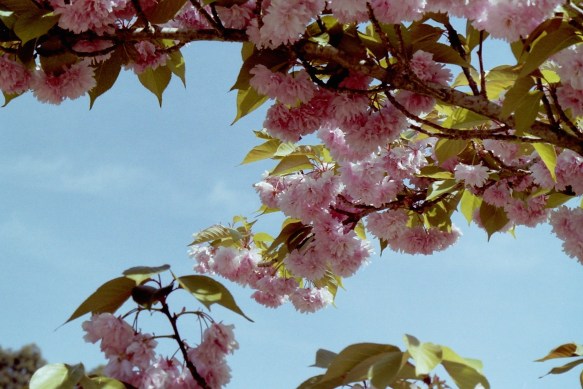
The cherry blossoms have been unfurled for over two weeks now, and they are beginning to flutter down like snowflakes illuminated by sunlight with each gusty wind. Two Robin males scuffled in an oak, quivering the leaves and then dropping as a roiling mass to the ground, sweeping out clouds of dust with furious wingbeats till one bird shot into flight and away, and a satisfied female Robin glided from her viewing perch to join her victorious mate. The hummingbird chicks have already fledged. Crickets and frogs sing after dusk and well into the night; and showers fall gently like velvet curtains that soon lift, unveiling a crisp brilliant world. The days are longer, the sun is warmer, the air soft and perfumed; it is spring.

Despite the crises of humanity, and despite our own urgencies and preoccupations, Nature cycles majestically on, renewing itself at every moment and in every gesture, oblivious to our preferences. The streams swollen with spring meltwater or the runoff of spring showers carry the weathered chaff of mountains down to the sea, slowly feeding the creation of future rocks from the destruction of older ones. The warming earth slowly exhales organic vapors once trapped in frozen ground or as living plant matter, even as new shoots and blossoms emerge. Nature is an entwinement of cycles in continuous change, a completely dynamic reality that has no static state nor time of pause, however calm it may momentarily seem to us. “You cannot step twice into the same river,” said Heraclitus (c. 535 – c. 475 BC), and so it is with the continuous flow of reality. The only constancies in Nature are the processes that cycle matter, energy, and life through the evolving sequence of forms manifested as the universe we perceive.

Every now and then it is good for us to break the spell of our everyday preoccupations, the “ten thousand and one things” that distract us from seeing fundamental reality, the “Māyā” as it is called in Sanskrit, and simply feel our connection to the authenticity behind all our abstractions. Despite our ephemeral externalities, like our financial situation, the amount of marriage counseling we’ve been assessed as needing, the love or indifference of our children, our degree or lack of employment, “whatever” (the epithet for understanding, these days), we embody Nature and thus the only eternity that has actual meaning. “Man is something Nature is doing,” Alan Watts (1915-1973) said in one of his lectures, and remembering that can help you to renew your outlook and produce your own attitudinal spring to counter the psychological gravity of our very imperfect and probably terminal global civilization.

Our externalities will soon enough fade away, and even our bodies will fall apart, ultimately exhaling our consciousness back into the churning void that continuously erupts matter, energy, and life as the Nature we are immersed in and express while visibly alive. During our time as flashes of life we can make our radiance sparkle instead of fading as a monotonous glow, by renewing our minds in ways that are simple and have long been obvious. In our obsessively acquisitive and unfairly competitive political economies, we can find someone to love by being faithful and caring, we can find trusting friends by being trustworthy, we can see some improvement in social conditions by resisting participation in schemes and occupations that are parasitic, mean-spirited, and dehumanizing. We can come upon beauty to enjoy by devoting time to the crafting of thoughtful and beautiful things and motions. We can be courteous, honest, and honorable despite their competitive disadvantages.

It is impossible to live without moral compromise in our civilization since so much of gainful employment involves exploitation of people and Nature, so we must forgive ourselves of our own sins and refuse judgments and guilt cast by others, but we must also make it a matter of personal honor to see that our actions propagate as little harm as we can manage. Attitude is character, and as Novalis said in his paraphrase of Heraclitus, “character is fate.” We experience a life that reflects the attitudes we express.

This ramble is not to be taken as a sermon cataloging a list of do’s and don’ts, but as an invitation to let the conscious part of you have a renewing spring regularly, just as the unconscious part, along with all of Nature, renew themselves on so many timescales with so many cycles: the beating of your heart, daily with the cock crowing, monthly with the Moon’s cool light, yearly with Spring’s resurrection of life; or at any sudden moment when you choose to empty the mind, dispel the Māyā, and actually experience life by sensing your breath.

<><><><><><><>

Originally published:

Renewal
8 April 2012
http://www.swans.com/library/art18/mgarci45.html

Poo-Tee-Weet (Happy Easter)
9 April 2012
https://manuelgarciajr.com/2012/04/09/poo-tee-weet-happy-easter/

<><><><><><><>

Job Application

Job Application

I would be good
at watching the quality of morning sun in fall
shift from crystalline horizontal incisiveness
to a near invisibility of diffused blue,
the texture of reality softening
from a pointillist granularity of color and shadow –
razor sharp in its purity –
to a shaded weave of fluid color, lit from within,
alive with the fullness of the universe,
autumn leaves tumbling like petals of amber
dancing across the luminescent blue,
carried by the eddying sighs of a living earth.

I would be good
at watching wispy white feathers of icy cloud
curl in slow vortical whorls,
sailing with majestic grace across the cupola of atmosphere;
and I would be good at telling you
how the rays of evening sun
glance off the salty foam of wavecrests in the Pacific
to warm the pink bellies of creamy pendulous clouds,
an amorous sky rolling its effulgent Rubenesque abundance
over the sprawling darkening body of the earth.

I would be good
at telling you how the droplets of mist
hang in the air between pine boughs and leaves of eucalyptus
in the quiet of the morning
before the rising sun crests the canyon rim
flooding the humid silence with light,
and how the silent swoop of a hawk low in the forest canopy
cores vortices of clarity as its wake,
a clarity that diffuses into misty white opaqueness,
an opacity that evaporates in the light;
and I could tell you about evening’s blanketing fog
pulled westward over the rim of the canyon
dissolving the panorama of clarity
into a hushed proximate blankness of unlit white
punctuated by the resonant whoo-whoo of a pair of owls
flapping noiseless wings to reach invisible perches
in the heavy coolness of descending night.

I would be good
at telling you how the hummingbirds pair,
drilling the noonday light
with a swirling darting weave of whistling clicks,
sprinkling glints of blazing color
as if sparking the very air with a furious friction;
and I could tell you of opalescent clouds,
rim-lit on passing across the sun,
trailing sweeping purple arcs of evaporating rain
that disappear into the clear blue,
only a shadow reaching the ground.

I would be good at all that.
Surely, many would want to hear
how the day’s light progressed,
being shut away in their self-contained preoccupations –
unconnected.
I could remind them,
my words would reach out
like a mother’s arms to a frightened baby,
encompassing it in warming comfort –
connection to the mother.
Surely, in today’s world
there must be a job like this,
the need is so great.
Think of me as the weatherman of the soul.

16 November 2001

Epiphany On The Glacier

<><><><><><><><><><><><>

Searching For The Hermit In Vain

I asked the boy beneath the pines.
He said, “The master’s gone alone
Herb-picking somewhere on the mount,
Cloud-hidden, whereabouts unknown.”

— Chia Tao (777-841), translated by Lin Yutang (1)

<><><>

Old now, I feel it more than ever — so good
to be here in the mountains!
Die at the foot of the cliff and even your bones are clean.

— Zen monk Jakushitsu Genko (2)

<><><>

“If only you knew how splendid it is up there, that’s where I want to die.”

“The land looks like a fairytale.”

“Adventure is just bad planning.”

— Roald Amundsen (1872-1928), the first human at the South Pole (and North Pole), speaking: in 1928 about the Arctic, and earlier about his 1911 Antarctic expedition. (3)

<><><><><><><><><><><><>

In the 1985 film series “The Last Place on Earth,” about the race between Roald Amundsen and Robert Falcon Scott to the South Pole, the screenwriters graced the cinematic climax of Amundsen’s success, on 14 December 1911, with fictionalized speech of a Zen-like sparseness and focus that matched the expansiveness and extremity of the scene. Against a visual field of white, the lone figure of the screen Amundsen is seen from a distance walking up to an indistinguishable point in space about which the Earth rotates. How does he feel?, his companions ask; “All I know is, how good it is to be alive.” (4)

During January and February of 1911, Amundsen’s expedition established three supply depots for the return trek from the South Pole, at intervals of about 150 km (93 miles) from their base camp on the edge of the Ross Ice Shelf at the Ross Sea. The South Pole is about 1300 km (808 miles) from the Ross Sea. Amundsen’s party for the dash to the South Pole comprised of five men, four sledges and 52 dogs. The five Norwegians departed their base camp on 19 October 1911 and returned 99 days later on 25 January 1912 with only 11 dogs. Amundsen had planned for a 100 day trip.

Scott’s party set off from Cape Evans, 883 miles (1421 km) from the South Pole, on 1 November 1911 with twelve men, ten sledges, ten ponies, and dogs. They established supply depots for the return journey at intervals of about 70 miles (113 km), and as groups of men were no longer needed they were sent back to base camp. By 3 January 1912, Scott’s party was reduced to five men pulling sledges, and no animals (the ponies were butchered for meat). Scott was 169 miles (272 km) from the South Pole and at 10,280 feet (3133 m) elevation. He reached the South Pole on 17 January 1912, thirty-four days after Amundsen, and his men were bitterly disappointed at the sight of the Norwegian flag and the many dog tracks around it. The last entry in Scott’s diary was dated 29 March 1912, he and the two men who had survived to that point were found frozen in their tent on the Ross Ice Shelf only 11 miles (18 km) from a large depot, and about 400 km (250 miles) from Cape Evans.

^^^^^

“How good it is to be alive” is both the alpha and omega of insight that some people find when facing the challenge of surviving extreme circumstances. It can be the endpoint of a difficult and dangerous effort; and it can be a rebirth, a new beginning, a way of focusing the mind to the tasks of living and the joy of consciousness, by overcoming fear. This attitude is the psychological buoyancy that frees the mind to direct a person’s full physical and analytical powers to working out the mechanics of survival. Such a person will go further against the opposition of implacable circumstances than a fearful one.

In the stories and poems of Zen and Taoist sages climbing the mountains to experience insight, like the Japanese poet Ryokan (1758-1831), there is usually the implicit suggestion of a subsequent descent. Otherwise, how could the tale have been told? This descent is the second part of the insight on the goodness of life; it is a descent back into the plane of human interaction, it is the goodness of life among other people. “Man is a social animal” (Aristotle, “Ethics,” IX, IX). (5)

The dual realization of the “goodness” of consciousness, and that this experience is rooted in and nourished by the field of our interconnected individual psyches, is what some call love.

^^^^^

On Friday the 13th of October 1972, a Fairchild FH-227D twin turboprop airplane chartered from the Uruguayan Air Force by the rugby team of Stella Maris College of Montevideo, Uruguay, the “Old Christians,” crashed high in the Andes Mountains while on route to Santiago, Chile from Mendoza, Argentina, the last leg of their trip. Forty-five people, the young men of the rugby team, some family members and friends, and a flight crew of five had boarded the aircraft. Ten weeks later, sixteen survivors were rescued. The search for survivors had been abandoned after eight days, and the rescue only occurred because two of the survivors had trekked from the crash site on Las Lagrimas Glacier in Argentina at 12,020 feet (3664 m) elevation, up to a ridge crest of the Andes Mountains at 14,774 feet (4503 m), and then descended into the valleys of Chile to 4,676 feet (1425 m) elevation by walking a total of 33.5 miles (54 km) over very rugged and desolate terrain in ten days before finding another human being.

The story has been told in a popular book, “Alive, The Story of the Andes Survivors,” by Piers Paul Read (6), which was made into a 1993 feature film “Alive, The Miracle of the Andes.” One good English language summary with links to maps of the area appears on the internet at (7), and another site in Spanish gives an extensive presentation, including a day-to-day chronology, which conveys the emotion of the story as Latin Americans would feel it. (8)

The sensational aspect of the story is that in order to survive, the living had to eat the flesh of the dead. The essential element of the story is that the rescue hinged on the determination of one man, Fernando Parrado, to see his father again or die trying; and that his trek out of the mountains only succeeded because of the combined efforts of the group.

Parrado’s mother had died in the crash, and his younger sister eight days later in his arms. The loss of nearly half of his immediate family, the excruciating effort to prolong the group’s survival for sixty days, and then finally his arrival at the ridge 2754 feet (839 m) above the crash site after a three day climb up the steep glacier to see a westward vista of seemingly endless snowy mountains had savagely shocked then forged Parrado to the realization of “how good it is to be alive.” Yes, death in these mountains seemed a certainty, but that apparent certainty did not compel him to surrender. He could choose to use all that was in him to find help and to return to Montevideo to express his love to his father personally, or to approach as near to that goal as the force of circumstance would permit. He had found a vision worth dying for; “how good it is to be alive.”

Of the forty-five people on FAU (Fuerza Aerea Uruguaya) Flight 571, nineteen died during the crash or the first eight days. The remaining twenty-six would dwindle to sixteen and struggle to overcome the tensions of surviving at high altitude on the snow in the wrecked fuselage, without cold-weather clothing and mountaineering gear like boots and dark goggles, with very little food and no medical supplies. Despite the inevitable conflicts and the depressed or debilitating psychological state of some of the people, an effective and admirable level of group cohesion evolved and was applied to the purpose of self-rescue.

It might seem that the commonality of religion (Catholic), class, school, sport and even team would more easily incline individuals to cooperate in unexpected and difficult circumstances. However, it is really personal character that determines the capacity for cooperation under stress, because extreme circumstances can give rise to panic, desperation and despondency, which can easily lead to a lack of judgment, and unthinking selfishness in behavior.

One key result of the group effort was the fabrication of a large, three-person, insulated sleeping bag. The insulation was salvaged from the tail section of the airplane, down the slope of the glacier about a kilometer or two (about 1 mile) from the fuselage; and the bag was sewn by a group of the survivors. When the supply of thread was finished, they had to use wires pulled from the electrical circuits in the fuselage. This sleeping bag enabled Fernando Parrado, Roberto Canessa and Antonio Vizintin to survive the nights during their trek west up the wall of the glacial valley to the crest of the Andes.

It was there that Fernando Parrado had his epiphany. After the sinking dread that came upon seeing the snowy jagged crags of the Andes stretching far out to the west, instead of the lush green valleys of Chile falling away to the Pacific, he accepted the fact of his mortality and awakened to his power to choose how to employ it. About this epiphany, Cynthia Boaz wrote “in the most hopeless of situations, we still have a choice. At its core, Nando’s story demonstrates that we always have a degree of control over our lives, even if that choice is simply defining the terms under which we die. This phenomenon is much more than hopefulness or optimism; it is the manifestation of human agency. It is the essence of empowerment.” (9)

Fernando Parrado describes his moment this way: “My love for my father swelled in my heart and I realized that, despite the hopelessness of my situation, the memory of him filled me with joy. It staggered me. The mountains, for all their power, were not stronger than my attachment to my father. They could not crush my ability to love. I felt a moment of calmness and clarity, and in that clarity of mind I discovered a simple, astounding secret: Death has an opposite, but the opposite is not mere living. It is not courage or faith or human will. The opposite of death is love. How had I missed that? How does anyone miss that? Only love can turn mere life into a miracle and draw precious meaning from suffering and fear. For a brief, magical moment, all my fears lifted and I knew that I would not let death control me. I would walk through the godforsaken country that separated me from my home with love and hope in my heart. I would walk until I had walked all the life out of me, and when I fell, I would die that much closer to my father.” This was Thursday, 14 December 1972. (10)

Parrado’s strength of purpose was enough to convince Canessa. Vizintin was sent back — a quick sled ride downhill — to wait with the thirteen others while Parrado and Canessa continued on with all the provisions the three had carried to that point. Six days later, on the 20th, the trekkers made contact with a Chilean horseman tending his cattle. On the 22nd and 23rd, Chilean helicopters brought rescue and medical people to the crash site and ferried the survivors out, two days being necessary because the weather and travel time only permitted one trip per day, and there was a limited carrying capacity.

^^^^^

There are many seasonal and religious themes that can come to the minds of Christians and people of the Americas when reflecting on the story of FAU Flight 571. The most poignant is that of Holy Communion, the sixteen survivors today are literally “the resurrection and the life” of many of their companions. They are a tight knit group who 35 years ago entered a horror during the harvest-time gaiety of pumpkins, Halloween and the Day of the Dead. They endured a ghastly negation of Thanksgiving, and were lifted to salvation for Christmas. Three Kings among them set forth from east to west following the star of Parrado’s vision, which carried the hopes of many and was itself the gift that gave birth to new lives for them all. Their gift to us is their story, reflecting on it can center minds otherwise distracted by the relentless hyper-animated flash of crass commercialism and mawkish religiosity that propels so many from pumpkins to turkeys to Santa Claus to cheap flat champagne with even shallower resolutions for “new” ways of living. The future is a fiction.

^^^^^

The plane in this story was a Fairchild FH-227D, an American built version of the Fokker F27 F. I flew in a Fokker F27 F over the Sierra Nevada Mountains of California many times, on trips to and from the Nevada Test Site. Flying at 18,000 feet (5487 m) and looking down, the rocky crags poking through the snow-pack (at about 13,000 feet or 4000 m) are very clear, and the expanse of the desolation — for a marooned unfortunate — is evident. Having been through bumpy flights and frightening storms, it is not hard for me to imagine the experience of the FAU Flight 571 crash.

^^^^^

The majestic inhuman beauty of the Andes made a compelling impression on the FAU Flight 571 survivors, and you, too, can experience it through the photographs of a 2005 expedition to retrace the trek over the crest of the Andes by Parrado and Canessa, on the exact same dates 33 years after the events. (11) The Uruguayan trekkers had no mountaineering experience nor specialized equipment and clothing, there was no trail laid out for them, and they had no maps. Try imagining this as you look at the 2005 pictures. The 2005 expedition was sponsored by National Geographic. (12)

^^^^^

To me, a compelling aspect of this story is how a sense of appreciation and love can grow out of the effort to overcome adversity, and how that in turn can give one a greater psychological stamina. This same theme appears in Zen, and I believe is the essence of Buddhist insight regarding “enlightenment” as opposed to religious superstitions, which can have an uplifting effect on people facing hard times, but which are unreliable because they are a placebo effect based on fantasy.

In his book “Man’s Search For Meaning,” (1946) Viktor Frankl expressed a similar idea. His epiphany was forged by surviving a Nazi concentration camp; he was a Jew. For Frankl, survival demanded that one made a conscious choice to live fully, even happily, despite external circumstances. Again, externalities may control my life and my lifespan, but I can always choose my attitude within my time of consciousness. The attitude that made life as fulfilling as possible, whatever the constraints, was one that saw itself as directed toward a goal greater than oneself. A great love for another person, for one’s family; a desire to preserve and publish original ideas on your field of study (Frankl’s motivation); a desire to produce art, literature or some invention you can visualize; these are all examples of what could motivate a person to “live through anything” or die trying. Frankl saw humans as having an innate need to create something of personal meaning out of the physical and mental labor of their lives. If individuals can bring this insight to consciousness and make it specific to their particular lives, they would be as steeled as any human could become to face the buffeting by reality.

What Parrado and Frankl express about their epiphanies may simply be particular examples of Novalis’ elegant presentation of Heraclitus’ aphorism “Character is fate.”

^^^^^

On a less elevated level, a sort of Marxian view of the FAU Flight 571 story would be that in the extremes of scarcity, group action and sharing rather than resource competition and inequity have to be the rule to survive. Yet, despite this there is no loss of individuality, in fact it seems to flower as each person discovers their niche in the collective endeavor. There could also be an element of dismal math here, when there simply isn’t anything, then everyone is “poor” and thus “equal.”

If we look at the Andes story as a microcosm of humanity in a world with a decaying environment, then we could say the lesson is that cooperative attitudes must precede any ability to respond effectively — globally — to halt and then repair environmental damage. Otherwise, I suppose we could hope that as environmental damage becomes more widespread and threatening we will all be drawn together into a more cooperative frame of mind, though this is a rather unappealing form of hope. The analogy does not preclude the possibility that humanity will simply kill itself off unnecessarily through blind, obstinate stupidity. One need only drop names like Cheney and Bush to make this point.

The FAU Flight 571 story — as a story for us — pivots on a realization of happiness by Fernando Parrado that relieved him of any anxiety about the inevitability and near eventuality of his own death. The external reality remained unchanged, and it was crushing and cruel, but he had changed. All the survivors had to have this experience to some degree. The escape was as much a shedding of psychological restraints as it was a trek out of the wilderness; survival was transformation, it was a release of one’s former self. I think this is the essence of the “happiness” that is signified in Thomas Jefferson’s phrase “pursuit of happiness,” and I think the reality upon which this “happiness” is based for any individual is their solidarity or “brotherhood” and “sisterhood” with the sea of individuals that surrounds them as our communities, societies and nations. Happiness is simply caring for others who care for you, and wealth can only be the extent of that mutual affection. The political structures of a population with this attitude would necessarily be socialist. So, happiness is solidarity, and solidarity is the objective of Socialism. George Orwell put the matter this way:

“I suggest that the real objective of Socialism is not happiness. Happiness hitherto has been a by-product, and for all we know it may always remain so. The real objective of Socialism is human brotherhood. This is widely felt to be the case, though it is not usually said, or not said loudly enough. Men use up their lives in heart-breaking political struggles, or get themselves killed in civil wars, or tortured in the secret prisons of the Gestapo, not in order to establish some central-heated, air-conditioned, strip-lighted Paradise, but because they want a world in which human beings love one another instead of swindling and murdering one another. And they want that world as a first step. Where they go from there is not so certain, and the attempt to foresee it in detail merely confuses the issue.” — George Orwell (“Can Socialists be Happy?” 24 December 1943)

“Love is the final goal of world history – the One of the universe.”
— Novalis (1772-1801)

Enjoy your time in the wild, behind every ridge is a marvelous vista.

NOTES

[1] This poem opens Alan Watts’ book Cloud-hidden, Whereabouts Unknown, a “mountain journal” (1973, Random House). It is a series of essays written between 1968 and 1972.

[2] This poem opens Jack Turner’s book Teewinot, Climbing and Contemplating the Teton Range. (2000, St. Martin’s Press)

[3] Map of Amundsen and Scott routes to the South Pole in 1911-1912
The Fram Museum,
http://www.fram.museum.no/en/default.asp?page=158

[4] The Last Place On Earth,
a 1985 film series based on Roland Huntford’s book with the same title,
http://www.imdb.com/title/tt0088551/

[5] “Man is a social animal” (Aristotle, “Ethics,” IX, IX)
http://www.cliffsnotes.com/WileyCDA/LitNote/id-21,pageNum-116.html

[6] Piers Paul Read, Alive, The Story of the Andes Survivors,
(1974, Avon Books/J. B. Lippincott, Inc.) ISBN 0-380-00321-X

[7] Uruguayan Air Force Flight 571, The Crash and Rescue,
wikipedia,
http://en.wikipedia.org/wiki/Uruguayan_Air_Force_Flight_571#The_crash_and_rescue

[8] Alexis J. Scarantino, El Milagro De Los Andes,
http://www.carlitospaez.com/elmilagrodelosandes/

[9] Cynthia Boaz, Thoughts About the True Miracle in the Andes,
14 October 2007,
http://www.truthout.org/docs_2006/101407A.shtml

[10] Fernando Parrado with Vince Rause,
Miracle in the Andes: 72 Days on the Mountain and My Long Trek Home, (2006, Crown Publishers)

[11] Ricardo Peña and James Vlahos,
National Geographic Adventure Expedition December, 2005,
Alpine Expeditions,
http://www.alpineexpeditions.net/ngc_adventure/index.html, http://www.alpineexpeditions.net/photos/ngc_adventure2/index.html

[12] Alive, Retracing The Survivors Daring Escape,
April 2006, National Geographic Adventure,
http://www.nationalgeographic.com/adventure/alive/survivors-expedition.html

Acknowledgment: Thanks to Jeffrey St. Clair for recommending Jack Turner’s book.

[Published by Counter Punch on 21 November 2007]