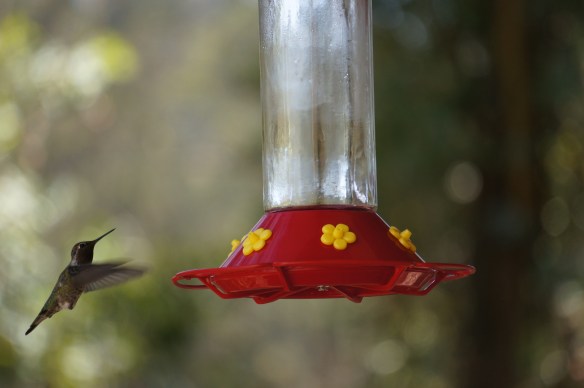
I love hummingbirds (Torchilidae) and have put up feeders for them for many years. This is a presentation on what I have learned about and seen regarding the hummingbird species that live in my area, or are regular visitors. The five parts of this presentation follow, along with some photos.
Enjoy!
<><><><><><><>
Hummingbird Moments
(video, 5:28)
30 July 2015
https://youtu.be/xrqm-_eLCr4
<><><><><><><>
Hummingbird Release
(video, 2:06)
18 June 2015
https://youtu.be/aM3ZutdAghQ
<><><><><><><>

Hummingbirds Near Me
(species near San Francisco Bay)
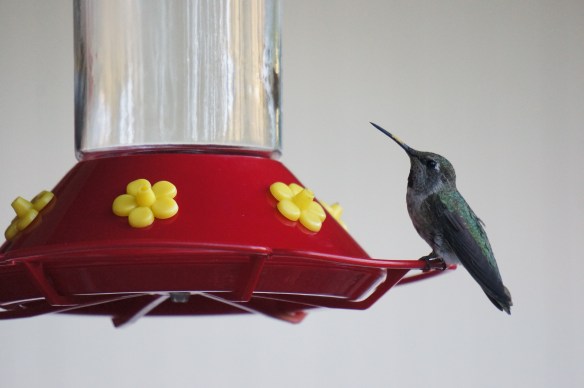
The most common species here (in Oakland, California, USA) is the Anna’s Hummingbird (Calypte anna), which are the largest-sized hummingbirds in this area, being 9 centimeters (3.5 in) to 10 centimeters (4 in) long, and weighing between 3 to 6 grams (0.1 to 0.2 ounce). The back feathers for both males and females are colored iridescent-metallic green. Males have blackish crowns and gorgets (a band around the throat), which flash rosy purplish red at certain angles to the sun; and on the chest grayish feathers mixed in with metallic green ones. Females have spotted throats with a central patch of red spots, grayish-white underparts, and white-tipped outer tail feathers. Juveniles have plainer color schemes.
I also see Allen’s Hummingbird (Salasphorus sasin) regularly but less often. The Allen’s Hummingbirds have about 85% of the length, and 3/4 the mass, of Anna’s Hummngbirds (of length 8-9 cm, 3-3.5 in; and weighing 2 to 4 grams, 0.075 to 0.15 ounce) but they are fierce! They charge other hummingbirds regardless of size to claim a feeder. The Allen’s have a rusty reddish color (rufous), along with some green. Males have iridescent green crowns and backs, white chests, rufous sides, rumps and tails, and they also have iridescent copper-red gorgets that appear dark when not in direct sunlight. Females are bronze-green above and along the central tail feathers, with white-tipped outer tail feathers, flecked throats, and white underparts with rust tinge on their flanks.
Another species I see now than then is the Black-chinned Hummingbird (Archilochus alexandri). These birds are of a size and coloration similar to Anna’s Hummingbirds. Black-chinned Hummingbirds are 8-10 cm (3.25-3.75 in) long, and both males and females have green backs (or, upper parts). The males have a black chin band that combined with the dark crown makes the entire head appear black when not in direct sunlight. The male’s chin band is sharply underlined with an iridescent violet-purple throat band, and below that are the mixed green and grey feathers of the underparts down to the rump. The female has a white throat and breast, buff sides, and white-tipped outer tail feathers. The male’s wings make a dry buzz in flight, I have observed this and it is quite distinctive. Black-chinned Hummingbirds have a greater preference for the dryer and warmer inland valleys east of San Francisco Bay than do the Anna’s Hummingbirds.
The Rufous Hummingbird (Salasphorus rufus) is very close to the Allen’s Hummingbird in both size and coloration, and it is possible I have seen members of this species in late winter and early spring during their migration north from Southern California and Mexico, and in late summer during their migration south from Alaska and the Pacific Northwest.
The Anna’s Hummingbirds originated in southern California and Mexico, and only moved north along the California coast as settlers planted eucalyptus trees and other flowering trees and bushes, and suburbanites put up nectar feeders in their gardens, and hung them from house eaves. I am guessing that the Anna’s Hummingbird evolved in green leafy coastal chaparral terrain (like that of the San Diego and Baja California region), while the Allen’s Hummingbird evolved in coastal redwood forests, and that the Anna’s Hummingbirds settled in as permanent residents in coastal Central and Northern California largely in the late 19th and early 20th centuries.

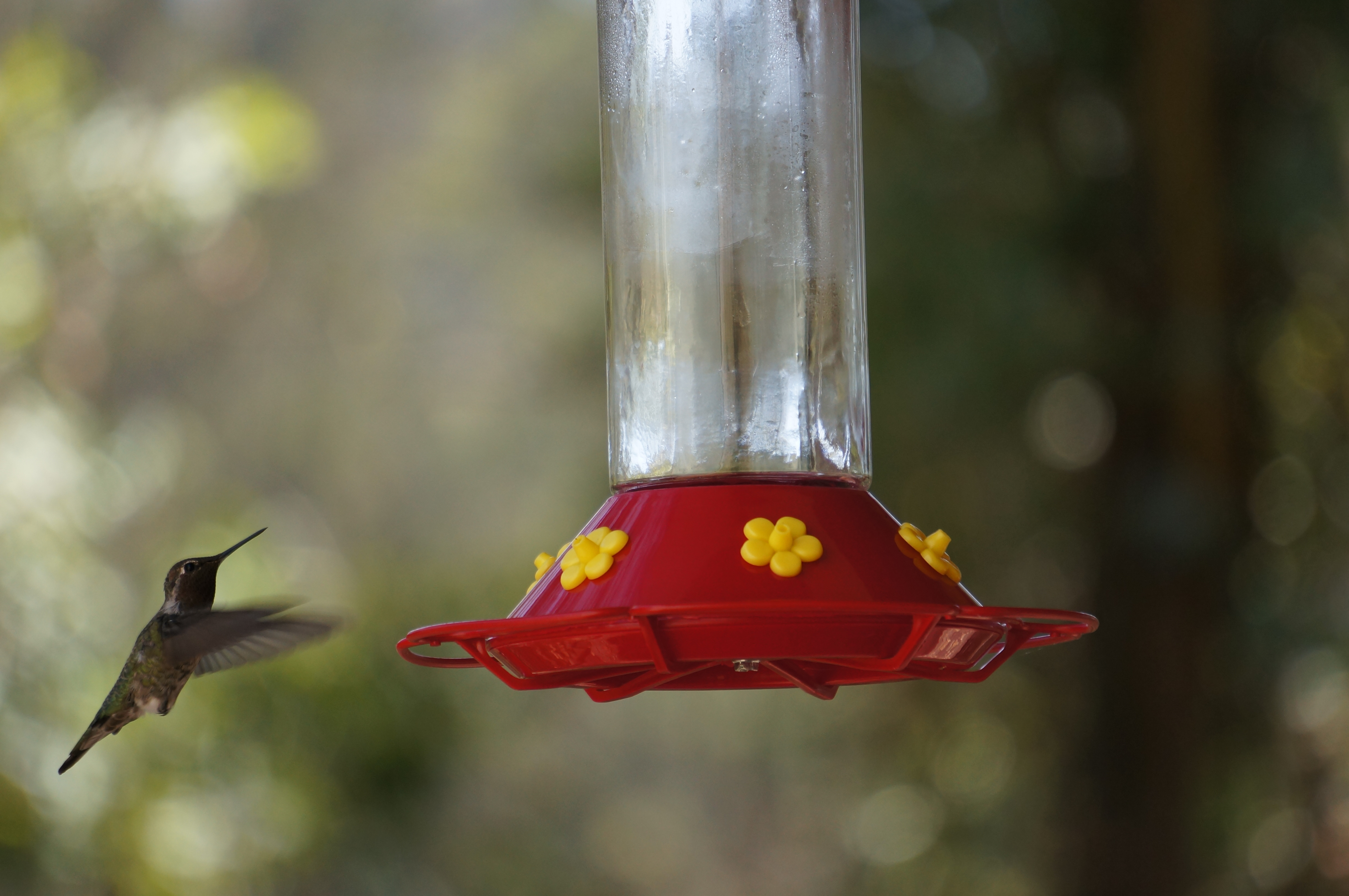
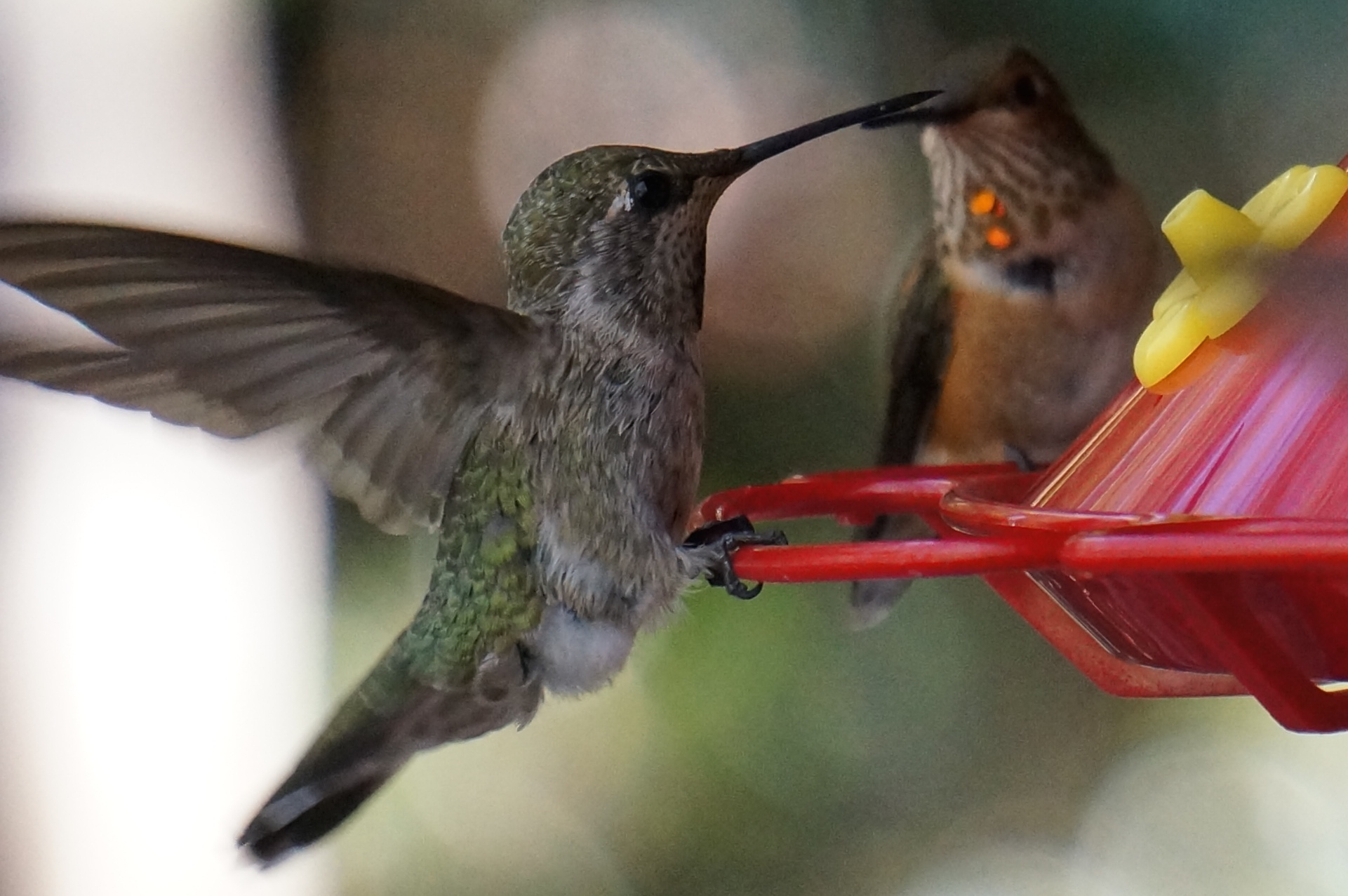
Anna’s Hummingbird (female, or juvenile)

Allen’s Hummingbird (young male, or female)

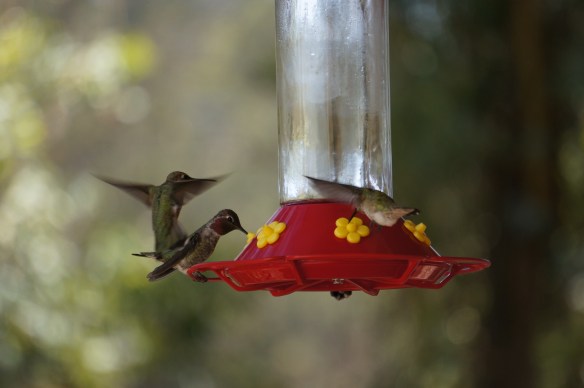
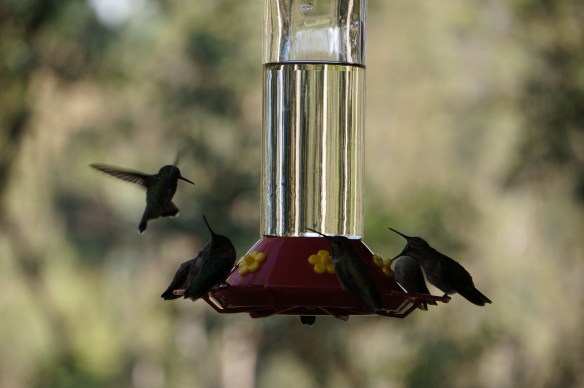
Anna’s Hummingbird (female, or juvenile), Allen’s Hummingbird (young male, in back)
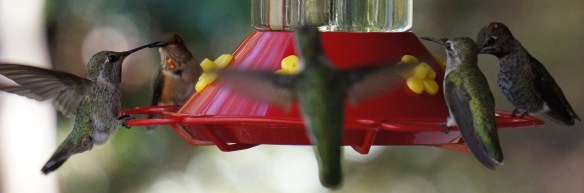
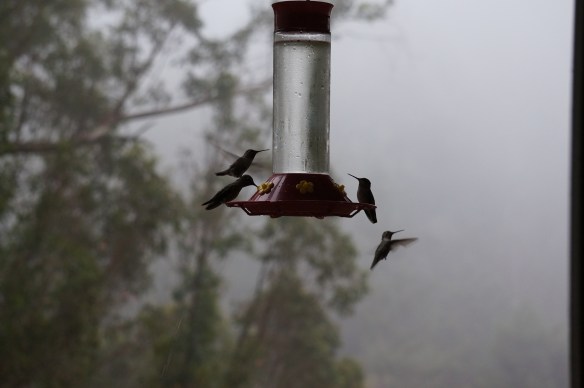
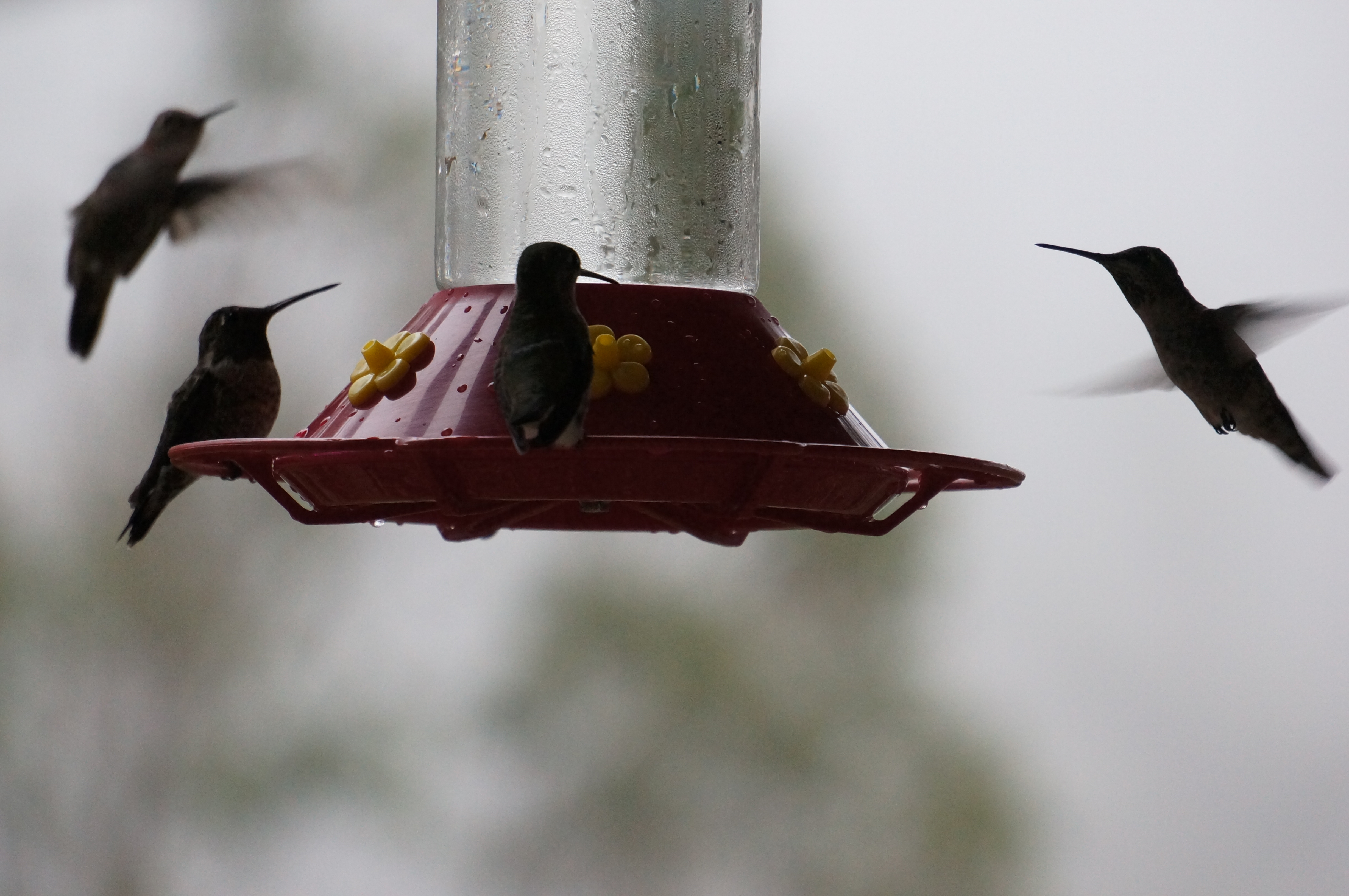
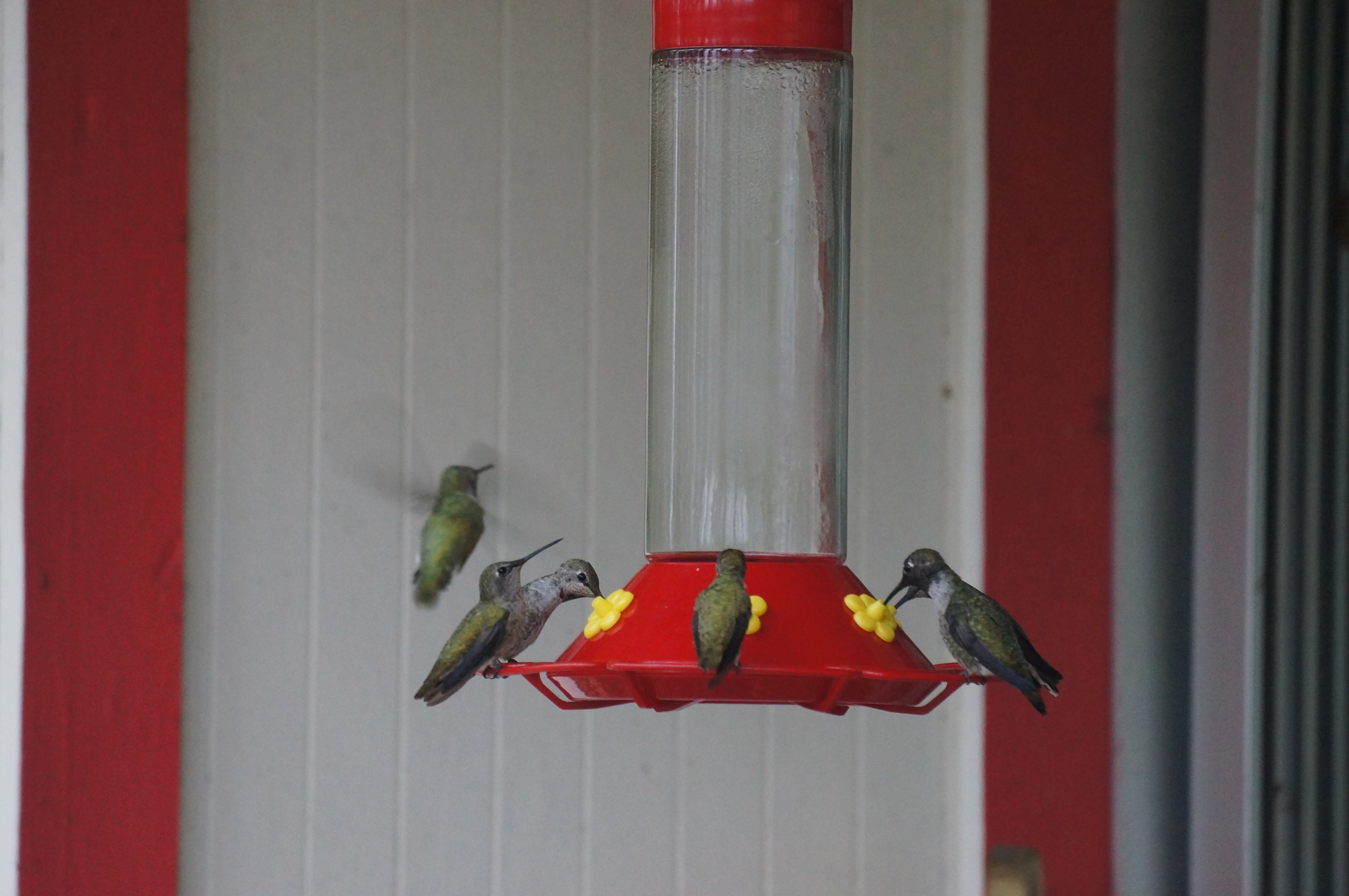
L to R: Anna’s (f), Allen’s (m), Anna’s, Anna’s (female or juvenile), Anna’s (juvenile male)
All hummingbirds are very feisty, though the Allen’s are particularly so. They are quick, proud and determined little motors of life, plucking insects out of the air in flight, and taking over and defending sources of nectar, which they lap up with gusto with very fine, long forked tongues. Despite what appear to us as delicate little bodies, hummingbirds are creatures of big and ferocious spirit, they are known to chase off birds of any size that threaten them, or perhaps just annoy them.
These are creatures that live life at a ferocious pace with imperious elegance, that make judgements with haughty confidence, and execute their decisions with lightning-fast precision. They are sugar transformed into sparks of wonder and flashes delight that arc through the air like rays of electrified rainbow.
<><><><><><><>







Overtones Of Awareness
The reality we live in is an infinite spectrum of overlapping cycles of creation and destruction, most of which usually remain outside of consciousness because we are all so focused on our immediate wants and distractions.
Sometimes it happens that the rhythms of two monads resonate in harmony because the fundamental frequencies of their individual creation-destruction cycles match, or synchronize with one as the overtone of the other. A human consciousness involved in such a synchrony could experience it as telepathy, or love, or cosmic consciousness, or all three.
I have been thinking about the past that I have lived through. This happens when you get old, old being defined as the age when a person begins to think about the past they have lived through. Smart old people don’t talk about this because nobody — especially in the America of youthful instant omniscience — wants to hear about it. Many old people are not smart, so they talk about their memories and hard-won wisdom (being generous in the use of that word), and as a result suffer being ignored except for being ridiculed, and experience an increasingly bitter loneliness in their final years.
I have been comparing my memories of significant events half a century ago to the commentaries, commemorations, and propaganda about them in present times.
In 2009, I recalled how incredible it was to experience the popular exultation in Cuba after the success of the Cuban Revolution of 1959. Freedom! I wish this for everyone on earth, always.
In 2010, I remembered how pleased we Catholics were that one of our own, John Fitzgerald Kennedy, had been elected president despite the wide popularity in 1960 of that stalwart commie-chaser Richard M. Nixon. (The other zealous commie-hound, still popular to American public memory, was Robert F. Kennedy.)
In 2011, I recalled how my juvenile political consciousness began to darken because of the fact, not the failure, of the Bay of Pigs invasion of April 1961 and the Kennedy brothers’ crusade against Cuban communism. My president had sent an armada against the home of my grandparents. Could my family ever return to Cuba?
In 2012, I remembered our family living in terror through the Cuban Missile Crisis of October 1962. At one point the question for us was: will Kennedy drop a nuclear bomb on grandma and grandpa in Havana before Khrushchev drops one on us in New York, or vice versa?
During this summer of 2013 we have seen much commemorative pageantry about Martin Luther King, Jr.’s stirring sermon on the steps of the Lincoln Memorial in Washington, D.C. (which I had visited in 1961), but nationally we have yet to seriously grapple with the pith of Martin Luther King Jr.’s message of brotherhood and sisterhood. As a society we cannot say we are more egalitarian and caring than we were fifty years ago.
Later this year I expect to see much ponderous vapor issued to coincide with the half-century anniversary of the assassination of President John Fitzgerald Kennedy on November 22, 1963. I remember the day and that week well. The sky was grey, the air was cold, the murder of a murderer was televised, and then all television was one long funeral; Thanksgiving was very subdued. I saw the “eternal flame” over John Kennedy’s grave at Arlington National Cemetery the following spring on a school trip to the nation’s capital. I also got to see an FBI man shoot off a Thompson submachine gun in the basement gun range of the FBI headquarters building: big noise, flares, and splats. Education for school kids.
I remember many things, and I hear so many lies about them today. But, enough of old-mannishness. I want to describe one experience I had of the resonance of awareness.
Back in the glory days of the Regression Reich of Ronald Reagan — when Americans had orgasmically plunged into an intellectual, moral, and spiritual nosedive that Godless hope will eventually level out — I was happily employed as a physicist dreaming up ways to focus the explosive energy of nuclear bombs into ray-beams and jets that could be pointed at the clay pigeons of imperial ambition. This would never be practically realized because the concept was a fantasy concocted by liars to fleece political nincompoops. It did work at fleecing.
At the time, I lived in a small Oakland (California) bungalow at 73 meters elevation (240 feet) near the crest of a small knob just northeast of the transition from the Coast Ranges to the flat land that extends about 5 km (3 miles) southwest to San Francisco Bay. That house would be nearly shoreline property if the Greenland and Antarctic ice sheets were to melt completely, because sea level would rise 65 meters (213 feet). The southeast to northwest trending Hayward Fault lay about 800 meters (0.5 miles) northeast of the house, and sometimes made it jolt and tremble when there was a surge of slippage along the fault.
Just east of the Hayward Fault from my old house lies a ridge, informally called the Leona Heights, whose crest line hovers at elevations between 274 m (900 ft) and 365 m (1200 ft), and that is composed of volcanic rocks about 150 million years old, from the Jurassic geologic period (201.3 Ma to 145 Ma; Ma is mega-annum, a unit of time equal to one million years). The Leona rocks were born as lava, ash, and rubble erupted from volcanoes in an oceanic arc, and have been conveyed eastward by the tectonic plates underlying the Pacific Ocean, to be altered as they were compressed onto earlier accretions crumpled onto the western margin of the westward moving North American continent.
In late afternoon and early evening during summer, the setting sun would cast its warm orange light on the western slope of Leona ridge with its tawny-colored rocks, dry golden grass and scattered oaks, and the image of that mountain would pulsate to the eye as if breathing, and glow as if flushed by a beating heart.
The back of my old house had a deck and faced San Francisco Bay. My view of the buildings in San Francisco to the west was narrowly framed by trees, and was horizontal, because of the modest elevation of my wage-earner neighborhood in comparison to that of the higher situated capital-gains neighborhoods. That view has undoubtedly disappeared with the growth of the intervening trees and shrubbery. During that particular summer, I had an ice chest on the deck with chilled Corona beers (sometimes Dos Equis, and sometimes Bombay Sapphire Gin and tonic), and I replenished it daily. I would also cook fish filets over a charcoal grill. It was nice.
One afternoon I was out on the deck immersed in reading The Platform Sutra of the Sixth Patriarch (translation by Philip B. Yampolsky, 1967) when I heard the clicking song of an Anna’s Hummingbird. I maintained a nectar (sugar syrup) feeder, which hung from a tree branch that extended over one corner of the deck, and I saw hummingbirds frequently. The feeder was near my deck chair because I liked seeing the hummingbirds at close range. If I were quiet and still they would soon gain the confidence to buzz in and out for meals in my presence, and for rests on the perch bars attached to the feeder.
These birds are amazing flyers: hovering, darting, and weaving to pluck insects in flight to add protein to their diet besides liquid carbohydrates, and making whirling aerial jousts (between males) and courting dances of great speed and agility, sometimes shooting right across my view inches from my nose, so intent were they on chasing each other. I sometimes wondered that I didn’t ever get a needle-like hummingbird bill arrowed into my temples or shins. They can reach speeds in excess of 54 km/h (34 mph). With their iridescent green backs and the iridescent ruby face and throat flares of the males, the air would seem to spark red and green as they zipped across my vision. In late afternoon the setting sun would backlight their activity from my deck chair vantage point, and they would dance as buzzing shadows outlined in blazing light.
The rhythm of hummingbird life is much faster than that for human life. Hummingbirds beat their wings between 12 and 80 times a second, and their hearts are known to pump at up to 1,260 beats per minute (21 times a second). The normal human heart rate is between 60 to 100 beats per minute. To conserve energy when asleep or when food is scarce, hummingbirds go into a hibernation-like state called torpor where their metabolism slows to one-fifteenth its normal rate. Despite such fast living they are hardy creatures, those that manage to survive their first perilous year usually live 3 to 5 years, and there are several recorded cases of 10- to 12-year longevity. Still, all animals have a life expectancy of about 1 billion heartbeats; long-lived humans may exceed 2 billion (the same as chickens that avoid being eaten for 15 years).
Having been called away from the Platform Sutra by the song of a hummingbird perched further off in a nearby redwood tree, I decided to position myself for a possible closer look. I got up from my deck chair and stood close to the feeder. I waited. In the shade under the boughs of the feeder tree the August marine air was balmy, calm, and relaxing. Soon, the miniature hovercraft rotor sound of a hummingbird filled the space around the feeder, and an Anna’s Hummingbird female alighted to dip her beak into the hanging pool of nectar. As she was absorbed in the suction of sweet delight, I observed the delicate grey-brown mottling pattern and filigrees of her breast feathers, and the exquisite detail of her design.
Suddenly, she became aware of my presence as an animal being, rather than as a static tree or rock. She lifted off the feeder perch into a hover and looked into my eyes. I thought she would dart away in a moment, but she stayed suspended in air, analyzing me. I was enchanted, my eyes following her slow swaying motions in hover. Or rather, her precision hovering tracked my eyeballs exactly.
In an instant, she flew close to my face, and I was so surprised I froze in place. She would slowly drift from side to side in a motion as wide as the spacing of my eyes, as if a snake charmer hypnotizing a cobra. I was entranced. I looked into her shiny black beady eyes and sent a telepathic message of admiration for the wonder she was, and gratitude for being allowed to experience her presence so closely. I was so slow in comparison to her, my siphoning from the ice chest having increased the viscosity of my motions. Her beak was so close to my face that I realized this bird could easily lunge at me and puncture my eyeballs, but I trusted her. As she turned her head to cast one eye then another into my own gaze, I felt the reception of a message from her, an acknowledgement of my existence, and even some gratitude for the nectar. Our bubble of connected awareness lasted for a few minutes, but then it popped and she was gone.
It is difficult to dissect the experience verbally, but basically we two beings saw eye-to-eye in a consciously-shared and harmoniously-synchronized few minutes of in-the-moment delight in our existence within the larger symphony of living reality. The mountain was breathing warmth, my heart was the pulse of the Earth, and the hummingbird a focal point of the scintillating sky. We were one.
It is rare to have as consciously intimate, knowing, and expansive an experience with another human being as I had with that hummingbird. That it was easy for her and surprising for me was a revelation about the degree of refinement of awareness that is possible in the animal world. We humans may have become so narcissistic about our own babbling that we have become deaf to the endless singing and harmonizing occurring in the natural world, which is to say all around us.
What is the point of life, beyond delight in the awareness of our existence in the moment? So much could be cured, settled, put to rest if more of us regained receptivity to the song cycles of creation, destruction, and being that we are immersed in.
Our share of eternity is to briefly give identity to monads of mass-energy that cycle through space-time according to enduring principles. Each evanescent individual expresses the eternal universal totality.
A human life is to the earth as a glint of sunlight on the surface of rippling water.
<><><><><><><>
“Overtones of Awareness” was originally published at Swans.com on 9 September 2013.
http://www.swans.com/library/art19/mgarci70.html
<><><><><><><>



















 manuelgarciajr