The Imprisoned American Mind

<><><><><><><><><><><><><><><><><><><><><><><><><><><><><><>

The following essay of mine originally appeared as:

The Imprisoned American Mind
2 August 2004
http://www.swans.com/library/art10/mgarci19.html

It is reprinted here without change. If you substitute “Donald Trump” for “George W. Bush,” “Hillary Clinton” for “John Kerry,” and “Bernie Sanders” for “Ralph Nader,” then you will easily find this essay “up to the minute.” Enjoy (or bemoan).

<><><><><><><><><><><><><><><><><><><><><><><><><><><><><><>

The Imprisoned American Mind

“Resistance to the organized mass can be effected only by the man who is as well organized in his individuality as the mass itself.”

—C. G. Jung, The Undiscovered Self, 1957


“I suggest that the real objective of Socialism is not happiness. Happiness hitherto has been a by-product, and for all we know it may always remain so. The real objective of Socialism is human brotherhood. This is widely felt to be the case, though it is not usually said, or not said loudly enough. Men use up their lives in heart-breaking political struggles, or get themselves killed in civil wars, or tortured in the secret prisons of the Gestapo, not in order to establish some central-heated, air-conditioned, strip-lighted Paradise, but because they want a world in which human beings love one another instead of swindling and murdering one another. And they want that world as a first step. Where they go from there is not so certain, and the attempt to foresee it in detail merely confuses the issue.”

—George Orwell, “Can Socialists Be Happy?”, 24 December 1943


Can an awareness of political reality be re-awakened in the American public mind? How do we produce this Second American Revolution?

The Perfect Prison Of The Unused Mind

If some great power were to grasp the molten magnetic generator at the core of the Earth, and twist it so the field now pointed with magnetic north emanating from Ecuador and magnetic south from Sumatra, then all the compasses on the planet would point differently, and all our systems of navigation would have to change.

The psychological relationship of each individual to the whole of society is similar to that of each compass to the planetary magnetic field. Our personal compass helps us align ourselves with the norms of society, with “good” and “evil,” and with our own conscience. When our psychic compass is broken, we are psychotic — our contact with reality is very seriously impaired.

Imagine a group of psychotics, one possibility being the inmates at an insane asylum. This would be an accumulation of individuals with broken psychic compasses confined in a protected environment that is managed by people with excellent psychic compasses, who are intent to help. Such a scene would speak well of a larger enlightened society.

But there is another possibility. The society could be deviant, its psychic “field” twisted and misdirected so its norms are skewed from what is easily understood — outside of this society — to be decent and humane. In such an aberrant society, the governing psychic field can easily orient the compasses of individuals who do not have their own independent source — or frame — of reference. Such individuals, placid in their continuity within the social norms of their group, are members of a mass psychosis.

The American prison guards in the Abu Ghraib jail in Baghdad were normal people fully adapted to their mass psychosis. Adolph Eichmann, a senior executive in the Nazi SS bureaucracy managing the industrial-scale death camp industry, was an individual proven by psychological testing to be normal and sane, and he too was a fully adapted member of a mass psychosis.

An individual inoculates himself from being infected by mass psychoses by developing a capacity for critical thought, an understanding of human nature and the reality of his own personality, by consciously working to improve and maintain his character, and by developing connections to sources of insight and compassionate awareness (religion can be one such example). This requires continuing mental effort over one’s lifetime.

Minds that remain largely unused because of ignorance, which is the child of laziness, will be found by mass media (“propaganda,” in the old days), filled with easily swallowed psychic worms that are coated with syrupy sweet sex, glistening cherry-red violence, desire-fulfillment fantasy, voyeurism, and lowest-common-denominator semi-pornographic mass culture. Once embedded, the underlying psychic messages re-program the thought patterns of the consuming individual for ease of remote control by the social programming elite.

If you don’t think, someone will do it for you, but not for your benefit.

The psychology of mass psychosis is how small groups of wealthy elites control larger populations. It may seem easy to look back on Hitler and the Nazi’s control of the German people and say “not me, not today.” But any truthful look at American politics would have to conclude that amazing progress has been made in the techniques of social control. Just look at how Americans so overwhelmingly volunteer to impoverish themselves, their society, their children’s future, even the very planet they live on — perhaps irreparably, all for the unique purpose of increasing the moneyed wealth of the moneyed class.

Control of a mass psychosis is the ultimate pyramid scheme. Political dictators seek to become cult deities, and economic elites seek to become admired nobilities by the combined labor and sacrifice of the enthralled proletariat, as well as by their delusional worship. A political revolution to free the serfs, the servants and the workers will have to overcome or bypass not only the physical and economic power of the state, but also the psychological power of a crypto-religious mythos that has been backfilled into the intellectual and spiritual void of an unthinking populace. And the people will resist the toppling of their idols, they will resist their own liberation, they will resist doing the mental work necessary to stay free.

Imagine the reaction to telling people “patriotism is psychotic.”

Zombie Nation

We are already brainwashed, and it is permanent. We are all conditioned, much as Aldous Huxley describes in his novel Brave New World. By high school, we are largely indoctrinated and imprinted with our attitudes and allegiances, and it is the rare individual who can overcome their silly embarrassment and their mental laziness to actually and overtly change their mind. Thought is effort, and this is contrary to being happy (remember “pursuit of happiness”?) because in minds trained for consumption, effort is work and work is unhappiness, and because achieving knowledge usually makes you angry at the follies and chicanery being committed under the cover of public ignorance — a socialist’s fundamental problem; read George Orwell’s essay “Can Socialists Be Happy?”

Most people are really of quite simple mind. They imagine that how they think (which is to say, not thinking much at all) is somehow an essential core of who they are — their self definition, their personality. Thus, confronting some comfortable, church-going Republican with vigorous calls to turn away from their party during the upcoming election is tantamount to asking them — from their frame of reference — to self-negate, to not be, to act and think as they “can’t” and as their anti-selves would act. You are asking someone to wrench free from their mass psychosis.

In the spirit of psychotic bipartisanship, let me note that the previous example can be inverted, to that of a conservative Republican importuning a brainwashed godless communist to betray his allegiances. However, the relevant situation for Americans is of witless popular allegiance to the Republican-championed mass psychosis combining corporate capitalist penuriousness and intolerant religiosity.

People who support George W. Bush (for example) are not swayed by ANY logical argument or observable fact (such as the false justification for the Iraq War, and no end to terrorism as a result). They vote to maintain the primacy of their self-image — reflected by Bush and conservative Republicanism — in American political and FINANCIAL affairs, the latter being the actual totality of concern. A voter votes for the “me”-reflector to be in charge. No logical or moral argument can ever counteract that.

This accounts for the intransigence of the Naderites and other US leftists who feel pushed out of electoral politics. No me-reflector of theirs is even permitted to get on the same national stage. Despite all the angry self-righteousness of Democrats who imagine they own all leftist votes just because Bush and the Republicans own rightist votes, they still do not mount me-reflectors for the leftists they would exploit, and Nader is running to protest this injustice.

On voting for “me,” see the work of George Lakoff, a linguist who describes how political debate is “framed” to limit the possibilities of discussion, and to resonate with the self image of a target audience the framers wish to co-opt. “Framing,” as Lakoff describes it is the control language of mass psychosis.

In many ways, the rivalry between Republicans and Democrats is a battle to control the mass psychosis of American socio-political placidity. The insurgency of Ralph Nader and the Green Party is an attack on the psychosis itself. The fond hope of the insurgents is that the inevitable bite of reality (weak economy, outsourcing, healthcare insecurity, withdrawal of social services, the price of imperialism and war) prods political movement to the left within the body of the mass psychosis, so it transfers control to Kerry and the Democrats, and then continues to build leftward momentum as conservative delusions fall before a widening awareness of political reality. Then the real revolution has a chance to break through popular conservative narcolepsy and challenge the hold of corporate imperialism over American politics. Of such stuff are dreams made of.

I think only external physical factors can influence Americans to do the mental and moral work needed to change their fundamental political perspectives — to drop the psychoses. I’m thinking of undeniable forces of change, like abrupt climate change leading to catastrophic social collapse, or thermonuclear war — possibly a civil war (a Yugoslavia style disintegration with nuclear strikes), or sudden and permanent loss of petroleum, or some combination of all three.

Since it took the Red Army to convince Germany to abandon Nazism (NATO forces helped in Western Europe); and close to total destruction in Japan — including the incineration of many of its inhabited cities by aerial bombardment — to convince the Japanese to abandon their military imperialism, I do not think it exaggerated to suggest that Americans might need an equally calamitous Armageddon to cause a reorientation of their politics.

Reorientation without the Armageddon? A beautiful wish, but not a logical one.

On The Articles

Ritt Goldstein describes the current American psychosis in terms of Erich Fromm’s concept of “socially patterned defects”, and R. D. Laing’s concept of “social-fantasy systems.” C. G. Jung, a co-founder of modern Western psychology, used the term “mass psychosis” to describe what second generation pychologists Fromm and Laing were describing in their own more elaborate terms. Like Jung, both Fromm and Laing witnessed the horrible mass psychoses of Europe in the 1930s and 1940s, and their theoretical work tried to make sense of these experiences. Goldstein describes how the insights of Fromm and Laing are being used to understand the psychology (or psychosis) of political thought within the Bush administration today. Insights of this sort can be used either to promote the work of 21st century equivalents of Josef Goebbels, or to undermine the effectiveness of such propaganda — depending on who is paying attention and who is not. Goldstein reminds us of Fromm’s warning for the United States in 1941,

There is no greater mistake and no graver danger than not to see that in our own society we are faced with the same phenomenon that is fertile soil for the rise of fascism anywhere.

Thomas Frank describes how the Democratic Party dropped the language of class warfare, and essentially abandoned unionism and the working class during the last thirty years, in an effort to win over corporate support and reflect the culture of affluent suburban professionals. In doing so, it opened the way for corporate-funded propagandists to craft a mass psychosis for social control of the working class. The success of this Republican-led effort is evident in states like Kansas, where self-inflicted impoverishment has left outcrops of affluence amidst a flatland of working class bitterness. The malevolent genius of the mass psychosis is evident in Frank’s probing conclusion,

Why shouldn’t our culture just get worse and worse, if making it worse will only cause the people who worsen it to grow wealthier and wealthier?

Kevin Phillips was the architect of Richard Nixon’s 1968 winning “southern strategy,” and as such has a keen eye for the fissures and fault lines within conservative politics. Like Frank and Lakoff, he too sees opportunities for leftward movement of the electorate by re igniting the class war (which, of course, conservative corporatists engage in continuously under the cover of the mass psychosis) and reframing it in Lakoffian language. In particular, he recommends Democrats engage in “Deconstructing the Republican coalition,” as this “is a better long-term bet, and could be done.” Though disenchanted with George W. Bush’s brand of Republicanism, Phillips is not yet a Naderite, and he notes the immediate danger of his own recommendation were Kerry to lose control of the electorate during this delicate transition, “The result, however, might be to uncage serious progressive reform.” Note the word “uncage.”

The conservative working class of Frank is the Republican “unbase” of Phillips, which he describes as

the 20-25 percent of the party electorate that has been won at various points by three national anti-Bush primary and general election candidates with Republican origins: Ross Perot (1992), John McCain (2000) and, in a lesser vein, Patrick Buchanan (1992). Most of the shared Perot-McCain issues – campaign and election reform, opposition to the religious right, distaste for Washington lobbyists, opposition to upper-bracket tax biases and runaway deficits, criticism of corporations and CEOs – are salient today and more compatible with the mainstream moderate reformist Democratic viewpoint than with the lobbyist driven Bush Administration. Perot and Buchanan’s economic nationalism (anti-outsourcing, anti-NAFTA) and criticism of Iraq policy under the two Bushes is also shared by many Democrats.

George Lakoff is a professor of linguistics and cognitive science at the University of California, Berkeley; an expert in “framing,” a communications ploy that defines the terms of debate, or defines a “frame” confining the extent of ideas available to influence a discussion. Republicans are masters of framing. As described by Orwell in his book 1984, the fundamental purpose of controlling the use of language (keeping discussion within a frame) is to limit the scope of thought; this is essential to social control. When you respond to an argument by using the terms defined by the framers, you have already lost. Lakoff uses the example of “tax relief,” used by Republicans to insinuate that taxes are an inherent affliction. Lakoff suggests that Democrats (and any opponents of the Republicans) counter the “tax relief” excuse of relieving affliction, as a cover for enriching the wealthy, by discussing the “dues” we owe as a patriotic duty to support freedom, democracy, and the American way. In Lakoff’s words,

I would say taxes are what you pay to be an American, to live in this country with democracy, with opportunity, and especially with the enormous infrastructure paid for by previous taxpayers — infrastructure like schools and roads and the Internet, the stock market, the Securities and Exchange Commission, our court system, our scientific establishment, which is largely supported by federal money. Vast amounts of important, marvelous infrastructure: all of these things were paid for by taxpayers. They paid their dues. They paid their fair share to be Americans and maintain that infrastructure. And if you don’t pay your fair share, then you’re turning your back on your country.

Lakoff helped start the Rockridge Institute, whose mission is to “reframe the terms of political debate to make a progressive moral vision more persuasive and influential.”

Scripting The Revolution

Psychologists have described how the human mind can literally be confined in the virtual prison of a psychosis, and how repetition by authority figures, as well as control of frames of reference (social, moral, psychological, linguistic) can channel naive individual thought into dependable compliance within a mass psychosis. This situation affects the majority of Americans, and it is prudent to assume that you and I are among those so influenced. Because unreality is unreal, the attempt to maintain it in the face of reality builds up stress. Being psychotic is like running around with your eyes closed; sometimes you get headaches from running into telephone poles. Nine-Eleven was one such pole.

Thomas Frank is a witness to this social stress among the psychotic faithful, while Kevin Phillips speculates on the political potentialities of this disaffection, and George Lakoff describes how a new control language can be devised to tap this stress and channel it into unidirectional political momentum.

The natives are restless. Perhaps the incantations of old, sung in a new way, will move them.

Those who would be social revolutionaries, and dream of America as a Green Socialist Paradise, would do well to understand the imprisoned American mind, its popular culture and the techniques used to control it. These are the keys to revolution. Understand that freeing this mind is only the first step. Once freed, where it chooses to go is uncertain. Acceptance of this uncertainty is the sign that self-declared liberators are authentic.

And how is the revolution to be implemented? That is a topic for a future article.

<><><><><><><>

References, in Topical Groups

(all web-links active as of 24 July 2004)

Carl Gustav Jung, The Undiscovered Self, Boston: Atlantic-Little, Brown Books, 1957 & 1958, Library of Congress #58-7854

Ritt Goldstein, “U.S.: Patriotic Pride and Fear,” Asia Times, 08 July 2004

Manuel García, Jr., “American Gulag, And A Dogfight Of Psychoses,” Swans, 24 May 2004, http://www.swans.com/library/art10/mgarci14.html

American Will Confined by Conservatism

George Lakoff and the Rockridge Institute,
http://www.rockridgeinstitute.org/

“Inside the Frame” (on George Lakoff), 15 January 2004,
http://www.alternet.org/story/17574

Thomas Frank, “Red-State America Against Itself,” Tom Dispatch, 16 July 2004

Kevin Phillips, “How Kerry Can Win,” The Nation, 15 July 2004,

“Propaganda: Then and Now”
Gilles d’Aymery
12 November 2001
http://www.swans.com/library/art7/ga120.html

<><><><><><><>

Your Genetic Presence Through Time

The propagation through time of your personal genetic presence within the genetic sea of humanity can be visualized as a wave that arises out of the pre-conscious past before your birth, moves through the streaming present of your conscious life, and dissipates into the post-conscious future after your death.

You are a pre-conscious genetic concentration drawn out of the genetic diffusion of your ancestors. If you have children who survive you then your conscious life is the time of increase of your genetic presence within the living population. Since your progeny are unlikely to reproduce exponentially, as viruses and bacteria do, your post-conscious genetic presence is only a diffusion to insignificance within the genetic sea of humanity.

During your conscious life, you develop a historical awareness of your pre-conscious past, with a personal interest that fades with receding generations. Also during your conscious life, you can develop a projective concern about your post-conscious future, with a personal interest that fades with succeeding generations and with increasing predictive uncertainty.

Your conscious present is the sum of: your immediate conscious awareness, your reflections on your prior conscious life, your historical awareness of your pre-conscious past, and your concerns about your post-conscious future.

Your time of conscious present becomes increasingly remote in the historical awareness of your succeeding generations.

Your loneliness in old age is just your sensed awareness of your genetic diffusion into the living population of your conscious present and post-conscious future.

To present the above ideas in a simple quantitative way, consider a model human population in which:

— every individual lives 75 years,

— at age 25, every individual mates and produces 2 children.

In this model, reproductive mating is assumed to produce 2 children so as to maintain a stable population by adding one replacement each for the mother and father (who only have one reproductive mating per lifetime; but any number of non-reproductive matings are allowed).

So, 175 years prior to the birth of a model individual here, 128 ancestors (ggggg-grandparents) are born. The genetic concentration leading to the target model individual proceeds forward with the birth of 64 gggg-grandparents 150 years prior to the birth of the target individual; 32 ggg-grandparents 125 years prior; 16 gg-grandparents 100 years prior; 8 great-grandparents 75 years prior; 4 grandparents 50 years prior; and 2 parents 25 years prior.

During conscious life the target individual has 2 children when at age 25, acquires 4 grandchildren when at age 50, and acquires 8 great-grandchildren when at age 75, when he/she dies. The number of progeny increases during the post-conscious future of the target individual, with a diminishing portion of the target individual’s genes in each descendant as their generation number increases.

You can see from the Table that you would have very little genetic connection with ancestors older than your great-grandparents (earlier than generation -3, or 75 years before “your” birth, in the model above), and thus (usually) a diminished interest in family history before that time.

Your most closely related other individual(s) is(are) your brother or sister (a twin in the model), with whom you share 100% of your genetic sources: 50% from your mother, and 50% from your father, for each of you, though your father’s mix may be different between the siblings, as well as the mother’s mix being different between the siblings. Identical twins would have identical paternal mixes, and identical maternal mixes.

You can see that for progeny beyond the +3 generation, your great-great-grandchildren, your genetic contribution is minor, and so your concerns about such distant future progeny (beyond 25 years after your death) is usually diminished.

So, the 175 year interval of human history that you (as a model individual, as above) would most likely have the greatest personal interest in would include the 75 years prior to your birth (your ancestors’ histories), the 75 years of your model lifetime (your conscious life), and the first 25 years of your post-conscious future (during times of conscious living for your children, grandchildren and great-grandchildren).

In summary: You are genetically concentrated from the pre-conscious past, genetically prominent in the conscious present, and genetically diffused into the post-conscious future.

<><><><><>

ADDENDUM, 15 June 2018

One can formulate a normalized genetic presence (NGP) parameter as follows (which I describe as it is applied to the specific population model used earlier):

(1) For your pre-conscious time, at each generation divide your potential genetic presence (which is equal to 1) by the number of ancestors (carriers) born at that generation. This will be a fraction, and we call it your potential genetic presence because it occurs prior to your live birth.

(2) For your conscious life time, at each generation form the sum of (a) + (b):

(a) your living genetic presence, which is defined as the ratio of your total genetic complement divided by the number of organisms carrying them. This number is 1/1 = 1 while you are alive, and it is zero after you die.

(b)  the sum of your transmitted genes, normalized by the number of your LIVING progeny, as follows:

— 2 children are each 50% carriers of your genes, thus there are 2 organisms carrying a total of 1 genetic presence of you (jumbled, of course), thus: 1/2 = 0.5, (from your 25th to 100th year, in the model), PLUS

— 4 grandchildren who are each 25% carriers of your genes, so there are 4 organisms carrying another 1 genetic presence of you (jumbled, of course), thus 1/4 = 0.25 (from your 50th to 125th year, in the model), PLUS

— 8 great-grandchildren who are each 12.5% carriers of your genes, so there are 8 organisms carrying another 1 genetic presence of you (jumbled, of course), thus 1/8 = 0.125 (for a brief time during your 75th year, as “you” die then in the model; they continue to your 150th year),

(3) For your post-conscious time, your NGP equals the transmitted genetic presence carried by your living progeny:

— after “your” (model) death, you continue to calculate transmitted genetic presence factors for advancing generations of your LIVING progeny by a similar logic to the previous steps.

The following TABLE 2, and graph, show the NGP over time of a target individual in the model used previously.

Memorial Day 2018 (My Reflections)

Still my truth:

Memorial Day 2017, Unfiltered
27 May 2017
https://manuelgarciajr.com/2017/05/27/memorial-day-2017-unfiltered/

My only update: the Ken Burns documentary on the Vietnam War is okay. Just remember to ignore the opening comment of ‘honorable men with good intentions who started it,’ because that comment is just a sop to the Koch brothers and other corporate donors to PBS (Burns needed the money to make the film). The testimony of the actual war participants seen and heard in the documentary gives a lie to that opening comment and gives the truth about the historic culpability of our successful war criminals. Memorial Day is a hypocritical pacifier and distraction by pathos offered to the American victims of American wars by the American perpetrators and beneficiaries of those wars: “Rich man’s war, poor man’s fight.”

My own shrine to the victims and the truly noble of that war is here:
Haunted By The Vietnam War
https://manuelgarciajr.com/2015/02/22/haunted-by-the-vietnam-war/

I want to be sure y’all see this (some may even read it):

We Need Memorial Day to Obscure the Unbearable Truth About War
Jon Schwarz, 29 May 2017
https://theintercept.com/2017/05/29/we-need-memorial-day-to-obscure-the-unbearable-truth-about-war/

Posted by Vivek Jain (on Facebook page of Intercept article linked just above):

“We must recognize that we cannot depend on the governments of the world to abolish war, because they and the economic interests they represent benefit from war. Therefore, we, the people of the world must take up the challenge. And although we do not command armies, we do not have great treasuries of wealth, there is one crucial fact that gives us enormous power: the governments of the world cannot wage war without the participation of the people. Albert Einstein understood this simple fact. Horrified by the carnage of the First World War in which 10 million died in the battlefields of Europe , Einstein said: “Wars will stop when men refuse to fight.”

“That is our challenge, to bring the world to the point where men and women will refuse to fight, and governments will be helpless to wage war.

“Is that utopian? Impossible? Only a dream?

“Do people go to war because it is part of human nature? If so, then we might consider it impossible to do away with war. But there is no evidence, in biology, or psychology, or anthropology, of a natural instinct for war. If that were so, we would find a spontaneous rush to war by masses of people. What we find is something very different: we find that governments must make enormous efforts to mobilize populations for war. They must entice young people with promises of money, land, education, skills. Immigrants are lured with promises of green cards and citizenship. And if those enticements don’t work, government must coerce. It must conscript young people, force them into military service, threaten them with prison if they do not comply.

“Woodrow Wilson found a citizenry so reluctant to enter the First World War that he had to pummel the nation with propaganda and imprison dissenters in order to get the country to join the butchery going on in Europe .

“The most powerful weapon of governments in raising armies is the weapon of propaganda, of ideology. It must persuade young people, and their families, that though they may die, though they may lose arms or legs, or become blind, that it is done for the common good, for a noble cause, for democracy, for liberty, for God, for the country.

“The idea that we owe something to our country goes far back to Plato, who puts into the mouth of Socrates the idea that the citizen has an obligation to the state, that the state is to be revered more than your father and mother. He says: “In war, and in the court of justice, and everywhere, you must do whatever your state and your country tell you to do, or you must persuade them that their commands are unjust.” There is no equality here: the citizen may use persuasion, no more. The state may use force.

“This idea of obedience to the state is the essence of totalitarianism. And we find it not only in Mussolini’s Italy , in Hitler’s Germany , in Stalin’s Soviet Union , but in so-called democratic countries, like the United States.”

– from Howard Zinn’s essay, “The Enemy Is War,” found in “A Power Governments Cannot Suppress”

I want to be sure y’all see this (some may even read it), so I repeat:
https://theintercept.com/2017/05/29/we-need-memorial-day-to-obscure-the-unbearable-truth-about-war/

Above Intercept article links to (poem by Wilfred Owen):

https://www.poetryfoundation.org/poems/46560/dulce-et-decorum-est

Another poem, about a WWII aviator:

The Death of the Ball Turret Gunner
https://www.poetryfoundation.org/poems/57860/the-death-of-the-ball-turret-gunner

Mike Nichols (director of Catch-22) mentioned the above poem in commenting on his movie.

Catch-22 (trailer)
https://youtu.be/ljHrBh0gV8s

[Read the book, by Joseph Heller]

Anti-War and Socialist Psychology Books and Movies
23 January 2018
https://manuelgarciajr.com/2018/01/23/anti-war-and-socialist-psychology-books-and-movies/

<><><><><><><>

Choosing Dignity During Climapocalypse

As industrialized civilization plows majestically forward towards its climapocalypse future created by the waste products trailed in the wake of its obsessive-compulsive fossil-fueled power-trip, guided by its delusional capitalist compass, an increasing number of establishment academics in the physical and social sciences are publicly announcing their utter despair about the likelihood for the continuation of the species homo sapiens beyond this century.

In an article earlier this year, Top Climate Scientist: Humans Will Go Extinct if We Don’t Fix Climate Change by 2023 (19 February 2018, https://gritpost.com/humans-extinct-climate-change/), Professor James Anderson opined that:

Climate change will wipe out all of humanity unless we stop using fossil fuels over the next five years. In a recent speech at the University of Chicago, James Anderson — a professor of atmospheric chemistry at Harvard University — warned that climate change is drastically pushing Earth back to the Eocene Epoch from 33 million BCE, when there was no ice on either pole. Anderson says current pollution levels have already catastrophically depleted atmospheric ozone levels, which absorb 98 percent of ultraviolet rays, to levels not seen in 12 million years. Anderson’s assessment of humanity’s timeline for action is likely accurate, given that his diagnosis and discovery of Antarctica’s ozone holes led to the Montreal Protocol of 1987. Anderson’s research was recognized by the United Nations in September of 1997. He subsequently received the United Nations Vienna Convention Award for Protection of the Ozone Layer in 2005, and has been recognized by numerous universities and academic bodies for his research.

In my previous article (https://www.counterpunch.org/2018/04/30/societal-death-or-transfiguration-cinema-visions-of-humanity-facing-extinction/) I quoted Mayer Hillman at length. Mayer Hillman is an 86-year-old social scientist, urban planner and senior fellow emeritus of the Policy Studies Institute in England, whose fundamental conclusion is (see The Guardian on 26 April 2018, https://amp.theguardian.com/environment/2018/apr/26/were-doomed-mayer-hillman-on-the-climate-reality-no-one-else-will-dare-mention):

“We’re doomed. — The outcome is death, and it’s the end of most life on the planet because we’re so dependent on the burning of fossil fuels. There are no means of reversing the process which is melting the polar ice caps.

So, what can we do individually, cooperatively and independently of the capitalist juggernaut to improve the prospects for our collective life and death on Planet Earth?

Idealistically, the best we might be able to do is to make our national and world societies fairer, more cooperative and more compassionate, so as to make the end-times (which I think are more likely to occur over a 200 year period) as “good” as we can manage; instead of uncooperatively and cruelly suffering the worst possible combinations of wars, refugee mass migrations-invasions, pandemics and natural catastrophes (e.g., violent weather, hurricanes, earthquakes) as the norm of humanity’s experience for decades to come.

Realistically, I don’t see humans having the capacity to cooperate globally to relinquish fossil fuels because combustion-based energy is the basis of economic power (capitalism) and military-political power (e.g., the US-DOD military-industrial complex, China, Russia, etc.).

I think it clear (based on acts versus talk during recent modern history) that the actual consensus of world opinion favors maintaining the hierarchies so individuals of all types can continue to contend to maintain their “rank” and try to advance it. This obsession ‘must’ continue forever (until our extinction), so there will never come a time when EVERYBODY agrees to transform world society (and by necessity their own little societies and even their own personalities and selves). Logically, I see no likelihood of a homo sapiens-wide rapid voluntary personal evolution and societal paradigm shift to world eco-socialism.

So, the best that the “willing volunteer eco-socialist segment of humanity” might be able to accomplish is to make humanity’s coming climapocalypse “less bad,” by helping to expand kinder social behaviors and societal policies (in the ideal extreme: ‘ending’ corruption, ‘ending’ authoritarianism, and normalizing democratic socialism), to reduce the extreme disparity between opulent selfishness and unconscionable suffering by the impoverished that exists now, and which disparity would otherwise expand.

There is so much greenhouse gas already in the climate-change pipeline that we are locked into continuing and accelerating climate change: a runaway train with no brakes. There is about a 30 year lag-time between new greenhouse gas/pollutants emission and their having GLOBAL climate-altering effects; today’s level of climate change is largely the effect of emissions prior to the 1990s!

Can that “willing volunteer eco-socialist segment of humanity” be vastly and quickly expanded into an overwhelming majority?

I always hope more people question and wonder, AND use critical thinking to study, read and learn more about important topics like climate change. This has motivated every word I’ve ever written on the subject. It just happens to be my observation that most people don’t do this. They get “bored” with factual, logical explanations of the science and the reality of climate change (and the reality of most everything else).

Technically speaking, there is much that could (should) be done to ameliorate the advancing stresses of climate change, but social-psychologically speaking it is the “mental inertia” of the masses and their “leaders” that is by far the most “hopeless” — and controlling — element in the entire human-geophysical complex called “climate change.” There is no physical law of nature that prohibits humanity from adapting, “evolving” to a new paradigm for world society in much greater balance with nature, but it is a simple fact they they haven’t, aren’t, and don’t seem inclined to do so in the future.

This is like a Greek Tragedy: the plot is clearly perceptible from the start but everyone continues implacably forward without alteration of their mindsets, so the tragic ending is programmed as the fate to be experienced. We are Titanics aimed straight at our icebergs with our eyes wide open, steaming at full speed ahead. A game theory (decision theory, Bayesian statistics example) abstraction of the whole mental-inertia dynamic described here is given by “The Prisoner’s Dilemma” (look it up).

However, it is also true that chaos erupts unexpectedly in our marvelously complex space-time-consciousness universe, and it is always (remotely) possible that we could experience future surprises in our benefit, which are logically unimaginable now.

In any case, it would be better to be guided by rational thought than by delusional hope for a quick-fix salvation from the workings of Nature, and to recognize that the best tools we have now for crafting a decent life-on-Earth and death-with-dignity for our species during the overwhelming climate change we are geophysically compelled to experience, are in the social dimensions rather than in any of our over-rated technological gimmickry.

<><><><><><><>

Butterfly Cove

<><><><><><><><><><><><><><><><><><><><><><><><><><><><><><>

Butterfly Cove

The sand is white, white, white,
warm and still and fine.
The tide is high as breakers roll
and sheets of foam sweep sandy slopes.
Sanderlings on quick stilt feet track the charging surge,
stitching ocean to the shore with rhythmic probing beaks.
The wind sweeps off the breakers
up the beach and overhead,
lofting rainbow spray and ribbon kites
over pine and cypress tops.
The woods enfold a bright cool shade
of breathless distant sound.
A river of air flows overhead,
a river of warmth shines down.
Clusters of butterflies shower in light
high at the airstream edge.
The laughter of children rings through the trees
and eddies on currents of mind.

22 January 1987

<><><><><><><>

Societal Death or Transfiguration?, Cinema Visions of Humanity Facing Extinction

How should world society respond to the approach of human extinction compelled by implacable external forces, such as: radioactive fallout after a global nuclear war (as in Nevil Shute’s novel On the Beach), or an alien invasion by a species of technologically superior beings from outer space, or an impending collision between Earth and a massive planetoid, or (as seems most likely today) by runaway and irreversible Climate Change?

The general question has long been the seed for spinning out entertaining speculations in fantasy novels and science-fiction movies, but now it has become a serious matter of immediate concern for an increasing number of geo- and social- scientists and social planners. Mayer Hillman, an 86-year-old social scientist, urban planner and senior fellow emeritus of the Policy Studies Institute in England, says (in an article published by The Guardian on 26 April 2018, https://amp.theguardian.com/environment/2018/apr/26/were-doomed-mayer-hillman-on-the-climate-reality-no-one-else-will-dare-mention):

“We’re doomed. — The outcome is death, and it’s the end of most life on the planet because we’re so dependent on the burning of fossil fuels. There are no means of reversing the process which is melting the polar ice caps. And very few appear to be prepared to say so. — I’m not going to write anymore [about the projected consequences of runaway Climate Change] because there’s nothing more that can be said. — With doom ahead, making a case for cycling as the primary mode of transport [instead of automobiles] is almost irrelevant. — We’ve got to stop burning fossil fuels. So many aspects of life depend on fossil fuels, except for music and love and education and happiness. These things, which hardly use fossil fuels, are what we must focus on. [Hillman is amazed that our thinking rarely stretches beyond 2100 when discussing scientific predictions on the increase of average global temperature.] This is what I find so extraordinary when scientists warn that the temperature could rise to 5C or 8C. What?, and stop there? What legacies are we leaving for future generations? In the early 21st century, we did as good as nothing in response to Climate Change. Our children and grandchildren are going to be extraordinarily critical. — Even if the world went zero-carbon today that would not save us because we’ve gone past the point of no return. [Action by individuals to limit their ‘carbon footprint’ – their direct and indirect production of greenhouse gases is] as good as futile. [National action by the UK along the same lines is also irrelevant] because Britain’s contribution is minute. Even if the government were to go to zero-carbon it would make almost no difference. — [The world as a whole would have to go zero-carbon, but can that be done without the collapse of civilization?] I don’t think so. Can you see everyone in a democracy volunteering to give up flying? Can you see the majority of the population becoming vegan? Can you see the majority agreeing to restrict the size of their families? — Wealthy people will be better able to adapt but the world’s population will head to regions of the planet such as northern Europe which will be temporarily spared the extreme effects of climate change. How are these regions going to respond? We see it now. Migrants will be prevented from arriving. We will let them drown. — [Few scientific, political; and religious leaders have been honest with the public on all this, in order to protect their own positions] I don’t think they can [be forthright] because society isn’t organised to enable them to do so. Political parties’ focus is on jobs and GDP, depending on the burning of fossil fuels. — [Can the now obvious signs of advancing Climate Change spark an epiphany in humanity’s collective mind, and cause it to relinquish its ultimately self-destructive fossil fueled binge?] It depends on what we are prepared to do. Standing in the way is capitalism. Can you imagine the global airline industry being dismantled when hundreds of new runways are being built right now all over the world? It’s almost as if we’re deliberately attempting to defy nature. We’re doing the reverse of what we should be doing, with everybody’s silent acquiescence, and nobody’s batting an eyelid.”

Now, let us consider the 2017 American movie Downsizing, given this context.

Downsizing is an intelligent and, by American standards, subtle cinematic science-fiction social satire about the individual’s problem of securing sufficient wealth to comfortably sustain their lives in a secure cosmopolitan community for the duration of their lifespan. This movie was conceived by Alexander Payne and his writing partner Jim Taylor, and directed by Payne who has numerous successful movies to his credit: Election (1999), About Schmidt (2002), Sideways (2004), The Descendants (2011) and Nebraska (2013). Downsizing was not well-received by the majority of the viewing public because it is a film about ideas, thus requiring thinking for its enjoyment, as opposed to being a cinematic delivery vehicle for emotive sensations and jolting stimuli to provide passive unthinking viewers with 135 minutes of thrilling distraction.

The central pit in Downsizing, around which the screenplay and the screenwriters’ implied social commentaries have been grown like the flesh of a stone-fruit, is that science has discovered a process for harmlessly shrinking living cells and organisms, enabling humans to be reduced to Lilliputian size so that their existing savings and equity in the “big world” can economically sustain them in lifetimes of luxury in the “small world,” because their “ecological footprints” – both for consumption and waste production – have been miniaturized. The attraction for “getting small” is basically a get-rich-quick scheme leading to an endlessly sustainable high-life coupled with the pleasurable sense of eliminating one’s big-world guilt over contributing to Climate Change and the environmental degradation of the planet, which is caused by its “overpopulation” with “big” capitalist-minded, wasteful and exploitative people. In brief: having it all.

The problem with making an expensive ($68M) artful cinematic work whose purpose is to stimulate thoughtful societal awareness – if you want to recoup your investment – is that you have to market it successfully to the masses of cinema-viewing yahoos. Downsizing was released on 22 December 2017, and as of 1 February 2018 (its theatrical closing) had only grossed $55M. It just didn’t hit the yahoo g-spot, and they hated it for boring them.

The “lesson” in the screenplay of Downsizing, which was delivered in a clear sedately-paced and understated way (which I like), is that the solution for achieving fulfilling individual lives in peaceful and comforting societies is for the people of such would-be societies to take care of one another: popular humanitarian socialism. Regardless of whether a society enjoys being situated in a natural or artificial paradise and is economically secure, or whether it is environmentally and economically stressed and doomed to extinction, the best that it can ever be for all of its inhabitants during its duration is entirely the result of its peoples’ commitment to construct mutually fulfilling lives of cooperation and compassion, instead of seeking to escape – from the masses of the less fortunate – into exclusive refuges and redoubts of enclosed privilege to continue with lives of egotistical self-centeredness and selfish indifference.

This message is ancient. It was part of the Buddha’s “Triple Jewel” teaching to his disciples and fellow monks and nuns (the Sangha), to ‘take care of one another’:

I will go to the Buddha for refuge.
I will go to the Dharma [the teachings of Buddha; the Buddhist way of life] for refuge.
I will go to the Sangha [harmonious community] for refuge.

The Buddhist sense of ‘taking refuge’ expressed here is not a running away from the rest of the world, but a commitment for living a truer life within it, based on Buddhist precepts.

There have been many book and movie stories centered on the idea of: individual fulfillment found through mutual help for securing group survival if possible, versus seeking individual escape from group peril, and from guilt over abandoning responsibility. Three such stories that came to my mind while pondering the movie Downsizing were the films: Lost Horizon (1937), The Day the Earth Stood Still (1951), and Zardoz (1974).

Lost Horizon is Frank Capra’s film of the James Hilton fantasy novel about Shangri-La: a fabulous and peaceful Buddhist-style refuge from modern society and its torments, situated in a life-extending green valley that is hidden within the otherwise frigid and snowy expanse of the high Himalayas. But, can Shangri-La truly be an escape?

The Day the Earth Stood Still is Robert Wise’s movie of Edmund H. North’s screenplay of Harry Bates’s story of an alien ambassador, Klaatu, and his all-powerful robot, Gort (with a heat-ray beam-weapon dematerializer), who arrive in a Flying Saucer to deliver a message to humanity from an alien Federation of Planets: live peacefully on Earth and join our Federation as an independent planet, but do not militarize space with your rockets and nuclear bombs, because we would take that as a mortal threat and then our space-patrolling robot police, like Gort, would “reduce your Earth to a burned-out cinder.” Humanity’s escape to the good life, which is offered in this movie fantasy, would be achieved by forsaking war-making in all its forms to instead gain the advanced knowledge and technology of Klaatu’s interplanetary civilization, and that technology would vastly enhance the quality-of-life of the popular humanistic socialism that humanity would have to adopt as its new social paradigm.

Zardoz is John Boorman’s film about a far future post-apocalyptic immiscibly stratified static society that is suddenly ruptured by violence against its tiny elite, which results in a complete blending of humanity and a rebirth of human evolution. The Eternals are non-aging humans who live in a paradisal community, the Vortex, bubbled from the external misery by invisible force fields, and containing advanced endlessly-fueled hidden technology that automatically maintains the Eternals’ unending and idyllic existences. All the fruits of humanity’s previous achievements are now maintained in the Vortex, but the Eternals are all bored with their immortal lives of effortless omniscience and leisure. The vast expanse of the Outlands beyond the Vortex is a wasteland inhabited by the Brutals, people reduced to being isolated dumb animals without any civilization or social cohesion, scrounging through the wreckage of the previous world for each individual’s survival. Among the Brutals is a horse-riding semi-organized militia of enforcers, the Exterminators, who receive guns from Zardoz, a god in the form of a huge flying stone head that orders the Exterminators to enslave defenseless Brutals into chain-gangs to perform rudimentary agricultural labor, or other such work as mining, as might be required to supply the Vortex with what its denizens desire. The Exterminators punish any infraction and every failure by a Brutal – however trivial – with instant death by gunfire. The Exterminators, all men, also exult in their power and preference by their god, Zardoz, by freely raping and pillaging among the Brutals. Zardoz tells them: “The gun is good.” It is the hobby and amusement of Arthur Frayn, one of the Eternals, to carry on the charade of being Zardoz (piloting the stone head, and supplying the Exterminators with commands and cascades of firearms). It happens that through an instance of Arthur Frayn’s carelessness one of the Exterminators, Zed, manages to get into the Vortex and once there evolves despite an oppressive captivity, from Brutal ignorance to Eternal knowledge, and this leads to the complete and violent death of Vortex society, and transfiguration of humanity. The movie Zardoz is a dark – black – analog to the much gentler if still subtly sharp Downsizing.

The essential lesson of responding to the approach of a destructive inevitability beyond your society’s power is to engage in compassionate cooperation to make your society as good as it can be for as long as you and it can be made to last, and to find your life’s fulfillment in doing so.

This idea is captured visually so simply in the last moments of Downsizing that it remains invisible to the majority of the viewing public. And so our fractious collectivity cruises onward, untrammeled, towards its willfully unexpected collision with fate.

<><><><><><><>

Societal Death or Transfiguration?, Cinema Visions of Humanity Facing Extinction
30 April 2018
https://www.counterpunch.org/2018/04/30/societal-death-or-transfiguration-cinema-visions-of-humanity-facing-extinction/

<><><><><><><>

Of related interest:

The Righteous And The Heathens of Climate And Capitalism
12 March 2012
http://www.swans.com/library/art18/mgarci43.html

<><><><><><><>

The Pentagon Papers in the Movies

The Pentagon Papers is the informal name given to a 47 volume, 7,000 page secret history of the US government’s actions in its pursuit of war in Vietnam, from 1954 to 1967, to prevent the adoption of communism in a unified Vietnam, and ultimately to contain the spread of the political and ideological influence of the People’s Republic of China. This report was commissioned by Robert S. McNamara (US Secretary of Defense, from January 1961 to February 1968) in 1967, and produced by RAND Corporation personnel including Daniel Ellsberg, to assemble an accurate history of the actual US policies (and their consequences) regarding Vietnam, which were enacted in secret by the Truman, Eisenhower, Kennedy and Johnson Administrations.

As early as 1965, McNamara saw the war as an ‘unwinable’ failure. He wanted to understand how this Cold War initiative in Southeast Asia had metastasized into a disaster and quagmire, and the Pentagon Papers were supposed to be the explanatory dissection, essentially a pre-mortem of this still-in-progress and irrationally unacknowledged catastrophe bullheadedly pursued by America’s leadership class.

The report was conducted as an internal study within the Pentagon (based entirely on document searches, no interviews were conducted), and marked “Top Secret – Sensitive” so as to keep it secret from the political and military leadership (the Johnson Administration) that did not want to hear fact-based conclusions that would destroy their illusions about their Vietnam War. The Pentagon Papers factually contradicted all the public pronouncements about the war that had been issued by Presidents from Truman through Johnson (1954 to 1967), and then from 1969 on by Nixon, about the purpose of the war (‘defending democracy against communist dictatorship’), the progress being made militarily to reach the publicly stated US goals (‘always improving’), and the extent of military operations (‘limited and measured strikes within Vietnam,’ “no wider war”).

The reality was that the purpose of the war, which maintained its inertia and caused its expansion, was the vanity of an American political and military leadership that feared losing face — what Henry Kissinger calls “credibility” — by being the “first president” (national administration) to “lose a war.” The “enemy” would win at tremendous cost of human life because the Vietnamese people were adamant to gain the right of self-determination as regarded their own lives and the format of their own political institutions within their own country.

The second type of lie by the US government that the Pentagon Papers devastatingly exposed was that the reports of military progress in the field were complete fabrications, and in fact the situation for the US troops was always deteriorating despite the monumental destruction and genocidal level of killing that the American technological war machine produced.

The third type of lie that the Pentagon Papers contradicted, with mountains of classified documentation from the State Department and the Pentagon, was that throughout the course of the war the US Presidents had always sought to expand the infusion of troops and military equipment, the magnitude of operations, and the ranging of operations into neighboring countries. Nixon continued this pattern of deceiving the public — whose sons and even daughters (nurses) — were bleeding and dying to provide the expendable labor needed to feed this behemoth of war-making hubris. Nixon (and Henry Kissinger) even expanded the war in 1970 with a secret invasion of Cambodia.

In 1971, Daniel Ellsberg and Anthony J. Russo leaked the Pentagon Papers to the public. How the leakers came to their commitment to act, how they accomplished this very risky caper, and what the profound consequences were, make for a compelling story — really a complex of entwined stories — that has been approached from several angles by movie-makers.

The Post is Steven Spielberg’s new movie (with Tom Hanks and Meryl Streep) about the publication of the Pentagon Papers in 1971. As true with all Spielberg movies, it has a quick pace, builds excitement, and ends happily. This movie makes the central hero Katharine Graham, the publisher of the Washington Post (newspaper) at that time. So, the movie is a ‘woman overcoming patronization (domination by men)’ feel-good story (because she gave the go-ahead to publish extracts of the Pentagon Papers despite oppositional threats by the Nixon Administration) as well as one about the importance of safeguarding the 1st Amendment rights of media to publish the truth about the malfeasance of government; to help the US people safeguard their democracy. So, a reasonably good movie (2017).

However, the real heroes of the entire series of events are the people who put their lives on the line to get the Pentagon Papers out of government safes and into the hands of the people (Daniel Ellsberg and Anthony J. Russo, both of whom the government prosecuted for leaking classified info, and more or less for “treason” = life in jail). The first of those US people to get the papers from Ellsberg and Russo were the reporters and editors at the New York Times and then the Washington Post (editor Ben Bradlee, publisher Katharine Graham), so they would have a chance (if they had the guts) of widely disseminating them through newspaper publication.

A superior movie (far superior in my opinion) about this great and patriotic leak is the 2003 film The Pentagon Papers starring James Spader (playing Daniel Ellsberg), with Paul Giamatti (playing Anthony J. Russo, who pushed Ellsberg into leaking the papers, and helped him copy and distribute them); with Alan Arkin playing an important supporting role (head of the RAND Corporation).

So, by all means go and enjoy the Spielberg movie with popular stars, but make sure not to miss the 2003 movie The Pentagon Papers for the real story (or just see it instead). It is a finely made and excellently played/acted movie, which clearly lays out the incidents of the real story (Ellsberg’s story from 1964 through 1973, in which Russo’s personal story is entwined), and the historical results and significance of that story: a major blow to the government’s effort to continue the Vietnam War, and for the Nixon Administration to continue.

Understanding the story of the Pentagon Papers is important to appreciate the true merits of the actions of Chelsea Manning, Julian Assange and Edward Snowden in recent years – and to properly identify the real crimes and the real culprits then and now.

Excerpt from “The Pentagon Papers” movie (2003)
4 September 2015, [3:42]
https://youtu.be/Nti8r-5prGg

<><><><><><><>

The Other Conspirator, the story of Anthony Russo
3 June 2015, [7:06]
https://youtu.be/TUv26sh_moU

<><><><><><><>

How draft resisters inspired Daniel Ellsberg to release the Pentagon Papers
17 January 2018, [3:55]
https://youtu.be/qQ6NKTruNHE

<><><><><><><>

The Most Dangerous Man in America (Daniel Ellsberg) – Trailer
25 November 2010, [2:27]
https://youtu.be/XwXylIaJ_Lg

<><><><><><><>

The Most Dangerous Man in America: Daniel Ellsberg and the Pentagon Papers (Full Documentary)
3 February 2018, [1:30:30]
https://youtu.be/xWJhWaBytqs

<><><><><><><>

Kill for Peace, Bomb for Justice, Behead for Nookie

<><><><><><><><><><><><><><><><><><><><><><><><><><><><><><>

Kill for Peace, Bomb for Justice, Behead for Nookie

Whenever you want to do something cruel, blame the necessity of it on God: Like the Allah-blamed wannabe caliphate of female sex slavery between Syria and Iraq, even between Arabia and Afghanistan; and the blue-eyed Christ-blamed same in Bible-thumping America.

Right now there is a contest between superpowers, mini-superpowers, micro-superpowers, and proxy wannabe powers to see who can kill the most Muslim civilians from Yemen through Palestine, Syria through Afghanistan, and even out to Burma, but mostly in the Levant.

Just yesterday (14 April 2018) Trump’s America threw in over $200M of ante-in poker chips (i.e., 112 Tomahawk cruise missiles bombing in) to the Syria gaming table of the Levant poker game, in league with returning players England and France, and all three are now mixing it up with new player China and always-in players: Israel, Syria, Russia, Iran, Turkey, shadow-player Arabia, and the usual regional proxy penny-ante bit players.

America must bomb the Syrian military because it kills masses of trapped innocent unarmed civilians, with poison gas and aerial bombs, and we want it to stop. America must not bomb the Israeli military because it kills masses of trapped innocent unarmed civilians, with hails of bullets and aerial bombs, and “we” don’t want it to stop. Nuance is important here, for statesmen-like conscience-free immorality.

Imagine if the Syrian and Israeli ghetto-blasting militaries could 69 their injustices for justice: The Syrian military poison-gas missile-bombing the Israeli military to distract it from killing Palestinian civilians, and the Israeli military retaliating by jet fighter airplane fire-bombing the Syrian military to stop it from killing Syrian civilians, who along with the Palestinians during the welcomed confusion would break out of their respective corralled ghettos to stampede free across the land from the Jordan and Euphrates to the sea, inundating the rabid remnants of the Syrian, Israeli, and Levant-stationed Iranian, Russian, etc., militaries biting each other’s asses in a range war of attrition, as a tsunami of popular revolution sweeping the land clean of authoritarian fundamentalism and imperial capitalism’s Sodom and Gomorrah colonies and Fort Apache military bases.

Such a World War 2-and-Three-Quarters could be a good reality if it didn’t result in a power vacuum that sucked back in new hordes of political opportunists crazed to kill for piece, bomb for “justice” and behead for nookie. To prevent that, we would need a whole series of simultaneous tsunami wave-trains of popular socialist revolution sweeping lands clean worldwide, to bust us all free of capitalism’s ghettos and eradicate the neo-feudalism of stifling authoritarian fundamentalism. That would be World War 3, a long shot last hope for popular liberation that would be increasingly beautiful as it was decreasingly bloody. Nuance is unnecessary for popularly obvious conscience-rooted compassionate morality.

<><><><><><><>

Kill For Peace, Bomb For Justice, Behead For Nookie
16 April 2018
https://www.counterpunch.org/2018/04/16/kill-for-peace-bomb-for-justice-behead-for-nookie/

<><><><><><><>

The Atlantic Overturning Current Is Slowing

<><><><><><><><><><><><><><><><><><><><><><><><><><><><><><>

The Atlantic Overturning Current Is Slowing

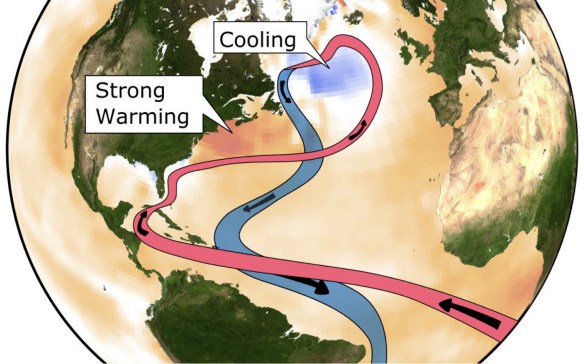
The Atlantic Overturning Current is part of a worldwide twisted loop of ocean water, called the thermohaline cycle (thermo = heat, haline = salt), which emerges very salty and warm out of the Gulf of Mexico, travels north as a surface current along the east coast of North America, veers east in the North Atlantic toward Europe, then loops back west to a region just south of Greenland where it cools and sinks to the ocean floor – because it has become denser than the surrounding and less salty North Atlantic waters (colder water is denser than warmer water, and saltier water is denser than fresher water of equal temperature). The dense highly salted descending water then runs as a cold deep ocean current south along the east coast of South America, and continues in a complicated path along the ocean floor into the Pacific Ocean, where it warms and eventually rises to become a surface current of more buoyant less salty water. This current distributes solar heat collected by ocean waters in tropical latitudes to higher latitudes (closer to the poles).

In 2004, Peter Schwartz and Douglas Randall described the thermohaline cycle this way: “In this thousand-year cycle, water from the surface in tropical areas becomes more saline through evaporation. When it circulates to the poles and becomes cold (“thermo”), the greater density still present from higher salt (“haline”) concentration causes the water to sink to great depths. As with most large-scale geological processes, the thermohaline cycle is not thoroughly understood. Wallace Broecker has been studying the cycle for decades and, according to the December 1996 issue of Discover magazine, he has shown that the thermohaline cycle has not always been in operation, and that it has a strong effect on global climate.”

In 2003-2004, the US Department of Defense commissioned a secret study of what might be the worst possible effects of Global Warming triggering an “abrupt climate change” in the near future, in order to estimate the potential liabilities that military planning would have to consider (to maintain US security, and global power). This study was conducted during the climate-change-denying George W. Bush Administration. When the existence of the resulting report, produced by independent researchers Peter Schwartz and Douglas Randall, became publicly known there was such a public outcry (bad PR for the DOD) that the report was declassified and made publicly available.

The Schwartz-Randall report pointed to the abrupt onset of a significantly colder, dryer climate in the Northern Hemisphere as the most perilous possible consequence of Global Warming up to about 2010, because such warming (the trapping of incoming solar radiation and outgoing infrared radiation from the land and oceans, by greenhouse gases in the atmosphere) might cause the thermohaline cycle to stop. How? Global Warming causes glaciers and ice caps to melt, and such fresh (unsalted) meltwater from Greenland floods into the North Atlantic where the thermohaline current dives to the ocean floor. This fresh surface water dilutes the high salinity of the presently descending thermohaline current, making its waters less dense (less heavy) and so less likely to sink. Sufficient freshening of the thermohaline current would cause it to stop entirely, shutting off this global conveyor belt of climate-regulating oceanic solar heat.

Though abrupt climate change is a less likely and worst case scenario as compared to gradual climate change, Schwartz and Randall concluded that such an occurrence would “challenge United States national security in ways that should be considered immediately.” The climatic cooling that might occur in the Northern Hemisphere as a result of a collapse of the thermohaline cycle could be like the century-long period 8,200 years ago with temperature 5 °F (2.8 °C) colder, or the 13 century-long period 12,700 years ago with temperature 27 °F (15 °C) colder. The shift to colder climate could occur as rapidly as 5 °F (2.8 °C) of cooling per decade. So, the world could plunge into a new Ice Age within a period of twenty years. In their 2004 report, Schwartz and Randall showed data on the salinity of the North Atlantic since 1960; the trend was a steady freshening. (I wrote about the above in an article for the Internet, in July 2004).

A 2015 scientific publication of new observations on the “Atlantic Meridional Overturning Circulation” (the Atlantic part of our thermohaline cycle) concluded that “the melting Greenland ice sheet is likely disturbing the circulation.” The Phys.org news article (https://phys.org/news/2015-03-atlantic-ocean-overturning-today.html) about this study [Rahmstorf, S., Box, J., Feulner, G., Mann, M., Robinson, A., Rutherford, S., Schaffernicht, E. (2015): “Evidence for an exceptional 20th-Century slowdown in Atlantic Ocean overturning.” Nature Climate Change (the journal)] concluded:

“The scientists certainly do not expect a new ice age, thus the imagery of the ten-year-old Hollywood blockbuster ‘The Day After Tomorrow’ is far from reality. However, it is well established that a large, even gradual change in Atlantic ocean circulation could have major negative effects. ‘If the slowdown of the Atlantic overturning continues, the impacts might be substantial,’ says Rahmstorf. ‘Disturbing the circulation will likely have a negative effect on the ocean ecosystem, and thereby fisheries and the associated livelihoods of many people in coastal areas. A slowdown also adds to the regional sea-level rise affecting cities like New York and Boston. Finally, temperature changes in that region can also influence weather systems on both sides of the Atlantic, in North America as well as Europe.’ If the circulation weakens too much it can even break down completely – the Atlantic overturning has for long been considered a possible tipping element in the Earth System. This would mean a relatively rapid and hard-to-reverse change.”

On April 11, 2018, an article titled “Stronger evidence for a weaker Atlantic overturning” appeared at Phys.org (https://phys.org/news/2018-04-stronger-evidence-weaker-atlantic-overturning.html). This article notes:

“The Atlantic overturning—one of Earth’s most important heat transport systems, pumping warm water northward and cold water southward—is weaker today than any time before in more than 1000 years. Sea surface temperature data analysis provides new evidence that this major ocean circulation has slowed down by roughly 15 percent since the middle of the 20th century, according to a study published in the highly renowned journal Nature by an international team of scientists. Human-made climate change is a prime suspect for these worrying observations. There have been long debates whether the Atlantic overturning could collapse, being a tipping element in the Earth system. The present study does not consider the future fate of this circulation, but rather analyses how it has changed over the past hundred years. Nevertheless, Robinson cautions: ‘If we do not rapidly stop global warming, we must expect a further long-term slowdown of the Atlantic overturning. We are only beginning to understand the consequences of this unprecedented process—but they might be disruptive.’ Several studies have shown, for example, that a slowdown of the Atlantic overturning exacerbates sea-level rise on the US coast for cities like New York and Boston. Others show that the associated change in Atlantic sea surface temperatures affects weather patterns over Europe, such as the track of storms coming off the Atlantic. Specifically, the European heat wave of summer 2015 has been linked to the record cold in the northern Atlantic [caused by the inflow of cold Greenland meltwater] in that year—this seemingly paradoxical effect occurs because a cold northern Atlantic promotes an air pressure pattern that funnels warm air from the south into Europe.”

While the scientists are not being alarmist Jeremiahs and warning of an imminent climapocalypse as depicted in the Hollywood movie “The Day After Tomorrow,” they nevertheless make it clear that if this Global Warming caused (fossil-fuel-burning human caused) slowing of the thermohaline cycle continues to the point of a dead stop, then this would likely be a tipping point of the entire Earth System of climate leading to “a relatively rapid and hard-to-reverse change” — not for the better.

<><><><><><><>

Thirsty Invaders, Chasing Heat
19 July 2004
Manuel García, Jr.
http://www.swans.com/library/art10/mgarci18.html

<><><><><><><>

Now appearing at Counterpunch:

An Oceanic Problem: the Atlantic Overturning Current is Slowing
13 April 2017
https://www.counterpunch.org/2018/04/13/an-oceanic-problem-the-atlantic-overturning-current-is-slowing/

<><><><><><><>

Schwartz-Randall report
http://stephenschneider.stanford.edu/Publications/PDF_Papers/SchwartzRandall2004.pdf

<><><><><><><>

The Atlantic Overturning Current Is Slowing
20 April 2018
https://dissidentvoice.org/2018/04/the-atlantic-overturning-current-is-slowing/

<><><><><><><>

April Springs

<><><><><><><><><><><><><><><><><><><><><><><><><><><><><><>

April Springs

I’ve outlived my dreams
and discovered true achievements
have all been unseen, now
traceless remnants I left in your pasts
reward me as
life’s glints scintillating memory’s deep
– a net of gems –
moments with twinkles in certain eyes,
sudden smiles across certain lips,
visions of grace rim-lit by cascades of light,
skin soaking warmth through hair tingling breeze,
the sound of breath holding me close in hushed dark,
bursts of emotion on seeing your face,
the touch of your hand walking timeless through space,
smells of your earthy excitement that sparked me alive,
your joyous abandon in muscular tussles,
the beating of hearts pulsing each other,
the image of your sweet repose,
the beauty of your thoughtful care,
the tolerance of your silent anger,
the gentleness of your just revenge,
the fading of sorrows trailed by regrets,
desires mellowing to insights on youth,
the blending of memories to soothing acceptance,
the calming of passion becomes gratitude
and awareness sharpened by time becomes peace.

9 April 2018

<><><><><><><>