Poet Blood

<><><><><><><><><><><><><><><><><><><><><><><><><><><><><><><><>

Poet Blood

“The mass of men lead lives of quiet desperation.”
– Henry David Thoreau, Walden

“We be of one blood, ye and I.”
– Rudyard Kipling, The Jungle Book

It is said one lives longer
if part of some community.
Does this mean outcasts
are slowly being murdered by society?,
and hermits are invisible suicides?
Both might see
a deadzone of spirit and intuition
in the congenial orthodoxies
and mindless homogeneities of social convention.
If so, then what does it mean to ‘live longer,’
and who, indeed, has really ‘lived?’
And for our loners,
driven by the unrelenting power of their visions of truth,
do their solitary paths
weave into some tenuous fabric of kinship?,
like castaways
trading messages in bottles across an indifferent sea?;
or cougars
spraying their pungent declarations on distant outcrops?
Some of them, I know,
distill experience down to its essence, its nuggets, its salts,
and throw these back as poems into an unsensing world,
knowing there are others like them
also casting,
also, occasionally, breathing in the sting
of newly found insight:
“We be of one blood, ye and I.”

30 December 2001

<><><><><><><>

Climate Change Denial Is Murder

Climate change denial by government is murder by weather.

By now everyone everywhere knows that climate change is a reality, especially the deniers who are simply lying to cover up their real intent, which is to continue with their capitalist schemes of self-aggrandisement even to the point of knowingly letting people die as a consequence.

During the last two weeks, Hurricanes Harvey, Irma and José, in succession, have formed in the tropical Atlantic Ocean to sweep northwest through the Caribbean toward the southern coasts of North America. Harvey has flooded hundreds of thousands of dwellings in the Gulf Coast area of Texas around Houston. Irma, the “lawnmower from the sky,” and the strongest Category 5 (out of 5) hurricane ever recorded, is just making landfall in Florida after razing a number of the smaller Caribbean islands; and Hurricane José is now sweeping into the Caribbean Sea from the east. Climate change denier and right-wing propagandist Rush Limbaugh, lounging in his Florida Xanadu, had called the official weather forecasts of Hurricane Irma’s path “fake news,” but has just heeded those same forecasts by evacuating from the storm, as well as from personal responsibility.

Climate change (as global warming) doesn’t “cause” hurricanes, it makes them more powerful and more frequent. Warmer oceans more easily evaporate, increasing the atmospheric moisture available for rain, and increasing the atmospheric heat energy available for driving winds. It takes heat to evaporate liquid water into vapor. Such vapor rising from the ocean surface mixes with the atmosphere. At higher elevations where the air temperature is lower, or in the presence of cold air currents, water vapor can lose its heat energy to the air and condense into droplets of liquid water. The heat energy released by water vapor to condense back into liquid – the latent heat of vaporization – is sizable (per unit mass of H2O) and adds to the energy of motion of the air molecules and air currents: wind. So, global warming makes for more moisture in the air over tropical ocean waters, and more heat energy in that air to drive winds and storms.

The scientific facts about global warming have been known for a very long time, and were largely learned through government-funded research. US Government officials, as in the George W. Bush administration and now in the Donald Trump administration, who publicly deny these facts – excruciatingly documented and warehoused by the scientific, technical, military and commercial agencies of the US Government – are simply voicing bald-faced lies, and are thus betraying their official and constitutional responsibilities to the American public. Since this lying (and its enabling of continued greenhouse gas pollution) is done knowingly and for monetary gain, and the consequential more violent weather (droughts, hurricanes, floods) erupting from today’s global warming climate change always causes fatalities, then that climate change denial is at the very minimum an accessory to criminally negligent manslaughter, and without a reasonable doubt to premeditated murder.

Outline History of Awareness of Climate Change

What follows is a timeline, which I first made for myself in 2013, of the development of scientific knowledge about climate change. This summary outline includes some of the incidents of the intimately related “world energy crisis,” which I define as getting enough energy for a decent standard of living worldwide, coupled with the commercial competition between: fossil fuel energy versus nuclear energy versus solar/green energy.

Both fossil fuel energy and nuclear energy are intrinsically capitalist forms of resource hoarding and market exploitation, because they are extracted from the Earth at specific locations, burned to generate electricity at large and complex industrial plants, and distributed widely and distantly through a large electrical transmission line distribution grid.

On the other hand, solar/green energy is intrinsically a socialist or public commons type of energy resource because it is naturally abundant everywhere – like sunshine and wind – and is easily converted to electricity wherever it is collected. It is because of its intrinsic socialist (anti-capitalist) nature that solar and green energy are being legally attacked and restricted in US political jurisdictions controlled by rabidly capitalist special interests. The outline now follows.

The clock for a public policy response to the “energy crisis” (now enlarged to “Global Warming” and “Climate Change”) started ticking in October 1973 with the First Arab Oil Embargo (1973 Oil Crisis), and we’ve yet to get off our asses in response to the alarm (40+ years later).

Four years later, the energy problem was serious enough for President Jimmy Carter to address the nation about it on the 202nd anniversary of Paul Revere’s ride (18 April 1977). See http://www.youtube.com/watch?v=-tPePpMxJaA

Peak Oil was the fear in 1977, not Global Warming, even though science had been certain about Global Warming since 1955-1957.

What follows is a very brief synopsis of the scientific development of knowledge about Anthropogenic Global Warming (AGW, which is human-caused, CO2-driven Climate Change), along with incidents of the parallel World Energy Crisis.

Atmospheric Carbon Dioxide is a gaseous insulator and high capacity heat-storage medium. It can retain much more heat energy per unit mass than the two dominate atmospheric gases making up 99.03% of the atmosphere: diatomic nitrogen (N2, 78.08% of the air), and diatomic oxygen (O2, 20.95% of the air). The remaining 0.97% of the dry atmosphere is a mixture of rare gases (with low heat capacity) and organic vapors (with high heat capacity), which include the high heat capacity species: methane (CH4) and carbon dioxide (CO2). The water vapor (H2O) carried along by the otherwise dry air is also a high heat capacity medium.

Quotes below are noted as from one of:
(HCCS): http://en.wikipedia.org/wiki/History_of_climate_change_science
(HS): http://www.eoearth.org/view/article/156308/

(JEA): John E. Allen, Aerodynamics, Hutchinson & Co. LTD, London, 1963.

In 1896 Svante Arrhenius calculated the effect of doubling atmospheric carbon dioxide to be an increase in surface temperatures of 5-6 degrees Celsius. Meanwhile, another Swedish scientist, Arvid Högbom, had been attempting to quantify natural sources of emissions of CO2 for purposes of understanding the global carbon cycle. Högbom found that estimated carbon production from industrial sources in the 1890s (mainly coal burning) was comparable with the natural sources. (HCCS)

In 1938 a British engineer, Guy Stewart Callendar, attempted to revive Arrhenius’s greenhouse-effect theory. Callendar presented evidence that both temperature and the CO2 level in the atmosphere had been rising over the past half-century, and he argued that newer spectroscopic measurements showed that the gas was effective in absorbing infrared [heat radiation] in the atmosphere. Nevertheless, most scientific opinion continued to dispute or ignore the theory. (HCCS)

In 1955 Hans Suess’s carbon-14 isotope analysis showed that CO2 released from fossil fuels was not immediately absorbed by the ocean. (HCCS)

In 1957, better understanding of ocean chemistry led Roger Revelle to a realization that the ocean surface layer had limited ability to absorb carbon dioxide. (HCCS)

In a seminal paper published in 1957 [Roger Revelle and Hans Suess, “Carbon dioxide exchange between atmosphere and ocean and the question of an increase of atmospheric CO2 during the past decades.” Tellus 9, 18-27 (1957)], Roger Revelle and Hans Suess argued that humankind was performing “a great geophysical experiment,” [and called] on the scientific community to monitor changes in the carbon dioxide content of waters and the atmosphere, as well as production rates of plants and animals. (HS)

AGW became common knowledge among aerodynamicists and atmospheric scientists by the 1960s, as witnessed by the following passage from John E. Allen’s 1963 book surveying the field of aerodynamics “for the non-specialist, the young student, the scholar leaving school and seeking an interest for his life’s work, and for the intelligent member of the public.”

Scientists are interested in the long-term effects on our atmosphere from the combustion of coal, oil and petrol and the generation of carbon dioxide. It has been estimated that 360,000 million tons of CO2 have been added to the atmosphere by man’s burning of fossil fuels, increasing the concentration by 13%. This progressive rise in the CO2 content of the air has influenced the heat balance between the sun, air and oceans, thus leading to small but definite changes in surface temperature. At Uppsala in Sweden, for example, the mean temperature has risen 2° in 60 years. (JEA)

22 April 1970: On this first Earth Day, MG,Jr decides to aim for a career in energy research, for a brave new future.

October 1973 – March 1974: The first Arab Oil Embargo (formally known as the 1973 Oil Crisis) erupts in the aftermath of the Yom Kippur War (1973 Arab-Israeli War, October 6–25, 1973).

Evidence for warming accumulated. By 1975, Manabe and Wetherald had developed a three-dimensional Global Climate Model that gave a roughly accurate representation of the current climate. Doubling CO2 in the model’s atmosphere gave a roughly 2°C rise in global temperature. Several other kinds of computer models gave similar results: it was impossible to make a model that gave something resembling the actual climate and not have the temperature rise when the CO2 concentration was increased. (HCCS)

18 April 1977: President Jimmy Carter’s Address to the Nation on Energy.

The 1979 World Climate Conference of the World Meteorological Organization concluded “it appears plausible that an increased amount of carbon dioxide in the atmosphere can contribute to a gradual warming of the lower atmosphere, especially at higher latitudes….It is possible that some effects on a regional and global scale may be detectable before the end of this century and become significant before the middle of the next century.” (HCCS)

1979-1980: The 1979 (or Second) Oil Crisis erupts from the turmoil of the Iranian Revolution, and the outbreak of the Iran-Iraq War in 1980.

March 28, 1979: A nuclear reactor meltdown occurs at the Three Mile Island power station in Pennsylvania.

July 15, 1979: President Jimmy Carter addresses the nation on its “crisis of confidence” during its 1979 energy crisis (oil and gasoline shortages and high prices). This address would become known as the “malaise speech,” though Carter never mentioned “malaise.” See http://www.youtube.com/watch?v=kakFDUeoJKM. Have you seen as honest an American presidential speech since? “Energy will be the immediate test of our ability to unite this nation.”

November 4, 1980: Ronald Reagan is elected president and the “big plunge” (the neoliberal shredding of the 1945 postwar social contract) begins. Poof went all my illusions about an American energy revolution.

April 26, 1986: A nuclear reactor at the Chernobyl power station in the Ukraine explodes, spewing radioactivity far and wide, and the fuel core melts down. The Chernobyl disaster was the worst nuclear power plant accident until the Fukushima Daiichi nuclear disaster of March 11, 2011.

1986: Ronald Reagan has the solar hot water system removed, which had been installed on the roof of the White House during the Carter Administration. The official US energy policy was obvious to me: solar energy and conservation were dead.

In June 1988, James E. Hansen [in Congressional testimony] made one of the first assessments that human-caused warming had already measurably affected global climate. Shortly after, a “World Conference on the Changing Atmosphere: Implications for Global Security” gathered hundreds of scientists and others in Toronto. They concluded that the changes in the atmosphere due to human pollution “represent a major threat to international security and are already having harmful consequences over many parts of the globe,” and declared that by 2005 the world should push its emissions some 20% below the 1988 level. (HCCS)

All that AGW scientific research has done since 1988 has been to add more decimal places to the numbers characterizing the physical effects. That was over a quarter century ago. So, I take it as a given that the American and even World consensus [so far] is in favor of probable human extinction sooner (by waste heat triggered climate change) rather than later (by expansion of the Sun into a Red Giant star). And, yes, the course of the extinction will proceed inequitably. Not what I want, but what I see as the logical consequences of what is. (End of the outline.)

Global warming is Earth’s fever from its infection with capitalism.

So, whenever some government, corporate or media potentate discharges another toxic cloud of climate change denialism, realize that what they are actually and dishonestly telling you is: “I am going to keep making my financial killing regardless, and I don’t care who has to die for it.”

<><><><><><><>

Also appearing at:

Climate Change Denial Is Murder
8 September 2017
https://dissidentvoice.org/2017/09/climate-change-denial-is-murder/

<><><><><><><>

Added on 11 September 2017:

<><><><><><><>

Added on 19 December 2019

How 19th Century Scientists Predicted Global Warming

<><><><><><><>

Why Does War Exist?

Preface

1 September 2017 was the 78th anniversary of the beginning of World War II; I went to the movies to see Dunkirk. I have thought, read and written about war for many years, particularly nuclear war (I am against war). Also, I have thought about the existential problem faced by Palestine, and other oppressed societies disadvantaged by an imbalance of power. And, finally, I have also been thinking about the many recent internet postings about the Antifa (antifascist) confrontational protest groups and some of their forceful tactics. All this led me to a summary of general principles about war, which follows.

Why Does War Exist?

War exists because aggressors, exploiters and oppressors, who have the advantage given an imbalance of power, will see no restraint to acting as they please; and their disadvantaged victims will find force to be their most effective defense.

Aggressive war exists because aggressors and oppressors, who rely on the imbalance of power to achieve their aims, find force to be the most expedient tactic against the weak.

The purpose of aggressive war is to forcefully take property, treasure, natural resources, sex and slaves from societies that are relatively weak, as well as gaining domination over them.

Defensive war exists because force is the only effective counter against aggressors and oppressors, who rely on the imbalance of power to forcefully pursue their aims.

The purpose of defensive war is to resist aggression and oppression, and to preserve or gain independence, freedom, social cohesion and territorial integrity that are under assault.

The necessary conditions for the elimination of war are:
(1) a balance of power; and,
(2) the absence of oppression.

Number 1 removes the incentive for aggressive war, and Number 2 removes the necessity of defensive war.

Given conditions 1 and 2, disputes between societies and nation-states would be resolved by negotiations, a process that eliminates all the waste, pain and destruction intrinsic to wars. Also, negotiated settlements under these conditions would be equitable.

Establishing conditions 1 and 2 as permanent and universal conditions of human society is an immeasurably difficult problem, and perhaps an impossibility.

<><><><><><><>

Louis-Joseph de Montcalm-Gozon, Marquis de Saint-Veran (28 February 1712 – 14 September 1759) was a French soldier best known as the commander of the forces in North America during the Seven Years’ War (whose North American theatre is called the French and Indian War in the United States). Montcalm died on 14 September 1759 from a British musket shot to his back below his ribs, received the day before at the Battle of the Plains of Abraham, which is also known as the Battle of Quebec. My photo of Montcalm’s skull (on display at a museum) was taken in the city of Quebec on 2 September 1976.

<><><><><><><>

This article now also appears (without the photograph) at:

Why Does War Exist?
4 September 2017
https://dissidentvoice.org/2017/09/why-does-war-exist/

<><><><><><><>

Herodias Then, Hillary Now

Francesco del Cairo, “Herodias with the head of John the Baptist,” 1625-1630


On reading the short story Herodias in Gustave Flaubert’s slim volume Three Tales (1877), I realized that this Biblical story of Salome’s dance being paid for by the beheading of John the Baptist could serve as an analogy to the political tragedy of the 2016 Democratic party’s national convention in the United States. This parallel is achieved if the story is cast in the following way:

Herodias: – – – – – -> Hillary Clinton
Herod Antipas: – – -> Barack Obama (understudy: Bill Clinton)
John the Baptist: – -> Bernie Sanders
Agrippa: – – – – – – -> Donald Trump
Mannaeï: – – – – – – > Al Franken
Caesar: – – – – – – -> Goldman Sachs
Assembly: – – – – – > DNC Super-delegates
Salome:
– – – – – – – – – – – – – > Michelle Obama?,
– – – – – – – – – – – – – > Loretta Lynch?,
– – – – – – – – – – – – – > Kamala Harris?,
– – – – – – – – – – – – – > Debbie Wasserman Schultz?,
– – – – – – – – – – – – – > Donna Brazile?,
– – – – – – – – – – – – – > Nancy Pelosi?,
– – – – – – – – – – – – – > Liz Warren?

During the reign of Tiberius as the Caesar of the Roman Empire, Herod Antipas was the king of Judea, which is the southern part of Palestine. Antipas had divorced his first wife, who was the daughter of the king of the Arabs, and married Herodias, who herself had been the wife of his brother Herod Agrippa. Herodias was extremely ambitious to be the queen of a great empire and had left Agrippa for Antipas to further that ambition. Agrippa was a rival to Antipas for the throne of Judea, and he had gone to Rome to conspire with Caius (the future Caesar to be known as Caligula) against Antipas. Both Herodias and Antipas wanted Agrippa killed by order of Tiberius Caesar.

Antipas was slavishly allied to Rome because he needed Imperial protection against the threat of invasion from the south by the Arabs angered by his divorce of their princess, as well as to ensure he was favored by Caesar instead of Agrippa. Herodias was fanatically allied to Rome because she saw its power as a means to advancing her aims, and of eliminating her enemies. As an occupied and subjugated people, the Jews of Palestine resented Rome and their subservient political leader Antipas, and their subservient and wealthy religious elites, but made an effort to minimize resistance to the Empire so as not to draw Rome’s ire upon themselves.

All of these incidents and attitudes were loudly and widely condemned by John the Baptist, a reformer popular with the common people, who talked about a Messiah who would create an independent kingdom free of both Romans and the compromised political (Antipas’s administration) and religious (Pharisees and Sadducees) ruling classes of the Jews. John the Baptist also railed against the immorality and weak moral character of Herod Antipas and his scheming, impious queen, Herodias.

Naturally, such talk in public was an irritant to the Roman governor (Vitellius), who was Caesar’s direct representative in Judea, as well as to the Pharisees, the Sadducees, Herod Antipas and especially Herodias, who felt threatened by it and whose vanity was deeply wounded, thus inflaming a malevolent obsession for a fatal revenge against the prophet. John the Baptist had already been imprisoned for his incitement of popular indignation and hope.

Salome was Herodias’s daughter from her previous marriage, and Antipas did not know about Salome because Herodias had had her brought up away from the palace. Salome was the key to Herodias’s scheme for revenge, and had been carefully prepared for her task. During a palace feast to celebrate Antipas’s birthday, with Vitellius and the political and religious elites of the Jews in attendance, Herodias sent Salome out to perform “the dance of the seven veils” to excite Herod Antipas’s lust. Herodias knew her craven and lecherous husband well, and before all the company he soon promised Salome anything she wanted, in payment for helping him maintain the tepid approval of the assembled company, and in anticipation of gaining her favors after her dance. Salome knew her mission, and requested the head of John the Baptist on a platter. Herod Antipas was bound by his word spoken before so many witnesses from the ruling classes, and so ordered Mannaeï, the executioner in his employ, to do the dirty deed. Concern for the hopes and dreams of his Jewish commoner subjects, and their inevitable disappointment were John the Baptist to be killed, was never a consideration.

Shortly after, Mannaeï returned with the requested platter and gave it to Salome who in turn presented it to the orgasmically satisfied Herodias. The company at the party were variously pleased, amused, curious or indifferent to inspect the bloody grimacing prize. And so was the prophet of the people dispatched for the political convenience of the Empire and the compromised Jewish elite; because of the fear and lust of Herod Antipas; and because of the malevolence, megalomania and vanity of Herodias.

Gustave Flaubert tells the Biblical story much better than I have. The 2016 American reality-show remake as a political intrigue was comparably shameful but much more tawdry.

In the painting, above, Herodias is sticking pins into the tongue that spoke out against her, and being so deliciously aroused in this climax of her revenge. The parallel to the American political events occurred between 12-26 July 2016.

<><><><><><><>

Post-Democracy America

George Washington at Boston Commons

Phyllis Wheatley

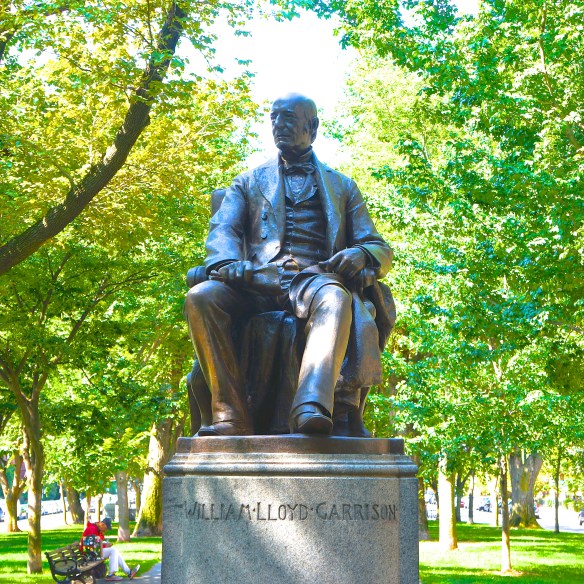
William Lloyd Garrison

Sacco and Vanzetti

Sunset, 50 miles east of San Francisco, CA

The reason our American Corporate Masters gave us a choice between corruption (Hillary Clinton) and bigotry (Donald Trump) in the 2016 national election is that either was acceptable to them, since both are intrinsic aspects of how business is being conducted.

In 2016, the Democratic (Party) National Committee saved corporate privilege from the threat of democratic accountability. American democracy did not die because of voter apathy, it was assassinated by the DNC in a conspiracy of pure betrayal of both the American people and democratic principles, with the coup de grâce being delivered on 26 July 2016. So, instead of America today being the mythical democratic republic portrayed in school textbooks, it is actually a corporatized oligarchy – or a fascist state, take your pick – with a modest social democratic insurgency carried on mainly by idealistic younger people.

That so many Americans cannot yet acknowledge these facts is a sad reflection on the extent of ignorance, bigotry, greed, insularity and self-absorption throughout the population. It is difficult to feel sympathy for the plebeian and bourgeois slaves who resist rebelling against their own exploitation, by slavishly attaching themselves to either the Donald Trump or Hillary Clinton (and Barack Obama) pacifying personality projections of the corporatized oligarchy.

Until a widespread and very profound personal and socialist awakening occurs to the American people:

– America will be a racist nation because so many of its people find solace in being self-righteous victims.

– America will be a classist nation because so many of its people find comfort in greed and possessiveness.

– America will be an ageist nation because so many of its people find freedom in: relief from memory, adulation of inexperience, impatience with thinking, and lust for youth.

The threats to American security and physical integrity by external enemies are minor, and are reactions caused by the American oligarchy’s imperialism. The threats to American security and physical integrity by Nature are increasingly self-induced by obtuse denial in the service of laziness and selfishness. The threats to American popular freedom, prosperity, sanity and social cohesion are purely internal and frighteningly contagious, being the corrosive disintegration of individual and collective moral character, which are unfortunately encouraged by the examples of these same failings set by so many of the careerists at the pinnacle of America’s pyramid of power and wealth.

An alert mind seeking to preserve some degree of personal fulfillment in such a society could reason:

– as a weary and isolated cynic: “don’t worry, it’s hopeless, so do what it is in me to do, regardless,” or

– as an idealistic social activist: “this is the nature of war, by protecting others you save yourself.”

Our best hope for a just and peaceful society may lie in the fact that the future unfolds as a chaotic and largely unpredictable process, not as an entirely pre-determined program. Out of the mixed jumble of unexpected great disasters and serendipitous great opportunities that will cascade upon us, we may find the right circumstances to rescue and elevate ourselves as individuals, and unify ourselves as a more worthy society.

<><><><><><><>

Now also appearing at Dissident Voice:

Post-Democracy America
2 September 2017
https://dissidentvoice.org/2017/09/post-democracy-america/

<><><><><><><>

The Touch Of The Open

<><><><><><><><><><><><><><><><><><><><><><><><><><><><><><><><>

The Touch Of The Open
(Between An Open Love and A Greedy Heart)

A butterfly surprising me
landed on my palm and made me see
the radiance of life’s floating smile
burning through the haze of my blue ennui
to melt my heart so gratefully
into your redeeming love for me.

But I know you’re that kind of grace
that must weave through life at your own pace,
and so I walk on fear’s knife-edge
dreading unknowns that might come to be,
standing in your glow between
an open love and my heart greedy.

If I close you in, I will crush your dreams,
If my love is open, you will float away.
If I keep you here, I will kill beauty,
If I love your freedom, my heart will break
when you leave
as you must
to be the wonder in this world that you are,
a butterfly
floating free
through the sunbeams of old age memories.

A butterfly surprising me
landed on my palm and made me see
the radiance of life’s floating smile
burning through the haze of my blue ennui
to warm my heart into love for you
and feeling that incredible high to be
the world’s heart now beating as me,
the fullness of all this joy so free,
as big as the sun to life can be.

I’ll think of you in future times,
smiling, knowing I could love so much,
grateful to remember how
you made me flower into springtime love,
a timeless grace flitting heart to heart
linking minds forever in your sea of love,
immersing those soon left behind
into the touch of the open,
the touch of the open,
the touch of the open…

23 August 2017

<><><><><><><>

Thoughts After Charlottesville 2017

Trump is the best wake-up call Americans have had in decades. America has always been this way, but American politicians and capitalists have tried to mask it to keep the wheels of profitability: business, pork barrel and graft, turning smoothly. “Political language has to consist largely of euphemism, question-begging and sheer cloudy vagueness” for that overarching purpose (Orwell quote). But Trump has dispensed with that, which is why the professional Republicans and Democrats hate him (for pantsing the long-standing corporate-run bipartisan con-job on the public) and most of the public hates him (for stating the crude heartless reality crudely; embarrassing, frightening and insulting them, a tough blow after eight years of Obama’s soothingly elegant and inspirational lying). Trump has the fool’s witless honesty of parading the leprous body of white-supremacy-capitalist-controlled government naked in public for all to see (because he’s a narcissistic true-believer in his religion: Mammonism). People who say “America has changed” or “America has degenerated” are actually reacting to the fact that the core reality of American government and capitalism (particularly since Ronald Reagan, 1980, but generally since far back) has finally broken through their benign wishful fantasies about American society. Trump’s overt and inadvertent ripping back of the curtain hiding the rotten truth has dispelled those innocent illusions, and that in turn has excited his religion’s worse elements to act out.

In Charlottesville, Virginia, resentful White knuckleheads torch-marched protesting against the demographic dilution of White Supremacy in America, shouting: “We will not be replaced!” Yvette Carnell (a Black woman political commentator) continues voicing the protests of resentful only-African-American-descendants-of-slaves against African and Afro-Caribbean Blacks and Hispanics prospering in America: “We should not be displaced!” These are two sides of that most popular American thousand-sided counterfeit coin: “My race uber alles!” Race-love and race-hate are both the opium of the discards from American capitalism.

Black men are 6% of the US population, and that group “contributes” 40% of the killed-by-police dead. Not all of those dead were armed and/or significant threats to society. Police in America have a very difficult job to do (because Americans are so efft-up, and on opoids and all kinds of other street shit, as well as alcohol, and are TV-addled dopes, sports fans, and even domestic abusers; besides so many just normal drama-queens wanting attention). And, by and large, our police are doing a meh job. Most cops are so-so, but too many are total shit. It would be good for Americans if their cops were unarmed (no guns). Those cops who didn’t like that would quit (good) and those who accepted that challenge would probably do okay. Knuckleheads seeking power-by-association do not make the best cops. Bigotry exists in America because most Americans find it comforting (they feel scared and inadequate), “business” finds it more profitable to tolerate than reject (don’t contradict the richer customers, and take advantage of the hungry workers), and most people are too chicken to go beyond their ethnic-racial-‘cultural’ clannishness, especially if it impedes attending to their greed/self-interest. America hasn’t changed, it’s just that in the Trump “era” no effort is being made to mask the reality: it’s all about the money. If you REALLY wanted to see racism disappear (at least in actions) in the USA, we would have to do what the Cuban Revolution did: full socialism (all in for the benefits and opportunities), and inflexible laws for inclusion and anti-discrimination (regardless of the “cost” to “business”). Americans aren’t there yet, they’re too wrapped up in their stupid, selfish fantasies.

It got so bad in Charlottesville, VA (where the whiney white supremacists were yowling about not being uber-special anymore, roughing people up, and in one case committing automobile homicide of a counter-protester), that President Trump had to give an almost Bernie-like speech, that “regardless of your race, color or creed, we are all Americans.” Wow, he had to push back on his base for his own political survival. What the proportions of hypocrisy and sincerity were in Trump’s speech, I’ll let you judge (and I believe there is some degree of sincerity in it) [15 August 2017, I now believe there was zero sincerity], because ALL Americans are race-conscious (that is to say, racist!!). Bigotry in our country will not die in our lifetimes, because it is so comforting. Bigotry will live in America as long as it is good for business (money beats morals every time). The popular attitude is: “I’m perfect, all my problems are caused by other people.” My vision of America is unachievable: fairness, support and equal opportunity for all, regardless: “to each according to his and her needs, from each according to his and her abilities.”

I Am The All, I Am Nothing

I Am The All, I Am Nothing

I am the peace of still water
in a granite fold of mountains
high up in the cool wild mists.
I am the combusting turbulence of dragon’s breath,
human passions erupting
in angry rebellion against injustice.
I am the fresh breath of life
wafting over a summer sea
to breeze across a warming hill, waving grasses,
and sink deep into earth’s luxuriant embrace
to seed for birth ripening fruits of love.
I am the hard cold solitude of ice
self-preserving against corrupting indolence,
and hard against the trampling mindless herds.
I am the midnight dawn of moonlight,
the mind’s awakening beyond the stars
to deep time’s calming vision.
I am the heat of summer sunshine
evaporating birthing dew from butterfly wings,
freeing my spirit to flutter among flowers of chance
and savor the nectar of experience.
I am the all, I am nothing:
the all of everything down to its subatomic particles,
its quantum fluctuations.
I am the all, I am nothing:
the all-everything by chance erupting from all-nothing,
just as you have.
And so we are linked
like individual ripples arising momentarily
from one great enduring ocean.

11 August 2017

<><><><><><><>

Garden by the Sea
17 June 2017
https://youtu.be/h4yVMtj8Rg8

<><><><><><><>

Will a Russo-American Nuclear War Happen (Soon)?

(1 September 2008; still topical on 9 August 2017)

Introduction

The first, and also previous, nuclear war consisted of two atomic bomb attacks that destroyed the Japanese cities of Hiroshima and Nagasaki, respectively, on August 6 and August 9 of 1945. These attacks by the United States of America against an utterly defeated and prostrate Japan occurred in the last month of the Pacific War (which occurred between December 7, 1941 to August 15, 1945 for the USA) and were demonstrations of remorseless American power intended to deflate the triumphant spirit of a Soviet Union victorious against Nazi Germany (May 8, 1945), and to check the Soviet leadership from advancing its forces into Japan (despite being implored to do so by the Allies at the Yalta Conference six months earlier).

Tsarist Russia had lost its 1904-1905 war with Imperial Japan for control of Manchuria (northern China) and Korea, both of which Japan occupied until 1945. During World War 1 (1914-1918) and the Russian Civil War (1917-1923), a dozen nations invaded Russia, occupying many regions and fielding troops that supported the pro-tsarist, anti-Bolshevik White forces between 1918 and 1920. Japan supplied 37 percent of the troops in this Allied Intervention, 70,000 of the 188,000 total and by far the single largest contingent; they were all deployed in the Vladivostok (northwestern Pacific) region and were the last to leave, in 1922. A series of Soviet-Japanese border wars occurred between 1938-1945, primarily a 1938 war along the Siberian-Manchurian border (western-eastern) just northeast of Korea, a 1939 war along the Mongolian-Manchurian border (eastern-western), northwest of Korea, and the Russian invasion of Manchuria on August 8, 1945.

With the demise of the Japanese Empire, the Russians and Chinese consolidated their adjoining domains of control spanning the Eurasian landmass east of the Baltic and north of the Black Sea, Caucasus and Himalayas, for over four decades until the breakup of the Soviet Union. Over the last twenty years, the United States has actively sought to encircle Russia with military forces implanted in client states that are former Soviet Republics or Eastern European Socialist Republics, now independent, whose compliance has been bought. A similar policy applies to China and its surrounding south and central Asian states. This US policy is often personified by Zbigniew Brzezinski (the Carter Administration National Security Advisor credited with funding the advanced militarization of the Afghani mujahideen that included Osama Bin Laden), who characterizes it as geostrategic dominance radiating from the control of Caucasus and Central Asian republics, several rich in oil.

In recent weeks, US commentators (e.g., P. C. Roberts and W. S. Lind) on Russia’s intervention into the Republic of Georgia (a US client state in the South Caucasus Mountains) to reverse the Georgian invasion of breakaway region South Ossetia, believe the blundering belligerence of US policy toward Russia could escalate to the point of armed confrontation, and this would erupt into a nuclear war.

The logic assumed is that the U.S. would have to rely on missile-borne tactical nuclear warheads launched by air and naval forces to counter Russian troops and armor in the Caucasus, since the U.S. is too distant to transport its troops quickly, and many of them are bogged down in Iraq, Afghanistan, and who knows, maybe also Iran by that time. The Russians could be assumed to use their tactical nuclear weapons to compensate for their possible disadvantage of having less technically sophisticated weapons systems relative to the ”smart bomb” precision-guided munitions and “stealth” delivery vehicles of the US military. Once a shooting war starts, the natural tendency is to reach for your biggest guns and fire away before the other guy can clear his holster.

So, is a new nuclear war possible? Let’s muse on this. After all, the time necessary for rationality to work its good is only available before the shoot-out, or after the killing is done and the survivors are ready to move on to the burials.

The purpose of war is to increase your degree of control OVER OTHERS. This is usually equated to having acquired greater political and military power. This is true even if the war is conducted as nothing beyond brigandage and piracy: plunder, profit and wealth are seen as increasing your power to control events. Using this metric, it is easy to judge if you have won or lost a war.

We proceed by inquiring about the psychological and technical enabling factors, and the political and diplomatic restraining factors for the outbreak of a nuclear war:

1, psychology: are the prospective belligerents easily inclined to war?

2, technology: are their military establishments ready for nuclear combat?

3, politics: can the ruling class be assured of maintaining control of its own population?, could there be a revolution if the war fares badly?

4, diplomacy: is the potential estrangement of and isolation from European states, and other allies, a significant restraint?; is it possible that in a mid-war or post-war weakened condition your state becomes unable to control new rebellions by imperial subject states, or to stop encroachments into your domain of influence by imperial rivals?

We can contract the previous four major questions in these two: have we identified all possible contingencies and devised alternative plans for each?, does the cost-benefit ratio for the war outweigh that of diplomatic alternatives, and after what period of time? We consider the four factors in turn.

Psychology: Remembering World War Two

It is important to know that the overwhelming fraction of the Allied war effort against Nazi Germany was provided by the Soviet Union (Russia and its union of socialist republics), and they suffered the greatest losses as a result. Consider the following numbers. The combined 1939 population of the fifty-five countries involved in World War Two (WW2) was 1.962 billion; the total number of war dead was 72.8 million, which was 3.7 percent of the 1939 population of participants. Of course, many of these countries bore only a slight to moderate burden in carrying on the war, while a small number provided the greatest efforts and made the greatest sacrifices (see “World War II casualties” http://en.wikipedia.org/wiki/World_War_II_casualties).

The combined human losses of the Soviet Union, China, Germany and Japan were just under 73 percent of the total deaths for WW2. The Asian theater of WW2 was essentially the Sino-Japanese War of 1937-1945, while the European theater of WW2 was essentially the Russo-German War of 1941-1945.

Let us look at the impact of WW2 on five selected countries, by using three ratios for each country, where these ratios are defined as follows.

Country:

the percentage of its 1939 population killed in WW2;
the ratio of its 1939 population to the 1.962 billion WW2 participants;
the ratio of its WW2 dead to the total WW2 dead;
(all ratios below are expressed as percents).

Soviet Union: 13.7; 8.6; 31.7.

China: 3.9; 26.4; 27.5.

Germany: 10.5; 3.6; 10.

Japan: 3.8; 3.6; 3.7.

USA: 0.3; 6.7; 0.6.

The Soviet Union lost nearly 14 percent of its population (every 7th person) in the war, and this mortality amounted to almost one third of the entire WW2 dead. China was three times as populous as the Soviet Union, so its loss of nearly 4 percent of its people (every 26th person) amounted to over one quarter of the entire WW2 dead. Germany lost over a tenth of its population (every 10th person), which amounted to 10 percent of the WW2 dead; and Japan’s loss of just under 4 percent of its people (every 26th person) amounted to nearly 4 percent of the WW2 dead.

Notice that the United States’ WW2 dead amounts to a fifty-fifth (1/55) of the Soviet total, and the 1939 national populations were comparable, the Soviet population being 29 percent higher. It would be very beneficial to the world if Americans, commemorating their Memorial and Veterans’ Days, would try imagining their feelings if they had suffered war as deeply as the Soviet people (every 7th person instead of every 324th person lost). Now, we never trivialize the real pain of war veterans, their relatives and and friends, however small a portion of a nation’s population they may happen to be. But, clearly, the impact of a WW2 experience like that of the Soviets will imprint a dread of war far more deeply into the national consciousness than a WW2 experience like that of the United States.

Another interesting numerical result is that the combined losses of Germany and Japan amount to only 13.7 percent of the WW2 dead, and the combined population of these two Axis powers amounted to only 7.2 percent of the WW2 participating population. Advanced industrialized nations hell-bent on war can drag in a multitude of victims vastly more numerous than themselves. A reasonable assumption for today is that the state planners and popular historical memories in both Russia and China viscerally appreciate the importance of this point, but that it may be dimly perceived in US popular imagination, and even dismissed by US policy-makers. This is probably the type of caution introduced by European allies when the U.S. engages them in multilateral diplomacy and planning, and which is so annoying to US unilateralists.

So, the U.S. may have a more casual attitude about bellicose posturing and nuclear war threatening bravado, while the Russians and Chinese are likely to be very circumspect and deliberate about threatening nuclear war; if they do, pay attention!

Technology: The Military Is A Hungry Robot

The US military is a brainless stomach that always wishes to be fed, it is the very definition of fiscal cancer. It has no other goal beyond immediate ingestion of capital drained from the US treasury, so all its pronouncements, papers, studies, proposals and testimony are devoid of meaning beyond their role as advertisements aimed at the audience of policy-makers heading the capitalist, government and propaganda ministries of the military-industrial-congressional complex (MICC). The purpose of these advertisements is to induce as many of these directorate-class individuals as possible to put their influence behind the many schemes for larding the military. So, we can expect any part of the military that sees initiating a nuclear war as an instant benefit to itself by calling its services into action, to lobby for it. A brainless stomach has no concept of consequences, or of others. “More” fills the conceptual space, and all the frenzied, convoluted babble is a drone of incantations intended to materialize that “more.”

While the hardware for nuclear war is complex, both the US and Russian military establishments have decades of experience with it, and they have maintained their training. These military forces could use their nuclear weapons as ordered without a significant number of technical or personnel failures. Some of the warheads launched might be duds, in that their detonation would be flawed and their full explosive yield would be unrealized; and some of the personnel might crack under the pressure of actual combat — either as a blind panic or an intentional rebellion — and fail at their posts. However, we can expect a low incidence of such failure in either the U.S. or Russian forces.

This is unfortunate from the point of view of preventing nuclear war. We now know that “a guy named Arkhipov saved the world” during the Cuban Missile Crisis. “During a naval skirmish between an American destroyer and a Soviet B-59 submarine off Cuba on Oct 27, 1962,” where “the destroyer dropped depth charges near the submarine to try to force it to surface, not knowing it had a nuclear-tipped torpedo…that the submarine was authorised to fire it if three officers agreed. The officers began a fierce, shouting debate over whether to sink the ship. Two of them said yes and the other said no.”

This was no failure of Russian military training (which like that in the arts and sciences is of unparalleled rigor), but instead the operation of vivid historical consciousness. I fear that the culture of the United States is so shallow and immature that thorough military training can transform any callow youth into a robot soldier attuned to his or her assigned functions, and unlikely to have the psychological depth and historical consciousness to question orders and training under conditions of extreme danger, urgency and confusion, or to recognize moments of pivotal importance.

Military establishments are intended to be robotic performers, reliable agents implementing commands abstracted and codified from the political directives of the national leadership. So, we should assume that by far the best way to prevent the military from proceeding with a nuclear war is by influencing the policy that it operates under, so that it is one of restraint.

Still, let me make a direct plea to any US soldier or sailor who finds themselves charged with launching a nuclear weapon: don’t do it, mutiny, revolt. Think, the more and sooner the better. Be Arkhipov. I think the Russians will be more restrained than the Americans about first use, but will have zero hesitation about second use.

Politics: Popular Loyalty Or Popular Revolt?

Because Russia is a lesser power than the United States, and because of the many and obvious provocations made by the US against Russia as part of its encirclement strategy, as well as the shameless advantage US capitalism took of Russia during the immediate post-soviet period of political fragmentation and economic reorganization, the Russian people will have no trouble supporting their government regardless of how any potential war with the U.S. transpires; they will always see themselves as the defenders, not the aggressors. This will be especially true if the U.S. fires first, which it delights in boasting it feels free to do; and we can be sure that if Russia does fire the first nuclear shot, it will be an evidently defensive preemptive strike. The expectation of popular loyalty, won by the robust revival of the Russian economy under Vladimir Putin’s administration, as well as a reaction to US belligerence, frees the Russian leadership of any fear about revolution erupting in reaction to possible reverses in a potential Russo-US war, even a nuclear one. Russia is united.

The US public is unprepared for the sacrifices attendant to a nuclear war, no matter how “tactical” and “limited.” Every nuclear munition carries the destructive power of many conventional bombs or cannons, and shot for shot every fall of a nuclear munition will produce proportionately many more casualties. US soldiers and sailors will fill coffins or dematerialize at rates not experienced since the Civil War. The American public has been protected, shielded and distracted from the impact of war, especially since the Vietnam War, but the number of casualties to be expected from even a limited tactical nuclear war would be impossible to hide (as the casualties from Iraq and Afghanistan are hidden today), and the mollycoddled American viewing public would be traumatized on apprehending the magnitude and pace of the carnage.

The reactions to this fright would be varied, but in all cases they would contribute to the agitation of the public, a loss of placidity and thus an increased difficulty of social control. This triggers the primary anxiety of the ruling class. It is nearly inconceivable that US public agitation over the number of military casualties from a foreign nuclear war would rise to the same intensity as the Parisian public’s agitation about starvation in 1789, but the great fear of the US ruling class would be that it had become of the same type. Today’s paycheck-dependent US Americans are disunited by their fearful prejudices and diminishing expectations in an eroding economy, while the Russian people are experiencing historically significant economic growth and political stability. At what point of disaffection would the US public unite into storming its own Bastilles, at what level of unsatisfied wants — in a population indoctrinated to be self-governed by wants — would the US public acquire the motivational rage of a Cindy Sheehan and become the 21st century sans-culottes whose pikes were now the subject of the 2nd amendment?

We should not let such florid rhetoric carry us on flights of fancy of Phil Gramm (‘let them whine for cake’) types arriving at their Sidney Carton moment, but neither should we underestimate the potential for outbreaks of real social unrest in the U.S. as a consequence of losing people to a nuclear war of imperialistic hubris.

Diplomacy: Consolidating Conquest, Or Chaotic Collapse?

The imperialist imagination sees conquest as the method of consolidating power. The emperor projects a conception of order onto the world, and then seeks to subject each actual state and population into fulfilling an assigned role. Every country is a tile that fits into the grand mosaic of the imagined empire, adding its unique hue to the overall image and easing the interconnectedness of all others into a consolidated structure. Conquest is accomplished by force, bribery or inequitable alliance.

However, every tile of the world mosaic has its own conception of itself and its role in the world, so there is always opposition to empire. Most people call this freedom.

Imperialistic thinking assumes that power, the ability of superior force to hold sway, is the only dimension along which international relations operate. It ignores chaos, the ability of nature and reality to erupt with surprises, and entropy, the tendency of all structure to dissipate, as other dimensions of international relations. It is impossible to predict all possible outcomes of present situations, so it is impossible to devise perfect systems of control. While we are always free to take action, we can never be certain of all its possible consequences. Aside from our common-sense plans for managing the practicalities of our lives, the overall contingency plan that comes closest to perfection is to “go with the flow.” This is zen. The only thing we can ever really control is our own behavior. Because all known previous empires have collapsed, chaos and entropy being prominent in their demise, we can anticipate a similar fate for the American empire.

The Russian economy is booming in part because Russia is a major supplier of oil and gas to Europe. Russia is also a leading supplier of military and nuclear power technology. Many people easily ascribe the various conflicts occurring in Eurasia to rivalries over the control of oil and gas fields and the routing of pipelines. China’s exploding economy would love to plunge its straw — direct trans-border pipelines — into Iran’s oil pools and drain them without interference; Iran would love China to monetize its oil bonanza, so it wants to power itself with nuclear energy to maximize its oil profits. Russia is eager to supply Iran the nuclear power technology it wants, because it is a profitable business venture, and because they want the security of controlling the fuel cycle of a close neighbor, for the purpose of nonproliferation (of nuclear weapons).

However, these logical commercial synergies fail the most important acceptance criterion of US capitalism, “what’s in it for me?” The U.S. would prefer a compliant Iran drained to its benefit, such as in the days of the Shah, it would prefer Central Asian oil to flow south through Afghanistan and east through the Caucasus, Black Sea and Turkey, and it would prefer Europe to limit its energy dependency on Russia. It is not just a matter of increasing the oil supplied to the U.S., it is about throttling the sources of Russia’s and China’s growing economic power; it is about control.

We can expect the Europeans to try soothing the neo-con fevered Bush Administration, quietly behind closed embassy doors, from working itself into a rabid lather for nuclear war with Russia, initially in the Caucasus. This will have some influence, because the failure of Europe to join in a diplomatic demonization campaign against Russia, like the earlier campaigns against Iraq, would make it more difficult for the U.S. to proceed to war. Also, the U.S. is mindful that were it to be seriously weakened by a unilateral nuclear war with Russia, an unscathed Europe would easily step into control of its empire. After all, this is what Franklin Delano Roosevelt and Harry Truman did to Winston Churchill’s British empire.

Also, Europe would worry that a nuclear war in the Caucasus might spread, war usually does when one side becomes desperate. If Russia were being “bombed back to the stone age” it would most certainly bomb the US bases in the Central Asian republics along its southern border. These would be legitimate military targets, and would no doubt be actively involved in the US war against Russia (why else are they there?). This would draw the Central Asian republics into the war and probably topple their ruling classes, which Russia would see as their just deserts. A similar catastrophe might happen to Poland and other Eastern European states hosting US missile systems. For Europe, the thought of the disruption of their oil supplies from Russia and Central Asia, along with the possibility of sustaining casualties from nuclear bombardment, should be enough to propel them into vigorous and sustained diplomatic action to restrain US belligerency. They will probably say all manner of nasty things about Russia, to mollify their infantile US emperor, and do as little as possible to disrupt their existing commercial arrangements with Russia.

Analogous to the situation of the US public, if Europe and American “allies” were to suffer directly and severely from the war, they might unite in revolt and then use their military forces against the U.S., or Russia, or both as they guessed would offer the best relief. What is that level of “direct and severe suffering” that would trigger a European military response? Good question.

There are many other possibilities for mischief once the US is embroiled in a nuclear war and inattentive to its empire. Other nations could decide it was an opportune time to settle their own scores with each other, independent of the US-Russia war. China and India fought a border war in 1962 during the Cuban Missile Crisis, which is believed to have erupted because the U.S. was completely preoccupied elsewhere. One can imagine Israel finding it opportune to accelerate its liquidation of the Palestinians, expand into Lebanon, attack Iran or a variety of its neighbors, or all of these, while the US was absorbed in a nuclear war radiating from the Caucasus.

Of course, a restraining consideration here is that the U.S. might not be capable or willing to assist and even fund Israel during the course of its own major war with Russia, unless Israel were a full-fledged partner in that war. If Israel were so blinded by its own ambition that it did join the war against Russia, then Russian arms would quickly and forcefully be turned against it, and this would almost certainly be joined by military actions from many states in the Middle East. The intelligent course for Israel would be to stay out of a US war against Russia (which will really look dirty to the US public as they see their own forces being nuked), but even then it might have to accept a diminished level of support from its great protector, and consequently a more successful opposition from its many subjects and neighbors.

Conclusion

Once the chaotic dimension of reality is realized, it becomes easy to envision any number of disastrous developments for each of the initial combatants, and even the initial bystanders. From any perspective, it is easier to imagine a negative cost-benefit ratio to this war than a positive outcome. For this reason, I think it less likely to occur. However, one must not underestimate the stupidity of imperialists, if war does break out then I think the Russians will have a clearer view of how to proceed, and this will mean painful losses for the U.S., its allies and enablers.

The great fallacy of the imperialistic mind is that the threat of destruction is equated with the power to control. Control is an illusion, chaos is the reality. A successful warrior dances with chaos, and success means simply that one is still alive.

<><><><><><><><>

Originally published as:

Will a Russo-American Nuclear War Happen (Soon)?
1 September 2008
https://www.counterpunch.org/2008/09/01/will-a-russo-american-nuclear-war-happen-soon/

<><><><><><><><>

Nuclear Weapons Are Obsolete

Because of recent media frenzy over nuclear explosives and ballistic missile tests by the Democratic People’s Republic of Korea (DPRK, a.k.a. North Korea), and US President Donald Trump’s angry threats in response that imply nuclear retaliation, I thought it might be useful to remind you of why nuclear weapons are obsolete as military tools for the United States.

The Atomic Bomb was invented during World War II (1939-1945), the energy of explosion being generated by the runaway fission of a temporarily clumped, or imploded, mass of uranium 235 or plutonium 239. By 1952 the Thermonuclear Bomb had been developed; these types of bombs can produce a much higher yield of explosive energy than fission bombs. Thermonuclear bombs are complex devices that combine a “primary” fission bomb and a “secondary” fusion bomb within a heavy metal case. The secondary is a container holding deuterium and tritium gases, or lithium deuteride salt. A thermonuclear bomb explosion involves three steps. First, the standard fission bomb is triggered to implode and generate intense X-ray radiation from the hot fissioning uranium 235 and/or plutonium 239. Second, the X-rays flood the interior of the bomb’s metal case. Third, that intense radiation pressure implodes the initially low-density secondary to the point that the nuclei of its fuel atoms fuse, and nuclear radiation is emitted. This radiation is the “E” of Einstein’s famous equation E = mc^2, where “m” is the amount of nuclear mass converted by the fusion reactions. Clearly, all this happens very quickly, before the bomb case shatters because of the exponential build-up of explosive pressure within it. By the 1960s, ballistic missile technology had been developed sufficiently to carry men to the Moon, or thermonuclear bombs around the world, and bomb designs had been refined for compactness so several could be carried on a single missile.

Because both fission and thermonuclear bombs produce so much explosive energy, and both prompt and lingering radioactivity (radiation and fallout), they are intrinsically large area-destruction weapons. This property could compensate for the poor targeting accuracy of 1940s and 1950s bomber airplanes and missiles. However, the major military drawback of this wide area radioactive destruction is that a massive amount of collateral damage and civilian death is inevitable with the destruction of each concentration of enemy military forces or facilities, which was the intended purpose of the bombing. Lingering radioactivity would not only be a severe health risk to the hapless residents of the bombed-out area, but also to any occupation forces that would wish to exert control over the area after the bombing (or the war).

Today, wide area-destruction bombs are unnecessary for the military purposes of the United States (and other technologically advanced nations) because pinpoint targeting accuracy is possible using the Global Positioning System (GPS). The GPS project was launched by the US Department of Defense in 1973 and became fully operational in 1995. Civilian use has been allowed since the 1980s. Also, advances in electronic and computer technologies have been applied to refine the control and guidance of ballistic and cruise missiles, and aerial drones. Today, chemical explosives – without radioactivity – can be delivered very precisely to “enemy” targets, and a great deal of this has actually been happening for years now.

So, nuclear weapons are obsolete for advanced military powers like the United States. It is also true that modern GPS-guided “delivery vehicles” with chemical warheads are much less expensive to produce than nuclear weapons. The true cost of each bomb and missile will include a share of the overall costs for building and maintaining the infrastructure that produced it. That infrastructure cost is monumental for nuclear weapons, not only because of the complexity of producing the radioactive metal, gas and salt fuels, but also because of the catastrophic legacy of long-term toxic radioactive waste management we are left with.

But, wouldn’t an atmospheric nuclear explosion be useful as an anti-missile defense? Again, destruction vehicles against “incoming” ballistic missiles, cruise missiles and drones can be devised with chemical explosive warheads, and multiple warheads per missile (like World War II “flak”), because of today’s advanced radar and satellite detection systems, computers (for fast calculation of flight paths), and GPS-guided missile technologies.

Even ten years ago, the obsolescence of nuclear weapons was so obvious that four of the leading foreign policy and military planners of the United States issued a joint public statement to the effect that “We endorse setting the goal of a world free of nuclear weapons and working energetically on the actions required to achieve that goal.” Those individuals were: George P. Shultz (Reagan Administration secretary of state from 1982 to 1989), William J. Perry (Clinton Administration secretary of defense from 1994 to 1997), Henry A. Kissinger (Nixon Administration national security advisor and secretary of state from 1969 to 1973, then Ford Administration secretary of state from 1973 to 1977) and Sam Nunn (chairman of the Senate Armed Services Committee from 1987 to 1995). (You can read more about that at: Nuclear Weapons Obsolescence, December 11, 2008, http://dissidentvoice.org/2008/12/nuclear-weapons-obsolescence/)

So, will the United States attack (“defensively” of course) North Korea with nuclear weapons, because of the perceived threat of the DPRK’s nuclear-tipped ballistic missile capability? I don’t know, but it would not be necessary. I have no doubt that US satellite and other airborne electronic surveillance systems can detect DPRK nuclear warhead manufacturing and storage sites, as well as ballistic missile launch sites, and could if necessary destroy them with precision-targeted conventional explosives. Intelligent diplomacy in concert with the United Nations should be able to eliminate the necessity to use force against the DPRK.

In conclusion, whatever the actual military threat, or perceived threat, or hyped threat (to frighten and shake down the American public for more military industry subsidies), there is no need for the use and maintenance of nuclear weapons by the United States – or anybody who cares to live in a civilized world.

<><><><><><><>

Now published at Dissident Voice:

http://dissidentvoice.org/2017/08/nuclear-weapons-are-obsolete/

<><><><><><><>