This music video is my personal celebration of the 50th Earth Day, 22 April 2020.
For Earth Day 2020
22 April 2020
https://youtu.be/VGuP1DqsPew
<><><><><><><>

This music video is my personal celebration of the 50th Earth Day, 22 April 2020.
For Earth Day 2020
22 April 2020
https://youtu.be/VGuP1DqsPew
<><><><><><><>
 <><><><><><><><><><><><><><><><><><><><><><><><><><><><><><><><>
Most COVID-19 Contagious People Are Asymptomatic
Most COVID-19 contagious people (carriers of the SARS-CoV-2 virus) are asymptomatic: they show no symptoms.
Social distancing is essential to slow the pace of the pandemic since neither you nor anybody else will know who is a carrier that crosses your path. This has been amply shown by the exemplary and highly effective Vietnamese response to COVID-19 (https://consortiumnews.com/2020/04/16/covid-19-vietnam-winning-new-war-against-invisible-enemy/)
A Reuters news story of 16 April 2020 (Coronavirus clue? Most cases aboard U.S. aircraft carrier are symptom-free, https://www.reuters.com/article/us-health-coronavirus-usa-military-sympt/coronavirus-clue-most-cases-aboard-u-s-aircraft-carrier-are-symptom-free-idUSKCN21Y2GB) notes:
Sweeping testing of the entire crew of the coronavirus-stricken U.S. aircraft carrier Theodore Roosevelt may have revealed a clue about the pandemic: The majority of the positive cases so far are among sailors who are asymptomatic, officials say. Roughly 60 percent of the over 600 sailors who tested positive so far have not shown symptoms of COVID-19, the potentially lethal respiratory disease caused by the coronavirus, the Navy says. The service did not speculate about how many might later develop symptoms or remain asymptomatic. “With regard to COVID-19, we’re learning that stealth in the form of asymptomatic transmission is this adversary’s secret power,” said Rear Admiral Bruce Gillingham, surgeon general of the Navy. The figure is higher than the 25% to 50% range offered on April 5 by Dr. Anthony Fauci, director of the National Institute of Allergy and Infectious Diseases and a member of President Donald Trump’s coronavirus task force.
A Boston25News story of 15 April 2020 (CDC reviewing ‘stunning’ universal testing results from Boston homeless shelter, https://www.boston25news.com/news/cdc-reviewing-stunning-universal-testing-results-boston-homeless-shelter/Z253TFBO6RG4HCUAARBO4YWO64/) reports a similar finding, that: ‘1.5 weeks ago’ (in the first days of April) testing revealed 146 positives out of a population of 397 in a Boston homeless shelter. That result indicates a rate of 36.8% positive for infection AND being asymptomatic. Those positives were then quarantined separately. ‘Now’ (15 April 2020) only one needs hospital care, while many of the other positives still show no symptoms.
If there is a ~2 week (or more?) delay between infection and outbreak of symptoms (during which time the person is invisibly infectious), then that is a long latency as compared to colds and flu (days). SARS-CoV-2 is a positive-sense single-stranded RNA virus; and by my understanding of such +single-stranded RNA viruses, they get inside infected cells, commandeer the messenger RNA manufacturing machinery and thence the protein manufacturing machinery (ribosomes) of the cell to produce the viral components (viral RNA = virions, and protein capsules to encase them) that are assembled into new viruses that exit the cell (killing it, when a large outflux), and tearing off some of outer cell lining to wrap themselves in a lipid (fat) cover.
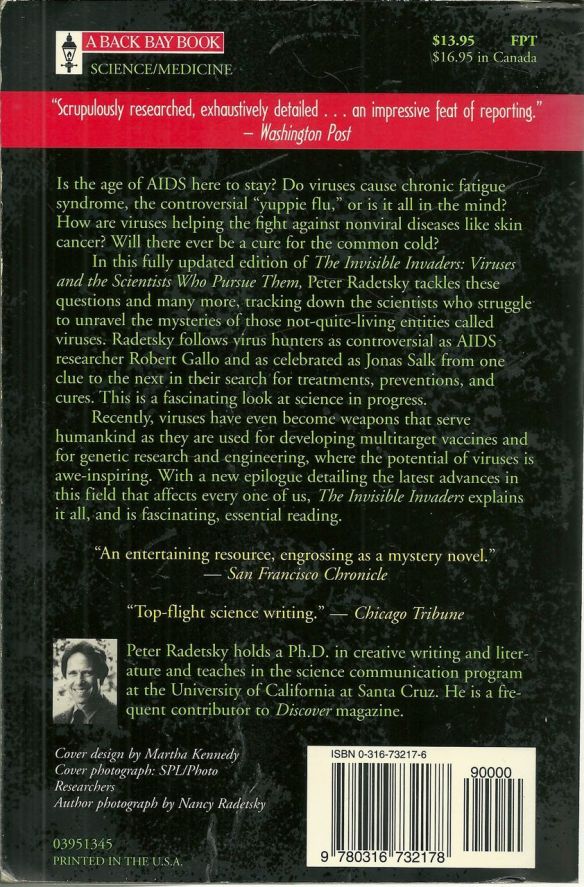
For details about viruses and the diseases they cause I highly recommend the 1994 book, Invisible Invaders, Viruses and the Scientists Who Pursue Them, by Peter Radetsky. It is an excellent book, well-written, with a wealth of information, and fascinating reading. It spans 200+ years of viral infectious disease discovery and vaccination development history; most of it for the 20th century.
Coronaviruses in general seem to have a very complex chemical process for coursing through their human hosts. A very technical summary of all this is given in a 2015 National Institutes of Health (NIH) paper, conveniently posted online (Coronaviruses: An Overview of Their Replication and Pathogenesis, https://www.ncbi.nlm.nih.gov/pmc/articles/PMC4369385/). The relative lengthiness of this process will account for some of the ‘delay’ or ‘latency period’ between initial infection and outbreak of symptoms.
Another and more insidious factor that could contribute to that delay is this, as described (in one sentence) in the NIH paper just noted (https://www.ncbi.nlm.nih.gov/pmc/articles/PMC4369385/):
“In several coronaviruses, S protein that does not get assembled into virions transits to the cell surface where it mediates cell–cell fusion between infected cells and adjacent, uninfected cells. This leads to the formation of giant, multinucleated cells, which allows the virus to spread within an infected organism without being detected or neutralized by virus-specific antibodies.”
In other words, some of the viral goop inside an infected cell bonds it to adjacent healthy cells into which the virus can then penetrate stealthily, out of “sight” of the antibodies of the immune system floating in our bloodstream. In that way many cells can become invisibly infected, as regards our immune system’s “radar,” — thus our asymptomatic latency period — before all viral hell breaks loose from all those “sleeper cells,” and the victim is obviously in full-blown disease.
The SARS-CoV-2 virus initially causes an upper tract respiratory disease in its infected human hosts, but it can migrate deeper down the airway, then into the lungs, and down very deep to lodge in and damage the alveoli, the ‘air sacs’ where air/oxygen enters the bloodstream through capillaries. From there it can drift along with the blood to arrive at (and possibly infect) the heart and the kidneys, these latter being another type of “spongy” organ for osmotic-type transfers (of oxygen into the blood with the alveoli, of liquid wastes out of the blood for the kidneys).
Several reports, one from 12 March 2020 is cited and quoted here (Are Kidneys Targeted by the Novel Coronavirus?, https://www.cathlabdigest.com/content/are-kidneys-targeted-novel-coronavirus), show that kidneys have been infected by SARS-CoV-2, and a significant fraction of survivors have lasting kidney damage requiring dialysis thereafter. This paper notes (in the following consolidated paragraph):
New data on coronavirus disease include some startling revelations: Kidney involvement seems to be frequent in people who have been tested positive and have developed symptoms. Two studies showed a high rate of renal abnormalities in corona-positive patients: Admitted to hospital, 34% of the 59 patients developed massively elevated levels of albumin in urine (=proteinuria), a symptom of kidney damage 63% of the study patients developed proteinuria while in hospital, and many of them also had blood loss in their urine (hematuria). Kidney function was impaired in 27% of the study population and in 66% of the patients who died from the coronavirus infection. These findings are supported by a second study involving 710 hospitalized patients: On admission, 44% had hematuria and proteinuria (26.7% had hematuria only), and kidney function decreased in nearly 15%. “This shows that COVID-19 also attacks the kidneys, not just the lungs”, explains Professor Carmine Zoccali, President of the ERA-EDTA. [ERA-EDTA is one of the biggest nephrology associations worldwide leading European nephrology and one of the most important European Medical Associations.]
Some recent news stories voice concerns that, after ventilators, kidney dialysis machinery may be the next area of medical equipment shortages caused by the COVID-19 pandemic.
People who died of “complications of COVID-19” might have succumbed to pneumonia (drowning because of fluid filled lungs); or hypertension heart attacks, exacerbated by obesity, where the heart was pumping furiously to try to capture and circulate oxygen from lungs that were clogging up and choking off that gas flow; or kidney failures; or any combination of these. “Old people” are more susceptible because they generally have weaker immune systems and more underlying conditions (e.g., hypertension and heart diseases, diabetes, airway constrictions/emphysema, obesity).
Many people are curious as to how COVID-19 might be similar to, or different from, the H1N1 avian flu that caused the 1918 pandemic. In particular, some observe and ask: ‘the 1918 flu targeted its fatalities in a far younger population, why?’ The culprit was “a cytokine storm in the body,” an effect that also certainly occurs to some COVID-19 unfortunates. This article on H1N1 (Influenza A virus subtype H1N1, https://en.wikipedia.org/wiki/Influenza_A_virus_subtype_H1N1) notes (in the following paragraph) that:
The 1918 flu caused an unusual number of deaths, possibly due to it causing a cytokine storm in the body. (The current H5N1 bird flu, also an Influenza A virus, has a similar effect.) The Spanish flu virus infected lung cells, leading to overstimulation of the immune system via release of cytokines into the lung tissue. This leads to extensive leukocyte migration towards the lungs, causing destruction of lung tissue and secretion of liquid into the organ. This makes it difficult for the patient to breathe. In contrast to other pandemics, which mostly kill the old and the very young, the 1918 pandemic killed unusual numbers of young adults, which may have been due to their healthy immune systems mounting a too-strong and damaging response to the infection.
The article Cytokine Release Syndrome (https://en.wikipedia.org/wiki/Cytokine_release_syndrome) describes cytokine storms in greater detail (the next 2 paragraphs):
Cytokine release syndrome (CRS) or cytokine storm syndrome (CSS) is a form of systemic inflammatory response syndrome (SIRS) that can be triggered by a variety of factors such as infections and certain drugs. It occurs when large numbers of white blood cells are activated and release inflammatory cytokines, which in turn activate yet more white blood cells. CRS is also an adverse effect of some monoclonal antibody drugs, as well as adoptive T-cell therapies. Severe cases have been called cytokine storms. When occurring as a result of drug administration, it is also known as an infusion reaction.
CRS occurs when large numbers of white blood cells, including B cells, T cells, natural killer cells, macrophages, dendritic cells, and monocytes are activated and release inflammatory cytokines, which activate more white blood cells in a positive feedback loop of pathogenic inflammation. Immune cells are activated by stressed or infected cells through receptor-ligand interactions. This can occur when the immune system is fighting pathogens, as cytokines produced by immune cells recruit more effector immune cells such as T-cells and inflammatory monocytes (which differentiate into macrophages) to the site of inflammation or infection. In addition, pro-inflammatory cytokines binding their cognate receptor on immune cells results in activation and stimulation of further cytokine production. This process, when dysregulated, can be life-threatening due to systemic hyper-inflammation, hypotensive shock, and multi-organ failure.
So, some COVID-19 fatalities may be due to over-acting immune systems that cause massive inflammation in response to the infection, and consequently excessive cell damage to the unfortunate human victims. As auto-immune diseases demonstrate, it is possible for people of any age to have a trigger-happy immune system.
Viral particles ride on tiny droplets (aerosols) released as part of infected breath. Given the uncertainty on the scope of infection in the population you live among, and their degree of contagiousness, both because of the asymptomatic latency and the limited extent of testing (especially in the USA), your best tack is to stay away from other people’s “breath plumes,” the clouds of vapor and water droplets that expand from their mouths and noses as coughs, sneezes and exhalations (which are stronger and of longer range when exercising or under physical strain). Eventually such droplets fall to the ground. Face masks are helpful for limiting the outward range of plumes expelled by an emitter, and also for shielding impacted passers-by, by filtering the wafts of an emitter’s infected breath (hopefully attenuated by an emitter’s mask) before it reaches their own noses and mouthes.
Over time, aerosolized virus is eliminated and destroyed by the combination of sunlight, heat and humidity. These three weather-related virus-destroying factors are noted in an 11 February 2020 report, which otherwise seems overly optimistic about when SARS-CoV-2 will “go away.” (https://www.accuweather.com/en/health-wellness/coronavirus-expert-says-the-virus-will-burn-itself-out-in-about-6-months/679415)
Sunlight, as ultraviolet (UV) radiation, ‘bleaches’ or ‘oxidizes’ the virus particles; heat can cook them to death (breaking them apart; heating is a technique that has been used to make weak-germ and killed-germ vaccines); and humidity can “rain out” virus particles from the atmosphere, washing them away in ground runoff, eventually to break apart. Flu is seasonal because of these effects: it expands through its human hosts in the fall and winter (in the northern hemisphere), and dissipates when sunnier warmer weather arrives (by retreating into asymptomatic wildlife hosts, usually migratory birds and also bats).
So to recapitulate, most people infected with COVID-19 are asymptomatic at a rate of 60%. (The two ‘full population testing’ studies cited here reported rates of 60% from over 600 infected on a US Navy aircraft carrier ship, and nearly 37% from 146 infected in a homeless Bostonian population housed in a single shelter.) For the SARS-CoV-2 virus, “stealth in the form of asymptomatic transmission is this adversary’s secret power.” That stealth, in the form of its asymptomatic latency period, seems to be due to its lengthier chemical process for reproducing itself in human host cells and then expelling itself from them, and probably also with the added subterfuge of ‘glueing’ infected cells to adjacent healthy ones, which the virus then penetrates and infects without going outside the cells so as to not alert the human immune system antibodies coursing through the bloodstream.
Social distancing and face masks — inconvenient, uncomfortable and unpopular — are essential behaviors to limit the expansive speed and range of this SARS-CoV-2 pandemic. This disease can be fatal, and it has been shown to leave lasting damage to the hearts and/or kidneys of a portion of its survivors. People most susceptible to succumbing fatally to COVID-19 are older, and/or have underlying medical conditions that weaken the operations of the lungs, and/or heart, and/or kidneys, and/or the immune system. Another morbidity factor, which can occur in people of all ages, is having a overly aggressive immune system that would unleash a cytokine storm in response to this viral infection.
The appropriate political response by the survivors of this pandemic is to support national universal healthcare, and to support the just and generous remuneration, job security and workplace safety of the frontline medical personnel attending to the sick and dying, not just during this pandemic but thereafter. Also, we must support the robust financial support of epidemic and pandemic response planning agencies, beyond the cheapskate, ‘just in time’ high-profit business-wise lower levels of support reluctantly agreed to by reactionary neoliberal privatization freaks like Donald Trump.
While several prototype vaccines and cures for COVID-19 are currently in clinical trials, it is not yet known if the SARS-CoV-19 virus will be able to be warded off once and for all with one or two antiviral vaccine “shots,” or if it will become another of the seasonally recurrent viruses, like the cold and flu viruses, that mutate (by viral “drift,” a small change in the surface H gene; or “shift,” by forming a new strand of RNA) too quickly for our medical science to ever devise an unchanging vaccine that affords us a permanent immunity.
Given this COVID-19 global experience, will humanity now find common cause to alter its various regional behaviors that in aggregate give rise to such insidious viral pandemics? We’ll see. I suppose that a science-fiction writer could craft a dystopian tale from the individual human and societal failures that we are yet likely to witness, in which our atmosphere is routinely contaminated with disease-causing viruses like SARS-CoV-2, along with our usual copious greenhouse gas and fossil fuel carbon particulate pollution, so that the human denizens of Planet Earth would then have to move about clothed in hazmat space suites with oxygen tanks, and with their livestock housed in large controlled atmosphere feedlot bubbles; and tough luck on the wildlife.
On the prospects of humanity changing its ways after this round of COVID-19, I am reminded of the last scene in the 1959 movie On The Beach, of the empty windblown streets of post-human Melbourne, Australia, with a slowly fluttering Salvation Army street banner that reads: “There is still time…Brother.”
I am grateful to Katje Erickson for pointing me to the two ‘full population testing’ studies cited here.
<><><><><><><>

Drawing by Babak Kateb, MD
<><><><><><><>

<><><><><><><><><><><><><><><><><><><><><><><><><><><><><><><><>
Asymptomatic COVID-19, a Long Latency Period to Evade the Immune System?
1.5 WEEKS AGO: testing revealed 146 positives out of 397 population (in a homeless shelter in Boston) = 36.8% positive AND asymptomatic. Those positives were then quarantined separately.
NOW: only 1 needs hospital care, while many still show no symptoms.
CONCERN RAISED: very possibly many infectious asymptomatics out and about in the general population. (https://www.boston25news.com/news/cdc-reviewing-stunning-universal-testing-results-boston-homeless-shelter/Z253TFBO6RG4HCUAARBO4YWO64/)
If there is a ~2 week (or more?) delay between infection and outbreak of symptoms (during which time the person is invisibly infectious), then that is a long latency as compared to colds and flu (days). SARS-CoV-2 is a positive-sense single-stranded RNA virus; and by my understanding of such +single-strand RNA viruses, they get inside infected cells, commandeer the messenger RNA manufacturing machinery and thence the protein manufacturing machinery (ribosomes) of the cell to produce the viral components (viral RNA = virions?, and protein capsules) that are assembled into new viruses that exit the cell (killing it, when a large outflux), and tear off outer cell lining to wrap themselves in a lipid (fat) cover.
Coronaviruses seem to have a very complex chemical process for doing all this (according to the 2015 NCBI paper PMC4369385 = https://www.ncbi.nlm.nih.gov/pmc/articles/PMC4369385/) and my surmise is that that may account for a relatively long latency period between initial infection and outbreak of symptoms.
Another factor for such a delay could be this (from https://www.ncbi.nlm.nih.gov/pmc/articles/PMC4369385/):
“In several coronaviruses, S protein that does not get assembled into virions transits to the cell surface where it mediates cell–cell fusion between infected cells and adjacent, uninfected cells. This leads to the formation of giant, multinucleated cells, which allows the virus to spread within an infected organism without being detected or neutralized by virus-specific antibodies.”
In other words, some of the viral goop bonds the infected cell to adjacent healthy cells into which the virus then penetrates stealthily, out of “sight” of the antibodies of the immune system. In that way many cells can become invisibly infected as regards our immune system “radar,” – our asymptomatic latency period – before all hell breaks loose from all those “sleeper cells” and the victim is evidently in full-blown disease.
These articles are interestingly suggestive; but beware that I have injected my own speculations here.
CDC reviewing ‘stunning’ universal testing results from Boston homeless shelter
15 April 2020
https://www.boston25news.com/news/cdc-reviewing-stunning-universal-testing-results-boston-homeless-shelter/Z253TFBO6RG4HCUAARBO4YWO64/
Coronaviruses: An Overview of Their Replication and Pathogenesis
12 February 2015
https://www.ncbi.nlm.nih.gov/pmc/articles/PMC4369385/
Invisible Invaders, Viruses and the Scientists Who Pursue Them, by Peter Radetsky (1994), is an excellent book, well-written, wealth of information, fascinating. Spans 200+ years of viral infectious disease discovery and vaccination development history; most of it for the 20th century.
Viruses are ever changing to evade immune systems, and reliably persistent at seeking to infect animal and human hosts. Humans can be amazingly clever in deciphering viral codes and schemes — giving us the cures and vaccines we have gotten so far — but for the most part are unchanging as regards being petty and conniving in the extreme, all for the sake of seeking approval, recognition, and to profit financially from their otherwise humanitarian efforts. Behaviorally, on average we are a monoculture, and monocultures are much more easily penetrated by viral diseases, whether physical (like COVID-19), or mental (like money-making one-upmanship, a.k.a. capitalism, neoliberalism).
While I have explicitly speculated here, please note that I defer to the medical experts, like Dr. Fauci, on “what it is,” and “what we should do.” My own best estimates are informed by the articles noted above, and the following, particularly Radetsky’s book (described above and in the pictures).
Three questions by Henry Coulter, and my “answers” follow.
1. “Is this virus compatible to the one of Spanish Flu fame?”
It is somewhat similar (a positive sense single strand RNA virus for SARS-CoV-2, and maybe also for H1N1 1918 Flu), both causing (initially) respiratory diseases. SARS-CoV-2 can migrate deeper into the airway, then lungs, and down deep there in severe (life threatening) cases. Now reports (mainly from China) have emerged that for severe cases (survivors) something like 30% (??) of them develop heart damage and permanent kidney damage thereafter requiring dialysis.
MY SPECULATION: is that once the virus is deep deep in the lungs, and damaging the alveoli (where air/oxygen enters the bloodstream through capillaries), that it may drift along with the blood to arrive at the heart and the kidneys (another “spongy” organ for osmotic-type transfers), and in that way infect and damage them. People who have died from “complications of COVID-19” MIGHT then have gone because of pneumonia (drowning), or hypertension heart attacks where the heart was pumping furiously to try to capture and circulate oxygen from lungs that were clogging up and choking off that gas flow, or kidney failures.
The “old” are more susceptible because they generally have weaker immune systems, and more underlying conditions (e.g., heart diseases, diabetes, airway constrictions/emphysema, obesity).
2. “If we simply have much better communication channels to mitigate the spread.. thus lower the impact on the population.”
See the story about Vietnam’s response to the pandemic. It shows exactly that, and much more (important story).
https://consortiumnews.com/2020/04/16/covid-19-vietnam-winning-new-war-against-invisible-enemy/
3. “The Spanish flu targetted a far younger population.”
There is an extreme immune system response called a “cytokinetic storm,” and is POSSIBLY (MY SPECULATION) more likely to occur with strong young adult (not child) immune systems:
From “Cytokine Release Syndrome,” https://en.wikipedia.org/wiki/Cytokine_release_syndrome, (next 2 paragraphs):
Cytokine release syndrome (CRS) or cytokine storm syndrome (CSS) is a form of systemic inflammatory response syndrome (SIRS) that can be triggered by a variety of factors such as infections and certain drugs. It occurs when large numbers of white blood cells are activated and release inflammatory cytokines, which in turn activate yet more white blood cells. CRS is also an adverse effect of some monoclonal antibody drugs, as well as adoptive T-cell therapies. Severe cases have been called cytokine storms. When occurring as a result of drug administration, it is also known as an infusion reaction.
CRS occurs when large numbers of white blood cells, including B cells, T cells, natural killer cells, macrophages, dendritic cells, and monocytes are activated and release inflammatory cytokines, which activate more white blood cells in a positive feedback loop of pathogenic inflammation. Immune cells are activated by stressed or infected cells through receptor-ligand interactions. This can occur when the immune system is fighting pathogens, as cytokines produced by immune cells recruit more effector immune cells such as T-cells and inflammatory monocytes (which differentiate into macrophages) to the site of inflammation or infection. In addition, pro-inflammatory cytokines binding their cognate receptor on immune cells results in activation and stimulation of further cytokine production. This process, when dysregulated, can be life-threatening due to systemic hyper-inflammation, hypotensive shock, and multi-organ failure.
4. Henry: Stay away from other people’s “breath plumes,” the clouds of vapor and water droplets that expand from their mouths and noses on exhalations (stronger and of longer range when exercising/under physical strain), coughs and sneezes. Eventually such droplets fall to the ground.
The aerosolized virus is eliminated and destroyed by the combination of sunlight, heat and humidity.
https://www.accuweather.com/en/health-wellness/coronavirus-expert-says-the-virus-will-burn-itself-out-in-about-6-months/679415
(But that report from February 2020 may be too optimistic about when SARS-CoV-2 will “go away.” We’ll see.)
Sunlight, as UV radiation, ‘bleaches’ or ‘oxidizes’ the virus particles [MY CHARACTERIZATION]; heat can cook it to death (breaks it apart, a technique often used when making weak-germ and killed-germ vaccines), and humidity can “rain it out” of the atmosphere (on to the ground, and washed away in runoff).
FINALLY: I AM NO MEDICAL NOR VIROLOGY NOR EPIDEMIOLOGY EXPERT!! But (since I’ve been explicit with my caveats), you can share this commentary as/if you like.
<><><><><><><>


<><><><><><><>
Over the last five years, Bernie Sanders has awakened every single mind in the United States of America to the following 12 ideas, which in the American political orthodoxy of 2015 were ‘known’ to be so ultra-radical that they were deemed politically impossible forever, and thus dismissed without further consideration:
— healthcare as a human right, implemented by Medicare-For-All;
— raising the minimum wage to $15 and hour;
— free education at publicly funded colleges and universities;
— cancellation of all student loan debt;
— a transaction tax on Wall Street trading, and prosecution for economy-crashing Wall Street fraud;
— revoking tax breaks to corporations and the extremely wealthy, and inverting both the tax code and the political campaign contribution system to the benefit of wage earners;
— transitioning from fossil fuels, and investing in infrastructure revitalization in a trillion dollar jobs-rich program;
— accepting the 11 million undocumented residents into a citizenship program, abolishing the ICE concentration camps, and reforming the immigration and political asylum system by humanizing it;
— reforming the criminal justice system to eliminate its evident racial bias and persecution of poverty;
— assuring women’s rights to equal pay for equal work and to abortion: keeping women in control of decisions regarding their own bodies;
— the abrogation of job and manufacturing outsourcing “free trade agreements”; and
— the regulation of drug pricing by pharmaceutical corporations.
Sanders has been able to appeal to people of every racial and sexual distinction, from every Abrahamic and non-Abrahamic religion as well as atheists, and to develop a grassroots political movement, which is both democratic and socialist, from that appeal. No other American, with the exception of Martin Luther King, Jr., has come close to this achievement since the days of Franklin Roosevelt.
People opposed to these 12 ideas, in part or in whole, are possessed by combinations of greed, bigotry and sexism. While such attitudes are repulsive to any decent mind, they are nevertheless common in several wealthy and corporatized constituencies that are inordinately politically powerful by dint of financially patronizing — purchasing — political legislators, policymakers, officeholders, and judges: straightforward political corruption.
The betrayal of public trust by timorous and hypocritical “public servants” who lack authentic moral character and are entirely cultish zealots of lucre is, tragically, all too common in American governance. That the richest and most powerful country in human history can consign so many of its people to abject misery, fear, neglect, financial ruin and death, is an abhorrent testament to the destructiveness of these narcissistic parasites on the American Body Politic.
One sad observation for me about the suspension — the ending — of Bernie Sanders’ 2020 presidential campaign is the pathetically bitter envy, expressed by isolated politically inconsequential failed leftist ideologues, of the historically major successes at politically bold mass consciousness-raising and organizing achieved by the progressive pragmatic politician Bernie Sanders.
The biting sarcastic glee of numerous self-styled advanced leftist commentators at the suspension of the Sanders presidential campaign are their outbursts of joy at the arrival of this “failure,” which they have been pining for for months, even years, so that now they can finally crow in triumph that they had always been right, that Sanders was merely a sheepdog, a stealth Judas goat and Pied Piper meant to lead the naïve masses into the electoral corral of the Democratic National Committee wolfpack, and away from the true lines of political thought these ideological pastors had stirringly and stridently preached at the inattentive and disinterested masses urging them to cuff their minds in alignment onto the iron rails of ‘correct’ revolutionary tenets inscribed on the Tablets of all these Red Moses, so as to amass the socialist tsunami these commissars-in-waiting wished so delusionally to crown with their leadership.
What pathetic failures of intellectual honesty to admit to their lifelong “revolutionary” ineffectiveness, and what pathetic failures of human decency to acknowledge with grace and gratitude the really incredible societally beneficial achievements of one near-octogenarian Jew from Brooklyn, New York, transplanted to Vermont. It is a fact that Bernie Sanders has permanently altered popular American political consciousness — which had been dominated since 1979 by the neoliberal paradigm — toward the favoring of the wage-earning masses, and that some of his ideas have already been implemented regionally and in several industrial operations.
Can you imagine that the new purely socialist COVID-19 economic relief legislation — however flawed it clearly is as it comes out of the Trump Administration, the Republican dominated Senate and the DNC Democrat dominated House — would be as comprehensive and as reluctantly ‘generous’ as it is at the moment, without the prior popular consciousness of Bernie’s 12 ideas, and without his continuing advocacy? Bernie Sanders has lit a fire in American minds under the age of 50 that will not be extinguished soon. Scores of young people with that fire in their hearts inspired by Bernie Sanders, and which so terrorizes the ensconced political elites, have now gained political office with a drive to change American society.
So to you my friends I say: be grateful for all of that and celebrate the triumphs of a man of integrity who struggles against a corrupted and degenerate establishment, instead of being childishly resentful that your imagined brilliance has perennially and once again been overshadowed.
‘Okay, so I’m a little bit asshole, but friends tell friends the truth’ (https://youtu.be/L8QYgpqbXQQ).
<><><><><><><><><><><><><><><><><><><><><><><><><><><><><><><><>
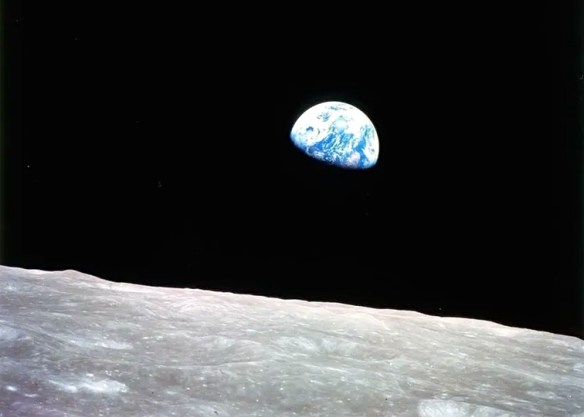
Can COVID-19 Save Lifeboat Earth?
Harbhajan Singh asks [6 April 2020]: “Could COVID-19 save Lifeboat Earth?”
Many realize that eliminating humanity would make Earth healthier for Nature, plants and animals.
Many also realize that without profound changes to human behavior — by everybody, everywhere; including limiting population growth and ending greenhouse gas emissions — that humanity can not exist in balance with Nature, and both will increasingly suffer, eventually — in a few lifetimes? — fatally.
It is well documented that as human encroachment and destruction of Nature (e.g., environments and biodiversity) advances, that habitability decreases.
That decrease is due to a combination of:
— pollution (bad air, ocean plastic, dead seas, lost topsoil, lost forests, toxic land);
— climate change (and more violent weather, floods, droughts, wildfires);
— food source degradation (inorganic industrial farming, loss of natural varietals, loss of seafood), and
— greater hazards of releasing viruses (epidemics and pandemics) fatal to people.
The scientific reports get very specific on ‘this particular negative effect has this particular [human stupidity] cause’, but in aggregate they show what I’ve just outlined.
More people are realizing that humanity’s accelerating encroachment and destruction of Nature can only cause more deadly virus pandemics to plague us. Hotter environmental temperatures from global warming, and greater particulate and noxious gases pollution from human activity (industrialization, capitalism, militarism) aggravate the severity and lethality of all respiratory illnesses, like COVID-19.
I prefer that humanity became vastly more intelligent, and cooperative, and altruistic, and balances its existence (both individual and collective) with Nature’s timeless rhythms and geophysical limits.
The most important aspect of that wished-for cooperativeness is that we cease viewing each other as deadly rivals in a grim zero-sum game of making-money one-upmanship and competing narcissistic schemes of enslaving others.
Miraculously, the Earth is the most wonderful Paradise we know of in the entire Universe. If we treated it as such, instead of treating it like a garbage dump and sewer, it would return that appreciation, and we would knowingly experience life in this actual Paradise, for ourselves and for endless future generations.
This is not just poetry, it is fact.
<><><><><><><>
Louis Proyect writes: “I understand the reluctance to put a plus where Trump does, but this article [“How New Jersey’s First Coronavirus Patient Survived,” in the New York Times, ~3 April 2020] indicates that a doctor who was close to death had a miraculous recovery after receiving Remdesivir and Hydroxychloroquine.”
Remdesivir (https://en.wikipedia.org/wiki/Remdesivir): “Remdesivir (development code GS-5734) is a novel antiviral drug in the class of nucleotide analogs. Remdesivir is an adenosine analogue, which incorporates into nascent viral RNA chains and causes their pre-mature termination. It was developed by Gilead Sciences as a treatment for Ebola virus disease and Marburg virus infections, though it subsequently was found to show antiviral activity against other single stranded RNA viruses such as respiratory syncytial virus, Junin virus, Lassa fever virus, Nipah virus, Hendra virus, and the coronaviruses (including MERS and SARS viruses). It is being studied for SARS-CoV-2 and Henipavirus infections. Based on success against other coronavirus infections, Gilead provided remdesivir to physicians who treated an American patient in Snohomish County, Washington in 2020, who was infected with SARS-CoV-2, and is providing the compound to China to conduct a pair of trials in infected individuals with and without severe symptoms.”
Hydroxychloroquine (https://en.wikipedia.org/wiki/Hydroxychloroquine): “Hydroxychloroquine (HCQ), sold under the brand name Plaquenil among others, is a medication used to prevent and treat malaria in areas where malaria remains sensitive to chloroquine. Other uses include treatment of rheumatoid arthritis, lupus, and porphyria cutanea tarda. It is taken by mouth. It is also being studied as an experimental treatment for coronavirus disease 2019 (COVID-19). Common side effects include vomiting, headache, changes in vision, and muscle weakness. Severe side effects may include allergic reactions. Although all risk cannot be excluded, it remains a treatment for rheumatic disease during pregnancy. Hydroxychloroquine is in the antimalarial and 4-aminoquinoline families of medication. Hydroxychloroquine was approved for medical use in the United States in 1955. It is on the World Health Organization’s List of Essential Medicines, the safest and most effective medicines needed in a health system. In 2017, it was the 128th-most-prescribed medication in the United States, with more than five million prescriptions.”
My CONJECTURE (a non-medical person’s hypothesis) is that the SARS-CoV-2 virus (causing COVID-19) may act in a somewhat similar manner to the Epstein-Barr Virus (EBV). If so, this hypothetical (and likely only partial) similarity might lead some doctors treating critically ill COVID-19 patients to administer the drug combination of: the antiviral drug Remdesivir to reduce the viral load, and the anti-malarial drug Hydroxychloroquine to buttress the patient’s immune system, which is assumed to be in a pre-existing weakened condition.
My following description of the Epstein-Barr Virus (EBV) and its several disease-causing effects are drawn from the book The Invisible Invaders, Viruses And The Scientists Who Pursue Them, by Peter Radetsky, (published by Little, Brown and Company, 1991, 1994). Passages quoted from that book are woven into my interpretive discussion, below.
Bone marrow produces a number of kinds of blood cells, including “the B and T lymphocytes, which comprise an essential part of the immune system. Without these disease-fighting cells [we] couldn’t fend off the mildest infection; something as insignificant as the common cold could kill [us].”
The Epstein-Barr Virus is ubiquitous in people (~95%), it invades B lymphocyte cells, but is usually held in check by the human immune system, which produce antibodies to eliminate EBV-infected B lymphocyte cells.
In poor regions with primitive and/or inadequate hygiene (e.g., parts of Africa) children are exposed to EBV early in life (3-4 years) and may only get a mild ‘childhood’ disease of sore throat, cough and flu-like symptoms for a few days, and that’s all. “For some reason, whether because of the immaturity of their B lymphocytes (the cells the Epstein-Barr virus invades) or the immaturity of their immune system as a whole, [most of these] children infected with EBV rarely come down with any kind of obvious illness.” (The EXCEPTION to this will be described further below.) Thereafter, these minimally affected and now recovered children have antibodies to EBV.
In the developed and generally very hygienic countries, children may not be exposed to EBV until much later: adolescence and early adulthood. “But when the virus invades later, the result is usually more severe: a case of mononucleosis. In causing a more serious illness in older people, EBV acts much like other viruses, hepatitis and poliovirus among them. The reason may be that in older individuals the immune system responds inappropriately to infection. In any case, as far as EBV is concerned, at least half of the people belatedly infected with EBV experience significant illness.”
“Mononucleosis is a disease in which blood cells proliferate out of control. Here [is] a virus, EBV, that was first detected in cancer tumors [Burkitt’s lymphoma], and now [has been shown] to be intimately involved in mononucleosis, a common cancer-like disease… Mononucleosis is essentially a disease of developed countries.”
Now for the EXCEPTION.
Denis Burkitt, a Scottish surgeon and physician practicing in Africa during the 1950s and 1960s, first identified the cancer “Burkitt’s lymphoma” in African children, by engaging in a massive study and expedition between 1957 and 1961. In 1963, EBV was isolated by M. Anthony Epstein and Yvonne Barr from specimen tumors sent by Burkitt to London in 1961. If so many African children were exposed to EBV as toddlers with little consequence (and certainly no mononucleosis in early adulthood), why did some of those children develop the specific cancer of Burkitt’s lymphoma?
Obviously, the fundamental factor that can lead to Burkitt’s lymphoma is exposure to and infection by EBV.
The first necessary co-factor to developing Burkitt’s lymphoma is having “been exposed to an unusually heavy dose of the [EBV] virus.”
The second necessary co-factor to developing Burkitt’s lymphoma is “a weakened immune system.”
“It has been suggested…that Burkitt’s lymphoma arises as a result of immunological disorders in children exposed since early infancy to heavy malarial infection.” [Guy de Thé, 1978].
The fact that infection with EBV in an individual with a weak immune system can lead to cancer was proved by the case of David, “The Bubble Boy.” David was born with no immune system and lived in the sterile interior of a plastic bubble (a tent). In 1983, he was given a bone marrow transplant from his healthy sister, but he died in 1984 at the age of 12. The cause of death was cancer, “the B cells that David had obtained through the bone marrow transplant had run amok. He died of cancer of the B lymphocytes, with tumors similar to Burkitt’s lymphoma. All the cancer cells contained Epstein-Barr virus. [David’s] sister had at some point been exposed without harm to EBV; she passed on this otherwise harmless dose to David through her bone marrow.”
Epstein-Barr virus causes a very broad stimulation of B-cell growth. Out of that a tumor can develop if given “some kind of other agent that compromises the immune system… In the case of Burkitt’s lymphoma, that agent is almost certainly malaria.”
Guy de Thé [1984]: “We know that very early viral infection can lead to Burkitt’s lymphoma. It’s a situation exactly like [that of] cigarette smoking and lung cancer. You don’t fully understand the mechanism, but you can measure the risk. Very heavy and early exposure to EBV is as though you were smoking all your life, two packs a day. Then malaria enters at the second level, by promoting further proliferation of the B cells infected with EBV. We’re all infected by EBV, but nothing happens to most of us because our immune system controls the infected B cells. Malaria specifically depresses the part of the immune system whose job it is to control the B cells. And after that, something, possibly a chance event, induced by nobody knows what, causes a change in chromosomes that transforms the cell into a tumor cell.”
Now, recall the CONJECTURE. Hypothetically, a similarity of causes exists between:
— the cause of serious COVID-19 illness and death (by the SARS-CoV-2 virus, plus an assumed immunodeficiency co-factor), and
— the cause of Burkitt’s lymphoma, as well David “Bubble Boy’s” cancer of the B lymphocytes (by the Epstein-Barr virus, plus an immunodeficiency co-factor; which for Burkitt’s lymphoma is malaria, and for David was a complete lack of an immune system).
Some doctors working under the stress of trying to save dying people during the explosive growth of this current COVID-19 pandemic, and who may have made conjectures about causes similar to the one stated here, arrived at the drug cocktail of:
— Remdesivir, to try a direct reduction the SARS-CoV-2 viral load in the patient’s respiratory tissues; and
— Hydroxychloroquine, to buttress an assumed immunodeficiency — as with malaria — of inadequate control of B lymphocyte cells presumably infected with the virus.
So much for my amateur speculations on the Remdesivir plus Hydroxychloroquine cocktail administered to some COVID-19 patients.
What I can see clearly as fact is that doctors and virologists are in a frantic race against death (within days to a couple of weeks for the unlucky patients), to save as many COVID-19 stricken as they can, while yet having incomplete knowledge about the mechanism, and its unknown associated co-factors, by which the SARS-CoV-2 virus actually causes fatalities. Also, they are simultaneously trying to ascertain the details of both the progression of infection and the nature of all associated co-factors that aggravate the disease to the point of fatality, so as to then be able to design drugs that cure COVID-19, and vaccines that can prevent people from developing the disease if exposed to the virus.
Both as individuals and as a society we should be very grateful to the medical people working so furiously — and for many at great personal risk — on COVID-19 today, and on all the as yet little-known and untamed viruses that might infect us in the future; and we should support their work fully (politically and financially) as a matter of public health national policy. “Public” as in Medicare-For-All, and as in drug and vaccine development that is as much a publicly funded and owned service, rather than only a for-profit exploitation of human need by a mercenary pharmaceutical industry.
Acknowledgement: I want to thank Gretchen Hennig for giving me a copy of Radetsky’s book, and for explaining the concept of “viral load” to me.
<><><><><><><>

<><><><><><><><><><><><><><><><><><><><><><><><><><><><><><><><>
Our Virally Porous Walls
“The Invisible Invaders” is the title of Peter Radetsky’s book on “viruses and the scientists who pursue them.” It is a richly detailed, smoothly written primer on the subject for the non-biochemist. This book arcs through four topics:
first: a history from 1744 to 1930 of the development of the medical science and vaccines aimed at combatting infectious diseases (for smallpox in 1796 by Edward Jenner [1749-1823], for rabies in 1885 by Louis Pasteur [1822-1895]); the discovery of the virus in 1898 by Martinus Beijerinck (1851-1931); and the discovery in 1917 by Félix d’Hérelle (1873-1949) that viruses could attack and kill bacteria — which are living cells;
second: the science of virology, and the present understanding that viruses are parasitic forms of ribonucleic acid (RNA) or deoxyribonucleic acid (DNA) that invade living cells and hijack their functional programming, so as to reproduce and expel more viruses;
third: modern-day concerns and discoveries about viral diseases: colds, herpes, flu, hepatitis, cancer, AIDS;
fourth: gene therapy inspired by natural viral action, the intentional manipulation of biochemical dynamics to thwart viral infections and to artificially create designer proteins for desired purposes.
Radestsky states that: “[Most] of us have little idea of the impact viruses have on our lives. For they are not simply dangerous enemies, the only organisms besides ourselves that pose a threat to our survival; they’re our co-travelers in life, our most intimate fellow workers. Viruses are literally everywhere — inside us, outside us, constantly permeating the boundaries of the self… They may swap our genes around, rearrange our destinies, act as agents of the ecosystem. In their admirable simplicity and appalling efficiency, they may be the most successful life-form of all… if they can be said to be alive in the first place.”
COVID-19 is a respiratory disease caused by infection with the SARS-CoV-2 virus (Severe Acute Respiratory Syndrome Coronavirus 2). We can metaphorically visualize a viral pandemic in a manner similar to the antique and unscientific ideas that the causes of inexplicable epidemics were astrological “influenza,” and bad airs, “malaria,” wafting out of swamps; by imagining viral epidemics as very tenuous and filamentary clouds of sub-microscopic nucleic acid particles, each wrapped in fat and coated with protein, that are all coursing through our atmosphere, propelled by air currents on every scale from weather systems to human exhalations, and despite their extreme fragility have the power to penetrate through our civilization and into our very bodies and once there to penetrate into the core genetic control units of our cellular functioning — and disrupt it.
We can never perfectly wall ourselves off from viruses, to them our bodies and our patterns of living are so easily permeable. Our surest defense against viral diseases for which we have no vaccines is avoidance of infection. Such avoidance if afforded by a combination of distancing from infectious people and environments (whether visibly or invisibly contaminated), and the conscientious frequent application of personal hygienic practices and household and occupational sterilization protocols. Physically, and mindlessly behaviorally, we are an open weave to viruses, a rich meshwork of protoplasm waiting to be virally colonized and explosively exploited.
The reason we have been hit so hard by the COVID-19 pandemic, and with its still increasing force, is that the United States is a nation and society structured like a Matryoshka Doll that imprisons its people but is transparent to viruses. We each are walled in by many types of barriers intended to exclude us from the ‘tribal clubs’ of others, those barriers being: ageist, bigoted, cultural, ethnic, financial, intellectual, political, racist, religious and sexual; we humans can come up with an endless array of repulsive distinctions about ourselves.
We have a multiplicity of forms of imposed isolation, of social distancing, each tailored to the individual’s demographic characteristics, to their sociological DNA if you will. We all live within walls, within outer walls, within still outer walls, and so on for many layers of confinement away from the more favored tribes and classes, yet also shielded from the more unfortunate ones. This structure of social fragmentation and hierarchical survival is the embodiment of capitalist civilization. It is the separations and differences and conflicts and jealousies and inequalities that exist among us that create the necessary socio-political spaces and the material opportunities to prosecute individualistic capitalist schemes, those personal drives toward profits — and also for crimes and wars.
That drive towards profits — in its extreme it is pure narcissism — is impossible to even imagine in a hypothetical society of ideal socialism, a society that has been largely homogenized in the sense of eradicating all the artificial exclusionary distinctions that define the house-of-cards capitalist paradigm. That those distinctions were always illusory and only seemed intellectually sacrosanct and physically rigid was because the popular will of the nation’s many individuals had been trained over many generations by pro-capitalist anti-socialist mass indoctrination to unconsciously project the capitalist paradigm that is imprisoning them.
The COVID-19 pandemic has collapsed the illusion of that paradigmatic rigidity, of the reality of capitalism. The viral ‘cloud’ has easily penetrated through not just our bodies, but the exclusionary distinctions we previously thought of as either protective shields or barriers to our aspirations. The collapse of those illusions is experienced by the benefactors of the capitalist economy as fears of economic depression and of political revolt by the laboring masses. The collapse of those same illusions is experienced by the masses excluded from prosperity in the current paradigm, as an awakening to and anger over the unreality of the many strains of slavery we all have imagined ourselves into for so long, and an awakening to the breathtaking proximity to us of the bracingly real alternate and liberating paradigm of socialism. We can actually all live better, happier and more securely starting right away! It is solely a matter of popular will.
During this pandemic many have already stated the obvious: any successful effort to end these epidemics will necessarily be a socialist action, and the more socialist those efforts are, the greater the degree of their ultimate successes. Our exclusionary ‘walls’ and clashes of hoarding behaviors are transparent to viruses, only social solidarity can be made reasonably opaque to them. To effectively combat viral epidemics we must close up the now-gaping weave of human civilization. Such a closing up will encounter much friction and resistance, as each person seeks to preserve their private bubble of self-importance, money-making, irrational fantasy and bigoted exclusivity, which are the forces of repulsion within our atomistic social collectivity. The capitalist benefactors will actualize their resistance to the closing up of the human social weave, their economic collapse fears of the awakened and just anger of the exploited masses, by tossing bribes and police-enforced compulsion at them: the smallest, cheapest weight they can put on the lid of the bubbling cauldron of neoliberal capitalism to keep it from flying off as it boils over.
Despite the widespread and atomizing disorientation of American society in reaction to COVID-19, as if it were some impending apocalypse, it would be wise to become disciplined, rational and socialist, and to realize that this pandemic is but a skirmish in the monumental and unavoidable karmic war we now must face against our own narcissistic desecration of Nature, and which we call climate change.
<><><><><><><>
Robert Babbitz, historian and my college dorm room-mate from 50 years ago, sent me the following reflection of poems appropriate for our remembrances today. I have added full texts of the poems mentioned to Bob’s commentary, a few small notes, and some of my own poems at the end (probably too many) — without any intention of trying to compare myself to the luminary poets Bob has listed. My purpose is just to share some literary beauty and insightful thoughts with my fellow humans burrowed into their social isolation, hiding from the SARS-CoV-2 virus.
Bob —
Compared to today’s shabby, disease-riddled existence, I cannot help but think of the early 1970’s, when we were roommates, and on into our grad school years, despite the insanity of Nixon, the war, and all the rest, as a better time. Thinking of those years reminds me, somehow of Wordsworth’s lines on the French Revolution:
Bliss it was in that dawn to be alive
and to be young was very heaven.
Of course, the French Revolution didn’t turn out all that well, given the Terror and the rise of Napoleon. An interesting if flawed book is Crain Brinton’s Anatomy of Revolution, in which the author compares the major revolutions. One problem is that Brinton wasn’t a historian, but more of a sociologist or political scientist, and it shows. I read it in grad school. At the time it was the only work of it’s kind.
Recently read an interesting poem by Rupert Brooke, best known as the patriotic British poet who died during the early years of WWI. But his poem “Tiare Tahiti” is not a war poem. I do not think it has racist implications. If you read it, please let me know what you think.
<><><><><><><>
Tiare Tahiti
(by Rupert Brooke, 1887-1915)
Mamua, when our laughter ends,
And hearts and bodies, brown as white,
Are dust about the doors of friends,
Or scent ablowing down the night,
Then, oh! then, the wise agree,
Comes our immortality.
Mamua, there waits a land
Hard for us to understand.
Out of time, beyond the sun,
All are one in Paradise,
You and Pupure are one,
And Taü, and the ungainly wise.
There the Eternals are, and there
The Good, the Lovely, and the True,
And Types, whose earthly copies were
The foolish broken things we knew;
There is the Face, whose ghosts we are;
The real, the never-setting Star;
And the Flower, of which we love
Faint and fading shadows here;
Never a tear, but only Grief;
Dance, but not the limbs that move;
Songs in Song shall disappear;
Instead of lovers, Love shall be;
For hearts, Immutability;
And there, on the Ideal Reef,
Thunders the Everlasting Sea!
And my laughter, and my pain,
Shall home to the Eternal Brain.
And all lovely things, they say,
Meet in Loveliness again;
Miri’s laugh, Teïpo’s feet,
And the hands of Matua,
Stars and sunlight there shall meet
Coral’s hues and rainbows there,
And Teüra’s braided hair;
And with the starred tiare’s white,
And white birds in the dark ravine,
And flamboyants ablaze at night,
And jewels, and evening’s after-green,
And dawns of pearl and gold and red,
Mamua, your lovelier head!
And there’ll no more be one who dreams
Under the ferns, of crumbling stuff,
Eyes of illusion, mouth that seems,
All time-entangled human love.
And you’ll no longer swing and sway
Divinely down the scented shade,
Where feet to Ambulation fade,
And moons are lost in endless Day.
How shall we wind these wreaths of ours,
Where there are neither heads nor flowers?
Oh, Heaven’s Heaven!—but we’ll be missing
The palms, and sunlight, and the south;
And there’s an end, I think, of kissing,
When our mouths are one with Mouth….
Taü here, Mamua,
Crown the hair, and come away!
Hear the calling of the moon,
And the whispering scents that stray
About the idle warm lagoon.
Hasten, hand in human hand,
Down the dark, the flowered way,
Along the whiteness of the sand,
And in the water’s soft caress,
Wash the mind of foolishness,
Mamua, until the day.
Spend the glittering moonlight there
Pursuing down the soundless deep
Limbs that gleam and shadowy hair,
Or floating lazy, half-asleep.
Dive and double and follow after,
Snare in flowers, and kiss, and call,
With lips that fade, and human laughter
And faces individual,
Well this side of Paradise! ….
There’s little comfort in the wise.
<><><><><><><>
The last two lines of this poem were used by F. Scott Fitzgerald (1896-1940) for the opening quote, and title, of his novel This Side Of Paradise.
<><><><><><><>
My favorite poet of The Great War is Wilfred Owen, who served in the British army and was sent back to Great Britain to be treated for PTSD, then, of course, known as “shell shock”. Owen was treated at Craiglockhart hospital in Scotland and eventually sent back to the front, where he was killed just days before the Armistice. His antiwar poem “Dulce et Decorum est” is, in my opinion, brilliant.
<><><><><><><>
Dulce et Decorum est
(by Wilfred Owen, 1893-1918)
Bent double, like old beggars under sacks,
Knock-kneed, coughing like hags, we cursed through sludge,
Till on the haunting flares we turned our backs,
And towards our distant rest began to trudge.
Men marched asleep. Many had lost their boots,
But limped on, blood-shod. All went lame, all blind;
Drunk with fatigue; deaf even to the hoots
Of gas-shells dropping softly behind.
Gas! GAS! Quick, boys!—An ecstasy of fumbling
Fitting the clumsy helmets just in time,
But someone still was yelling out and stumbling
And flound’ring like a man in fire or lime.—
Dim through the misty panes and thick green light,
As under a green sea, I saw him drowning.
In all my dreams before my helpless sight
He plunges at me, guttering, choking, drowning.
If in some smothering dreams, you too could pace
Behind the wagon that we flung him in,
And watch the white eyes writhing in his face,
His hanging face, like a devil’s sick of sin,
If you could hear, at every jolt, the blood
Come gargling from the froth-corrupted lungs,
Bitter as the cud
Of vile, incurable sores on innocent tongues,–
My friend, you would not tell with such high zest
To children ardent for some desperate glory,
The old Lie: Dulce et decorum est
Pro patria mori.
<><><><><><><>
Ironic then, and now:
Dulce et decorum est pro patria mori.
How sweet and honourable it is to die for one’s country.
<><><><><><><>
Some of my favorite poems: Yeats’s “The Lake Isle of Innisfree”, Eliot’s “The Lovesong of J. Alfred Prufrock”, Matthew Arnold’s “Dover Beach”, and many others. What are some of your favorites?
<><><><><><><>
The Lake Isle of Innisfree
(by William Butler Yeats, 1865-1939)
I will arise and go now, and go to Innisfree,
And a small cabin build there, of clay and wattles made;
Nine bean-rows will I have there, a hive for the honey-bee,
And live alone in the bee-loud glade.
And I shall have some peace there, for peace comes dropping slow,
Dropping from the veils of the morning to where the cricket sings;
There midnight’s all a glimmer, and noon a purple glow,
And evening full of the linnet’s wings.
I will arise and go now, for always night and day
I hear lake water lapping with low sounds by the shore;
While I stand on the roadway, or on the pavements grey,
I hear it in the deep heart’s core.
<><><><><><><>
The Lovesong of J. Alfred Prufrock
(by T. S. Eliot, 1888-1965)
S’io credesse che mia risposta fosse
A persona che mai tornasse al mondo,
Questa fiamma staria senza piu scosse.
Ma percioche giammai di questo fondo
Non torno vivo alcun, s’i’odo il vero,
Senza tema d’infamia ti rispondo.*
Let us go then, you and I,
When the evening is spread out against the sky
Like a patient etherized upon a table;
Let us go, through certain half-deserted streets,
The muttering retreats
Of restless nights in one-night cheap hotels
And sawdust restaurants with oyster-shells:
Streets that follow like a tedious argument
Of insidious intent
To lead you to an overwhelming question …
Oh, do not ask, “What is it?”
Let us go and make our visit.
In the room the women come and go
Talking of Michelangelo.
The yellow fog that rubs its back upon the window-panes,
The yellow smoke that rubs its muzzle on the window-panes,
Licked its tongue into the corners of the evening,
Lingered upon the pools that stand in drains,
Let fall upon its back the soot that falls from chimneys,
Slipped by the terrace, made a sudden leap,
And seeing that it was a soft October night,
Curled once about the house, and fell asleep.
And indeed there will be time
For the yellow smoke that slides along the street,
Rubbing its back upon the window-panes;
There will be time, there will be time
To prepare a face to meet the faces that you meet;
There will be time to murder and create,
And time for all the works and days of hands
That lift and drop a question on your plate;
Time for you and time for me,
And time yet for a hundred indecisions,
And for a hundred visions and revisions,
Before the taking of a toast and tea.
In the room the women come and go
Talking of Michelangelo.
And indeed there will be time
To wonder, “Do I dare?” and, “Do I dare?”
Time to turn back and descend the stair,
With a bald spot in the middle of my hair —
(They will say: “How his hair is growing thin!”)
My morning coat, my collar mounting firmly to the chin,
My necktie rich and modest, but asserted by a simple pin —
(They will say: “But how his arms and legs are thin!”)
Do I dare
Disturb the universe?
In a minute there is time
For decisions and revisions which a minute will reverse.
For I have known them all already, known them all:
Have known the evenings, mornings, afternoons,
I have measured out my life with coffee spoons;
I know the voices dying with a dying fall
Beneath the music from a farther room.
So how should I presume?
And I have known the eyes already, known them all—
The eyes that fix you in a formulated phrase,
And when I am formulated, sprawling on a pin,
When I am pinned and wriggling on the wall,
Then how should I begin
To spit out all the butt-ends of my days and ways?
And how should I presume?
And I have known the arms already, known them all—
Arms that are braceleted and white and bare
(But in the lamplight, downed with light brown hair!)
Is it perfume from a dress
That makes me so digress?
Arms that lie along a table, or wrap about a shawl.
And should I then presume?
And how should I begin?
Shall I say, I have gone at dusk through narrow streets
And watched the smoke that rises from the pipes
Of lonely men in shirt-sleeves, leaning out of windows? …
I should have been a pair of ragged claws
Scuttling across the floors of silent seas.
And the afternoon, the evening, sleeps so peacefully!
Smoothed by long fingers,
Asleep … tired … or it malingers,
Stretched on the floor, here beside you and me.
Should I, after tea and cakes and ices,
Have the strength to force the moment to its crisis?
But though I have wept and fasted, wept and prayed,
Though I have seen my head (grown slightly bald) brought in upon a platter,
I am no prophet — and here’s no great matter;
I have seen the moment of my greatness flicker,
And I have seen the eternal Footman hold my coat, and snicker,
And in short, I was afraid.
And would it have been worth it, after all,
After the cups, the marmalade, the tea,
Among the porcelain, among some talk of you and me,
Would it have been worth while,
To have bitten off the matter with a smile,
To have squeezed the universe into a ball
To roll it towards some overwhelming question,
To say: “I am Lazarus, come from the dead,
Come back to tell you all, I shall tell you all”—
If one, settling a pillow by her head
Should say: “That is not what I meant at all;
That is not it, at all.”
And would it have been worth it, after all,
Would it have been worth while,
After the sunsets and the dooryards and the sprinkled streets,
After the novels, after the teacups, after the skirts that trail along the floor—
And this, and so much more?—
It is impossible to say just what I mean!
But as if a magic lantern threw the nerves in patterns on a screen:
Would it have been worth while
If one, settling a pillow or throwing off a shawl,
And turning toward the window, should say:
“That is not it at all,
That is not what I meant, at all.”
No! I am not Prince Hamlet, nor was meant to be;
Am an attendant lord, one that will do
To swell a progress, start a scene or two,
Advise the prince; no doubt, an easy tool,
Deferential, glad to be of use,
Politic, cautious, and meticulous;
Full of high sentence, but a bit obtuse;
At times, indeed, almost ridiculous—
Almost, at times, the Fool.
I grow old … I grow old …
I shall wear the bottoms of my trousers rolled.
Shall I part my hair behind? Do I dare to eat a peach?
I shall wear white flannel trousers, and walk upon the beach.
I have heard the mermaids singing, each to each.
I do not think that they will sing to me.
I have seen them riding seaward on the waves
Combing the white hair of the waves blown back
When the wind blows the water white and black.
We have lingered in the chambers of the sea
By sea-girls wreathed with seaweed red and brown
Till human voices wake us, and we drown.
<><><><><><><>
*From Ella García:
Roughly translated, it says:
If I believed that my response were
To a person who would never return to this world,
This flame would be no more shaken.
But alternatively if for some reason
I don’t return alive–yes, I hate the truth–
Without theme of infamy I will respond to you.
This is pretty old Italian. It’s hard to understand and translate poetically because some of the phrases are colloquialisms from that time. It sounds like a love poem involving the afterlife. Italian flows beautifully, but most of the phrases are very exaggerated and long. I may have misunderstood some passages, but I think I got the basic theme.
<><><><><><><>
Dover Beach
(by Matthew Arnold, 1822-1888)
The sea is calm tonight.
The tide is full, the moon lies fair
Upon the straits; on the French coast the light
Gleams and is gone; the cliffs of England stand,
Glimmering and vast, out in the tranquil bay.
Come to the window, sweet is the night-air!
Only, from the long line of spray
Where the sea meets the moon-blanched land,
Listen! you hear the grating roar
Of pebbles which the waves draw back, and fling,
At their return, up the high strand,
Begin, and cease, and then again begin,
With tremulous cadence slow, and bring
The eternal note of sadness in.
Sophocles long ago
Heard it on the Ægean, and it brought
Into his mind the turbid ebb and flow
Of human misery; we
Find also in the sound a thought,
Hearing it by this distant northern sea.
The Sea of Faith
Was once, too, at the full, and round earth’s shore
Lay like the folds of a bright girdle furled.
But now I only hear
Its melancholy, long, withdrawing roar,
Retreating, to the breath
Of the night-wind, down the vast edges drear
And naked shingles of the world.
Ah, love, let us be true
To one another! for the world, which seems
To lie before us like a land of dreams,
So various, so beautiful, so new,
Hath really neither joy, nor love, nor light,
Nor certitude, nor peace, nor help for pain;
And we are here as on a darkling plain
Swept with confused alarms of struggle and flight,
Where ignorant armies clash by night.
<><><><><><><>
Though I am in no way religious, since Toni passed, I find myself rereading the 23rd Psalm. Make of that what you will.
 Toni Jean Crouse (Mrs. Robert Babbitz) 1950-2015, in 1972
<><><><><><><>
23rd Psalm (King James Bible version)
The Lord is my shepherd; I shall not want.
He maketh me to lie down in green pastures: he leadeth me beside the still waters.
He restoreth my soul: he leadeth me in the paths of righteousness for his name’s sake.
Yea, though I walk through the valley of the shadow of death, I will fear no evil: for thou art with me; thy rod and thy staff they comfort me.
Thou preparest a table before me in the presence of mine enemies: thou anointest my head with oil; my cup runneth over.
Surely goodness and mercy shall follow me all the days of my life: and I will dwell in the house of the Lord for ever.
<><><><><><><>
Based on your recommendation, I will look for the book “Cadillac Desert.” Unfortunately, there’s probably not much chance I will catch up with the Disney movie about Cape Cod [The Finest Hours, a movie about the 1952 rescue, by Bernard C. Webber and three other volunteers, of the 32 survivors of a busted tanker off Cape Cod during a nor’easter]. However, I remembered the correct name of the book about the brutal 1929 Nor’Easter at the Cape. It’s “The Outermost House”, by Henry Beston. Obscure and difficult to find, but IMO, worth reading.
<><><><><><><>
I add the following items to Bob’s thoughtful letter.
Begrenzt ist das Leben, doch unendlich ist die Erinnerung.
Life is limited, but unending is the memory.
<><><><><><><>
Why does the Buddha smile?
(by Manuel García, Jr.)
Autumn light falls on the leaves
and makes them luminous against the blue,
it falls upon a woman’s form
and chisels breath to beauty –
even desire.
Breeze percolates through the light,
quivering leaves;
life is sweet.
Like a lotus, radiant, blooming
above the fetid pond it roots in,
so the luminous beauty and joy of life
flower in every corner of time and place.
Whether we find ourselves in war or peace,
satisfied or desolated,
the honeyed light
dims not its warming grace
to match the hue of our anxiety.
Somewhere in this world,
at this moment
for some individual
there is no personal God,
there is only loss, abandonment, despair.
We each will have this moment.
Yet, the light falls,
the lotus blooms,
the grace is there
amidst the wreckage we feel entangled by.
Tranquil beauty and stark terror are all one in this world.
The lotus blooms over the stench of death,
but it blooms – daily.
And so, the Buddha smiles.
27 October 2001
<><><><><><><>
That poem is not a great nor clever work, just a personal and heartfelt one.
<><><><><><><>
Ghosts
(by Manuel García, Jr.)
Ghosts crowd the mind,
living flesh only mirrors images cast by memory —
realities lost to dust —
scattered into wind.
A woman, alive only in fantasies of desire,
an aroma in the mind, gardenias?
How is it I can feel the palpitations
under a receptive embrace
now not even a breath from butterfly wings?
Motionless life fills thought
while lifeless motion crowds vision of the street.
Who are these people?
They appear real but they are castaways
boring through their mutual unconscious
with blaring determination,
their horizons close,
filled with illusions but free of ghosts.
I sit in a eucalyptus grove,
the afternoon sun cascading down tiers of leaves
shimmering to the eddies,
the streaming air shushing
through swaying fronds, against vaulting trunks;
a weaving dance of light and shadow,
the shifting of veils hung from a dome of light.
Spirit brushes along quivering green,
the caress of light warming earth’s uplifted hands,
massaging warmth down eager limbs
drawing the milk of life deep into folds
below the darkness of all birthing,
beneath the gravity we rise from.
Is some of the air you once breathed
now drifting in this stream?
Is some of the force of your life
now rippled by waves of birdsong?
Is some of the heat of your passion
now a whisper of love
absorbed imperceptibly from this day?
Am I as much a ghost as you?
Yes, of course;
this breath is what matters,
this kiss is what matters,
this love is the vessel of life.
I hear the voice of Maria Callas —
la divina —
an echo preserved to rekindle sensations of presence,
to relive our own times of transcendence,
to feel life.
And yet, what of hers?,
less than the whisper of sunlight on seafoam,
now as much part of the Aegean wind
as the smile of Helen of Troy.
And, so it must be,
as we loose our last breath
we melt into the earth’s breathing.
Perhaps our bones will imprint future rocks,
perhaps our ashes will trail the last eddy of our body’s heat
like spent candle soot coiling up into darkness.
Is that your memory, a lingering warmth in the darkness?
And now you mingle with so many,
my mind a country of spirits,
new immigrants arriving daily;
a land I can know yet never visit.
Shall I tell you about it?
There is a wonderful bar, top shelf in the well,
jazz trio backing Ella;
all the many Jesus drinking wine, relaxed,
dancing with Mary, Martha, Salome,
the intense political debates resolved.
Down by the river, the poets convene,
and I listen as their word plays
wrap around the fire and lift into velvety night
twinkling unseen with the chirping of crickets.
At dawn we stretch to greet the sun,
naked bodies flushed with warmth, washed of time.
At night in the city
I will hear sopranos and drink white Burgundy,
I will see Don Giovanni and drink Médoc.
The once ambitious wander the streets bewildered —
harmlessly deranged —
there will be no order, only peace.
At the shore, a poet will say of the dawning light
“It is as bright as the love left behind.”
I hear the voice — love is an art.
29 October 2006
<><><><><><><>
Variation of parameters
(by Manuel García, Jr.)
Perhaps it was a change in the weather
that caused things to happen.
I remember warm winds
blowing up from the south in early spring,
and yellow moons in blue glazed nights.
The melting of the cell phones was first.
Overnight,
they were just frozen puddles of plastic and metal,
nothing seen, no heat felt,
just stone-cold carbonized slag heaps
in their hundred millions.
None have been made since –
they all dissolve –
as if the very form, even the concept
had been banished by some capricious god.
Soon after, every fifth spark plug failed,
crankshafts and turbine blades
inexplicably disintegrate.
No cause can be found, no process observed,
large gasoline motors rarely run, now,
there was much fearful whispering about gremlins.
Still, we all adjusted reasonably soon,
and then the great shock arrived –
all the money disappeared.
One morning,
no account could be found with a balance,
all bills showed zero totals,
all currency had vanished.
Everyone is penniless and free of debt,
work has no pay, selling has no buyers –
no obligations, no inducements.
At first, there was chaos, riots, death,
many went insane or took their lives,
“He’s gone back to look for his money,”
we say now –
our phrase for the departed.
Yet, soon enough, most people found occupations,
either from habit, inclination,
or simply to shake off boredom,
like a group of children
picking through a pile of costumes
to take on roles in a game.
In this game, we trade
for food, for our chores, for our entertainment.
With so much use of time,
and no easy accounting,
no one can accumulate
beyond the stores for a winter.
Our leaders bemoan the fall of civilization,
and, as they are ignored,
it must be so.
Our evangelicals howl in ecstasy,
dancing naked around bonfires through the night.
The children are delighted,
now, with so many schools close by,
and always elders, and relatives in attendance
along with their teachers,
so joyous, compared to what now seems imprisonment
in the old moneyed days.
I think it is the learning joy of children everywhere
that makes one feel as if always walking in a village,
even as it stretches between the oceans.
The young easily try on any role,
experimenting with great fervor,
adding such sparkle to the daily routines,
and reminding us to keep our perspective,
for they can leave without notice
for vacations of unknown length,
to satisfy the needs of the spirit.
Yet, in this ebb and flow,
all social needs are filled,
like the hollows children dig out at the beach;
our social lives are smoothed
by the washing of tides from an unseen ocean.
While the fortunes of many have tumbled,
most have tasted liberation, by now,
and those who have lost are left to their own devices.
Shortly after the money left,
the wars erupted – somebody had to pay.
By two years the shooting sputtered to a halt,
all the bullets were turning out to be duds –
plutonium turned to salt, rockets crumbled to powder –
and so they remain.
No explanations.
Our armies are helpless, vulnerable,
unable to attack, and unassailable.
The great migrations began when the guns died,
but soon quelled
when gold was found dissolved in the oceans,
and laced through the sand underfoot.
It is so common, now, it is worthless,
though most beautiful,
and a warm metal to replace broken teeth.
And so, we live under a mysterious power
we cannot explain.
We are people with a broken history
and a continuously randomized future,
liberated from our parallel lives of isolation,
and the apprehension of survival.
Around here, we each hoe our gardens
while spending long afternoons watching clouds curl,
or walking into town to carry home a gallon of milk.
Just this afternoon,
I heard the pub switched from sports on TV to poetry –
for a change.
Maybe I’ll go down and have a few, tonight.
17 February 2003
<><><><><><><>
Footprints in the river, handprints on the sky
(by Manuel García, Jr.)
My life is as dewdrops on a lotus leaf
spread above the quiet of Walden Pond,
disappearing slowly, inexorably, in the warmth of the sun
birthing an unending present – my unknowable future;
evaporating my sufferings
into the buzz of hummingbird wings
and the laughter of children playing,
no different today than in the days of Pericles and Gautama,
and certainly no different in those days to come
when my forgotten name will be half as old as theirs.
The American Ryōkan, the Japanese Thoreau,
how glad I am of their gifts,
examples of living by principle –
content, enlightened, generous, humane, calm, funny,
engaging me with their words
the way their living engaged their neighbors,
waking so many from torpid lives of expediency
by the sheer force of example –
without exhortation,
their tangible traces, now, pure art.
And when I am gone what will be my legacy?:
the impish glee of a child laughing on the swings,
hands furrowing the warmth of the sand,
plunging through sweet air reaching for the higher bar,
watching ripples of light on the water.
24 November 2002
<><><><><><><>
I love the collection of Ryōkan poetry, One Robe, One Bowl: The Zen Poetry of Ryōkan, translated by John Stevens.
<><><><><><><>
Horizon
(by Manuel García, Jr.)
I drank from a hidden fountain:
everything stopped,
sound froze,
cracked, fell to the ground as powder;
light melted,
dripped, clung to the skin like sweat,
sank in.
I breathed in cold darkness
and exhaled puffs of light,
my eyes illuminated everything,
my vision bore through steel,
rocks, smoke;
mirrors evaporated.
I closed my eyes
and saw a brilliant azure sea
caressing a band of dazzling white
stretching away past the edges of sight,
fringing the toes of flower strewn dunes;
the air alive, vibrant, yet light as grace,
and all in a shower of warmth
under the luminous dome of sky.
My eyes opened,
I saw my other cell mates,
“We can get out,” I said,
“You must leave,” they replied,
“Come, let me show you,”
I said, leading them to the great iron door,
it was unlocked, as always.
I opened it, walked out,
calling for them to follow, saying
“We are always free.”
They closed the door behind me,
pushing hard to keep it sealed,
“Go, do not come back, do not speak,”
they screamed without speaking,
“Wolves will eat your flesh,
your bones will lie in the open,”
they cried in fearful anger
and returned to their cells.
I can see them,
each staring at the texture of the bricks
in the walls of their cells,
pining for freedom,
clinging to the certainty of parallel isolation.
And I am cast out, left to die,
wandering the dunes, eating wild strawberries,
watching the flight of birds,
the unfolding of clouds,
listening to the hymn of wind across sand,
the fall of water into the embrace of surf,
sheets of water wiping the face of the beach,
the hissing kiss of foam on wet sand.
Mountains have grown and been ground flat,
washed into the sea –
and still, I am here.
17 April 2002
<><><><><><><>
An American Prayer
(by Manuel García, Jr.)
God, let me experience life without thought of profit, preference or death.
Let me know justice, by allowing me to experience the consequences of my acts as others experience them.
Let me know You for what You are: the life in all, the knower, the known and the unknown.
Let me be curious without fear of thought.
Let me be expressive without thought of fear.
Let me be forgiving, an instrument of compassion.
Let me be alert, an instrument of knowledge.
Let me be humane, an instrument of peace.
Let me know truth.
Let me be grateful.
5 July 2004
<><><><><><><>
The Buried Rainbow
(by Manuel García, Jr.)
His mind is a graveyard of memories
of young and beautiful faces,
utopian dreams,
transformative art
unseen in this island world of blind cyclopses
bumbling into each other with hurtling ambition
in the shadowed canyon bottoms.
He tosses pearls of protein, lipids and carbohydrates
on the frozen ground, and they erupt
as fluttering clouds of rock doves
rising into the clear air
to wheel about the shafts of light
streaming onto the canyon walls,
and carrying his gaze up into
the buried rainbow of an undiscovered country,
where fields of energy emanate
from fingertips of generosity
to unfurl a mesh of loving care
that cradles a race of poets.
25 January 2015
<><><><><><><>
Night Sail
(original, in Chinese, by Tu Fu, 712-770)
Soft wind gently through shore grass waving,
Alone by the tall mast sailing at night.
Fields of stars stretch far beyond seeing,
The great river flow is quavering moonlight.
All my writing is born for oblivion,
Myself, aged past thought by people today.
Heaven, Earth and I are sounding the One
Out of sand-gull wings fluttering away.
<><><><><><><>
MG,Jr. version (19 July 2016) of Tu Fu’s poem Nocturnal Reflections While Travelling.
<><><><><><><>
Love at Dawn
(by Manuel García, Jr.)
I still can feel your dawn-window eyes
as I walk through this night,
and I still can smell your long, dark hair
softly catching the light.
The sweet taste of your tender lips
I still can savor with care,
and the warming voice of your soft, soft skin
still glides upon my face.
I still can feel your dawn-window eyes
as I walk through this night,
this night though but a wisp of the past
is an eternal delight.
7 October 1969
<><><><><><><>
As the bee takes the essence of a flower and flies away without destroying its beauty and perfume, so let the sage wander in this life.
— The Dhammapada, 49 (translation by Juan Mascaró)
<><><><><><><>
Coiling Oak Smoke
(a song by Manuel García, Jr.)
Dewdrop jewels on the berries of spring
Golden grain waves in the fresh wind that brings
Crystal fresh rains that wells once again fills
And moistens the fields, the woods and the hills
Vibrant green shoots coat with radiance our land
Nature’s benev’lence again is at hand
Clear light infuses warm breath through the trees
Dispelling the mists by dawning degrees
Our gardens now lush emerge from shadow
Birds rustle and flit by rivulets low
Mayhaps our boatmen will hook us some fish
To grill tonight for a savory dish
Maybe our cider cooled down in the creek
Will loosen spirits to merriment seek
Round the oak fire that pulls us all in
As our tribe of foundlings now becomes kin
Let the young children seek sparkly rocks
Treasures and playthings their dreams to unlock
Delighting in games with imagined friends
Out in the clearings and where the beach ends
Hiding and seeking and scurrying ‘round
Learning each corner of our tribal ground
While we tend to patching houses and clothes
To keep out the rains and cold wintery blows
In afternoon balm I’ll auger flute-holes
And string my guitar to serenade those
Who ring round the fire as dusk closes in
As we rim the warmth that centers our being
And I might think back to times long ago
When my world froze up and melted like snow
And then burnt away in long hopeless wars
When all that I was became nothing more
We each disappeared into private ends
Abandoned alone by fate and by friends
Emerging alive by luck some would say
Finding each other by chance day by day
Intimate strangers now braided as tribe
Castaways now on this earth that abides
Each guarding mem’ries of those that they lost
Each guarding a soul or’whelmed by grief’s cost
Tomorrow I take Young Buck up the hill
To teach him the bow and of deers to kill
We’ll seek cedar stalks to make arrow shafts
Talk about fletching and archery crafts
To ready ourselves for hunting to come
When fall chills the days and fog shrouds the sun
In time he’ll move off with borns of his own
As I once had before being alone
When young Buck’s become the man he must be
I will be feeding my gone away tree
Returning my spirit to these deep woods
Content I suppose I did what I could
We old men and women work so to fill
Young bellies with food and young lives fulfill
With savory scents coiled up in oak smoke
That bind us together as tribal folk.
9 December 2019
<><><><><><><>
Soar Hawk Soar
(a song by Manuel García, Jr.)
I walked beneath a freeing sky
A soaring hawk wings thoughts up high
The calmed remembrance of old dreams
And clouds aglow in silent streams
That drift on by the mountain peaks
Of stories I will never speak
The light of day unfurling space
Illuminates my winding pace
Unshadowed hills of grit and green
The finest landscapes I have seen
A fading wake of memories
That seep out softly as eddies
All so common and all so mine
Connecting ever each ‘cross time
By light on silent distant themes
Adrift alone on warped time’s seas
Beyond horizons of each one
So mind hawklike soars to the sun
To look to where experience ends
Perhaps to catch a glimpse of friends
So very long ago with you
When warmth was shared between us two
Till now forgotten urgencies
Cast us adrift to families
That drew our lives out as we’ve seen
Remote from those that now are keen
As my regards go out so fleet
With hope your journey has been sweet
For mine was good despite the storms
And I survived to now inform
This freeing sky with soaring hawk
And see descending light past dark
To bask so warmly as so true
Reflections burnish life anew.
9 December 2019
<><><><><><><>

<><><><><><><><><><><><><><><><><><><><><><><><><><><><><><><><>
A Strictly Personal Looking Past The Pandemic
This morning there was a Red-Tailed Hawk perched low in the woods outside my window for a least forty minutes. It was a large very calm bird perched not too high up in the trees that were downhill from my window, so binocular viewing was good, but it was too difficult to take a picture today. It was perhaps a young bird since its colors were mainly mottled, grey-brown on top, white with grey-brown blotches below. It had no obvious strong red on its tail feathers, but the wing and tail feathers were very clearly banded, partly like a tartan, and very crisply.
I have a sense that wildlife in general is seeping back into the daytime outdoor spaces they shy away from when humans are active. My neighborhood, in a canyon, is extremely quiet: no buzz saws, no leaf blowers, no house construction noises, very very few cars going down the road, no trucks, Amazon Prime delivery vans are about but again quite rarely (though I notice more of them in general since the lockdown began), very few walkers (with or without dogs), no house party noises, no landscaping services nor tree cutting services around, no water nor phone nor cable utility trucks (Pacific Gas & Electric is supposed to be inspecting power lines for fire safety), and on the weekend no mail nor garbage nor recycling trucks.
I can hear deer clomp and turkeys forage through the leaf litter; but the usual small birds and songbirds of this area seem to be gone today, and have been less in number over the last five years; a climate change die-off? Except for the odd pulses of breeze — rain should be coming later today — it is still and quiet throughout the canyon and the hillsides forming it. The Earth seems to be awaiting humanity’s fate with fatally baited breath: COVID-19.
We humans — the lucky ones that is — are shuffling around in our rooms in our bathrobes and slippers, with coffee and tea mugs or cocktails in our hands, and burrowing our heads into our cross-connected electronic attention-deficit infotainment memory holes. For the luckiest of the hapless people, society as we used to know it is slowly collapsing in on itself; and for the largely unseen and more socially distanced than ever before extremely unlucky people that social collapse is miserable and catastrophic. “That’s the way it’s always been” reflected our Apex Narcissist philosophically, to his cognitive limit in this regard, about these pandemic days.
Richard Eskow wrote a touching and reflective ramble on life and death, from his personal perspective as an older American man during this indeterminate period of the COVID-19 pandemic (COVID in the Web Of Generations: A Faint Hello From the “Only” Ones, 20 March 2020, https://www.counterpunch.org/2020/03/20/covid-in-the-web-of-generations-a-faint-hello-from-the-only-ones/).
Some of Eskow’s thoughts are:
“I’ll tell you a secret now, one that older adults carry with them every day: We walk with the dead. Oh, a lot of us don’t admit it, not even to ourselves. But once you’ve reached a certain age, the dead are with you wherever you go. Your parents are dead. Mine both died in the last couple of years. Your aunts and uncles, the ones who nurtured you and reminded you what sanity was when your parents went off the rails? They’re dead, too… I’m 66. I know now that I walk with the dead, and with death. That awareness is part of the job description, at least if you’re wired a certain way. That said, though, I’m not in any fucking hurry to go. I’ve got 20 good years, if I’m lucky. Maybe 30… This system is dying, infected with a contagion as old as humanity: greed… The time will come, the bell will toll. It sounds obvious, and it is. Until it happens. Then it feels as new as birth, as new as waking up in an unfamiliar room… And so, in the meantime, all I can do is pass on what the survivors of past worlds told me while they lived. They said you can survive by remembering to love. They said you can learn to care, even if caring doesn’t always come easily in this life.”
The present personal isolation people have receded into to avoid contagion can be heaven for introverts who are in safe circumstances. In my own case, it has led me to think back over my life, since I am celebrating my 70th birthday this week.
Since 2009 I’ve played the game of remembering where I was and what I saw “fifty years ago.” For me, the years 1959-1962 had to do with Cuba (which I visited twice to see my grandparents), the Revolution (which I saw in its glory of triumph), the Bay of Pigs, and the Missile Crisis (which nearly killed us all). 1963 was about JFK, 1964-1967 about dreading the Vietnam War draft while in high school, and having so many dreams about my “future.” 1968-1969 was about my roller-coaster ride in college, the highs of really getting into the science and chasing girls (who were always way smarter and more mature than I was), and the lows all 1969 of fending off the draft board while I was 1A (my deferment had been revoked in error, and they refused to correct that error). 1970-1972 was a combination of being a psychological wreck after surviving the December ’69 draft lottery, and the super-high of imagining an abundant Green Energy future after that first Earth Day on 22 April 1970 (perhaps the greatest day of my life). 1973-1976 was getting past Nixon, and the graduate school grind. 1976-1978 was in my view the peak of collective life in the U.S., including the first two years of the Carter Administration, and I had the illusion that that Green Energy future was about to begin and I would become one of the first generation physicist-engineers running its new-style engines, like Montgomery Scott in the original Star Trek science fiction television series. I was wrong.
During 1979-1980, President Jimmy Carter was pulled to the right by Zbigniew Brzezinski, his National Security Advisor, who laid the trap of the Afghan War quagmire the Russians sank into (and then later and still now the U.S.!), and then that bastard Reagan gained power in November 1980, and John Lennon was assassinated a month later by a gunshot to the chest fired by a narcissistic asshole, and Lennon’s death seemed emblematic of the instant death of all my illusions and those of the youthful “Imagine” dreamers of my age. It has been neoliberally downhill since.
After 1980, I realized that the best I would probably ever be able to do was to support my family. There was little chance I would change any part of our society — let alone government policy — toward green energy, environmentalism, energy efficiency and all that (even though I’ve tried doing so to this day). The political power people just wanted bombs, and my science employers just wanted more government subsidies.
For the biotech and computer people it was all an obsession with patents and getting rich off the need, addictions and misery of the masses. It is so damnably telling about our mercenary times to remember that doctors Jonas Salk and Albert Sabin, each a developer of a polio vaccine (by 1955 and by 1960), put their discoveries into the public domain, giving up many billion in royalties and saving billions of lives since. Frederick Banting, who with the help of a few others invented the process for synthesizing insulin, patented it in 1923 for a token payment of $1.00 so as to ward off all other patent attempts by drug companies, and put the use of the method into the public domain.
So, even with numerous bumps in the road, humped over with the help of a Faustian bargain for brainy employment, I’ve managed to support my family, get three kids decently — though not always perfectly — cared for and off and independent for the two oldest, and well on the way to that for the youngest. And, I’ve got my little beat-up house in a reasonably pleasant hilly spot, and still have a little bit saved up (of which college tuition and a major and unavoidably necessary house-property repair three years ago took half). I’m banking on my okay pension and social security allotment for the duration, so I’m at the mercy of the thugs in Washington as regards the future of my social security.
When it comes to dying I’m just hoping that I go out like my father, a massive hemorrhage suddenly wiping out the brain, and the body dying off in just a few days. That way I won’t have the indignity of a long lingering death as a cripple during which all my remaining money will be drained away to the point of bankruptcy. My quick death is the only way there will be anything left (in the way of financial assets) for me to pass on, at least hopefully this house if I get to pay it off. It’s all quite a poker game, isn’t it?
It’s not hard to look back on my parenting and see many things I could have done much better. Hindsight is 20-20. But I’m glad that many of the efforts I made were good ones, and that my kids are all good and strong people, in many ways all smarter than I am. In my own case the work I put into helping raise the kids, despite many errors with each of them, is pretty clearly the best work I’ve done at anything in my life. I can accept being a failure at all else, but would hate being a failed parent. So, their successes are my consolation for everything else. I’ve had my fun and some high points with technical stuff (physical science, energy advocacy) and writing (ranting and bad poetry), but nothing in the world has changed because of it, and that’s okay because I can feel good about the kids.
I only wish I had been more perceptive way back when, to better appreciate the people who were kind, accepting and tolerant of me, who gave me help that I did not always recognize, and who graced my fairly clueless young adulthood when I pursued my simplistic dreams of sports cars, girls in miniskirts, protection from the Vietnam War, achieving science learning highs (and being high while learning science), and visions of saving the world through science by finding sources of unlimited electrical energy.
For me, enlightenment came through caring for my family and helping to raise children, along with a little bit of reading about Zen Buddhism. But having children was the touchstone of my essential insights. A Skinnerian behaviorist might say this is all just a genetically programmed self-delusional sense of fulfillment in male human drones to ensure the propagation of the species. Maybe so, what’s it matter? The same would then be true of that Red-Tailed Hawk who winged through this patch of its forested domain, and perched in dappled shade to regard its territory with such majestic calm.
And the same would be true of our two young cats, who move between periods of lying about sprawled out resting before the heater or curled up in a cardboard box in absolute luxuriant comfort, or rolling over and wrapping their legs and paws about my forearm as I massage-pet them while they stretch and purr, as I draw my nails along their upturned throats and the lines of their their thin lips, which they sometimes open to knead my hand with their strong sharp fangs, with exquisite precision. Our cats will burst into activity out of their keen vigilance of human activity in the kitchen when food bowls are presented, and from there gleefully go frolicking out onto the wooded hillside, delighting in their primordial wildness.
I have had too much knowing eye-to-eye personal contact, and traded too much hand-and-body-to-body personal touch with other living creatures, each with their own warmth, elegance and intent, to ever believe any of us are mere generic behavioral biological machines, though I know that fundamentally we are each unique gene colony organisms whose evolutionary role is to transmit genetic programming for birthing and animating through a lifespan future and always subtly unique examples of our particular kind.
What is not biomechanical about the more brainy creatures, which can include humans, is that we can become aware of our role in the great chain of being, the propulsive urge of life to continue on Planet Earth, by both our conscious actions emanating out of our cerebral cortexes, and our embedded instincts and emotions emanating from our limbic systems, instincts and emotions we share with so many of our fellow heterotrophs.
So, like everyone else I want to continue healthily so I can keep enjoying the greatest show on Earth: life. While I have many many preferences on how other people should think and behave so that show will unfold as I believe best, I realize I have infinitesimal power to mold reality to my vision, and trying to force that conformity can only drive me mad and destroy me. Thus I have to tread that knife-edge between letting go and giving up, and my compass for determining that pathway is how fares the wellbeing of my family.
To frolic like the cats and soar like the hawks with calm and elegant self-assurance, while finally remembering with appreciation long-lost friends as I should, dumping all lingering superficial careerist ambitions of a clueless past, and being grateful for having been able to move the next generation of my family (and others) forward into their own fulfilling independence, is what I now take with me as I look past the pandemic into my own uncertain yet hopeful future.
<><><><><><><>
ADDENDUM, 25 March 2020
Raymond McConnie Zapater
25 March 2020
FELIZ CUMPLEAÑOS MANGO GARCÍA
Dear Dr. García:
Some of us ageing fools can relate to your feelings and past experiences as humane baby-boomers. I also had to dodge the draft for three years while bumbling in North American and European Universities and not being able to shed a 1-A classification. I had to flush the god-dammed card down the toilet to wash out that stain without having to embarrass my Dad furthermore. After the Complutense in Madrid was shuttered and the youthful leaders and “foreign interlopers” of the revolt were chased down by Franco, without considerable funds, I wandered alone hitching rides across Southern Europe and the wondrous Islamic world of Southwest and Central Asia before settling in a secluded hamlet with the Pashtun, deep in the Hindu Kush, “somewhere ‘they’ can’t find me”, hearkening that old song by The Moody Blues. Who would have known then that those valiant, elegant, generous, hospitable successors of the lost tribes of Israel and the Scythian and the Parthian would become the more recent targets of the “bastards from Washington” in their ceaseless search for enemies. Actually, Pashto is a Semitic language with a Persian script.
And, so it went … This long story pertains to all of us rebels of good-will still trying to survive as fugitives in Junk Terror Acropolis even though the Vietnamese people did get rid of the North American hordes and established their own stupid criminal regimes. At least, it was their own bitter wine. I almost vomit when the other night I heard right off in the first episode of Ken Burns’ “The Vietnam War” that the United States had gotten involved in that genocidal venture “with good intentions”. Even though the sixteen installments that followed belied that initial assertion absent any allusion to it, I couldn’t explain to my thirty-three year old PhD candidate living at home and his mother why the statement was yet another lie by the national security state. It’s unconscionable that Geoffrey C. Ward (the writer of the series) set it forth as a salvo revisionism, and that Burns would allow it if he were paying attention. I had escaped watching that series in honor of my Puerto Rican friends who were drafted and never returned and of one in particular, who, as a green beret, was dropped in a black parachute into the thickness of northern Laos on reconnaissance, but who found for himself a Buddhist monastery, took refuge there and remained to train monks in the arts of modern warfare, so they could defend their communities from the Americanos. Manny was MIA for years during the war until he surfaced in Saigon where he boarded one of the last helicopters out of that quagmire after treading the Ho Chi Minh Trail with other fellow monks and soldiers. Once in the “Land of Liberty”, Manny served five years in Attica (under the Rockefeller laws) for dealing an ounce of pot to a friend turned informant. Thereafter he became a candlemaker and sculptor in San Juan where he died.
After graduate school, my long-standing girlfriend cum wife and I left the perfumed colony of Puerto Rico to settle in Philadelphia where we raised four boys against all odds, and with a little help from our friends. The intention had been to spare our kids a colonial mind-set and still preserve the Spanish language as the Lingua Franca home and country. They are doing pretty good with that. It’s easier to live in the trigger of the Gatling gun than in the target. Puerto Ricans of the diaspora have learned that lesson.
I also walk among the dead especially when I endeavour to visit my one-hundred year + old aunt in Ponce. She is my link with the past generations. I go every three months to see her at a convent of Catholic nuns who look after the elderly. Everyone else is gone: those who haven’t yet among my family, relatives and friends are queuing up with me. The pecking order is up for grabs.
Our boys are strong decent upstanding citizens. They made it through college and graduate school facing their own provocations unlike those contended by their father. Three of them crossed the vastness of North America seeking the promised land in California while the more sensible one thought that the East Coast was a better option for him and his Puerto Rican live-in girlfriend who’s attending medical school. Like you, raising a family alongside their mother has been my saving grace. Who knows how and where I would have ended up? I also loved drugs, sex and cheap thrills not unlike Janis Joplin. Thankfully, my mistakes are solely mine to contend with going forward. I’m chastened by my karma and the teachings of the Buddhadharma, for sure.
Although I have a few solitary retreats under my belt, this quarantine is driving me overboard into the ocean of nirvana and samsara.
Beg your pardon for the long-winded screed!
Allow me to say the following without being trite – I love you!
May you have much health, happiness and a long life.
Respectfully,
– Raymond McConnie Zapater
<><><><><><><>
Manuel García, Jr.:
Dear Señor Zapater,
My favorite joke on the “Dr.” thing (from the New Yorker): Maître d’ of a fancy restaurant, on the phone: “Yes, doctor, a reservation at 7:30, and may I ask, sir, is that an actual medical degree or merely a Ph.D.?”
Yours is one of the best letters I’ve ever received in my life. I believe what you have recounted would be a wonderful contribution to human (and even Americano) consciousness.
First, your adventure through life has been much more dramatic, exciting and scary than mine. So, I salute you for surviving with such verve and elegance, and I commend you for la familia. You are clearly very well put together, as is shown by your excellent and vivid writing, and by your evident knowledge of cultures, philosophy and life.
My impression of the Ken Burns TV series on the Vietnam War (the “American War” for the Vietnamese) is that the reference in the first episode about ‘America getting into the war inadvertently and with good intensions’ (despite the rest of the series entirely belying that canard) was a sop to one of the Koch Boys, who was a generous financial contributor making possible the production of the series. You know, “and now a word from our sponsors.” I’m guessing that Koch Boy just wanted to plaster his name-tag on an artful electronic edifice he thought might last, and thus be a pedestal to his self-imagined glory. There are a lot of pedestal seekers and pedestal self-polishers in this world; the former throw their money at their vanity, and the latter usually try to write and publish themselves into popular acclaim.
During my time in college, in 1970, I met an absolutely beautiful woman in one of my basic science or mathematics classes. She was very friendly in a most upstanding way, and I was smitten and daydreaming of much closer contact. She asked me if I would help her understand some of the assigned work, which Mister Science Boy was delighted to do. She was a Puertorriqueña, and her English was good, but a second language. We arranged for her to visit my dorm-apartment room one day to get on with this work. Somewhere in the subsequent verbal exchanges over this it emerged that she was married! So she brought her husband with her to my apartment, and we ended up having a wonderful time learning about each others’ lives.
She was enrolled at the University of Pennsylvania (in Philadelphia, your home-away-from-home town!) on her husband’s GI veteran’s benefit, going for a degree in nursing (I think). She introduced her husband: Patrick Murphy. He was a recently discharged Vietnam War veteran, and had become a repair technician for the Sweda Cash Register Company. So, he worked at a wage-paying job during the day while his wife went to college. When I first spoke with Patrick Murphy he didn’t quickly understand me: he was pure Puertorriqueño and spoke minimal English! How the hell was that? It seems his grandfather or great-grandfather had been a US sailor in the Great White Fleet during the Spanish-American War, and had jumped ship in Puerto Rico in 1898, stayed there, married, and fathered children, who had their own children one of whom was this wonderful guy with his family-traditional name: Patrick Murphy.
He was a veteran of the US Marine Corps, into which he had been drafted in Puerto Rico (as you know, Puertorriqueños living on the island can’t vote for voting representatives in the US Congress, or for the US President, but they are more than welcome to fight and die in the front lines of America’s imperialist wars). I thought during the Vietnam War we boys could only get drafted into the US Army, but I was wrong (I’ve been wrong about a lot of things). He told his story. At the boot camp that the Boricua recruits had been taken (I’m guessing in North Carolina) they and the other mainland recruits were lined upon arrival. The Army drill sergeant facing them barked out “All of you who speak Spanish take one step forward! Left face! Forward march!” And there before the line of Spanish-speaking recruits was the Marine drill sergeant.
So most of those boys ended up in the forward deployed combat units of the always-first-to-attack Marine Corps in Vietnam during the height of the ground war (for the U.S.). Patrick Murphy, though deployed in Vietnam, was shunted into a mechanics role, probably because of some manual dexterity aptitude that emerged from his testing, and that exposed him less to the hazards of combat patrols, which along with surviving the various shellings of the bases he was stationed at, got him through the war alive. I would look at his lovely lively wife as we three enjoyed each others’ company, and think “he really deserves her.” Patrick Murphy told me of a common experience of US Latino Vietnam War soldiers on combat patrols during the war: their platoon commander (the usual white First Lieutenant West Pointer or maybe ROTCer) would call out one of his ‘spics’ (Spanish speakers, a.k.a. ‘no-speak-eh-de-inglesh’), like “Rodriguez, go out on point!”, to lead the file of soldiers into the jungle, and thus be the most likely first killed in the inevitable ambuscade by sniper or mine. Patrick Murphy and his lovely wife (Linda?) will always live in my memory of a sunny day in 1970 when we all felt a resplendent future lie just a few years ahead for all of us young Americanos.
My own hodge-podge memorial of the Vietnam War is posted here:
Haunted by the Vietnam War
22 February 2015
https://manuelgarciajr.com/2015/02/22/haunted-by-the-vietnam-war/
I understand exactly how you feel about your mother. Mine is 95, and living quietly, independently and happily in Santa Rosa. I was lucky in the parents I was given: papá Cubano-Español, y mamá puro Boricua.
And now, I must steal from you to complete my reply:
“Although I have a few solitary retreats under my belt, this quarantine is driving me overboard into the ocean of nirvana and samsara.
“Beg your pardon for the long-winded screed!
“Allow me to say the following without being trite – I love you!
“May you have much health, happiness and a long life.”
With deep appreciation y cariño,
Manuel García, Jr.
<><><><><><><>

<><><><><><><><><><><><><><><><><><><><><><><><><><><><><><><><>
The Conquerors Of America
Patrick Weidhaas, a colleague of mine from the Lawrence Livermore National Laboratory, and also a colleague from the union group there (Society of Professional Scientists and Engineers) sent me a note saying:
You may remember Ben Santer from the Lab, one of the foremost climate scientists. He just published an article in the online Scientific American:
How COVID-19 Is like Climate Change
(Both are existential challenges—and a president who belittles and neglects science has made them both tougher to address)
https://blogs.scientificamerican.com/observations/how-covid-19-is-like-climate-change/
García’s reactions to Santer’s article follow, as responses to some of Santer’s entirely accurate and admirable statements:
“In the Trump administration, the buck never stops at the top.”
Because Trump does not care about the masses of people anywhere. He is merely the figurehead of a plutocratic-oligarchic faction that sees themselves occupying — not representing — the people of the United States, as in a hostile takeover, as in the Israeli occupation of Palestine. It is all about them: their wealth, their take, their bigotry, their personal aggrandizement and their personal safety. All other people are merely impediments, or at best temporarily exploitable resources, like slave labor. As Don Michael Corleone said in “The Godfather,” “It’s not personal…it’s strictly business.” (https://youtu.be/0qvpcfYFHcw) As Don Trump said when he wacked the U.S. pandemic response team: “I’m a business person.”
“And a leader cares more about saving lives than winning reelection.”
Trump, and Biden, are not leaders; they are conquerors. They are on campaigns of conquest for plunder. The lives of the people conquered are not of interest, they are impediments beyond their utility for profitable exploitation. “Reelection” is entirely about maintaining the conquerors’ reign of plunder. That is it.
“And in an abundance of concern for public health, members of the Trump administration should have corrected the President’s misstatements on the seriousness of the coronavirus. Instead, they largely remained silent.”
They made sure to get accurate information for their own safety, and for their insider advantages in stock trading. Their prime directive is: “make money at the expense of everybody else.” Obfuscation and deception to the public are essential to the successes of their conspiracies of plunder. There is no limit to how many “other” people can die to achieve the conquerors’ unquenchable selfishness.
“After years of belittling and neglecting science, Donald J. Trump is suddenly discovering that science is imperative to human survival, and perhaps even to his own political survival.”
For the Conquerors Of America (currently led by Trump and Biden) science is entirely a means for finding patentable items needed and wanted by the masses, so the conquerors can own the exclusive rights to these items and then sell the use of them “at the highest prices that the market will bear.” It is about getting rich off the fears of death by the people, and getting rich off the people’s addictions to drugs and electronics of all kinds. The items the conquerors want their science minions to provide are life-saving and life-extending drugs (“your money or your life” is the supreme moneymaker); and better, faster, more powerful weapons, which can boost the conquerors’ ability to cow and kill rivals and enemies. Their purposes for science are to keep death further away from themselves, to find them novel ways of furthering personal enrichment, and to make it easier for them to rain death down on all others.
“If we truly care about the health of our communities, countries and global commons, we must find ways of powering the planet without relying on fossil fuels.”
“We” might care about that, but our overlords, the Conquerors Of America do not. The conquerors weave their imagined-eternal cocoons of invulnerability out of personal wealth vampire-drawn from the masses, and from their orgasmic fantasies of invincibility.
When all this will change, I do not know; but I fear that if that change ever does occur it will be preceded by a tsunami of blood. It may well be that Pandemic 2020, or a subsequent one, if it readjusts human orientation and behavior across our species for the better thereafter, would be a blessing in comparison to that now-gathering tsunami.
<><><><><><><>
 manuelgarciajr