Biosphere Warming in Numbers

<><><><><><><><><><><><><><><><><><><><><><><><><><><><><><><><>

Biosphere Warming in Numbers

At this time, the Biosphere is warming at a rate of 3.03×10^15 Watts, which is equivalent to a temperature rate-of-rise of 0.0167°C/year. The warming rate has been increasing steadily since the 19th century, when it was on average “zero” except for natural fluctuations (plus and minus) that were hundreds of times smaller than today’s warming rate.

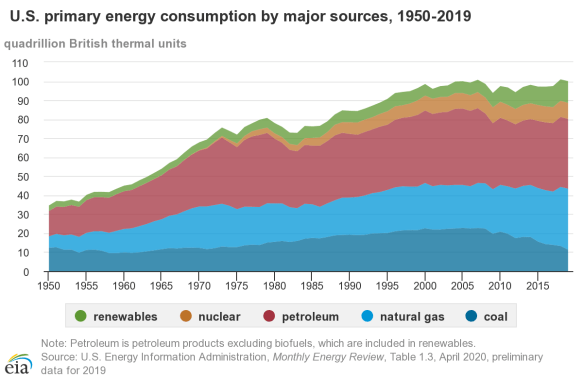
The total energy use by the United States in 2019 was 100 quadrillion BTU (British Thermal Units), which is equivalent to 1.055×10^20 Joules. Averaged out over the 31,557,600 seconds in a year implies a use rate of 3.34×10^12 Watts during 2019.

From the above two observations, we can deduce that the current rate of Biosphere warming on a yearly basis is equivalent to the yearly energy use in 2019 of 907 United States of Americas.

The total increase in the heat energy of the Biosphere since 1910 is 5.725×10^24 Joules, with a corresponding increase of its temperature by 1°C. That heat energy increase over the last 110 years is equivalent to 54,260 years of U.S. energy use at its 2019 amount, per year.

So, today the Biosphere is warming at a rate equivalent to it absorbing the total energy used by the U.S. in 2019, every 9 hours and 40 minutes.

In 2008, I estimated the energy of a large hurricane to be 6.944×10^17Joules. [1] Thus, 152 such hurricanes amount to the same total energy as that used by the U.S. during 2019.

The heat energy increase of the Biosphere during 2019 was 9.56×10^22 Joules, with a corresponding temperature increase of 0.0167°C. That heat energy increase is the energetic equivalent of 137,741 hurricanes. Now, of course, that Biosphere heat increase during 2019 did not all go into making hurricanes, but it should be easy enough to see that a small fraction (for a whopping amount) went into intensifying the weather and producing more and stronger hurricanes (and consequent flooding).

Two clear observations from all this are:

– the Biosphere is warming at an astounding rate, even if “we don’t notice it” because we gauge it by the annual change in average global surface temperature (which is in hundredths of degrees °C per year);

– the immense amount of heat added to the Biosphere every year is increasingly intensifying every aspect of weather and climate, and consequently driving profound changes to all of Earth’s environments.

Those environmental changes directly affect habitability, and species viability, because they are occurring at a rate orders of magnitude faster than the speed at which biological evolution can respond to environmental pressures.

What should we do about it all?

That is obvious: ditch capitalism and socio-economic inequities worldwide; ditch all forms of bigotry, intolerance, racism, war and social negativity; form a unified planetary political administration for the management of a socialist Earth; deploy reasonable technical mitigation strategies (like drastic reductions in the use of fossil fuels, transforming the transportation infrastructure); implement very deep and comprehensive social adaptation behaviors (“lifestyle changes,” eliminating consumerism, scrupulously protecting biodiversity, resettlement of populations displaced by permanent inundation or uninhabitable drought and heat, worldwide sharing of food production).

None of this will actually stop global warming, as the amount of carbon dioxide already in the atmosphere (assuming it has a lifetime there of thousands of years [2]) has us programmed to warm by about another 1°C to 2°C within two centuries, even if we immediately and permanently shut off all our greenhouse gas emissions.

But, such an improved civilization would experience the least amount of suffering — which would be equitably distributed — from the consequences of advancing global warming; and it would contribute minimally toward exacerbating future global warming.

Notes

[1] The Energy of a Hurricane
5 September 2008
https://www.counterpunch.org/2008/09/05/the-energy-of-a-hurricane/

[2] Global Warming and Cooling After CO2 Shutoff at +1.5°C
20 June 2020
https://manuelgarciajr.com/2020/06/20/global-warming-and-cooling-after-co2-shutoff-at-1-5c

<><><><><><><>

Long Term Worries Are A Luxury

<><><><><><><><><><><><><><><><><><><><><><><><><><><><><><><><>

Long Term Worries Are A Luxury

It is impossible to think about long term problems when you are in the midst of an emergency. Who can worry about the balance of their bank account, or who should get elected, or global warming, when they are in the middle of a medical emergency, or a police nightmare, or a flood, or just the “normal” worries of a homeless person looking for food for themselves or their children, and a safe place to get some badly needed sleep? And this situation is repeated by the billions around the world.

Because so many people are struggling to deal with their basic survival and personal security needs, which are under assault from so many directions by the forces of human malevolence: political, economic and racial, they have no mental capacity nor psychological reserves left to expend on long term worries like global warming. That long term worry is a luxury enjoyed by people who are fortunate in life, secure and safe, and even prosperous. They are also likely to be the kind of people who are in the most anthropogenic greenhouse gas emitting classes on Earth.

I consider global warming to be an emergency, exactly as Greta Thunberg has so brilliantly broadcast to the world. Many professional “Green” activists, bloggers, book writers and internet “influencers” have advanced a variety of social behavioral adaptation schemes, and technical schemes, that governments are urged to mandate and manage in order to “transition” our current profits-above-life-itself economies to a “post carbon” alternative energy mode. In general I agree with such ideas, but I realize they are just fantasies of luxurious long term worries (LLTWs). I suppose my Marxist friends would call LLTWs a class interest.

It has finally dawned on me that the route to real action on global warming climate change is through a complete social revolution that meets the immediate survival and security needs of the great mass of humanity, and which spectrum of aspirations is being vibrantly voiced through the worldwide George Floyd protests. A psychologist might phrase this as the need for a climb up the ladder of Maslow’s hierarchy of needs. The smaller the fraction of the world’s population that is overwhelmingly taxed by scrambling for their survival and safety needs, the larger the fraction of the world’s population that can begin to enjoy the LLTW of global warming climate change.

Because meeting those many aspirations for societal renewal and social transformation are technically the easiest and quickest remedies to begin addressing the root causes of the LLTW of global warming, they should be pushed for hard by everybody who gives a damn. Thus, the George Floyd protests are really for much more than just their essential and vitally important calls for anti-racist anti-capitalist and public health actions by governments, they are also the trumpet fanfares and bugle calls for a worldwide charge up the hierarchy of popular needs, from physical survival and personal security through societal reconstruction based on indiscriminate human dignity and the wide availability of opportunity that affords achievement of personal fulfillment, and ultimately up to us “all” having the luxury to worry about global warming, and then actually act on it.

I do not think there will ever be useful action on global warming until the social needs of the masses of humanity are vigorously and effectively attended to. This is not a utopian fantasy, this is realistic hard nuts logical thinking. The first and foundation step for everything that should follow is for all of us to actually become “we.”

So, yes, I realize that implies many wished-for political, economic and social revolutions and changes, but there it is. That is what “we” need to do if we want to make “anthropogenic” a positive adjective describing our stewardship of Planet Earth, instead of leaving it with its currently negative connotation regarding our massive fouling of the most beautiful jewel known to exist in the entire Universe.

<><><><><><><>

Global Warming and Cooling After CO2 Shutoff at +1.5°C

I have done further analytical modeling of global warming, using the same general method described earlier (https://manuelgarciajr.com/wp-content/uploads/2020/05/global-warming-model.pdf).

The question addressed now is: what is the trend of temperature change after an abrupt shutoff of all CO2 emissions just as the net temperature rise (relative to year 1910) reaches +1.5°C, given the lifetime of CO2 in the atmosphere?

For this problem, it is assumed that when the temperature rise (relative to 1910) reaches ~+1.5°C, that:

– all greenhouse gas emissions cease;

– pollution grit (which scatters light) falls out of the atmosphere “instantly” (a few weeks);

– CO2 (greenhouse gas) concentration decays exponentially after emissions shutoff;

– for CO2 lifetimes [e^-1] in years: 20, 50, 100, 238.436, 500, 1,000, 10,000, 100,000;

– temperature sensitivities of cloud cover, ice cover and albedo are as in the previous model;

– all other fixed physical parameters are as in the previous model,
(https://manuelgarciajr.com/2020/06/13/living-with-global-warming/).

In general, for the 8 cases calculated, the temperature increases at a diminishing rate after the emissions shutoff, reaches a peak, then trends downward.

The longer the lifetime of carbon dioxide in the atmosphere, the later and higher is the temperature peak, and the longer it takes to cool back down to the baseline temperature of 1910, which is 1.5°C below the starting temperature for this problem.

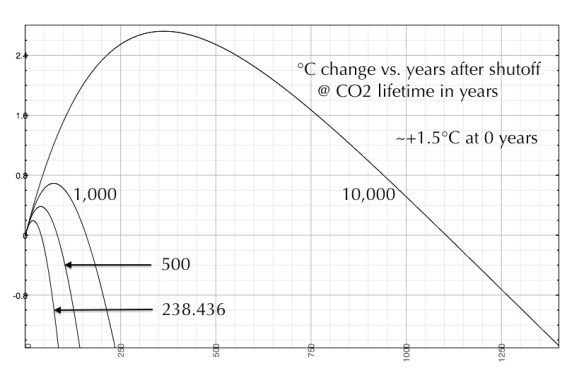
The 4 figures below show the calculated results.


Figure 1: °C change vs. years after shutoff, for lifetimes: 20, 50, 100, 238.436 years.


Figure 2: °C change vs. years after shutoff, for lifetimes: 20, 50, 100, 238.436, 500, 1,000 years.


Figure 3: °C change vs. years after shutoff, for lifetimes: 238.436, 500, 1,000, 10,000 years.


Figure 4: °C change vs. years after shutoff, for lifetimes: 1,000, 10,000, 100,000 years.

It is evident from the figures that if the lifetime of carbon dioxide in the atmosphere is greater than 500 years, that a temperature overshoot above +2.0°C (relative to 1910) will occur before cooling begins.

If the lifetime of carbon dioxide in the atmosphere is greater than about 250 years, it will take over a century for the eventual cooling to reduce average global temperature to its baseline temperature (which is for 1910 in this model).

If the lifetime of carbon dioxide in the atmosphere is greater than 10,000 years, the temperature overshoot will take global warming past +4.0°C (above our 1910 datum) for hundreds to thousands of years, and cooling back down to the temperature at our datum would take millennia.

The clearing of carbon dioxide from the atmosphere is a slow process. The absorption of CO2 by the oceans, and the subsequent dissolution of seafloor sediments (acidifying the oceans) occur over decades to centuries. The uptake of carbon dioxide by weathering reactions in carbonate and silicate soils and rocks occurs over millennia to many tens of millennia.

It took about 200,000 years to clear away the CO2 that caused the +8°C to +12°C global warming spike that occurred 55.5 million years ago, which is known as the Paleocene-Eocene Thermal Maximum (PETM).

Beyond its intrinsic scientific interest, this study confirms what has long been known as the needed remedy: anthropogenic emissions of greenhouse gases must permanently cease as soon as possible in order to limit the ultimate extent and duration of unhealthy global warming.

My notes on the mathematical solution of this problem are available through the following link

Global Warming, CO2 Shutoff

<><><><><><><>

Climate System Response Time

The parameter “beta” is a reaction rate, or frequency, or inverse response time of the biosphere and its climate system. By my calculation, that rate is 1.329×10^-10 seconds^-1, or 0.004194 years^-1, or a response time of 238.436 years. Of course I am not saying the precision of this estimate is as suggested by all the decimal places shown, it’s just that these are the numbers that come out of my calculations, and these numbers are kept to remind me of what choices I made to eventually arrive at this result.

The parameter beta is the product:

beta = (S•a1)/C = [S•(a-cloud – a-ice)]/C,

where:

S = the insolation on the entire disc area of the Earth (1.7751×10^17 Watts),

a-cloud = the temperature sensitivity of the albedo because of the extent of cloud cover (1/°C),
for a positive quantity of: increase of albedo for a given temperature rise (5.715×10^-3 1/°C),

a-ice = the temperature sensitivity of the albedo because of the extent of ice cover (1/°C),
for a negative quantity of: decrease of albedo for a given temperature rise (1.429×10^-3 1/°C),

C = the heat capacity of the biosphere (5.725×10^24 Joules/°C).

A better determination of a-cloud and a-ice would improve the estimate of beta. I chose these quantities to be in the ratio of 4:1, as is the ratio between the cloud reflection portion of the albedo (24%) to the Earth surface portion of the albedo (6%) for the total pristine (pollution free, pre-global warming) albedo (30%).

So, beta incorporates physical parameters that characterize: solar energy, atmospheric and Earth surface reflectivity of light, and the thermodynamics of the mass of the biosphere.

Events and inputs to that Earth climate system are recognized and responded to on a timescale of 1/beta. Events and inputs with timescales less than 1/beta are blips whose impact will become evident much later, if they are of sufficient magnitude and force. Events and inputs of timescales longer than 1/beta are “current events” to the biosphere’s thermodynamic “consciousness,” and act on the climate system as it reciprocally acts on them over the course of the input activity.

Turning a large ship around takes advanced planning and much space because it’s large inertia tends to keep it on its original heading despite new changes to the angle of its rudder. Even more-so, changes in the direction of Earth’s climate, which may be sought with new anthropogenic rudder angel changes — like drastic reductions of greenhouse gas emissions — will require fairly deep time because of the immense thermodynamic inertia of that planetary system.

This means that the climate system today is responding to the “short time” impulses it was given over the previous two centuries or more; and that both the more enlightened and most stupid impulses that we give it today could take several human lifetimes to realize their full response. We are dealing with Immensity here, and our best approach would be one of respect and commitment.

<><><><><><><>

Global Warming After 1.5°C Without Emissions

If greenhouse gas emissions stop just as the temperature rise (relative to 1910) reaches 1.5°C, what is the projected trend of temperature rise (or fall) after that point in time (year)?

[This scenario presumes an infinite lifetime of CO2 in the atmosphere. So it is the extreme of pessimism. The effect of finite lifetimes of CO2 in the atmosphere is shown in later work, at https://manuelgarciajr.com/2020/06/20/global-warming-and-cooling-after-co2-shutoff-at-1-5c/]

If greenhouse gas emissions ceased entirely in the year 2047 (in 27 years), just as the relative temperature was nearly 1.5°C above that of 1910, then the subsequent trend of relative temperature would still be a rise but at a decreasing rate over time, and with an asymptote of 6.2877°C, which would essentially be achieved by the year 3160. Projections here are that for

year 2120 (in 100 years):
with same emissions rate after 2047, temperature rise = 3.2°C,
without any emissions after 2047, temperature rise = 2.75°C,

year 2185 (in 165 years):
with same emissions rate after 2047, temperature rise = 5°C,
without any emissions after 2047, temperature rise = 3.6°C.

The “no emissions” asymptotic temperature rise of ~6.29°C (by year 3160) would mean the average global temperature would be comparable to that of 55.5 million years ago at the very beginning of the upswing in temperature during the Paleocene-Eocene Thermal Maximum (PETM). The PETM began at a temperature about +4°C above that of our 1910 datum, and shot up to somewhere in the vicinity of +8°C to +12°C above it, and even possibly +16°C above it. It then took 200,000 years for the “excess” atmospheric CO2 to be cleared away by rock weathering, and the average global temperature to return to +4°C above our datum. This all occurred during the early Eocene geological epoch (which occurred between 56 to 33.9 million years ago).

In the post 2047 “no emissions” model used here, the albedo (the light reflectivity of the Earth) would still be higher than today because of increased reflective cloud cover, because of higher temperature.

Though the fallout of light-reflecting pollution grit would occur quickly in and after 2047, which is an albedo-reducing (warming) effect, it is not considered significant in relation to the reflective effect of the temperature-enhanced cloud cover (a cooling effect). The Earth’s albedo is dominated by cloud cover.

The temperature-enhanced reduction of ice cover (an albedo-reducing and thus warming effect) is always insignificant in comparison to the effect of cloud cover.

The infrared (heat) absorptivity (parameter F in the model) remains unchanged after 2047 because no new greenhouse gases are added to the atmosphere after that year (hypothetically), and because carbon dioxide (CO2) remains present in the atmosphere for a very long time (once the oceans are saturated with it), on the order of 150,000 years or more.

As noted previously (in “Living With Global Warming”), because of the immense thermal inertia of the biosphere and its climate system, the effect of an abrupt cessation of greenhouse gas emissions would come on slowly over the course of hundreds of years [an e-folding time of 240 years].

As will be evident from Figure 3, below, if we cared to limit temperature rise as much as possible for the sake of future generations, we could never cease emitting greenhouse gases too soon.

On the basis of the modeling described here, it seems impossible to ever limit the ultimate rise of temperature to below +2°C relative to 1910.

If we ceased all greenhouse gas emissions this minute in the year 2020, we might be able to keep the average global temperature from ever rising above +5.8°C, relative to 1910, in the distant future.

It will be interesting to see what the state-of-the-art supercomputer numerical models project as possible future “no emissions” temperature rises, as those models are further refined from today.

Technical Details

The technical details of how I reached these conclusions now follow. This discussion is a brisk and direct continuation of

Living With Global Warming
13 June 2020
https://manuelgarciajr.com/2020/06/13/living-with-global-warming/

For a description of the parameters used in my model, and their numerical values, see

A Simple Model of Global Warming
26 May 2020
https://manuelgarciajr.com/wp-content/uploads/2020/05/global-warming-model.pdf

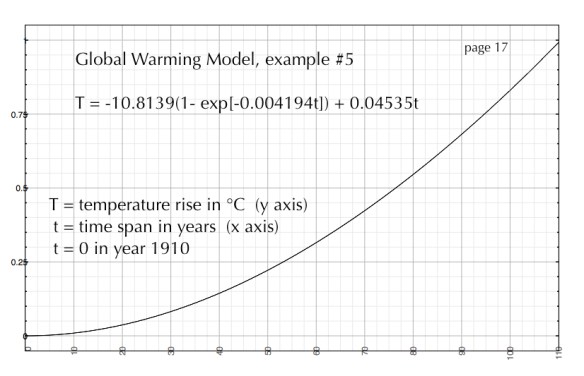
The previous model of temperature rise relative to 1910 is called “example #5” because it was the 5th numerical example devised from the general solution of the relative temperature rate-of-change equation. For that model, at relative time =137 years (for year 2047, which is 137 years after 1910):

T = 1.4867°C, temperature rise relative to 1910,

A = 0.5226, albedo,

F = 0.5931, infrared (heat) absorptivity.

If greenhouse gas emissions cease entirely in year 2047 (at 137 years of relative time), then:

ap = 0, (grit pollution enhancement of albedo over time ceases),

fp = 0, (increasing greenhouse gas pollution enhancement of heat absorptivity over time ceases),

and the temperature change trend continues after t = 137years with:

T(at t=137) = 1.4867°C, (the “initial” relative temperature at t=137),

A = 0.5226 + 0.004286T, (albedo after t=137 is only dependent on relative temperature: clouds),

F = 0.5931, (heat absorptivity is unchanged after t=137, greenhouse gases persist, but none added),

alpha = 0.019919 °C/year, (new value),

beta = 0.004194 year^-1, (unchanged),

gamma = 0, (since strictly temporal increases/effects of pollution have ceased).

The relative temperature from t=137 on is now given by:

T(t≥137) = 1.4876°C + (4.801°C)[ 1 – exp(-0.004194[t-137]) ].

Figure 3: Relative Temperature Change after 2047 (1.5°C) w/o Greenhouse Gas Emissions

Note the following points on the “no emissions” relative temperature curve:

for t=210 (year 2120), T=2.75°C instead of 3.2°C,

for t=275 (year 2185), T=3.6°C instead of 5°C,

for t=1250 (year 3160), T=~6.28°C

The “no emissions” relative temperature curve after 1.5°C has an asymptote of 6.2877°C.

Note

For descriptions of the PETM, see:

Paleocene-Eocene Thermal Maximum
https://en.wikipedia.org/wiki/Paleocene%E2%80%93Eocene_Thermal_Maximum

Ye Cannot Swerve Me: Moby-Dick and Climate Change
15 July 2019
https://manuelgarciajr.com/2019/07/15/ye-cannot-swerve-me-moby-dick-and-climate-change/

<><><><><><><>

Living With Global Warming

I modeled mathematically the thermal imbalance of our biosphere, which we call global warming, so as to gain my own quantitative understanding of the interplay of the two major effects that give rise to this phenomenon. This is a “toy model,” an abstraction of a very complicated planetary phenomenon that teams of scientists using supercomputers have been laboring for decades to enumerate in its many details, and to predict its likely course into the future.

The result of my model is a formula for the history of the rise of average global surface temperature. The parameters of the model are ratios of various physical quantities that affect the global heat balance. Many of those physical quantities are set by Nature and the laws of physics. A few of those parameters characterize assumptions I made about physical processes, specifically:

the degree of increase in Earth’s reflectivity of light because of an increase of cloud cover with an increase of temperature,

the degree of decrease in Earth’s reflectivity of light because of a decay of ice cover with an increase of temperature,

the rate of increase in Earth’s reflectivity of light because of the steady emission of air pollution particles,

the rate of increase of the infrared radiation absorptivity — heat absorptivity — of the atmosphere because of the steady emission of greenhouse gas pollution.

The parameters for the four processes just mentioned were selected so that a calculated temperature rise history from 1910 to 2020 matched the trend of the data for average global surface temperature rise during that period. That average temperature rise was 1°C between 1910 and 2020.

The two major effects involved in the dynamics of the current global heat imbalance are: heating because of the enhanced absorptivity by the atmosphere of outbound infrared radiation — which is heat; and cooling because of the enhanced reflectivity of the atmosphere to inbound sunlight.

The biosphere is in thermal equilibrium — existing at a stable average global temperature — when the rate of absorbed inbound sunlight is matched by the rate of heat radiated out into space.

Heating

Greenhouse gases emitted into the atmosphere capture a portion of the infrared radiation — heat — rising from the surface of the Earth, and retain it. They are able to do this because the nature of their molecules makes them highly efficient at absorbing infrared radiation. The molecules involved are primarily those of carbon dioxide (CO2), water vapor (H2O), and methane (CH4).

This captured heat is then redistributed to the rest of the atmosphere by molecular collisions between the greenhouse gas molecules and the molecules of the major constituents of our air: nitrogen (N2) and oxygen (O2). The excess atmospheric heat evaporates more seawater, makes more clouds, drives stronger winds and causes more intense rainstorms — such as hurricanes, typhoons and tornadoes — and more frequent and severe flooding.

That excess atmospheric heat is gradually absorbed by the oceans, which as a unit is the most massive and heat retentive component of the biosphere. The biosphere encompasses: the atmosphere, the oceans, and the land surface down to a depth of perhaps 10 meters, below which the temperature variations due to the seasons and the weather do not penetrate significantly. The oceans are the “heat battery” of Planet Earth.

The biosphere naturally emits a portion of the greenhouse gases contained in the atmosphere, but humanity has been adding massively to that load, and at an increasing rate since the beginning of the 20th century. So, global warming is an anthropogenic — human caused — effect.

Natural emissions of greenhouse gases and aerosols include: evaporation from the surfaces of the oceans to form clouds; the ejection of sulfur dioxide gas (SO2) and ash particles by volcanic eruptions; the rising of smoke from wildfires with their loads of carbon dioxide gas and soot; the rising of windblown dust; and the bubbling up of methane gas from the rotting of organic matter on land and at the ocean bottom.

Anthropogenic emissions of greenhouse gases include: carbon dioxide gas (CO2) and soot particles from the combustion of liquid fossil fuels, coal, and biomass; and the emission of organic vapors like: methane from industrialized agriculture, mining, and oil and natural gas drilling; and ozone-depleting gases evaporated from cleaning fluids, solvents, and refrigerants.

Prior to significant anthropogenic emissions, there was a long-term balance between the natural emissions of greenhouse gases and aerosols, and their being rained-out and reabsorbed by the land and ocean surfaces. In particular, carbon dioxide gas is absorbed by green plants, which combine it with water to form sugar — used to supply the metabolic energy for plant growth, and of the animals that feed on plants — in a process called photosynthesis, and which is powered by sunlight.

Cooling

About 30% of the sunlight incident on the Earth is reflected back into space. This light reflectivity by Planet Earth is called the albedo. Droplets of water in the atmosphere — often condensing around particles of soot, ash or dust — form into clouds, which are very efficient light reflectors, and are responsible for 24% of Earth’s reflectivity.

The other 6% of the Earth’s albedo is due to the overall light reflectivity of the surface of the Earth, which is the combined effect of reflections from the surfaces of the ice caps, oceans and lands. The rejection of a portion of the inbound solar light energy is a cooling effect.

The Earth’s albedo increases with a rise in the average global surface temperature, and with an increase in the load of aerosols in the atmosphere. Higher average temperature enhances evaporation and atmospheric humidity, creating more reflective cloud cover. A larger load of aerosols provides a greater number of light scattering particles to interfere with the influx of sunlight.

Aerosols tend to fall out and rain out of the atmosphere within a short period of weeks to months. So their contribution to the albedo — and thus to global cooling or “global dimming” — would be short-lived were they not being continuously replenished in the atmosphere by natural processes like the rainwater cycle, volcanic eruptions and wildfires; and by anthropogenic emissions of gas and aerosol pollution from the industrialized activities of civilization.

Despite the slightly greater cooling effect of Earth’s albedo being increased by the introduction of anthropogenic pollution that scatters light, the biosphere is steadily warming because the greenhouse gases also included in that anthropogenic pollution have the dominating influence.

The only way to slow global warming is to reduce — and ideally eliminate — anthropogenic emissions of greenhouse gas and aerosol pollution.

Temperature History, Past and Future

Figure 1 shows the average global surface temperature rise, relative to the temperature in 1910, for the 110 years between 1910 and 2020. This calculated history matches the trend of the observational data. The temperature rise shown in Figure 1 is 1°C. The Earth in 1910 was experiencing a spatially and temporally averaged global surface temperature that I take to have been 13.75°C (56.75°F). The Earth in 2020 is experiencing a spatially and temporally averaged global surface temperature that I take to be 14.75°C (58.55°F).

Figure 1: Average Global Surface Temperature Rise between 1910 and 2020
(°C of temperature rise vs. relative time in years)

Figure 2 shows the average global surface temperature rise, relative to the temperature in 1910, for the 210 years between 1910 and 2120. Obviously, the temperature history beyond 2020 is a projection, and it is based on a continuation of the same conditions — which are reflected in a constancy of the parametric values used in my model calculation for between 1910 and 2020 — beyond 2020 for another 100 years. This is a projection of the consequences of “business as usual.”

Figure 2: Average Global Surface Temperature Rise between 1910 and 2120
(°C of temperature rise vs. relative time in years)

Three points to be observed in Figure 2 are the temperature rises of:

1.5°C (2.7°F) by 2047 (in 27 years),

2.0°C (3.6°F) by 2070 (in 50 years),

3.2°C (5.76°F) by 2120 (in 100 years).

A temperature rise of 2°C has been declared as the must-never-exceed “redline” on our global thermometer because it is seen by the widest range of climate scientists, earth scientists, biologists, ecologists and evolutionary biologists, as a threshold beyond which the Earth’s climate would run away to conditions inimicable to human and non-human habitability and survival, without any possibility of alteration by human restraint or human action.

A temperature rise of 1.5°C has been declared as the realistic upper limit humanity could allow itself to tolerate if it still wished to slow the rate of subsequent global warming, by the drastic reduction of its anthropogenic emissions of atmospheric greenhouse gas and aerosol pollution.

Responsiveness of Earth’s Climate System

By my calculation, if magically all emissions of greenhouse gases and pollution grit ceased immediately today, it would take a minimum of 9,000 to 11,000 years for the excess 1°C in the biosphere to dissipate and thus return Earth to the climate we had for 10,000 years up to about 1910. The actual recovery time could be much longer. [This estimate is based on the thermal diffusivity of seawater.]

Because the Earth’s biosphere and its climate are immense systems with immense inertia, Earth’s recognition of our hypothetically abrupt cessation of greenhouse gas emitting, and Earth’s reaction to that cessation with a climatic response — a slowing of global warming — could take over 200 years to become noticeable. [This estimate is based on my calculated e^-1 exponential decay time of 240 years.]

The timescales of the planetary processes whose interactions produce climate are much longer than those of individual human attentiveness or of current societal preoccupations.

How Should We Respond?

The physics is clear, whether reflected by my simple analytical toy model, or by the immensely intricate state-of-the-art supercomputer numerical models by the many climate science institutes.

How global warming — as a complex of interrelated physical phenomena — will affect us can be estimated by climate scientists from their models. What we should do about the present and anticipated effects of global warming remains an open question that is beyond physics, and whose answer rests entirely on human choice.

What aspects of human and non-human life do we consider essential to protect and preserve? What degree of commitment are we willing to make to strategies for the continuation of civilization that require an equitable sharing of the new burdens imposed on human activity by increases of global temperature? In short, what kind of people do we want to be as we all live out our lives in a globally warming world?

It is easy to imagine many utopian or dystopian responses to global warming. We — as a species — are completely free to choose the type of cooperative or uncooperative collective future that we wish to inhabit, for as long as Planet Earth allows us to enjoy its hospitality.

Note

If you wish to examine my global warming model for yourself, you can take a copy of it from:

A Simple Model of Global Warming
26 May 2020
https://manuelgarciajr.com/wp-content/uploads/2020/05/global-warming-model.pdf

<><><><><><><>

Global Warming is Nuclear War

<><><><><><><><><><><><><><><><><><><><><><><><><><><><><><><><>

Global Warming is Nuclear War

The average global surface temperature rose by 1°C during the 110 years between 1910 and 2020.

During the 50 years between 1910 and 1960, the average global temperature rose by 0.25°C, an average rate-of-increase of 0.005°C/year. Another 0.25°C of biosphere heating occurred during the 25 years between 1960 and 1985, a rate-of-rise of 0.010°C/year. During the 20 year span between 1985 and 2005 another 0.25°C of temperature was added, a rate-of-rise of 0.0125°C/year. During the 15 year span from 2005 to 2020 another 0.25°C of temperature rise occurred, with an average rate-of-rise of 0.0167°C/year.

While the average temperature rise of 0.25°C was the same for each of the four intervals, the first (between 1910 and 1960) required 45.5% of the 110 years between 1910 and 2020; the second (between 1960 and 1985) only required 22.7% of the 110 years; the third (between 1985 and 2005) required the smaller fraction of 18.2% of the 110 years; and the most recent period (between 2005 and 2020) took the smallest fraction of 13.6% of the 110 years.

Given that a 1°C rise of the temperature of Earth’s Biosphere (EB) is the equivalent of it absorbing, as heat, the energy yield of 109 billion Hiroshima atomic bomb explosions, we could imagine the EB being bombarded by an average of 1 billion Hiroshima bombs per year between 1910 and 2020 (within 109 year-long intervals). If that yearly bombardment were done uniformly, it could represent 2 Hiroshima bomb explosions per square kilometer of the Earth’s surface once during the year; or it could represent one Hiroshima bomb explosion per day in each 186 km^2 patch of the Earth’s surface, for a worldwide bombing rate of 2.74 million/day. Global warming is very serious!

Let’s refine this analogy so it reflects the acceleration of global warming since 1910.

The 27.25 billion Hiroshima bomb equivalents of heating that occurred between 1910 and 1960 would represent a bombing rate of 545 million/year; or 1.5 million/day spaced out at one daily explosion per 342 km^2 patch of the Earth’s surface.

The 27.25 billion Hiroshima bomb equivalents of heating that occurred between 1960 and 1985 would represent a bombing rate of 1.09 billion/year; or 3 million/day spaced out at one daily explosion per 171 km^2 patch of the Earth’s surface.

The 27.25 billion Hiroshima bomb equivalents of heating that occurred between 1985 and 2005 would represent a bombing rate of 1.36 billion/year; or 3.73 million/day spaced out at one daily explosion per 137 km^2 patch of the Earth’s surface.

The 27.25 billion Hiroshima bomb equivalents of heating that occurred between 2005 and 2020 would represent a bombing rate of 1.82 billion/year; or 5 million/day spaced out at one daily explosion per 103 km^2 patch of the Earth’s surface.

The heating rate for the 1°C temperature rise of the EB since 1910, averaged on a yearly basis, was 5.725×10^24 Joules/110years, or 5.2×10^22 Joules/year, or 1.65×10^15 Watts of continuous heating. This rate of heat storage by the EB (into the oceans) is only 0.827% of the continuous “heat glow” given off as infrared radiation by the EB (mainly at the Earth’s surface), which is 1.994×10^17 Watts at a temperature of 288.16°K (Kelvin degrees; an absolute temperature of 288.16°K = 15°C+273.16°C; absolute zero temperature occurs at -273.16°C).

If we were to imagine impulsively infusing the EB with the same amount of energy, by a regular series of “heat explosions” each of energy release equivalent to the Hiroshima bomb, then the 1 billion explosions per year (the 109 year average) would have to occur at a rate of 31.7 per second.

Atomic bombs release their energy explosively within 1 microsecond, representing a radiated power of 5.25×10^19 Watts for an energy release equivalent to the Hiroshima bomb yield (5.25×10^13 Joules). In this hypothetical exercise, I am lumping all the atomic bomb explosive yield into heat, but in real atomic explosions energy is released in a variety of forms: heat, nuclear radiation (gamma rays, energetic neutrons, X-rays, radioactive material) and blast pressure. The energy forms emitted by atomic bomb explosions ultimately heat the materials they impact and migrate through, and this is why I lump all of the bomb yield as heat.

An explosion sphere with a 56.4 centimeter diameter (22.2 inches) radiating heat at 5.25×10^19 Watts during a burst time of 1 microsecond would present a 1m^2 surface area at a temperature of 5,516,325°K = 5,516,051°C. Imagine 32 of these popping into existence at random points around the world during every second of the day and night since 109 years ago. We would certainly consider that form of global warming a crisis deserving our attention.

Because the invisible low temperature heat glow style of global warming that we actually experience does not rudely punctuate our lives with random blasts of such intense X-ray conveyed heat that any human standing nearby would simultaneously be vaporized while the molecules of that vapor were atomized and those atoms stripped of all of their electrons down to the atomic cores, we ignore it. But the heating effect on the biosphere is energetically equivalent to what we are causing with our greenhouse gas and pollution emissions.

Thermodynamically, we have greenhouse gas-bombed out of existence the pristine biosphere and its habitable climate that first cradled and nurtured the infancy of our species 2000 centuries ago, and then fed and protected the development and growth of that fragile chimera we call “civilization,” which our potentates have been proudly boasting about for at least 8,000 years. And we’re still bombing, now at an ever increasing rate.

All of the numbers quoted here come out of the results described in my report “A Simple Model of Global Warming” that I produced to help me understand quantitatively the interplay of the major physical effects that produces global warming. I invite both the scientists and the poets among you to consider it.

Global Warming Model

70% or less of the sunlight shining onto the Earth reaches the surface and is absorbed by the biosphere. From this absorbed energy, in combination with the presence of water and organic material, all life springs. The oceans, which cover 70.2% of the Earth’s surface and comprise 99.4% of the biosphere’s mass, form the great “heat battery” of the planetary surface. All weather and climate are generated from the heat glow of that battery. A portion of that heat glow, equivalent to the solar energy absorbed, must escape into space for the planetary surface to remain in heat balance, at a constant average temperature. For that temperature being 15°C (59°F), 62.31% of the heat glow must escape.

30% or more of the incident solar energy is reflected back into space, with 24% of that reflection by clouds, and 6% of that reflection from land and ocean surfaces. While snow and ice are the most nearly perfect reflective of such surfaces, they only cover 10% to 11% of the planet and that coverage is slowly being reduced by global warming, increasing the solar heating.

Our introduction of greenhouse gases and pollution particles into the atmosphere has added to the already existing load of naturally emitted humidity, organic vapors and grit from volcanic eruptions and windblown dust. These components of the atmosphere absorb and retain heat (infrared radiation), blocking some of the necessary heat glow loss, and thus warming the planet. The increasing accumulation of these components — because a warmer world has higher humidity producing more clouds, and because of our continuing emission of atmospheric pollutants — scatter an increasing portion of the incoming sunlight back into space, which is a cooling effect called “global dimming.” The imbalance of all these effects is dominated by warming and the biosphere’s temperature is rising at an accelerating rate.

My life is a race against the clock of a certain though indeterminate finality. The COVID-19 pandemic has made me very conscious of this inevitability. After seven decades of existence I cannot do everything I want, in terms of living, fast enough. This is not irrational terror, it is awakened appreciation and understanding. There is all of Shelley yet to read, and Keats, and so many more; and so many more birds and flowers, and daylight and nighttime beauties of the Nature to see, and so many more differential equations and physical problems to solve, to not want to go on living. The urge for continuation is innate, genetically programmed, whether in robotic virus particles or in cognitive life forms like cats and human beings. For me, that cognition includes the irrational emotional desire to combat global warming so that future generations of all Earth’s life forms have decent chances of continuing.

<><><><><><><>

<><><><><><><>

Endgame For Green Utopia

<><><><><><><><><><><><><><><><><><><><><><><><><><><><><><><><>

Endgame For Green Utopia
[REVISED, EXPANDED, IMPROVED, 12 May2020]

On these two opposing types of responses to the movie “Planet Of The Humans”
(https://planetofthehumans.com/):

PRO: “The key, however, is that all these [‘greenish’] energy policies have to be carried out after capitalism has been wiped out and under conditions where production is based strictly on use.“

CON: “This documentary is trashy fake news. It’s Trumpian in its disdain for the facts…, they point away from real climate action solutions (such as renewable energy infrastructure) and peddle fascist snake oil of population growth i.e. advocate ecofascist genocide…Meanwhile, those of us who aren’t raving ecofascist lunatics will continue to fight to change society.”

Dreams of Utopias and illusions of self-importance die hard, even in the face of reality. Nature doesn’t care about how we fantasize; it just keeps on with its grand cycles, which those of global heating, environmental destruction and species extinction are now overstimulated by us, homo sapiens. The fundamental question here is: how good of an equitable world society could we energetically have, and by ‘greening it’ can we limit global warming?

PART 1:

The best we could possibly do would be to equalize the standard of living (Human Development Index) worldwide to HDI=0.862 (the range is from 0.28 for the poorest, to 0.97 for the richest nations), with a per capita electrical energy use of u=4000 kWh/c (kilowatt-hours-per-year/capita). The world average by nation (in 2002, and similar now) was: HDI=0.741 at u=2465 kWh/c. The U.S.A. had HDI=0.944 at u=13,456 kWh/c (a rich highly developed country). Niger had HDI=0.281 at u=40kWh/c (a poor underdeveloped country).

The recommended leveling is for nations with u>4000kWh/c to REDUCE energy use (a.k.a economic activity AND militarism), and nations with u<4000kWh/c to INCREASE energy use ENTIRELY APPLIED to raising living conditions (a.k.a. human-centered health and welfare: “socialism”).

This means world socialist government and no wars, and no nationalism.

Examples of enlightened HDI=~0.861 countries (ranked by energy efficiency) are Malta (HDI=0.867), Czech Republic (HDI=0.874), Estonia (HDI=0.853). There is no excuse for a nation to expend more than u=6560kWh/c, because that was Ireland’s usage and it had an HDI=0.946 (and a phenomenal energy efficiency as I calculate it).

All of this is to equalize the experience of whatever is going to happen to humanity because of geophysical changes (“global warming”).

My numbers for the above come from the following linked analysis (using 2002 data).
https://manuelgarciajr.com/2019/06/09/linking-energy-use-and-human-development/

PART 2a:

From where do we source that energy powering the world-equalized “decent life”? Obviously, we use the fossil fuel and nuclear power infrastructure that we have now to power a maximum effort “full speed ahead” program of developing, building and installing greenish energy technology based on:

– solar (from light-to-heat in water, oil and brine slurry pipes; and also photovoltaics but that is materially limited for the needed exotic elements),

– wind (especially offshore),

– hydro (using existing dams-plus-reservoirs as “pumped storage” facilities, so “excess” solar energy collected during the day pumps water “uphill,” which can then be released “downhill” through the turbo-generators to produce nighttime electricity),

– wave/tidal as possible (without wrecking important inter-tidal bio-zones),

– energy conservation by building/home design (both for insulation, energy capture and greenhousing),

– energy conservation by design of appliances and the mechanical and thermal systems used industrially and for personal living,

– also a necessary transformation of our transportation sector (for bicycles, trolleys, trains, ships even with sails; and bye-bye to most planes, most cars especially big-engined SUVs and trucks, cruise ships, and all that high-waste military gear),

– also necessary is a transformation of agriculture to localized small organic multiculture farms, and away from international-aimed large oil-chemical stimulated monoculture agro-factories/feedlots/plantations.

PART 2b:

As greenish energy sources come on-line, an equivalent generating capacity of fossil and nuclear infrastructure is taken off-line AND SCRAPPED (and materially recycled/reprocessed).

The goal is to always increase the proportion of greenish technology and always decrease the proportion of old energy technology, while keeping the total energy generation such as to provide u=~4000kWh/c worldwide (to maintain HDI>0.862 worldwide).

It will never be possible to eliminate all of the old energy technology and still maintain the decent level of HDI “we” experience and is the moral right of all 7.78B (and growing) of Earth’s people to experience.

Note that fertility rates decrease (they are already negative in some rich countries) as HDI increases; so the rate of population growth will diminish as higher standards of living are widely experienced; with greater physical, heath, child, and economic survival and security, as well as education, provided socialistically worldwide.

ENDGAME:

Global warming would most likely still continue, but at a slower pace, if given all the above. So the endgame is to equalize the experience of “the geophysical inevitable” (whatever it actually ends up being), while always striving to increase energy efficiency so as to maximize HDI given the energy used.

It seems PHYSICALLY POSSIBLE to have a very high standard of living worldwide (HDI~0.9) with a per capita energy use that is at least 3x less (or, at 1/3 current US-level usage) to 7x less (or, at 1/7 current usage by the most profligate) of ‘rich, energy-wasting nation’ usage.

But global warming (the buildup of greenhouse gases in the atmosphere) may be too far advanced to ever stop by throttling back or even eliminating human (economic) activity; though undoubtedly it could be noticeably slowed by such cutbacks, as has been vividly demonstrated in a very short time by the COVID-19 economic slowdown that has visibly reduced pollution, and afforded greater freedom to wildlife (seen roaming in emptied city streets around the world!).

All of this would mean the ‘best world available’ for ‘everybody’ for as long as it is energetically possible to maintain it. And if human extinction is ultimately unavoidable, then we’ll all go together as brothers and sisters of equal rank.

Now to all who would say that this “all in” paradigm is so psychologically and politically improbable that it will never happen, I say fine, I won’t argue it, but realize that in order to accurately and realistically gage the actual (really potential) value of whatever your scheme or dream for Utopia is, it is essential to know how to calculate what is POSSIBLE within the limits imposed by geophysics (the laws of physics and the workings of Nature) given the natural resources sustainably available from Planet Earth (this is to say without the degradation of its environments and biodiversity).

One small example. Today it is possible to use an ‘app’ on your smart-phone to alert your local coffee shop to prepare your preferred caffeinated concoction, and pay for it electronically over the vast internet-banking computer network (humming and exhausting heat 24/7), then drive to your Java pit-stop and pick up your to-go order, discarding the container after consuming the contents, which container may end up as soiled waxed paper in a municipal organic compost pile, or as plastic in a solid waste landfill, or at worst as litter.

Imagine that modality of coffee consumption is gone in the “all in” world, and instead you have to appear in person at your coffee shop — perhaps on one of your walks into town, or on the walk home from the trolley stop after work — place your order to a human being manning the Java-preparing technology, pay cash (to eliminate all the internet energy-to-heat waste), and drink your coffee from a washable mug you carry or they provide; or, extravagantly, from a paper cup that easily composts. Even more efficiently, you could buy a bag of coffee beans, take them home and grind them with a handcrank grinder, and make delicious coffee at home.

The quality of life is not diminished by simplifying it energetically, or by relaxing its pace. More likely these increase it.

4000kWh/c HDI>0.862 Equalized Green Utopia World:

The 4000kWh/c Equalized Green Utopia World (HDI>0.862) would need 18% more electrical generation than in 2017 (for a world total of 30,189TWh), and applied with 62% greater efficiency for producing social value than we currently do.

In our current World Paradigm, we only get an average of 62% of the potential social value inherent in the world electrical energy generated, and which social value is also very inequitably distributed. The average 38% of annual socially wasted (SW) electrical energy (9,730TWh total at 1,289kWh/c in 2017) goes into all the Social Negativity (SN) of: capitalist-economic, nationalist-political and prejudicial-societal inequities; militarism and wars; and to a lesser degree some technical inefficiencies of electrical generation and of appliances.

The potential (or Primary) energy (PE) contained in the natural resources (all raw fuels and sources) used to generate the World Energy in 2017 was 162,494TWh; and 25,606TWh of electrical energy was generated that year, which was 15.8% of the Primary Energy. That percentage can be taken as a lower bound on the efficiency of our current conversion of raw energy resources into socially applicable energy, because some quantity of fuel (PE, with some refined) is converted by combustion directly to heat, both to drive heat engines and for industrial and personal uses (e.g., smelting, cooking, heating).

CONCLUSIONS:

For a 4000kWh/c Equalized Green Utopia World “today” we would need 18% MORE usable (electrical and available heat) energy than consumed in 2017, applied with 62% GREATER EFFICIENCY for producing social value than we do currently. Eliminating today’s Social Negativity (SN) would be the energetic equivalent of gaining 38% more energy (in our current paradigm).

But global warming will continue because it is impossible to eliminate all CO2 and greenhouse gases producing processes of energy generation and use. The rate of increase of global warming (the upward trend of temperature) can be reduced as the purely Green (non-CO2 and non-greenhouse gases producing) methods of energy production and use provide a larger portion of the total World Energy production and consumption.

EXCERPTS FROM: World Energy Consumption
[HEAVILY EDITED and AMENDED by MG,Jr]
https://en.wikipedia.org/wiki/World_energy_consumption

According to IEA (in 2012) the goal of limiting warming to 2°C is becoming more difficult and costly with each year that passes. If action is not taken before 2017 [sic!], CO2 emissions would be locked-in by energy infrastructure existing in 2017 [so, now they are]. Fossil fuels are dominant in the global energy mix, supported by subsidies totaling $523B in 2011 (up almost 30% from 2010), which is six times more than subsidies to renewables. So, limiting the global temperature increase to 2 degrees Celsius is now doubtful.

To limit global temperature to a hypothetical 2 degrees Celsius rise would demand a 75% decline in carbon emissions in industrial countries by 2050, if the population is 10 billion in 2050. Across 40 years [from 2010 to 2050], this averages to a 2% decrease every year.

But, since 2011 the emissions from energy production and use have continued rising despite the consensus on the basic Global Warming problem. Hypothetically, according to Robert Engelman of the Worldwatch Institute [in 2009], in order to prevent the collapse of human civilization we would have to stop increasing emissions within a decade [by 2019!] regardless of the economy or population.

Carbon dioxide, methane and other volatile organic compounds are not the only greenhouse gas emissions from energy production and consumption. Large amounts of pollutants such as sulfurous oxides (SOx), nitrous oxides (NOx), and particulate matter (like soot) are produced from the combustion of fossil fuels and biomass. The World Health Organization estimates that 7 million premature deaths are caused each year by air pollution, and biomass combustion is a major contributor to that pollution. In addition to producing air pollution like fossil fuel combustion, most biomass has high CO2 emissions.

FINALLY:

Even with the 4000kWh/c HDI>0.862 Equalized Green Utopia World, global warming would continue at a rate faster or slower depending on how low or high, respectively, a proportion of World Energy is generated and used by purely Green methods. To repeat:

All of this would mean the ‘best world available’ for ‘everybody’ for as long as it is energetically possible to maintain it; and if human extinction is ultimately unavoidable, then we’ll all go together as brothers and sisters of equal rank.

The quality of life is not diminished by simplifying it energetically and by relaxing its pace. More likely it would be increased even in today’s paradigm; and most decidedly so with the elimination of Social Negativity in all its forms, which are so wasteful of energy.

Our potential civilizational collapse and subsequent extinction is up to Nature; but whether that occurs sooner or later, and with what level of shared quality of life we experience our species’ remaining lifetime, as well as its degree of equitable uniformity, is entirely up to us.

<><><><><><><>

<><><><><><><>

Can COVID-19 Save Lifeboat Earth?

<><><><><><><><><><><><><><><><><><><><><><><><><><><><><><><><>

Can COVID-19 Save Lifeboat Earth?

Harbhajan Singh asks [6 April 2020]: “Could COVID-19 save Lifeboat Earth?”

Many realize that eliminating humanity would make Earth healthier for Nature, plants and animals.

Many also realize that without profound changes to human behavior — by everybody, everywhere; including limiting population growth and ending greenhouse gas emissions — that humanity can not exist in balance with Nature, and both will increasingly suffer, eventually — in a few lifetimes? — fatally.

It is well documented that as human encroachment and destruction of Nature (e.g., environments and biodiversity) advances, that habitability decreases.

That decrease is due to a combination of:

— pollution (bad air, ocean plastic, dead seas, lost topsoil, lost forests, toxic land);

— climate change (and more violent weather, floods, droughts, wildfires);

— food source degradation (inorganic industrial farming, loss of natural varietals, loss of seafood), and

— greater hazards of releasing viruses (epidemics and pandemics) fatal to people.

The scientific reports get very specific on ‘this particular negative effect has this particular [human stupidity] cause’, but in aggregate they show what I’ve just outlined.

More people are realizing that humanity’s accelerating encroachment and destruction of Nature can only cause more deadly virus pandemics to plague us. Hotter environmental temperatures from global warming, and greater particulate and noxious gases pollution from human activity (industrialization, capitalism, militarism) aggravate the severity and lethality of all respiratory illnesses, like COVID-19.

I prefer that humanity became vastly more intelligent, and cooperative, and altruistic, and balances its existence (both individual and collective) with Nature’s timeless rhythms and geophysical limits.

The most important aspect of that wished-for cooperativeness is that we cease viewing each other as deadly rivals in a grim zero-sum game of making-money one-upmanship and competing narcissistic schemes of enslaving others.

Miraculously, the Earth is the most wonderful Paradise we know of in the entire Universe. If we treated it as such, instead of treating it like a garbage dump and sewer, it would return that appreciation, and we would knowingly experience life in this actual Paradise, for ourselves and for endless future generations.

This is not just poetry, it is fact.

<><><><><><><>

Climate Change and Voting 2020

<><><><><><><><><><><><><><><><><><><><><><><><><><><><><><><><>

Climate Change and Voting 2020

Today, humanity faces a situation unique in the 200,000 year existence of our species Homo sapiens sapiens, and unique in the 2 million year existence of our genus, Homo: the unprecedented steady linear advance of global warming since 1970, which is making our planet irreversibly less habitable as time progresses, and which is driven entirely by the emission of greenhouse gases as waste products of human activity, particularly the extraction and combustion of fossil fuels. If this human-caused global warming remains unchecked it could ultimately lead to our extinction.

Global warming is intimately coupled with population growth (see Note). The universal desire for a better life leads people everywhere to try to acquire and use more energy to reduce the drudgery of daily survival, and beyond that to increase their security, comfort and enjoyment. Food is the source of our internal energy, that which powers our metabolism. The most popular source of our external energy today is fossil fuels: the burning of refined petroleum fuels, natural gas, and coal. From these we derive most of the heat and electricity we generate and use both industrially and personally, as well as for propelling our transportation. It is the increasing energy demand per person of a growing world population that drives the unprecedented rate of global warming we are experiencing.

Motivating people everywhere to see global warming as the fundamental cause of their local disasters of severe weather, drought, failed agriculture and fishing, habitat loss and resource scarcity wars, and then motivating them to cooperate internationally to immediately reduce the rate of global warming as much as geophysical conditions will allow, is the singular political problem of our time for our species.

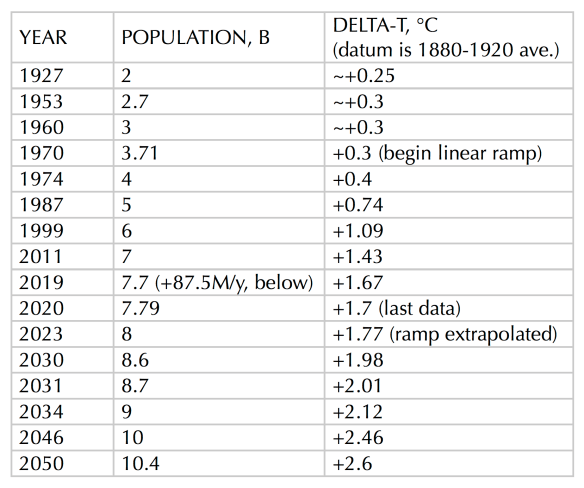
The trends of population (in billions) and global warming (in degrees °C increase relative to the average global temperature during 1880-1920, the datum) are given in the table shown. The quantities listed up to the years 2019-2020 are based on data. The populations listed after 2019 are extrapolations based on an assumed linear population increase of +87.5 million per year (M/y), which was the average rate of increase from the years 2011 to 2019. The temperature increase above datum (delta-T) for years after 2020 are linear extrapolations based on the temperature ramp observed between years 1970 and 2020 (a +1.4°C increase over 50 years).

What is not yet known is if and when global warming will accelerate beyond the linear trend assumed after the year 2020, in the table. Such acceleration would be caused by the appearance of new physical conditions such as:

the transition of tropical forests from being carbon absorbers and sinks to becoming carbon emitters because of their severe degradation brought about by logging, drought and wildfires;

a massive methane release from the thawing Arctic;

sudden and massive glacial calving and melt in Greenland and Antarctica baring more ground for the absorption of solar radiation and the release of formerly trapped methane and carbon dioxide;

methane released from warmed oceans because of the breakdown by heat of methane clathrates (solid methane hydrate “ices” formed under cold high pressure at ocean depths).

Because of the unprecedented pace of our current global warming, we do not have the luxury of unlimited time — as was true in prior millennia — to physically evolve adaptively or escape by migration in response to climate change. (Migrate to where?, a billionaire’s habitat bubble on Mars? We already have a worldwide climate change and environmental collapse refugee crisis, and it will only get worse without a civilization-transforming response to climate change.)

To slow global warming to the minimum rate now limited by geophysics (the carbon load of the atmosphere) will require a species-wide change of human behavior as regards how energy is generated, conserved and used; how we steward the environment; and how the growth of human population is to be limited and people cared for everywhere. It takes Nature 200,000 years to clear a massive excess of carbon dioxide in the atmosphere (such as we have injected over the previous century), and this occurs through a sequence of increasingly longer term processes: CO2 uptake by the oceans (years to decades), dissolution of seafloor sediments (the dissolving of chalk acidifying the oceans over decades to centuries), the weathering of carbonate rocks (centuries to millennia), and silicate weathering (tens to hundreds of millennia). CO2 uptake by photosynthesis is blunted by the ‘torrential rain-flooding plant-growth punctuated drought-wildfire’ cycle.

We can only attenuate global warming by species-wide willpower, and the sooner we develop and apply that willpower the greater will be the degree of that attenuation, and the further the likelihood of our causing our own extinction.

Without an internationally coordinated climate change response effort within the next dozen years that is 70% larger than the combined war efforts of World War II (to account for the +5.5B population increase between 1939 and 2020), global warming will reach and then exceed 2°C above the 1880-1920 datum. Warming beyond that point will likely be impossible to counteract by any human actions, and the climatic and weather-disaster consequences will be dire and unrelenting.

We have lost the luxury of unlimited time to dawdle in our many egocentric obsessions and illusions — waiting for the ideologically “perfect” revolution; seeking the most ethnically pure nationalism; the ideal theocracy; the maximization of our wealth; the complete destruction and disappearance of those “other types” of people whose savings, lands, resources and lives we want to steal; mindless absorption in superficial consumerism and ‘electronic comic book video game TV internet social media entertainment’ — before collectively reforming ourselves into better futures. Nature has made our old awareness-blunting time-wasting games obsolete by becoming feverish over its infection from our greenhouse gas toxicity. Our last chance for civilizational transformation that can alter the course of climate change is now, this next decade.

Clearly, the single best strategy to slow global warming is to replace fossil fuel energy with solar and “green” energy, whose production and use does not emit CO2, CH4 (methane), and other organic greenhouse gases and vapors.

Everything I have described up to this point has been said before by many people in many ways over many years. Now, about voting.

The only way we can achieve the civilizational transformation required to have any ameliorating effect on the course of global warming, and tackle the singular political problem of our time for our species, is to wrest control of governments from oligarchic, neoliberal, capitalism-obsessed, theocratic, nativist, and climate change ignoring elites — especially in countries having disproportionate political-economic-military power, expelling disproportionate quantities of greenhouse gases, and causing disproportionate environmental destruction — and then establishing regimes committed to real and immediate climate change response. Such real climate change response naturally subsumes all narrowly defined issues of economic equity and social justice.

In countries that offer some degree of democracy to their people, it is necessary to vote for politicians — now — whose prior history indicates they would be most reliable at vigorously pursuing a maximal climate change response, locally, nationally and internationally. For U.S. voters in 2020 that means electing Bernie Sanders to lead the Democratic Party ticket for the presidency, and then voting to ensure he wins the November general election. It is also necessary to elect people who would be Congressional representatives and Senators allied with Bernie Sanders. It does not matter whether sweeping the Sanders socialist-populist groundswell youth-quake “revolution” into power fits in with your ideal of an American government regime, however intellectually refined, or crudely simplistic, or myopically and corruptly partisan, or vainly and egocentrically identity political your ideal regime would be. We no longer have time to put off making partial gains in the direction of our goal, in order to wait for anyone’s variety of personally tailored political perfection.

The burden of responsibility on the citizens of the politically powerful, economically rich, profligate greenhouse gas emitting countries is to agitate and vote for, and vigorously implement, the real type of climate change response that is being described here. The burden of responsibility on the older citizens and older non-citizens is to put their time, money and energy into creating and protecting a good world with a decent future for the young. That has always been the responsibility on adults, and in our time — now — that responsibility must be discharged by implementing a real climate change response which is intrinsically a revolution of: economic equity, social justice, energy conservation and efficiency, rapid transition of energy sources and infrastructure from fossil fuels to green energy, and demilitarization.

In countries whose governing elites do not offer the people an effective political voice, it is necessary that those people find ways to change the nature of their governments. Risky, I know, but essential in order to respond to the looming threats of climate change.

I know that everybody can easily rationalize continuing to drift along with the mindsets they have now. But that will only keep us as distracted, delusional and disunited as we are now, and convey us all haplessly into the implacable civilization-chewing grinder of runaway climate change. We do not have the luxury of preferences anymore if we are to prevent the worst, especially for our children and grandchildren.

As I write this during a warm rainless mid-February spring in Northern California, with whitish pink-tinged apple, cherry and plum blossoms; magnolias flowering; purple florets of vinca; yellow tufts of eucalyptus; small purplish rosy globular flowers of polygonum, light blue florets of rosemary, bright orange California poppies, yellow flowers of oxalis and daffodils; and many other varieties of flowers blooming two months early, I wonder if the dry season October wildfires will now flare up in August, or even July. There has been no rain this February, “normally” the wettest month of the year for California; it appears we are entering a new drought.

And I wonder if the slow, tentative awakening in the public mind to the reality of increasingly inhospitable climate change, which awakening I observed during the course of 2017, 2018 and 2019, will accelerate and coalesce into the national and world “cosmic consciousness” that I know is essential if we Homo sapiens sapiens are to have any chance of actually protecting ourselves (all of us everywhere), within the next decade, from the worst possibilities of runaway climate change.

Note

The purpose of social welfare societies — socialism — is to provide their individuals with sufficient quantities of water, food, shelter and energy to carry on fulfilling lives, without subjecting those individuals to lonely struggles for precarious survival. This is why mortality rates are lowest in highly socialized prosperous societies, and why the consensus of individuals living in them is for low rates of reproduction, even to the point of birth rates below 2.1 per woman, the replacement rate necessary to maintain the existing size of a society’s population.

Clearly, the single best strategy to slow, and perhaps even reverse global population growth, is to provide a global system of reliable socialized security to completely support individual healthcare for life, obviously including: maternity care; safe birthing; safe abortion; child survival, healthcare, education and launching into “independent” living; elder care; and humane natural and self-willed dying. There is simply less incentive to have more children if more of them are guaranteed to survive and experience full and decent lives, and if the individual has a socially guaranteed protection of their own survival.

The above Note is from:

Oil, Population, Temperature, What Causes What?
9 June 2019
https://manuelgarciajr.com/2019/06/09/oil-population-temperature-what-causes-what/

<><><><><><><>

A History of Humanity’s Future

<><><><><><><><><><><><><><><><><><><><><><><><><><><><><><><><>

A History of Humanity’s Future

Our variety of the human species, homo sapiens sapiens, emerged from out of bands of more primitive yet contemporaneous older variants of humanity well over 200,000 years ago and rapidly expanded in both their numbers and the range of their occupancy on our planet. The competitive pressure by this efflorescence of homo sapiens sapiens against the older variants of humanity reduced the numbers of the latter to the point of extinction over the course of 1600 centuries, leaving just our variety of the human species to range over the Earth for 40,000 years up to the beginning of the 21st century. The story of our species from then up to the present moment is the subject of this work.

Calendar Year 2032

During at least the decade prior to CY2032, Planet Earth had experienced a continuous sequence of weather event catastrophes spawned from an immense and increasingly powerful undercurrent of climate change. Trains of maximally energetic hurricanes scythed through Caribbean islands and into the southeastern coasts of the United States of America, and similarly destructive typhoons swept westward out of the Pacific Ocean to blast into the islands and eastern fringes of Southern Asia.

Wildfires that spanned the horizon burned for months across huge swathes of land desiccated by drought, whether scrub-desert, rolling grassland hills, seemingly limitless prairies and taiga, or logged-out withered jungles, and on every continent except Antarctica. The long droughts that parched Earth’s verdure to the point of tinder were sometimes punctuated by torrential rain, snow and hail storms fed by titanic aerial rivers of evaporated ocean water transported by climatically altered atmospheric currents, and resulted in rapid, deep, turbulent and scouring floods that could wipe away the surface of the land and whatever our human vanity had caused to be built upon it, with the force of an all-devouring tsunami.

The excess heat energy firing the greater wrath of Earth’s weather was stored in the oceans, landmass surface layers, and atmosphere, and had been accumulating for over a century because of the capture by carbon dioxide gas, primarily, of radiant heat emitted from the surface of the Earth as a cooling phenomenon, and thus preventing its escape into space. That carbon dioxide gas, along with methane, nitrous oxide and several similar heat-trapping molecular gases, had been exhausted into the atmosphere as waste products of energy production by the combustion of fossil fuels for humanity’s industrial, recreational and personal uses.

The entwined mutually resonant growth of human population and fossil-fueled energy production caused increasingly massive amounts of heat-trapping gases to be exhausted into the atmosphere every year, and thus an increasing rate of global warming. By CY2032, the average temperature of the surface of the Earth was over 2° Celsius above what it had been a century before, and there was no effort to stop or even attenuate this human-caused global warming. In fact, all human effort was bent on accelerating this trend because it was seen as the mechanism for generating immediate personal financial riches and political power.

Sea ice disappeared from the Arctic Ocean, decimating both seal and polar bear populations, and opening the way for an “Oil Rush” by Russian, Canadian and US oil and gas drilling companies. A few incidents of scuffles between these Oil Rush prospectors prompted the respective governments to send in naval forces to “protect their interests.” Oil extraction platforms were quickly erected along the shallow continental shelves rimming the Arctic Ocean, and the new petroleum output both boosted the profitability and stock market prices of the respective energy companies while also depressing the global price of oil. This proved especially hard for oil-rich countries, like Iran and Venezuela, under economic sanctions by the United States and its economic followers.

Calendar Year 2035

Methane had been bubbling up from the East Siberian Shelf for over 20 years because of ocean warming and tundra permafrost melt, but the rate of such emission increased significantly after CY2032. In CY2033 summer fires along the northern shore of Siberia ignited steady plumes of erupting methane, and the incidence of these “natural” gas flares spread out to sea over the East Siberian Shelf. In CY2034 an oil spill from a shallow water Russian oil well was touched off by offshore methane flares, and the conflagration was quickly spread about the area. Unfortunately there was loss of life, and an increase in the ignition of sea-based gas flares.

Local fires of high intensity were able to survive the winter, and they were the source of later and expanded burning during CY2035. In that year offshore methane flares erupted in the Chukchi and Beaufort Shelves, and caused the US and Canadian Coast Guards to rush counter-fire protective resources to their offshore oil extraction facilities. These efforts required emergency appropriations from the respective governments, which were offset by sudden reductions of social services budgets, along with corporate tax reductions as measures of “emergency relief.”

All of these activities greatly increased the presence of naval forces in the Arctic Ocean in efforts to protect the corporate economic assets associated with each of the Arctic Oil Rush nations, and to erect militarized cordon sanitaires to keep rival and “dirty” methane flare-initiating oil prospecting operations from “infecting” declared “exclusive economic zones.” All this raised international tensions among the nations rimming the Arctic Ocean.

Calendar Year 2036

The average concentration of CO2 in the atmosphere reached 473 parts-per-million (ppm), and an unprecedented melting and sudden calving of glaciers all along the southern coasts of Greenland occurred on April 15th of that year; sea level rose 1.7 meters, though it took till mid-October for that effect to become stabilized and uniform across the globe.

Catastrophic inundation occurred in Bangladesh with tremendous loss of life, and many of the smaller West Pacific islands were made uninhabitable. The Bangladeshi refugee crisis sparked conflict on the Indian subcontinent, and the Australian and Southeast Asian naval forces were all deployed to repel refugee make-shift flotillas. The United States, Europe, Japan, China and Korea each scrambled to build sea walls and other forms of dikes to protect their most economically valuable coastal installations (Dutch construction firms cognizant of the advanced and massive hydrological infrastructure protecting The Netherlands were suddenly avidly sought out and richly rewarded for their work). Again, monies for such construction was appropriated on an emergency basis at the cost of social welfare programs. One tragic loss to world culture was the inundation of the city of Venice.

The drought-fire-hurricane-flood cycles of violent weather had continued with increasing force in the equatorial latitudes during the advance of the preceding years, and by CY2036 huge refugee streams were fleeing north from famine, because of the collapse of subsistence agriculture, and fleeing drug-and-plantation warlord violence. Similar refugee streams attempted to flee north from Africa across the Mediterranean Sea, from sub-Saharan lands devastated by a combination of drought and overwhelming plagues of locusts. As in the Western Pacific, European and American navies were deployed to repel northward bound refugee flotillas. There were reports, impossible to substantiate, of a few incidents of the sinking of refugee ships by drone bombers.

Social unrest increased everywhere. Uniformly, the wealthiest strata of societies increased their efforts at personal enrichment and for government subsidies and tax reductions for their associated corporations, all at increasing costs to public concerns and especially social welfare programs and charitable institutions for the poor. The middle and wage-labor strata of societies increasingly acceded to increased militarization of their national economies, whether in rationalized “logical” beliefs or out of emotional fearful xenophobia-bigotry, to have their governments deploy expanded military forces offshore and along their national borders to repel refugee “invasions.”

Such sentiments quickly hardened with the sudden outbreaks of disease epidemics, feared to become pandemics spread by refugees. Indeed, epidemics were breaking out more often as the globe warmed and pathogens old and new (some unlocked from thawed tundras) expanded latitudinally. Also, tropical bacterial and parasitic pathogens were expanding their ranges northward with the increased warming.

The increasing fractional capture of GDP by military establishments because of all of this boosted the financial gains of war industries and wealthy investors. The fraction of American citizens now living entirely mobile lives in camper vans, trucks and trailers, or cars, or even on foot, now reached 1% of the population. Sentiments similar to the “us versus them” attitudes taken by national populations toward foreign refugees now began to spring up domestically by homeowners (colloquially called “the settled”) toward their fellow citizen transients (“the unsettled”), and many local police forces were morphing into militias manning internal cordon sanitaires ‘protecting’ wealthier areas.

Commendably, there were new and spontaneous popular charitable efforts of both mutual and unrestricted aid, but these occurred only at and among the lower economic strata of societies, and they were often fragile against dissolution by forces of social negativity, and occasionally of criminality.

Calendar Year 2039

This was a year of major disaster. The CO2 concentration reached 489 ppm, and the average global surface temperature was now 2.4° Celsius above the temperature of the late 19th and early-mid 20th centuries. A sudden massive area-wide eruption of methane occurred from the continental shelves rimming the Arctic Ocean with a coincident gas-flame flaring expanding all around that ocean, which included the ignition of thawed and dried peat bogs, into a new “Ring of Fire.”

By the end of the year the CO2 concentration had leaped to 510 ppm. While the initial methane concentration in the atmosphere above the Arctic continental shelves had skyrocketed, the extensive and expanding flaring there burned a significant portion of that methane to carbon dioxide and carbon monoxide, and at higher altitudes much slower paced oxidation also converted some methane to CO2 and CO.

In any case the total load of greenhouse gases in the atmosphere had been vastly increased and the pace of global warming accelerated beyond all previous experience. By year end the global surface temperature had reached 2.6° Celsius above the early 20th century datum.

Calendar Year 2041

The average global temperature broke through 3° Celsius above the datum. The CO2 concentration reached 518 ppm.

For a decade now Australia had been experiencing wildfires that burned continuously throughout the year. Since the Methane Burp of CY2039 those fires had been expanding into horizon-to-horizon “flame deluges” that raced toward the coasts. The much expanded Australian Navy was frantically busy shuttling between open ocean refugee repulsion missions and amphibious coastal operations of wildfire victims evacuation. Despite strident outcry by Australian environmentalists and significant portions of the Australian public, against further Australian coal exportation to China, that economic activity expanded because it was one of Australia’s few remaining sources of revenue that helped pay for its mushrooming military and navel expenses, and firefighting costs, since much of the agricultural and livestock industries had been burned away. Also, there was some absorption of agricultural and animal husbandry unemployment into expanded coal industry labor employment.

Calendar Year 2042

Summer heat deaths in Europe expanded significantly, and many European governments established watering and relief stations throughout their cities in public parks, squares and plazas. Too many medical emergencies were now occurring of people collapsing in the streets and in public transit from heat stroke, to respond to them individually from just the traditional fire, ambulance and emergency services facilities of the past.

Ominously, in an increasing number of localities these stations were also water distribution sites for rationed water. Similar water rationing stations, of a much more haphazard nature and sparsely spaced, were to be found in the Middle East and throughout the globe in historically dry and desert lands. In the most primitive, impoverished and remote of such dry lands, militia level water wars were now common. India and Pakistan were dangerously close to resorting to war over Kashmir, and each had made explicit threats to the other about using nuclear weapons.

The drought-wildfire-hurricane-flooding cycles in the United States had also increased, and economic devastation of the agricultural and livestock industries of the vast center of the country was now severe with a doubling of food prices from just five years earlier. Again, economic benefits were increasingly restricted to a diminishing sliver of the American population at the uppermost rungs of the economic ladder, and economic costs of militarization and high-end wealth protection were increasingly shifted to the lowermost economic classes. None of this was hidden anymore.

The panic for wealth protection increased in desperation the higher one went up the economic ladder. The vast majority of the American public, in the rapidly shriveling “middle class,” were increasingly panicked about straightforward economic survival: even with many successful “socialist” minimum wage increase reforms, income increasingly lagged expenses since rent, food and loan costs ramped up relentlessly, and the number of decent-paying (usually corporate sponsored) jobs was shrinking. The lowest stratum of American society, the poor, were consumed with a panic for elementary physical survival.

Calendar Year 2043

This was a calamitous year. A virulent pathogen that had lain dormant in Arctic permafrost for millennia was now finally able to escape into the open air, and it spread widely and quickly, borne on windblown dust and water droplets, and attached to avian and insect bodies. It produced a pulmonary illness of high mortality. The causative virus was robust against the disinfecting actions of time, sunshine, oxygen and natural antiviral chemicals in plants, and unfortunately also in human immune systems. Hundreds of millions would die within the year.

Complicating the cure was the fact that the viral agent was quick to mutate into equally lethal forms, some of which caused fatal heart and liver infections. All the viral strains remained active. The pandemic emergency of this Arctic Flu caused real panics: naval operations to repel refugee flotillas now routinely and openly fired upon and sank them. Triage centers were set up by nearly all countries, and in the more impoverished ones mass burials by bulldozer were implemented.

The first instance of the intentional shoot-down of an inbound commercial airliner with infected passengers occurred. Internationally, protests to this outrage were muted because all nations were quietly steeling themselves to accept this practice if need be, “for protection.” The accelerating death toll everywhere from the Arctic Flu took some of the bellicose fervor out of the numerous chronic conflicts underway at that time, from Indonesia through Southeast and Central Asia, the Indian subcontinent, the Middle East from Pakistan to Syria, Israel and Turkey, the Arabian peninsula, and across much of Africa east to west and north to south.

Large populist socialist and anti-capitalist movements in both North and South America had been active for years now, some in Central and South America engaging in outright guerrilla warfare against their oligarchic and neoliberal governing regimes, while others as in the United States were agitating politically to gain increased political power through electoral victories. In all cases the governing political establishments, which were after all entirely subsidiaries of incorporated wealth, worked against all types of popular reforms by both legal and illegal means. The undermining of populist and socialist electoral campaigns was standard, as were election interference and tampering by establishment agencies, both private and governmental.

While insurrections were common throughout much of the more impoverished world, there now began to appear more instances of political violence against state and federal authority in the United States, though such incidents remained isolated. Some observers believed that popular frustrations that had traditionally sought relief through school and shopping mall mass shootings were now being refocused into anti-government violence.

The CO2 concentration reached 527 ppm; the global average temperature reached 3.9° Celsius above baseline; steady glacial melt over the last seven years had increased the sea level rise to 3 meters above the “normal level” of the 20th century.

Calendar Year 2045

By now large coastal areas everywhere were inundated to some degree, continental interiors were becoming unlivable, and internal social unrest and politically destabilizing pressures had reached levels that were between frightening to nearly overwhelming, depending of the degree of development of the society in question, and the extent of the firepower, militarized police forces and security infrastructure its government had available for social control.

The Arctic Flu was now reducing national populations at noticeable rates. For years already, wealthy individuals had been building underground bunker retreats both at home and abroad, intended to house them for long periods with stores of food, water and energy supplies, with air filtration and disinfection systems, and waste disposal systems. For the most well-heeled, such bunkers-redoubts would include stand-alone air and water generation, recycling and re-purification systems. The super wealthy would have a colony of such clustered shelters so as to maintain protective private militias around them as well. New Zealand did a brisk business of catering to this high-end real estate demand.

The CO2 concentration reached 535 ppm that year, average global surface temperature reached 4° Celsius above baseline. No reliable cure had yet been found for the Arctic Flu, and massive famines added to the death toll from the flu. Because of the shrinking area of previously habitable terrain, due to unbearable heat in dry continental interiors and inundation of coastal areas, human crowding was very uncomfortably increased and fueled social unrest and insurgencies, and this despite the population reductions by the Arctic Flu.

The ski industry everywhere collapsed due to year-round elevated temperatures and lack of winter snow. Marine life was rapidly dying out, and the seafood industry as well as subsistence fishing was in sharp decline. Severe earthquakes in California, Iran, Turkey, Japan, Missouri and Tennessee, and volcanic eruptions in the Philippines added to the chaos and misery in their respective countries. A rebellion broke out in Western China; Israel, Saudi Arabia and Iran exchanged missile attacks for aerial bombardments in an uncoordinated manner. On August 9th of that year a nuclear bomb exploded in Pakistan.

After CY2045 global communications and air travel became more erratic and it became increasing difficult to acquire the data necessary to form a comprehensive picture of global events. The prospects for peaceful international cooperation in facing many of the current difficulties seemed exceedingly dim.

Calendar Year 2046

It was now clear that the world had lapsed into isolationist regionalism with severe social unrest or insurrections and wars within each region. The American government completed vast underground complexes from which to operate in future. Fatal pandemics continued. Attacks had been made against satellites and space platforms, and it seemed evident that weapons platforms had been put into Earth orbit, conceivably with nuclear tipped missiles. Nuclear explosions had occurred on the Eurasian landmass. Radioactivity levels in the atmosphere were rising. The average citizen came to realize he and she was going to be left out on their own, there wasn’t enough room “underground” for everybody.

Calendar Year 2049

We saw the night sky whiten then glow red for hours. Liquor stores and gun shops were looted with abandon. Electrical power and electronic communications failed here. What was happening elsewhere was unknown. People hunkered down with their families around here, or else fled in their cars if they had saved-up gasoline to use. I will report more later, given the opportunity.

<><><><><><><>