The Political Realities of Science Work

The author at work, 1983

The author at university, ~1970

<><><><><><><><><><><><><><><><><><><><><><><><><><><><><><><><>

The Political Realities of Science Work

Josue De Luna Navarro had an article published (in two parts) in the 4 and 7 October 2019 editions of Counterpunch, on how fossil fuel companies are distorting the orientation of engineering and science education to their favor by making large funding grants to universities to promote the idea that geo-engineering schemes can make it possible to continue with fossil fuel extraction and burning indefinitely:

How Fossil Fuels Pollute STEM Education
https://www.counterpunch.org/2019/10/07/how-fossil-fuels-pollute-stem-education/

Geoengineering is a Scam
https://www.counterpunch.org/2019/10/04/geoengineering-is-a-scam/

I agree with Navarro’s criticisms completely, and I add the following.

Mr. Navarro points out a fact that has always been true of the engineering profession (and also most other highly refined professions) that its students, first seeking education, and then as graduates seeking employment and lengthy careers, are destined to serve monied patrons, the Golden Rule: “those that have the gold make the rules.” Four to five millennia ago those patrons would have been called “Pharaoh,” and later “king,” “caesar,” “emperor” and “queen,” and in more recent centuries “the company” and “the corporation.” Professional expertise, like high art, has a dependency on patronage by the wealthy without whose largesse professional ambitions would be nearly fruitless (for there are always some successful independent scientists, like Charles Darwin).

My engineering education and physics career (1968-2007) was funded (besides by my parents paying my tuition and living expenses during my undergraduate years) by U.S. government money (the public) funneled through the military. Most decent paying options for employment after schooling were with manufacturing, electronics or energy corporations, defense (war industry) corporations, and government agencies. A tiny fraction of engineering science jobs were in academia. In any case, all such engineering science employees were servicing the aims of the Big Money: profitability for the corporations, greater military power through advanced technology, and the combination of both as greater global political power for the policy-making elite of the nation. Same as in Khufu’s day.

Because America’s militarism-backed capitalism is fossil fueled, both in my time and Navarro’s the oil and gas industry has been a major buyer and owner of engineering and science talent, as Navarro states. The great challenge for any engineer and scientist working in today’s government-funded paradigm of science professionalism is to try to keep body and soul together through corporate and government (and academic) employment while at the same time trying to produce work that is as much in the public interest as possible. A very difficult ideal to achieve, and not all engineers and scientists even try to. Our engineering professors were reluctant to talk about the political realities of our profession, and our economic captivity by the Big Money and its Capitalist Government, because they saw no alternative to it.

Navarro is right to excoriate the fossil fuel industries’s efforts to corrupt the intellectual integrity of the engineering and physical sciences, by urinating money on our professions’s training academies to drench them in the odor of the narrowly self-serving corporate mindset of fossil fuel burning forever, and for the endless profitability of oil and gas (and coal) extraction. Even so, it is up to each individual engineer and scientist to learn the facts about global warming and climate change and environmental degradation, and the unfortunate political realities governing the economics of their profession, as a matter of professional ethics and personal integrity. This is the necessary first step for them to have any possibility of producing work for the public good.

Navarro is correct to call geo-engineering to attenuate global warming a scam. It’s like trying to design a more effective helmet that would allow you to continue playing Russian Roulette. The most energy efficient, cost effective, socially beneficial and rapid solution to the fundamental problem is to simply stop the damaging behavior, which in the case of climate change is greenhouse gas emitting capitalism. But, that would be economically leveling and fatal to militarism, so unacceptable to the courtiers of capitalism, in all their national factions.

Like all engineers, I like machines and gizmos and gadgets, and I especially like flows of energy. But the best use of such engineered mechanisms are as adjuncts in harmony with the workings of nature for the beneficial maintenance of a sustainable society. There are so many delectable challenges to be enjoyed in the fashioning of a non-fossil fueled civilization, a Green New Deal, that operates within the natural tolerances for the continuation of a stable and benign (interglacial) global climate, that all the 21st century engineers could be fulfillingly employed for their lifetimes to help fashion and maintain that kind of world society. The immediate challenges are twofold: transform energy systems and industrial and food production operations to eliminate greenhouse gas emissions and toxic chemical pollution, and stop environmental damage and engage massively in environmental restoration of lands and the oceans. Planting trees and cleaning up plastic pollution are just two examples of specific tasks that easily come to mind.

So I circle back to the same conclusion as always: our problems are not technological but political. So long as our politics are bad — our economics held captive by fossil fueled capitalism and militarism, to the general detriment of the public — our technologists will be directed by the self-interests of the Big Money and the War Industries, and not by the public good of engineering and managing a decent society in harmony with Nature.

<><><><><><><>

Molotov–Ribbentrop Pact 1939, and the Russian-German War 1941-1945

World War II began 80 years ago, on 1 September 1939. The following commentary is at heart a critique of ideologically-driven historical revisionism, which distorts the the truth and promotes falsehoods, and is thus a disservice to the public.

<><><>

The article by Jacques R. Pauwels, “The Hitler-Stalin Pact of August 23, 1939: Myth and Reality” (https://www.counterpunch.org/2019/08/26/the-hitler-stalin-pact-of-august-23-1939-myth-and-reality/) appeared on CounterPunch on 26 August 2019. The article described many interesting details of the political maneuverings, prior to 22 June 1941, by Joseph Stalin’s Soviet Russian regime, and the British, French and Polish governments, to either protect themselves from Hitler’s evident planned aggressions, or abet and take anti-communist advantage of them. Pauwels is an enthusiastic partisan of the Russian policy of that time: “The notion that the Hitler-Stalin Pact triggered the Second World War is worse than a myth, it is an outright lie. The opposite is true: the pact was precondition for the happy outcome of the Armageddon of 1939-1945, that is, the defeat of Nazi Germany.” While an interesting article, I did not like Pauwels’s portrayal of events for the following reasons.

I never believed in Stalin’s goodness nor his infallibility, as Pauwels seems to (though a Belgian-Canadian, Pauwels is clearly an anti-“Atlanticist” ‘Communisant,’ of the type so accurately criticized by Albert Camus, Arthur Koestler, Raymond Aron and Tony Judt). I have read “Let History Judge” (Roy Medvedev), “Russia At War” (Alexander Werth), and other samizadt literature, and I think Pauwels was way too glib glossing over Stalin’s policies on: starving the Kulaks (forced collectivization in the Ukraine, 1932-1933, which Pauwels essentially denies), purging the Red Army in 1937-1938 (eliminating many capable professionals from the officer corps, and replacing them with incompetent Stalinist lackeys), and Stalin’s insistence (in 1941) that the Red Army position themselves right up to the legal limit of Russia’s western border (and/or frontline positions in occupied territories), ‘to defend every inch of Russian soil,’ instead of deploying defensive positions in depth (as the Red Army generals pleaded with Stalin to do) to be able to absorb and erode the expected Nazi mechanized army and air force invasion. These last two stupidities nearly cost Russia the war in 1941, and it was a scramble to move surviving troops (many killed, imprisoned and overrun by the invading German forces in June 1941) and industries east for regrouping.

I can easily believe that Soviet Russia did some planning in this regard prior to June 1941, but not nearly enough and not the prescient strategy that Pauwels would have you believe. Pauwels even mentions “Let History Judge,” but he certainly didn’t use it. Also, Stalin fobbed off (ignored) the incredible spying coup (the greatest ever perhaps, in this case lifting the detailed Nazi plan and schedule for the June 1941 invasion of Russia, from the German ambassador in Japan) given him by Richard Sorge’s spy ring in Japan, and even did zero to try to extract the members of that spy ring (by a prisoner exchange? diplomacy? even just a pro forma request for clemency?) from their sad executions by the Japanese military, by hanging in 1944.

Another problem with Pauwels Stalinist revisionism is that he portrays the Nazi-Soviet Pact of 1939 (Molotov–Ribbentrop Pact, 23 August 1939) as a principled diplomatic strategy by Russia to buy time to prepare for the expected eventual Nazi invasion – since Britain and France refused to form a defensive alliance with Soviet Russia against Nazi Germany. The pact was an agreement between Nazi Germany and Soviet Russia not to make war on each other, and it contained secret protocols detailing the limits of the Polish territories Hitler (in western Poland) and Stalin (in eastern Poland) intended to occupy when they started the war, on 1 September 1939. For Nazi Germany the goal of this pact was to secure its Eastern Front while it would prosecute war to the west, on France, England, Holland, Belgium and Norway; for Russia the goal of the pact was to buy time before having to deal with eventual Nazi aggression, but also to enable Stalin’s imperialist ambitions regarding Poland. The Non-Aggression Pact of 23 August 1939 opened the door to World War II, contrary to Pauwels’ revisionist assertion.

Stalin’s Red Army sweep into eastern Poland on 1 September 1939 [actually 17 September 1941] was anything but an unfortunately necessary, principled as possible (to the Poles) occupation to set up a defensive buffer between Germany and Russia; it was bloody murder. Part of the secret protocols of the 1939 pact was an agreement to exchange political dissidents who had fled from the two dictatorships: German Communists who had fled to Russia, and Russian fascists and anti-communists who had fled to Nazi Germany. These dissidents were marked for death.

In the samizadt literature I have read (in the 1980s), including Roy Medvedev’s “Let History Judge,” the execution of these 150 German Communists is described. It occurred at a shipyard or large factory in Poland. The German Communists originally harbored by the Russian Revolution had been corralled by the NKVD (Russia’s secret police), and at this prisoner exchange first had their Communist Party cards confiscated. Then they were individually inspected and identified (as the fugitives sought) by the Gestapo, while the NKVD similarly inspected and identified fugitive Russian anti-communists that Germany had harbored and now the Gestapo was returning to Stalinist Russia, in this secretive prisoner exchange. Once the exchange was complete, the Gestapo and the NKVD shot their prisoners. The reason the NKVD confiscated the German Communists’s party cards (expelling these Germans from the Communist Party) was to prevent fascists from executing communists — that was the extent of principle here. Apparently the bodies were burned in furnaces at this industrial plant. That, and the execution of the Polish Army officer corps (by one Red Army colonel – later highly decorated – shooting the Polish men in the back of the head every few minutes for weeks, while Red Army troops mustered them in and disposed of the bodies in the Katyn Forrest) was the essence of the “secret protocols” of the 1939 pact. Pauwels is silent on all this.

Pauwels’ story of 1934-1941 is far too neat and pro-Stalinist ideologically pure to accurately reflect the reality of those times. Without doubt, though Stalin was a crushing amoral and sadistic dictator, there was signifiant group policy-making occurring among the Soviet elite during the Russian-German War — mainly regarding military campaigns (which included civilian mobilization and control) — coordination between military people like Georgy Zhukov, political (commissar) people like Nikita Khrushchev, and the internal security and all-around coercion people (NKVD) like Lavrentiy Beria; and such coordination within the Soviet elite resulted in many of the good moves against the Nazis, and recovery from Stalin’s dictatorial blunders where possible.

Also, in real life, human planning is never perfect, chaos always introduces disruptions especially in large fast-moving situations like modern mechanized warfare of continental dimensions. This element of chaos means that for both the Nazis and the Soviets their campaigns (military and political) were punctuated by unforeseen events, sometimes big and often small, sometimes beneficial and sometimes catastrophic. No one is always ever fully “in control.” So the “end result” was an outcome derived from an initial plan that embodied an ideology — neither as well thought-out as subsequent ideological partisans would claim — that had flowed from dictatorial cunning and delusion, was brutally massaged through group “dough kneading and pounding” coordination, and then shredded and flacked by the shrapnel of war-time chaos, leading to uncountable numbers of hasty improvisations in the field at all levels from the Generalissimo down to the Good Soldiers Schweik. That “end result” was a near pyrrhic victory for Soviet Russia (and I agree probably the greatest feat of arms in human history), and a devastating defeat for Nazi Germany and the German people in 1945.

What I dislike about Pauwels’ version of WWII history (on the Eastern Front, at least 80% of the European War in my estimation), besides its ideologically-driven inaccuracy, is that it comes across as an apologia of the “wisdom” of great far-sighted deep-thinking and keen-planning political leadership (that one is partisan to), and so justifies the immense suffering that actually occurs as a consequence of the self-serving careerism of such power elites, who always ensure they are insulated from the karma they unleash on their people (except if they lose their wars badly enough to end up being captured, facing a war crimes tribunal, and executed).

I prefer historians who detail the full spectrum of reality’s unfolding: the palace intrigues (important people in high places making plans for us all to fit in as cogs and fodder), fumbled and jumbled by group planning and implementation (courtiers and mandarins filtering the emperor’s dictates and fantasies), which are aided and/or shredded by chaotic eruptions (“The best-laid schemes o’ mice an’ men gang aft agley”) especially in the dynamic instability of wartime. Such realistic histories help us — as survivors for the moment — see “how we got here,” and can help us learn to leave bigger margins for error, the unexpected, as well as undisclosed elite criminality, in our collective social and political planning.

There’s no doubt that during those early decades of the 20th century that Neville Chamberlain and his Conservative Party associates were primarily concerned to maintain and protect the British capitalist class system — money; that Hitler and Stalin were each avid to expand and consolidate their dictatorial national control — power; that Poland’s leadership was more delusional than realistic about Polish military power and its international political leverage, and anti-semitism was ripe among the Catholic populace (though that did not justify the bloody destruction of Poland by both Nazi Germany and Soviet Russia, the latter clearly acting on more than just realpolitik to establish a defensive buffer); and that the United States was popularly allergic to European power struggles (its white supremacy types favoring the Nazis, and its working/depression underclass favoring the Communists), while its corporate elite was politically and financially supportive of the Nazi regime both for its money-making and Russian Communist-eradicating potential.

The course and outcome of the European War of 1939-1945 (or 1914-1945, if you prefer) was no subtly elegant political dance and clean-cut military masterstroke of Soviet planning, as Pauwels paints, but the mashing together of the all the schemes — whose perpetrators Pauwels identifies — and their haphazard disruptions by wartime chaos: luck.

The tragedy of human affairs, especially as regards war and politics, is that we have learned nothing since Thucydides spelled it all out 2,430 years ago in his “History Of The Peloponnesian War.” No historian since has surpassed him; and people worldwide still suffer the same types of tragedies and atrocities that Thucydides described in antiquity, because human civilization continues to perpetrate them.

<><><>

After I wrote the essay above (and sent an earlier draft to Counterpunch) a much more authoritative and much more detailed article on the subject, by Louis Proyect and Pawel Szelegieniec, was published by Counterpunch; I recommend it.

The Hitler-Stalin Pact, Reconsidered
30 August 2019
https://www.counterpunch.org/2019/08/30/the-hitler-stalin-pact-reconsidered/

<><><>

For an explanation of my earlier characterization of Pauwels as (in my opinion) “an anti-‘Atlanticist’ ‘Communisant,’ of the type so accurately criticized by Albert Camus, Arthur Koestler, Raymond Aron and Tony Judt,” see the section “Raymond Aron and the Paris Intellectuals of the 1950s” in my 2011 article

Political Belief And Self Image: Aron, OWS, And Libya
7 November 2011
http://www.swans.com/library/art17/mgarci31.html

In fact, here is that section.

Raymond Aron and the Paris Intellectuals of the 1950s

The Opium of the Intellectuals, by Raymond Aron, was published in France in 1955. This book is a sociological study of the mid 20th century intelligentsia, and a polemic against ideological fanaticism. Aron opposed the pro-Soviet views of the French intelligentsia, as exhibited by prominent personalities like Jean-Paul Sartre and Maurice Merleau-Ponty. The crux of Aron’s argument was that Soviet-style communism was not in the interests of the French public because as a 19th century conception of the organization of an industrial society it was outmoded for 20th century France, and as a political system it was devoid of the personal liberties, especially of political free speech, prized by the fractious French.

Aron advocated “politics” in place of “revolution” as the means of changing French society, arguing that a modern industrialized state would progress toward a more just political economy, more swiftly and with far fewer personal tragedies, through reformism rather than violent revolution. Aron illustrated this by comparing the lag in socioeconomic development and the achievement of political stability in France in comparison to that of England during the century from 1789 (the French Revolution to the Third Republic).

Aron’s criticism of the legitimacy of the pro-communist belief of his contemporaries was not aimed at members of the Communist Parties in Europe (the true believers), but at the “communisants,” the French fellow-travelers who did not join the Communist Party in France, nor relocate to Communist countries, but condemned post-war American influence in Europe (“Atlanticism”), praised Marxist ideology, and never criticized the Soviet Union nor its actions in Eastern Europe.

“Seeking to explain the attitude of the intellectuals, merciless toward the failings of the democracies but ready to tolerate the worst crimes as long as they were committed in the name of the proper doctrines, I soon came across the sacred words Left, Revolution, Proletariat.” (The Opium of the Intellectuals)

It is possible to interpret the communisant attitude, which Aron criticized, as a defense of wounded pride. The Fall of France (1940) was not just a national catastrophe along the material dimensions of military and economic power, political independence, and social cohesion, but a psychological catastrophe as well. The humiliation imposed on the German people by the Treaty of Versailles (1919) was avenged twenty-one years later when France was placed under the control of a German Occupation and a collaborationist Vichy Government for over four years, a period we can bracket from the occupation of Paris to its liberation: June 14, 1940, to August 25, 1944.

The liberation of France began with the invasion of Europe by Allied forces, landing on the beaches of Normandy on June 6, 1944, and was completed by the end of World War II in Europe on May 8, 1945. Resistance organizations had formed themselves in every occupied country, and many of these irregular anti-Nazi fighters and agents were Communists. Immediately after WWII, the Communist parties of Western Europe had a well-deserved prestige because of the many risks taken and sacrifices made by Communist members of the Resistance.

Anyone from a country that had been occupied by the Germans, seeking some source of national pride to counter the humiliation of the occupation years, could at least look back and point to his country’s partisans.

The physical and economic ruin of Europe after WWII left the United States as the leading world power, and it applied its wealth to the rebuilding of Western Europe out of a mixture of motives: sympathy and goodwill, commercial self-interest, and a competition with the Soviet Union for political power: anti-communism. A major effort combining all these motivations was the Marshall Plan, which cycled $13B though Europe during the four years beginning in April 1948 (the U.S. had already contributed $12B in aid to Europe between the end of WWII and 1948).

Anyone who has suffered a calamity and then receives charity (which often has strings attached) can feel grateful up to the point where relief becomes overshadowed by resentment because of a growing sense of humiliation over one’s dependency. So it was with some Europeans in the early 1950s, when the United States and the Soviet Union locked horns in their Cold War and used Europe, Germany in particular, as their field of contention.

The Greek Civil War between the US-backed government and the Greek Communist Party lasted from March 1946 to October 1949. This was the beginning of US military assistance applied against the anti-Nazi partisans of the Occupation years. The Berlin Blockade, which was relieved by a NATO airlift, occurred between June 24, 1948, and May 12, 1949. Stalin died on March 5, 1953, and thwarted proletarian expectations erupted as the Uprising in East Germany on June 17, 1953. The Western European Union was founded on October 23, 1954, with the first inclusion of an independent West German state (the Federal Republic of Germany) into an economic and defense association of Atlantic Alliance (NATO) European nations, and which allowed the FRG to industrialize without restriction, and rearm. The Hungarian Uprising occurred during October 23 to November 10, 1956. Both the East German and Hungarian uprisings were ruthlessly suppressed by the Red Army and local paramilitary police troops.

In societies where there is wide public appreciation of their men and women of letters, the intellectuals belong to the elite class that interprets the nation to itself. The French intellectuals of the immediate postwar period were sensitive to the popular desire for a recovery of national pride, and also very sensitive to their own loss of importance in shaping the political narrative of their time. The centers of power affecting daily life throughout Europe were no longer Paris, London, and Berlin, but Moscow and Washington, D.C.

That the relatively unsophisticated Americans should have such wealth that they could act like a Salvation Army for derelict Western European nations; that they should have such military power that they could align their propped-up European charity cases like pawns in a geostrategic chess game with the Soviet Union; that America would gleefully spin the gears and pull the levers of politics in Western Europe and around the globe without the least thought to the wounded self-regard of France, or to the interpretations of history-in-the-making from one of the most brilliant sources of such narration in Western Civilization since the Enlightenment — the French intelligentsia — was galling to distraction, and shaped the pro-Soviet anti-Atlanticist orientation of a French intelligentsia seeking redemption and relevance.

<><><><><><><>

11 May 2021: Intense [link below]. In the 1980s I read about the prisoner exchanges in 1939 of escaped German communists (antifascists) from Russia (out of ‘asylum,’ and) given (back) to the Gestapo; and escaped Russian anticommunists (fascists) from Germany (out of ‘asylum,’ and) given (back) to the NKVD. According to the high level Russian ex-official, who wrote a book called “Nomenklatura,” (this was during the Gorbachev era, the Livermore Lab library was well stocked with the latest books on “cold war politics” and scholarship of many different slants): the NKVD took the party card away from the communist prisoners, then with a Gestapo officer present verified the identity of the individual (to check that item off the Gestapo’s shopping list), and similarly verified the identity of an anticommunist prisoner being given to the NKVD in exchange, then both the Gestapo and the NKVD led their repatriated prisoners away for executions in private. The reason the communists’ party membership cards were removed was so the Gestapo would not shoot “communists,” defined as those being members of the party in good standing. Very large gears in the machinery of power, indeed, and lubricated with the blood of lives whose identities were erased from memory. In the 2000s I met a woman who was a Spaniard born in Arkhangelsk (in West Arctic Russia), as her parents were Spanish communists who escaped Franco’s fascist Spain, on the defeat of the Spanish Republicans in 1939. Her daughter and my youngest were friends in a girls chorus in San Francisco. She said that Stalin wanted the Spanish Communists as far from Europe (western, southern, central) as possible. She was a survivor (and very Russian), and obviously did not believe in any ideology. She made it real for me, without having to say very much.

I also read “Let History Judge” by Roy Medvedev. A deep dive into the abyss of human desolation. And for that reason: instructive. All of this literature is about the victims, nearly all unnamed and long forgotten, of the successful practitioners of the Arthashastra, The Prince, and their more modern derivatives of such manuals of “statecraft.”

The Nazi-Soviet Pact: A Betrayal of Communists by Communists
[An excerpt from Bini Adamczak’s book “Yesterday’s Tomorrow: On the Loneliness of Communist Specters and the Reconstruction of the Future.”]
https://thereader.mitpress.mit.edu/the-nazi-soviet-pact-a-betrayal-of-communists-by-communists/

<><><><><><><>

Population, Oil and Global Warming

Our ignorance is not so vast as our failure to use what we know.
—M. King Hubbert (1903-1989)

<><><><><><><><><><><><><><>

This article is identical to:

Oil, Population And Global Warming
15 March 2004
http://www.swans.com/library/art10/mgarci10.html

The only change is the addition of the graphs (below), which I made today (30 May 2019).

Numbers beyond the year 2020 are speculative (by the sources cited). Numbers for oil used to date (globally) are less certain than the numbers for population and average global temperature. The temperature history has been simplified (you can find very detailed data if you wish). Oil extraction by fracking since ~2000 (and since this article was originally published, in 2004), has drastically changed the numbers for oil production in the United States.

<><><><><><><><><><><><><><>

Future historians will look back on the 200 years of the 20th and 21st centuries as the Oil Period in world history. During this time, the latent heat of buried petroleum will have been mined and released into a dramatically warmed and crowded planetary surface. In the century from 1950 to 2050, the world will have shifted from one with 2.7 billion people, 96% of its petroleum reserves intact, and insignificant global warming, to one with perhaps over 9 billion people, less than 10% of its petroleum reserves left and a 2 °C average global temperature rise. For perspective, during the last Ice Age — about 16,000 years ago — the average global temperature was 4 °C (7 °F) below the 1860 to 1920 average of 14.7 °C (58.5 °F).

What will be the politics of a hot, crowded world without oil, and possibly on the brink of abrupt climate change?

Oil

Within the sixty years from 1970 to 2030, we will have used up about 80% of the world’s oil, the peak rate of production occurring now, during these few years about the turn from 20th to 21st century. Half of the world’s oil endowment has already been used. Efforts at conservation and improved extraction technology may extend till the years 2007 to 2013 when the oil production rate will peak (at about 26 billion barrels/year, or 70 million barrels/day). Inevitably, beyond this time the rate of oil extraction will diminish.

The bell-shaped curve of oil production rate variation over time is called the Hubbert Peak, in honor of the late geophysicist who — in 1949 — first predicted the brevity of the fossil fuel era. Hubbert’s 1956 prediction that US oil production would peak in 1970 and then decline was scoffed at, but he was proven exactly correct. (1), (2)

Today [15 March 2004], over 87% of the oil endowment in the continental U.S., and over 95% of that in Alaska have been consumed. America uses 28% of the world’s yearly oil production, producing 12% domestically, and importing the remaining 16%. Americans consume oil at six times the rate of the world average (25 versus 4 barrels/person/year). America imports oil to supply 29% of the energy it consumes, domestic oil supplying another 12%, so that 41% of our energy comes from oil. This fact is fundamental to national planning. (3), (4)

Oil used (accumulated giga-barrels, GB) by a given year (estimated)

People

World population increased at an accelerating rate until 1990 (when 85 million people joined us), and has continued increasing at a diminishing pace since. The world family was 2 billion people in 1930, 3 billion in 1959, 4 billion in 1974, 5 billion in 1987, and 6 billion in 1999. Estimates published by the US Census Bureau show a potential world population of 7 billion by 2013, 8 billion by 2028, and 9 billion by 2048. The future US population is estimated to be 4.5% of the world total, as it is today. (5)

World population (billions, B) vs. year

Temperature

Instrumental records of global surface temperature begin in 1860. The average global surface temperature for the period between 1961 and 1990 was 15 °C (59 °F). The deviations of global surface temperature, relative to the reference temperature of 15 °C, are — very generally! — as follows: -0.4 °C prior to 1920, a rise to 0 °C by 1940 (being at 15 °C), a plateau at +0.1 °C during 1940-1945, a lower plateau at -0.05 °C during 1945-1975, a rise to +0.6 °C by 2000. The actual year-to-year variations within each of these five periods are within a swing of 0.2 °C either way. (6), (7)

The temperature rise after 1975 is unprecedented (averaging +0.03 °C/year). The temperature today is 1°C (1.8 °F) warmer than in the late 19th century. The initial 40% of this temperature rise took 55 years, while the final 60% only required 25 years.

It is interesting to view the finely-detailed temperature history presented by the United Nations Environment Programme, and to imagine the warming trend beginning in 1920 as reflective of the oil boom then underway, as the industrialized nations moved from coal to petroleum for their energy; and to the warmth during WWII, which was not equaled until the 1980s.

Predictions of global warming above the early 20th century temperature of 14.7 °C are +2.3 °C in 2050 (between +1.5 °C and +3 °C), and +3.3 °C in 2100 (between +2.1 °C and +6.5 °C). (8)

Average global temperature (degrees Centigrade, C) vs. year (simplified)

Is it possible to directly relate temperature rise with human activity? For example, linking fossil energy, greenhouse gases, and global warming? What about fossil energy, industrialized agriculture, energy-intensive social systems and human population? Finding causal links to global warming is a scientific problem of great complexity, and one that has engaged many scientists for at least two decades. (9), (10)

However, without appealing to causal arguments, it is sometimes possible to show that trends for two phenomena coincide. If so, some limited insight might be found by contemplating this.

Proportionality, people and oil

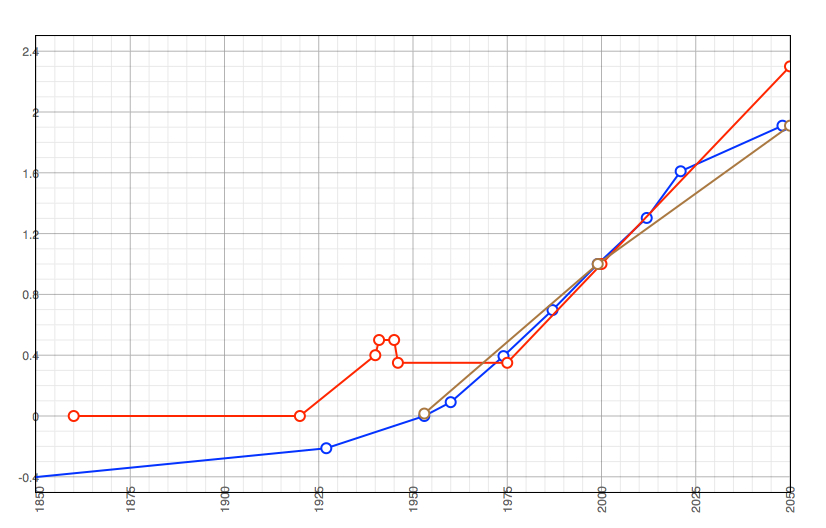
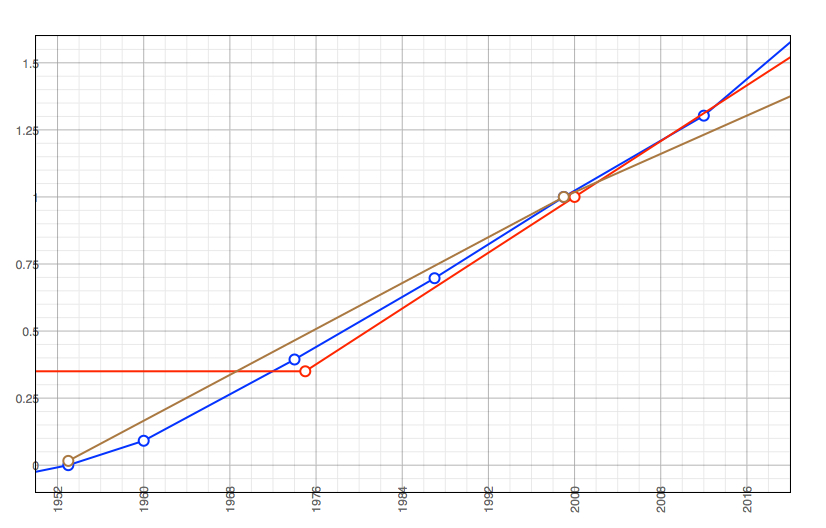
The growth of human population, the depletion of oil resources and the rise of global temperature each mirror one another to a remarkable degree, a result that can be arrived at from the data and projections already described.

The world population of 2.7 billion by 1953 can be taken as a base that required negligible petroleum energy to produce. The addition of people beyond this level is fueled at a rate of 264 barrels of oil per person.

So, population minus the base equals cumulative oil production in barrels divided by 264 (equation 1).

For example, today’s population of 6 billion required the expenditure of 871 Gb (Gb is for Giga-barrel, or 1 billion barrels); the actual consumption by January 1999 was 857 Gb. Similarly, a projected population in 2050 of 9 billion would coincide with an accumulated depletion of 1,663 Gb, or 95% of the estimated 1,750 Gb of the world’s oil endowment.

The actual population and cumulative oil production data between 1950 and 2000 correlate startlingly well with the proportionality and offset (base population) given here. The projections to 2050 also correlate extremely well, but of necessity they contain uncertainties only time can clarify.

Proportionality, people and temperature

By direct comparison, the trends of temperature rise above 14.7 °C (the pre-1920 plateau) and population growth mirror each other after 1975 with a proportionality of 3.3 billion people per °C.

So, the difference of population minus base, divided by 3.3 billion equals the temperature difference above 14.7 °C (equation 2).

For example, the 6 billion people of today coincide with a rise of 1 °C to 15.7 °C (60.3 °F), and the projected 9 billion people of 2050 would coincide with a rise of 1.9 °C to 16.6 °C (61.9 °F).

Proportionality, temperature and oil

By a ratio of the previous two proportionalities, one finds that for each 870 Gb of oil produced, the global surface temperature rises by 1 °C.

So, cumulative oil production in barrels divided by 870 Gb equals temperature rise above 14.7 °C (equation 3).

It has already been noted that today we have a global warming of about 1 °C above the 19th century level of 14.7 °C, and that just over 857 Gb of oil have been extracted; this matches the proportionality of 870 Gb/°C. The anticipated global warming in 2050, with 1663 Gb of oil having been extracted, would be 1.9 °C, for a temperature of 16.6 °C (61.9 °F).

Summary of proportionalities

Three proportionalities: 264 barrels/person, 3.3 billion people/°C, and 870 Gb/°C, correlate the data and projected trends in world population (above a base of 2.7 billion), cumulative oil production and global warming (above 14.7 °C). Population and oil production are correlated from 1950, while all three quantities are correlated after 1975.

Population (blue), oil (brown) scaled to match temperature rise (red) above 14.7 C, 1850-2050, (see text, proportionalities)

Population (blue), oil (brown) scaled to match temperature rise (red) above 14.7 C, 1950-2050, (see text, proportionalities)

Population (blue), oil (brown) scaled to match temperature rise (red) above 14.7 C, 1950-2020, (see text, proportionalities)

What’s Next?

Are we to believe that these correlations will remain intact until the world’s oil is exhausted? Will we really age to 2050 with an accumulation of 9 billion people, no petroleum, and unchanged climate despite a heating of unprecedented magnitude, comparable to the cooling of the Ice Ages?

Many find it easy to fantasize from this point: ice caps melt, oceans swell, shorelines recede so that countries like the Netherlands and Bangladesh disappear; jungles and deserts expand but in different locations than at present, waves of extinction and population-drop sweep the animal kingdom, equatorial zone agriculture collapses, massive migrations spark wars; America, Europe and Japan militarize heavily, including space, to capture foreign resources and repel invaders and refugees; America invades Canada because the ‘corn belt’ has moved north to the former tundra; the exploding price of oil spurs a frenzy of invention into synthetic fuels and alternate forms of energy, as well as a return to coal and a depletion of timber; sunny territory is invaded and conquered by foreign armies, and used for solar energy plantations by a colonial elite who export the accumulated energy to their imperial homelands.

Politics (finally!)

In fact, we don’t know what will happen, or when. But, we can “use what we know” to begin rational planning now for a transition to a new method of powering our society (particularly transportation systems), and of weaning ourselves from imported energy and the imperialism it seems to require. It would also be wise to rearrange our politics, that is to say remove the inequities between economic classes, so that our nation can retain its integrity while facing the environmental, economic and political pressures to be expected with a shift to a post-petroleum world. The added stress of a civil war during such a time would be tragically cruel.

Such planning is unlikely — at best very difficult — in America, because business has a quarterly-profits myopia, and the electorate in the suburban American “heartland” is thoroughly indoctrinated in capitalist ideology, with an anti-socialist “every man for himself (and women too)” attitude. The world’s revenge for our past imperialism may well be realized by our lack of social planning for the inevitable shocks of the collapse of the oil-powered economy, accompanied by a climate shift.

There are no physical reasons, no “laws of nature” that prevent us from devising an alternative way of organizing and powering our American society. There would certainly be many technical problems and intellectual challenges, but we have the means to prepare for what we can predict is likely to unfold. An enduring society would do this on a continuing basis. To me, that is socialism. Sometimes it’s as simple as seeing that everyone is in the boat, and they’re all rowing in the same direction.

In looking at our political figures, which ones seem to concern themselves with just the self-interest of one or another faction, and which ones seem to concern themselves with the good of the “whole boat?” We need leadership that can draw our involvement into long-term, democratic, social planning that achieves dependable commitments. We need such a process to bear fruit this decade, and we need a well-understood general plan for embarking on an intentional social transformation. If not, we will be the witless victims of a foreseeable catastrophe of our own making.

Notes

1.  “Hubbert Peak of Oil Production” – http://www.hubbertpeak.com (as of 29 February 2004).

2.  James M. MacKenzie, “Oil as a finite resource: When is global production likely to peak?” World Resources Institute, 1996 & 2000 – http://www.wri.org/climate/jm_oil_000.html (as of 24 February 2004).

3.  Energy Information Administration, U.S. Department of Energy – http://www.eia.doe.gov (as of 28 February 2004).
“Energy in the United States: 1635-2000” – http://www.eia.doe.gov/emeu/aer/eh/frame.htm
“25th Anniversary of the 1973 Oil Embargo” – http://www.eia.doe.gov/emeu/25opec/anniversary.htm
“U.S. Total Petroleum Consumption” – http://www.eia.doe.gov/emeu/25opec/sld007.htm
“Imported Oil as a Percent of Total U.S. Consumption” – http://www.eia.doe.gov/emeu/25opec/sld002.htm

4.  U.S. Department of Interior, Press Release, 19 March 2003 – http://www.doi.gov/news/030319.htm (as of 28 February 2004).

5.  Bureau of the Census, U.S. Department of Commerce “Population Clock,” – http://www.census.gov/main/www/popclock.html (as of 28 February 2004).
“World Population Information” – http://www.census.gov/ipc/www/world.html
“Total Midyear Population for the World: 1950-2050” (table) – http://www.census.gov/ipc/www/worldpop.html
“World Population: 1950-2050” (graph) – http://www.census.gov/ipc/www/img/worldpop.gif
“Historical Estimates of World Population” – http://www.census.gov/ipc/www/worldhis.html
“Annual World Population Change: 1950-2050” – http://www.census.gov/ipc/www/img/worldpch.gif
“Methodology and Assumptions for the Population Projections of the United States: 1999 to 2100” – http://www.census.gov/population/www/documentation/twps0038.html

6.  “Trend in global average surface temperature,” United Nations Environment Programme / GRID-Arendal – http://www.grida.no/climate/vital/17.htm (as of 24 February 2004).

7.  Intergovernmental Panel on Climate Change (IPCC) of the United Nations Environment Programme (UNEP) – http://www.unep.ch/ipcc (as of 28 February 2004).
“Variations of Earth’s surface temperature for the past 140 years (global), and the past 1000 years (Northern Hemisphere)” – http://www.unep.ch/ipcc/present/graphics/2001syr/large/05.16.jpg
“Variations of the Earth’s surface temperature: years 1000 to 2100” – http://www.unep.ch/ipcc/present/graphics/2001syr/large/05.24.jpg

8.  The reference temperature in [6] is 15.08 °C (the 1961-1990 average), while in [7] it is 15.43 °C (the 1990 value). This article uses the 1860-1920 plateau (estimated average) of 14.7 °C as the reference for global warming. So, the data and projections of temperature “deviations” and “variations,” from [6] and [7], have been adjusted to ensure consistency in describing global warming.

9.  “Global Warming,” National Oceanic and Atmospheric Administration – http://lwf.ncdc.noaa.gov/oa/climate/globalwarming.html (as of 24 February 2004)

10.  “What is Climate Change,” Government of Canada – http://www.climatechange.gc.ca/english/issues/what_is/index.shtml (as of 24 February 2004).

<><><><><><><>

Facing Greta’s Challenge

<><><><><><><><><><><><><><><><><><><><><><><><><><><><><><><><>

Facing Greta’s Challenge

On Thursday, 13 December 2018, Greta Thunberg, a 15-year-old climate activist from Sweden, addressed the U.N. Plenary Session at Katowice, Poland, to condemn global inaction in the face of the climate change crisis. (https://youtu.be/HzeekxtyFOY) Her address of under 4 minutes was a diamond of unadorned clarity, a challenge to all adults worldwide. In an 11 minute address earlier this year, Greta described her own evolution as a climate change activist while still a child, from: learning about the crisis, to spurring herself into solo public advocacy, and now forcefully challenging national and international politicians to act immediately in response. (https://youtu.be/EAmmUIEsN9A) Greta’s withering criticism of her elders is fully justified because no real action in response to climate change has occurred during the last quarter century, and since Severn Cullis-Suzuki, then 12, issued the exact same critical challenge to the world’s adults, over the course of 6 sparkling minutes, at the Rio de Janeiro summit on climate change in 1992. (https://youtu.be/oJJGuIZVfLM)

We all know what effective action means: an immediate disavowal of capitalism, militarism and imperialism, and the obscene wealth inequities they protect and are motivated by; and the redirection of the human energies, financial treasures and political powers wasted as tribute for the preservation of global rule by the elites of those wealth pyramids, to instead propel a vigorous and unlimited global program of climate change action based on economic equity and climate justice. Basically, Green World Socialism without end (or, till the end).

The only barriers to achieving this social and political transformation of the world are purely mental, not physical: the reluctance in less than perhaps 800 million minds (10.43% of humanity) to relinquish extracting unnecessary and excessive wealth and luxury from the operations of socio-political and economic systems that impoverish, exploit, injure and kill people in the disadvantaged 90% of humanity. What is lacking is a species-wide solidarity among homo sapiens. How do we gain that?

Solidarity arises out of a homogeneity of misery. A steep grading of affluence, along with a media-indoctrinated consensus for devotion to anxiety, acquisition and up-class envy, assures against any outbreak of solidarity. When there can be no thought for the world until the wanted “needs” of me and mine have first been met, we have a societal atomization assuring against any disruption, by enmeshing social solidarity, of our parallel isolated preoccupations. Societal inertia is condensed from the individually encapsulated and blunted awarenesses of people immersed in a regime of economic disparity. Transformative social evolution is simply the fluid mixing of a commonality of experience in the struggle for life within a leveled and even disorganized population.

To meet a species-wide challenge to survival, like climate change, we must first develop a species-wide solidarity. And, our history suggests that for that to happen we must first suffer a leveling catastrophe so the survivors and their successors can marinate in an equality of want for a sufficiently long time until it ferments into tangles of solidarity that eventually connect all human thought. This is how democratic socialism and social democracy emerged in Western Europe after World War II.

Our dread today is that we don’t want to suffer such a leveling catastrophe because it would be a devastatingly painful, tediously drawn out tragedy, and a holocaust undeserved by multitudes of its innocent victims, regardless of how just a retribution it would be against our criminal elite who brought us to this extremity; and we don’t want to suffer through such a catastrophe because the survivors of that purge (maybe you and me?) would have no idea how long they would have to scratch and shift largely alone and unprotected in the pitiless rubble of human society’s destroyed past before mind, spirit and moral character revived and interconnected into a new socially uplifting solidarity. But, that uplift might never occur, and the destruction that begs for it could be terminal. So, how do we break through the paralyzing dread and proceed expeditiously anyway?

We can’t wait for hope; hope follows action. Action must engage without relying on hope because for all we know the geophysical situation may be hopeless, and the social benefits of action would be widespread and immediate regardless of the duration and ultimate outcome of our efforts. Concerns over the financial costs of those efforts are irrelevant because only the social value gained matters. Waiting for some reassuring hope, telegraphed back into the present from the uncertain future, guaranteeing that our careening societal inertia can be finessed with minimal change to its governing prejudices and inequities, so it can then swerve around the geophysical wall our fossil-fueled fate is raising along the entire line of our horizon, is a blind and cowardly stupidity unworthy of our intellectual capabilities.

Some, including me, have wished for a mass popular awakening that erupts into a socialist revolution that then engenders a socially transformative climate change response. Such a response would surge toward the goal of achieving a self-sustaining balance between universal human aspirations and needs, with the enduring processes of Nature that support All-Life. Short of such a miraculous mass satori, I see little prospect of anything beyond a trail of excuses ejected behind our obviously inevitable surprising collision with fate’s wall.

In the absence of a species-wide solidarity, we are left with the prospect of class, race and intergenerational wars erupting out of the struggles for survival during the accelerating calamities of advanced climate change. The young and the striving workers, whose futures and economic viability are being robbed, will be driven by a righteous anger and the courage of those with nothing to lose to rebel and make war against the parasitic fossil-fueled regimes destroying them. Such wars would be heartbreakingly bloody for the rebels against capitalism because of the monopoly on highly technological violence held by the entrenched capitalist powers, a machinery of violence which would be used mercilessly against the much larger impoverished populations in rebellion. It would be like the Vietnam War, perhaps multiply and perhaps globally. Why do I think such gloomy thoughts? Because I have not yet found a major counterexample to the observation by Frederick Douglass (1818-1895) that:

“Power concedes nothing without a demand. It never did and it never will. Find out just what any people will quietly submit to and you have found out the exact measure of injustice and wrong which will be imposed upon them, and these will continue till they are resisted with either words or blows, or both. The limits of tyrants are prescribed by the endurance of those whom they oppress.”

Gaining the 13th Amendment to the U.S. Constitution (the abolition of slavery, exclusive of prison labor) required the bloodletting of the American Civil War (1861-1865). The liberation of so many countries from dictatorial regimes and from colonial exploitation by foreign powers over the last two centuries required tsunamis of blood and long periods of societal torture of the oppressed. And, what of the Yemenis, Palestinians and the Uyghurs, among others today? It seems that Douglass’s dictum will remain a tragic tautology for humanity for some time.

If the capitalist establishment remains intransigent in its embrace of fossil-fueled inequity and acquisitiveness then any determined uprising against it, motivated by both a thirst for socio-economic justice and the mounting of an all-encompassing response to advancing climate change, has the potential to expand into a conflict that could itself collapse civilization in advance of the geophysical termination of planetary habitability for us.

An anti-capitalist and climate change motivated revolution that did triumph after sustaining massive losses over a long war would undoubtedly be morally coarsened by the experience, and their postwar socialist regime might not be as generous and utopian as we could wish for. But none of this need be so. As Greta and Severn have said, we could all just decide to agree and bypass all the “blood, toil, tears and sweat” of resisting, and get the job done.

So, I don’t bother being critical of the many types of advocacy for climate change action that are being tried today, from the confrontational consciousness-raising theatrics of Extinction Rebellion and the Sunrise Movement, to Alexandria Ocasio-Cortez’s political proposal of a Green New Deal, to the articles, books, speeches, sermons and rants by many people, from distinguished to unknown. It’s all good if it tickles our species to wake up, unite, discipline its greedy capitalists and take control of its destiny. However, all these efforts combined have yet to induce government action, so it is obvious that a great deal more “motivation” has to be found or manufactured to spur governments to act now.

The time for our somnambulant capitalist bullshit and our hypocritical navel-gazing narcissism is over. Greta is right to kick us “adults” in the ass. We need to wake up, stop making excuses, unite, and get moving. Act now!

<><><><><><><>

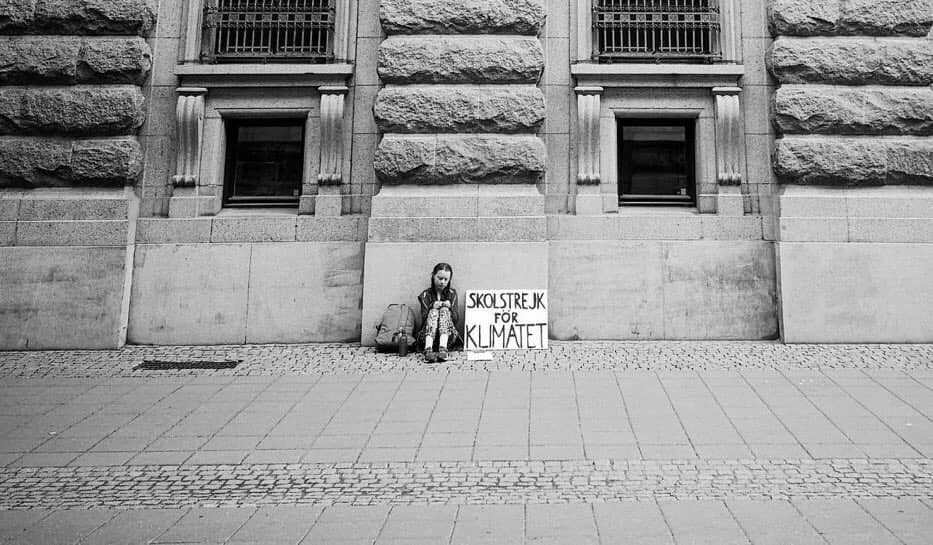
21 September 2019

Greta Thunberg alone by the Swedish parliament building, earlier in 2018. On 20 September 2019, 4 million others worldwide, most young people, joined her on the streets in a “School Strike for Climate.” Greta is a most admirable and powerful girl.

<><><><><><><>

A Formula For U.S. Election Outcomes

<><><><><><><><><><><><><><><><><><><><><><><><><><><><><><><><>

A Formula For U.S. Election Outcomes

I am wondering what the chances are for significant U.S. government action on the following ten issues, before 2022:

1. Equity of taxation
(popular/leveling vs. corporate/plutocratic),
2. Extract money from politics, kill Citizens United
(prosecute influence peddling and financial crimes),
3. climate change action (Green New Deal),
4. cut war spending, end the Yemen War
(and cut military-corporate subsidies),
5. Medicare-for-All
(versus insurance company gouging),
6. Social Security expansion
(versus general impoverishment for fat cat gains),
7. fund and staff welfare programs
(food, shelter, childcare, post-disaster assistance),
8. immigration reform and smart liberalization,
9. public school upgrades and teacher funding
(versus vouchers for resegregation; free college),
10. end subsidies for Christian xenophobia bigotry
(pursue Civil rights prosecutions, and Reparations).

This depends on what kinds of administrations we get as a result of national and state elections in 2020 and 2022. So, I devised a mathematical model of U.S. voting outcomes based on voter political affiliations and voting preferences. My aim is to have a tool to quantify my guesses about future election outcomes, so as to improve my speculations on when and to what degree desirable action will be taken on the ten issues stated. This exercise was better than being glum, dejected and confused about American politics, and this essay summarizes my findings. I based my model on voting behavior during U.S. presidential (quadrennial) elections instead of on midterm elections, but why not use it for both?

There were 7 of steps in devising this model: 1, determining the fractional composition of the American electorate by age brackets (15 of them); 2, finding the percent voter turnout by age bracket; 3, finding the party identification (both formal affiliation and casual identification) proportionally by age bracket; 4, collapsing all that data into the percent of the voting population that favors each of the three major U.S. political ideologies (from least to most amorphous): Republican, Democratic, and Independent; 5, examining the tabulated numerical date to divine the most general and instructive relationship, dependent on the fewest number of parameters, to devise a specific correlating and predictive mathematical formula; 6, calculate hypothetical results from this formula and then compare them (to the extent possible) with data on prior election outcomes; and 7, generalize the initial formula into an easily used estimating tool.

The Data

My source for population data was the U.S. Census Bureau [1]. On July 1, 2017, the US population was (officially) 325,719,178, and the voting age (18-85+) population (without considering legal barriers) was 252,018,630. I used data published by Charles Franklin on voter turnout as a function of age (https://medium.com/@PollsAndVotes/age-and-voter-turnout-52962b0884ef), [2]. I collapsed Franklin’s smooth data curve (for voter turnout, by age, to presidential elections) into 15 single values of percent turnout, one for each of the 15 age brackets: 18-19, 20-24, 25-29, 30-34, 35-39, 40-44, 45-49, 50-54, 55-59, 60-64, 65-69, 70-74, 75-80, 80-84, 85 and up. Turnout for teen and early 20s voters is 47%-55% (17%-25% for midterms), and turnout increases steadily with age, reaching a broad peak between 80% and 85% for voters 55 to 80 years old (70% to 73% for ages 62 to 79, for midterms). The population between 18 and 34 years (16 year span) is 75,913,971; the population between 60 and 79 years (19 year span) is 58,412,409. The population between 55 and 79 (24 year span) is 80,420,365; the population between 18 and 39 (21 year span) is 97,145,968. Voters between the ages of 18 and 29 (11 year span) contribute 17% of the presidential vote; voters between the ages of 50 and 59 (9 year span) contribute 19% of the presidential vote. Ah, poor youth, condemned to struggle and strive in a country (and world) shaped and directed by the crabbed and brittle prejudices of a smaller number of futureless self-satisfied property owners.

Party affiliation is of two types: being a reliable voter to a party you are registered with, or being an independent voter who will admit to “leaning” (in the voting booth) to the Democrats or Republicans, especially when you are alarmed or enthused about a particular election or issue. Those voters who refuse to declare a duopolistic party allegiance or even a “lean” are the staunch Independents. The Gallup organization has published data on the percent of voters who are Democrats, Republicans, and Independents, as well as leaners to the Democrats and Republicans, by age (https://news.gallup.com/poll/172439/party-identification-varies-widely-across-age-spectrum.aspx), [3]. Using this data, I lumped leaners in with declared party loyalists (respectively, for Republicans and Democrats), and then for each of the 15 age brackets assigned three numerical factors for the percentage of the age bracket voting in each of three modes: Republican, Democratic or Independent. From all the data described to this point, I was able to calculate, for each age bracket, the percent of the presidential vote that went to the Republican and Democratic parties, and to the Independent category. I summed up the results for the 15 age brackets to get an overall composition of the entire voting population, and rounded the final numbers slightly for convenience, to arrive at: 45% Democratic, 40.5% Republican, and 14.5% Independent. I will call this the “baseline.”

Note that all the data described above refers to conditions between 2014 and 2017.

The Formula (!)

If people voted consistently with their declared affiliations, we would have a continuous sequence of Democratic Party administrations; but people don’t, so we have flux and upheaval. In fact, the outcome of our national elections is driven by the surreptitious faithlessness of our tight-lipped (to pollsters at least) Independent voters. Our staunch Independent voters number between 1-in-8 (12.5%) to 1-in-5 (20%) of the voting population, and this fraction varies geographically and over time, in mysterious ways. What actually happens with Independents in the privacy of their voting booths is that they make individual choices about individual issues and candidates, and for each of these they vote in one of three ways: Democratic, Republican, or for one of the myriad of Independent options available, including abstention. So, the 14.5% (to take a fixed number for now) of the voting population that is incorrigibly Independent actually splits into three fractions during voting (quantified here as percentages of the Independent voting population only): I%D, I%R, and I%I. The label I%D represents the percentage of the Independents who voted Democratic in a particular election. Similarly, I%R corresponds to the percentage of the Independents who supplied Republican votes, and I%I corresponds to the percentage of the Independents who remained purely Independent. Note that I%D + I%R + I%I = 100%.

The 4.5% advantage Democrats have over Republicans nationally, based on my calculations (the baseline), can easily be overcome by a 5% or greater net contribution of Republican votes from the Independents. For example, if the Independent population splits: 50% Republican, 5.2% Democratic, and 44.8% staunch Independent (50% + 5.2% + 44.8% = 100% of the Independent population) then they contribute, nationally: 7.2% for Republicans (50% of the 0.145 fraction of the national vote made up of Independents), 0.8% for Democrats (5.2% of their 0.145 national fraction), and 6.5% (44.8% of their 0.145 national fraction) for Independent candidates. The result for the national election becomes: 47.7% Republican (40.5% + 7.2%), 45.8% Democratic (45% + 0.8%), and 6.5% Independent (14.5% – 7.2% – 0.8%). Note that 47.7% + 45.8% + 6.5% = 100% of the national vote. In this case the Republicans win the election with a 2.0% lead (with slight rounding).

By calculating several examples, as just shown, one can arrive at the following equation for election outcomes (for the duopoly horse race).

D-R = 4.5% + [0.145 x (I%D – I%R)].

In words: the percentage difference between Democrats and Republicans in national elections is equal to 4.5% plus the fraction 0.145 multiplied by the difference between the percentage of the Independent voting population that voted Democratic, and the percentage of the Independent voting population that voted Republican. The calculation for the previous example is as follows:

D-R = 4.5% + [0.145 x (5.2% – 50%)] =
D-R = 4.5% + [0.145 x (-44.8%)] =
D-R = 4.5% + [-6.5%]
D-R = -2%

Democrats lose, numerically, by 2%. Also, the actual vote going to Independents nationally is:

Actual Independent Vote Nationally =
14.5% (Independents) – 7.2% (to R) – 0.8% (to D) = 6.5%.

After playing a while with the duopoly horse race estimator formula, give above, I realized one can generalize it further.

D-R = D0 + [Fl x (I%D – I%R)].

D-R = percentage difference between Democrats and Republicans, from election.
D0 = percentage advantage (+) or disadvantage (-) for Democrats, based on affiliations.
FI = the fraction (not percentage) of the voting population that is Independent.
I%D = the percentage of the Independent population that chooses D (this time).
I%R = the percentage of the Independent population that chooses R (this time).
I%I = the percentage of the Independent population that remains I (this time).
Note that: I%D + I%R + I%I = 100%.

So far here, I have used D0 = 4.5%, and FI = 0.145. However, you can choose different numbers based on your own survey of population, voter turnout and party affiliation data, or on your intuition about a particular electoral contest. As mentioned earlier, estimates of FI can range between 0.125 (1/8) to 0.2 (1/5), and perhaps beyond.

Comparing To Previous Elections

I have not found data on the population sizes and voting splits of the Independent voting contingent in previous elections. It would be nice to validate the formula using such data. While the assumptions underpinning this model may not be representative of conditions in all prior US elections, we can nevertheless use prior election results to calculate inferences about what might have been the voting behavior of Independent voters in the past. To do that, we assume that the baseline (40.5% R, 14.5% I, 45% D), which was calculated from 2014-2017 data, has been constant (or nearly constant) since 1968. Here are the calculated inferences on how Independents voted in elections since 1968, based on the known national outcomes.

1968, Nixon
R. Nixon (R) 43.4% vs. H. Humphrey (D) 42.7% vs. G. Wallace (I) 13.5%
Remainder of the national vote is 0.4%
Independents contribute 14.5% of the national vote
Independents split: 77.2% (Wallace), 20% (R), 0% (D), 2.8% (I).

1972, Nixon
R. Nixon (R) 60.7% vs. G. McGovern (D) 37.5%
Remainder of the national vote is 1.8%
Independents contribute 14.5% of the national vote
Independents split: 87.6% (R), 0% (D), 12.4% (I)

1976, Carter
J. Carter (D) 50.1% vs. G. Ford (R) 48%
Remainder of the national vote is 1.9%
Independents contribute 14.5% of the national vote
Independents split: 51.7% (R), 35.2% (D), 13.1% (I)

1980, Reagan
R. Reagan (R) 50.7% vs. J. Carter (D) 41% vs. J. Anderson (I) 6.6%
Remainder of the national vote is 1.7%
Independents contribute 14.5% of the national vote
Independents split: 42.8% (R), 0% (D), 45.5% (Anderson), 11.7% (I)

1984, Reagan
R. Reagan (R) 58.8% vs. W. Mondale (D) 40.6%
Remainder of the national vote is 0.6%
Independents contribute 14.5% of the national vote
Independents split: 95.9% (R), 0% (D), 4.1% (I)

1988, Bush Sr.
G.H.W. Bush (R) 53.4% vs. M. Dukakis (D) 45.6%
Remainder of the national vote is 1.0%
Independents contribute 14.5% of the national vote
Independents split: 89% (R), 4.1% (D), 6.9% (I)

1992, Clinton
W. Clinton (D) 43% vs. G.H.W. Bush (R) 37.4% vs. R. Perot (I) 18.9%
Remainder of the national vote is 0.7%
Independents contribute 14.5% of the national vote
Independents split: 0% (R), 0% (D), 95.2% (Perot), 4.8% (I)

1996, Clinton
W. Clinton (D) 49.2% vs. R. Dole (R) 40.7% vs. R. Perot (I) 8.4%
Remainder of the national vote is 1.7%
Independents contribute 14.5% of the national vote
Independents split: 1.4% (R), 29% (D), 58% (Perot), 11.6% (I)

2000, Bush Jr.
G. Bush (R) 47.9% vs. A. Gore (D) 48.4%
Remainder of the national vote is 3.7%
Independents contribute 14.5% of the national vote
Independents split: 51% (R), 23.5% (D), 25.5% (I)
Bush appointed despite a 0.5% deficit.

2004, Bush Jr.
G. Bush (R) 50.7% vs. J. Kerry (D) 48.3%
Remainder of the national vote is 1.0%
Independents contribute 14.5% of the national vote
Independents split: 70.3% (R), 22.8% (D), 6.9% (I)

2008, Obama
B. Obama (D) 52.9% vs. J. McCain (R) 45.7%
Remainder of the national vote is 1.4%
Independents contribute 14.5% of the national vote
Independents split: 35.9% (R), 54.4% (D), 9.7% (I)

2012, Obama
B. Obama (D) 51.1% vs. M. Romney (R) 47.2%
Remainder of the national vote is 1.7%
Independents contribute 14.5% of the national vote
Independents split: 46.2% (R), 42.1% (D), 11.7% (I)

2016, Trump
D. Trump (R) 46.1% vs. H. Clinton (D) 48.2%
Remainder of the national vote is 5.7%
Independents contribute 14.5% of the national vote
Independents split: 38.6% (R), 22.1% (D), 39.3% (I)
Trump appointed despite a 2.1% deficit.

The 2.1% Republican Credit

In the 2000 election, G. Bush (R) had a 0.5% deficit and was still appointed the 43rd President of the United States of America.

In the 2016 election, H. Clinton (D) gained a 2.1% lead over D. Trump (R) – the same lead J. Carter (D) used to win in 1976 – and yet Trump was appointed the 45th President of the United States of America.

These “deficit wins” were due to a combination of nefarious factors: the Electoral College, pro-Republican judicial bias, voter suppression efforts (in both R and D varieties), vote counting sabotage, and undoubtedly other forms of creative incompetence.

So, today we must assume that because of embedded structural irregularities in the American electoral mechanism, that Democrats must gain more than a 2.1% advantage over Republicans in order to win national elections.

I easily concede that my simple clean mathematical formula does not contain the full range of rascally dirty realities in American electoral spectacles.

Dreams Of DSA Utopia

Could a significant politically leftward sentiment ever take hold among the Independent voting population, and this cause a leftward shift in electoral outcomes? The more socialist (or democratic-socialist, or progressive, of left) the legislators, executives and administrations that result from near-future elections, the more likely the ten issues I listed at the beginning would get serious attention – and action!

W. Clinton (D) won in 1996 with an 8.5% advantage. His Democratic administration was pure corporate, no different from center-right Republican policy before Reagan. I assume that if the voting population turned further away from Republicans, and more in favor of the most socialist-oriented Democratic candidates, that the resulting Democratic administrations would be less corporate-oriented (yes, I know this is magical thinking at present).

So, perhaps a Democratic victory with a 12.5% advantage would result in a Democratic administration that is a half-and-half mixture of corporate (DNC type) Democrats and socialist (DSA type) Democrats, and then some serious nibbling would occur on the ten issues. Mathematically, this could result if the hypothetical Independents split: 55.2% (D), 0% (R), and 44.8% stayed pure (I). The projected national election result would be 53% Democratic, 40.5% Republican, and 6.5% Independent.

An even better though less likely occurrence would be a socialist Democratic Party that gains a 16.5% electoral advantage, driving the Republican Party to extinction (instead of us!). Using the formula, we can infer an Independent split of: 82.8% (D), 0% (R), 17.2% pure (I). The projected national election result would be 57% Democratic, 40.5% Republican, 2.5% Independent.

The ultimate fantasy is of all Independents becoming enthusiastic DSA socialists, so they would add their 14.5% of the national vote to a socialist Democratic Party, with a projected electoral result of: 59.5% Democratic (pure DSA), 40.5% Republican, 0% Independent. An electorate that could accomplish this would empower national and state administrations that would address the ten issues listed earlier, with vigor and all the resources – human, material, and intangible – available to this rich nation.

However improbable the last scenario – of a Socialist political tsunami – appears in the United States of today, I think it is better to keep it in mind as a vision (more easily done if you are young), rather than acidly disparaging and brusquely dismissing it (more likely done by the old and bitter), because it can help motivate useful activism and kind action from those who want a better world with fairer politics and economics, and know that it is humanly possible to get it.

Notes

[1] Annual Estimates of the Resident Population for Selected Age Groups by Sex for the United States, States, Counties, and Puerto Rico Commonwealth and Municipios: April 1, [use above title to search in “2017 Population Estimates,” link below is just a start]
https://factfinder.census.gov/faces/tableservices/jsf/pages/productview.xhtml?src=CF

[2] Age and Voter Turnout (Charles Franklin)
https://medium.com/@PollsAndVotes/age-and-voter-turnout-52962b0884ef

[3] Party Identification Varies Widely Across the Age Spectrum
https://news.gallup.com/poll/172439/party-identification-varies-widely-across-age-spectrum.aspx

<><><><><><><>

“Fifty-Year” Look Back At Lived History, 1963-2013

This essay is a summary of U.S. history, which I lived through from 1963 to 2013 (primarily during the 1960s and 1970s). This essay is simply a combination of two of my items published by Swans (now gone) in 2013. I wrote them for the benefit of younger people. In writing these essays, I did make an effort (research) to verify my statements of fact. I am posting this compendium here because 2018 is the half-century mark after 1968, which I consider the most consequential year in U.S. history since 1945.

Fifty-Year Look Back 1963-2013, Part I: 1963-1968
18 November 2013
http://www.swans.com/library/art19/mgarci75.html

Fifty-Year Look Back 1963-2013, Part II: 1968-2013
2 December 2013
http://www.swans.com/library/art19/mgarci76.html

<><><><><><><><><><><><><><><><><><><><><><><><><><><><><>

“Fifty-Year” Look Back At Lived History, 1963-2013
(Part I, 1963-1968)

(November 18, 2013)   November 22, 2013, is the fiftieth anniversary of the assassination of US president John Fitzgerald Kennedy. We can expect many commentaries on, remembrances of, and uses and misuses made of this anniversary during this month of November. My contribution to that chatter is this look back at the last fifty years in American history, from my personal perspective. I make no claims of scholarship, inclusiveness, balance, or attitudinal and interpretive “correctness,” only that the following characterizes how I remember what I’ve chosen to focus on with respect to the “big picture” of American history that I have lived through.

Before 1963

The America of November 1963 was a country that had seen the collapse of European colonialism in Asia and Africa during the post World War II period of 1945-1960. America’s own imperialistic Monroe Doctrine presumptuousness was sorely tried by the Cuban Revolution of 1959, which openly declared itself communist in 1961. The Cuban Missile Crisis of October 1962 had brought the United States and the Union of Soviet Socialist Republics (Soviet Russia) dangerously close to nuclear war, but was fortunately defused, and subsequent diplomacy led to a treaty limiting nuclear weapons testing.

There had been about 100 atmospheric nuclear weapons tests, primarily by the U.S. and the USSR, during the period 1951-1956 (there had been about 9 between 1945 and 1950). The annual number of nuclear tests jumped to over 40 in 1957, and over 100 in 1958. There was a voluntary halt to testing during 1959-1960 (except for a few tests by France) in response to public fears about the radioactive fallout contamination of the milk supply. The peace symbol, which is now an icon of our culture, was designed by Gerald Holtom in 1958, and first popularized as a badge by Eric Austen, both nuclear disarmament advocates in Britain. In 1961 — John Kennedy’s first year as US president — the USSR launched a major series of over 30 nuclear tests, and the U.S. mounted about half that number. This weapons race accelerated wildly to a frenzied peak in 1962, with 140 tests performed (over 90 for the U.S. and nearly 40 for the USSR). Except for 1958 and 1962, there have never been more than about 90 nuclear tests in any year (and from 1971 usually under 60), and only very few since 1992, the last year of US testing (post 1992 testing has been by France, China, India, Pakistan, and North Korea). The numbers I quote for nuclear tests in a given year are read off a chart and rounded. (1)

The environmental movement was born on September 27, 1962, with the publication of Rachel Carson’s book, Silent Spring, on the ecological devastation caused by pesticide pollution.

In 1963

The negotiations initiated in October 1962 to defuse the Cuban Missile Crisis blossomed into the crafting of, signing (August 5, 1963), US ratification (September 24, 1963), and implementation (October 10, 1963) of the Limited Nuclear Test Ban Treaty of 1963, which banned nuclear weapon tests in the atmosphere, in outer space, and under water.

The Civil Rights (anti-apartheid or anti-segregation) movement for black Americans had been very vigorous in the southern U.S. from the beginning of John Kennedy’s presidency in 1961. The Reverend Martin Luther King, Jr. gave his famous “I have a dream speech” from the steps of the Lincoln Memorial in Washington, D.C. on August 28, 1963.

From 1961, John Kennedy had sent US military advisors to aid the anti-communist Ngô Ðình Diêm regime of South Vietnam in its fight against a communist insurgency (the will of the peasantry) allied with communist North Vietnam. By late 1962, there were 12,000 US soldiers in South Vietnam. Disappointed with Diem as an anti-communist unifier for North and South Vietnam, Kennedy approved a CIA program to aid Diem’s generals in a coup to produce new leadership, which occurred on November 2, 1963, with the deposed Diem summarily executed.

Lee Harvey Oswald, a disaffected American seeking glorious recognition as a leftist hero, acted as a freelancing James Bond (the world’s favorite fictional Tory) to impress the Dirección General de Inteligencia de Cuba (DGI, the Cuban intelligence service) by assassinating President Kennedy on November 22, 1963. The DGI had been locked in a battle with the CIA to keep Fidel Castro from being assassinated, a project pushed hard by the Kennedy brothers, John and Robert. Lyndon Baines Johnson, John Kennedy’s successor, stopped the CIA’s Fidel assassination program shortly after taking office. The Soviet Russian intelligence service (KGB) had found Oswald too unstable to rely on as an agent, and happily let him return to America from his self-imposed exile in Russia (October 1959 to June 1962). The DGI had the difficulty of being a much less powerful organization situated far closer to its small nation’s overwhelmingly superior enemy. Thus, the DGI unlike the KGB might be willing to exploit the improvisations of a volunteer useful idiot. Oswald spent the last week of September 1963 in Mexico City, visiting the Cuban and Russian consulates seeking a visa to travel to Cuba, and as a consequence met DGI agents. The DGI was too professional to compromise itself by inducting a delusional American outcast into its ranks, but the DGI seems to have been either gutsy enough or desperate enough to allow Oswald to imagine he would be welcomed in Cuba should he accomplish something of significant value for the Cuban Revolution. Oswald returned to Dallas on October 14, 1963. (2)

During 1964-1968

1964:

The Beatles conquer America by capturing the hearts of its teenage girls. We boys had no choice but to follow.

Lyndon Baines Johnson wins a landslide electoral victory over conservative Republican Barry Goldwater (Au-H2O), who had said in his nomination acceptance speech, “I would remind you that extremism in the defense of liberty is no vice.” The Johnson campaign exploited Goldwater’s strident public image with the most explosive political advertisement ever devised, the famous Daisy commercial. (3)

The Johnson administration bequeathed America the national tragedy experienced as the Vietnam War (between 1964 to 1968, after which the Republican administration continued it till 1975), but also the towering civil rights triumphs codified by three laws:

– Civil Rights Act of 1964 prohibits discrimination based on race, color, religion, sex, and national origin by federal and state governments as well as some public places.

– Voting Rights Act of 1965 prohibits states and local governments from imposing any “voting qualification or prerequisite to voting, or standard, practice, or procedure … to deny or abridge the right of any citizen of the United States to vote on account of race or color.”

– Civil Rights Act of 1968, also known as the Fair Housing Act, prohibits discrimination in the sale, rental, and financing of housing based on race, creed, and national origin.

1965:

Unsafe At Any Speed, Ralph Nader’s book about deficiencies of automotive design as regards passenger safety, launches the consumer product safety movement.

President Lyndon Johnson sends American troops into South Vietnam; by July there are 75,000. On July 28, Johnson announces he is increasing the troop level to 125,000 and doubling the monthly draft calls (from 17,000 to 35,000). A gradual and sustained aerial bombardment of the Democratic Republic of Vietnam (North Vietnam), Operation Rolling Thunder, had begun on March 2, 1965, and would continue until November 2, 1968.

1967:

Positive Crankcase Ventilation (PCV) valves, which are simple pollution control devices, are mandated for internal combustion engines. This was the first regulation for automobile exhaust pollution control. Since Silent Spring in 1962, numerous concerns had combined into a broad environmental movement: the flooding of Glen Canyon on the Colorado River in 1963 behind the new Glen Canyon Dam, the logging of old growth redwood trees, air pollution — smog — caused by auto and truck exhaust gases, river and coastal pollution from industrial and farm wastes, and the danger of ecological damage by oil spills from offshore drilling platforms, which infamously occurred at Santa Barbara, California, in 1969.

The Six Day War, between Israel and the combined forces of Egypt, Jordan and Syria, takes place in early June. Israel is victorious, and the present Palestinian crisis of Israeli occupation begins.

Ernesto “Che” Guevara is captured and executed on October 9, 1967, by the Bolivian military aided by the CIA. One of many blows by a perpetually petulant US establishment vainly seeking a satisfying vengeance for the Kennedy hit.

1968:

The Tet Offensive, launched by the Communist Party of Vietnam on January 30, stuns the Johnson administration as well as the US public. It was now clear that the American war for South Vietnam was futile, but nevertheless it would continue till 1975.

On March 31, Lyndon Baines Johnson announces that he will not seek reelection; it is a presidential election year. Robert F. Kennedy (John Kennedy’s younger brother and attorney general) was a senator at that time, and had announced his own bid for the presidency on March 16.

Martin Luther King, Jr. is assassinated on April 4, in Memphis, Tennessee. Major rioting breaks out in many cities. Because of the extensive damage and fires caused during these urban riots, and the deployment of National Guard troops to restore order, the television images of these scenes on US soil had an eerily disquieting resemblance to images of Stalingrad in 1943, Berlin in 1945, and Hue and other Vietnamese cities besieged during the previous three months during the Tet Offensive. Many Americans became very frightened, and a diversity of Americans had their various prejudices deepened.

Robert Kennedy is assassinated after a campaign speech in Los Angeles on June 6 by a resentful Palestinian with Jordanian citizenship, Sirhan Sirhan, who is still serving a life sentence for that crime. Robert Kennedy had captured the imagination of liberals, especially young ones, who were ignorant of his earlier political career (as a McCarthy-type commie chaser, and the zealous prosecutor of the Fidel assassination project) and crushed by his loss. Robert Kennedy had been deeply affected by John Kennedy’s death and the politics behind it, and as a result he had undoubtedly become much more sympathetic to the aspirations and suffering of marginalized populations, like the Mexican-American farm workers that Cesar Chavez was organizing in California’s Central Valley. However, the degree to which Robert Kennedy had become more “revolutionary,” or “socialist,” or just moral after 1963, and how such a presumed deepening of compassion and conviction might express itself politically, are matters of pure speculation mooted by his death. Hubert Humphrey, the vice president and eventual 1968 Democratic nominee for President, was the quintessential mainstream liberal politician of the 1960s.

Richard Milhous Nixon, a Republican from California, wins the 1968 presidential election with a campaign promoting “law and order” and appealing to anti-civil rights southern white resentment (Dixiecrats become Republicans). Nixon’s winning concept was called “the southern strategy.” It would become the formula applied by all subsequent Republican presidential contenders to this day, very effectively by Ronald Reagan in the 1980s, who vastly increased the formula’s content of rhetoric and cant on fiscal soundness and the evils of taxation, but unsuccessfully by Willard Mitt Romney in 2012 because of the changed demographic composition of the American electorate since 1968 and 1988.

Notes to Part I

1.  Nuclear Weapons Testing,
http://en.wikipedia.org/wiki/Nuclear_weapons_testing

2.  Manuel García, Jr.,
“Castro And The Kennedy Image After The Checkmate”
Swans, 23 April 2012,
http://www.swans.com/library/art18/mgarci46.html

Some Words About JFK,
see the section “Castro And The Kennedy Image After The Checkmate”
https://manuelgarciajr.com/2017/11/20/some-words-about-jfk/

3.  Daisy Commercial (1964),
http://www.youtube.com/watch?v=9Id_r6pNsus

<><><><><><><>

“Fifty-Year” Look Back At Lived History, 1963-2013
(Part II, 1968-2013)

(December 2, 2013) This two-part series is a look back at the last fifty years in American history, from my personal perspective. The thread of my historical narrative begins in Part I (1963-1968). (1)

Enjoy the show.

The Vietnam War and the US Presidential Election in 1968

On January 30, the Communist Party of Vietnam launched its stunning though costly and ultimately stymied Tet Offensive across all of South Vietnam. For the Vietnamese Communist Party, the Tet Offensive was a propaganda victory and foreign relations coup; for the Johnson administration and the American public it was a crippling blow to self-confidence about the conduct of the war. The number of American troops in Vietnam peaked at 543,482 in late April.

The year was the most expensive in the Vietnam War with America spending US$ 77.4 billion (US$ 519 billion in 2013) on the war. The year also became the deadliest of the Vietnam War for America and its allies with 27,915 South Vietnamese (ARVN) soldiers killed and the Americans suffering 16,592 killed compared to around two hundred thousand of the communist forces killed. The deadliest week of the Vietnam War for the USA was during the Tet Offensive, specifically February 11-17, 1968, during which 543 Americans were killed in action and 2,547 were wounded. (2)

On March 31, Lyndon Johnson announced in a nationally televised address that he would not seek reelection as US president in the November election. That same month, to encourage the North Vietnamese to begin negotiations, he halted the aerial bombing of the northern portion of North Vietnam, which includes those regions surrounding the capitol city Hanoi but not those areas bordering the 10 kilometer-wide 1954 treaty line — the DMZ or demilitarized zone — marking the separation into North and South Vietnam. The parties agreed to conduct the negotiations in Paris, and met for the first time on May 10. However, the North Vietnamese were adamant in demanding the Americans halt all aerial bombing in the North before discussing anything else, which Johnson finally acceded to on October 31, after which serious negotiations began. (3)

On November 5th, Richard Milhous Nixon, a Republican from California, won the 1968 presidential election with a campaign promoting “law and order” and appealing to anti-civil rights southern white resentment (Dixiecrats become Republicans). Nixon’s winning concept was called “the southern strategy.” It would become the formula applied by all subsequent Republican presidential contenders to this day, very effectively by Ronald Reagan in the 1980s, who vastly increased the formula’s content of rhetoric on fiscal soundness and cant on the evils of taxation, but unsuccessfully by Willard Mitt Romney in 2012 because the demographic composition of the American electorate had changed significantly since 1968, and 1988.

The Arc Of American Liberalism

The years 1964 through 1980 spanned the arc of American liberalism, arising out of the optimism of the Kennedy administration and plunging into the sour witless eruption of neo-liberalism: Thatcherism (1979) and Reaganism (1981)
.
The legislative triumphs of civil rights occurred during the same years as the vast expansion of the Vietnam War, 1964 to 1968. The accumulating costs of that war combined with the growing costs of social welfare programs to cause fiscal problems and a mild recession in late 1969 through 1970, and a monetary crisis in 1971 (the Nixon Shock, the end of the Bretton Woods system of international financial exchange, and the beginning of the present situation of freely floating currencies).

The Oil Crisis of 1973 (the Arab Oil Embargo in retaliation for the US support of Israel during its October 1973 war with Egypt and Syria) introduced Americans to the energy crisis: shortages of gasoline and fuel oil, with a quadrupling of prices. The recession triggered by the 1973 oil crisis lasted until 1975. By that time, American economic productivity (or profitability) had fallen from its peak levels during the previous thirty years of the post World War II boom (Les Trente Glorieuses), in part because advanced automation could now replace more human labor, and in part because of increased foreign competition, since the post WWII recovery of Europe and Japan had advanced rapidly though the 1950s and matured in the 1960s.

The reductionist quest for profitability led to the “outsourcing” and “offshoring” practices of seeking minimum cost foreign labor (with minimum investment in foreign health, safety, environment, and taxation) to produce products for sale and consumption in the United States. The inflation of the 1970s coupled with slow economic growth (“stagflation”) spurred the intensification of well-financed campaigns by corporate interests to acquire political influence, which could be used to lower corporate taxes, eliminate or loosen government regulations on business practices, and break unions. This neo-liberal ideology of corporatism above all considerations of social democracy became the American paradigm with the arrival of the Reagan administration (1981-1988), and continues to the present despite its destruction — catastrophically in 2008 — of the American economy for over 90% of the population.

The long, horrible, drawn-out bleeding of the Vietnam War was totally unnecessary. The 1973 Oil Crisis was never addressed as it should have been, by the development of sustainable, non-nuclear energy and power sources not based on fossil fuels (or combustion). I think of how much better off Americans and the world would be today if these two problems had been solved compassionately and intelligently. The successors of the Vietnam War have been briefer, more streamlined, and far too numerous. The newest American wars are now carried out as computer games of automated assassination, equipped with real remotely-controlled unmanned bomber aircraft and missiles, and programmed directly from the White House. The energy crisis that erupted in 1973 has now metastasized into the anthropogenic global warming problem. To my mind, the way to move the United States beyond its present glut of drone wars and military adventurism and wastefulness, as well as most effectively address the energy and global warming dilemma, is to be found by abandoning neo-liberalism and embracing its exact opposite, social democracy.

Vietnamization For “Peace With Honor,” Mega-Death For “Credibility”

For Americans, the Vietnam War had a slow buildup. It began during the Harry S. Truman administration with the behind-the-scenes provisioning with military equipment for, and the financing of, the French colonial forces in Indochina in 1945-1952. The Dwight D. Eisenhower administration (1953-1960) continued this support after the French defeat in 1954, with the propping up of anti-communist regimes in the southern half of Vietnam, and supporting anti-communist factions in Laos.

The forces of communist North Vietnam completed the north-south Ho Chi Minh Trail in 1959, along the eastern margins of the countries west of Vietnam: Laos in the north, and Cambodia in the south. This route for the clandestine re-supply of communist forces in South Vietnam would be the key to the eventual communist victory in 1975. The trail was camouflaged to evade aerial surveillance and bombardment. American aerial bombardment along the Ho Chi Minh Trail between 1964 and 1973 was so intense that Laos has the sad distinction of being the most bombed country on a per capita basis.

During the Richard M. Nixon administration (1969-1974), the American bombardment of North Vietnamese military activities in eastern Cambodia was secretly expanded to include an invasion with ground forces (in 1970). The officially neutral Cambodian government, led by Prince Sihanouk, had publicly protested the violations of its territory in the east, but quietly accepted both: the North Vietnamese infiltration, in order to maintain the possibility of good relations with the Vietnamese communists who Sihanouk saw as the inevitable victors; and Sihanouk accepted some of the American bombardment of the North Vietnamese in Cambodia’s east so as to placate the Americans, discourage the Vietnamese communists from openly invading and occupying Cambodia, and to keep the small Cambodian communist factions from gaining popular support. Unfortunately, the American bombardment was so massive, unrelenting, and deadly, that many survivors among the rural population in both Laos and Cambodia became radicalized and joined the communist forces in their countries, who all swept to victory in 1975.

Richard Nixon knew the Vietnam War was a lost cause, and his plan to gain “peace with honor” and extricate the United States from the meat grinder of war-making was to build up the military forces of the anti-communist regime in South Vietnam while simultaneously withdrawing American personnel. This was called “Vietnamization.” From a certain distance, Nixon’s plan had a reasonable cast to it. The idea was to prosecute the war by substituting well-trained and amply equipped South Vietnamese troops for American troops, and in so doing show the world that the United States “kept its promises” to allies, and it would thus retain its “credibility.”

You have to hear Henry Kissinger’s leaden intonation of “American credibility” to understand why an additional 21,257 deaths of Americans in Vietnam, and over a million Vietnamese deaths, and hundreds of thousands of combined Laotian and Cambodian deaths had to be sustained between 1969 and 1975. The arc of American mortality because of the Vietnam War, grouped by presidential administration, was a follows: 9 Eisenhower (1956-1960), 191 Kennedy (1961-1963), 36,756 Johnson (1964-1968), 21,195 Nixon (1969-1974), 62 Ford (1975-1976), and 7 during 1987-2006. (4)

The Vietnamization process to retain “American credibility,” that is to say the international reputation of the American foreign policy-making elite, was based on thinking in which individual American lives were mere ciphers to be churned in the calculations of force projection to gain diplomatic advantage for elite geo-strategic gamesmen, while the individual lives of Vietnamese, Laotians, and Cambodians were not even considered up to the level of ciphers. A ceasefire, truce, declaration of defeat, withdrawal of American forces, and less violent consolidation of communist power in Indochina could have been accomplished much sooner, with the stated goal of stopping bloodshed and limiting casualties by accepting the inevitable. That course of action would have lost the United States one form of “credibility” but it would have gained it another I think far more valuable.

The Nixon-Kissinger Vietnamization policy was an egotistical face-saving crime of genocidal proportions. Thinking back to it leaves me wondering if human history is farcical tragedy or a tragic farce.

Some Incidents In The History Of My Times

The following incidents made impressions on me, for one reason or another.

20 July 1969. Neil Armstrong lands on the Moon, and a gesture is fulfilled. The other side of the coin was the CIA-sponsored killing of Ernesto “Che” Guevara in Bolivia on 9 October 1967. The American Gods must be propitiated. (5)

1 December 1969. The first Draft Lottery, and the beginning of the end for antiwar protests in the U.S. For my little story about that see (6).

22 April 1970. The first Earth Day, the environmental movement at its height, the most radiantly hopeful day I ever had dreaming about the future. It was pure bliss, and I was also in love.

7 November 1972. Richard M. Nixon wins a landslide presidential electoral victory against antiwar Democrat George Stanley McGovern. I liked McGovern.

11 September 1973. Chile’s Marxist president, Salvador Allende, dies and his government falls in a very violent coup led by a fascist Chilean general, Augusto Pinochet, aided by the CIA as directed with disgusting enthusiasm by Henry Kissinger, National Security Advisor to Richard Nixon, and then Secretary of State (from 22 September 1973).

17 June 1972 – 9 August 1974. The Watergate scandal unfolds, Nixon resigns, and his former vice president, Gerald Ford, advances to the presidency and pardons Nixon, immunizing him from all Watergate-related prosecution, making Ford unelectable in 1976.

20 November 1975. Francisco Franco, the pseudo-fascist monarchist-authoritarian Spanish dictator, dies, and Spain carefully emerges out of its enforced medieval slumber of 36 years.

1977-1980. The Jimmy Carter administration is the twilight of American political liberalism (the unifying concept being the social welfare state), which effectively ends in 1978 as Carter’s initiatives became more militarized.

18 April 1977. Jimmy Carter addresses the nation on energy. This could have been the start of the sustainable and solar energy revolution in America, but it wasn’t. Think of how much better served and secure we would be today if it had.

28 March 1979. Three Mile Island nuclear accident, a partial meltdown of a commercial nuclear reactor at a power station in Pennsylvania. The worst such accident in the U.S.

15 July 1979. President Jimmy Carter addresses the nation on its “crisis of confidence” during its 1979 energy crisis (oil and gasoline shortages and high prices, consequences of the Iranian Revolution). This address would become known as the “malaise speech,” though Carter never mentioned “malaise.”

August 1979. Paul Volcker is appointed chairman of the Federal Reserve by President Jimmy Carter, and his monetary policies cure the persistent inflation of the 1970s and early 1980s.

1979. Zbigniew Kazimierz Brzezinski, the National Security Advisor to President Jimmy Carter, initiates the covert transfer of billions of dollars in arms to the Afghan mujahideen militants opposed to the Soviet military forces that had invaded in support of the allied central government, which itself faced insurrection. Osama Bin Laden, from Arabia, led one such mujahideen group in the ensuing Afghan War prosecuted by the Soviets. That war proved to be a quagmire for the Union of Soviet Socialist Republics, and drained sufficient resources and caused enough human suffering and resentment among Russians that it initiated the political instability that eventually led to the collapse of communism in the USSR.

4 November 1980. Ronald Reagan is elected president, and the neo-liberal shredding of the 1945 postwar social contract begins. My heart sank that day, and of Americans I thought: “Whom the gods would destroy, they first make mad.” (An anonymous ancient proverb wrongly attributed to Euripides. This variant is spoken by Prometheus, in The Masque of Pandora (1875) by Henry Wadsworth Longfellow.)

1980-1988. The Shah of Iran is deposed by the Shiite theocratic Iranian Revolution of 1979, and American embassy personnel are held as hostages for 444 days, being released shortly after Reagan’s inauguration. Iraq under the control of its dictator, Saddam Hussein, attacks Iran in 1980, initiating an eight year Iran-Iraq War during which the United States government aides Iraq by providing satellite reconnaissance information about Iran to the Iraqis, and eases the transfer of materials and technology that Iraq uses to fabricate and then deploy chemical weapons against Iranian troops, and later dissident Iraqi populations. It is estimated one million lives were lost in the Iran-Iraq War.

1981-1989, The Reagan Administration launched proxy wars against the peasantry in Central America (Nicaragua, Guatemala, El Salvador, Honduras). The underlying conflicts between an impoverished peasantry and a wealthy land-owning elite that sponsored the national military and police establishments had erupted into armed struggle (again) after 1959, becoming ferocious by the late 1970s. Using the excuse of fighting communism putatively infiltrated into Central America by Cuba, the Reagan administration supplied and funded local anti-communist and reactionary militias as proxy military forces, to destroy popular social democracy by despicable terrorism. These proxy militias, or “contras” (“against” the revolutions), were usually police and army personnel acting out of uniform in Guatemala, El Salvador, or Honduras, or in Nicaragua they were former police and army personnel of the Somoza regime, which had been deposed by the Sandinista Revolution of 1979. The savage cruelty inflicted on the ethnic Mayan peasantry by the contra forces reached their crests of genocidal magnitude under Reagan Administration sponsorship. These Central American Wars all trailed off in the 1990s.

20 August 1985 – 4 March 1987. Iran-Contra Scandal. (7)

26 April 1986. A nuclear reactor at the Chernobyl power station in the Ukraine explodes, spewing radioactivity far and wide, and the fuel core melts down. The Chernobyl disaster was the worst nuclear power plant accident until the Fukushima Daiichi nuclear disaster of March 11, 2011. Also during 1986, Ronald Reagan has the solar hot water system removed, which had been installed on the roof of the White House during the Carter Administration. The spirit of Earth Day 1970 had been executed.

17 October 1987. “Black Monday” stock market crash. The Dow Jones Industrial Average experienced a drop of 22%. Alan Greenspan had just been appointed as chairman of the Federal Reserve by Ronald Reagan, replacing Paul Volcker. This crash occurred during the midst of the Savings and Loan Crisis of the 1980s.

23 June 1988. In testimony before the US Senate, NASA scientist James Hansen stated that anthropogenic global warming had begun.

22 November 1988. Twenty five years since the assassination of John Kennedy, and twenty five years before today [2013].

9 November 1989. The Berlin Wall falls, communism in Eastern Europe crumbles. I was elated and exhausted. I believed nuclear disarmament was now immanent, as well as a revamping of the US war economy (Defense Department funding) into a robust “peace” and “green” economy. Clearly, I was naively delusional.

2 August 1990 – 28 February 1991. The Gulf War (Persian Gulf War, First Iraq War) is successfully prosecuted by a NATO combined force under US direction, acting to reverse the annexation of Kuwait by the Iraqi regime of Saddam Hussein. America’s ally to punish Iran during 1980-1988 had since fallen out of favor. The chemical and biological weapons, and some nuclear technology held by the Saddam Hussein regime were now seen as intolerable threats to American interests.

26 December 1991. The USSR formally ceased to exist. The twelve republics that had comprised the USSR were declared independent.

Into The 21st Century

William Jefferson Clinton Administration (1991-2000)

Bill Clinton is a 1960s center-right Republican dressed up as a 1960s liberal Democrat. He went along with deregulating the banks (repeal of the Glass-Steagall Act of 1933) and financial industry (signing the Commodity Futures Trading Act of 2000, allowing easy trading in derivatives), which together set up the casino environment that would lead to the publicly-damaging financial collapse of 2008.

George Walker Bush Administration (2001-2008)

G. W. Bush spent profligately on tax cuts for the rich, and the Iraq War (20 March 2003 – 15 December 2011), using the 11 September 2001 attacks as an excuse. The loose money policy of Alan Greenspan, chairman at the Federal Reserve, fed a housing bubble that peaked in 2006, deflating into an expanding financial crisis in late 2007, and a catastrophic banking collapse in October 2008.

Barack Hussein Obama Administration (2009-2016)

Barack Obama is a corporatist Democrat in the Clinton mold, and shepherds the financial industry’s interests by managing the economy with a bias for public austerity maintained to preserve speculator (a.k.a. investor) accumulations (gains), and the continuing regime of insufficient regulations and taxes on trading. Keynesianism to lift the economy out of its chronic joblessness is denied. The current official unemployment rate (based on definitional sophistry) is about 7%, the real unemployment rate is about 23%. (8)

Obama is a master of symbolism, and much of a wishful-thinking public allows that symbolism to distract them from reality.

Hillary Rodham Clinton, today’s [2013] leading Democratic Party contender for president

Hillary Clinton is the presumed frontrunner in the race to become the Democratic Party’s nominee for president in the 2016 election. She has already captivated the attention of those Americans for whom the symbolism of “the first female US president” overwhelms all rational considerations. So, perhaps the underwriting of her presidential campaign will pay off for corporate America, in giving the first female president the historic privilege of privatizing Social Security, and staking multi-millionaire Wall Street gamblers with an abundance of other people’s money they can play with risk-free. The symbol-awed will never notice.

Notes to Part II

1.  Fifty Year Look Back 1963-2013,
(Part I: 1963-1969)
 [above here]

2.  1968 in the Vietnam War
http://en.wikipedia.org/wiki/1968_in_the_Vietnam_War

3.  Paris Peace Accords
http://en.wikipedia.org/wiki/Paris_Peace_Accords

4.  Statistical Information about Fatal Casualties of the Vietnam War
U.S. National Archives
http://www.archives.gov/research/military/vietnam-war/casualty-statistics.html

5.
“Castro And The Kennedy Image After The Checkmate”
Swans, 23 April 2012,
http://www.swans.com/library/art18/mgarci46.html

Some Words About JFK,
see the section “Castro And The Kennedy Image After The Checkmate”
https://manuelgarciajr.com/2017/11/20/some-words-about-jfk/

6.  The Promise Of Remembered Soundtracks
7 October 2013
http://www.swans.com/library/art19/mgarci72.html

7.  Iran-Contra Affair
http://en.wikipedia.org/wiki/Iran%E2%80%93Contra_affair

8.
“Official” US Unemployment Rate
http://data.bls.gov/timeseries/LNS14000000

“Real” US Unemployment Rate
http://www.shadowstats.com/alternate_data/unemployment-charts

<><><><><><><>

Publicly Subsidized Climate Change Insurance for Big Oil

“Whom the gods would destroy they first make mad”
— Henry Wadsworth Longfellow

My 14 August 2018 article, “Climate Change Bites Big Business” (https://www.counterpunch.org/2018/08/14/climate-change-bites-big-business/), described the now evident large financial impacts on Big Business caused by climate change, for example:

— the bankrupting-level liabilities to one California electric utility company (PG&E) for causing massive wildfires in 2017,

— the threat of similar future liabilities to the entire electric utility industry, especially in Western America,

— huge losses to fire insurance companies in California during 2017-2018 (and similar possibilities wherever drought occurs in highly developed areas),

— huge losses to flood, hurricane and tornado insurance companies, because of the more violent rain-and-wind storms of recent years (like Hurricane Sandy in 2012, and the hurricanes since),

— the possible throttling of future commercial and real estate investment if insurance rates and bank loan interest rates increase sharply because wildfire and weather related destructive events are now permanently amplified by climate change.

In the article cited above, I concluded:

“I think that the pretense of climate change denialism by the Big Money has crumbled, and we are now entering a period of overt climate change acknowledgment coupled with fanatical efforts to gain public subsidies for private interests to both insure and indemnify them against climate change-related financial losses, and to also preserve the nature of their businesses even if they are major CO2 and organic vapor polluters, like the petrochemical and coal companies.”

Confirmation of the above conclusion is provided by The Associated Press article of 22 August 2018, “Big oil asks government to protect its Texas facilities from climate change” (https://www.cbsnews.com/news/texas-protect-oil-facilities-from-climate-change-coastal-spine/), which describes:

“An ambitious proposal to build a nearly 60-mile ‘spine’ of concrete seawalls, earthen barriers, floating gates and steel levees on the Texas Gulf Coast… to shield some of the crown jewels of the petroleum industry, which is blamed for contributing to global warming and now wants the federal government to build safeguards against the consequences of it. The plan is focused on a stretch of coastline that runs from the Louisiana border to industrial enclaves south of Houston that are home to one of the world’s largest concentrations of petrochemical facilities, including most of Texas’ 30 refineries, which represent 30 percent of the nation’s refining capacity. Texas is seeking at least $12 billion for the full coastal spine, with nearly all of it coming from public funds. Last month, the government fast-tracked an initial $3.9 billion for three separate, smaller storm barrier projects that would specifically protect oil facilities.”

Capitalism is a combustion engine that burns fossil fuels to churn out privatized financial wealth, government power (by fueling the military) and socialized waste heat and greenhouse gas pollution whose accumulation in Nature creates and accelerates global warming-induced climate change.

The bald fact of the oil industry seeking to have the public subsidize the protection of its facilities — and its profitability — from the natural climate-changing consequences of its own operations must rank as one the most colossal combinations of blind greed, chutzpah, cognitive dissonance and inertia during this Oil Age.

But, this is where we are today in our collective response (if you can call it that) to the advancing threats posed by climate change to organized human life.

More polemics are pointless, and our existing politics is madness.

Note:

The phrase “Whom the gods would destroy they first make mad” is spoken by Prometheus in Henry Wadsworth Longfellow’s poem “The Masque of Pandora” (1875).

<><><><><><><>

Climate Change Bites Big Business
14 August 2018
https://manuelgarciajr.com/2018/08/14/climate-change-bites-big-business/

<><><><><><><>

Now also at Counter Punch;

Publicly Subsidized Climate Change Insurance for Big Oil
27 August 2018
https://www.counterpunch.org/2018/08/27/publicly-subsidized-climate-change-insurance-for-big-oil/

<><><><><><><>

You Can’t Sue Fossil Fuel Industry Over Climate Change

”Turns out cities can’t sue oil companies for climate change” reads the title of an article in Wired.Com magazine (https://www.wired.com/story/climate-lawsuits-dismissed/).* Well, obviously; the purpose of the US judiciary is to protect massed capital from popular democracy.

The truth is that climate change denial is primarily a failure of the U.S. Government (and other governments), from – at a minimum – the Reagan and then George H. W. Bush Administrations. Government scientists as well as government supported academics in the meteorological/atmospheric, oceanic, geological, and energy sciences all had combinations of observational data and computer models that clearly showed the advance and effects of global warming/climate change. The first definitive modern peer-reviewed scientific publication (in the journal Nature) describing the mechanism of CO2-caused global warming (the inability of the oceans to absorb all the CO2 being emitted, hence its buildup in the atmosphere, hence the growing heat retention by the CO2-laced atmosphere, hence the continuing rise in average air-ocean-earth temperature) was published in 1955.

By 1988, when James Edward Hansen (NASA’s chief scientist on atmospheric modeling and global warming at that time) gave his testimony to Congress – stating that global warming was man-made by CO2 emission – essentially all physically and mathematically reasonable computer models of the atmosphere and/or oceans, internationally, gave the same overall result: the more CO2 in the atmosphere, the higher the global average temperature; and the observed rise in global average temperature with time tracked the rate of increase of CO2 (and other organic gases and vapors) in the atmosphere. The National Academy of Sciences, as well as every real scientific and engineering professional society also agrees with this conclusion and states so.

The failure of protecting the public interest falls squarely on the political leadership class, who populate succeeding administrations of the USG and who collectively chose not to face the obvious facts presented by America’s (and the world’s) scientists, because that political leadership class did not want to accept or act on the clear societal implications of the scientific facts. Why? because the political leadership was more concerned to protect the financial self-interests of currently entrenched and very wealthy capitalist combines (in particular fossil fuel industries and the financial industries associated with them) than it was concerned to protect the long-term interests of the majority of the public for survival and well being (workers, wage earners, “ordinary people” relatively few of whom one could consider as “investors” in stocks, bonds and paper securities).

In brief, our politicians have for decades preferred to sell out the long term survival (and sustainable prosperity) of “the people” in favor of protecting the exploitative profitability of capital-intensive CO2-polluting industry and economic gamesmanship, and the super-wealthy (who are invariably corporatists and investor/speculators banking on those capital-intensive CO2-polluting industries). So, while it is true that the energy companies were very deceitful in funding P.R. campaigns of climate change denial while their own scientists/technologists knew that climate change was real and caused as a result of using their fossil fuels – just to keep raking in huge short-term profits – we had ample ways of knowing the truth without needing the fossil fuel companies to admit it, because we have had the publicly funded and publicly available scientific results of world-wide modern geo-science for decades.

American cities trying to sue energy companies for lying about climate change and hence “causing” damage to such municipalities has some legal logic to it as a way for these cities to “recover” financial compensation for their climate change-related “damages.” However, as noted here that is really a rather limited, petty, and at least partly hypocritical finger-pointing response to the accelerating climate change crisis, because that crisis is essentially the direct consequence of a willful (intentional!) failure of American (and other national) government, which was in cahoots with the CO2 polluter industries (and especially the Pentagon) and related finance capital industries.

Basically, capitalism is a fossil-fueled political-economic parasite feeding off the public good, both in its societal and environmental dimensions, and the US government (and others with similar energy and finance capital policies) is entirely in the business of protecting capitalism (the economic parasites) against the personal and societal interests of the majority of the national population (e.g., the ensuring of sustainable environmental security and long-term habitability, and having national political power controlled by popular and populist democracy rather than institutions of concentrated wealth).

And that’s where it stands today. We are on an accelerating plunge into extinction by climate change induced disasters (vast wildfires, collapsing agriculture, desertification and the poisoning of aquifers, the expanding range of disease pathogens, very destructive wind and rain storms) from the bottom up (first the poorest, last the richest) driven by a mad obsession to further concentrate the financial wealth of the wealthiest. It’s really all just a mass psychosis, and all our wars and military rivalries (nuclear armed no less) and political forms of oppression, repression and cruelty, and all our myopically fanatical exercises for maintaining control of factional and personal advantages parasitic to the public good are just ripples on the surface of the one great oceanic reality of our time: the survival of organized human life in the face of accelerating (and still out of our control) climate change.

Collectively, we humans just don’t want to face the fact that to have any useful (for our survival, and for social equity) impact on the present course of climate change we would have to change EVERYTHING, and NOW. Hypothetically, humanity has the capacity to do this, but realistically, based on the observation of past human behavior, it seems that the high degree of long-term cooperative altruism required to make such a complete change of world society (i.e., “the revolution,” or the “instant” conscious evolution of humanity’s super-ego) may be beyond the capacity of our collective social psychology. For now we each remain the randomly surprised victims of the sporadic disasters that erupt from our accumulating karma of obsessive-compulsive fossil-fueled climate change denial.

As an engineer, the only wild-ass guess of a solution that I can think of today is to hope for a miraculous “world satori” – a collective spontaneous and consensus-forming waking up of “everyone” to the same new vision of world society – and this then leading to our world buckling down to doing the numerous (and monumental) technical tasks of transforming all the structures of our civilization into a new paradigm in harmony with nature. Admittedly, this is an extremely fuzzy and rarefied engineering solution. What’s your idea?

*(Thanks to Michael Huff of Philadelphia, for the reference to the Wired article.)

See also:

Noam Chomsky: Survival of Organized Human Life is at Risk Due to Climate Change & Nuclear Weapons
30 July 2018
https://www.democracynow.org/2018/7/30/noam_chomsky_survival_of_organized_human

<><><><><><><>

Political Memes, Opus #2

Why do what’s right when you can make money?
Why be courteous when you can get ahead?
Why be truthful when you can lie to get your way?
Why share when you can have it all?

<><><>

Telling the truth is not hard,
guaranteeing you’ll like it
is impossible.

<><><>

The Socialist overthrow of Capitalism
would be a greater victory
than the capture of the Roman Empire
by Christianity.

<><><>

It must be a terrible heartbreak to have lived through the 1960s, and clearly remember the Civil Rights struggles and your protests against the Vietnam War, and then have had Reaganite Republican children and Bush and Trump Republican grandchildren. What a waste of all your child-rearing sacrifices, after having dreamt of an approaching just and democratic world, to bitterly realize that your turn at genetic transmission had been hijacked by fascism. Because of Hillary Clinton’s connivance in thwarting the Bernie Sanders campaign of 2016, and her being singularly responsible for bringing Donald Trump to power, there will never come a time in which I won’t detest the women (and men) who voted for Hillary Clinton in the primary elections, and still insist she should have been US president. I pity Trump voters, despite them being at least disappointing and at worst horrible people, because they are infected with a self-defeating and obdurate stupidity. Hillary Clinton-loving people are supposedly more intelligent and moral, but are in fact absolute failures who are irredeemably vain and selfish, and thus unworthy of concern.

<><><>

West God In Rut
Wine God Strut
We Trusting Do
Go Turd In West
Wet Gin Or Dust
Go Trust I Wend
I Trod New Gust
Wet Gin Do Rust
West Rust In Dog
Wet God In Rust
In Dog We Trust
I Got Us Newt’rd
In God We Trust.

<><><>

It is so sad to see intelligent, fundamentally decent people
in the prime of their lives
lost in bitterness,
unreachable to friendship
by those outside their exclusive club of resentment.
It is a sadness like grief for a loss in the family
of one still living
but forever beyond contact.

<><><><><><><>

American society is ignorant, self-absorbed,
fearful and thus cruel, surrendering to enslaving greed,
and soulless by lacking a compassionate unifying vision.

Its best hope lies in the individual development
of strong moral character, and thus socialist vision,
by enough people to revolutionize the entire culture.

Manuel García, Jr. — 23 March 2018

<><><><><><><>

Zionist manifest destiny
in Palestine and beyond
is a war crime, which
Americans should not
subsidize nor sacrifice for.

<><><>

VW is Germany’s Ford, Audi is VW’s Lincoln.
US VW’ers pretend having MB & BMW status
they’re too poor and chintzy to pay for,
by being pushy obnoxious drivers.

<><><>

Inflation is money’s shelf-life.

<><><>

Extinction sooner is better than profits delayed.
(It’s all about the money.)

<><><>

Genocide is the original sin of the real estate industry.

<><><>

“I tremble for my country when I reflect that God is just;
that his justice will not sleep forever…”
– Thomas Jefferson,
(Commerce Between Master and Slave, 1782)

“Freedom is the right to tell people
what they do not want to hear.”
– George Orwell
(The Road to Wigan Pier, 1937)

“If a nation values anything more than freedom,
it will lose its freedom; and the irony of it is
that if it is comfort or money that it values more,
it will lose that too.”
– William Somerset Maugham
(Strictly Personal, 1941)

“It is the responsibility of intellectuals
to speak the truth and to expose lies.”
– Noam Chomsky, (1966)
(The Responsibility of Intellectuals)

“It’s typical for educated classes to be more effectively controlled
by the indoctrination system to which they are directly exposed,
and in which they play a social role as purveyors,
hence coming to internalize it.”
– Noam Chomsky, (1985)
(Intervention in Vietnam & Central America: Parallels & Differences)

“Nothing is easier
than to convince oneself of the merits
of actions and policies that serve self-interest.”
– Noam Chomsky
(Year 501, The Conquest Continues, 1993)

<><><>

The Victim Queen controls the World by projecting an infinite spectrum of dislikes.

<><><>

“I don’t want to have to think!”
Why humanity will extinct itself as soon as possible,
and pat itself on the back for doing so.

<><><>

God is a self-righteous excuse
for inflicting unconscionable cruelty.

<><><>

Will there be Love in 200 years?

<><><>

My biggest mistake:
having unrealistic expectations
of people I don’t know.
(Mainly everybody.)

<><><>

An old type of “joke” applied by racists/bigots who happen to be People-Of-Whiteness, against Black People (also known as People-Of-Color, and/or include: African-Americans, Afro-Caribbean, Africans) compares them disparagingly to apes: monkeys, chimpanzees and gorillas. Genetically, there is only one race: the human race. And, we are all a species of primate: apes. Genetically, humans and chimpanzees are 98.8% identical. There is a greater difference between chimp and gorilla DNA (94.8% same) than there is between chimp and human DNA (98.8% same). White skin only developed in humans after 12,000 years ago (after the Ice Ages) and most likely after 6000 years ago. Very well preserved human DNA from recently uncovered human remains in Britain, from 6000 years ago, was analyzed to determine that such early Britons had black skin (very deeply dark brown, or “negro” skin color), straight black hair, and blue eyes! Racial jokes are the lame humor of ignorant people.

<><><>

U.S. Political Parties:

Libertarian:
the sociopathic anti-war pro-greed party.

Republican:
the sociopathic pro-bigotry classist party
run by careerist touts for capitalism.

Democratic:
the anti-bigotry classist party
run by careerist touts for capitalism,
and now fighting off an insurgency
by democratic socialists.

<><><>

The only 2 excuses for voting Trump:
1. You’re a bigot too,
and he lets you feel good about it.
2. Dementia.

<><><>

The Gates of Heaven are locked shut
to bar the dark children
of the despoiled colonies
from climbing into the Olympus
of their White Gods
who luxuriate in the effulgence
of their self-satisfying beneficence
that is the envy of the sacrificed
whose blood and sweat
are fermented and distilled
into the intoxicating ambrosia
swilled
at the never-ending
Harvest Feast of the Gods.

<><><><><><><>

I could whisper words of milk and honey in your ear,
and tell you sweetly what you want to hear.
I could entertain and lull you like the smoothest joint
But, really folks, what would be the point?

<><><><><><><>

The Imprisoned American Mind

<><><><><><><><><><><><><><><><><><><><><><><><><><><><><><>

The following essay of mine originally appeared as:

The Imprisoned American Mind
2 August 2004
http://www.swans.com/library/art10/mgarci19.html

It is reprinted here without change. If you substitute “Donald Trump” for “George W. Bush,” “Hillary Clinton” for “John Kerry,” and “Bernie Sanders” for “Ralph Nader,” then you will easily find this essay “up to the minute.” Enjoy (or bemoan).

<><><><><><><><><><><><><><><><><><><><><><><><><><><><><><>

The Imprisoned American Mind

“Resistance to the organized mass can be effected only by the man who is as well organized in his individuality as the mass itself.”

—C. G. Jung, The Undiscovered Self, 1957


“I suggest that the real objective of Socialism is not happiness. Happiness hitherto has been a by-product, and for all we know it may always remain so. The real objective of Socialism is human brotherhood. This is widely felt to be the case, though it is not usually said, or not said loudly enough. Men use up their lives in heart-breaking political struggles, or get themselves killed in civil wars, or tortured in the secret prisons of the Gestapo, not in order to establish some central-heated, air-conditioned, strip-lighted Paradise, but because they want a world in which human beings love one another instead of swindling and murdering one another. And they want that world as a first step. Where they go from there is not so certain, and the attempt to foresee it in detail merely confuses the issue.”

—George Orwell, “Can Socialists Be Happy?”, 24 December 1943


Can an awareness of political reality be re-awakened in the American public mind? How do we produce this Second American Revolution?

The Perfect Prison Of The Unused Mind

If some great power were to grasp the molten magnetic generator at the core of the Earth, and twist it so the field now pointed with magnetic north emanating from Ecuador and magnetic south from Sumatra, then all the compasses on the planet would point differently, and all our systems of navigation would have to change.

The psychological relationship of each individual to the whole of society is similar to that of each compass to the planetary magnetic field. Our personal compass helps us align ourselves with the norms of society, with “good” and “evil,” and with our own conscience. When our psychic compass is broken, we are psychotic — our contact with reality is very seriously impaired.

Imagine a group of psychotics, one possibility being the inmates at an insane asylum. This would be an accumulation of individuals with broken psychic compasses confined in a protected environment that is managed by people with excellent psychic compasses, who are intent to help. Such a scene would speak well of a larger enlightened society.

But there is another possibility. The society could be deviant, its psychic “field” twisted and misdirected so its norms are skewed from what is easily understood — outside of this society — to be decent and humane. In such an aberrant society, the governing psychic field can easily orient the compasses of individuals who do not have their own independent source — or frame — of reference. Such individuals, placid in their continuity within the social norms of their group, are members of a mass psychosis.

The American prison guards in the Abu Ghraib jail in Baghdad were normal people fully adapted to their mass psychosis. Adolph Eichmann, a senior executive in the Nazi SS bureaucracy managing the industrial-scale death camp industry, was an individual proven by psychological testing to be normal and sane, and he too was a fully adapted member of a mass psychosis.

An individual inoculates himself from being infected by mass psychoses by developing a capacity for critical thought, an understanding of human nature and the reality of his own personality, by consciously working to improve and maintain his character, and by developing connections to sources of insight and compassionate awareness (religion can be one such example). This requires continuing mental effort over one’s lifetime.

Minds that remain largely unused because of ignorance, which is the child of laziness, will be found by mass media (“propaganda,” in the old days), filled with easily swallowed psychic worms that are coated with syrupy sweet sex, glistening cherry-red violence, desire-fulfillment fantasy, voyeurism, and lowest-common-denominator semi-pornographic mass culture. Once embedded, the underlying psychic messages re-program the thought patterns of the consuming individual for ease of remote control by the social programming elite.

If you don’t think, someone will do it for you, but not for your benefit.

The psychology of mass psychosis is how small groups of wealthy elites control larger populations. It may seem easy to look back on Hitler and the Nazi’s control of the German people and say “not me, not today.” But any truthful look at American politics would have to conclude that amazing progress has been made in the techniques of social control. Just look at how Americans so overwhelmingly volunteer to impoverish themselves, their society, their children’s future, even the very planet they live on — perhaps irreparably, all for the unique purpose of increasing the moneyed wealth of the moneyed class.

Control of a mass psychosis is the ultimate pyramid scheme. Political dictators seek to become cult deities, and economic elites seek to become admired nobilities by the combined labor and sacrifice of the enthralled proletariat, as well as by their delusional worship. A political revolution to free the serfs, the servants and the workers will have to overcome or bypass not only the physical and economic power of the state, but also the psychological power of a crypto-religious mythos that has been backfilled into the intellectual and spiritual void of an unthinking populace. And the people will resist the toppling of their idols, they will resist their own liberation, they will resist doing the mental work necessary to stay free.

Imagine the reaction to telling people “patriotism is psychotic.”

Zombie Nation

We are already brainwashed, and it is permanent. We are all conditioned, much as Aldous Huxley describes in his novel Brave New World. By high school, we are largely indoctrinated and imprinted with our attitudes and allegiances, and it is the rare individual who can overcome their silly embarrassment and their mental laziness to actually and overtly change their mind. Thought is effort, and this is contrary to being happy (remember “pursuit of happiness”?) because in minds trained for consumption, effort is work and work is unhappiness, and because achieving knowledge usually makes you angry at the follies and chicanery being committed under the cover of public ignorance — a socialist’s fundamental problem; read George Orwell’s essay “Can Socialists Be Happy?”

Most people are really of quite simple mind. They imagine that how they think (which is to say, not thinking much at all) is somehow an essential core of who they are — their self definition, their personality. Thus, confronting some comfortable, church-going Republican with vigorous calls to turn away from their party during the upcoming election is tantamount to asking them — from their frame of reference — to self-negate, to not be, to act and think as they “can’t” and as their anti-selves would act. You are asking someone to wrench free from their mass psychosis.

In the spirit of psychotic bipartisanship, let me note that the previous example can be inverted, to that of a conservative Republican importuning a brainwashed godless communist to betray his allegiances. However, the relevant situation for Americans is of witless popular allegiance to the Republican-championed mass psychosis combining corporate capitalist penuriousness and intolerant religiosity.

People who support George W. Bush (for example) are not swayed by ANY logical argument or observable fact (such as the false justification for the Iraq War, and no end to terrorism as a result). They vote to maintain the primacy of their self-image — reflected by Bush and conservative Republicanism — in American political and FINANCIAL affairs, the latter being the actual totality of concern. A voter votes for the “me”-reflector to be in charge. No logical or moral argument can ever counteract that.

This accounts for the intransigence of the Naderites and other US leftists who feel pushed out of electoral politics. No me-reflector of theirs is even permitted to get on the same national stage. Despite all the angry self-righteousness of Democrats who imagine they own all leftist votes just because Bush and the Republicans own rightist votes, they still do not mount me-reflectors for the leftists they would exploit, and Nader is running to protest this injustice.

On voting for “me,” see the work of George Lakoff, a linguist who describes how political debate is “framed” to limit the possibilities of discussion, and to resonate with the self image of a target audience the framers wish to co-opt. “Framing,” as Lakoff describes it is the control language of mass psychosis.

In many ways, the rivalry between Republicans and Democrats is a battle to control the mass psychosis of American socio-political placidity. The insurgency of Ralph Nader and the Green Party is an attack on the psychosis itself. The fond hope of the insurgents is that the inevitable bite of reality (weak economy, outsourcing, healthcare insecurity, withdrawal of social services, the price of imperialism and war) prods political movement to the left within the body of the mass psychosis, so it transfers control to Kerry and the Democrats, and then continues to build leftward momentum as conservative delusions fall before a widening awareness of political reality. Then the real revolution has a chance to break through popular conservative narcolepsy and challenge the hold of corporate imperialism over American politics. Of such stuff are dreams made of.

I think only external physical factors can influence Americans to do the mental and moral work needed to change their fundamental political perspectives — to drop the psychoses. I’m thinking of undeniable forces of change, like abrupt climate change leading to catastrophic social collapse, or thermonuclear war — possibly a civil war (a Yugoslavia style disintegration with nuclear strikes), or sudden and permanent loss of petroleum, or some combination of all three.

Since it took the Red Army to convince Germany to abandon Nazism (NATO forces helped in Western Europe); and close to total destruction in Japan — including the incineration of many of its inhabited cities by aerial bombardment — to convince the Japanese to abandon their military imperialism, I do not think it exaggerated to suggest that Americans might need an equally calamitous Armageddon to cause a reorientation of their politics.

Reorientation without the Armageddon? A beautiful wish, but not a logical one.

On The Articles

Ritt Goldstein describes the current American psychosis in terms of Erich Fromm’s concept of “socially patterned defects”, and R. D. Laing’s concept of “social-fantasy systems.” C. G. Jung, a co-founder of modern Western psychology, used the term “mass psychosis” to describe what second generation pychologists Fromm and Laing were describing in their own more elaborate terms. Like Jung, both Fromm and Laing witnessed the horrible mass psychoses of Europe in the 1930s and 1940s, and their theoretical work tried to make sense of these experiences. Goldstein describes how the insights of Fromm and Laing are being used to understand the psychology (or psychosis) of political thought within the Bush administration today. Insights of this sort can be used either to promote the work of 21st century equivalents of Josef Goebbels, or to undermine the effectiveness of such propaganda — depending on who is paying attention and who is not. Goldstein reminds us of Fromm’s warning for the United States in 1941,

There is no greater mistake and no graver danger than not to see that in our own society we are faced with the same phenomenon that is fertile soil for the rise of fascism anywhere.

Thomas Frank describes how the Democratic Party dropped the language of class warfare, and essentially abandoned unionism and the working class during the last thirty years, in an effort to win over corporate support and reflect the culture of affluent suburban professionals. In doing so, it opened the way for corporate-funded propagandists to craft a mass psychosis for social control of the working class. The success of this Republican-led effort is evident in states like Kansas, where self-inflicted impoverishment has left outcrops of affluence amidst a flatland of working class bitterness. The malevolent genius of the mass psychosis is evident in Frank’s probing conclusion,

Why shouldn’t our culture just get worse and worse, if making it worse will only cause the people who worsen it to grow wealthier and wealthier?

Kevin Phillips was the architect of Richard Nixon’s 1968 winning “southern strategy,” and as such has a keen eye for the fissures and fault lines within conservative politics. Like Frank and Lakoff, he too sees opportunities for leftward movement of the electorate by re igniting the class war (which, of course, conservative corporatists engage in continuously under the cover of the mass psychosis) and reframing it in Lakoffian language. In particular, he recommends Democrats engage in “Deconstructing the Republican coalition,” as this “is a better long-term bet, and could be done.” Though disenchanted with George W. Bush’s brand of Republicanism, Phillips is not yet a Naderite, and he notes the immediate danger of his own recommendation were Kerry to lose control of the electorate during this delicate transition, “The result, however, might be to uncage serious progressive reform.” Note the word “uncage.”

The conservative working class of Frank is the Republican “unbase” of Phillips, which he describes as

the 20-25 percent of the party electorate that has been won at various points by three national anti-Bush primary and general election candidates with Republican origins: Ross Perot (1992), John McCain (2000) and, in a lesser vein, Patrick Buchanan (1992). Most of the shared Perot-McCain issues – campaign and election reform, opposition to the religious right, distaste for Washington lobbyists, opposition to upper-bracket tax biases and runaway deficits, criticism of corporations and CEOs – are salient today and more compatible with the mainstream moderate reformist Democratic viewpoint than with the lobbyist driven Bush Administration. Perot and Buchanan’s economic nationalism (anti-outsourcing, anti-NAFTA) and criticism of Iraq policy under the two Bushes is also shared by many Democrats.

George Lakoff is a professor of linguistics and cognitive science at the University of California, Berkeley; an expert in “framing,” a communications ploy that defines the terms of debate, or defines a “frame” confining the extent of ideas available to influence a discussion. Republicans are masters of framing. As described by Orwell in his book 1984, the fundamental purpose of controlling the use of language (keeping discussion within a frame) is to limit the scope of thought; this is essential to social control. When you respond to an argument by using the terms defined by the framers, you have already lost. Lakoff uses the example of “tax relief,” used by Republicans to insinuate that taxes are an inherent affliction. Lakoff suggests that Democrats (and any opponents of the Republicans) counter the “tax relief” excuse of relieving affliction, as a cover for enriching the wealthy, by discussing the “dues” we owe as a patriotic duty to support freedom, democracy, and the American way. In Lakoff’s words,

I would say taxes are what you pay to be an American, to live in this country with democracy, with opportunity, and especially with the enormous infrastructure paid for by previous taxpayers — infrastructure like schools and roads and the Internet, the stock market, the Securities and Exchange Commission, our court system, our scientific establishment, which is largely supported by federal money. Vast amounts of important, marvelous infrastructure: all of these things were paid for by taxpayers. They paid their dues. They paid their fair share to be Americans and maintain that infrastructure. And if you don’t pay your fair share, then you’re turning your back on your country.

Lakoff helped start the Rockridge Institute, whose mission is to “reframe the terms of political debate to make a progressive moral vision more persuasive and influential.”

Scripting The Revolution

Psychologists have described how the human mind can literally be confined in the virtual prison of a psychosis, and how repetition by authority figures, as well as control of frames of reference (social, moral, psychological, linguistic) can channel naive individual thought into dependable compliance within a mass psychosis. This situation affects the majority of Americans, and it is prudent to assume that you and I are among those so influenced. Because unreality is unreal, the attempt to maintain it in the face of reality builds up stress. Being psychotic is like running around with your eyes closed; sometimes you get headaches from running into telephone poles. Nine-Eleven was one such pole.

Thomas Frank is a witness to this social stress among the psychotic faithful, while Kevin Phillips speculates on the political potentialities of this disaffection, and George Lakoff describes how a new control language can be devised to tap this stress and channel it into unidirectional political momentum.

The natives are restless. Perhaps the incantations of old, sung in a new way, will move them.

Those who would be social revolutionaries, and dream of America as a Green Socialist Paradise, would do well to understand the imprisoned American mind, its popular culture and the techniques used to control it. These are the keys to revolution. Understand that freeing this mind is only the first step. Once freed, where it chooses to go is uncertain. Acceptance of this uncertainty is the sign that self-declared liberators are authentic.

And how is the revolution to be implemented? That is a topic for a future article.

<><><><><><><>

References, in Topical Groups

(all web-links active as of 24 July 2004)

Carl Gustav Jung, The Undiscovered Self, Boston: Atlantic-Little, Brown Books, 1957 & 1958, Library of Congress #58-7854

Ritt Goldstein, “U.S.: Patriotic Pride and Fear,” Asia Times, 08 July 2004

Manuel García, Jr., “American Gulag, And A Dogfight Of Psychoses,” Swans, 24 May 2004, http://www.swans.com/library/art10/mgarci14.html

American Will Confined by Conservatism

George Lakoff and the Rockridge Institute,
http://www.rockridgeinstitute.org/

“Inside the Frame” (on George Lakoff), 15 January 2004,
http://www.alternet.org/story/17574

Thomas Frank, “Red-State America Against Itself,” Tom Dispatch, 16 July 2004

Kevin Phillips, “How Kerry Can Win,” The Nation, 15 July 2004,

“Propaganda: Then and Now”
Gilles d’Aymery
12 November 2001
http://www.swans.com/library/art7/ga120.html

<><><><><><><>