A History of Humanity’s Future

<><><><><><><><><><><><><><><><><><><><><><><><><><><><><><><><>

A History of Humanity’s Future

Our variety of the human species, homo sapiens sapiens, emerged from out of bands of more primitive yet contemporaneous older variants of humanity well over 200,000 years ago and rapidly expanded in both their numbers and the range of their occupancy on our planet. The competitive pressure by this efflorescence of homo sapiens sapiens against the older variants of humanity reduced the numbers of the latter to the point of extinction over the course of 1600 centuries, leaving just our variety of the human species to range over the Earth for 40,000 years up to the beginning of the 21st century. The story of our species from then up to the present moment is the subject of this work.

Calendar Year 2032

During at least the decade prior to CY2032, Planet Earth had experienced a continuous sequence of weather event catastrophes spawned from an immense and increasingly powerful undercurrent of climate change. Trains of maximally energetic hurricanes scythed through Caribbean islands and into the southeastern coasts of the United States of America, and similarly destructive typhoons swept westward out of the Pacific Ocean to blast into the islands and eastern fringes of Southern Asia.

Wildfires that spanned the horizon burned for months across huge swathes of land desiccated by drought, whether scrub-desert, rolling grassland hills, seemingly limitless prairies and taiga, or logged-out withered jungles, and on every continent except Antarctica. The long droughts that parched Earth’s verdure to the point of tinder were sometimes punctuated by torrential rain, snow and hail storms fed by titanic aerial rivers of evaporated ocean water transported by climatically altered atmospheric currents, and resulted in rapid, deep, turbulent and scouring floods that could wipe away the surface of the land and whatever our human vanity had caused to be built upon it, with the force of an all-devouring tsunami.

The excess heat energy firing the greater wrath of Earth’s weather was stored in the oceans, landmass surface layers, and atmosphere, and had been accumulating for over a century because of the capture by carbon dioxide gas, primarily, of radiant heat emitted from the surface of the Earth as a cooling phenomenon, and thus preventing its escape into space. That carbon dioxide gas, along with methane, nitrous oxide and several similar heat-trapping molecular gases, had been exhausted into the atmosphere as waste products of energy production by the combustion of fossil fuels for humanity’s industrial, recreational and personal uses.

The entwined mutually resonant growth of human population and fossil-fueled energy production caused increasingly massive amounts of heat-trapping gases to be exhausted into the atmosphere every year, and thus an increasing rate of global warming. By CY2032, the average temperature of the surface of the Earth was over 2° Celsius above what it had been a century before, and there was no effort to stop or even attenuate this human-caused global warming. In fact, all human effort was bent on accelerating this trend because it was seen as the mechanism for generating immediate personal financial riches and political power.

Sea ice disappeared from the Arctic Ocean, decimating both seal and polar bear populations, and opening the way for an “Oil Rush” by Russian, Canadian and US oil and gas drilling companies. A few incidents of scuffles between these Oil Rush prospectors prompted the respective governments to send in naval forces to “protect their interests.” Oil extraction platforms were quickly erected along the shallow continental shelves rimming the Arctic Ocean, and the new petroleum output both boosted the profitability and stock market prices of the respective energy companies while also depressing the global price of oil. This proved especially hard for oil-rich countries, like Iran and Venezuela, under economic sanctions by the United States and its economic followers.

Calendar Year 2035

Methane had been bubbling up from the East Siberian Shelf for over 20 years because of ocean warming and tundra permafrost melt, but the rate of such emission increased significantly after CY2032. In CY2033 summer fires along the northern shore of Siberia ignited steady plumes of erupting methane, and the incidence of these “natural” gas flares spread out to sea over the East Siberian Shelf. In CY2034 an oil spill from a shallow water Russian oil well was touched off by offshore methane flares, and the conflagration was quickly spread about the area. Unfortunately there was loss of life, and an increase in the ignition of sea-based gas flares.

Local fires of high intensity were able to survive the winter, and they were the source of later and expanded burning during CY2035. In that year offshore methane flares erupted in the Chukchi and Beaufort Shelves, and caused the US and Canadian Coast Guards to rush counter-fire protective resources to their offshore oil extraction facilities. These efforts required emergency appropriations from the respective governments, which were offset by sudden reductions of social services budgets, along with corporate tax reductions as measures of “emergency relief.”

All of these activities greatly increased the presence of naval forces in the Arctic Ocean in efforts to protect the corporate economic assets associated with each of the Arctic Oil Rush nations, and to erect militarized cordon sanitaires to keep rival and “dirty” methane flare-initiating oil prospecting operations from “infecting” declared “exclusive economic zones.” All this raised international tensions among the nations rimming the Arctic Ocean.

Calendar Year 2036

The average concentration of CO2 in the atmosphere reached 473 parts-per-million (ppm), and an unprecedented melting and sudden calving of glaciers all along the southern coasts of Greenland occurred on April 15th of that year; sea level rose 1.7 meters, though it took till mid-October for that effect to become stabilized and uniform across the globe.

Catastrophic inundation occurred in Bangladesh with tremendous loss of life, and many of the smaller West Pacific islands were made uninhabitable. The Bangladeshi refugee crisis sparked conflict on the Indian subcontinent, and the Australian and Southeast Asian naval forces were all deployed to repel refugee make-shift flotillas. The United States, Europe, Japan, China and Korea each scrambled to build sea walls and other forms of dikes to protect their most economically valuable coastal installations (Dutch construction firms cognizant of the advanced and massive hydrological infrastructure protecting The Netherlands were suddenly avidly sought out and richly rewarded for their work). Again, monies for such construction was appropriated on an emergency basis at the cost of social welfare programs. One tragic loss to world culture was the inundation of the city of Venice.

The drought-fire-hurricane-flood cycles of violent weather had continued with increasing force in the equatorial latitudes during the advance of the preceding years, and by CY2036 huge refugee streams were fleeing north from famine, because of the collapse of subsistence agriculture, and fleeing drug-and-plantation warlord violence. Similar refugee streams attempted to flee north from Africa across the Mediterranean Sea, from sub-Saharan lands devastated by a combination of drought and overwhelming plagues of locusts. As in the Western Pacific, European and American navies were deployed to repel northward bound refugee flotillas. There were reports, impossible to substantiate, of a few incidents of the sinking of refugee ships by drone bombers.

Social unrest increased everywhere. Uniformly, the wealthiest strata of societies increased their efforts at personal enrichment and for government subsidies and tax reductions for their associated corporations, all at increasing costs to public concerns and especially social welfare programs and charitable institutions for the poor. The middle and wage-labor strata of societies increasingly acceded to increased militarization of their national economies, whether in rationalized “logical” beliefs or out of emotional fearful xenophobia-bigotry, to have their governments deploy expanded military forces offshore and along their national borders to repel refugee “invasions.”

Such sentiments quickly hardened with the sudden outbreaks of disease epidemics, feared to become pandemics spread by refugees. Indeed, epidemics were breaking out more often as the globe warmed and pathogens old and new (some unlocked from thawed tundras) expanded latitudinally. Also, tropical bacterial and parasitic pathogens were expanding their ranges northward with the increased warming.

The increasing fractional capture of GDP by military establishments because of all of this boosted the financial gains of war industries and wealthy investors. The fraction of American citizens now living entirely mobile lives in camper vans, trucks and trailers, or cars, or even on foot, now reached 1% of the population. Sentiments similar to the “us versus them” attitudes taken by national populations toward foreign refugees now began to spring up domestically by homeowners (colloquially called “the settled”) toward their fellow citizen transients (“the unsettled”), and many local police forces were morphing into militias manning internal cordon sanitaires ‘protecting’ wealthier areas.

Commendably, there were new and spontaneous popular charitable efforts of both mutual and unrestricted aid, but these occurred only at and among the lower economic strata of societies, and they were often fragile against dissolution by forces of social negativity, and occasionally of criminality.

Calendar Year 2039

This was a year of major disaster. The CO2 concentration reached 489 ppm, and the average global surface temperature was now 2.4° Celsius above the temperature of the late 19th and early-mid 20th centuries. A sudden massive area-wide eruption of methane occurred from the continental shelves rimming the Arctic Ocean with a coincident gas-flame flaring expanding all around that ocean, which included the ignition of thawed and dried peat bogs, into a new “Ring of Fire.”

By the end of the year the CO2 concentration had leaped to 510 ppm. While the initial methane concentration in the atmosphere above the Arctic continental shelves had skyrocketed, the extensive and expanding flaring there burned a significant portion of that methane to carbon dioxide and carbon monoxide, and at higher altitudes much slower paced oxidation also converted some methane to CO2 and CO.

In any case the total load of greenhouse gases in the atmosphere had been vastly increased and the pace of global warming accelerated beyond all previous experience. By year end the global surface temperature had reached 2.6° Celsius above the early 20th century datum.

Calendar Year 2041

The average global temperature broke through 3° Celsius above the datum. The CO2 concentration reached 518 ppm.

For a decade now Australia had been experiencing wildfires that burned continuously throughout the year. Since the Methane Burp of CY2039 those fires had been expanding into horizon-to-horizon “flame deluges” that raced toward the coasts. The much expanded Australian Navy was frantically busy shuttling between open ocean refugee repulsion missions and amphibious coastal operations of wildfire victims evacuation. Despite strident outcry by Australian environmentalists and significant portions of the Australian public, against further Australian coal exportation to China, that economic activity expanded because it was one of Australia’s few remaining sources of revenue that helped pay for its mushrooming military and navel expenses, and firefighting costs, since much of the agricultural and livestock industries had been burned away. Also, there was some absorption of agricultural and animal husbandry unemployment into expanded coal industry labor employment.

Calendar Year 2042

Summer heat deaths in Europe expanded significantly, and many European governments established watering and relief stations throughout their cities in public parks, squares and plazas. Too many medical emergencies were now occurring of people collapsing in the streets and in public transit from heat stroke, to respond to them individually from just the traditional fire, ambulance and emergency services facilities of the past.

Ominously, in an increasing number of localities these stations were also water distribution sites for rationed water. Similar water rationing stations, of a much more haphazard nature and sparsely spaced, were to be found in the Middle East and throughout the globe in historically dry and desert lands. In the most primitive, impoverished and remote of such dry lands, militia level water wars were now common. India and Pakistan were dangerously close to resorting to war over Kashmir, and each had made explicit threats to the other about using nuclear weapons.

The drought-wildfire-hurricane-flooding cycles in the United States had also increased, and economic devastation of the agricultural and livestock industries of the vast center of the country was now severe with a doubling of food prices from just five years earlier. Again, economic benefits were increasingly restricted to a diminishing sliver of the American population at the uppermost rungs of the economic ladder, and economic costs of militarization and high-end wealth protection were increasingly shifted to the lowermost economic classes. None of this was hidden anymore.

The panic for wealth protection increased in desperation the higher one went up the economic ladder. The vast majority of the American public, in the rapidly shriveling “middle class,” were increasingly panicked about straightforward economic survival: even with many successful “socialist” minimum wage increase reforms, income increasingly lagged expenses since rent, food and loan costs ramped up relentlessly, and the number of decent-paying (usually corporate sponsored) jobs was shrinking. The lowest stratum of American society, the poor, were consumed with a panic for elementary physical survival.

Calendar Year 2043

This was a calamitous year. A virulent pathogen that had lain dormant in Arctic permafrost for millennia was now finally able to escape into the open air, and it spread widely and quickly, borne on windblown dust and water droplets, and attached to avian and insect bodies. It produced a pulmonary illness of high mortality. The causative virus was robust against the disinfecting actions of time, sunshine, oxygen and natural antiviral chemicals in plants, and unfortunately also in human immune systems. Hundreds of millions would die within the year.

Complicating the cure was the fact that the viral agent was quick to mutate into equally lethal forms, some of which caused fatal heart and liver infections. All the viral strains remained active. The pandemic emergency of this Arctic Flu caused real panics: naval operations to repel refugee flotillas now routinely and openly fired upon and sank them. Triage centers were set up by nearly all countries, and in the more impoverished ones mass burials by bulldozer were implemented.

The first instance of the intentional shoot-down of an inbound commercial airliner with infected passengers occurred. Internationally, protests to this outrage were muted because all nations were quietly steeling themselves to accept this practice if need be, “for protection.” The accelerating death toll everywhere from the Arctic Flu took some of the bellicose fervor out of the numerous chronic conflicts underway at that time, from Indonesia through Southeast and Central Asia, the Indian subcontinent, the Middle East from Pakistan to Syria, Israel and Turkey, the Arabian peninsula, and across much of Africa east to west and north to south.

Large populist socialist and anti-capitalist movements in both North and South America had been active for years now, some in Central and South America engaging in outright guerrilla warfare against their oligarchic and neoliberal governing regimes, while others as in the United States were agitating politically to gain increased political power through electoral victories. In all cases the governing political establishments, which were after all entirely subsidiaries of incorporated wealth, worked against all types of popular reforms by both legal and illegal means. The undermining of populist and socialist electoral campaigns was standard, as were election interference and tampering by establishment agencies, both private and governmental.

While insurrections were common throughout much of the more impoverished world, there now began to appear more instances of political violence against state and federal authority in the United States, though such incidents remained isolated. Some observers believed that popular frustrations that had traditionally sought relief through school and shopping mall mass shootings were now being refocused into anti-government violence.

The CO2 concentration reached 527 ppm; the global average temperature reached 3.9° Celsius above baseline; steady glacial melt over the last seven years had increased the sea level rise to 3 meters above the “normal level” of the 20th century.

Calendar Year 2045

By now large coastal areas everywhere were inundated to some degree, continental interiors were becoming unlivable, and internal social unrest and politically destabilizing pressures had reached levels that were between frightening to nearly overwhelming, depending of the degree of development of the society in question, and the extent of the firepower, militarized police forces and security infrastructure its government had available for social control.

The Arctic Flu was now reducing national populations at noticeable rates. For years already, wealthy individuals had been building underground bunker retreats both at home and abroad, intended to house them for long periods with stores of food, water and energy supplies, with air filtration and disinfection systems, and waste disposal systems. For the most well-heeled, such bunkers-redoubts would include stand-alone air and water generation, recycling and re-purification systems. The super wealthy would have a colony of such clustered shelters so as to maintain protective private militias around them as well. New Zealand did a brisk business of catering to this high-end real estate demand.

The CO2 concentration reached 535 ppm that year, average global surface temperature reached 4° Celsius above baseline. No reliable cure had yet been found for the Arctic Flu, and massive famines added to the death toll from the flu. Because of the shrinking area of previously habitable terrain, due to unbearable heat in dry continental interiors and inundation of coastal areas, human crowding was very uncomfortably increased and fueled social unrest and insurgencies, and this despite the population reductions by the Arctic Flu.

The ski industry everywhere collapsed due to year-round elevated temperatures and lack of winter snow. Marine life was rapidly dying out, and the seafood industry as well as subsistence fishing was in sharp decline. Severe earthquakes in California, Iran, Turkey, Japan, Missouri and Tennessee, and volcanic eruptions in the Philippines added to the chaos and misery in their respective countries. A rebellion broke out in Western China; Israel, Saudi Arabia and Iran exchanged missile attacks for aerial bombardments in an uncoordinated manner. On August 9th of that year a nuclear bomb exploded in Pakistan.

After CY2045 global communications and air travel became more erratic and it became increasing difficult to acquire the data necessary to form a comprehensive picture of global events. The prospects for peaceful international cooperation in facing many of the current difficulties seemed exceedingly dim.

Calendar Year 2046

It was now clear that the world had lapsed into isolationist regionalism with severe social unrest or insurrections and wars within each region. The American government completed vast underground complexes from which to operate in future. Fatal pandemics continued. Attacks had been made against satellites and space platforms, and it seemed evident that weapons platforms had been put into Earth orbit, conceivably with nuclear tipped missiles. Nuclear explosions had occurred on the Eurasian landmass. Radioactivity levels in the atmosphere were rising. The average citizen came to realize he and she was going to be left out on their own, there wasn’t enough room “underground” for everybody.

Calendar Year 2049

We saw the night sky whiten then glow red for hours. Liquor stores and gun shops were looted with abandon. Electrical power and electronic communications failed here. What was happening elsewhere was unknown. People hunkered down with their families around here, or else fled in their cars if they had saved-up gasoline to use. I will report more later, given the opportunity.

<><><><><><><>
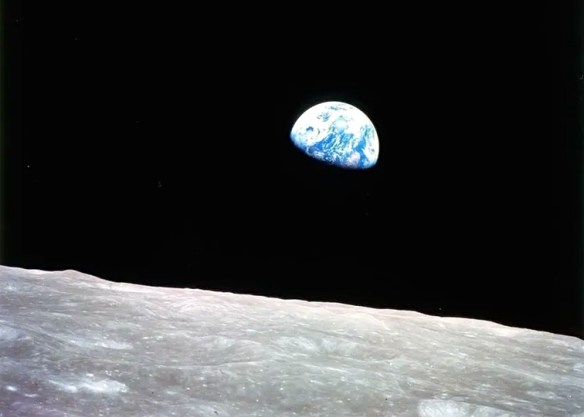
Manuel García, Jr.’s Worldview, 2020

<><><><><><><><><><><><><><><><><><><><><><><><><><><><><><><><>

Manuel García, Jr.’s Worldview, 2020

I am just over one-eighth of a billionth of humanity, and I think that the impact and value of my thoughts and ideas are about as significant. This year, 2020, I will be 70 years old, and I think that I have probably said everything original that I was capable of saying. I am sure that I will write more of my little essays, and put them out there, but they are more than likely to be repetitions and rehashes of what I have previously written. Right now I cannot imagine squeezing any new insights out of all the reading and studying (and living) I have done in physics, science, history, psychology, Buddhism, and literary fiction.

So, I have compiled a list of 20 of my essays (of recent years), which as a group I offer as representative of my “worldview,” as of 20 January 2020. I post that list here, “for the record,” and for the ‘benefit’ of people new to my web-pages. All of this represents my annual (in January) “state of the world” message.

I have no ego regarding my Internet publications; if they are useful and encouraging to you then great, if not then I think at least they have done no harm.

My plans are to continue absorbing things that interest me, learning as I can, and expressing myself as feels right and enjoyable. I am satisfied that at the very minimum I have improved just over one-eighth of a billionth of humanity.

~~~~~~~~~~~~~~~~~~~~~~~~~~~~~~~~~~~~~~~~~~~~~~~~~~~~~~~

Eight Categories, and Numbers of Articles in Each:

1 TRANSFORMING U.S. AND WORLD SOCIETIES (3)
2 CLIMATE CHANGE ACTION VERSUS CAPITALISM AND MILITARISM (4)
3 THE PHYSICAL REALITY OF GLOBAL WARMING (2)
4 WAR IS A CRIME, AND THE FOLLY OF WAR WITH IRAN (2)
5 POPULATION GROWTH + CLIMATE CHANGE + ENERGY USE (3)
6 CLIMATE CHANGE FACTS AT THE MOVIES (2)
7 THE TRUE PURPOSE OF A HUMAN LIFE (2)
8 HOW TO FACE THE FUTURE: ENJOY, AND BE KIND (2)

3+4+2+2+3+2+2+2=20

Article titles are within their respective web-links

~~~~~~~~~~~~~~~~~~~~~~~~~~~~~~~~~~~~~~~~~~~~~~~~~~~~~~~

TRANSFORMING U.S. AND WORLD SOCIETIES (1/3)
https://manuelgarciajr.com/2019/04/09/whats-wrong-with-the-united-states/

TRANSFORMING U.S. AND WORLD SOCIETIES (2/3)
https://manuelgarciajr.com/2018/10/16/the-inner-dimensions-of-socialist-revolution/

TRANSFORMING U.S. AND WORLD SOCIETIES (3/3)
https://manuelgarciajr.com/2019/05/13/too-many-people-or-too-much-greed/

~~~~~~~~~~~~~~~~~~~~~~~~~~~~~~~~~~~~~~~~~~~~~~~~~~~~~~~

CLIMATE CHANGE ACTION VERSUS CAPITALISM AND MILITARISM (1/4)
https://manuelgarciajr.com/2018/11/19/climate-change-action-would-kill-imperialism/

CLIMATE CHANGE ACTION VERSUS CAPITALISM AND MILITARISM (2/4)
https://manuelgarciajr.com/2017/09/09/climate-change-denial-is-murder/

CLIMATE CHANGE ACTION VERSUS CAPITALISM AND MILITARISM (3/4)
https://manuelgarciajr.com/2019/06/27/american-climate-change-policy-you-dont-matter/

CLIMATE CHANGE ACTION VERSUS CAPITALISM AND MILITARISM (4/4)
https://manuelgarciajr.com/2019/11/20/climate-change-is-a-war-crime/

~~~~~~~~~~~~~~~~~~~~~~~~~~~~~~~~~~~~~~~~~~~~~~~~~~~~~~~

THE PHYSICAL REALITY OF GLOBAL WARMING (1/2)
https://manuelgarciajr.com/2019/07/15/ye-cannot-swerve-me-moby-dick-and-climate-change/

THE PHYSICAL REALITY OF GLOBAL WARMING (2/2)
https://manuelgarciajr.com/2019/12/20/co2-and-climate-change-old-and-new/

~~~~~~~~~~~~~~~~~~~~~~~~~~~~~~~~~~~~~~~~~~~~~~~~~~~~~~~

WAR IS A CRIME, AND THE FOLLY OF WAR WITH IRAN (1/2)
https://manuelgarciajr.com/2020/01/05/war-the-unending-theft/

WAR IS A CRIME, AND THE FOLLY OF WAR WITH IRAN (2/2)
https://manuelgarciajr.com/2020/01/05/attacking-iran-will-save-the-world-redux/

~~~~~~~~~~~~~~~~~~~~~~~~~~~~~~~~~~~~~~~~~~~~~~~~~~~~~~~

POPULATION GROWTH + CLIMATE CHANGE + ENERGY USE (1/3)
https://manuelgarciajr.com/2019/06/02/our-globally-warming-civilization/

POPULATION GROWTH + CLIMATE CHANGE + ENERGY USE (2/3)
https://manuelgarciajr.com/2019/06/09/oil-population-temperature-what-causes-what/

POPULATION GROWTH + CLIMATE CHANGE + ENERGY USE (3/3)
https://manuelgarciajr.com/2019/06/09/linking-energy-use-and-human-development/

~~~~~~~~~~~~~~~~~~~~~~~~~~~~~~~~~~~~~~~~~~~~~~~~~~~~~~~

CLIMATE CHANGE FACTS AT THE MOVIES (1/2)
https://manuelgarciajr.com/2019/12/12/climate-from-catastrophe-to-cataclysm/

CLIMATE CHANGE FACTS AT THE MOVIES (2/2)
https://manuelgarciajr.com/2019/12/31/climate-change-at-the-movies/

~~~~~~~~~~~~~~~~~~~~~~~~~~~~~~~~~~~~~~~~~~~~~~~~~~~~~~~

THE TRUE PURPOSE OF A HUMAN LIFE (1/2)
https://manuelgarciajr.com/2017/12/29/being-alive/

THE TRUE PURPOSE OF A HUMAN LIFE (2/2)
https://manuelgarciajr.com/2017/08/04/what-is-the-purpose-of-life/

~~~~~~~~~~~~~~~~~~~~~~~~~~~~~~~~~~~~~~~~~~~~~~~~~~~~~~~

HOW TO FACE THE FUTURE: ENJOY, AND BE KIND (1/2)
https://manuelgarciajr.com/2015/12/11/living-confidently-in-times-of-climate-change/

HOW TO FACE THE FUTURE: ENJOY, AND BE KIND (2/2)
https://manuelgarciajr.com/2017/05/04/what-can-i-do-about-climate-change/

~~~~~~~~~~~~~~~~~~~~~~~~~~~~~~~~~~~~~~~~~~~~~~~~~~~~~~~

War, the Unending Theft

<><><><><><><><><><><><><><><><><><><><><><><><><><><><><><><><>

The following is my response to an old friend about his fear and disgust with the new Iran War fever being stirred up by the Trump Administration.


Why Does War Exist?
https://manuelgarciajr.com/2017/09/05/why-does-war-exist/

Attacking Iran Will Save The World (redux)
5 January 2020 (26 March 2012)
https://manuelgarciajr.com/2020/01/05/attacking-iran-will-save-the-world-redux/


The war is “a great big noisy rather stupid game that doesn’t make any sense at all. None of us know what it’s all about or why. Here we are going at it hammer and tongs, and I bet you those fellows over there feel exactly the same way about it, the enemy… Then one day I suppose it will all end as suddenly as it began. We’ll go home till some other bunch of criminalated* sitting around a large table shoves us into another war and we go at it again… Do you remember my father used to be a professor of biology at Queen’s? He always used to say: man is a savage animal who periodically to relieve his nervous tension tries to destroy himself.”

— Errol Flynn’s monologue in the 1938 film “The Dawn Patrol.”
[* origin of word described at https://manuelgarciajr.com/2019/11/11/criminalated-warmongers/]


Iraq War protest SF 2003
https://manuelgarciajr.com/2016/04/10/iraq-war-protest-sf-2003/

An Iraq War Retrospective
https://manuelgarciajr.com/2012/01/05/an-iraq-war-retrospective/

Through My Lens, Clearly
https://manuelgarciajr.com/2019/08/11/through-my-lens-clearly/

What’s Wrong With The United States?
https://manuelgarciajr.com/2019/04/09/whats-wrong-with-the-united-states/

Civics 911
https://manuelgarciajr.com/2016/09/14/civics-911/

Heartrending Antiwar Songs
https://manuelgarciajr.com/2019/11/15/heartrending-antiwar-songs/


<><><><><><><>

A Measure of Societal Vitality

Figure 1, HDI vs. kWh/c, data points and statistical average,
linear plot, from 10 kWh/c to 29,247 kWh/c, (2002 data)

Figure 2, HDI vs. kWh/c, data points and statistical average,
logarithmic plot, from 10 kWh/c to 29,247 kWh/c, (2002 data)

<><><><><><><><><><><><><><><><><><><><><><><><><><><><><><><><>

A Measure of Societal Vitality

Following is my response to Robert Hunziker’s article “Kill GDP to Help Save the Planet,” published in Counterpunch on 2 January 2020. [1]

Robert Hunziker describes why the economic statistical measure known as GDP — Gross Domestic Product — is a deeply flawed indicator of the actual economic health and societal wellbeing of the United States, and really of any nation. As Hunziker notes, it is based purely on “the monetary value of all finished goods and services,” and as Joseph Stiglitz has shown (as pointed out by Hunziker): “The world is facing three existential crises: (1) a climate crisis, (2) an inequality crisis and (3) a crisis in democracy… Yet the accepted ways by which we measure economic performance gives absolutely no hint that we might be facing a problem.” I agree.

Is there a statistical measure that overcomes these objections? Yes: the Energy-HDI Efficiency Number. Explanation follows.

The United Nations uses an economic parameter called the Human Development Index (HDI) to characterize the typical standard of living of every nation. [2]

It is observed that affluent nations have high HDI scores (they range from 0 to 1) and a high use of electrical energy per year per capita (in kilowatt-hours/year/person the range is from 0 to 30,000), while poor nations have relatively low values for both quantities. In 2006, I made a study of the correlation of national HDI to the electrical energy use per capita, for 177 nations. [3]

The Human Development Index

The UN Human Development Index (HDI) is a comparative measure of poverty, literacy, education, life expectancy, childbirth, and other factors for countries worldwide. It is a standard means of measuring well-being, especially child welfare.

The index was developed in 1990 by the Pakistani economist Mahbub ul Haq, and has been used since 1993 by the United Nations Development Programme in its annual report.

The HDI measures the average achievements in a country in three basic dimensions of human development:

1. A long and healthy life, as measured by life expectancy at birth.

2. Knowledge, as measured by the adult literacy rate (with two-thirds weight) and the combined primary, secondary, and tertiary gross enrolment ratio (with one-third weight).

3. A decent standard of living, as measured by gross domestic product (GDP) per capita at purchasing power parity (PPP) in USD.

Each year, UN member states are listed and ranked according to these measures. Those high on the list often advertise it, as a means of attracting talented immigrants (economically, individual capital) or discouraging emigration.

The Human Development Index is the average of three indices: the Life Expectancy Index (LEI), the Education Index (EI) and the GDP Index (GDPI).

The Education Index is itself a weighted sum of: the Adult Literacy Index (ALI, weight = 2/3) and the Gross Enrollment Index (GEI, weight = 1/3).

All of these measures have minimum and maximum values, which appear in the differences and normalizations used to construct the three major indices. The formulas are as follows:

LEI = (LE – 25)/(85 -25),
LE = life expectancy in years;

EI = (2/3)*ALI + (1/3)*GEI;

ALI = (ALR – 0)/(100 – 0),
ALR = adult literacy rate;

GEI = (CGER – 0)/(100 – 0),
CGER = combined gross enrolment ratio;

GDPI = [log(GDPpc) – log(100)]/[log(40000) – log(100)],
GDPpc = GDP per capita at PPP in USD;

HDI = [LEI + EI + GDPI]/3.

The Human Development Index is a measure that helps to capture the overall socio-economic health of a country, and a measure that allows for useful comparisons whether by international bodies like the UN or concerned individuals.

Linking Energy Use And Human Development

It is evident that a higher standard of living, as indicated by HDI, will obtain when a greater quantity of electrical energy per capita (kWh/c/yr) is available. Yet, in 2002 Ireland expended 6560 kWh/c/yr to provide its people with an HDI of 0.946, ranking 8th in the world; while Saudi Arabia expended 6620 kWh/c/yr (essentially the same as Ireland) to only provide its people — on average — with an HDI of 0.772, ranking 77th in the world.

It is obvious that Ireland made much more efficient use of the energy it expended in order to support the wellbeing of its people. That wellbeing must necessarily include caring for the natural environment within which the national population lives. The statistical measure that I propose for indicating the degree to which a nation’s energy consumption provides for a healthy society is the Energy-HDI Efficiency Number. In 2002, Ireland’s Energy-HDI Efficiency Number was +21 (the world leader), while Saudi Arabia’s was -50, ranking at best 38th in the world (in 2002, the year of the HDI data available for my 2006 study).

In 2002, the U.S.A. expended 13,456 kWh/c/yr to provide its people with an HDI of 0.944, ranking 10th in the world, with an Energy-HDI efficiency number of -1, a level of overall performance behind 21 other nations despite having the 9th highest per capita energy expenditure.

What makes for Energy-HDI efficiency?: low GDP waste on a military establishment, an arms industry, and unproductive government subsidies as with underwriting Wall Street bankster gambling losses; wide use of energy efficient equipment, methods and attitudes; minimal income and wealth inequality; robust national social welfare programs; and diligent stewardship of a healthy natural environment, which naturally contributes to healthy human longevity. [4]

Some nations do a great deal with very little, like Cuba, with an HDI of 0.817 and an HDI rank of 52 out of 177 with an expenditure of only 1395 kWh/c/yr (in 2002). In my study I found that, statistically, a nation would have had to use 2425 kWh/c/yr in order to provide an HDI of 0.817. It is as if Cuba had generated its social benefits with only 57.5% of the electrical energy one would expect. [3]

Societal Vitality

Regardless of what anyone says, all national economies are exercises in intentional social engineering, and as such their features and their degrees of success at providing popular wellbeing can be characterized numerically. GDP alone is a poor indicator of societal health and vigor, but HDI and the Energy-HDI Efficiency Number are much better indicators of societal vitality.

The value of any such indicator, like the temperature shown on an air thermometer outside your window, and the speedometer in your automobile, is to apprise you quantitatively of your current reality so that you can then go and do something intelligent and useful in dealing with it. That is what we have to do about the societal vitality of our national economies and the natural environments they reside within: characterize their overall performances truthfully, and then fix them.

Notes

[1] Kill GDP to Help Save the Planet
Robert Hunziker
https://www.counterpunch.org/2020/01/02/kill-gdp-to-help-save-the-planet/

[2] Human Development Index
http://en.wikipedia.org/wiki/Human_Development_Index

[3] An Introduction Linking Energy Use And Human Development
28 April 2006
https://manuelgarciajr.com/2019/06/09/linking-energy-use-and-human-development/

[4] TABLE: Country Ranking by Energy-HDI Efficiency Number
9 June 2019
https://manuelgarciajr.com/wp-content/uploads/2019/06/table-a.jpg
AND
https://manuelgarciajr.com/wp-content/uploads/2019/06/table-b.jpg

<><><><><><><>

Climate Change at the Movies

Here are some movies and videos about climate change and human society, which I found interesting and recommend.

I think you all would enjoy the short movie, “Mazz Alone,” by Ken Avidor. This fictional story is about a man’s survival through an abrupt climate change of runaway heating. The style of presentation is a slideshow (a sequence of still images) each drawn and colored by the filmmaker, and with a running narration of the plot. It is a clever 23-and-a-half minute production that is both factually rich, entertaining, and thought-provoking. It is easy enough to image a big-budget Hollywood version of this movie, but Ken Avidor has already produced the essential work, so there’s really no need for wasting a big carbon footprint for a Hollywood extravaganza on this story.

Mazz Alone
[23:35]
https://vimeo.com/319602435

A movie I thought was really clever as regards the whole overpopulation/climate change conundrum was “Downsizing.” This film is the product of the fertile imaginations of Alexander Payne and Jim Taylor (and directed by Payne). “Downsizing” is a social satire with extravagant special effects, but as it was a very subtle and – by American standards – an intellectual movie, it lost money ($65+M invested, $58M take). The comic book mentality of sci-fi movie viewers did not appreciate the insufficiency of whiz-bang action, and the “boring” slide into explorations of human emotions and struggles with adaptation to extinction-avoidance. To my mind the last scene of this movie is a very powerful and poignant expression of what I think is the essential truth about personally dealing with extinction/climate change — and life in general — should be: be good to the ones you love, and expand on that as you are willing. I suspect any decent Hollywood movie these days has to be a failure.

Downsizing (2017) – Official Trailer – Paramount Pictures
[2:31]
https://youtu.be/UCrBICYM0yM

Here are a few more, but all of the following are documentaries, not fictional-plot entertainment as are “Mazz Alone” and “Downsizing.”

The Age of Stupid” is a marvelous and ahead-of-its-time (for a behind-the-times-and-unaware-of-reality mass consciousness) documentary from 2009 (made during 2005 to 2009, the years of the second G. W. Bush Administration). It presents itself as a “look back” from 2055 at the stupid lack of recognition and action by the people of 2005-2009 to the climate catastrophe that was soon to engulf them. A wonderfully factual and nicely paced film, deliciously critical of the NIMBY attitude toward wind-power and by extension green energy efforts generally, and British, so it has that patina of accessible sophistication that American audiences love about their imported PBS shows. Because of societal inertia “The Age of Stupid” has not aged (we’ve done nothing about climate change; just ask Greta), but even so a 10 year retrospective was produced by The Guardian newspaper, and it too is interesting.

The Age of Stupid
2009
[1:28:44]
https://youtu.be/awVbLg59tR8

The Age of Stupid revisited: what’s changed on climate change?
15 March 2019
[11:04]
https://youtu.be/GqHKYwxEIRA

A succinct and yet richly detailed summary of “where we are today” on climate change trends, and why COP25, like all such meetings, was a failure was very recently given by Dr. Peter Carter. This “movie” is really an interview that is nearly a monologue (which is a good thing). This has no plot and is not entertainment like a feature film, but it complements “The Age of Stupid” perfectly. This is one of those less-than-half-hour films that should be widely viewed and thought about, but, you know: sports fans and sci-fi fans couldn’t even begin to process it with its lack of comic book plot, explosions, and eye-popping CGI special effects. Human extinction is just boring.

Dr Peter Carter: summarising the lack of “climate emergency” at #COP25
[23:11]
10 December 2019
https://youtu.be/oa13KrOvE2s

For me, one of the most important videos I saw in 2019 was the presentation by Dr. Scott Wing on the scientific investigation of the global warming that occurred 56 million years ago, at the Paleocene-Eocene temporal boundary. I know this video would bore most people to tears — how unfortunately! — but it is the most wonderful and clear presentation of just exactly what happens on Earth when the global temperature (driven by massive CO2 injection) moves up 4°C, or 8°C, or more beyond today’s level. To make the information in this video more palatable to a wider audience, I made the effort to analyze this video in detail and “transcribe” its many detailed facts into my article “Ye Cannot Swerve Me: Moby-Dick and Climate Change,” which became my biggest “research paper” of the year. I think that if you are patient and watch Dr. Scott Wing’s entire presentation, you will be thoughtfully satisfied.

Global Warming 56 Million Years Ago, and What it Means For Us
30 January 2014
Dr. Scott Wing, Curator of Fossil Plants,
Smithsonian Museum of Natural History
Washington, DC
[1:44:12]
https://youtu.be/81Zb0pJa3Hg

Ye Cannot Swerve Me: Moby-Dick and Climate Change
15 July 2019
[text to accompany the above video]
https://manuelgarciajr.com/2019/07/15/ye-cannot-swerve-me-moby-dick-and-climate-change/

Finally, a “fast food” or “quickie” complement to Dr. Scott Wing’s video-recorded presentation on the Paleocene-Eocene Thermal Maximum (PETM) is the following 11 minute video produced for PBS. Enjoy it, certainly, but don’t take it as an adequate substitute to the real thing, above.

The Last Time The Globe Warmed (PETM)
PBS Eons [10:53]
4 December 2017
https://youtu.be/ldLBoErAhz4

I have not included sci-fi disaster-action-drama movies like “The Day After Tomorrow” here, because I don’t see them offering any useful thoughts about actual climate change (and population growth). Their entertainment takes you away from thinking, not into it.

Maybe some filmmaker will succeed next year, or later, in producing a Hollywood-style climate change urgency/doom movie that combines the factually-rich and dramatic narrative punch for Ken Avidor’s art film “Mazz Alone,” with the screen-writing polish and high production values of “Downsizing.” But, this may be as likely as our governments actually addressing climate change as the monumental emergency it really is.

<><><><><><><>

CO2 and Climate Change, Old and New

<><><><><><><><><><><><><><><><><><><><><><><><><><><><><><><><>

CO2 and Climate Change, Old and New

How long has science known about CO2-induced climate change, and are we clever enough today to geo-engineer our way out of cooking ourselves to extinction?

In brief: a long time, and most likely no.

Clive Thompson has written engagingly about the 19th century scientists — Joseph Fourier (1768-1830), Eunice Newton Foote (1819-1888), John Tyndall (1820-1893), Svante Arrhenius (1859-1927), Arvid Högbom (1857-1940), and Samuel Pierpont Langley (1834-1906) — whose work in aggregate pieced together the essential facts about CO2-induced global warming. [1]

In 1856 Eunice Newton Foote, an American woman, suffragette and amateur scientist, conducted the first known experiment in CO2-induced climate change science, which proved carbon dioxide and water vapor were radiant-heat trapping and retaining gases, and not thermally transparent as generally believed. In the scientific paper she submitted to the American Association for the Advancement of Science (which had to be presented by a man) she prophetically observed: “An atmosphere of that gas would give to our earth a high temperature.”

Between 1859 and 1860 Irish physicist John Tyndall conducted many elaborate experiments that confirmed Eunice Newton Foote’s results with great precision (without acknowledging her, whether intentionally or out of ignorance is unknown). He found that CO2 could trap 1,000 times as much heat (infrared radiation) as dry air.

In 1896, after an arduous yearlong effort, Swedish scientist Svante Arrhenius created the first model of CO2-induced climate change, aided theoretically by geologist Arvid Högbom’s findings on the carbon cycle, and aided experimentally by Samuel Pierpont Langley’s thermal detector invention.

Quoting from Clive Thompson’s article:

When [Arrhenius] was done, he made a striking prediction: If you doubled the amount of CO2 in the atmosphere, it would raise the world’s temperature by 5 to 6 degrees Celsius. Remarkably, that analysis holds up pretty well today, even in an age where climate analysis involves far more information and variables and are crunched by cloud supercomputers. Despite having done his work by hand, using data that even he regarded as woefully inadequate, Arrhenius reached “a conclusion that millions of dollars worth of research over the ensuing century hardly changed at all,” as Isabel Hilton wrote in 2008. The era of modern climate modeling was born. …[Arrhenius] expected it would take 3,000 years — fully 30 centuries — for CO2 levels in the atmosphere to rise by 50%. Instead, [they] shot up by 30% in only one century.

In the century since Arrhenius (the 20th century), the scientific awareness of CO2-induced global warming skipped along to Guy Stewart Callendar in 1938, Hans Seuss in 1955, Roger Revelle in 1957, the computational three-dimensional Global Climate Model by Syukuro Manabe and Richard T. Wetherald in 1975 (where doubling CO2 in the model’s atmosphere gave a roughly 2°C rise in global temperature), and then to James E. Hansen’s striking Congressional testimony in 1988 that changes in the atmosphere due to human pollution “represent a major threat to international security and are already having harmful consequences over many parts of the globe.” [2]

The Intergovernmental Panel on Climate Change (IPCC) of the United Nations was established in 1988, and since then we have all known or denied the truth of the matter, to variously fret gloomily or agitate frantically over it, and to governmentally ignore responding usefully to it.

Well, our food, wealth, comfort, entertainment and daydreams are all disgorged (or destroyed if you’re among the sacrificed) by fossil-fueled capitalism, so cook ourselves we must because we can’t bring ourselves to trim any of those economically fungible desirables. Can our clever technologists geo-engineer an atmospheric CO2 retrieval and sequestration technique? Today, many such ideas are being proposed and explored experimentally, which their promoters hope if developed successfully into patented salvations will shower them ceaselessly with torrents of gold.

One such project that has shown technical feasibility is the Carbfix Project in Iceland, where CO2 gas is mixed into and retained by a large quantity of water (salt or fresh) that is then injected under pressure deep underground (800 to 2000 meters) into formations of vesicular or porous basalt rock. Basalt is a mafic extrusive igneous rock formed from the rapid cooling of magnesium-rich and iron-rich lava exposed at or very near the surface of a terrestrial planet or a moon; for example at spreading centers between tectonic plates. Iceland sits athwart the Mid-Atlantic Spreading Center and is an island mountain of volcanic and geothermal activity. The Carbfix scientists and engineers have demonstrated the petrification of aqueous CO2 into carbonate rock nodules within basalt vesicles (pores). Basalt does not wash away under pressurized aqueous injection, as softer sedimentary rocks do, and the metals in basalt are needed to react with the carbonated water (ideally the CO2-water mixture having been pushed entirely into carbonic acid) to petrify it. [3]

The pumping of CO2 into deep basalt formations, for petrified sequestration, has been known scientifically since 1976 (first proposed by Italian physicist Cesare Marchetti) [4], [5]. In 2012, as a satirical hypothetical example of fossil-fueled fanaticism, I proposed that the United States capture all the CO2 released by burning the expected liquid fuel to be processed out of the Athabasca Oil Sands of Alberta, Canada (to be imported to the U.S. via the proposed Keystone Pipeline), by piping that CO2 300 kilometers (186 miles) west of the Oregon coast into the Pacific Ocean and then under extreme pressure down 2,700 meters (8,900 feet) into the basalt formations of the Juan de Fuca tectonic plate. [6]

The difficulty with any carbon sequestration technique is demonstrating that it has a positive Energy Return On Energy Invested (EROEI).

Basically, is the amount of energy expended per unit mass of CO2 sequestered (the energy to capture, store, transport, pump and contain the CO2 underground) LESS THAN the energy liberated (with perhaps only 30% of it converted to useful work — mechanical/electrical energy/power/torque) from the combustion of whatever amount of fossil fuel produces that same unit mass of CO2?

If not (which has always been the case so far) then it is MORE EFFICIENT, and LESS CO2 releasing to- and accumulating in- the atmosphere, to not burn the fossil fuel in the first place. Consequently, it would be unnecessary to bother with the proposed geo-engineering scheme of CO2 retrieval and sequestration.

But even if such a sequestration scheme has a negative EROEI, wouldn’t it at least slow the overall rate of CO2 emissions from our fossil-fueled civilization?, and so slow the ever-increasing rate of global warming?

A better investment of the energy required for negative EROEI sequestration schemes would be to apply that fossil fuel-derived energy to the construction of reliable (well-known, old in concept advanced in construction) robust for the long-term ‘green’ energy technologies that REPLACE (not add to) an equivalent capacity (in Watts) of existing fossil-fueled power-generating and power-using infrastructure: a fossil-fueled conversion to a green energy future. This in fact is the only realistic and practical Green New Deal (GND) that we could have. We are locked into cooking ourselves disastrously but we could do it at a slower rate — and that is what a real GND would be.

To my mind the fact that terrible climatic things are unavoidably scheduled to happen does not mean that we — humanity — are physically helpless to prevent the worst of all possible fates, by vigorously responding with intelligent and cooperative social adaptations (lifestyle simplification and energy efficiency) and clever engineering for an ongoing and permanent transition from fossil fuels to green energy.

The state of the natural world is a mirror to our civilization in the same way that Dorian Gray’s poisonously false beauty was reflected by his hideously magical portrait picture.

Thanks to Katje Erickson for pointing me to items [1] and [3].

Notes

[1] How 19th Century Scientists Predicted Global Warming
by Clive Thompson
(Today’s headlines make climate change seem like a recent discovery. But Eunice Newton Foote and others have been piecing it together for centuries.)
17 December 2019
https://daily.jstor.org/how-19th-century-scientists-predicted-global-warming/

[2] Climate Change Denial is Murder
https://manuelgarciajr.com/2017/09/09/climate-change-denial-is-murder/

[3] Researchers In Iceland Can Turn CO2 Into Rock. Could It Solve The Climate Crisis?
by Robin Young and Karyn Miller-Medzon
10 December 2019
https://www.wbur.org/hereandnow/2019/12/10/iceland-climate-change-carbon

[4] Carbon sequestration
https://en.wikipedia.org/wiki/Carbon_sequestration

[5] Ocean storage of carbon dioxide
https://en.wikipedia.org/wiki/Ocean_storage_of_carbon_dioxide

[6] Energy for Society in Balance with Nature
https://manuelgarciajr.com/2015/06/08/energy-for-society-in-balance-with-nature/

<><><><><><><>

Why celebrate Greta Thunberg?

“So, why should we celebrate Greta Thunberg being named Time Magazine’s person of the year?”

Because she’s young (thus having a greater claim to “the future”), committed, absolutely correct about climate change, witheringly clear, endearingly free of emotionalism and self-promotion, and more effective at public advocacy and consciousness-raising about the need for profound and immediate socio-economic transformation than anyone else on the planet. How she did this is immaterial but the fact is it’s done and she’s using it to maximum advantage for her (and our?) cause. She’s on the cover of Time Magazine for the same reason Obama wanted to shake her hand, TV hosts want her on their shows, and UN conferences invite her to speak: because they all want to attach themselves to her authenticity to make up for the deficiencies of their own. Many people high, low, right, left and center are envious of her, and that envy merely illuminates the extent of their bullshit.

<><><><><><><>

Climate, from Catastrophe to Cataclysm

Australian wildfire, 2019
Image from Near Term Human Extinction Evidence Group

Image from Near Term Human Extinction Evidence Group

<><><><><><><><><><><><><><><><><><><><><><><><><><><><><><><><>

Climate, from Catastrophe to Cataclysm

Please watch the 23 minute video, linked below, to completion. It shows an interview of Dr. Peter Carter (Director Climate Emergency Institute, IPCC expert reviewer, Co-author in 2018 of Unprecedented Crime: Climate Science Denial and Game Changers for Survival). This interview was conducted at COP25 (“this is set up to fail”) currently underway in Madrid, Spain, on 10 December 2019.

Peter Carter gives a vividly clear, trenchantly concise summary of the state of Earth’s climate; the increasing acceleration of all the phenomena that drive global warming climate change (carbon dioxide, methane and nitrous oxide emissions); the obdurate denial of the climate emergency, and the opposition to any action in response to it by the high carbon-emitting fossil fuel-loving nations: the United States, Russia, Kuwait and Saudi Arabia, at the very least. I would venture to guess that Australia, under its current reactionary Morrison Administration, would also join the objecting ‘carbonaholics’ despite it currently experiencing a mega-drought with massive and uncontrolled wildfires.

The average global temperature today is just under 1.4°C above its level during the years 1951 to 1980 (the baseline). The level in year 1000 coincided with the baseline. Between 1000 and the baseline years the temperature dipped to an average low 0.5°C below baseline, which extended from 1500 to 1800. All temperature fluctuations during the 800 years between 1000 and 1800 were well less than 0.5°C (plus or minus). Average global temperature has risen since 1980 at an average rate of 0.5°C every 14 years. Climate science has identified 1.5°C above baseline as the threshold between catastrophe to cataclysm; the threshold of 2°C above baseline, much publicized for over a decade as the “safe limit,” is actually over the redline of our climate change tachometer: “blown engine,” biosphere collapse.

The global carbon dioxide (CO2) level was between 275ppm and 285ppm (ppm = parts per million, 1 ppm is equivalent to 0.0001% by volume) between years 1000 and 1800. By 1900 it was 300ppm, rising increasingly rapidly since. Today’s CO2 concentration in the atmosphere is 415ppm, a level that last occurred 3 million years ago.

The global methane (CH4) level was between 650ppb and 700ppb (ppb = parts per billion) between years 1000 and 1750. The methane level has risen at an increasing rate since: from 700ppb in 1750 to 850ppb in 1900; and then zooming to over 1850ppb today. Methane is 86 times more potent a greenhouse gas than carbon dioxide. Peter Carter describes the massive explosion of methane emission that is occurring right now around Point Barrow, Alaska.

The global nitrous oxide (N2O) level was between 264ppb and 274ppb between years 1000 and 1880. Thereafter it zoomed at an increasing rate to 332ppb today.

Considering the mean sea level to have been at a baseline elevation in 1900 (which also coincided with its elevation in 1150, 1300, 1450 and 1800) its fluctuations about baseline between years 1000 and 1900 were limited to 8 centimeters (3.2 inches) above, and 3 centimeters (1.2 inches) below. Since 1900 the elevation of mean sea level has increased to almost 22 centimeters (8.7 inches) above baseline today; a steady average rate-of-rise of almost 2 centimeters per decade since the beginning of the 20th century.

Again, please watch the video to hear Dr. Peter Carter’s very important, concise and pungent summary of where our world is today regarding its climate change emergency: stepping out blindly from catastrophe into cataclysm.

Dr Peter Carter: summarising the lack of “climate emergency” at #COP25
[23:11]
10 December 2019
https://youtu.be/oa13KrOvE2s

Note

The numerical values given for CO2, CH4, N2O concentrations, and changes in global temperature and mean-sea-level, were read from charts published by the 2 Degrees Institute.

<><><><><><><>

From Caesar’s Last Breath To Ours

After the career: books donated in 2019.

<><><><><><><><><><><><><><><><><><><><><><><><><><><><><><><><>

From Caesar’s Last Breath To Ours

Human Life is a sexually transmitted planetary disease, Climate Change is the disinfectant that will cure it. (I’ll explain myself on this later.)

Sam Kean’s concluding 5 paragraphs, on CO2 in the atmosphere, from his book Caesar’s Last Breath (And Other True Tales of History, Science, and the Sextillions of Molecules in the Air Around Us, 2017, Back Bay Books, Little Brown & Co) are interesting, being a series of statements of long-known physical quantities. Since I studied “gas physics” for my graduate studies (in the 1970s), and I developed an interest in climate change at least by 2004 (when I published my first article on climate change), I’ve known the basic facts Kean commented on for quite some time.

In one of my technical books on gas physics (Introduction to Physical Gas Dynamics, by Walter G. Vincenti and Charles H. Kruger, 1965, John Wiley & Sons, NY) an example is given in which the authors illustrate the physical phenomena of gaseous diffusion by showing that the last breath expelled by Julius Caeser will have taken years to fully disperse in a homogenous manner throughout the earth’s atmosphere, and so each person ‘today’ would likely breath in, on average, 5 molecules of that last breath. One amazing feature of the example is that it shows just how many molecules there are in each cubic meter of air (at sea level and ‘normal’ temperature), 2.69×10^25 per meter^3 = 2.69×10^19 per cm^3. Vincenti and Kruger quote the following from James Jeans’ 1940 book An Introduction to the Kinetic Theory of Gases (Cambridge University Press):

“…, a man is known to breath out about 400 c.c. of air at each breath, so that a single breath of air must contain about 10^22 molecules. The whole atmosphere of the earth consists of about 10^44 molecules. Thus one molecule bears the same relation to a breath of air as the latter does to the whole atmosphere of the earth. If we assume that the last breath of, say, Julius Caesar has by now become thoroughly scattered through the atmosphere, then the chances are that each of us inhales one molecule of it with every breath we take. A man’s lungs hold about 2000 c.c. of air, so that the chances are that in the lungs of each of us there are about five molecules from the last breath of Julius Caesar.”

The average spacing between air molecules (at sea level, or “standard temperature and pressure” = STP) is about 3.3×10^-7 centimeters. Since air molecules travel at an average speed of 5×10^4 centimeters/second (at STP), and each such molecule travels an average distance of 6×10^-6 centimeters before colliding into another molecule (obviously whizzing by many others between collisions), the frequency of collisions per molecule is about 10^10 collisions/second, or about 10 collisions per nanosecond.

Each such collision will deflect the colliding molecules into new directions of travel, so it can take them a very long time to actually transport from Point A to Point B separated by global distances. One number bandied about by commentators on climate change (who at least halfway know what they’re talking about) is that it takes “30 years” for local CO2 emissions to begin having a “global effect” as part of global warming. This is basically the timescale of atmospheric homogenization by diffusion of the locally emitted plumes, because of course the individual CO2 molecules of such plumes are quite ready to absorb infrared radiation, and lose it as heat released to other air molecules during collisions (the actual mechanics of global warming) from the instant those CO2 molecules are formed.

A different indicator of atmospheric trace gas homogenization is that a uniform (independent of geographical location) quantity per unit mass of radioactive fallout absorption/take-up by trees was first measured (recently, from tree corings) to have occurred in late 1965. Radioactive fallout was first created in 1945, and the greatest number of atmospheric (and any) nuclear explosions, by far, occurred in 1962. Some geologists have now proposed labeling the beginning of the Anthropocene from late 1965, and calling that year the end of the Holocene (which is/was the current geological epoch, which began with the last glacial period/retreat approximately 11,650 years ago). “Anthropocene” because it is the first epoch in which human activity (anthropo) has a global geophysical impact; such impacts being worldwide nuclear fallout (as in the 1957 book and 1959 movie On The Beach), and anthropogenic CO2/greenhouse gas-driven global warming.

When I first wrote about global warming/climate change, it was out of this perspective as a gas physicist trying to explain the technical details to a lay audience. I soon learned that the audience was not only laying, but snoring. I was trying to prod “people” into action to forestall climate change by “greening” energy technology, since I was also an engineer focused on “energy” and “efficiency.” Plus I was hoping a huge public shift in this direction would open up some nice ($$$) job opportunities for me. But the snoozing audience just wants consumerism at the lowest common denominator level, and the Big Bosses just want bombs (and money for themselves). So no sweet high-tech green-physics job for me, but more firepower for the ‘criminalated’ psychopaths who are our guiding self-worshipping self-imagined Olympians, more gargantuan Black Friday tsunamis of electro-plastic garbage consumerism for the ‘amnesiatariat,’ and as a result giga-tons more carbonation of the atmosphere and acidification of the seas, and less viability for our planet with its growing human population.

Since “the human element” (mental inertia, ego, tribalism) always controls and limits the actualization of any technical enterprise by a group of people — like greening away from fossil fuels — it was quickly obvious to me that though most “solar energy” technologies were ancient and well-understood “we” were not going to give up fossil fuel convenience, wealth-generation and enablement-of-political-power in favor of green energy, and so consequently global warming could only increase. And it has, and will. So I write about climate change “for the art of it” and for personal satisfaction, in particular to put my views “on the record” for my children. But I can only fantasize, without belief, that such writing will have any practical political effect — of course I’d like it to, but I’m a realist. Happily, it’s always nice to hear every now and then from someone who already agrees with my views, that something I’ve written has given them some encouragement.

And that is where the arc of my climate change consciousness — from the science to our society — has brought me to today: human connection. Given that fossil fueled humanity is intransigent, and now the advance of climate change is implacable (“tipping points”), I see the best focus for most people’s limited energies beyond their immediate survival and family needs to be the developing of a consciousness of climate change and political reality, and a commitment to acting toward others at a minimum with benign neutrality and better yet with compassion, honesty and solidarity, so human society is generally improved and economically more leveled, regardless of the geophysical conditions under which it exists at any given time. For a society that is as deeply humane as I’ve suggested (and vastly different than today’s) then if and when we really do enter a rapidly accelerating “end time” our individual exits would be as decently humane as possible because they would be occurring within a societal death-with-dignity of a society of broad solidarity. I suppose this is kind of glum thinking, but maybe that’s an inevitable result of my growing ‘old’ in these times.

All this has been a rather prolix introduction to a video about climate change I thought you might enjoy. The Age Of Stupid is a 90 minute British documentary from 2009 (five years in the making) that remains brilliantly cogent about the “human element” driving the climate change geophysics, and is also refreshingly accurate about the physical details of that geophysics. [1] The Age Of Stupid Revisited is a 15 minute look back on the original documentary, from today. [2] Nothing has changed for the better; for the worse yes. Reflecting on this documentary, on the arc of my climate change consciousness, and on my belief (which I wish future reality would contradict) that there will never be any significant collective action to stop anthropo-exacerbation of climate change, and to also end poverty and to economically level national and world societies, I arrived at the rather tart characterization that: human life is a sexually transmitted planetary disease, and climate change is the disinfectant that will cure it.

Notes

[1] The Age of Stupid
2009
https://youtu.be/awVbLg59tR8

[2] The Age of Stupid revisited: what’s changed on climate change?
15 March 2019
https://youtu.be/GqHKYwxEIRA

<><><><><><><>

What Should You Do About Climate Change?

<><><><><><><><><><><><><><><><><><><><><><><><><><><><><><><><>

Earth’s climate is changing before our eyes, and at a faster rate than given by all previous scientific predictions. The melting of glaciers and permafrost, and the methane burping from tundras and the Arctic Sea; the enhanced power of hurricanes, rain and snow storms, and floods; the swelling of the oceans and the creeping inundation of shorelines worldwide; the unrelenting severity of droughts and wild fires; the acidification of the oceans, die-off of corals and reduction of marine life; and the havoc all these geophysical phenomena play on food production and on the habitability of the many environments both humans and wildlife call home, are all startling clear to see.

The present form of our climate change is global warming, which is caused by the greenhouse gas emissions (carbon dioxide, carbon monoxide, methane, oxides of nitrogen, and volatile organic compounds), from our fossil-fueled economic activity, which is capitalist in either a “free market” or command economy format.

The only way to reduce the geophysical stimulation enhancing and accelerating global warming is to reduce and ideally halt the burning of fossil fuels. Humanity has not had the willpower to do this because it is from fossil fuels that we derive almost all of the power — and wealth — we use continually to each maintain our personal activity, and for us all to power our societies and civilization on every scale of their structures. While there are still people who live “off the grid” within the enchantment of nature as human wildlife, and who do not use fossil fuels at all, they are only a minority of Earth’s people. Humanity, 7.74B souls (25 November 2019) and growing by about 200,000 people a day (350,000 births, 150,000 deaths) burns fossil fuels to live.

The many poor and disadvantaged people around the world would like greater access to fossil fuels and electricity, which would allow them to increase their expenditure of external energy (exosomatic energy, outside their metabolism) in order to work themselves up from the drudgery and terror of surviving at a subsistence level, to safer more secure and comfortable modes of living. Many of the fortunate people experiencing relatively secure lives within the advanced highly developed economies of the First World would like greater access to, and cheaper prices for, exosomatic energy so as to extend the scope of their materialistic pleasures. Whether justified or unjustified, most people want more exosomatic power, and that demand drives the relentless expansion in the use of fossil fuels; and so global warming advances.

What should you do about climate change? There are as many answers to this question as there are commentators, critics, charlatans, careerists, environmentalists, philosophers, politicians, preachers, scientists, sages, saviors, speculators, know-it-alls and know-nothings with an axe to grind. The purpose of this essay is to whet your Occam’s Razor to slice through it all.

Consider the following Bayesian Statistics model problem, “Four Societies,” an abstraction of an extremely complex ‘what to do about climate change’ reality, to help organize our thoughts in hopes of eventually pointing to the correct actions we, individually, should take.

The purpose of Bayesian analysis is to logically select the best course of action from a set of available options, despite uncertainties about the probabilities of the outcomes that may occur, and where the decision-making process takes into account your own personal preferences regarding those outcomes. You can easily learn the mechanics of basic Bayesian analysis by looking up articles on the Prisoner’s Dilemma. Also, I give a patient explanation of decision-making using Bayesian statistics, with examples, at [1].

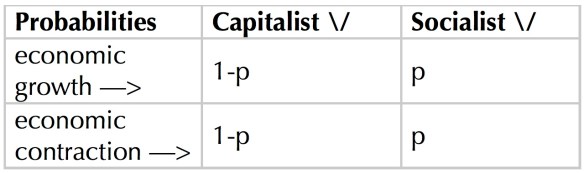
Four options for configuring our society are presented above (Bayesian outcomes), two capitalist and two socialist. For each of the capitalist and socialist formats there are two economic modes: politically unrestricted economic growth, and highly regulated and politically programmed economic contraction. Each is labeled somewhat fancifully to suggest its characteristics.

The “Billionaire Boys & Girls Club” (BB&GC) is the unrestricted capitalism of Ayn Randian dreams, and such dreamers as Milton Friedman, Alan Greenspan, Donald Trump, the Republican Party, and the many millions of people enthralled by their income-generating activities. These are people who see their life’s blood as issuing from their successful dog-eat-dog competition within a growing economy under capitalism.

The “Green New Deal,” (GND) as used here, is the idea of a 21st century interpretation of the Franklin Roosevelt Administration public works programs of the 1930s, and the military Keynesianism of the 1940s, to combine economic stimulation for the uplift of the bottom two-thirds of America’s standard-of-living pyramid, with a revolutionary revamping of American energy, housing, transportation, healthcare and social services infrastructure, that in sum total aggressively acts to minimize the further stimulation of global warming. The popular idea here is that America’s existential threat from climate change had its analog 80 years ago as the existential threat from the Great Depression and World War II, and that a Rooseveltian-style socialism now would be just as effective as it was then for overcoming the threat.

“Carbon Limited Capitalism” (CLC) is my term for the regulation and carbon-emission taxing of capitalism to significantly, if not entirely, eliminate its reliance on fossil fuels. Objectively, this would mean a contraction of economic activity for quite a while (perhaps forever) since green energy technology, though growing, is still too insufficient to supply the entire quantity of power consumed by our industrialized civilization — as we presently choose to wastefully conduct it.

“Enviro Co-op Simplification” (ECS) designates an intentional simplification of every aspect of American life so as to eliminate any reliance on fossil fuels. This format of American life would be centered on environmentalism, rather than gargantuan consumerism, and of necessity be a tightly interwoven network of cooperative associations and groupings — lots of socialism. It would be the “Certified Organic” model of American life and work, instead of our current ‘Fast Junk Glitz-o-tainment’ isolation-in-parallel format.

Each one of us will have preferences for or against residing in each of these four possible societies, and those preferences can be quantified on a purely subjective basis, as desirabilities D1, D2, D3 and D4, and assigned as follows.

A person primarily concerned with wealth accumulation might choose desirabilities as D1=100, D2=20, D3=10, D4=0.

A person primarily concerned with minimizing climate change and revitalizing Earth’s environments might choose desirabilities D1=0, D2=10, D3=20, D4=100.

There are as many possible sets of choices (D1, D2, D3, D4) as there are choosers. I will lead this presentation toward some general results, eventually.

What I (and you) — as the person in this model problem asking “what should I do about climate change?” — have to do is to decide: what am I going to commit myself to, both in my personal life and in any social and political activism I may engage in?

The two choices given here are for either economic growth or economic contraction.

What is unknown is whether our society will remain in its current capitalist format or transition into socialism because of the force of geophysical and sociological pressures. Let the quantity p designate the probability that socialism will arise in the historical near future in time to organize American society’s response to climate change. The quantity p is a number between 0 and 1. Thus, the probability that capitalism will remain the societal paradigm is the quantity (1-p).

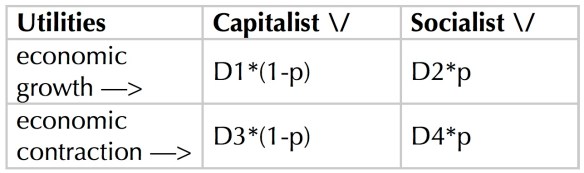
Given “my” desirabilities (D1, D2, D3, D4) for the four potential outcomes (BB&GC, GND, CLC, ECS), and the probability, p, of uncertain magnitude (between 0 and 1) for a socialist transformation, how would I nevertheless quantify my expectations — or utility values — regarding my two possible courses of action: committing to economic growth or committing to economic contraction? As follows.

Here, the symbol * designates multiplication.

Given my subjectively quantified desirabilities (D1, D2, D3, D4) for the four potential societal outcomes, along with the as yet unknown probability p for a near-term socialist transformation, the utility value or expectation (a quantification of my potential satisfaction or dissatisfaction) for committing to economic growth is

Eg = D1*(1-p) + D2*p.

Similarly, the utility value or expectation for committing to economic contraction is

Er = D3*(1-p) + D4*p.

While “I” can pick desirabilities out of my own subjective preferences, feelings and biases, I can only guess — or ‘guesstimate’ — at what p might be. So, making such a guesstimate, I can then actually calculate a numerical value for each of Eg and Er. Comparing these, I would then choose to act according to whichever expectation quantity had the higher value. This is Bayesian decision-making, you choose the action that is subjectively of higher value to you, given your estimate of the probabilities of the uncertainties.

For example, the wealth seeker whose desirabilities are D1=100, D2=20, D3=10, D4=0, and who estimates the likelihood of a socialist transformation at p=0.5 (50%), would have utility values of

Eg = 50 + 10 = 60.

Er = 5 + 0 = 5.

Obviously, this capitalist bull would choose to devote himself to economic growth.

Similarly, the “Earth First” environmentalist whose desirabilities were listed earlier as D1=0, D2=10, D3=20, D4=100, and who estimated the probability of a socialist transformation at p=0.5 would have utility values of

Eg = 0 + 5 = 5.

Er = 10 + 50 = 60.

Obviously this environmentalist would choose to devote herself to economic contraction.

But not everybody is so lopsided in their preferences. An individual pulled in different directions by the need to make a living and enjoy a bit of consumerism, a yearning for greater social solidarity, a concern about global warming, and who has few ideological rigidities might select desirabilities D1=3, D2=8, D3=2, D4=10.

For this mild liberal

Eg = 3*(1-p) + 8*p,

Er = 2*(1-p) + 10*p.

It turns out that for this individual Eg=Er when p=1/3 (33%).

So, for the probability of socialism, p, estimated at greater than 1/3, Er is greater that Eg; committing to economic contraction will have more personal value that committing to economic expansion.

Obversely, for the probability of socialism, p, estimated at less than 1/3, Eg is greater than Er; and committing to economic expansion will have more personal value than committing to economic contraction.

For this mild liberal individual, if they believe that socialism has a better than 33% chance of happening, they should commit to economic contraction, environmentalism and consequently socialism. If they believe that socialism has less than a 33% chance of occurring then they should commit to being an economic growth capitalist. All this is based on personal subjectivities that arise from the confrontation with the objective realities of this American’s life in a world of climate change, and an assumed probability of future political change.

How would you quantify your preferences and inclinations into a set of numbers D1, D2, D3, D4 and p, and then what would your utility values be for the two actions of: working for economic growth, or working for economic contraction? How much are you willing to give up in order to forestall climate change? It might take more than you imagine. [2]

Now, I’ll state some general results for this model problem, and spare you the mathematical details.

For the probability, p, of socialist transformation to be a positive number between 0 and 1 (where any real probability must be within), the desirabilities must satisfy the following conditions.

Both (D1-D3) and (D4-D2) are greater than 0, or both (D1-D3) and (D4-D2) are less than zero.

Given these conditions, the value of probability at which Eg is equal to Er is designated as q, and has the value

q = (D1-D3)/[(D1-D3)+(D4-D2)].

For p less than q, one of either Eg or Er will dominate; and for p greater than q that dominance will switch. The “mild liberal” example shown earlier exhibited all this.

Another general result is that individuals with positive (D1-D3) and (D4-D2) — or D1 greater than D3, and D4 greater than D2 — can be ideologically capitalist and not really concerned about climate change; wanting economic growth under capitalism to strengthen it, and economic contraction under socialism to weaken it.

Similarly, individuals with negative (D1-D3) and (D4-D2) — or D3 greater than D1, and D2 greater than D4 — can be ideologically socialist and not primarily concerned about climate change; wanting economic contraction under capitalism to weaken it, and economic expansion under socialism to strengthen it.

Individuals who only care about economic expansion without regard to either capitalist or socialist ideology, and obviously don’t care about climate change, will have D1 greater than D3, and D2 greater than D4. Their utility value for economic growth, Eg, is always dominant regardless of any numerical value of probability p (which is in fact irrelevant to them).

Similarly, individuals who only care about economic contraction — our deeply committed climate change-confronting environmentalists — will have D3 greater than D1, and D4 greater than D2. Their utility value for economic contraction, Er, is always dominant regardless of any numerical value of probability p (which is only of interest as a political indicator of a national shift to economic contraction).

Finally, for both totally committed economic expansionists and economic contractionists, those who are inclined to favor capitalist ideology will see a decrease in the happiness of their unwavering efforts as the probability, p, of the transformation to socialism increases; and conversely, those inclined to favor socialist ideology will see an increase in the happiness of their unwavering efforts as the probability, p, of the transformation to socialism increases.

Those of you who are charter members or committed aspirants of the Billionaire Boys & Girls Club, or the Enviro Co-op Simplification Movement have no need for this Bayesian analytical method of making the emotional decision of how to conduct your life in the presence of climate change. But for us “regular people” this kind of theoretical exercise can help clarify the mind on what one’s priorities and concerns really are, and how best to focus your limited energies in the face of uncertain political shifts in a world of advancing climate change. What are you and I willing to accept — and sacrifice — in order to forestall climate change? Bayesian analysis is one way to personally come to grips with that question.

My wish would be for a socialist Green New Deal that miraculously disappeared fossil fuel usage without a loss of the exosomatic energy we now enjoy — achieved by some combination of energy conservation and the use of renewable energy (solar, wind and gravity derived) — and that such a transformation of the energy technologies powering our society and civilization were accomplished without further greenhouse gas emissions. In other words, that the required rapid contraction of fossil fueled economies, to forestall climate change, was also simultaneously a societal transformation to a new highly equitable economic paradigm operating harmoniously within the limits of nature. But I know that is impossible. Even the best effort in that direction will necessarily be an approximation to the ideal that is deficient to some degree, perhaps significantly. Climate change may now be beyond the ability — and the willingness — of humanity to avert; the best we can likely do is to minimize our further exacerbation of it. [3], [4]

Personally, I think that Enviro Co-op Simplification Socialism could be alright if we all made an effort for it.

Notes

[1] Bayesian Bargains: Jail, Shopping, Debt, And Voting
MG,Jr., (30 January 2012)
http://www.swans.com/library/art18/mgarci39.html

[2] That Green Growth at the Heart of the Green New Deal? It’s Malignant
Stan Cox, (13 January 2019)
http://greensocialthought.org/content/green-growth-heart-green-new-deal-it%E2%80%99s-malignant

[3] End-of-life anxiety and finding meaning in a collapsing climate
Leonie Joubert (20 November 2019)
https://www.dailymaverick.co.za/article/2019-11-20-end-of-life-anxiety-and-finding-meaning-in-a-collapsing-climate/

[4] Choosing Dignity During Climapocalypse
MG,Jr., (26 May 2018)
https://manuelgarciajr.com/2018/05/26/choosing-dignity-during-climapocalypse/

<><><><><><><>