Book and Movie Reviews by MG,Jr. (2017-2020)

1 August 2020, was the 201st anniversary of the birth of Herman Melville. 2019 was my year to be totally immersed in Moby-Dick (for the third time), an awesome masterpiece. This is PERHAPS, the greatest novel yet written in the English language.

I’ve written previously on Melville and Moby-Dick here:

Happy 200th, Herman!
https://manuelgarciajr.com/2019/08/01/happy-200th-herman/

Moby-Dick
https://manuelgarciajr.com/2019/08/07/moby-dick/

Ye Cannot Swerve Me: Moby-Dick and Climate Change
https://manuelgarciajr.com/2019/07/15/ye-cannot-swerve-me-moby-dick-and-climate-change/

The Ultimate Great American Novel
https://manuelgarciajr.com/2018/09/04/the-ultimate-great-american-novel/

<><><><><><><>

W. Somerset Maugham’s “Ten Novels And Their Authors”

Maugham wrote a book of this title, describing his picks, ranked as shown below, His essays on each are excellent.

War and Peace (Tolstoy)
Madame Bovary (Gustave Flaubert)
Pride and Prejudice (Jane Austen)
The Brothers Karamazov (Dostoevsky)
Le Père Goriot (Honoré de Balzac)
Wuthering Heights (Emily Brontë)
Le Rouge et le Noir (The Red and The Black; Stendhal)
Tom Jones (Henry Fielding)
David Copperfield (Charles Dickens)
Moby-Dick (Herman Melville)

Read by MG,Jr (from Maugham’s list), so far:

Madame Bovary (Gustave Flaubert)
The Brothers Karamazov (Dostoevsky)
Le Père Goriot (Honoré de Balzac)
David Copperfield (Charles Dickens)
Moby-Dick (Herman Melville)

I like the following, as SOME of the other novels that I think are “classics”:

The Three Musketeers (Alexandre Dumas)
Huckleberry Finn (Mark Twain)
On The Road (Jack Kerouac)
Slaughterhouse Five (Kurt Vonnegut)

The Three Musketeers is described here:

My Favorite Classics
https://manuelgarciajr.com/2017/09/18/my-favorite-classics/

Huckleberry Finn and Slaughterhouse Five are described here:

The Ultimate Great American Novel
https://manuelgarciajr.com/2018/09/04/the-ultimate-great-american-novel/

<><><><><><><>

Three movies from 2015-2016:

Heal the Living (Réparer les vivants) (2016)

Superb film by Katell Quillévéré (screen-writer and director), about life, death and organ donors. The meditative nature of this film, without excessive pathos, with a lovely piano accompaniment (most of the time except for two noisy rock songs), the lovely crisp photography possible with today’s equipment, and its seamless transitions between wakeful reality and introspective day-dreaming, and back, and its transitioning ensemble – constellation – of collaborative actors (instead of a star in front of background “support”), make this a very thoughtful and artistic film that presents fundamental truths. All these sterling qualities (except for the crisp photography) will make this film largely unpopular for US audiences, especially when spoken in French with English subtitles.
https://youtu.be/otYWveDaplo

Genius (2016)

A superb English film about legendary American authors, particularly Thomas Wolfe (author of “Look Homeward, Angel”) and really about Max Perkins, the Scribner’s (book publishing company) editor who discovered Ernest Hemingway, F. Scott Fitzgerald and, most flamboyantly, Thomas Wolfe (the movie is ostensibly about him). The heart of the story is about friendship (male friendship) collaborating in the creative artistic process, in this case to produce literary novels. Anyone who likes reading (actual books of literature, in paper), and who strives to produce excellent art that requires collaborators (particularly theater and often music, and inevitably every art) in any medium would like this movie. However, the American reviewers were not keen on this movie because they and most American audiences don’t really like reading and find the movie “slow;” it’s basically a detailed exposition of intellectual processes (and what American wants to watch that?); its lighting is “dark” (which is how it actually looks in downtown Manhattan); Americans don’t like foreigners making movies about American subjects (English actors can do any variety of American accents, but American actors can’t do English, or any other foreign accent); and the movie unrolls like a well thought-out play since it was in fact directed by an English theatrical director (with a story based on a carefully studied biography of Max Perkins).
https://youtu.be/gCvcD3IBSlc

Mr. Holmes (2015)

This is a modern and very clever modern story (i.e., not by Arthur Conan Doyle) of Sherlock Holmes near the end of his life in retirement, living as a beekeeper. The plot, photography, score, and acting by the (largely) English cast are all first rate, naturally. The film has proved popular with English and American audiences, and rightfully so. The story involves Holmes as a 93-year-old (in ~1947) who, despite failing memory, is trying to recall the details of his last case, which ended tragically and caused him to retire. The jumps between “the present” (~1947) and flashbacks (~1912) are clear, as are the transitions to the flashbacks to Holmes’s post WWII visit to Japan (1946/1947). There is enough of the “solve the mystery” element in the film to satisfy most Sherlock Holmes fans, and a thoughtful emotional-psychological thread to the story that was not ruined by an excess of pathos or icky sweetness. Of course the acting, photography and score were good and well-integrated into this polished work of cinema. Overall, nicely paced and good entertainment with wit, polish and good heart.
https://youtu.be/0G1lIBgk4PA

<><><><><><><>

Some commentary on Anti-War movies and books:

The Pentagon Papers in the Movies
[the 2003 movie is the best, and what a story!]
20 April 2018
https://manuelgarciajr.com/2018/04/20/the-pentagon-papers-in-the-movies/

Anti-War and Socialist Psychology Books and Movies
23 January 2018
https://manuelgarciajr.com/2018/01/23/anti-war-and-socialist-psychology-books-and-movies/

<><><><><><><>

Lafcadio Hearn

Lafcadio Hearn (1850-1904) was an unusual American who eventually became a Far Eastern foreign correspondent to American newspapers and magazines, and an expert interpreter of Japanese and Chinese stories, legends and fables, as well as a keen observer of how life was conceptualized and conducted in Asia (mainly Japan).

Lafcadio Hearn was born in Lefkada, a Greek island in the Ionian Sea on the west coast of Greece. He had an Irish father and Greek mother, and a difficult childhood filled with rejection. He also lived a very unusual life, for some time a newspaper crime reporter in the U.S.A. (Cincinnati, New Orleans), marriage to a Black Women at a time when mixed marriages were extremely difficult to sustain socially in the U.S., and then moving on to a foreign correspondent role, first in the French West Indies and then in Japan. There, he learned Japanese, taught in Japanese schools, married a Japanese woman and had four sons, and lived out a happy last chapter to his colorful and literary life.

A superb book by Hearn is Kwaidan, which is a book of Japanese ghost stories, and which book was the basis of an amazing 1965 Japanese art film (movie) of the same title by Kobayashi. I think Kwaidan is a masterpiece.

Gleanings In Buddha Fields is a collection of stories (the mythical, legendary and fabulous) and essays (on the realities of life), which in total immerse the reader into the zeitgeist, or context, of late 19th and early 20th century Japan.

Alan Watts noted that Lafcadio Hearn’s book Gleanings In Buddha Fields (1897) sparked (or was one of the sparkers of) his interest in Buddhism and Eastern Philosophy. I read Gleanings In Buddha Fields because I was curious to learn the source (about one of the sources) of where Alan got his Zen.

I recommend Gleanings in Buddha Fields to you (and Kwaidan).

Because some (at least one or two) of Hearn’s references to historical personalities of 19th century (and earlier) Japan are not part of modern memory, you might have to do a little Internet researching to gather some of the historical facts about the incidents Hearn was referring to (in Gleanings…), in order to fully appreciate Hearn’s presentation. But even without such deeper investigation, Gleanings In Buddha Fields is an excellent, informative, thoughtful and Zen-atmospheric book. In discovering it with your first reading, you can also imagine yourself reliving, at least in part, the juvenile awakening to Zen Buddhism experienced by Alan Watts (whose The Way of Zen is a masterpiece).

A modern collection of selected Japanese stories (including some from Kwaidan) by Hearn is the following. It is excellent, and well-researched, with a very informative introductory essay by the editor-researcher, who was Ireland’s ambassador to Japan.

<><><><><><><>

Cinema Art From 1968 For Today
18 August 2018
https://manuelgarciajr.com/2018/08/18/cinema-art-from-1968-for-today/

<><><><><><><>

The Ultimate Great American Novel
4 September 2018
https://manuelgarciajr.com/2018/09/04/the-ultimate-great-american-novel/

<><><><><><><>

All Quiet On The Western Front

“All Quiet On The Western Front,” by Erich Maria Remarque (22 June 1898 – 25 September 1970), is the greatest war novel of all time. Why? Because it vividly conveys the physical, psychological and emotional realities of being at the front face-to-face with the enemy in an all-out massively industrialized war. “All Quiet On The Western Front” is also the greatest anti-war novel of all time. Why? Because it vividly conveys the physical, psychological and emotional realities of being at the front face-to-face with the enemy in an all-out massively industrialized war.

This novel was first published 92 years ago, in 1928; and its story is set a century ago, in 1918, during World War I. This novel describes the realities of a soldier’s transformation from naïve enthusiastic recruit to hardened emotionally vacant veteran, the deadly and depersonalizing confusion of military operations, the rush and terror of frontline combat, the haphazard allocation of injuries, the slow-motion dread of being in hospital, the brief joys and overwhelming alienation and anguish of home leave, the struggle against insanity, the scant and fleeting serendipitous joys in the field, the loss of a personal past that moored one to a potentially fulfilling future in one’s culture, and the crushing of the lonely human spirit shadowed by the omnipresence of death. The human reality of this novel is timeless. Most of us casually say we are anti-war, but to truly inoculate yourself against any taste for war you must read this book and allow its story, and its feeling, to soak deep into your psyche.

<><><><><><><>

F. Scott Fitzgerald

Fitzgerald’s novel Tender Is The Night hit me like a thunderbolt. Fitzgerald drew the title from a line in John Keats’s poem “Ode to a Nightingale.” I’ve written quite a bit about Fitzgerald (follow the links to that). Below are a few of the comments about Fitzgerald and movies about him and his novels.

Appreciating F. Scott Fitzgerald
https://manuelgarciajr.com/2019/04/24/appreciating-f-scott-fitzgerald/

The Poetry of Disillusionment in “Gatsby” is Beyond the Movies
https://manuelgarciajr.com/2020/04/27/the-poetry-of-disillusionment-in-gatsby-is-beyond-the-movies/

F. Scott Fitzgerald and Lost American Lyricism
https://manuelgarciajr.com/2019/06/17/f-scott-fitzgerald-and-lost-american-lyricism/

I Learn About F. Scott Fitzgerald
https://manuelgarciajr.com/2019/03/16/i-learn-about-f-scott-fitzgerald/

Two “F. Scott Fitzgerald” movies:

Last Call is based on the memoirs of Frances Kroll Ring (1916-2015), Fitzgerald’s last secretary, and sounding board, to whom he dictated his last novel The Love Of The Last Tycoon, A Western. Frances Kroll Ring’s book (1985), highly praised by both scholars and Fitzgerald aficionados for its accuracy, detail and sympathy, is about the last two years (1939-1940) of Fitzgerald’s life. Frances Kroll Ring (herself in 2002) appears at the end of the film. A very well made film, as close as we’ll ever get to “being there” with Scott. Jeremy Irons plays Scott, Neve Campbell plays Frances Kroll Ring, both excellently in my opinion. The Cambridge Companion To F. Scott Fitzgerald (2002) is dedicated to Frances Kroll Ring “with affection, gratitude, and respect from everyone who reveres F. Scott Fitzgerald as man and artist.”

Getting Straight is a fun movie of college life and protest in 1970, and centers on a much put upon ex-activist and graduate student of literature (“Harry,” played by Elliot Gould) who ultimately gives it all up (except the girl) in a very spirited defense of the art and spirit of F. Scott Fitzgerald. This movie was approvingly pointed out by Ruth Prigozy, the editor of The Cambridge Companion To F. Scott Fitzgerald. I was surprised at how many references Harry makes to characters and incidents in both Fitzgerald’s novels and in his life (with Zelda and then Sheilah Graham). The movie can be fun without having to know all these references, but it is much funnier being in the know. I thought, my god!, this bright, breezy, light-hearted confection from 1970 would be over the heads of the illiterate comic-book-cartoon-movie-consuming popular audiences of today: we’re doomed!

Last Call (2002, trailer)
https://youtu.be/uzxx8C2xWDc

Getting Straight (1970, stills and music)
https://youtu.be/vWER0TLWLuo

The Crack-Up
F. Scott Fitzgerald
[originally published as a three-part series in the February, March, and April 1936 issues of Esquire.]
https://www.esquire.com/lifestyle/a4310/the-crack-up/

The Moment F. Scott Fitzgerald Knew He Was a Failure
By Lili Anolik
Sep 22, 2015
https://www.esquire.com/entertainment/a38113/f-scott-fitzgerald-1015/

“It was a gorgeous evening. A full moon drenched the road to the lustreless color of platinum, and late-blooming harvest flowers breathed into the motionless air aromas that were like low, half-heard laughter.”
— F. Scott Fitzgerald, from The Curious Case Of Benjamin Button, section V.

“The test of a first-rate intelligence is the ability to hold two opposed ideas in the mind at the same time, and still retain the ability to function.”
— F. Scott Fitzgerald, from The Crack-Up, part I, 1936

<><><><><><><>

My Wicked, Wicked Ways, by Errol Flynn

A mostly honest book. I have always loved Flynn in the movies. A very engaging character, with his own flaws and tragedies despite all the glamour and antics. What I most like about him is that despite everything, he always sought to enjoy, to laugh, to be happy and make others happy; but a major prankster.

I think he knew he was doomed to a short life from very early on; he had contracted tuberculosis and malaria as a teenager prospecting in New Guinea in the late 1920s very early 1930s. So, he enjoyed his smokes and booze and morphine, and most of all women, who shamelessly threw themselves at him, especially after he made money but even before when broke and homeless. Besides, he pursued them very keenly, too.

Alan Watts mentioned that some Zen master from the past had said that there were two paths to enlightenment: the path of thoughtful study, meditation, good works, piety, humility and patience; and the path of debauchery leading to exhaustion of that attitude leading in turn to an awakening. This in fact is the main comparison presented in Herman Hesse’s Siddhartha. But, Watts continued, the first path is by far recommended even though its “success rate” is not particularly high, because the second path can easily be fatal (in every way) though it was considered a “sure thing” and “quicker” for gaining enlightenment: if you survived to getting to that point! The story of Siddhartha Gautama (Buddha) is in fact of a life of renunciation of a princely life of luxury and dissipation to first seek meaning through asceticism, which was ultimately found to be arid, and then to settle on the “middle way,” between asceticism and dissipation: which for today we can think of as consumerist materialism (dissipation, that is).

So, Flynn’s book was fun for me to help reflect on these ideas. Besides, it is a fun book on vignettes and quips about “golden age” Hollywood.

Errol Flynn starred in the 1938 movie, The Dawn Patrol, about WWI British fighter pilots in France. This is an anti-war movie. I describe it here:

Criminalated Warmongers
https://manuelgarciajr.com/2019/11/11/criminalated-warmongers/

<><><><><><><>

Magister Ludi (The Bead Game)

Herman Hesse received the Nobel Prize for Literature for Magister Ludi (The Bead Game). Interesting book (long), but sometimes a bit remote/slow for me. The “three tales” appended at the end are superb. I wonder if the whole big book before it was really just an enormous lead-in to them. Hesse put tremendous thought and work into this book, there are many undercurrents and subtleties that I may not have fully appreciated. I think it is basically a book about religious feeling (existentialism?) in a non-religious way; similar to the orientation of Carl G. Jung’s psychology. Both Jung and Hesse were born in religious/missionary families from Switzerland (Jung) or southwest Germany near Switzerland (Hesse, who spent much of his life till the end in Switzerland). I think Hesse was working from a view of life like looking at the Swiss Alps from a remote chalet (which is in fact where he lived).

Excerpts from Magister Ludi (The Bead Game), (1943)

He had also made the discovery that a spiritual man in some curious way arouses resentment and opposition in others, who esteem him from afar and make claims on him in times of distress, but by no means love or look upon him as one of themselves and are more inclined to avoid him. He had learned from experience that old-fashioned or home-made magic formulas and spells were more willingly acceptable to sick people or victims of misfortune than intelligent advice. He had learned that man prefers misfortune and external penance rather than attempt to change himself inwardly, and had found that he believed more easily in magic than in intelligence, and in formulas more readily than in experience — many things in fact which in the few thousand years that have elapsed have presumably not altered so much as many history books would have us believe. He had also learned that a man in quest of the spiritual should never abandon love, that he should encounter human desires and follies without arrogance, but should, however, never allow them to dominate him; for, from the sage to the charlatan, the priest to the mountebank, from the helping brother to the parasitical sponger, is only a short step, and people fundamentally prefer to pay a rogue or allow themselves to be exploited by a quack than to accept selflessly offered assistance for which no recompense is asked. They would not readily pay with confidence and love, but preferably with gold or wares. They cheated each other and expected to be cheated in return. One had to learn to regard man as a weak, selfish and cowardly being, but one had also to see how greatly one participated in all these characteristics and urges and longs for ennoblement.

We must no longer rely on the fact that the cream of the talented from out there flock to us and help us to maintain [our society]: we must recognise our humble and heavy responsibility to the schools of the world as the most important and the most honourable part of our task, and we must elaborate it more and more.

Times of terror and the deepest misery may arrive, but if there is to be any happiness in this misery it can only be a spiritual happiness, related to the past in the rescue of the culture of early ages and to the future in a serene and indefatigable championship of the spirit in a time which would otherwise completely swallow up the material.

Siddhartha

I love “Siddhartha” by Hesse; easy to see why that book of his is so popular. It is an “awakening” story similar to the life of Buddha, who appears as a support character to the protagonist. I said more about “Siddhartha” in my comments on Errol Flynn, above.

<><><><><><><>

After The End of The World: books by George R. Stewart, and Walter M. Miller, Jr.

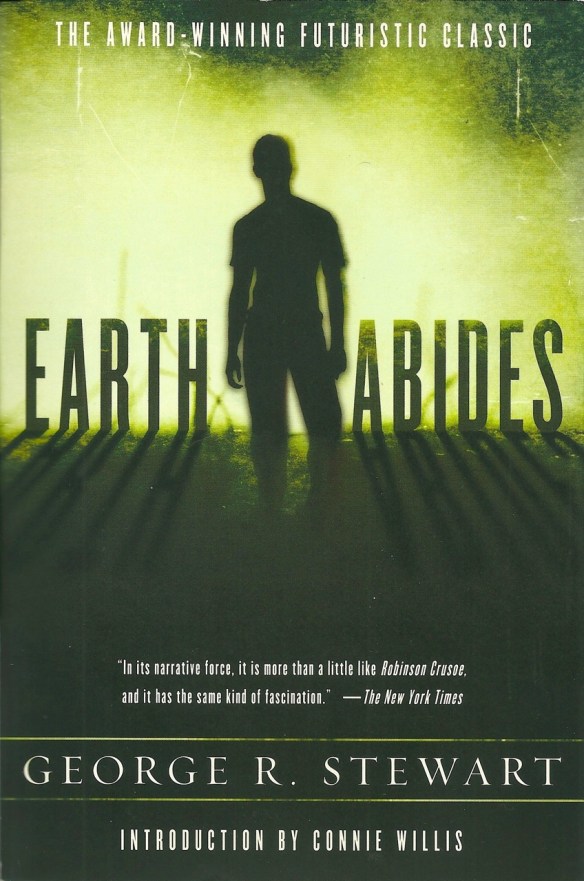
Here are two classic “after the end of the world” books. In Earth Abides, George R. Stewart’s end-of-the-world is by pandemic!, and in A Canticle for Leibowitz, Walter M. Miller Jr.’s is by post nuclear war taking America back to a Medieval Period, and then eventually over a few millennia to a new rocket and nuclear age, which ends as one would expect.

Stewart was an English professor at the University of California, Berkeley, in the 1930s-1940s, and his book here is from 1949. Amazingly prescient, realistic “speculative fiction” about the subsequent lives of the few survivors of the nearly overnight pandemic.

Miller’s book is definitely different, but there are no cheesy sci-fi gadgetry nor “special effects,” despite the strangeness of the worlds he portrays. Interestingly, the monastery life that is the center of Miller’s book is similar in many ways to the monastery life that is the center of Herman Hesse’s Magister Ludi (which is also a sort-of after the end of the world book, really of a “distant” future after the end of the fascist world).

I cannot imagine Miller’s vision becoming reality, but I can easily imagine Stewart’s coming about.

<><><><><><><>

The Twilight Zone

A PERSONALLY IMPORTANT LIFE GOAL OF MINE MET!

During this 2020 summer of hiding out from the pandemic, I watched all 156 episodes of the anthology TV show, THE TWILIGHT ZONE, which originally ran between 1959 and 1964. This feat was accomplished by seeing 2 to 6 episodes a night on consecutive nights over the course of several weeks.

This show is a collective work of TV art, guided by Rod Serling, who wrote 59% of the episodes. Amazingly, despite this show being in the neighborhood of 60 years old, its anachronisms relative to today’s typical attitudes and technological paraphernalia are infrequent (as regards the attitudes) and not distracting (as regards the technicalities). But it really shines in its depiction of the inner workings of human hearts and minds, and also human heartlessness. In this most important artistic-literary aspect, The Twilight Zone has not been surpassed by television shows since.

The Twilight Zone is a sequence of — usually — morality tales (interspersed with occasional comedies) whose telling is freed imaginatively and dramatically by allowing for the arbitrary actions of mysterious metaphysical forces. It’s as if Lafcadio Hearn, Ambrose Bierce and H. P. Lovecraft had been transported 60 years into their futures to write for television. One of the most thrilling aspects of Rod Serling’s Twilight Zone is the intense social consciousness, and anti-war, anti-greed, anti-bigotry and anti-cruelty attitudes nearly every minute of the entire series exudes. The acting, by many many actors, is uniformly excellent; and the production values of all the technicalities are also very good, but also very obviously more modest than in the costly productions of TV fare today.

In seeing the entire 156 episodes in one concentrated period of time, I have gotten a very clear appreciation of The Twilight Zone’s beauty and value as art. Without intending to be blasphemous, pretentious or dumb, let me say that I can see The Twilight Zone representing, for discerning American (and beyond?) viewers of the 1960s, a thought-provoking and socially instructive film-electronic art form in the same way that the plays of Sophocles, Euripides and Aristophanes were thought-provoking and socially instructive theatrical art forms to the Fifth-century Athenians.

The bubbling cauldron of social tensions, aspirations and fears of dynamic yet troubled societies were artistically abstracted and polished into the diamond-sharp facets of intense dramatic plays, reflecting the whole of contemporary society back into itself through the fascinated gaze of its individual people. If “the eyes are the mirror of the soul” then The Twilight Zone, through TV screens, was the mirror of the collective or societal American soul, which soul is always hidden behind a flashy loud and positivist front.

If you see the whole series, looking past the incidentals of its presentation, but deep into the essence of its conception, literateness and soul, you will see and hear as sharp and accurate depictions of the personalities and preoccupations of our society today as was the case for the American society of the early 1960s, during the show’s first run 61 to 56 years ago.

<><><><><><><>

John Keats, poet

Much feeling here, combined with a tremendous amount of work to present that feeling with refinement and grace of language, without dilution of the emotion, and without making it all seem a labored construction. Also wonderful feeling for nature and the natural world. I can’t criticize anything here, only try to learn from it. To my mind, Keats is to English poetry what Mozart is to music. Keats was a major influence on F. Scott Fitzgerald, who I see as an American “3rd generation” English Romantic poet who expressed his artistry in prose.

I have to dig into Shelley next (I have a huge tome), who was more “ferocious” than Keats. Both were very focussed artists. I’m struck by the idealism they felt and worked from.

<><><><><><><>

In Pursuit of the Unknown: 17 Equations That Changed the World, by Ian Stewart

Hello math lovers! (sic),

At one time or another a member of my family or friends has expressed an interest in:

Pythagoras’s Theorem (triangles, distance, areas, surfaces), or

Calculus (rates of change of anything and everything), or

Newton’s Law of Gravity (planetary motion, satellite trajectories), or

Pure Math (Napier’s Bones, the weirdness of the square root of -1, and Möbius Strip topology), or

Normal Distribution (the probability distribution of IQ, and “The Bell Curve” book), or

The Wave Equation (tones, semitones, musical scales, even tempering, beats within harmony), or

Fourier Transform (sines and cosines, single frequency/pitch modes and equalizers, digital camera images), or

The Navier-Stokes Equation (fluid flow, aerodynamics, F1 car design, global warming computation), or

Maxwell’s Equations (electricity, magnetism, radiation, wireless communication, TSA body scanners), or

Thermodynamics (entropy, efficiency of engines and renewable energy technology, disordering of the universe), or

Relativity (curved space-time, bent light rays, black holes, Big Bang, dark matter, dark energy), or

Quantum Mechanics (Schrödinger’s Cat, many parallel worlds, semiconductor electronics), or

Information Theory (codes, coding, data compression, digital communications), or

Chaos (species population dynamics with explosive growth and collapse, erratic unpredictability), or

Black-Scholes Equation (insane financial speculation, options, futures, derivatives, credit default swaps, the banking/real estate/financial crash of 2007-2008).

Because of that, here is my review of Ian Stewart’s 2012 book: In Pursuit of the Unknown: 17 Equations That Changed the World. Stewart says of his book: “This is the story of the ascent of humanity, told through 17 equations.”

This is an excellent enthralling book: interesting, very informative, very well written clear explanations of the mathematics and the applications of that mathematics to: classical mathematical calculations, lots of physics and related technology, information theory (codes and computers), chaos (wild swings in species populations), and the insane 21st century finance economics of our previous financial crash and its inevitable successors. This brief description does not in any way convey the complete range of this book.

On the front cover you can see the 17 (sets of) equations, which Stewart describes (and their many uses) over the course of 17 chapters. Of the 13 equations I feel confident about knowing something about (all “basic” math and/or mathematical physics), I find Stewart to be accurate and masterfully clear in his descriptions.

My only quibble is where he states about the main causes of global warming being the production of carbon dioxide and methane (gases) that: “These are greenhouse gases: they trap incoming radiation (heat) from the Sun.”

This is a collapsing of the actual mechanism, which is: the the capture of outgoing heat radiation (infrared radiation) by CO2 (most importantly) and CH4 (along with other heat-trapping molecular gases in trace amounts in the atmosphere), which upward radiated heat energy is derived from the earlier absorption (by the oceans and lands) of incoming light energy; a necessary process for cooling the Earth and stabilizing its temperature (if we didn’t mess with the process). So I would rephrase the Stewart sentence quoted as: “These are greenhouse gases: they trap outgoing radiation (heat) from the Earth.”

[If you think about it you will see that wherever the biosphere captures the incoming LIGHT from the Sun — in the air, lands or oceans — it ultimately heats to the same degree; but when our pollution intercepts and stores a greater portion of the re-radiated outward going HEAT (infrared radiation) from the biosphere than would be the case “naturally,” that the Earth’s “cooling system” is impaired and the biosphere warms up steadily, for an Earth out of heat balance.]

Regardless of this quibble, Stewart knows much much more about all the mathematics he presents and all the uses of it than I do. The 4 equations I knew nothing about (and learned about from Stewart) are: #1 Euler’s formula for polyhedra (topology); #2 information theory; #3 chaos theory (I know a little a bit about nonlinear dynamics, sensitivity to initial conditions, and limit cycles: similar to the “butterfly effect”); and #4 the Black-Scholes, or “Midas” equation that was heavily abused to produce the financial meltdown of 2007-2008. On these four, I learned a great deal from Stewart (basically everything I know about them now), and in the reading of this book I gained a sense of trust in his descriptions and pronouncements.

My only other critique of the book (and a minor one) is that there are a number of proofreading lapses (both of text and substance) that show up as typographical errors, and/or what I presume to be mischosen words (some obviously errors, others didn’t make sense to me). The few instances of these errors occur most frequently in the later chapters of the book, and none is fatal (especially if you don’t notice them). So, I agree with the praise for the book highlighted on the back cover.

I especially recommend the book for its explanation (in 8 chapters) of the physics of: classical gravity (Newtonian mechanics), waves, heat flow, fluid flow, electrodynamics, thermodynamics (entropy), relativity and quantum mechanics. I also appreciate his logical and scathing take-down of the modern hyperactive derivative-based financial speculation that dominates and threatens the world’s economies today. For me, the 8 physics chapters are superb; but there is no part of the book that is weak: “a wonderfully accessible book.”

<><><><><><><>

Upanishads

Juan Mascaró was a superb poetic translator. His selections from the Upanishads is enthralling. His translation of the Dhammapada was also wonderful:

“As the bee takes the essence of a flower and flies away without destroying its beauty and perfume, so let the sage wander in this life.” — The Dhammapada, 49

Joseph Campbell (author of The Hero With A Thousand Faces, editor of Heinrich Zimmer’s book The Philosophies of India) said of the Upanishads: “It’s all there.”

<><><><><><><>

Books I must add to my list of essential classics:

History of the Peloponnesian War (Thucydides, translated by Rex Warner)
The Plays of Euripides
The Plays of Sophocles
L’Avare (The Miser, a play by Molière)
Phèdre (Phaedra, a play by Racine)
The Picture of Dorian Gray (Oscar Wilde)
The Moon and Sixpence (W. Somerset Maugham)
The Razor’s Edge (W. Somerset Maugham)
Brave New World (Aldous Huxley)
Homage to Catalonia (George Orwell)
1984 (George Orwell)
Collected Essays (2002, George Orwell)
Bhagavad Gita (Swami Prabhavananda and Christopher Isherwood)
Bhagavad Gita (Juan Mascaró)
Memories, Dreams, Reflections (Carl Gustav Jung)
The Autobiography of Malcolm X (Malcolm X, with Alex Haley)
Cadillac Desert (Marc Reisner)

…and others as I think of them.

Ocean Heat, From the Tropics to the Poles

The heat being captured by the increasing load of carbon dioxide and other greenhouse gases in the atmosphere is subsequently transferred into the oceans for storage. This process — global warming — has raised the temperature of the biosphere by 1°C (or more) since the late 19th century.

Heat introduced into any material body at a particular point will diffuse throughout its volume, seeking to smooth out the temperature gradient at the heating site. If heat loss from that body is slow or insignificant, then a new thermal equilibrium is eventually achieved at a higher average temperature.

Thermal equilibrium does not necessarily mean temperature homogeneity, because the body may have several points of contact with external environments at different temperatures that are held constant, or with other external thermal conditions that must be accommodated to. Equilibrium simply means stable over time.

The heat conveyed to the oceans by global warming is absorbed primarily in the Tropical and Subtropical latitudes, 57% of the Earth’s surface. The Sun’s rays are more nearly perpendicular to the Earth’s surface in those latitudes so they receive the highest fluxes of solar energy, and oceans cover a very large portion of them.

That tropical heat diffuses through the oceans and is also carried by ocean currents to spread warmth further north and south both in the Temperate zones (34% of the Earth’s surface) and the Polar Zones (8% of the Earth’s surface).

What follows is a description of a very idealized “toy model” of heat distribution in the oceans, to help visualize some of the basics of that complex physical phenomenon.

Heat Conduction in a Static Ocean

The model is of a stationary spherical globe entirely covered by a static ocean of uniform depth. The seafloor of that ocean is at a constant temperature of 4°C (39°F), the surface waters at the equator are at 30°C (86°F), and the surface waters at the poles are at -2°C (28°F). These temperature conditions are similar to those of Earth’s oceans. These temperature boundary conditions are held fixed, so an equilibrium temperature distribution is established throughout the volume in the model world-ocean. There is no variation across longitude in this model, only across latitude (pole-to-pole). (See the Notes on the Technical Details)

Figure 1 shows contours of constant temperature (isotherms) throughout the depth of the model ocean, from pole to pole. The temperature distribution is shown as a 3D surface plotted against depth, which is in a radial direction in a spherical geometry, and polar angle (from North Pole to South Pole).

Figure 2 is a different view of the temperature distribution. Three regions are noted: The Tropical Zone (from 0° to 23° of latitude, north or south) combined with the Subtropical Zone (from 23° to 35° of latitude, north or south); the Temperate Zone (from 35° to 66° of latitude, north or south); and the Polar Zone (from 66° to 90° of latitude, north or south).

The model temperature distribution is perfectly stratified — isotherms uniform with depth — in the Tropical-Subtropical Zones, from 30°C at the surface at the equator, to 4°C at the seafloor. On entering the Temperate Zones, the isotherms arc up into a nearly radial (vertical) orientation. In the small portions of the planetary surface covered by the Polar Zones the isotherms are now more horizontally stratified because the surface waters are chillier that the those at the seafloor.

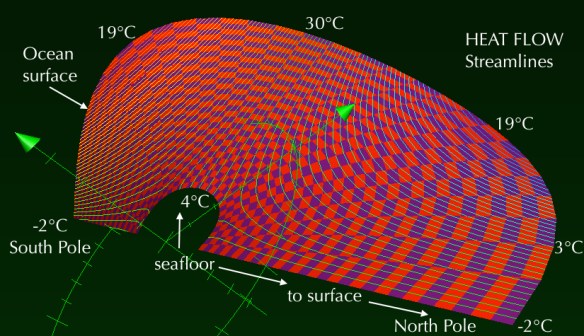
Figure 3 shows the streamlines of heat flow (the temperature gradient) for this temperature distribution. At the equator the heat is conducted down from the 30°C surface to the 4°C seafloor. As one moves further away from the equator the streamlines become increasingly lateral, until they are entirely so at 35° of latitude (north or south) where the model surface waters are at 19°C. The heat flow is entirely horizontal at this latitude, which separates the Subtropical and Temperate Zones; tropical heat is being conducted laterally toward the poles. In the Polar Zones the heat flow is up from the lower depths because the surface waters are chiller than those at depth, and because there is too little temperature variation with distance along the surface to drive a lateral heat flow.

Thermally Driven Surface Currents

Much oceanic heat is distributed by currents, and many of these occur along the surface.

The average speed of the Gulf Stream is 6.4km/hr (4mph), being maximally 9kph (5.6mph) at the surface but slowing to 1.6kph (1mph) in the North Atlantic, where it widens (information from the National Oceanic and Atmospheric Administration, NOAA).

Heat-driven equator-to-poles surface currents on the model ocean were estimated from the combination of the pole-to-pole surface temperature distribution, and thermodynamic data on liquid water. (See the Notes on the Technical Details)

The pressure built up by tropical heat in the model ocean’s equatorial waters pushes surface flows northward (in the Northern Hemisphere) and southward (in the Southern Hemisphere): from a standstill at the 30°C equator; with increasing speed as they recede from the equator, being 2kph (1.3mph) where the surface waters are at 25°C (77°F); a continuing acceleration up to a speed of 2.8kph (1.7mph) at the 35° latitude (the boundary between the Subtropical and the Temperate Zones); and an ultimate speed of 3.6kph (2.2mph) at the poles.

The currents are converging geometrically as they approach the poles, so a speed-up is reasonable. Logically, these surface currents are legs of current loops that chill as they recede from the equator, plunge at the poles, run along the cold seafloor toward the equator, and then warm as they rise to the surface to repeat their cycles.

An equator-to-pole average speed for these model surface currents is 2.8kph (1.7mph). Their estimated travel times along the 10,008km surface arc (for a model world radius of 6,371km, like that of a sphericalized Earth) is 3,574 hours, which is equivalent to 149 days (0.41 year).

Greater Realities

The model world just described is very simple in comparison to our lovely Earth. Since it does not rotate, it does not skew the north-south flow of currents that — with the help of day-night, seasonal, and continental thermodynamic inhomogeneities — creates all of the cross-longitudinal air and ocean currents of our Earth.

The irregularity of seafloor depth on Earth also redirects cross-latitudinal (pole-to-pole) and cross-longitudinal bottom currents, as do the coastlines of the continents; and the very slight and subtle changes in seawater density with temperature and salinity — neither of which is distributed uniformly throughout the body of Earth’s oceans — also affect both the oceans’s volumetric temperature distributions, and the course of ocean currents.

Recall that the model ocean is bounded by constant imposed temperature conditions at its seafloor (4°C) and surface waters (a particular temperature distribution from 30°C at the equator, to -2°C at the poles). Since this model world is otherwise suspended in a void, if these boundary conditions were removed the oceanic heat concentrated at the equator would diffuse further into the watery volume, seeking to raise the temperatures of the poles and seafloor while simultaneously cooling the equatorial region. The ultimate equilibrium state would be an ocean with a constant temperature throughout its volume.

Additionally, if it is also assumed that the now “liberated” model ocean-world can radiate its body heat away — as infrared radiation into the void of space — then the entire planet with its oceanic outer shell slowly cools uniformly toward -273.16°C (-459.69°F), which is the “no heat at all” endpoint of objects in our physical Universe.

When our Earth was in its Post-Ice Age dynamic thermal equilibrium, the “heat gun” of maximal insolation to the Tropics and Subtropics warmed the oceans there; a portion of that heat was conducted and convected into the Temperate Zones and toward the Poles; where the “ice bags” of masses of ice absorbed seasonal oceanic heat by partially melting — which occurs at a constant temperature — and then refreezing. Also, the atmosphere did not trap the excess heat radiated into space. In this way cycles of warming and cooling in all of Earth’s environments were maintained in a dynamic balance that lasted for millennia.

What has been built up in the atmosphere since about 1750 is an increasing load of carbon dioxide gas and other greenhouse gases, which have the effect of throwing an increasingly heated “thermal blanket” over our planet. Now, both the heat conduction pathways and the heat convection currents, described with the use of the model, convey increasing amounts of heat energy over the course of time. As a result the masses of ice at the poles are steadily being eroded by melting despite their continuing of cycles of partial re-freezing during winter, and additional melting during summer.

Simple mathematical models can help focus the mind on the fundamental processes driving complex multi-entangled physical realities. From there, one can begin assembling more detailed well-organized quantitative descriptions of those realities, and then using those higher-order models to inform decisions regarding actions to be taken in response to those realities, if responses are necessary. This point of departure from physics plunges you into the world of psychology, sociology, economics, politics, and too often sheer madness. I leave it to another occasion to comment outside my field of expertise about all that.

Notes on the Technical Details

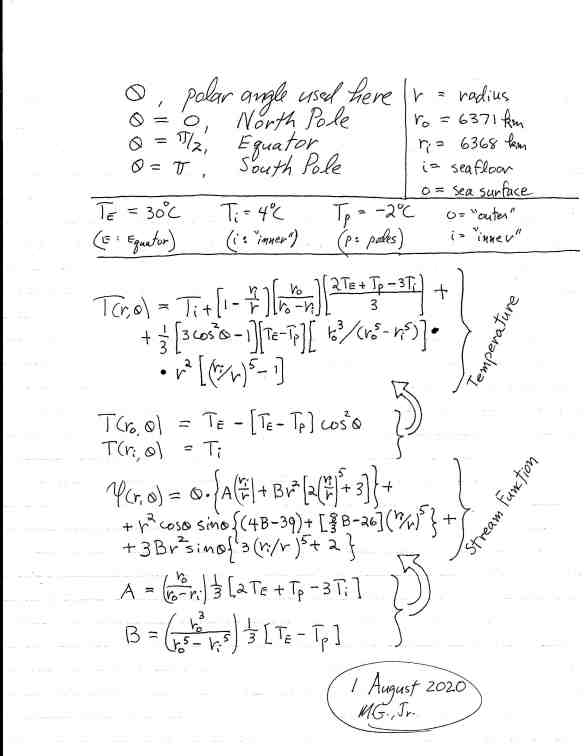
The cylindrically symmetric equilibrium temperature distribution for a static ocean of uniform depth, which entirely covers a spherical planet, was solved from Laplace’s equation. The temperature of the seafloor everywhere is 4°C, the surface waters at the Equator are at 30°C, and the surface waters at the poles are at -2°C. The variation of surface water temperature with respect to polar angle (latitude) is in a cosine squared distribution. Displays of the 3D surface T(r,ɵ) show isotherms down through the ocean depths at all polar angles (ɵ). The contour lines on the stream function associated with T(r,ɵ) are heat flow streamlines, the paths of the heat gradient (which are always perpendicular to the isotherms).

Bernoulli’s Theorem was applied to surface flow from the equator to the poles (no radial, nor cross-longitudinal motion) for incompressible liquid water with thermal pressure given by:

P(T°C)=[62.25kg/m-sec^2]*exp{0.0683*[T(R,ɵ)-Tp]}

for R equal to the planetary radius to the ocean surface; Tp=-2°C; and using thermodynamic data for water between 32°F (0°C) and 100°F (37.8°C) that indicates a thermal pressure equal to 62.25kg/m-sec^2 in liquid water at 0°C; and that the density of water is essentially constant at 1000kg/m^3 (for the purposes of this model) within the temperature range of the data surveyed.

Inserting P(T°C) into the Bernoulli Theorem definition of equator-to-pole lateral (cross-latitudinal) velocity gives a formula for that velocity as a function of polar angle:

v(ɵ)=±sqrt{(2*[62.25kg/m-sec^2]/[1000kg/m^3])*exp[0.0683*(Te-Tp)]*[1-exp(-0.0683*[Te-T(R,ɵ)])]}

v(ɵ)=±(1.0523m/s)*sqrt{1-exp(-0.0683*[Te-T(R,ɵ)])}

for Te=30°C, and ± for northward (in the Northern Hemisphere) or southward (in the Southern Hemisphere) surface flows.

<><><><><><><>

<><><><><><><>

One Year of Global Warming Reports by MG,Jr

<><><><><><><><><><><><><><><><><><><><><><><><><><><><><><><><>

One Year of Global Warming Reports by MG,Jr

Over the last year, I have posted a series of reports on global warming climate change that address it in a quantitative physics, rather than qualitative and sociological manner. Those reports are listed below in chronological order. My estimation of what global warming “will look like” in the immediate and longer term future was refined over the course of producing these reports; but they are all of-a-piece on the topic.

The first report is primarily “data” for subsequent calculations (and very important). The two PDF reports are my mathematical physics notes on my calculations (the first of these being most significant). The other five are applications of the numerical results for descriptive purposes — to help the general reader understand the magnitude and duration of the global warming effect.

A number of these reports found their way onto Internet Magazines, most significantly Counterpunch, and Green Social Thought.

The versions on my blog have had minor numerical and/or typographical errors corrected (as I find them), and are followed by my comments of subsequent thoughts, with more physics on them just after they were posted.

My sociological recommendations about “what to do about climate change” are summarized in one brief paragraph at the end of Biosphere Warming in Numbers.

My purpose in doing this work should be obvious; first, for me to understand, quantitatively, the nature of global warming; and, secondly, to help “you” to understand it.

I welcome comments and questions on the topic; after all it was such inquiries that prompted me to look into this topic (scientifically) more deeply in the first place.

Please also note, I do NOT dispute the work of professional geophysics/climate change scientists, who work at climate change institutes of various kinds around the world (e.g., meteorological, geological, atmospheric physics and chemistry, oceanographic, biological/ecological/evolutionary sciences), and who use banks of supercomputers to model the many complexities of global warming and climate change (with numerous such complexities still beyond current science’s grasp).

Ye Cannot Swerve Me: Moby-Dick and Climate Change
15 July 2019
https://manuelgarciajr.com/2019/07/15/ye-cannot-swerve-me-moby-dick-and-climate-change/

A Simple Model of Global Warming
26 May 2020
https://manuelgarciajr.com/wp-content/uploads/2020/05/global-warming-model.pdf

Global Warming is Nuclear War
28 May 2020
https://manuelgarciajr.com/2020/05/28/global-warming-is-nuclear-war/

Living With Global Warming
13 June 2020
https://manuelgarciajr.com/2020/06/13/living-with-global-warming/

No emissions with exponential decay of CO2 concentration: Model
18 June 2020
https://manuelgarciajr.com/wp-content/uploads/2020/06/global-warming-co2-shutoff.pdf

Global Warming and Cooling After CO2 Shutoff at +1.5°C
20 June 2020
https://manuelgarciajr.com/2020/06/20/global-warming-and-cooling-after-co2-shutoff-at-1-5c/

Biosphere Warming in Numbers
3 July 2020
https://manuelgarciajr.com/2020/07/03/biosphere-warming-in-numbers/

Carbon Dioxide Uptake by Vegetation After Emissions Shutoff “Now”
8 July 2020
https://manuelgarciajr.com/2020/07/08/carbon-dioxide-uptake-by-vegetation-after-emissions-shutoff-now/

<><><><><><><>

ALSO:

Global Warming and Ocean Acidification Accelerate
18 July2020
https://manuelgarciajr.com/2020/07/18/global-warming-and-ocean-acidification-accelerate/

Ocean Heat, From the Tropics to the Poles
1 August 2020
https://manuelgarciajr.com/2020/08/01/ocean-heat-from-the-tropics-to-the-poles/

The Improbability of CO2 Removal from the Atmosphere
9 August 2020
https://manuelgarciajr.com/2020/08/09/the-improbability-of-co2-removal-from-the-atmosphere/

ClimateSIM Junior, Simplified Prognostication from Unrealistic Hypothesis
16 August 2020
https://manuelgarciajr.com/2020/08/16/climatesim-junior-simplified-prognostication-from-unrealistic-hypothesis/

Facing Extinction, My View
2 September 2020
https://manuelgarciajr.com/2020/09/02/facing-extinction-my-view/

<><><><><><><>

Possible Future Trends of CO2 Concentration and Global Temperature
7 September 2020 (revised 9 September 2020)
https://manuelgarciajr.com/2020/09/07/possible-future-trends-of-co2-concentration-and-global-temperature/

The above (a brief summary) includes a web-link to the big report below.

A Rate Equation for Accumulation or Loss of Atmospheric CO2
5 September 2020 (revised 9 September 2020)
https://manuelgarciajr.com/wp-content/uploads/2020/09/rate-equation-for-atmospheric-co2-revised.pdf

<><><><><><><>

Major improvement on the above

Anthropogenic CO2 Emissions Are Fate
12 September 2020
https://manuelgarciajr.com/2020/09/12/anthropogenic-co2-emissions-are-fate/

For those interested in the technicalities, see

A Carbon Balance Model of Atmospheric CO2
11 September 2020
https://manuelgarciajr.com/wp-content/uploads/2020/09/a-carbon-balance-model-of-atmospheric-co2.pdf

<><><><><><><>

Reducing CO2 Emissions to Reverse Global Warming
17 September 2020
https://manuelgarciajr.com/2020/09/17/reducing-co2-emissions-to-reverse-global-warming/

Global Warming Burps, Bubbles, Simmers and Sours On
24 September 2020
https://www.counterpunch.org/2020/09/24/global-warming-burps-bubbles-simmers-and-sours-on/

Another Model of Atmospheric CO2 Accumulation
5 October 2020
https://manuelgarciajr.com/2020/10/05/another-model-of-atmospheric-co2-accumulation/

The CO2 and Temperature of the PETM
2 November 2020
https://manuelgarciajr.com/2020/11/02/the-co2-and-temperature-of-the-petm/

<><><><><><><>

Carbon Dioxide Uptake by Vegetation After Emissions Shutoff “Now”

If all carbon dioxide emissions were immediately and permanently shut off in the year 2020 (with 417ppm of CO2 presently in the atmosphere), when would the natural uptake of CO2 by Earth’s vegetation (primarily, at first) bring the CO2 concentration down to its “ancient” level of 280ppm?; and when would the average global surface temperature return to its 1910 level (the “ancient” level, with 0°C of global warming)?

By a series of inferences based on my previous calculations of global warming, I estimate that the answers to the above questions are:

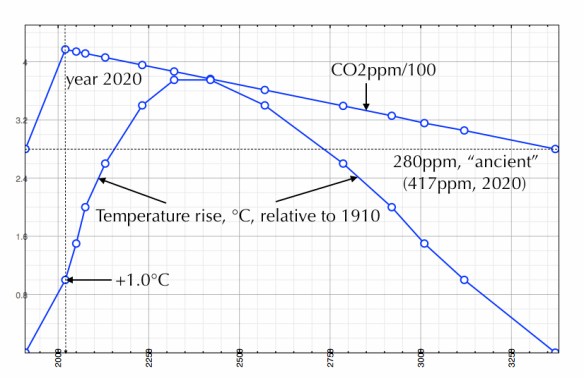
1,354 years to reach 280ppm (after an abrupt CO2 shutoff in 2020);

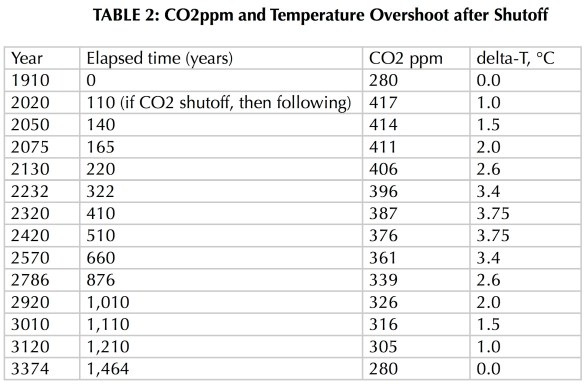
even so, the global temperature will rise another +2.75°C by 300 years (year 2320), remain there for a century (till year 2420), then slowly reduce to the point of 0°C of global warming (the temperature in 1910, used as my baseline for “ancient” pre-warming conditions) in the year 3374.

Figure 1, below, summarizes these findings.

FIGURE 1: CO2ppm/100 and Relative Temperature after 2020 shutoff

What follows is an explanation of how I arrived at these conclusions. It is an exercise of inductive reasoning that I present in a detailed manner for the benefit of the reader’s understanding of my logic, and to give the reader every opportunity to challenge the arguments I advance.

I proceed by making inferences from incomplete data at my disposal, linked as necessary by physical assumptions that are clearly stated, to eventually arrive at projected histories of CO2 concentration in the atmosphere, and the relative temperature (with respect to that of 1910), for the 1,354 years between 2020 and 3374.

Data on Earth’s Biomass

Humanity today comprises only 0.01% of all life on Planet Earth, but over the course of human history our species has destroyed 83% of wild mammal species. [1]

The world’s 7.6 billion people [in May 2018] represent just 0.01% of all living things. Yet since the dawn of civilization, humanity has caused the loss of 83% of all wild mammals and half of plants, while livestock kept by humans abounds. The new work cited is the first comprehensive estimate of the weight of every class of living creature and overturns some long-held assumptions. Bacteria are indeed a major life form – 13% of everything – but plants overshadow everything, representing 82% of all living matter. All other creatures, from insects to fungi, to fish and animals, make up just 5% of the world’s biomass. Farmed poultry today makes up 70% of all birds on the planet, with just 30% being wild. The picture is even more stark for mammals – 60% of all mammals on Earth are livestock, mostly cattle and pigs, 36% are human and just 4% are wild animals. Where is all that life to be found?: 86% on land, 1% in the oceans, and 13% as deep subsurface bacteria. [2]

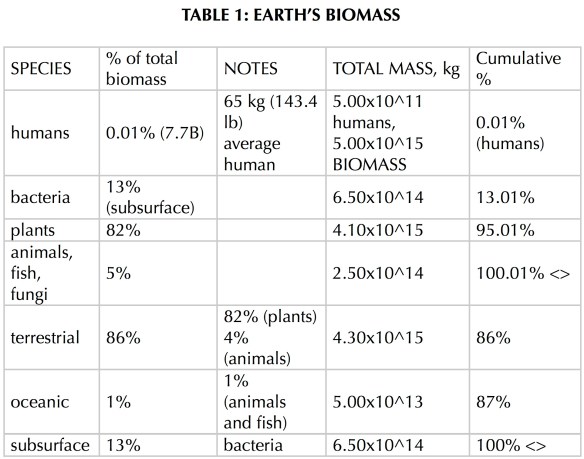
I assume that “today” 7.7 billion humans are 0.01% of Earth’s biomass, and that the “average” human weighs 65 kilograms (kg), which is equivalent to 143.4 pounds (lb).

From this, the mass of humanity is estimated to be 5.0×10^11 kg, and the totality of biomass is estimated to be 5.0×10^15 kg.

The estimated totality of biomass can also be stated as 5,000 giga-metric-tons. A metric ton (tonne) is equivalent to 1,000 kg.

The following table lists the quantitative estimates made from the data (above) regarding the Earth’s biomass (the NOTES column in the table indicate assumptions made). Yes, there are gaps and imperfections in the table, which reflect the incomplete knowledge I begin with.

Mass of CO2 in the Atmosphere

The mass of Earth’s atmosphere is 5.2×10^18 kg.

To a good approximation, Earth’s atmosphere is made up of diatomic nitrogen (N2), at 79%, and diatomic oxygen (O2) at 21%. The molecular weight of an N2 molecule is 28 (atomic mass units); and the molecular weight of an O2 molecule is 32 (atomic mass units). A conceptual “air” molecule is defined as having a molecular weight that is 79% that of N2 plus 21% that of O2; that value is 28.8 atomic mass units (AMU).

A carbon dioxide molecule has a molecular weight of 44 atomic mass units (the carbon atom contributes 12 AMU, the two oxygen atoms contribute 32 AMU, combined). So, a CO2 molecule is 1.526x heavier than an “air” molecule.

The concentration of CO2 in the “ancient” atmosphere was 280ppmv (parts per million by volume). The mass (weight) of that ancient (original or baseline) quantity of atmospheric CO2 is thus:

(280ppmv) x (5.2×10^18 kg) x (1.525) = 2.22×10^15 kg.

The mass (weight) of the CO2 presently in the atmosphere (417ppmv) is estimated by a simple ratio:

(417ppm/280ppm) x 2.22×10^15 kg = 3.31×10^15 kg.

The difference between the masses of CO2 today, and in the “ancient” (pre 1910) atmosphere, is the “excess” CO2 driving global warming. The quantity is:

(3.31×10^15 kg) – (2.22×10^15 kg) = 1.09×10^15 kg.

That is 1,090 giga-tonnes.

A second route to estimating the mass of CO2 in the atmosphere is as follows.

Modeling of the huge CO2 spike that occurred 55.5 million years ago and that produced the Paleocene-Eocene Thermal Maximum (PETM) was described in [2], drawing on work cited in [3] and [4].

5,000 billion tonnes of carbon were quickly injected into the model atmosphere, producing a concentration of 2,500ppmv of CO2. The modeling showed the excess CO2 being cleared from the atmosphere by a variety of processes, down to a level of about 280ppmv by 200,000 years.

I interpreted the statements about this modeling, in both [3] and [4], to mean that 5,000 billion metric tonnes of carbon (which happened to be bound in carbon dioxide molecules) — but not 5,000 gigatons carbon dioxide — were injected into the model atmosphere.

The ratio of the molecular weight of carbon dioxide, to the atomic weight of carbon is 44/12 = 3.667.

The quantity of injected CO2 (2,500ppmv) in that model is then:

(3.667) x (5,000×10^9 tonnes) x (1,000 kg/tonne) = 1.834×10^16 kg.

By simple ratios I estimate the masses of CO2 at both 280ppmv and 417ppmv:

(280ppmv/2500ppmv) x (1.834×10^16 kg) = 2.05×10^15 kg,

(417ppmv/2500ppmv) x (1.834×10^16 kg) = 3.06×10^15 kg.

Note that by the first method of estimating these masses I arrived at:

2.22×10^15 kg, at 280ppmv,

3.31×10^15 kg, at 417ppmv.

The agreement between the two methods is heartening. So, continue.

Notice that the mass of CO2 per ppm is:

1.834×10^16kg/2500ppm = 7.34×10^12kg/ppm; equivalently 7.34giga-tonne/ppm.

Lifetime of CO2 in the Atmosphere

The modeling of the PETM described in [2], [3] and [4] showed that after about 10,000 years after the “quick” CO2 injection, the concentration had been reduced to about 30% of its peak level, so to about 750ppm.

This means that the mass of atmospheric CO2 was reduced by 12,840 giga-tonnes (from 18,340 giga-tonnes to 5,500 giga-tonnes) over the course of 10,000 years.

Assuming that this reduction occurred at a uniform rate (linearly) implies that the rate was -1.284 giga-tonne/year, or -1.284×10^12 kg/yr.

The Earth during the PETM (55.5 million years ago) and the Eocene (between 56 and 35 million years ago) was ice-free. The Arctic was a swamp with ferns, Redwood trees and crocodiles; and the Antarctic was a tropical jungle. The quantity of vegetation over the surface of the Earth must certainly have been at a maximum.

Roughly half of the CO2 injected into the model of the PETM atmosphere (mentioned earlier) was drawn out by a combination of photosynthesis, uptake by the oceans, and some dissolution of seafloor sediments (chalk deposits), by 1,000 years. About 30% remained at 10,000 years, and that was further reduced (to about 280ppm, or 11% of the 2,500ppm peak) by 200,000 years by the processes of weathering of carbonate rocks, and then silicate rocks.

If the linear reduction rate of -1.284 giga-tonnes/year (estimated for the first 10,000 years of CO2 reduction during the PETM) were operative for the next millennia or two, the excess 1,090 giga-tonnes of CO2 presently in the atmosphere could be cleared down to 280ppm within:

(1,090 giga-tonnes)/(1.284 giga-tonne/year) = 849 years.

However, since 13 million years ago Antarctica has been in a deep deep freeze; and the Arctic has also been a region of deep cold, ice, and minimal vegetation. Also, “since the dawn of civilisation, humanity has caused the loss of 83% of all wild mammals and half of plants.” [1]

So this combination of natural and anthropogenic reductions of Earth’s vegetation from it’s peak during the Eocene would mean that the process of extracting CO2 from the atmosphere by photosynthesis will be slower. For the moment, I assume at half the rate given earlier, or -0.642 giga-tonnes/year. At that rate, clearing the current CO2 excess (linearly) would take 1,698 years.

In [5] I described my model of how average global surface temperature can be influenced by the exponential decay of CO2 in the atmosphere, after an abrupt and permanent cessation of CO2 emissions. I call the time constant (parameter) used in the exponential function that models the longevity of CO2 in the atmosphere, it’s “lifetime.” In [5], I showed a number of post-shutoff temperature histories, each characterized by a specific value of the lifetime parameter, which in mathematical jargon is called the “e-folding time.” The exponential function is reduced to 36.79% of its peak value when the elapsed time is equal to the e-folding time (e^-1).

The case of the e-folding time being 10,000 years (in my model) has the excess CO2 cleared out of the atmosphere by 1,300 years after the abrupt shutoff of emissions (when global warming is at +1°C, as it is now). That “10,000 year case” is shown in Figure 3 of reference [5], and will be described further below.

It also happens that 10,000 years was found to be the time span required to reduce the CO2 concentration in the model PETM atmosphere to about 30% to 40% of its beginning peak value.

So, I infer that 10,000 years is a reasonable estimate of the lifetime parameter (e-folding time) for CO2 in the atmosphere, and that the present excess of CO2 in the atmosphere (417ppm – 280ppm = 137ppm) would be cleared — if there were an immediate and permanent cessation of emissions — within about 1,300 years, which is similar (in this speculative modeling) to the 1,698 years clearing time gotten by halving an estimated clearing rate during the PETM, above.

A linear rate of decrease of 137ppm over 1,300 years would be -0.11ppm/year (this number will be further refined below).

Reduction of excess CO2 concentration after Abrupt Shutoff
(given a 10,000 year e-folding parameter)

Using the “10,000 year case” post-shutoff temperature change history, just noted [5], the following is observed:

The global temperature relative to “now” (2020, at +1°C) is:

above +2.75°C, at 300 to 400 years (net >3.75°C),
above +2.4°C, at 212 to 550 years (net >3.4°C),
above +1.6°C, at 110 to 766 years (net >2.6°C),
above +1.0°C, at 55 to 900 years (net >2°C),
above +0.5°C, at 30 to 1,100 years (net >1.5°C),
above +0°C, at 0 to 1,100 years (net >1°C).

200 years after the temperature overshoot dips below +0°C (below the 1°C of global warming above “ancient” we have now), further cooling returns the global temperature to its level in 1910 (“ancient,” as used here). This is the behavior, over a span of 1,300 years, of the “10,000 year case” calculated in reference [5].

So, I assume that a CO2 “lifetime” of 10,000 years (e-folding time parameter) would result in a reduction of the atmospheric concentration of CO2 from 417ppm (“now”) to 280ppm (“ancient”) in about 1,300 years. That would be a 32.8% reduction of concentration down to a level of 67.2% of the present peak; a linear rate of decrease of 137ppm/1,300years = 0.105ppm/yr (this number will be further refined, below).

Earlier (above) I had found that the mass of CO2 per ppm is:

7.34×10^12kg/ppm, equivalently 7.34giga-tonne/ppm.

If so, then the weight of CO2 removed per year (at -0.105ppm/yr) is:

7.71×10^11kg/yr, equivalently 0.771 giga-tonnes/yr.

The present excess of CO2 is 1,090 giga-tonnes. Clearing it in 1,300 years would imply a uniform (linear) removal rate of 0.839 giga-tonnes/yr.

I will average the two estimates just given for the CO2 removal rate, to settle on:

0.805 giga-tonnes/yr = 8.05×10^11kg/yr

as the CO2 removal rate.

Earlier (above) I found the mass of the present excess of CO2 in the atmosphere to be 1,090 giga-tonnes. It would take 1,354 years to clear away that excess, given a uniform removal rate of 0.805 giga-tonnes/yr.

That reduction of 137ppm over 1,354 years implies a uniform rate of -0.1012ppm/yr.

Earlier (above) I found the total mass of Earth’s plants to be 4,100 giga-tonnes, equivalently 4.10×10^15 kg. The present excess of atmospheric CO2 (1,090 giga-tonnes) is equivalent to 26.6% of the present cumulative mass of all of Earth’s vegetation (plants). The uptake per year is equivalent to 0.0196% of the current total mass of Earth’s plants.

CO2 uptake occurs within the continuing carbon cycle of:

– carbon dioxide absorbed by plant photosynthesis,

– plants consumed as food by animals (heterotrophs),

– organic solids and wastes absorbed by the soil (decay, nutrients, peat, oil, coal),

– carbon dioxide absorbed by the oceans and used to make shells and corals,

– organic gases emitted to the atmosphere (like methane, CH4, which is soon oxidized to CO2 and water vapor),

– re-release of plant-bound carbon to the atmosphere by wildfires,

– mineralization of CO2 by the weathering of carbonate, and then silicate rocks

From “final” quantities and rates determined in all the above, the following projected histories of the reduction of CO2 concentration (in ppm), and global warming (average global temperature excursion above its level in 1910), after an abrupt cessation of CO2 emissions “now,” are determined and tabulated. This is my estimation of the 1,464 year global warming blip projected to occur between 1910 and 3374.


Figure 1, at the top of this report, is a graph of this table.

It is important to note that the conclusions of inductive reasoning — as is the case with this exercise — are viewed as supplying some evidence for the truth of the conclusion. They are not definitive as is the case with proofs by deductive reasoning.

In other words, I did the best I could with what I have. Only the unrolling of the future can supply us the definitive answers.

Notes

[1] Humans just 0.01% of all life but have destroyed 83% of wild mammals – study
https://www.theguardian.com/environment/2018/may/21/human-race-just-001-of-all-life-but-has-destroyed-over-80-of-wild-mammals-study

[2] Ye Cannot Swerve Me: Moby-Dick and Climate Change
15 July 2019
https://manuelgarciajr.com/2019/07/15/ye-cannot-swerve-me-moby-dick-and-climate-change/

[3] Global Warming 56 Million Years Ago, and What it Means For Us
30 January 2014
Dr. Scott Wing, Curator of Fossil Plants,
Smithsonian Museum of Natural History
Washington, DC
[1:44:12]
https://youtu.be/81Zb0pJa3Hg

[4] CO2 “lifetime” in the atmosphere
National Research Council 2011. Understanding Earth’s Deep Past: Lessons for Our Climate Future. Washington, DC: The National Academies Press.
Figure 3.5, page 93 of the PDF file, page numbered 78 in the text.
https://doi.org/10.17226/13111

[5] Global Warming and Cooling After CO2 Shutoff at +1.5°C
20 June 2020
https://manuelgarciajr.com/2020/06/20/global-warming-and-cooling-after-co2-shutoff-at-1-5c/

<><><><><><><>


Biosphere Warming in Numbers

<><><><><><><><><><><><><><><><><><><><><><><><><><><><><><><><>

Biosphere Warming in Numbers

At this time, the Biosphere is warming at a rate of 3.03×10^15 Watts, which is equivalent to a temperature rate-of-rise of 0.0167°C/year. The warming rate has been increasing steadily since the 19th century, when it was on average “zero” except for natural fluctuations (plus and minus) that were hundreds of times smaller than today’s warming rate.

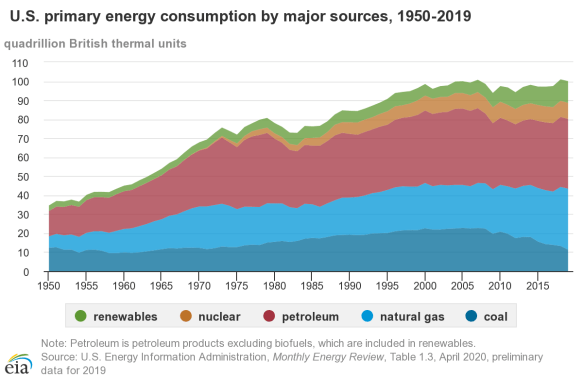
The total energy use by the United States in 2019 was 100 quadrillion BTU (British Thermal Units), which is equivalent to 1.055×10^20 Joules. Averaged out over the 31,557,600 seconds in a year implies a use rate of 3.34×10^12 Watts during 2019.

From the above two observations, we can deduce that the current rate of Biosphere warming on a yearly basis is equivalent to the yearly energy use in 2019 of 907 United States of Americas.

The total increase in the heat energy of the Biosphere since 1910 is 5.725×10^24 Joules, with a corresponding increase of its temperature by 1°C. That heat energy increase over the last 110 years is equivalent to 54,260 years of U.S. energy use at its 2019 amount, per year.

So, today the Biosphere is warming at a rate equivalent to it absorbing the total energy used by the U.S. in 2019, every 9 hours and 40 minutes.

In 2008, I estimated the energy of a large hurricane to be 6.944×10^17Joules. [1] Thus, 152 such hurricanes amount to the same total energy as that used by the U.S. during 2019.

The heat energy increase of the Biosphere during 2019 was 9.56×10^22 Joules, with a corresponding temperature increase of 0.0167°C. That heat energy increase is the energetic equivalent of 137,741 hurricanes. Now, of course, that Biosphere heat increase during 2019 did not all go into making hurricanes, but it should be easy enough to see that a small fraction (for a whopping amount) went into intensifying the weather and producing more and stronger hurricanes (and consequent flooding).

Two clear observations from all this are:

– the Biosphere is warming at an astounding rate, even if “we don’t notice it” because we gauge it by the annual change in average global surface temperature (which is in hundredths of degrees °C per year);

– the immense amount of heat added to the Biosphere every year is increasingly intensifying every aspect of weather and climate, and consequently driving profound changes to all of Earth’s environments.

Those environmental changes directly affect habitability, and species viability, because they are occurring at a rate orders of magnitude faster than the speed at which biological evolution can respond to environmental pressures.

What should we do about it all?

That is obvious: ditch capitalism and socio-economic inequities worldwide; ditch all forms of bigotry, intolerance, racism, war and social negativity; form a unified planetary political administration for the management of a socialist Earth; deploy reasonable technical mitigation strategies (like drastic reductions in the use of fossil fuels, transforming the transportation infrastructure); implement very deep and comprehensive social adaptation behaviors (“lifestyle changes,” eliminating consumerism, scrupulously protecting biodiversity, resettlement of populations displaced by permanent inundation or uninhabitable drought and heat, worldwide sharing of food production).

None of this will actually stop global warming, as the amount of carbon dioxide already in the atmosphere (assuming it has a lifetime there of thousands of years [2]) has us programmed to warm by about another 1°C to 2°C within two centuries, even if we immediately and permanently shut off all our greenhouse gas emissions.

But, such an improved civilization would experience the least amount of suffering — which would be equitably distributed — from the consequences of advancing global warming; and it would contribute minimally toward exacerbating future global warming.

Notes

[1] The Energy of a Hurricane
5 September 2008
https://www.counterpunch.org/2008/09/05/the-energy-of-a-hurricane/

[2] Global Warming and Cooling After CO2 Shutoff at +1.5°C
20 June 2020
https://manuelgarciajr.com/2020/06/20/global-warming-and-cooling-after-co2-shutoff-at-1-5c

<><><><><><><>

Global Warming and Cooling After CO2 Shutoff at +1.5°C

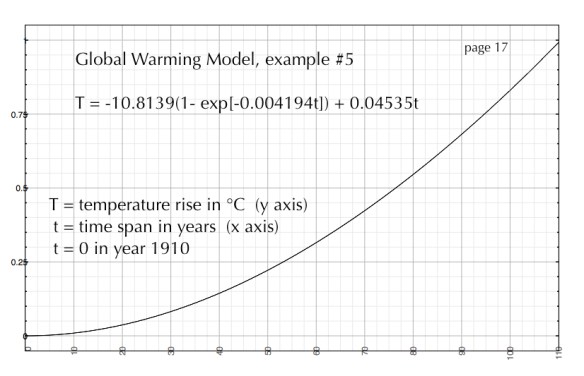
I have done further analytical modeling of global warming, using the same general method described earlier (https://manuelgarciajr.com/wp-content/uploads/2020/05/global-warming-model.pdf).

The question addressed now is: what is the trend of temperature change after an abrupt shutoff of all CO2 emissions just as the net temperature rise (relative to year 1910) reaches +1.5°C, given the lifetime of CO2 in the atmosphere?

For this problem, it is assumed that when the temperature rise (relative to 1910) reaches ~+1.5°C, that:

– all greenhouse gas emissions cease;

– pollution grit (which scatters light) falls out of the atmosphere “instantly” (a few weeks);

– CO2 (greenhouse gas) concentration decays exponentially after emissions shutoff;

– for CO2 lifetimes [e^-1] in years: 20, 50, 100, 238.436, 500, 1,000, 10,000, 100,000;

– temperature sensitivities of cloud cover, ice cover and albedo are as in the previous model;

– all other fixed physical parameters are as in the previous model,
(https://manuelgarciajr.com/2020/06/13/living-with-global-warming/).

In general, for the 8 cases calculated, the temperature increases at a diminishing rate after the emissions shutoff, reaches a peak, then trends downward.

The longer the lifetime of carbon dioxide in the atmosphere, the later and higher is the temperature peak, and the longer it takes to cool back down to the baseline temperature of 1910, which is 1.5°C below the starting temperature for this problem.

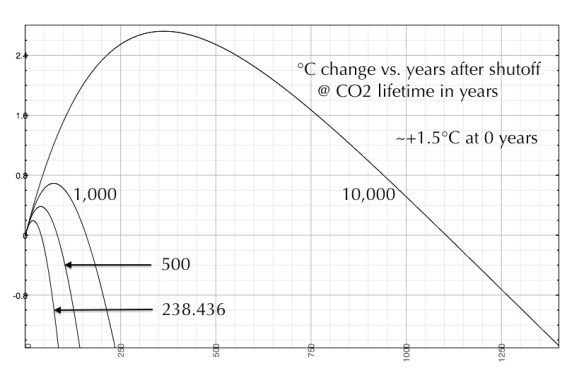
The 4 figures below show the calculated results.


Figure 1: °C change vs. years after shutoff, for lifetimes: 20, 50, 100, 238.436 years.


Figure 2: °C change vs. years after shutoff, for lifetimes: 20, 50, 100, 238.436, 500, 1,000 years.


Figure 3: °C change vs. years after shutoff, for lifetimes: 238.436, 500, 1,000, 10,000 years.


Figure 4: °C change vs. years after shutoff, for lifetimes: 1,000, 10,000, 100,000 years.

It is evident from the figures that if the lifetime of carbon dioxide in the atmosphere is greater than 500 years, that a temperature overshoot above +2.0°C (relative to 1910) will occur before cooling begins.

If the lifetime of carbon dioxide in the atmosphere is greater than about 250 years, it will take over a century for the eventual cooling to reduce average global temperature to its baseline temperature (which is for 1910 in this model).

If the lifetime of carbon dioxide in the atmosphere is greater than 10,000 years, the temperature overshoot will take global warming past +4.0°C (above our 1910 datum) for hundreds to thousands of years, and cooling back down to the temperature at our datum would take millennia.

The clearing of carbon dioxide from the atmosphere is a slow process. The absorption of CO2 by the oceans, and the subsequent dissolution of seafloor sediments (acidifying the oceans) occur over decades to centuries. The uptake of carbon dioxide by weathering reactions in carbonate and silicate soils and rocks occurs over millennia to many tens of millennia.

It took about 200,000 years to clear away the CO2 that caused the +8°C to +12°C global warming spike that occurred 55.5 million years ago, which is known as the Paleocene-Eocene Thermal Maximum (PETM).

Beyond its intrinsic scientific interest, this study confirms what has long been known as the needed remedy: anthropogenic emissions of greenhouse gases must permanently cease as soon as possible in order to limit the ultimate extent and duration of unhealthy global warming.

My notes on the mathematical solution of this problem are available through the following link

Global Warming, CO2 Shutoff

<><><><><><><>

Climate System Response Time

The parameter “beta” is a reaction rate, or frequency, or inverse response time of the biosphere and its climate system. By my calculation, that rate is 1.329×10^-10 seconds^-1, or 0.004194 years^-1, or a response time of 238.436 years. Of course I am not saying the precision of this estimate is as suggested by all the decimal places shown, it’s just that these are the numbers that come out of my calculations, and these numbers are kept to remind me of what choices I made to eventually arrive at this result.

The parameter beta is the product:

beta = (S•a1)/C = [S•(a-cloud – a-ice)]/C,

where:

S = the insolation on the entire disc area of the Earth (1.7751×10^17 Watts),

a-cloud = the temperature sensitivity of the albedo because of the extent of cloud cover (1/°C),
for a positive quantity of: increase of albedo for a given temperature rise (5.715×10^-3 1/°C),

a-ice = the temperature sensitivity of the albedo because of the extent of ice cover (1/°C),
for a negative quantity of: decrease of albedo for a given temperature rise (1.429×10^-3 1/°C),

C = the heat capacity of the biosphere (5.725×10^24 Joules/°C).

A better determination of a-cloud and a-ice would improve the estimate of beta. I chose these quantities to be in the ratio of 4:1, as is the ratio between the cloud reflection portion of the albedo (24%) to the Earth surface portion of the albedo (6%) for the total pristine (pollution free, pre-global warming) albedo (30%).

So, beta incorporates physical parameters that characterize: solar energy, atmospheric and Earth surface reflectivity of light, and the thermodynamics of the mass of the biosphere.

Events and inputs to that Earth climate system are recognized and responded to on a timescale of 1/beta. Events and inputs with timescales less than 1/beta are blips whose impact will become evident much later, if they are of sufficient magnitude and force. Events and inputs of timescales longer than 1/beta are “current events” to the biosphere’s thermodynamic “consciousness,” and act on the climate system as it reciprocally acts on them over the course of the input activity.

Turning a large ship around takes advanced planning and much space because it’s large inertia tends to keep it on its original heading despite new changes to the angle of its rudder. Even more-so, changes in the direction of Earth’s climate, which may be sought with new anthropogenic rudder angel changes — like drastic reductions of greenhouse gas emissions — will require fairly deep time because of the immense thermodynamic inertia of that planetary system.

This means that the climate system today is responding to the “short time” impulses it was given over the previous two centuries or more; and that both the more enlightened and most stupid impulses that we give it today could take several human lifetimes to realize their full response. We are dealing with Immensity here, and our best approach would be one of respect and commitment.

<><><><><><><>

Global Warming After 1.5°C Without Emissions

If greenhouse gas emissions stop just as the temperature rise (relative to 1910) reaches 1.5°C, what is the projected trend of temperature rise (or fall) after that point in time (year)?

[This scenario presumes an infinite lifetime of CO2 in the atmosphere. So it is the extreme of pessimism. The effect of finite lifetimes of CO2 in the atmosphere is shown in later work, at https://manuelgarciajr.com/2020/06/20/global-warming-and-cooling-after-co2-shutoff-at-1-5c/]

If greenhouse gas emissions ceased entirely in the year 2047 (in 27 years), just as the relative temperature was nearly 1.5°C above that of 1910, then the subsequent trend of relative temperature would still be a rise but at a decreasing rate over time, and with an asymptote of 6.2877°C, which would essentially be achieved by the year 3160. Projections here are that for

year 2120 (in 100 years):
with same emissions rate after 2047, temperature rise = 3.2°C,
without any emissions after 2047, temperature rise = 2.75°C,

year 2185 (in 165 years):
with same emissions rate after 2047, temperature rise = 5°C,
without any emissions after 2047, temperature rise = 3.6°C.

The “no emissions” asymptotic temperature rise of ~6.29°C (by year 3160) would mean the average global temperature would be comparable to that of 55.5 million years ago at the very beginning of the upswing in temperature during the Paleocene-Eocene Thermal Maximum (PETM). The PETM began at a temperature about +4°C above that of our 1910 datum, and shot up to somewhere in the vicinity of +8°C to +12°C above it, and even possibly +16°C above it. It then took 200,000 years for the “excess” atmospheric CO2 to be cleared away by rock weathering, and the average global temperature to return to +4°C above our datum. This all occurred during the early Eocene geological epoch (which occurred between 56 to 33.9 million years ago).

In the post 2047 “no emissions” model used here, the albedo (the light reflectivity of the Earth) would still be higher than today because of increased reflective cloud cover, because of higher temperature.

Though the fallout of light-reflecting pollution grit would occur quickly in and after 2047, which is an albedo-reducing (warming) effect, it is not considered significant in relation to the reflective effect of the temperature-enhanced cloud cover (a cooling effect). The Earth’s albedo is dominated by cloud cover.

The temperature-enhanced reduction of ice cover (an albedo-reducing and thus warming effect) is always insignificant in comparison to the effect of cloud cover.

The infrared (heat) absorptivity (parameter F in the model) remains unchanged after 2047 because no new greenhouse gases are added to the atmosphere after that year (hypothetically), and because carbon dioxide (CO2) remains present in the atmosphere for a very long time (once the oceans are saturated with it), on the order of 150,000 years or more.

As noted previously (in “Living With Global Warming”), because of the immense thermal inertia of the biosphere and its climate system, the effect of an abrupt cessation of greenhouse gas emissions would come on slowly over the course of hundreds of years [an e-folding time of 240 years].

As will be evident from Figure 3, below, if we cared to limit temperature rise as much as possible for the sake of future generations, we could never cease emitting greenhouse gases too soon.

On the basis of the modeling described here, it seems impossible to ever limit the ultimate rise of temperature to below +2°C relative to 1910.

If we ceased all greenhouse gas emissions this minute in the year 2020, we might be able to keep the average global temperature from ever rising above +5.8°C, relative to 1910, in the distant future.

It will be interesting to see what the state-of-the-art supercomputer numerical models project as possible future “no emissions” temperature rises, as those models are further refined from today.

Technical Details

The technical details of how I reached these conclusions now follow. This discussion is a brisk and direct continuation of

Living With Global Warming
13 June 2020
https://manuelgarciajr.com/2020/06/13/living-with-global-warming/

For a description of the parameters used in my model, and their numerical values, see

A Simple Model of Global Warming
26 May 2020
https://manuelgarciajr.com/wp-content/uploads/2020/05/global-warming-model.pdf

The previous model of temperature rise relative to 1910 is called “example #5” because it was the 5th numerical example devised from the general solution of the relative temperature rate-of-change equation. For that model, at relative time =137 years (for year 2047, which is 137 years after 1910):

T = 1.4867°C, temperature rise relative to 1910,

A = 0.5226, albedo,

F = 0.5931, infrared (heat) absorptivity.

If greenhouse gas emissions cease entirely in year 2047 (at 137 years of relative time), then:

ap = 0, (grit pollution enhancement of albedo over time ceases),

fp = 0, (increasing greenhouse gas pollution enhancement of heat absorptivity over time ceases),

and the temperature change trend continues after t = 137years with:

T(at t=137) = 1.4867°C, (the “initial” relative temperature at t=137),

A = 0.5226 + 0.004286T, (albedo after t=137 is only dependent on relative temperature: clouds),

F = 0.5931, (heat absorptivity is unchanged after t=137, greenhouse gases persist, but none added),

alpha = 0.019919 °C/year, (new value),

beta = 0.004194 year^-1, (unchanged),

gamma = 0, (since strictly temporal increases/effects of pollution have ceased).

The relative temperature from t=137 on is now given by:

T(t≥137) = 1.4876°C + (4.801°C)[ 1 – exp(-0.004194[t-137]) ].

Figure 3: Relative Temperature Change after 2047 (1.5°C) w/o Greenhouse Gas Emissions

Note the following points on the “no emissions” relative temperature curve:

for t=210 (year 2120), T=2.75°C instead of 3.2°C,

for t=275 (year 2185), T=3.6°C instead of 5°C,

for t=1250 (year 3160), T=~6.28°C

The “no emissions” relative temperature curve after 1.5°C has an asymptote of 6.2877°C.

Note

For descriptions of the PETM, see:

Paleocene-Eocene Thermal Maximum
https://en.wikipedia.org/wiki/Paleocene%E2%80%93Eocene_Thermal_Maximum

Ye Cannot Swerve Me: Moby-Dick and Climate Change
15 July 2019
https://manuelgarciajr.com/2019/07/15/ye-cannot-swerve-me-moby-dick-and-climate-change/

<><><><><><><>

Living With Global Warming

I modeled mathematically the thermal imbalance of our biosphere, which we call global warming, so as to gain my own quantitative understanding of the interplay of the two major effects that give rise to this phenomenon. This is a “toy model,” an abstraction of a very complicated planetary phenomenon that teams of scientists using supercomputers have been laboring for decades to enumerate in its many details, and to predict its likely course into the future.

The result of my model is a formula for the history of the rise of average global surface temperature. The parameters of the model are ratios of various physical quantities that affect the global heat balance. Many of those physical quantities are set by Nature and the laws of physics. A few of those parameters characterize assumptions I made about physical processes, specifically:

the degree of increase in Earth’s reflectivity of light because of an increase of cloud cover with an increase of temperature,

the degree of decrease in Earth’s reflectivity of light because of a decay of ice cover with an increase of temperature,

the rate of increase in Earth’s reflectivity of light because of the steady emission of air pollution particles,

the rate of increase of the infrared radiation absorptivity — heat absorptivity — of the atmosphere because of the steady emission of greenhouse gas pollution.

The parameters for the four processes just mentioned were selected so that a calculated temperature rise history from 1910 to 2020 matched the trend of the data for average global surface temperature rise during that period. That average temperature rise was 1°C between 1910 and 2020.

The two major effects involved in the dynamics of the current global heat imbalance are: heating because of the enhanced absorptivity by the atmosphere of outbound infrared radiation — which is heat; and cooling because of the enhanced reflectivity of the atmosphere to inbound sunlight.

The biosphere is in thermal equilibrium — existing at a stable average global temperature — when the rate of absorbed inbound sunlight is matched by the rate of heat radiated out into space.

Heating

Greenhouse gases emitted into the atmosphere capture a portion of the infrared radiation — heat — rising from the surface of the Earth, and retain it. They are able to do this because the nature of their molecules makes them highly efficient at absorbing infrared radiation. The molecules involved are primarily those of carbon dioxide (CO2), water vapor (H2O), and methane (CH4).

This captured heat is then redistributed to the rest of the atmosphere by molecular collisions between the greenhouse gas molecules and the molecules of the major constituents of our air: nitrogen (N2) and oxygen (O2). The excess atmospheric heat evaporates more seawater, makes more clouds, drives stronger winds and causes more intense rainstorms — such as hurricanes, typhoons and tornadoes — and more frequent and severe flooding.

That excess atmospheric heat is gradually absorbed by the oceans, which as a unit is the most massive and heat retentive component of the biosphere. The biosphere encompasses: the atmosphere, the oceans, and the land surface down to a depth of perhaps 10 meters, below which the temperature variations due to the seasons and the weather do not penetrate significantly. The oceans are the “heat battery” of Planet Earth.

The biosphere naturally emits a portion of the greenhouse gases contained in the atmosphere, but humanity has been adding massively to that load, and at an increasing rate since the beginning of the 20th century. So, global warming is an anthropogenic — human caused — effect.

Natural emissions of greenhouse gases and aerosols include: evaporation from the surfaces of the oceans to form clouds; the ejection of sulfur dioxide gas (SO2) and ash particles by volcanic eruptions; the rising of smoke from wildfires with their loads of carbon dioxide gas and soot; the rising of windblown dust; and the bubbling up of methane gas from the rotting of organic matter on land and at the ocean bottom.

Anthropogenic emissions of greenhouse gases include: carbon dioxide gas (CO2) and soot particles from the combustion of liquid fossil fuels, coal, and biomass; and the emission of organic vapors like: methane from industrialized agriculture, mining, and oil and natural gas drilling; and ozone-depleting gases evaporated from cleaning fluids, solvents, and refrigerants.

Prior to significant anthropogenic emissions, there was a long-term balance between the natural emissions of greenhouse gases and aerosols, and their being rained-out and reabsorbed by the land and ocean surfaces. In particular, carbon dioxide gas is absorbed by green plants, which combine it with water to form sugar — used to supply the metabolic energy for plant growth, and of the animals that feed on plants — in a process called photosynthesis, and which is powered by sunlight.

Cooling

About 30% of the sunlight incident on the Earth is reflected back into space. This light reflectivity by Planet Earth is called the albedo. Droplets of water in the atmosphere — often condensing around particles of soot, ash or dust — form into clouds, which are very efficient light reflectors, and are responsible for 24% of Earth’s reflectivity.

The other 6% of the Earth’s albedo is due to the overall light reflectivity of the surface of the Earth, which is the combined effect of reflections from the surfaces of the ice caps, oceans and lands. The rejection of a portion of the inbound solar light energy is a cooling effect.

The Earth’s albedo increases with a rise in the average global surface temperature, and with an increase in the load of aerosols in the atmosphere. Higher average temperature enhances evaporation and atmospheric humidity, creating more reflective cloud cover. A larger load of aerosols provides a greater number of light scattering particles to interfere with the influx of sunlight.

Aerosols tend to fall out and rain out of the atmosphere within a short period of weeks to months. So their contribution to the albedo — and thus to global cooling or “global dimming” — would be short-lived were they not being continuously replenished in the atmosphere by natural processes like the rainwater cycle, volcanic eruptions and wildfires; and by anthropogenic emissions of gas and aerosol pollution from the industrialized activities of civilization.

Despite the slightly greater cooling effect of Earth’s albedo being increased by the introduction of anthropogenic pollution that scatters light, the biosphere is steadily warming because the greenhouse gases also included in that anthropogenic pollution have the dominating influence.

The only way to slow global warming is to reduce — and ideally eliminate — anthropogenic emissions of greenhouse gas and aerosol pollution.

Temperature History, Past and Future

Figure 1 shows the average global surface temperature rise, relative to the temperature in 1910, for the 110 years between 1910 and 2020. This calculated history matches the trend of the observational data. The temperature rise shown in Figure 1 is 1°C. The Earth in 1910 was experiencing a spatially and temporally averaged global surface temperature that I take to have been 13.75°C (56.75°F). The Earth in 2020 is experiencing a spatially and temporally averaged global surface temperature that I take to be 14.75°C (58.55°F).

Figure 1: Average Global Surface Temperature Rise between 1910 and 2020
(°C of temperature rise vs. relative time in years)

Figure 2 shows the average global surface temperature rise, relative to the temperature in 1910, for the 210 years between 1910 and 2120. Obviously, the temperature history beyond 2020 is a projection, and it is based on a continuation of the same conditions — which are reflected in a constancy of the parametric values used in my model calculation for between 1910 and 2020 — beyond 2020 for another 100 years. This is a projection of the consequences of “business as usual.”

Figure 2: Average Global Surface Temperature Rise between 1910 and 2120
(°C of temperature rise vs. relative time in years)

Three points to be observed in Figure 2 are the temperature rises of:

1.5°C (2.7°F) by 2047 (in 27 years),

2.0°C (3.6°F) by 2070 (in 50 years),

3.2°C (5.76°F) by 2120 (in 100 years).

A temperature rise of 2°C has been declared as the must-never-exceed “redline” on our global thermometer because it is seen by the widest range of climate scientists, earth scientists, biologists, ecologists and evolutionary biologists, as a threshold beyond which the Earth’s climate would run away to conditions inimicable to human and non-human habitability and survival, without any possibility of alteration by human restraint or human action.

A temperature rise of 1.5°C has been declared as the realistic upper limit humanity could allow itself to tolerate if it still wished to slow the rate of subsequent global warming, by the drastic reduction of its anthropogenic emissions of atmospheric greenhouse gas and aerosol pollution.

Responsiveness of Earth’s Climate System

By my calculation, if magically all emissions of greenhouse gases and pollution grit ceased immediately today, it would take a minimum of 9,000 to 11,000 years for the excess 1°C in the biosphere to dissipate and thus return Earth to the climate we had for 10,000 years up to about 1910. The actual recovery time could be much longer. [This estimate is based on the thermal diffusivity of seawater.]

Because the Earth’s biosphere and its climate are immense systems with immense inertia, Earth’s recognition of our hypothetically abrupt cessation of greenhouse gas emitting, and Earth’s reaction to that cessation with a climatic response — a slowing of global warming — could take over 200 years to become noticeable. [This estimate is based on my calculated e^-1 exponential decay time of 240 years.]

The timescales of the planetary processes whose interactions produce climate are much longer than those of individual human attentiveness or of current societal preoccupations.

How Should We Respond?

The physics is clear, whether reflected by my simple analytical toy model, or by the immensely intricate state-of-the-art supercomputer numerical models by the many climate science institutes.

How global warming — as a complex of interrelated physical phenomena — will affect us can be estimated by climate scientists from their models. What we should do about the present and anticipated effects of global warming remains an open question that is beyond physics, and whose answer rests entirely on human choice.

What aspects of human and non-human life do we consider essential to protect and preserve? What degree of commitment are we willing to make to strategies for the continuation of civilization that require an equitable sharing of the new burdens imposed on human activity by increases of global temperature? In short, what kind of people do we want to be as we all live out our lives in a globally warming world?

It is easy to imagine many utopian or dystopian responses to global warming. We — as a species — are completely free to choose the type of cooperative or uncooperative collective future that we wish to inhabit, for as long as Planet Earth allows us to enjoy its hospitality.

Note

If you wish to examine my global warming model for yourself, you can take a copy of it from:

A Simple Model of Global Warming
26 May 2020
https://manuelgarciajr.com/wp-content/uploads/2020/05/global-warming-model.pdf

<><><><><><><>

Global Warming is Nuclear War

<><><><><><><><><><><><><><><><><><><><><><><><><><><><><><><><>

Global Warming is Nuclear War

The average global surface temperature rose by 1°C during the 110 years between 1910 and 2020.

During the 50 years between 1910 and 1960, the average global temperature rose by 0.25°C, an average rate-of-increase of 0.005°C/year. Another 0.25°C of biosphere heating occurred during the 25 years between 1960 and 1985, a rate-of-rise of 0.010°C/year. During the 20 year span between 1985 and 2005 another 0.25°C of temperature was added, a rate-of-rise of 0.0125°C/year. During the 15 year span from 2005 to 2020 another 0.25°C of temperature rise occurred, with an average rate-of-rise of 0.0167°C/year.

While the average temperature rise of 0.25°C was the same for each of the four intervals, the first (between 1910 and 1960) required 45.5% of the 110 years between 1910 and 2020; the second (between 1960 and 1985) only required 22.7% of the 110 years; the third (between 1985 and 2005) required the smaller fraction of 18.2% of the 110 years; and the most recent period (between 2005 and 2020) took the smallest fraction of 13.6% of the 110 years.

Given that a 1°C rise of the temperature of Earth’s Biosphere (EB) is the equivalent of it absorbing, as heat, the energy yield of 109 billion Hiroshima atomic bomb explosions, we could imagine the EB being bombarded by an average of 1 billion Hiroshima bombs per year between 1910 and 2020 (within 109 year-long intervals). If that yearly bombardment were done uniformly, it could represent 2 Hiroshima bomb explosions per square kilometer of the Earth’s surface once during the year; or it could represent one Hiroshima bomb explosion per day in each 186 km^2 patch of the Earth’s surface, for a worldwide bombing rate of 2.74 million/day. Global warming is very serious!

Let’s refine this analogy so it reflects the acceleration of global warming since 1910.

The 27.25 billion Hiroshima bomb equivalents of heating that occurred between 1910 and 1960 would represent a bombing rate of 545 million/year; or 1.5 million/day spaced out at one daily explosion per 342 km^2 patch of the Earth’s surface.

The 27.25 billion Hiroshima bomb equivalents of heating that occurred between 1960 and 1985 would represent a bombing rate of 1.09 billion/year; or 3 million/day spaced out at one daily explosion per 171 km^2 patch of the Earth’s surface.

The 27.25 billion Hiroshima bomb equivalents of heating that occurred between 1985 and 2005 would represent a bombing rate of 1.36 billion/year; or 3.73 million/day spaced out at one daily explosion per 137 km^2 patch of the Earth’s surface.

The 27.25 billion Hiroshima bomb equivalents of heating that occurred between 2005 and 2020 would represent a bombing rate of 1.82 billion/year; or 5 million/day spaced out at one daily explosion per 103 km^2 patch of the Earth’s surface.

The heating rate for the 1°C temperature rise of the EB since 1910, averaged on a yearly basis, was 5.725×10^24 Joules/110years, or 5.2×10^22 Joules/year, or 1.65×10^15 Watts of continuous heating. This rate of heat storage by the EB (into the oceans) is only 0.827% of the continuous “heat glow” given off as infrared radiation by the EB (mainly at the Earth’s surface), which is 1.994×10^17 Watts at a temperature of 288.16°K (Kelvin degrees; an absolute temperature of 288.16°K = 15°C+273.16°C; absolute zero temperature occurs at -273.16°C).

If we were to imagine impulsively infusing the EB with the same amount of energy, by a regular series of “heat explosions” each of energy release equivalent to the Hiroshima bomb, then the 1 billion explosions per year (the 109 year average) would have to occur at a rate of 31.7 per second.

Atomic bombs release their energy explosively within 1 microsecond, representing a radiated power of 5.25×10^19 Watts for an energy release equivalent to the Hiroshima bomb yield (5.25×10^13 Joules). In this hypothetical exercise, I am lumping all the atomic bomb explosive yield into heat, but in real atomic explosions energy is released in a variety of forms: heat, nuclear radiation (gamma rays, energetic neutrons, X-rays, radioactive material) and blast pressure. The energy forms emitted by atomic bomb explosions ultimately heat the materials they impact and migrate through, and this is why I lump all of the bomb yield as heat.

An explosion sphere with a 56.4 centimeter diameter (22.2 inches) radiating heat at 5.25×10^19 Watts during a burst time of 1 microsecond would present a 1m^2 surface area at a temperature of 5,516,325°K = 5,516,051°C. Imagine 32 of these popping into existence at random points around the world during every second of the day and night since 109 years ago. We would certainly consider that form of global warming a crisis deserving our attention.

Because the invisible low temperature heat glow style of global warming that we actually experience does not rudely punctuate our lives with random blasts of such intense X-ray conveyed heat that any human standing nearby would simultaneously be vaporized while the molecules of that vapor were atomized and those atoms stripped of all of their electrons down to the atomic cores, we ignore it. But the heating effect on the biosphere is energetically equivalent to what we are causing with our greenhouse gas and pollution emissions.

Thermodynamically, we have greenhouse gas-bombed out of existence the pristine biosphere and its habitable climate that first cradled and nurtured the infancy of our species 2000 centuries ago, and then fed and protected the development and growth of that fragile chimera we call “civilization,” which our potentates have been proudly boasting about for at least 8,000 years. And we’re still bombing, now at an ever increasing rate.

All of the numbers quoted here come out of the results described in my report “A Simple Model of Global Warming” that I produced to help me understand quantitatively the interplay of the major physical effects that produces global warming. I invite both the scientists and the poets among you to consider it.

Global Warming Model

70% or less of the sunlight shining onto the Earth reaches the surface and is absorbed by the biosphere. From this absorbed energy, in combination with the presence of water and organic material, all life springs. The oceans, which cover 70.2% of the Earth’s surface and comprise 99.4% of the biosphere’s mass, form the great “heat battery” of the planetary surface. All weather and climate are generated from the heat glow of that battery. A portion of that heat glow, equivalent to the solar energy absorbed, must escape into space for the planetary surface to remain in heat balance, at a constant average temperature. For that temperature being 15°C (59°F), 62.31% of the heat glow must escape.

30% or more of the incident solar energy is reflected back into space, with 24% of that reflection by clouds, and 6% of that reflection from land and ocean surfaces. While snow and ice are the most nearly perfect reflective of such surfaces, they only cover 10% to 11% of the planet and that coverage is slowly being reduced by global warming, increasing the solar heating.

Our introduction of greenhouse gases and pollution particles into the atmosphere has added to the already existing load of naturally emitted humidity, organic vapors and grit from volcanic eruptions and windblown dust. These components of the atmosphere absorb and retain heat (infrared radiation), blocking some of the necessary heat glow loss, and thus warming the planet. The increasing accumulation of these components — because a warmer world has higher humidity producing more clouds, and because of our continuing emission of atmospheric pollutants — scatter an increasing portion of the incoming sunlight back into space, which is a cooling effect called “global dimming.” The imbalance of all these effects is dominated by warming and the biosphere’s temperature is rising at an accelerating rate.

My life is a race against the clock of a certain though indeterminate finality. The COVID-19 pandemic has made me very conscious of this inevitability. After seven decades of existence I cannot do everything I want, in terms of living, fast enough. This is not irrational terror, it is awakened appreciation and understanding. There is all of Shelley yet to read, and Keats, and so many more; and so many more birds and flowers, and daylight and nighttime beauties of the Nature to see, and so many more differential equations and physical problems to solve, to not want to go on living. The urge for continuation is innate, genetically programmed, whether in robotic virus particles or in cognitive life forms like cats and human beings. For me, that cognition includes the irrational emotional desire to combat global warming so that future generations of all Earth’s life forms have decent chances of continuing.

<><><><><><><>

<><><><><><><>

Endgame For Green Utopia

<><><><><><><><><><><><><><><><><><><><><><><><><><><><><><><><>

Endgame For Green Utopia
[REVISED, EXPANDED, IMPROVED, 12 May2020]

On these two opposing types of responses to the movie “Planet Of The Humans”
(https://planetofthehumans.com/):

PRO: “The key, however, is that all these [‘greenish’] energy policies have to be carried out after capitalism has been wiped out and under conditions where production is based strictly on use.“

CON: “This documentary is trashy fake news. It’s Trumpian in its disdain for the facts…, they point away from real climate action solutions (such as renewable energy infrastructure) and peddle fascist snake oil of population growth i.e. advocate ecofascist genocide…Meanwhile, those of us who aren’t raving ecofascist lunatics will continue to fight to change society.”

Dreams of Utopias and illusions of self-importance die hard, even in the face of reality. Nature doesn’t care about how we fantasize; it just keeps on with its grand cycles, which those of global heating, environmental destruction and species extinction are now overstimulated by us, homo sapiens. The fundamental question here is: how good of an equitable world society could we energetically have, and by ‘greening it’ can we limit global warming?

PART 1:

The best we could possibly do would be to equalize the standard of living (Human Development Index) worldwide to HDI=0.862 (the range is from 0.28 for the poorest, to 0.97 for the richest nations), with a per capita electrical energy use of u=4000 kWh/c (kilowatt-hours-per-year/capita). The world average by nation (in 2002, and similar now) was: HDI=0.741 at u=2465 kWh/c. The U.S.A. had HDI=0.944 at u=13,456 kWh/c (a rich highly developed country). Niger had HDI=0.281 at u=40kWh/c (a poor underdeveloped country).

The recommended leveling is for nations with u>4000kWh/c to REDUCE energy use (a.k.a economic activity AND militarism), and nations with u<4000kWh/c to INCREASE energy use ENTIRELY APPLIED to raising living conditions (a.k.a. human-centered health and welfare: “socialism”).

This means world socialist government and no wars, and no nationalism.

Examples of enlightened HDI=~0.861 countries (ranked by energy efficiency) are Malta (HDI=0.867), Czech Republic (HDI=0.874), Estonia (HDI=0.853). There is no excuse for a nation to expend more than u=6560kWh/c, because that was Ireland’s usage and it had an HDI=0.946 (and a phenomenal energy efficiency as I calculate it).

All of this is to equalize the experience of whatever is going to happen to humanity because of geophysical changes (“global warming”).

My numbers for the above come from the following linked analysis (using 2002 data).
https://manuelgarciajr.com/2019/06/09/linking-energy-use-and-human-development/

PART 2a:

From where do we source that energy powering the world-equalized “decent life”? Obviously, we use the fossil fuel and nuclear power infrastructure that we have now to power a maximum effort “full speed ahead” program of developing, building and installing greenish energy technology based on:

– solar (from light-to-heat in water, oil and brine slurry pipes; and also photovoltaics but that is materially limited for the needed exotic elements),

– wind (especially offshore),

– hydro (using existing dams-plus-reservoirs as “pumped storage” facilities, so “excess” solar energy collected during the day pumps water “uphill,” which can then be released “downhill” through the turbo-generators to produce nighttime electricity),

– wave/tidal as possible (without wrecking important inter-tidal bio-zones),

– energy conservation by building/home design (both for insulation, energy capture and greenhousing),

– energy conservation by design of appliances and the mechanical and thermal systems used industrially and for personal living,

– also a necessary transformation of our transportation sector (for bicycles, trolleys, trains, ships even with sails; and bye-bye to most planes, most cars especially big-engined SUVs and trucks, cruise ships, and all that high-waste military gear),

– also necessary is a transformation of agriculture to localized small organic multiculture farms, and away from international-aimed large oil-chemical stimulated monoculture agro-factories/feedlots/plantations.

PART 2b:

As greenish energy sources come on-line, an equivalent generating capacity of fossil and nuclear infrastructure is taken off-line AND SCRAPPED (and materially recycled/reprocessed).

The goal is to always increase the proportion of greenish technology and always decrease the proportion of old energy technology, while keeping the total energy generation such as to provide u=~4000kWh/c worldwide (to maintain HDI>0.862 worldwide).

It will never be possible to eliminate all of the old energy technology and still maintain the decent level of HDI “we” experience and is the moral right of all 7.78B (and growing) of Earth’s people to experience.

Note that fertility rates decrease (they are already negative in some rich countries) as HDI increases; so the rate of population growth will diminish as higher standards of living are widely experienced; with greater physical, heath, child, and economic survival and security, as well as education, provided socialistically worldwide.

ENDGAME:

Global warming would most likely still continue, but at a slower pace, if given all the above. So the endgame is to equalize the experience of “the geophysical inevitable” (whatever it actually ends up being), while always striving to increase energy efficiency so as to maximize HDI given the energy used.

It seems PHYSICALLY POSSIBLE to have a very high standard of living worldwide (HDI~0.9) with a per capita energy use that is at least 3x less (or, at 1/3 current US-level usage) to 7x less (or, at 1/7 current usage by the most profligate) of ‘rich, energy-wasting nation’ usage.

But global warming (the buildup of greenhouse gases in the atmosphere) may be too far advanced to ever stop by throttling back or even eliminating human (economic) activity; though undoubtedly it could be noticeably slowed by such cutbacks, as has been vividly demonstrated in a very short time by the COVID-19 economic slowdown that has visibly reduced pollution, and afforded greater freedom to wildlife (seen roaming in emptied city streets around the world!).

All of this would mean the ‘best world available’ for ‘everybody’ for as long as it is energetically possible to maintain it. And if human extinction is ultimately unavoidable, then we’ll all go together as brothers and sisters of equal rank.

Now to all who would say that this “all in” paradigm is so psychologically and politically improbable that it will never happen, I say fine, I won’t argue it, but realize that in order to accurately and realistically gage the actual (really potential) value of whatever your scheme or dream for Utopia is, it is essential to know how to calculate what is POSSIBLE within the limits imposed by geophysics (the laws of physics and the workings of Nature) given the natural resources sustainably available from Planet Earth (this is to say without the degradation of its environments and biodiversity).

One small example. Today it is possible to use an ‘app’ on your smart-phone to alert your local coffee shop to prepare your preferred caffeinated concoction, and pay for it electronically over the vast internet-banking computer network (humming and exhausting heat 24/7), then drive to your Java pit-stop and pick up your to-go order, discarding the container after consuming the contents, which container may end up as soiled waxed paper in a municipal organic compost pile, or as plastic in a solid waste landfill, or at worst as litter.

Imagine that modality of coffee consumption is gone in the “all in” world, and instead you have to appear in person at your coffee shop — perhaps on one of your walks into town, or on the walk home from the trolley stop after work — place your order to a human being manning the Java-preparing technology, pay cash (to eliminate all the internet energy-to-heat waste), and drink your coffee from a washable mug you carry or they provide; or, extravagantly, from a paper cup that easily composts. Even more efficiently, you could buy a bag of coffee beans, take them home and grind them with a handcrank grinder, and make delicious coffee at home.

The quality of life is not diminished by simplifying it energetically, or by relaxing its pace. More likely these increase it.

4000kWh/c HDI>0.862 Equalized Green Utopia World:

The 4000kWh/c Equalized Green Utopia World (HDI>0.862) would need 18% more electrical generation than in 2017 (for a world total of 30,189TWh), and applied with 62% greater efficiency for producing social value than we currently do.

In our current World Paradigm, we only get an average of 62% of the potential social value inherent in the world electrical energy generated, and which social value is also very inequitably distributed. The average 38% of annual socially wasted (SW) electrical energy (9,730TWh total at 1,289kWh/c in 2017) goes into all the Social Negativity (SN) of: capitalist-economic, nationalist-political and prejudicial-societal inequities; militarism and wars; and to a lesser degree some technical inefficiencies of electrical generation and of appliances.

The potential (or Primary) energy (PE) contained in the natural resources (all raw fuels and sources) used to generate the World Energy in 2017 was 162,494TWh; and 25,606TWh of electrical energy was generated that year, which was 15.8% of the Primary Energy. That percentage can be taken as a lower bound on the efficiency of our current conversion of raw energy resources into socially applicable energy, because some quantity of fuel (PE, with some refined) is converted by combustion directly to heat, both to drive heat engines and for industrial and personal uses (e.g., smelting, cooking, heating).

CONCLUSIONS:

For a 4000kWh/c Equalized Green Utopia World “today” we would need 18% MORE usable (electrical and available heat) energy than consumed in 2017, applied with 62% GREATER EFFICIENCY for producing social value than we do currently. Eliminating today’s Social Negativity (SN) would be the energetic equivalent of gaining 38% more energy (in our current paradigm).

But global warming will continue because it is impossible to eliminate all CO2 and greenhouse gases producing processes of energy generation and use. The rate of increase of global warming (the upward trend of temperature) can be reduced as the purely Green (non-CO2 and non-greenhouse gases producing) methods of energy production and use provide a larger portion of the total World Energy production and consumption.

EXCERPTS FROM: World Energy Consumption
[HEAVILY EDITED and AMENDED by MG,Jr]
https://en.wikipedia.org/wiki/World_energy_consumption

According to IEA (in 2012) the goal of limiting warming to 2°C is becoming more difficult and costly with each year that passes. If action is not taken before 2017 [sic!], CO2 emissions would be locked-in by energy infrastructure existing in 2017 [so, now they are]. Fossil fuels are dominant in the global energy mix, supported by subsidies totaling $523B in 2011 (up almost 30% from 2010), which is six times more than subsidies to renewables. So, limiting the global temperature increase to 2 degrees Celsius is now doubtful.

To limit global temperature to a hypothetical 2 degrees Celsius rise would demand a 75% decline in carbon emissions in industrial countries by 2050, if the population is 10 billion in 2050. Across 40 years [from 2010 to 2050], this averages to a 2% decrease every year.

But, since 2011 the emissions from energy production and use have continued rising despite the consensus on the basic Global Warming problem. Hypothetically, according to Robert Engelman of the Worldwatch Institute [in 2009], in order to prevent the collapse of human civilization we would have to stop increasing emissions within a decade [by 2019!] regardless of the economy or population.

Carbon dioxide, methane and other volatile organic compounds are not the only greenhouse gas emissions from energy production and consumption. Large amounts of pollutants such as sulfurous oxides (SOx), nitrous oxides (NOx), and particulate matter (like soot) are produced from the combustion of fossil fuels and biomass. The World Health Organization estimates that 7 million premature deaths are caused each year by air pollution, and biomass combustion is a major contributor to that pollution. In addition to producing air pollution like fossil fuel combustion, most biomass has high CO2 emissions.

FINALLY:

Even with the 4000kWh/c HDI>0.862 Equalized Green Utopia World, global warming would continue at a rate faster or slower depending on how low or high, respectively, a proportion of World Energy is generated and used by purely Green methods. To repeat:

All of this would mean the ‘best world available’ for ‘everybody’ for as long as it is energetically possible to maintain it; and if human extinction is ultimately unavoidable, then we’ll all go together as brothers and sisters of equal rank.

The quality of life is not diminished by simplifying it energetically and by relaxing its pace. More likely it would be increased even in today’s paradigm; and most decidedly so with the elimination of Social Negativity in all its forms, which are so wasteful of energy.

Our potential civilizational collapse and subsequent extinction is up to Nature; but whether that occurs sooner or later, and with what level of shared quality of life we experience our species’ remaining lifetime, as well as its degree of equitable uniformity, is entirely up to us.

<><><><><><><>

<><><><><><><>