E Pluribus Unum

<><><><><><><><><><><><><><><><><><><><><><><><><><><><><><><><>

E Pluribus Unum

Let’s make everybody worthless,
Then we can own them
Without paying a dime!
Think of the profits
Selling everybody everything
For nothing!
They’ll be so jealous
They’ll love us to death,
’N even that we’ll own!
We’ll buy rockets
Go take Mars
So when they get there
They’ll have to buy it from us!
We’ll buy a curtain
To wrap ‘round the Sun
So when they want sunshine
We meter it out
At what the market will bear,
Even more!
We’ll stream their dreams
And fantasies
Even God’s prayers
Will be by subscription
Through our monthly service
Autopay no cancellation!
Human achievement will reach its end
When we are gods
We will be eternity
Our logo slapped on the Universe’s ass,
Even inside Black Holes!
Praise be!
For all to see!

16 October 2020

<><><><><><><>


On Voting U.S.A. 2020

Many Americans are confused, conflicted and concerned about how and for whom they should vote by 3 November 2020. I say “by” because we all have the option to vote by mail, even though that option is imperiled in much of the country by campaigns of voter suppression and mail tampering by the crooks, criminals, cranks, crack-pots, conspirators, conspiracists, con-men and con-molls of the Trump mind-pithed death-cult.

The United States is not a country of overwhelmingly democratic sentiment. It was, after all, founded by a propertied and slave-owning White Male grande bourgeoisie resistant to colonial taxes imposed by 18th century Imperialist England; and it has resisted every popular social movement since to expand the franchise to life, liberty, prosperity, equality under the law, freedom of self-expression, and participation in democratic governance.

It is a country with the most propagandized population on the face of the Earth, ruled by a corporate-owned political class of mediocrities whose worship of power reveal their deepest instincts to be authoritarian, materialistic, careerist, sexist, white supremacist, and xenophobic. As a result, the “right to vote” is a precious commodity however unevenly it may be available and however tenuously it may affect the course of governance in favor of the public good.

The way for a citizenry to safeguard and expand any right they have been granted by their government is to use it massively, often and vigorously, even when the expectation of its transformative power is low. Today, the single best possibility for approaching a socialist-inspired revolution in the United States would be the overwhelming participation in knowledgeable voting by young Americans; those between the ages of 18 and 44, and most particularly those between the ages of 18 and 30. They should “all” register to vote, learn the realities about the available candidates, and vote carefully — not lackadaisically — at every opportunity available to them, so as to advance their interests which are uniformly: anti-war, anti-capitalist, anti-discriminatory, anti-sexist; and socialist, environmentalist, responsive to the global warming climate crisis, and thus most widely beneficial to the overall public good.

The 24% of Americans below the age of 18 are ineligible to vote. Of the older, eligible 76%:

– 16.78% are between 18 and 30 years old,

– 19.82% are between 30 and 44 years old,

– 26.4% are between 44 and 65 years old,

– 13% are 65 years or older (to ~100 years).

Thus, people 18 to 44 years old make up 36.6% of the population, while people 44 years and older make up 39.4% of the population. [1], [2]

U.S. Demographics 2010-2018

Older people are generally more conservative (reactionary) and consistent voters, while younger ones are generally more progressive — but unfortunately for themselves — less consistent, less informed and more lackadaisical voters.

What young Americans need to do in their own economic, political and social interests is to massively, knowledgeably and consistently vote despite having realistically low expectations of any rapid and significant socialist improvements resulting from any given U.S. election. Persistence is required for this “water on stone” process of national transformation.

Youthful outbursts of violent and destructive frustration in reaction to the intransigence of the status quo will be quickly quenched by far superior government firepower (applied with far lower moral restraint); and youthful surrender by escapism into sensory bubbles will simply mire them more deeply in the control and exploitation mechanisms of the ageist ‘corporatocracy’ managing national affairs.

What youth has on its side electorally is numbers, and a commonality of shared dreams and prospects which are being grossly abused by the status quo. The median age of the U.S. population is 38 years. There are as many eligible voters under the age of 46 (38% of the population) as over the age of 45 (38% of the population).

If young Americans can coalesce on a generalized socialist vision and stick with it even as they age, and they persist in applying that vision through their social practices and through the legal yet highly flawed mechanisms of voting in the United States, they would be able to shift the direction of all national policies.

It is important to remember that not all older voters are reactionaries, many of us still retain the dreams and visions of our glory days even if we appear to be feeble wrecks incapable of implementing anything. So the central cohesive element needed for a socialist transformation of the U.S. political economy is a strong popular and continuing socialist mindset — and thus allied progressive civic movements — among America’s young people.

The difficulty in sustaining such a socialist youth movement today is the obvious disincentive given by the nearly-guaranteed piss-poor results of U.S. electoral politics. We all know this is civic failure by design to maintain corporate-funded political corruption administered by careerist mediocrities. Rooting out that cancer will take a long time, perhaps an eternity (that is to say till human extinction). But offering it no resistance would be the ignominious suicide of human decency and our public moral character; and such resistance must necessarily be a multi-generational effort.

So I say vote we must even though it stinks. Offering American youth incentives of utopian hopes as likely outcomes from electoral “victories” in November of 2020, is dishonest. What is honest is telling them to be steeled by Raymond Aron’s observation that: the choice in politics is never between good and evil, but between the preferable and the detestable. Most of the time in U.S. elections we are not offered the opportunity to choose what and who we really want, we are only offered a very constrained set of options that range from the truly detestable to the relatively preferable.

What I see as the greatest failure of civic insight among American voters is them being overwhelmingly identity voters. Most people vote for reflections of themselves — really for reflections of their self-illusions — instead of for “imperfect” candidates of integrity committed to policies aimed at the overall public good. Identity politics is the greatest propaganda coup ever perpetrated on the American public by the American capitalist ‘corporatocracy.’

The drumbeat to vote for who looks like you and sounds like you and feels like you, or like your avuncular uncle, or like your wise and feisty aunt — without a thought as to who actually owns these candidates or what they are financially obligated to actually do and not do once elected — is unrelenting and earsplitting. Just turn on your TVs and computer mass-media streams and you get inundated by that propaganda.

The second greatest failure I see among progressive American voters is the inability of many of them — by their unwillingness — to be pragmatic when it comes to voting. Voting is a gross, slow, cumbersome and inaccurate tool for social change and improvement. It entirely lacks the sharp rapid elegance of a skillfully deployed scalpel (and the political equivalents of scalpels are bloody revolutions, which are more often tragic catastrophes), and it lacks the sustained political pressure of continuing mass movements.

Yes, it is easily possible to have a very far advanced socialist ideal in mind when voting, but no your co-visionary utopian political aspirants and microscopic political parties have no statistically significant probability of gaining any political power. So voting “for them” is purely an act of politically ineffectual egoism: you voted for your self-image. You will feel good about it, and that’s all. Voting for the country means getting over yourself. This is a major hurdle among people indoctrinated since infancy to mindless selfishness — and individualistic “exceptionalism” — by mass media in the service of your exploitative capitalist overlords.

In 2020, Americans have a civic duty and moral obligation to dethrone the Trump and Republican malignancy. Doing so will not immediately usher in a New Socialist Millennium, nor a United Federation of Planets, not any scintillating utopian fantasy of fully enlightened government. It will just be a necessary first step to a long, long projected recovery of political decency in this country. To accomplish that step — and the many needed after it — we have to accept reality, defy the propaganda, get over ourselves, persist in our socialist mass movements acting for political reform and the good of all, and persist in our voting despite its many deficiencies.

So far as I can tell, for the first time in its 208 year history The New England Journal of Medicine, one of the most prestigious peer-reviewed medical journals as well as the oldest continuously published one, has editorialized to endorse an electoral choice in a U.S. election: vote Trump and his partisans out. [3]

They begin that editorial with:

“Covid-19 has created a crisis throughout the world. This crisis has produced a test of leadership. With no good options to combat a novel pathogen, countries were forced to make hard choices about how to respond. Here in the United States, our leaders have failed that test. They have taken a crisis and turned it into a tragedy.”

The list of particulars that follows from this point in the NEJM indictment of the Trump Administration and its allied state government partisans is clear and damning (more than 200,000 Americans have died from Covid-19, a number equivalent to half the American fatalities in World War II); after which they conclude with the following:

“Anyone else who recklessly squandered lives and money in this way would be suffering legal consequences. Our leaders have largely claimed immunity for their actions. But this election gives us the power to render judgment. Reasonable people will certainly disagree about the many political positions taken by candidates. But truth is neither liberal nor conservative. When it comes to the response to the largest public health crisis of our time, our current political leaders have demonstrated that they are dangerously incompetent. We should not abet them and enable the deaths of thousands more Americans by allowing them to keep their jobs.”

To my mind, this should be the central focus of our pragmatic voting in 2020. It’s not about “you,” it’s about “us.”

Given human nature, there will always be new generations of fascists, bigots, religious fanatics, capitalists, careerists, exploiters, would-be slavers and criminals in American political life. So there can never be an enduring final victory of political good over political evil. To socialize a capitalist society, especially one as militarized, regressive and imperialistic as that of the United States, would take much more than just voting. The effort to advance American societal decency must necessarily be a continuing process of indeterminate duration.

Our utopian socialist visions should be used as compass needles to point our efforts past ourselves and in the direction our grudgingly pragmatic and personally imperfect steps should take on the way to that far horizon of our aspirations.

I have already mailed in my ballot. I wish more of my choices could have been reflections of how I like to think of myself, but “you can’t always get what you want.” [4]

NOTES

[1] Demographics of the United States
https://en.wikipedia.org/wiki/Demographics_of_the_United_States

[2] Population of the United States (2020 and historical)
https://www.worldometers.info/world-population/us-population/

[3] Dying in a Leadership Vacuum
The New England Journal of Medicine
8 October2020
https://www.nejm.org/doi/full/10.1056/NEJMe2029812

[4] You Can’t Always Get What You Want
https://youtu.be/krxU5Y9lCS8

<><><><><><><>
Another Model of Atmospheric CO2 Accumulation

I continue to model the accumulation of carbon dioxide (CO2) in the atmosphere, because the topic fascinates me.

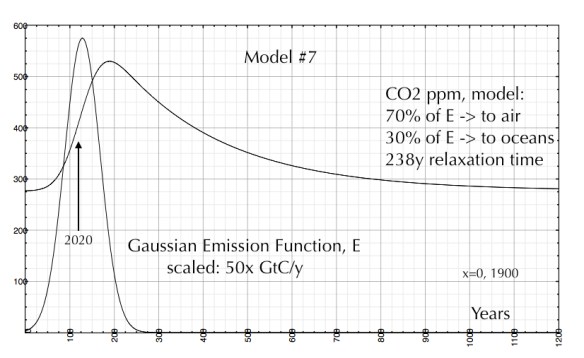
This time, I constructed a global warming scenario driven by a pulse of anthropogenic CO2 emissions (mathematically, a slightly skewed Gaussian function), which launches in the year 1900, peaks in the year 2028, and disappears by year 2150. This model emissions rate function matches the actual trend of the increase of anthropogenic CO2 emissions (data) since the year 2000.

The point of this study is to see how a reduction of anthropogenic emissions, as by the mathematical function assumed, would influence the subsequent reduction of CO2 accumulation in the atmosphere.

The equation describing the accumulation of carbon dioxide in the atmosphere is based on these assumptions:

– 70% of the emissions accumulate in the atmosphere,

– 30% of the emissions are immediately absorbed by the oceans (surface waters),

– the only sink (mainly photosynthesis) is characterized by a relaxation time of 238 years (a characteristic time scale for the absorption process),

– emissions peak in ~2028 at 11.5GtC/y (42.1GtCO2/y) and die away skew-symmetrically thereafter. (GtC/y = giga metric tons of carbon per year; GtCO2/y = giga metric tons of carbon dioxide per year).

Figure 1 shows the resulting projected temporal profile of atmospheric CO2, in units of ppm (parts per million). Also shown is the emissions function, E(x), scaled by 50x GtC/y. The unperturbed baseline concentration is assigned as 277ppm.

The time scale, “x” in years, begins (x=0) at year 1900.

Figure 1: Time Profile of Atmospheric CO2 Concentration, for given Gaussian emissions pulse

In this scenario, the CO2 concentration peaks at 529ppm for years 180<x<200 (years 2080-2100). The continuation of this story out to year x=1200 (year 3100) is shown in Figure 2.

Figure 2: Time Profile of Atmospheric CO2 Concentration, to year 3100

Choosing a longer relaxation time (e.g., ~1000y) would significantly reduce, or eliminate, the decay of the concentration over time (the air CO2 would “never” go away). A long relaxation time would be the case if weathering were the dominant absorption phenomenon (with relaxation time ~12,000 to ~14,000 years), because the photosynthesis and absorption by the oceans sinks were saturated (as was the case during the 200,000 year-long clearing of atmospheric CO2 during the Paleocene-Eocene Thermal Maximum, PETM, 55.5 million years ago).

Figure 3 shows the increase in global temperature, in °C, corresponding to the CO2 concentration profile, shown above.

Figure 3: Average Global Temperature Increase corresponding to model CO2 concentration profile

The global temperature increase above baseline, for this scenario, is projected to peak at +1.94°C in year x=190 (2090); it arrives at +1.5°C at x=142 (year 2042).

It is obvious that if the future reality of anthropogenic CO2 emissions is an increasing trend, that the consequent time profile of atmospheric CO2 concentration will be a continuously rising trend as well. That would mean higher global temperature increases, and sooner, than those shown here.

The Gaussian emissions pulse used here is an “optimistic” scenario in that the annual rate of anthropogenic emissions peaks in 8 years, and then decreases nearly symmetrically to its profile of increase prior to 2028.

This scenario would have us avoid crossing the +2°C threshold. But, the global warming would remain above +1.5°C for the 130 years between 2042 and 2172, undoubtedly degrading many environments.

The model CO2 concentration profile found here matched data (measurements by NOAA); quite well since 2000, and adequately before that to 1960.

The important implication of this model is already well-known: if we begin reducing anthropogenic CO2 emissions very soon, and continue doing so at a steady rate so as to eliminate them completely within a century, we can avoid having Planet Earth warm up by a total of +2°C, relative to the 19th century.

The corollary to this observation is that if we instead continue increasing our CO2 emissions, it will get warmer sooner for longer.

Also, whatever we do (or don’t do) about CO2 emissions, their accumulation in the atmosphere will linger for centuries. The clearing of this atmospheric CO2 will occur on several parallel timescales:

– absorption through photosynthesis (happening daily),

– capture by the surface waters of the oceans over the course of years, decades and centuries (and eventual sequestration at the sea bottom in a surface-to-bottom mixing cycle of millennial time scale), and

– the chemical reactions of rock weathering (on a tens-of-millennia time scale).

Injecting CO2 into the atmosphere can be done instantly; removing it requires a long time.

So, it would be wise to stop emitting it.

The above report, with the addition of figures showing comparisons to data for the trends of emission rate and CO2 concentration prior to 2020, is available here (PDF file).

Gaussian Emission Function & Air CO2

Gaussian Emission Function, and Atmospheric CO2 Accumulation
(Model #7)
4 October 2020
https://manuelgarciajr.com/wp-content/uploads/2020/10/gaussian-emission-function-air-co2.pdf

<><><><><><><>

The Connected, and The Unmoored

<><><><><><><><><><><><><><><><><><><><><><><><><><><><><><><><>

The Connected, and The Unmoored

I saw the sunrise, from pitch black to clear light over the canyon rim this morning. An owl was hooting before the light, the air warming as the dark faded. Heard the birds wake up and each begin its chatter; the hummers buzzing over my head to inspect me before tanking up at the nectar bottle. The turkeys gobbled confidently from across the canyon.

Made French Press coffee. Watched our cats play, stalking and chasing each other on the hill as morning light expanded. We later ate some simple cold cuts, cheeses, bread, pasta salad; cool water.

I played, stumbling with some exponential functions, trying to simulate CO2 buildup in the atmosphere (55.5 million years ago, and also again today), a perennial project. Seems pointless to tell people about it, but it keeps my mind occupied, and I’m curious. That CO2 and its growing heat will be with “us” for centuries, a millennia? (who cares?).

Went out a few times to look at the day, which was lovely, with only a subdued hint of ash haziness from the fires up north. My mother is living with us for a while, waiting it out. She told me of her grandmother who raised her, who was born in the last days of Spanish rule in Puerto Rico, before the 1898 takeover by the Yankee Conquistadores. My mother wishes she could buy the platanos to make pastelón, like her grandmother used to make for her in Río Piedras.

I thought of my father, who would have been 96 on his birthday during these early days of October. I remember the stories he told me of his father’s childhood, spent with his father sheepherding in the Cantabrian Mountains, in the very early years of the 20th century: stories of facing off against prowling wolves, armed with long wooden staffs and Great Pyrenees mountain dogs, of drinking wine from the bota, of wild strawberries, and bagpipes.

Watched a nature video from 26 years ago, about Caribbean sea life, so lovely then. Had Caprese and guacamole (with tortilla chips) for supper, both made to perfection; I handwashed the dishes.

Watched a video (from 30 years ago) on the life and art of Mozart; I always have tears well up when I hear the Lacrimosa.

Life is short, and there is so much to do, so much to experience, even for us lacking the talent, grace and insight of a Wolfgang Amadeus, and I see none of what is worthwhile in the close-in noisy opaque bubbles everyone jams their heads into to plug up their senses with the flickering trivialities and remote dramas of the moment.

The owl, the birds, the turkeys, the cats, the critters who keep out of my sight (but not the cats’s), and later the crickets at night, they all know what is happening at any moment every moment. They have to, to eat, to stay alive; for them paying attention is the essence of living, but so is napping in the sunshine, which they all in their turn do so luxuriantly.

We can be so pitifully disconnected, and most of us always are, for we just don’t notice the whole world changing: drying, melting, burning, receding, dying. It’s no wonder animals look at us with such amazement: “how could they be so clueless?” There’s always a reason I guess, a crisis of the moment, to not get out of your head and wake up to the flow of the world; but that’s just tragic: death. It’s also why people feel so alone, because in fact they are alone in desert bubbles, befuddled, lost castaways, wired to artificiality: empty static.

I realize I’m an anti-social socialist, a hermit socialist, “out of the loop” in every way for sure. And I need to be, it’s best.

My boy black cat — Buster — will bump into my leg at night, when I’m out looking onto the deep sound of the unseen. He understands of course, his connection to the primordial is undimmed by civilization, his wisdom is locked safely in DNA that has been 25 million years in the imprinting, and I appreciate his encouragement.

<><><><><><><>

Burning Thoughts on the Sonoma Fires

<><><><><><><><><><><><><><><><><><><><><><><><><><><><><><><><>

Burning Thoughts on the Sonoma Fires

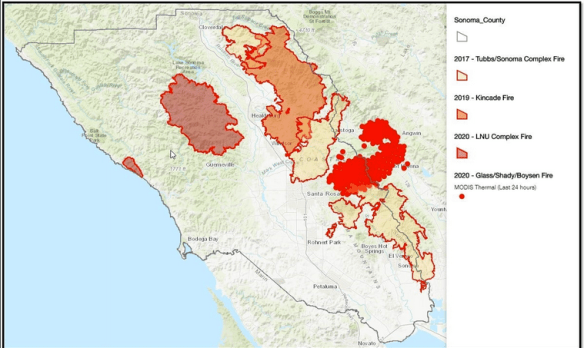
The map shows the fires in Sonoma County, California, USA, during 2017-2020. These were/are all big. My mother had to evacuate in 2017, and stayed with us for 10 days. Today (28 September 2020), I went to get her and bring her here again.

I monitor the internet to follow the progress of the fire (the Glass-Shady fire of 2020 – now – is 0% contained; it started about 2 days ago – see the red blotch). This year I know of 8 people – 5 directly and personally – who have had to evacuate from fires: in Sonoma and Solano Counties, and in Oregon. Many fires in Western America right now, and they occur from earlier in the year, and more frequently, and last longer, and are bigger, with each succeeding year.

Other regions and nations have their own increasing environmental degradation trials and tribulations: droughts, heat waves, crop failures, locusts, storms, hurricanes, floods. My thoughts about all this are rather dark, as reflected in my recent writing.

The gems to be found in all these hard events are the generous and kind actions individuals can take on behalf of others, very often strangers, to help them get through the difficulties and losses. I was fortunate to have two such people help my mother (who is 95) in the first rush to evacuate yesterday. The fact that people, as individuals, can be so decent is what keeps me from condemning all of humanity (being a total misanthrope) because human society has been so adamant to continue failing miserably when it comes to seriously addressing global warming climate change.

In this, my attitude is similar to that of Jonathan Swift, who said he cared not for human society, but appreciated John and Tom and Dick (I paraphrase) because of the very thing I just described: stellar individuals (even if just occasionally so) live among a society we curmudgeons find morally bankrupt, and their good actions are momentary redemptions of that reprehensible mass.

This outlook makes it basically impossible for me to find any interest (or waste any time) on the many frivolous concerns of others, and which are often most on display on that frivolity of social media: Facebook. Sorry about that.

My appreciation for the beauty and organic complexity of Nature remains undimmed, but my interest in the minutia of the daily drama, or the silly entertainments of the last 15 minutes (with shelf lives of 10 seconds), is zero. I can’t help looking at American society as reenacting the fate of Captain Ahab and his crew, so obsessed with their delusions that they could not wake up from them even as they were being drowned by them.

The Romantic in me wants the Next Generation to float free from the doom we’ve programmed ourselves for, like Ishmael floating free atop Queequegs’s coffin; and refashion the World aright. The Realist in me is not so optimistic. But I don’t feel it is fair for me to criticize the Next Generation, whose elders – as American Society – have so basely used and poorly provided for. I had a decent shot at life, and did what I did with it; now it’s their turn, and they should be free to make their own choices, and learn (hopefully) from their mistakes (preferably enjoyable ones) just as I and my predecessors did (well, some of us did).

The Romantic Engineer and Artist in me knows that tackling Climate Change – which means entirely transforming human society worldwide – would be the greatest adventure, and moral and social uplift, that our species could ever have in its history as part of Life-On-Earth, if we “all” had the Zen-like satori (awakening, AHA!) to motivate a joyful coming together to achieve that purpose in all of its many dimensions: personal, political, social, economic, technical, moral, intellectual; the fullest expansion of human potential for everyone.

The Realist in me scoffs at this flight of fancy by the Sappy Curmudgeon, but the Romantic in me still wishes it were not entirely a hopeless dream. Others, I know, have particular and detailed wishful fantasies for our Future, and I have few quarrels with most of them. But I think the simplest life of fulfilling work (self-assigned), safety, security, health, happiness and freedom for artistic and intellectual pursuits; with Nature secure in all its beauty – on this Planet! – is my ideal.

My mother is now afraid that she will be threatened by fires every year. This should not be so, she should be able to live tranquilly tending her roses without such concern. That our governments and societies will not do anything — as we should for the rest of human history — to eliminate such fear (which many people now have) has led me to cancel any sense of allegiance to them, or respect for “the institutions.” Like Jonathan Swift.

<><><><><><><>

Conflict and Choice for Human Survival

<><><><><><><><><><><><><><><><><><><><><><><><><><><><><><><><>

Conflict and Choice for Human Survival

What can you say about people for whom the beauty of Nature does not inspire, and the fear of its destruction does not motivate?

People do not change unless they feel pain. Politics does not allow for social improvements unless first stung by social revolts. The idea of a spontaneous, peaceful and uneventful evolution of social improvement is delusional. Conflicts are necessary before social improvements can arise. The greater the need for those social improvements, the greater the conflicts necessary to open the possibilities for them to be realized.

Such conflicts always involve violence to one degree or another. Realistic proponents of non-violent social agitation know that the minimum violence necessary for them to achieve their goal requires that their people — the non-violent — suffer all the violence generated during their struggle, and which violence is perpetrated by the reactionary elements of society, those opposed to the social improvements sought. The status quo always reacts with violence to maintain itself. In the United States today that status quo is the domination of all aspects of economic, political and social life by White Supremacy and Capitalism. The magnitude of societal violence escalates in a vicious cycle as social reformers increase their own resorts to rebellious violence. Such vicious cycles are civil wars.

So it has been throughout history, and so it seems destined to remain for our species, as long as we are unable — by being unwilling — to renounce such behavior and evolve beyond it.

As of today, it seems that those who aim for the social improvements needed for all of humanity to live through the deterioration of climate brought on by affluent-human-caused global warming, and to eventually reverse it, will have to resort to social conflicts that admit to the inevitability of violence; minimally reactionary violence, and at worst civil wars.

If there is any threat of premature human extinction, it will only come from the escalation of violence in social conflicts with social reformers — revolutionaries — facing reactionary resistance during a time of rapid and severe deterioration of the environmental conditions necessary for human survival.

Since every creature and form-of-life has an instinct and will for survival, the possibility of such extinction will ultimately never deter revolutionaries motivated by global warming climate change, if they determine that the forces of reaction are implacable. Better then to die fighting than relinquish life, liberty and volition, to exploitation and annihilation by the global warming death-cult of intransigent reactionary domination.

As the conditions of life deteriorate for more and more people, an increasing number of them will be willing to make more desperate choices on the conduct of their lives, and on the conduct of their social advocacies.

The optimistic realization here — which is certainly utopian — is that we already have it in our power, as a collective, to make life whole for everybody. We only have to unite together in the choice to do so.

Premature human extinction is only as inevitable as the degree of our commitment to being intransigent in our fractious class-based and bigoted opposition to the species-wide social improvements necessary for our so-called civilization to be reformulated for the equitable benefit of all.

<><><><><><><>

Reducing CO2 Emissions to Reverse Global Warming

<><><><><><><><><><><><><><><><><><><><><><><><><><><><><><><><>

Reducing CO2 Emissions to Reverse Global Warming

We know that Global Warming can be reduced during the years of the century ahead of us if we — our civilization — steadily reduces its emissions of carbon dioxide gas (CO2) into the atmosphere.

Given a specific rate for the reduction of anthropogenic (our CO2) emissions:

— how long will it take to return Earth’s average temperature to its unperturbed pre-industrial level?, and

— how much higher will Global Warming (Earth’s temperature) become before it begins to decrease?

Answering these questions is the subject of my recent study. This work is based on a Carbon Balance Model, which I described in an earlier report. [1]

That model has been further refined in order to address these questions, and the details of that refinement are described in a technical report. [2]

Prior to the buildup of anthropogenic CO2 emissions in the air, the fluxes of CO2 released by the respiration of Life-on-Earth; and the fluxes of CO2 absorbed from the air by photosynthesis, the surface waters of the oceans, and rock weathering chemical reactions; were in balance. That balance is known as the Carbon Cycle.

As the rate and buildup of anthropogenic emissions increased (after ~1750, but particularly from the mid-20th century), the Carbon Cycle was perturbed out of balance, and the magnitude of that imbalance is determined by the difference between two effects: Anthropogenic Sources, and Stimulated Sinks.

The Anthropogenic Sources are:

— the CO2 emissions by the human activities of fossil-fueled energy generation and industry, and

— the CO2 emissions from land use changes (deforestation and its attendant increase of wildfires).

The Stimulated Sinks are the additional absorption of CO2 by photosynthesis and the surface waters of the oceans, because of higher atmospheric concentrations of CO2. At a sufficiently high level of atmospheric CO2 concentration, both these sinks will saturate — stop absorbing CO2. What that “sufficiently high level” is remains uncertain.

The work summarized here includes more realistic (more complicated) models of these source and sink terms in the rate equation for the change of the Carbon Balance over time.

Now I am able to quantitatively link specific rates of the reduction of anthropogenic CO2 emissions, to consequent projected histories of the slowing and then reversal of Global Warming.

Such quantitative linkages have long been featured in the super-computer models of CO2 accumulation in the atmosphere, by the major Climate Science institutes; but now I have my own quantitative version of this correlation, which is analytical (expressed as math formulas, and enumerated with a hand calculator and basic home computer).

Anthropogenic CO2 emissions in year 2020 are 42.2GtCO2/y (42.2 giga-metric-tons of CO2 per year = 42.2*10^+12 kilograms/year). This magnitude of total anthropogenic emissions, E, is the addition of our fossil-fueled and land use emissions.

I considered three cases of the intentional steady reduction of annual human-caused CO2 emissions, which are defined to decrease exponentially. The characteristic decay time of each case is: 40 years (CASE 1, a 2.5% annual reduction), 100 years (CASE 2, a 1% annual reduction), and 200 years (CASE 3, a 0.5% annual reduction).

Emissions would be reduced to half their initial rate in 28 years for CASE 1; in 69 years for CASE 2; and in 139 years for CASE 3.

If each of these reduction plans were alternatively initiated in the year 2020, then:

CASE #1, ∆t=40y:

This trend reaches a peak of 449ppm and +1.32°C in year 2048 (in 28 years); it remains above 440ppm and +1.25°C over the years 2032 to 2064 (between 12 to 44 years from now); then descends to 350ppm and +0.56°C in year 2120 (in 100 years); and 300ppm and +0.18°C in year 2140 (in 120 years).

CASE #2, ∆t=100y:

This trend reaches a peak plateau of 485ppm and +1.6°C over the years 2078 to 2088 (between 58 and 68 years from now); it remains above 480ppm and +1.56°C during years 2066 to 2100 (between 46 and 80 years from now); it descends to 350ppm and +0.56°C in year 2202 (in 182 years); and 300ppm and +0.18°C in year 2225 (in 205 years).

CASE #3, ∆t=200y:

This trend reaches a peak plateau of 524ppm and +1.9°C over the years 2125 to 2135 (between 105 and 115 years from now); it remains above 500ppm and +1.72°C between years 2075 and 2190 (between 55 and 170 years from now); and descends down to 360ppm and +0.64°C in year 2300 (in 280 years).

Message to the Humans

The singular challenge for the progressive political and social elements of our civilization is to awaken the rest of the world — and particularly the “developed” and “developing” high-emissions nations — to a full commitment (demonstrated by action) to steadily and significantly reduce anthropogenic CO2 emissions for the rest of human history.

The sooner such reduction programs are initiated, and the greater the vigor with which they are implemented, the sooner we will begin slowing the advance of Global Warming and its continuing erosion of the habitability of Planet Earth, which humans have enjoyed for over 2 million years, and particularly since the end of the Ice Ages (~11,000 year ago).

With decades to a century of discipline applied to this purpose, we can even reverse Global Warming. The longer we wait to do this, the worse the consequences we will have to suffer through, and the longer it would take to extricate our species — and so many other wonderful forms of Life-on-Earth — from the Hell-on-Earth we are creating by our willful and destructive ignorance.

I can only imagine such major programs of CO2 emissions reductions being synonymous with the economic, political and social uplift of the vast majority of people, because Global Warming is directly caused by the unbounded economic, political and social exploitation of the many by the few.

The fact is that we all live on the same planet, and whatever happens to it — whether worsening conflagration and flooding in the now, or eventual cooling and restoration by human commitment — will affect everybody. There is no guaranteed escape.

The CO2 accumulation model that I have described here is just this old scientist’s way of saying: We can do so much better for ourselves, and our children deserve that we try.

NOTES

[1] A Carbon Balance Model of Atmospheric CO2
11 September 2020, [PDF file]
https://manuelgarciajr.com/wp-content/uploads/2020/09/a-carbon-balance-model-of-atmospheric-co2.pdf

[2] Trends for Reducing Global Warming
15 September 2020, [PDF file]
https://manuelgarciajr.com/wp-content/uploads/2020/09/trends-for-reducing-global-warming.pdf

<><><><><><><>

Anthropogenic CO2 Emissions Are Fate

<><><><><><><><><><><><><><><><><><><><><><><><><><><><><><><><>

Anthropogenic CO2 Emissions Are Fate

I developed a model of Global Warming based on the anthropogenic perturbation of the Carbon Cycle. The essence of this model is a rate equation for the evolution of the carbon dioxide (CO2) concentration in the atmosphere.

The interesting results from this model are projected trends for the CO2 concentration and the average global temperature during the next century. The character of those trends — whether rapid rises, shallow plateaus, or diminishment into the future — depend crucially on the magnitude of our civilization’s emissions of CO2, and whether those anthropogenic emissions increase or decrease with time. In the real world at present, they are increasing.

I have now been able to include the effect of linearly increasing or decreasing anthropogenic emissions into my Carbon Balance Model, which has been significantly improved.

This model also includes the effect of the increase in the rate at which atmospheric CO2 is absorbed by photosynthesis and the surface waters of the oceans, because those absorption rates are increasingly stimulated by the higher levels of CO2 in the air. This process of absorption-enhancement cannot continue indefinitely as the atmospheric CO2 concentration increases, but at what point of elevated CO2 concentration it saturates and then absorption largely shuts down, is unknown.

The third process included in the model is that of the slow absorption of atmospheric CO2 by the chemical reactions of weathering on the surfaces of rocks and soils. CO2 not “quickly” scavenged from the air by photosynthesis or the surface waters of the oceans will stay airborne for 12,000 to 14,000 years. The ~2,500ppm spike of atmospheric CO2 that occurred 55.5 million years ago took 200,000 years to clear away. That geological episode is known as the Paleocene-Eocene Thermal Maximum (PETM). At that time there was no ice at the poles, instead they were jungles and swamps with crocodiles. The global temperature at the peak of the PETM was as much as +12°C to +18°C warmer than in our pre-industrial 18th century.

I made three case studies from this model, called E-growth, E-flat, and E-fall.

E-growth

The E-growth case is driven by a relentlessly steady rise of anthropogenic CO2 emissions, based on the average upward trend of those emissions between years 1960 and 2020.

This trend arrives at 470ppm of atmospheric CO2, and a warming of +1.5°C (above pre-industrialization), in the year 2038 (in 18 years). It arrives 540ppm and +2°C in year 2055 (in 35 years); and it arrives at 800ppm and +4°C in year 2100 (in 80 years).

E-flat

The E-flat case is driven by a constant annual rate of 42.2GtCO2/y of anthropogenic emissions (42.2 giga-metric-tons of CO2 emissions per year), which is the rate in year 2020.

It arrives at 470ppm and +1.5°C in year 2041 (in 21 years); and 540ppm and +2°C in year 2070 (in 50 years); and 600ppm and +2.5°C in year 2100 (in 80 years).

E-fall

The E-fall case is driven by a steady linear reduction of anthropogenic emissions over 40 years: from 42.2GtCO2/y in 2020, to 0GtCO2/y in 2060; a reduction of 1.05GtCO2 every year for 40 years. This amount of annual reduction is 2.5% of the total anthropogenic emissions in year 2020. In this scenario, after year 2060 we would continue our civilization with zero CO2 emissions from our human activities.

This trend rises to 437ppm and +1.23°C during years 2035 to 2040 (from 15 to 20 years in the future) after which both fall. It arrives back down to 407ppm and +1°C in year 2059 (in 39 years); and 320ppm and +0.4°C in year 2100 (in 80 years).

Finally

In this year of 2020, we are presently at 417ppm and +1.08°C.

The math and physics details of this new work, as well as graphs of the trends calculated from it, are shown in the report (PDF file) linked at

A Carbon Balance Model of Atmospheric CO2
11 September 2020

Click to access a-carbon-balance-model-of-atmospheric-co2.pdf


<><><><><><><>

Possible Future Trends of CO2 Concentration and Global Temperature

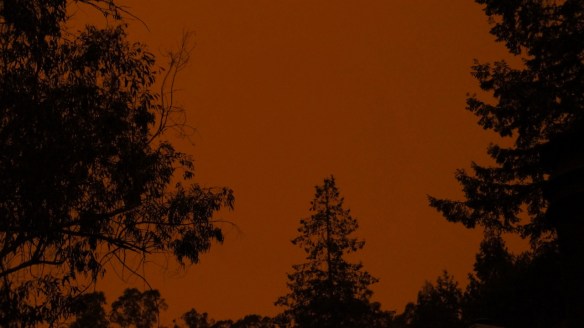
Oakland, California, 10:15 AM, 9 September 2020, “Burning Land Eclipse”

<><><><><><><><><><><><><><><><><><><><><><><><><><><><><><><><>

Possible Future Trends of CO2 Concentration and Global Temperature

Carbon dioxide gas (CO2) has been accumulating in the atmosphere since the dawn of the Industrial Revolution (~1750), because increasingly voluminous fluxes of that gas have been exhausted from the lands and the oceans, and are beyond the capacity of natural CO2 sinks to absorb completely.

Prior to the Industrial Revolution, carbon would cycle through a variety of processes that sustained the continuation of life, death, evolution and rebirth, and that all meshed into one grand balance. That balance is called the Carbon Cycle.

The explosive growth of human activity, numbers, exosomatic power, economic wealth, military overkill, and hubristic political pretensions, all spring from the access to and profligate use of heat-energy liberated from fossil fuels. Carbon dioxide is the exhaust fume from our Promethean exertions for greater conquests — and wealth.

The carbon dioxide exhausted by our civilization’s generation of heat-energy, and from our massive exploitation of once virgin land areas, is an increasingly destabilizing perturbation of the Carbon Cycle. This perturbation is called Anthropogenic Emissions.

The imbalance of the Carbon Cycle reverberates through the natural world in many ways that are increasingly harmful and dangerous to Planet Earth’s habitability for ourselves and for many other animal and plant species. The central reality of this complex of growing threats to the viability of the Biosphere is called Global Warming.

Carbon dioxide gas traps heat radiated towards space, as infrared radiation from the surface of Planet Earth, reducing our planet’s ability to regulate its temperature by cooling to compensate for the influx of solar light that is absorbed by the lands and the oceans, and stored by them as heat.

Because of the existential implications of runaway global warming — as well as the intrinsic fascination to curious minds of such a richly complex and grand human-entwined natural phenomenon — scientists have been studying global warming, and its impact on the biosphere, which is called Climate Change.

While scientists of all kinds are excited to share their findings on climate change and impress their colleagues with their new insights, members of the public are singularly interested to know how climate change will affect their personal futures. Can science offer them clear and reliable answers to their questions — and fears — and provide practical remedies and technological inoculations to ward off the threats by climate change to our existing ways of life?

Science does what it can to offer practical insights and helpful recommendations, and humanity does what it usually does when faced with a collective existential crisis: it hides from the inconvenience of drastically changing its personal attitudes and societal structures, which is in fact the only way it would be able to navigate the majority of Earth’s people through the transition to a new social paradigm; a new, sustainable and harmonious relationship between human life and Planet Earth.

While I am grateful to all the professional climate scientists — and their related life scientists who study many aspects of this complex of geophysical processes and biological organisms and systems — for making known so much of the workings of the globally warming biosphere, I am nevertheless curious to gain a quantitative understanding of it all for myself. To that end, I have devised my own phenomenological thermodynamic “toy models” of global warming. The sequence of my reports charting the evolution of my quantitative understanding of global warming, are listed at [1].

My newest report describes a rate equation for the accumulation or loss of atmospheric CO2 over the course of future time. This equation is derived from considerations of recent data on the Carbon Cycle (from the Global Climate Project), along with some mathematical assumptions about the relationships used to quantify “carbon dioxide sweepers,” the processes that scavenge atmospheric CO2.

The results of this work are projections of possible future histories of the concentration of atmospheric carbon dioxide, as well as a projection of the most likely trend of rising average global temperature.

The complete report on the new work (of which this is just a brief summary) is available at [2].

As is true of all future-casts, we will just have to wait till then to see if they were accurate, assuming we don’t do anything beforehand — collectively — to avoid the worst possibilities.

Such is the dance with the chaos and nonlinearity of the approaching future.

From the general mathematical result of this model, three possible future trends of CO2 concentration history were calculated:

CASE #1, “business as usual,” anthropogenic emissions continue at today’s level indefinitely;

CASE #2, anthropogenic emissions are immediately reduced to the point of holding CO2 concentration constant at today’s level, indefinitely;

CASE #3, anthropogenic emissions are immediately reduced to a trickle, so as to reduce the excess of CO2 in the atmosphere as quickly as possible.

Also, the trend of rising global temperature that accompanies CASE #1 was calculated.

CASE #1 is a pure growth trend, from 407.4ppm to 851.8ppm over the course of about 3,000 years (ppm = parts per million of concentration in the atmosphere).

CASE #2 requires that the anthropogenic emission rate be ~50% of the current rate (or 21GtCO2/y instead of 41GtCO2/y; for the units GtCO2/y defined as giga-metric-tonnes of CO2 emission per year).

This reduced rate of anthropogenic emission would just keep the CO2 concentration at 407.4ppm (from the beginning of 2019) into the near distant future (~1,600 years, and beyond), during which time the excess heat-energy presently in the biosphere would continue to degrade our weather, climate, environments, biodiversity, and planetary habitability.

CASE #3 would clear away the current excess of CO2 in the atmosphere, and then continue to reduce the atmospheric CO2 concentration to a very low level over the course of about 700 years. This would require that anthropogenic emissions be immediately reduced to about one-fifth (1/5) of their current levels, and maintained at or below that level indefinitely.

The implication is clear: if we wish to reduce the amount of CO2 in the atmosphere we have to reduce our anthropogenic emissions well below 50% of what they are today, maintain that discipline indefinitely, and wait centuries to millennia to achieve a significant reduction.

The global temperature excursion (above the average global temperature of the pre-industrial world) that accompanies CASE #1 rises steadily, though at a diminishing rate, from +1°C in 2019, to nearly +2.6°C in 2300 (~300 years). Along the way it passes +1.5°C in year 2065 (in ~40 years), and it passes +2°C in year 2120 (in ~100 years).

Global temperature would rise higher and sooner if the absorption rates of CO2 by photosynthesis and the oceans did not continue increasing — as they do today — in proportion to the increases in the atmospheric concentration of CO2. At present, increased CO2 concentration stimulates increased CO2 absorption. The model here assumes this is always true, but in reality this “sink growth” effect may saturate (be limited) at some higher level of CO2 concentration. Whether any such saturation limit on the absorption (sink) rate exists or not, is unknown.

If the +1.5°C and +2°C temperature rise milestones are truly to be avoided then it is imperative that anthropogenic emissions be drastically reduced immediately. As yet there is no sign that such reductions will occur.

The physics and mathematics of all this are fascinating, but the implications for civilization and life-on-Earth are stark.

NOTES

[1] One Year of Global Warming Reports by MG,Jr.
15 July 2020
https://manuelgarciajr.com/2020/07/15/one-year-of-global-warming-reports-by-mgjr/
Updated to 7 September 2020

[2] A Rate Equation for Accumulation or Loss of Atmospheric CO2
5 September 2020 (revised 9 September 2020)
[take a copy]
Rate Equation for Atmospheric CO2 (revised)

or view directly:

Click to access rate-equation-for-atmospheric-co2-revised.pdf

<><><><><><><>

Facing Extinction, My View

<><><><><><><><><><><><><><><><><><><><><><><><><><><><><><><><>

Facing Extinction, My View

I read Ms. Catherine Ingram’s essay:

Facing Extinction
https://www.catherineingram.com/facingextinction/

The data she cites seems realistic and reasonable;

the inferences she draws about potential, likely and current forms of consequential social and societal breakdown seem logical;

the observations she makes about the feelings, reactions, sadnesses and denial many people will respond with to the facts about global warming and biodiversity loss — and the dire implications for the long-term health and even survival of the human species — also seem rational and accurate;

and the recommendations she makes for managing one’s own state-of-mind — consciousness, psychology, expectations, mood, calmness — are helpful.

My comments on Ms. Ingram’s essay

You have to remember that (1 to 4):

1. Despite science being able to make credible estimates (from climate and socio-economic models with super-computers) about the pace at which the climate and environment will degrade, nobody really knows how quickly and to what extent society will degenerate. In 10 years time, life might be worse than we would imagine that future now, or it could be better than our fearful projections today. Who knows?

2. Looking back over the history of homo sapiens (200,000+ years), and over the history of homo (2M+ years), one sees a talent for adaptability to difficult circumstances. So, I find it unlikely that homo sapiens will “go extinct” even if social and environmental conditions deteriorate very quickly and very badly. But, those degradations would certainly cause much suffering, much death, and at some point begin reducing the human population. How far a reduction? I don’t know, but certainly not to zero, for a long long time.

3. If I had to throw out a number, I’d say we are good for at least 200 years. Why that number? Because anything less seem improbable to me, based a bit on the physics and a lot on gut feeling; and I can’t really project from any factual basis beyond 200 years, so I don’t know. Even so, I suspect people will continue to exist well beyond 200 years, but a guess without any educated justification.

4. Ingram phrases her recommendations for mentally coping with the facts about global warming climate change in a manner I would characterize as “psychotherapy.” I tend to phrase the same ideas from a perspective I think of as Zen Buddhism, in its most general sense. That is to say (a through g):

a. For each individual: life is always uncertain, life is precarious, death is certain to occur, but when and how are unknown.

b. Life is a gift, don’t waste it by living unaware of it: distracted by the “maya” of all our social fads, obsessions and daily ego dramas, and by all our technological gee-gaws facilitating our entertainment and “games.” You don’t necessarily have to be a Zen monk sitting in Za-Zen all night (kept up by green tea) and with consciousness totally focussed on the breath of the moment, but you definitely should keep very clear awareness of yourself, your body, the environment that surrounds you and beyond that the human network you allow yourself to be “attached” to.

c. The point is to actually experience the awareness — and joy — of being alive, as often as possible. Obviously, sometimes we immerse ourselves in tasks — pleasurable or unpleasurable — that “we lose ourselves in” for a while. For my mother such immersion is gardening, for me it can be working out a differential equation or a new poem. But I “resurface” to enjoy a meal, enjoy listening to the birds on my hillside, to see the changing of the light, to feel the changing of the temperature and the breeze, to inhale the stars at night, to remember many good times of the past, to eat ice cream, and even to watch the Twilight Zone on TV.

d. This clear awareness (c) equates to being grateful for experiencing life, at the very least when the momentary experience is not one of pain. But even so, the best way to live through pain is to not deny it and try to avoid it, thus setting up a conflict with the external reality of pain pushing on you, and which conflict only adds anxiety and more frustration to the pain you already are experiencing — and that means added pain. Every painful experience comes with a minimum level of pain we must experience, like it or not. So facing this fact is the best we can do: suffering through that minimum (which is not to say it is negligible) realistically rather than trying to deny it and thus causing ourselves to suffer more than the minimum. It’s not fair, it just is.

e. This all means that one should engage in their lives with a positive attitude: do what is in you to do, for the good and for a sense of fulfillment. The details of this depend on the individual and their circumstances. I don’t think of this as a mad rush to check off a bucket list of fantasy treats and entertainments, but instead to apply your mind, body and talents to those activities (creative, kind, socially and psychologically positive, at least harmless) that bring a sense of satisfaction and fulfillment to you. Your life is a gift, a very improbable gift, so use it in a way that does credit to you and justifies the receipt of that gift. For Christians, I refer them to the Parable of the Talents. For folklorists, I remind them of Joseph Campbell’s advice: “Don’t waste time” and “get it done.”

f. My contention is that the more people that live as outlined in “e,” the better the state of the social (and physical) world we all live in at the moment, and therefore that regardless of what happens geophysically and environmentally to that world, we will have a better life than might otherwise be the case under the circumstances. The utopian extreme of this view is that if “everybody” lived the ‘e-life,’ then we would have the best social network for dealing with the physical consequences of global warming climate and environmental degradation, and consequently the best deployment of both warming attenuation responses (e.g., changing our energy systems, that sort of thing) and mitigation strategies (e.g., helping those impacted by droughts, crop losses, inundation, extreme unlivable heat, intelligent applications of technology for social benefit, etc.).

g. Regardless of what everybody else does, or doesn’t do, your life is your responsibility to set right and enjoy as best you can (again, being kind regarding your societal impact). Also, you are just one individual and can hardly take on the whole problem of “fixing the world.” It’s too much, you can’t do it, and trying to will just destroy you. Being the best and happiest “you” (in a clear-eyed knowing way) that you can be is the best contribution you can make to the whole of society, besides being the most personally rewarding way to use the gift of time and consciousness that you have been given by the intriguing randomness of evolution.

So, yes, it is sad that we can see into a future that looks rather grim, and it is difficult to avoid upsetting deniers when we try to speak frankly about the facts we are aware of, and it can be sad to have to “let go” of many youthful illusions about both the continuity of the natural world that hosts us, and about the human networks we are entangled with or which cast us off, but maybe this awareness of and adaptation to reality is not really new. Maybe it has always been true that clear-sighted individuals have always had to navigate their lives through an unstable present and into an uncertain and apparently increasingly hostile future, and that their most honorable and most satisfying course of action was to live up to their potential, as best as they could, for the duration allotted to them.

It should be obvious that all the above is a projection on my part, my “best guess” of how I would like to try to behave if and when I am faced with an existential crisis, a life and death situation. In my own case, the above attitude came to me as a result of dealing with personal crises — which for me were the equivalent to life-and-death — and my application of Zen ideas garnered from much reading. Basically, I extracted ideas from my intellectual storehouse, in times of stress, to find something practical to make passage through hard times bearable.

A person I have corresponded with very recently is an ex-psychotherapist who is dying of cancer, and who wrote: “The only thing that I know is that PEOPLE DONT CHANGE UNTIL THEY FEEL PAIN.”

I agree that people only really question their self-image, and attitudes toward the conduct of their lives, until after having first been gob-smacked by the random and cruel realities of life. One way of rephrasing the above would be:

“Every body continues in its state of rest, or of uniform motion in a right line, unless it is compelled to change that state by forces impressed upon it.”
—Sir Isaac Newton (1642-1727),

Newton’s 1st Law of Motion, a.k.a. inertia.

So my conclusion is: live confidently, make the best of it and enjoy it; in that way you add goodness to the world. And, yes, we have to accept that there will be pain and suffering for many many others no matter what, and even despite whatever best efforts we put in to relieve and prevent as much of that pain that the rest of the world will be burdened with. And, this has always been true. This is what I want my children to know and apply in their own lives, because I know that then their lives will be as happy as is possible.

Be aware, be intelligent, be confident, be kind. Life is a gift. And, have fun!

I guess this last is my definition of love.

<><><><><><><>