Conformal Mapping of Dickinsonia Costata

Dickinsonia costata

Dickinsonia costata

Dickinsonia costata was one of nine species of Dickinsonia life forms, which resemble bilaterally symmetric ribbed ovals, which lived during the Ediacaran Period (635–542 Mya) and which went extinct, along with all the biota (life forms) of that period, by the beginning of the Cambrian Period (which occurred during 542-488 Mya).

Dickinsonia
http://en.wikipedia.org/wiki/Dickinsonia

The Ediacaran biota were enigmatic tubular and frond-shaped organisms living in the sea, and are the earliest known complex multicellular organisms. The adult phase of life in most Ediacaran species was spent at fixed individual sites, such as barnacles, corals and mussels do today. In contrast, the Dickinsonia moved around to feed.

My curiosity about Dickinsonia costata was sparked by reading Richard Dawkins’ description of this organism in “The Velvet Worm’s Tale,” which is in his book The Ancestor’s Tale, A Pilgrimage to the Dawn of Evolution (highly recommended).

What intrigues me is the similarity of Dickinsonia costata’s ribbed planform to the mathematical result known as the conformal mapping of a circle in cylindrical coordinates to a line segment in cartesian coordinates. I wrote about my use of this mathematical transformation to solve a problem in electrostatics in the blog entry

DEP Micro-device 2D Electric Field.
https://manuelgarciajr.com/2015/01/19/dep-micro-device-2d-electric-field/

Conformal Mapping Circle-Line

Conformal Mapping Circle-Line

The left side of the diagram looks like a very simple model of a Dickinsonia costata planform. Hyperbolas branch out perpendicularly from a central line segment and fan apart, while ellipses of greater circularity with increasing distance from the central line segment cross the hyperbolas at right angles. The right side of the diagram shows a unit circle, which corresponds to the central line segment on the left, and radial rays (corresponding to the hyperbolas on the left) which are crossed at right angles by larger diameter circles.

The equations of the transformation conformally map each point of the radial (radius-angle) two-dimensional geometry, from the unit circle out, to corresponding points in the cartesian (length-width ’square grid’) two-dimensional geometry, from the line segment out. An inverse conformal mapping relates each point in the planar cartesian geometry to a corresponding point in the planar cylindrical geometry. Note that the interior of the unit circle corresponds to the collapsed now infinitesimal ‘interior’ of the line segment, and these spaces are excluded from consideration.

This conformal mapping is very useful in solving the problem in electrostatics of calculating the falloff in voltage from a flat strip electrode (the 2D part is the plane with finite line segment) that is infinitely long in the third dimension (“into” the paper or screen of the diagram). Physically, the ellipses of increasing circularity with distance from the line segment are contours (“surfaces” in a 2D view) of constant voltage. If the line segment (strip electrode) has a positive voltage, then the equipotential ellipses have decreasing voltage with increasing distance. If the line segment electrode has a negative voltage then the ellipses increase in voltage with distance. The rate at which voltage falls off from its value at the strip electrode is most rapid close to that electrode, and decreases (flattens out) with distance. The hyperbolas, which cross the elliptical equipotential contours, are the paths of greatest increase (for +) or decrease (for -) of voltage from the far distance into the line segment. The hyperbolas are lines of electric field, which is high where those lines are steep near the electrode, and which is low where those lines are flat, out at great distance.

It is much easier to arrive at the mathematical formulas for the equipotential ellipses and the hyperbolic field lines by first solving the corresponding problem in cylindrical coordinates, where the equipotentials are circles and the field lines straight radial rays, and then using the conformal mapping to arrive at the 2D cartesian result.

If we now imagine the unit circle and its corresponding line segment (in the above) to be the sensing centers of living and mobile organisms, then we can see that the radial rays and hyperbolas, respectively, are the paths of fastest communication with and reaction to the surrounding environment, and that a bodily bounding circle or ellipse, respectively, is a contour of simultaneous sensation of that external environment. Here, I am thinking of organisms that are flat and that do most of their living and moving two-dimensionally, that is to say more or less perpendicular to gravity.

The cartesian ‘strip electrode’ form of Dickinsonia costata gave it a head and tail (a fore and aft) as well as a left and a right (a bilateral aspect). In fact, the left and right sides of the Dickinsonia organisms were not mirror images of one another, but instead had an alternating pattern according to glide reflection symmetry. That is to say, a boundary rib or ridge or depression line on the right side emanates from the central line segment at a point midway between similar boundary hyperbolas on the left, and vice versa.

The fore-and-aft left-and-right layout of the Dickinsonia species meant that they had an internal coordinate system with which to reference the headings (directions) of sensations of the environment, and reactions to it in the form of motions.

It is probable (that is to say my uneducated guess) that they ingested nutrients by absorbing them (sucking them up) through their undersides from the algal mats they skimmed over in the sunlit shallows of Precambrian seas.

They could have moved straight ahead by alternately expanding the forward part of their bodies while contracting the rear, then contracting the forward segments (between the hyperbolas) while expending the rear ones, to produce a wave-like forward motion. Clearly, some point of contact would be necessary with the surface below Dickinsonia in order to gain traction for motion. Another possibility for motion would be an oscillation of the (nearly) elliptical bounding edge of the body into a wave-train that moved from head to tail (fore to aft), as a flounder, sea ray or skate does today.

Paleontologists have speculated that the Dickinsonia segments between hyperbolas were filled to overpressure with fluid (compared to the seawater exterior), so it is reasonable to speculate that these inter-hyperbola segments were plenums whose volumes (and widths) were modulated hydrostatically, for forward motion and for turning. A left turn could be effected by expanding the forward right side while contracting the forward left side, and simultaneously contracting the aft right side while expanding the aft left side. A right turn would require the opposite pattern of contractions and expansions.

It is possible that improvements in responsiveness and maneuverability were gained through evolution by collapsing an earlier cylindrically symmetric planform into the fore-and-aft left-and-right planform of the ‘strip electrode’ Dickinsonia organisms. If so, then Nature has made elegant use of the conformal mapping of a circular center of life into a linear one.

Enjoy.

<><><><><><><>
Correcting Publisher’s Errors in Einstein’s “Relativity”

In 1916, Albert Einstein (1879-1955) wrote a book in German for the general public about his theory of relativity, and he continued to add to it until its fifteenth edition in 1952. That book is called Relativity, The Special and the General Theory, and its English version is an “authorized translation by Robert W. Lawson.” That fifteenth edition has been in continuous publication since, and its copyright is held by “the Estate of Albert Einstein,” dated 1961.

It is a wonderful book. “The author has spared himself no pains in his endeavor to present the main ideas in the simplest and most intelligible form,” and Einstein’s exposition is a model of what every scientist should strive for in the clarity of their writing, and every journal should seek to publish to serve humanity’s interest in the widest dissemination of knowledge.

The particular edition of this book that I will comment on is published by Three Rivers Press, which is a trademark of Random House, Inc., and this edition of the book has the identification code: ISBN 0-517-88441-0. The publisher (NOT Albert Einstein!) — somewhere between the editor and the typesetter — has introduced errors into the text, and the purpose of this article is to show the corresponding corrections (to the three errors I have noticed). Page numbers are cited for the specific edition noted here.

Page 46 (Theorem of the Addition of the Velocities. The Experiment of Fizeau), footnote, in the second sentence (at the third line of text), a second closing parenthesis is needed for the expression for W, which should then appear mathematically equivalent to:

W = {w + v∙[1 – (v∙w)/c^2]}.

Note that the velocity w (of light in a motionless liquid) is much much greater than the velocity v (of the liquid in a tube). The speed of light in a vacuum is c. W is the “addition of velocities,” of light with respect to a liquid that is itself flowing along a tube, where W is observed from the frame of reference of the tube.

Page 129 (The Structure of Space According to the General Theory of Relativity), footnote, in the second sentence (at the third line of text), the symbol (label) “x” should instead be the symbol (label) “ƙ,” the Greek letter kappa. This makes line 3 consistent with the mathematical expressions in the previous lines of the footnote.

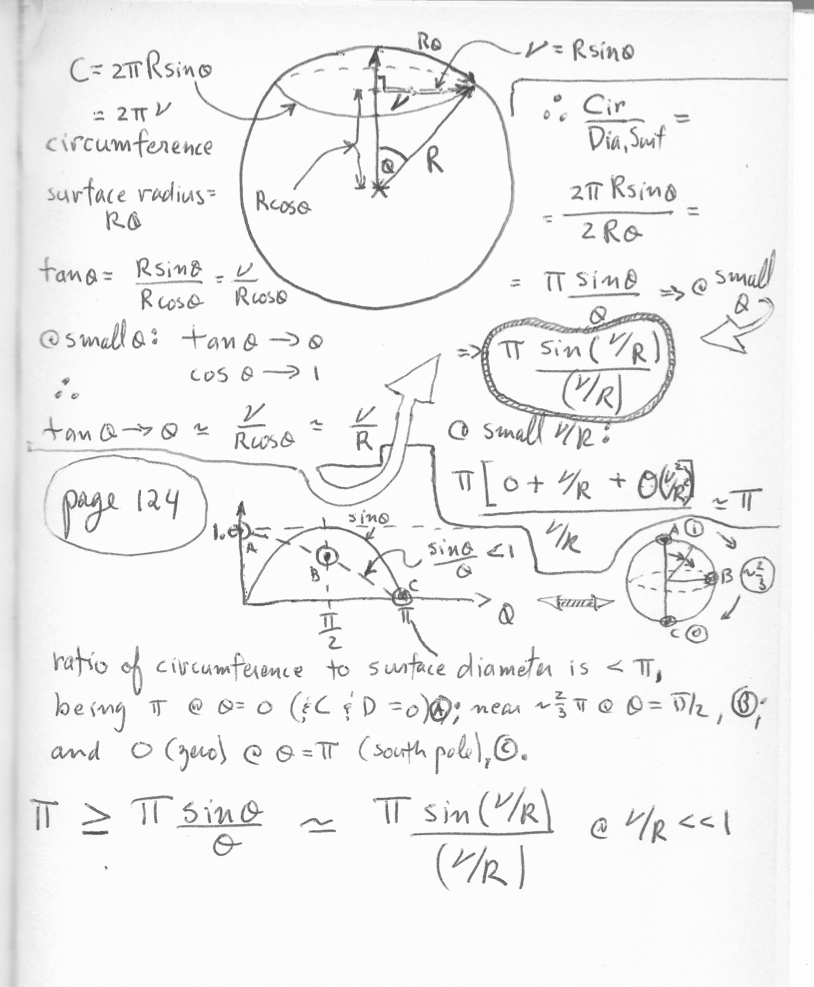
Page 124 (The Possibility of a “Finite” and Yet “Unbounded” Universe), the equation shown in the book is multiply wrong. The equation should be a mathematical statement that the ratio [circumference/surface diameter] = [pi] x [sine(nu/R)/(nu/R)], and this is always less than or equal to pi.

π ≥ π∙{ [sin(nu/R)] / (nu/R) } = [circumference/“radial” arc x 2]

The Greek letter “nu” can look like the lower case script “v,” which appears in the denominator of the erroneous formula on page 124. The first error to correct in that formula is to replace the lower case “r,” which is shown in the argument of the sine function, with the same “v” as in the denominator (and which “v” I will call “nu” further below).

The second error to correct is to replace the equal sign (=) with a multiplication symbol (×, or ∙), or to make that multiplication implicit by eliminating that equal sign and enclosing the entire ratio (corrected as above), to the right of the pi, within parentheses or brackets.

The lower case “r” that Einstein uses on page 125 refers to a quantity (an arc length along a “great circle,” my “radial arc x 2”) that is shown as the product 2x[R]x[theta] in the display that follows.

The following display shows what Einstein is describing on pages 124-125, and how the equation shown above comes about. The quantity (ratio) that should be printed on page 124 is shown within a hatched bean-shaped outline in the display. I leave it to you to enjoy that display, and I hope the trustees of Einstein’s legacy can cause future printings of “Relativity” to be free of textual errors.

Finite Unbounded

Finite Unbounded

<><><><><><><>

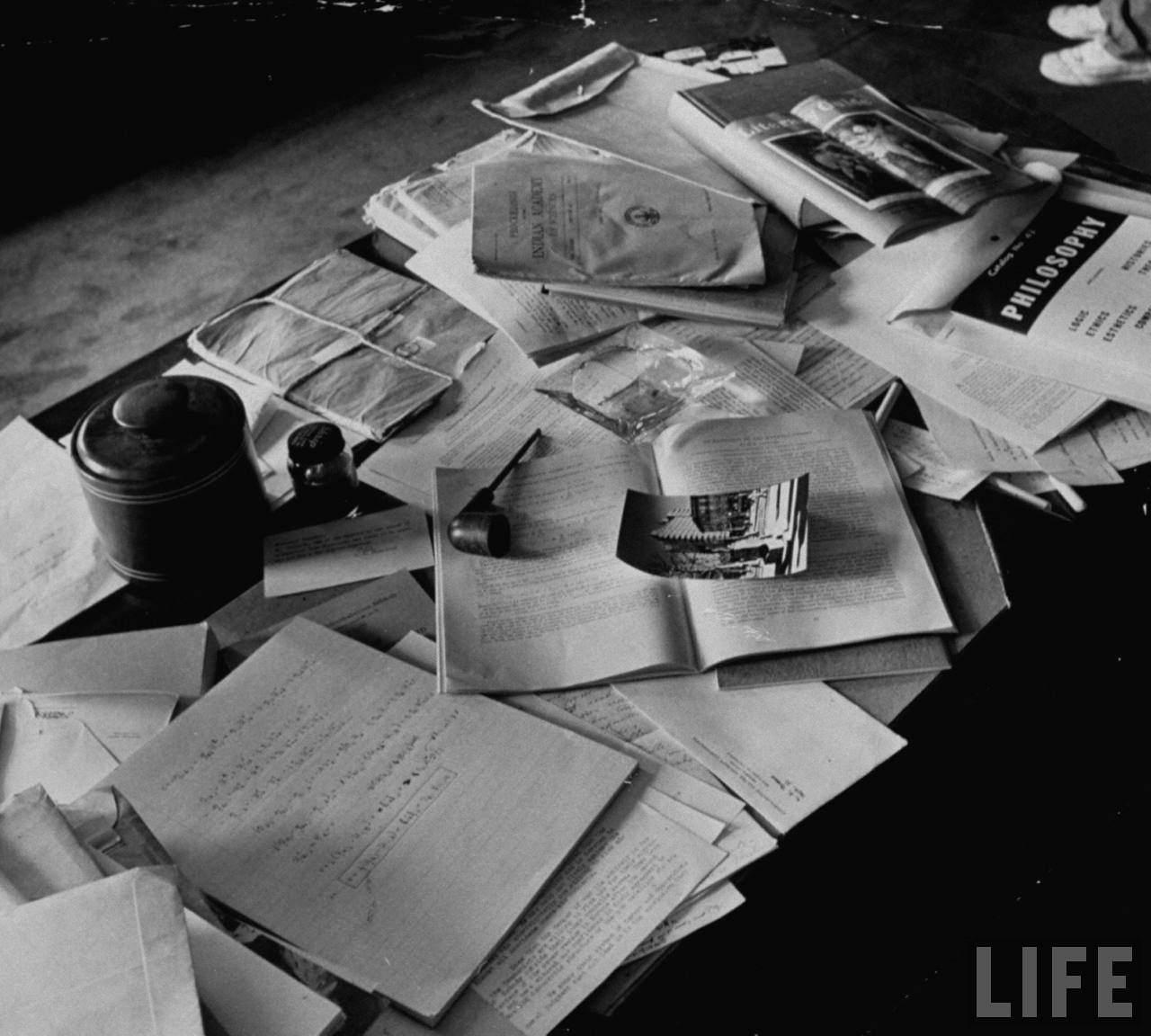
Albert Einstein's desk

Albert Einstein’s desk, 19 April 1955

This is a photograph of Albert Einstein’s desk on 19 April 1955, the day after he died.

The Buried Rainbow

The Buried Rainbow

His mind is a graveyard of memories
of young and beautiful faces,
utopian dreams,
transformative art
unseen in this island world of blind cyclopses
bumbling into each other with hurtling ambition
in the shadowed canyon bottoms.
He tosses pearls of protein, lipids and carbohydrates
on the frozen ground, and they erupt
as fluttering clouds of rock doves
rising into the clear air
to wheel about the shafts of light
streaming onto the canyon walls,
and carrying his gaze up into
the buried rainbow of an undiscovered country,
where fields of energy emanate
from fingertips of generosity
to unfurl a mesh of loving care
that cradles a race of poets.

25 January 2015

<><><><><><><>

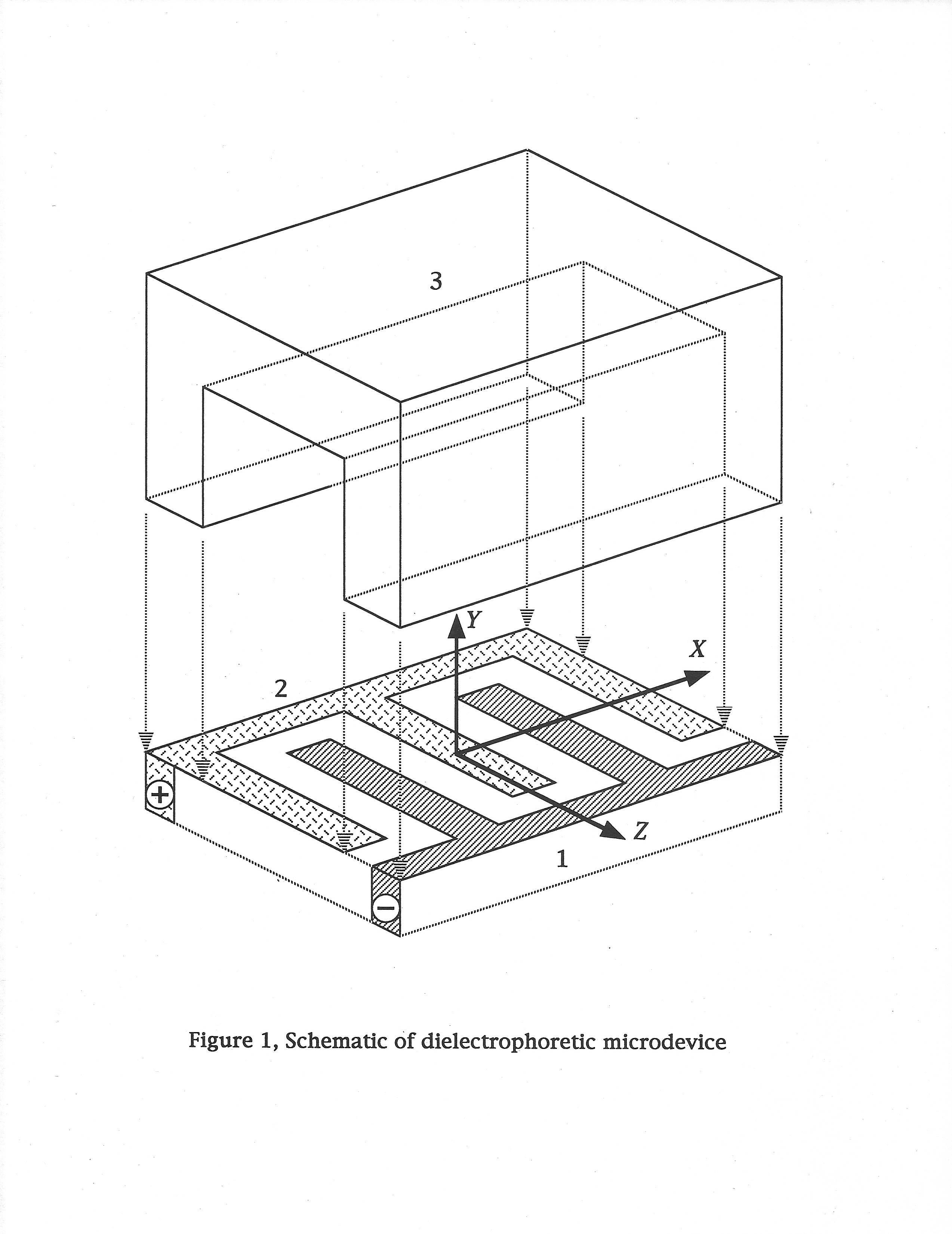
DEP Micro-device 2D Electric Field

I used to have the ambition of being an “artistic scientist,” a physicist and engineer aiming to produce scientific findings that were both useful and elegant, and which I would present in as beautiful a manner as I was able. The type of beauty I sought is a combination of logical simplicity, mathematical elegance, some range and depth of insight provided by the ideas, all communicated with visual and literary crispness in my written reports and other presentations.

I achieved this ideal, to my own satisfaction at least, a few times during my scientific career. One of those proud achievements is my model of the electric field in dielectrophoretic (DEP) micro-devices.

My original report “The 2D Electric Field Above A Planar Sequence Of Independent Strip Electrodes” is available below (a link to a PDF file). The report is dated 4 October 1999, and lists two authors; the second author is the patron who paid my salary during the months I worked on this project.

This paper was sent to a journal and subsequently published, but with egregious errors introduced by the journal’s editors, who “simplified” my math for publishing convenience. Months after I pointed this out to them, they issued an errata. The combination of the published paper and the errata (showing correct formulas) did not include many of the illustrations I had produced for my original report (Version 1), and which I think would help anyone actually thinking of using my mathematical model of DEP electrostatics.

So, this blog entry is similar to the case of a former artist who pulls out an obscure and favorite painting of theirs from storage in an attic or basement, dusts it off, and hangs it up on the wall so he can look at it again, and remember how good it felt to make.

A second report (an excerpt in PDF form) describes how use of the electrostatic model could assist in the development of DEP micro-devices (which are used in DNA sequencing technology).

DEP Device Diagram

DEP Device Diagram

DEP 2D Math Beauty

DEP 2D Math Beauty

DEP 2D Model Version-1

DEP 2D Model & micro-devices

Enjoy!

<><><><><><><>

Footprints In The River, Handprints On The Sky

Footprints In The River, Handprints On The Sky

My life is as dewdrops on a lotus leaf
spread above the quiet of Walden Pond,
disappearing slowly, inexorably, in the warmth of the sun
birthing an unending present – my unknowable future;
evaporating my sufferings
into the buzz of hummingbird wings
and the laughter of children playing,
no different today than in the days of Pericles and Gautama,
and certainly no different in those days to come
when my forgotten name will be half as old as theirs.
The American Ryokan, the Japanese Thoreau,
how glad I am of their gifts,
examples of living by principle –
content, enlightened, generous, humane, calm, funny,
engaging me with their words
the way their living engaged their neighbors,
waking so many from torpid lives of expediency
by the sheer force of example –
without exhortation,
their tangible traces, now, pure art.
And when I am gone what will be my legacy?:
the impish glee of a child laughing on the swings,
hands furrowing the warmth of the sand,
plunging through sweet air reaching for the higher bar,
watching ripples of light on the water.

24 November 2002

Hello Void, A Thanksgiving Message

<><><><><><><><><><><><><><><><><><><><><><><><><><><><><><><><>

This is a country of very ignorant selfish people who are being exploited by very smart selfish people. I can’t do anything to change that, but I don’t have to help it along, either. I can forgo getting the best possible deal at the lowest possible price with the least amount of thought.

I don’t talk politics during the holiday season, at family gatherings, or basically ever. People believe what they want to believe, and facts don’t matter. Challenging people’s beliefs only upsets them and drives them into bunkers of defensiveness. By adolescence, people don’t change, certainly not because of what others tell them. Any change of thinking and attitude is purely a result of responding to life’s traumatic experiences, and such change is rare even when the traumas are regular.

All talk of universal cooperativeness: world socialism, population control, decarbonizing industrialization to prevent climate change, and similar visions of worldwide social justice and economic equity are fantasies never to be achieved. Individual selfishness will always trump social responsibility, satisfying immediate desires will always trump achieving long-term social improvement, confident willful ignorance will always stymie hesitant and deliberate thoughtfulness and understanding.

The fear for human extinction caused by climate change, overpopulation and nuclear war, which is increasingly expressed by intelligent, socially conscious long-range thinkers, is beyond permanent relief. This fear springs from a deep-seated belief that humanity must endure eternally, that it cannot be allowed to pass away. But why? The history of life on earth is one of species emerging, evolving and fading away. Extinction is the rule, the average lifespan of species on earth is a few million years.

A human lifetime is too brief an instant for any individual to have any impact on the course of humanity’s drift toward extinction. It is true that some individuals find themselves in positions of immense temporal power and are able to initiate, or halt, genocidal events. However, the power to cause rapid human extinction is beyond any single individual. The intentional rapid extinction of humanity requires the cooperative madness of many individuals engaged in launching the world’s stockpile of nuclear weapons in one apocalyptic world war. Individual selfishness is one deterrent to the selfless cooperative attainment of this radioactive crescendo of extinction.

A better response by socially conscious people, to the realization of humanity’s drift toward extinction as a mass of insular selfish individuals ensconced in their little logic and fantasy bubbles that are opaque beyond close-in personal horizons, is to make their face-to-face interactions as compassionate, honest, honorable and calming as is reasonable given the circumstances. Obviously, sometimes conflict is necessary and right, but one tries to minimize that. This is “being peace” as Thich Nhat Hanh has written about so eloquently.

You as a living experience are peace for your own well being in the here and now, and as a socially conscious expression of solidarity with whatever individual human being you are dealing with at the moment, because you recognize the same spirit of life in them as in you, and because you realize that every other person is a bundle of largely unseen and unknowable mental fears and psychological conflicts – just as you have, largely unseen by the rest of humanity.

Be peace because that is what you can do. Forget about saving humanity, you can’t do it, it can’t be done, and it doesn’t matter. Before you were here, while you are here, and after you are gone, the universe is.

<><><><><><><>

Siboney — Español-English

Ernesto Lecuona (1896-1963) published his classic Cuban song Siboney in 1929. It has been sung and played by many many performers since, in a multitude of styles.

Ernesto Lecuona was a contemporary of George Gershwin (1898-1937), and both played similar roles in the development of the music of their respective countries, Cuba and the United States. They were each classical musicians, piano virtuosos and brilliant composers, who brought Afro-American strains of folk music characteristic of their countries — son cubano and jazz, respectively — into musical theater works (zarzuelas and musicals, some considered as operas today), piano concertos, works for solo piano, and many songs.

Siboney is a song that has said “Cuba” to the ears and hearts of listeners around the world since 1929, in the same way that George Gershwin’s Summertime has infused listeners with a sense of Mark Twain’s America since 1935. These aren’t national anthems, they’re better, they are the songs of the soul.

Siboney (1929)
(música y letras de Ernesto Lecuona)

Siboney,
yo te quiero,
yo me muero
por tu amor.
Siboney,
en tu boca
la miel puso
su dulzor.

Ven a mí,
que te quiero,
y que todo tesoro
eres tú para mí.

Siboney,
al arrullo
de la palma
pienso en tí.

Siboney,
de mi sueños,
¿si no oyes la queja de mi voz?

Siboney,
si no vienes,
me moriré de amor.

Siboney,
de mi sueños,
te espero con ansia en mi caney,

Porque tú
eres el dueño
de mi amor, Siboney.

Oye el eco
de mi canto
de cristal,
no se pierda
por entre el rudo
manigual.

~~~~~~~~~~~~~~~~~~~~~~~~~~~~~

Siboney
(a poetic translation of Ernesto Lecuona’s lyrics)

Siboney,
how I want you,
I would die to
have your love.
Siboney,
honey’s sweetness
from your lips wings
like a dove.

Come to me,
I who love you,
my treasure, and want you
as close to me as can be.

Siboney,
breezes whisper,
as palms murmur
thoughts of you.

Siboney,
my dreams call out,
can’t you hear my voice for you all about?

Siboney,
if you don’t come
I’ll die with your love away.

Siboney,
with tides dreaming
in my hut awaiting you anxiously.

You alone
are that person
who owns all my love, Siboney.

Hear the echo
of my song so
crystal clear.
Don’t lose your way
in the shadows of
swamp night fear.

~~~~~~~~~~~~~~~~~~~~~~~~~~~~~

Eduardo Brito (1931)


[The recording that made Siboney a hit, sung by an excellent baritone; a superb rendition: full, flowing, tuneful, without distracting affectations or showiness. Classic.]

Lecuona plays Siboney (1954)
http://www.youtube.com/watch?v=FlOSe79FuKM
[Ernesto Lecuona plays Siboney on the piano. Perfection.]

Plácido Domingo (1984)


[The Caruso of our time gives us the ultimate Siboney.]

Alfredo Kraus (1982)
http://www.youtube.com/watch?v=LrptSvmjCkg
[Alfredo Kraus was a lyric tenor with a sparkling and powerful voice. This recording has nice sound and is accompanied by a slideshow of scenes of the Canary Islands — one can imagine Cuba from them — and historical notes on both Lecuona and Kraus, who each had roots in the Canary Islands.]

Xiomara Alfaro (1950s)
http://www.youtube.com/watch?v=hpx4ev8atSE
[An Afro-Cuban coloratura sings Siboney in this video from a TV broadcast.]

Los Sabandeños (2012)
http://www.youtube.com/watch?v=vyvXS2KU9gI
[A big chorus! A slideshow of photos of the beach called Siboney, in the province of Santiago de Cuba in southeastern Cuba, accompanies the music; there are also historical notes.]

Concha Buika (2013)


[A black Afro-Cuban propulsive jazz rendition with a smokey/raspy?-voiced singer.]

Aurelio Gabaldón (2007)
http://www.youtube.com/watch?v=wDOaotiQOEI
[A video of Siboney performed at this tenor’s recital (in Spain?). He did a nice job.]

<><><><><><><>

Lessons For Life

Learn how to fail gracefully,
success is rare and failure most likely.

Do not put off what is in you to do.
Do not let death overtake you,
having denied yourself by submission
to obligation.

Sabor a mí — Español-English

Sabor a mí was written in 1959 by the Mexican agricultural engineer and songwriter Álvaro Carillo Alarcón (1921-1969).

Sabor a mí (1959)

Tanto tiempo disfrutamos de este amor
Nuestras almas se acercaron tanto así
Que yo guardo tu sabor
Pero tú llevas también
Sabor a mí.

Si negaras mi presencia en tu vivir
Bastaría con abrazarte y conversar
Tanta vida yo te di
Que por fuerza tienes ya
Sabor a mí.

No pretendo ser tu dueño
No soy nada yo no tengo vanidad
De mi vida doy lo bueno
Soy tan pobre, ¿qué otra cosa puedo dar?

Pasarán más de mil años, muchos más
Yo no sé si tenga amor la eternidad
Pero allá, tal como aquí
En la boca llevarás
Sabor a mí.

A Taste of Me
(a translation of Álvaro Carillo’s lyrics for Sabor a mí)

We had spent so much time savoring our love,
Our souls came so close together and yet stayed free,
Tasting still how you would love,
As you too must also have
A taste of me.

If you now negate my presence from your life,
Hugs and conversation now and then’s alright.
I know you have come to be
Infused indelibly with
A taste of me.

Not pretending that I own you,
I am nothing, and I have no vanity.
Giving what good in life I do,
As I’m so poor what else do I have to give you?

A thousand years must pass at least, and even more,
I do not know if love is in eternity,
Whether there or here where you may be
Your lips will always savor
A taste of me.

~~~~~~~~~~~~~~~~~~~~~~~~~~~~~~~~~~~~~~~~~~~~~~~~~~~~~~~~

Álvaro Carrillo (1960s)
http://www.youtube.com/watch?v=_MGhcaT1HSM
[The composer sings his song, accompanying himself on the guitar (a sound recording). Completely endearing.]

Alvaro Carrillo: Amor mio, Un poco mas, Sabor a mí (1960s)
http://www.youtube.com/watch?v=YH_jng60ewU
[A video of a TV show with Álvaro Carillo performing a medley of three of his own compositions, accompanying himself on guitar. Absolutely precious.]

Eydie Gormé & Trio Los Panchos (1964)
http://www.youtube.com/watch?v=6yVQeLirfIg
[Eydie Gormé’s biggest hit, and the recording of Sabor a mí that brought the song into popular consciousness worldwide. This particular posting of the recording has good stereo sound, and video of Eydie singing; also extensive notes on Eydie. Eydie’s big, sunny and warm singing style blends perfectly with the refined ensemble guitar playing (and singing) by Los Panchos, to produce an irresistible rendition of Sabor a mí. It is both of its time and ageless.]

Gustavo “Pájaro” Ogara & Ximena Bedó (2013)
http://www.youtube.com/watch?v=Ji3k7rsVW8A
[One guitarist and one singer, perfection in its simplicity, sencillo y así puro. Very nice guitar playing by Gustavo “Pájaro” Ogara, and very nice singing by Ximena Bedó.]

Cover Estereo Son (2012)
http://www.youtube.com/watch?v=11SvEFdXZEc
[I like this trio of young musicians: Voz – Karen Mondragón, Bajo – Wilfredo Vinasco, Synth – Jhonatan Herrera. Karen’s singing is expressive, honeyed and brisk (contralto?). Both Wilfredo and Jhonatan are very adept at their instruments. The group produces a unified uncluttered sound that moves gracefully through their performances: modern (youthful enthusiasm in a streamlined format), warm, moving and polished. I wish them success. I liked their Lágrimas Negras, which is how I first heard them.]

Guadalupe Pineda (1980s-2000s?)
http://www.youtube.com/watch?v=45gHIZFcEdI
[A refined production, large though graceful, framing Guadalupe’s bell-like tones.]

Javier Solis (1960s)
http://www.youtube.com/watch?v=3jBvVwR8_Tw
[El rey del bolero ranchero. Silky smooth and sentimental.]

Los Lobos (1990s-2000s?)
http://www.youtube.com/watch?v=rU-LeccqS48
[“Just another band from East L.A.” But one of the best. This performance is both solid and elegant; urban, unpretentious, sincere and aware of its roots. Sabor a mí is a guitar player’s delight.]

Classico Latino (2012)
http://www.youtube.com/watch?v=0bAcvnd29e0
[Performed at the Teatro Colsubsidio in Bogotá, Colombia, June 2012. Elegant and polished, with piano, violin, cello, conga drums, guitar and electric bass, all backing soprano Eirini Tornesaki.]

Beatriz Marquez (2007)
http://www.youtube.com/watch?v=rBfmsqtI9Lo
[Beatriz Marquez, a long-established Cuban singer from a musical family (at least 3 generations), plays the piano as she sings Sabor a mí, accompanied by guitar and percussion. A live performance at an Italian restaurant in Cuba, captured on video by a tourist.]

Manoella Torres (1980s-2000s?)
http://www.youtube.com/watch?v=kiF4hsKlYWk
[A soft velvety rendition, something for an evening on the Riviera in tux and gowns. Born in New York City of Puerto Rican parents, Manoella Torres moved to Mexico as a child and lives there still. She was first recorded for discs in 1966, as a twelve-year old. In 1971, she signed with Columbia Records, and launched the career that continues today.]

Maridalia Hernandez (1980s?)
http://www.youtube.com/watch?v=KhKM1DNTQik
[Smooth melodious alto (?) from Santo Domingo, in a gently lush production.]

Laura Fygi (1990s-2000s?)
http://www.youtube.com/watch?v=aeDC3xyerQA
[A beautiful rendition, slow silky smooth sensuousness without sloppiness, but a bit of crackle on the sound recording.]

<><><><><><><>

Twelve Spanish Songs — Español-English

I have completed a project that is of great significance to me, but of little importance otherwise (isn’t this true of most of what everybody accomplishes?). Like the Little Red Rooster jumping up to the barn roof at dawn to wake up the world to his pride of place, I am sending out this notice about my new work.

For many reasons, because of my family, ethnicity, first language, cultural inclinations, artistic interests, and time and place in history (20th century US Latino), I have been interested for some time to learn, and translate into English, some of the most beloved and enduring Spanish songs of the 20th century.

Toward that end, I have selected twelve Spanish language songs — most of which I can remember hearing from my earliest days — and then sought out (through the ease of the Internet, and sheet music) the earliest and likely authentic lyrics, and devised poetic translations of them. By “poetic translations” I mean English language poems that faithfully convey the Spanish language intent of the originals, and are as close to literal translations as can be achieved without sacrificing the metric and rhyming structure of the Spanish language originals — or at least approaches that ideal.

There is no doubt that better English language poems could be devised to fit the music if one gave up any connection to the original Spanish lyrics. But that was not my aim. I wanted to convey the word flow and sentiment, and as much of the word-images and metaphors of the originals as I could, in English language poems that had their own degree of elegance and fluidity, fitting the music.

Working on this project has improved my Spanish reading and writing a bit, which was worthwhile since neither is that good.

The results of this work appear as twelve entries on this blog — one per song. Each such blog posting gives a few details about the song’s composer, before displaying the Spanish language lyrics (and notes about them, since there are always variations). After that, I show my own poetic translation.

For a view of the shortcomings of a purely literal translation (as well as the shortcomings of computer translators) just copy the Spanish lyrics I provide into Google Translator (or an equivalent) and observe the results in Bizzaro Speak.

After each of my poetic translations of a Spanish song, I list a number of music video performances of that song, posted at YouTube. I also give a capsule summary of each such music video.

The intent of each blog entry is to present the song in as original a form as I can find, to give the briefest of historical context for it, to give my “singable” English version, and then list a series of performances that show why that song has endured through many periods of 20th century musical tastes, and in numerous cultures. These songs are good music, and good music is eternal and unconfined by the boundaries that human groups segregate themselves with.

The primary audience for this project is my own children, who I hope gain something of my ancestors’ culture by it. It is possible that vocal music students interested in this repertoire could gain from these postings; and perhaps amateur poets may also find something of value here.

As I said, in the whole scheme of things this is an inconsequential accomplishment, but nevertheless: COCK-A-DOODLE-DOO!

The list of twelve web-links can be found at the “About” web-page for this blog, and are also listed here for convenience.

Bésame Mucho, Español-English
23 December 2013
https://manuelgarciajr.com/2013/12/24/besame-mucho-espanol-english/

Cucurrucucú Paloma, Español-English
23 December 2013
https://manuelgarciajr.com/2013/12/23/cucurrucucu-paloma-espanol-english/

Frenesí — Español-English
12 October 2014
https://manuelgarciajr.com/2014/10/12/frenesi-espanol-english/

Historia de un amor — Español-English
30 September 2014
https://manuelgarciajr.com/2014/09/30/historia-de-un-amor-espanol-english/

Júrame — Español-English
9 October 2014
https://manuelgarciajr.com/2014/10/09/jurame-espanol-english/

Lágrimas Negras — Español-English
14 November 2013
https://manuelgarciajr.com/2013/11/14/lagrimas-negras-black-tears/

Nuestro Juramento — Español-English
23 June 2014
https://manuelgarciajr.com/2014/06/23/nuestro-juramento-espanol-english/

Perfidia — Español-English
13 October 2014
https://manuelgarciajr.com/2014/10/13/perfidia-espanol-english/

Quiéreme Mucho — Español-English
13 October 2014
https://manuelgarciajr.com/2014/10/13/quiereme-mucho-espanol-english/

Siempre En Mi Corazón — Español-English
4 October 2014
https://manuelgarciajr.com/2014/10/04/siempre-en-mi-corazon-espanol-english/

(listed in alphabetical order)

And after 15 October 2014:

Sabor a mí — Español-English
19 October 2014
https://manuelgarciajr.com/2014/10/19/sabor-a-mi-espanol-english/

Siboney — Español-English
22 October 2014
https://manuelgarciajr.com/2014/10/22/siboney-espanol-english/

Enjoy!

<><><><><><><>

See “About” for songs added after 2014

<><><><><><><>