Oil, Population, Temperature, What Causes What?

<><><><><><><><><><><><><><><><><><><><><><><><><><><><><><><><>

Oil, Population, Temperature, What Causes What?

In statistics, correlation is not proof of causation. Causation between coincidences has to be established by deeper investigation. Three trends that are tightly coincident, between the years 1960 to 2025, are: the increase in global population above its 1953 total of 2.7 billion (2.7B), the accumulated petroleum production since 1900 (in giga-barrels, Gb), and the increase in average global temperature, T, above a baseline of 14.7 degrees Centigrade (T – 14.7C).

No one, except lying hypocritical ideologues, denies that causal links exist between these three trends, but what are they? Let’s explore the possibilities.

P1: Increases in oil production could cause increasing population and global warming.

P2: Increases in population could cause more oil production and global warming.

P3: Increases in global warming could cause increases in population and more oil production.

Possible causal links in P1 are: fossil fuel energy made available through continuing oil production could support human reproductive activity and the increase of existing families, and it could support and expand existing industrial activity that emits carbon dioxide (CO2) and methane (CH4) gases.

Possible causal links in P2 are: the genetically programmed impulse to gather all resources possible in order to reproduce as much as possible could cause the continuation of oil production to garner fossil fuel energy, and it could cause global warming by expanding the mass of CO2 exhaling human life.

Possible causal links in P3 are: the increase in the temperature of the biosphere could cause continuing and expanded human reproductive activity, and the continuing production of oil.

Because the biosphere is not heating up independently of human activity, we can dismiss P3. This dismissal would only be argued against by lying hypocritical ideologues, who are irrelevant to the good of humanity and Planet Earth, so we ignore them and move on.

We are left then with oil production (P1) and population growth (P2) as fundamental drivers of global warming. Still to determine is whether oil production fuels population growth, or population growth spurs oil production, and we can suspect that they amplify each other.

Homo sapiens are one species of life on Planet Earth, and they are also one variety of primates. Since the inception of the species over 2,000 centuries ago, a sole human being without any other support has had little chance of survival, and this was also true of humanity’s precursor primate species.

All living creatures have an instinct to survive, and the strongest outlets for that instinct are: finding food and water, securing shelter and defending territory, and reproducing. Territory is defended because it offers food and water gathering and reproductive opportunities. One strategy for individual survival is to associate in groups that cooperate for mutual survival: families, packs, herds, monkey troops, clans, and human societies. Racism among humans is a degeneration of this survival strategy.

Family is the most reliable — and most genetically linked — association an individual can form to support their survival. This is why the urge to reproduce is innate, and that is why Life on Earth continues.

A larger family provides the individual with more loyal associates for water and food gathering, for defense against predators, and for protection and care when aged and ill. For individual humans, this primitive survival strategy becomes more important the less they have social welfare networks and social welfare societies to rely on.

The purpose of social welfare societies — socialism — is to provide its individuals with sufficient quantities of water, food, shelter and energy to carry on fulfilling lives, without subjecting those individuals to lonely struggles for precarious survival. This is why mortality rates are lowest in highly socialized prosperous societies, and why the consensus of individuals living in them is for low rates of reproduction, even to the point of birth rates below 2.1 per woman, the replacement rate necessary to maintain the existing size of a society’s population. It is entirely logical for individuals living without reliable socialized guarantees of getting sufficient access to water, food, shelter and energy to conduct safe and decent lives, to procreate larger families. This is why population growth is greatest among the poorer people on Earth, whether in the Industrialized Societies, the Developing World, or the impoverished Third World.

Clearly, the single best strategy to slow, and perhaps even reverse global population growth, is to provide a global system of reliable socialized security to completely support individual healthcare for life, obviously including: maternity care; safe birthing; safe abortion; child survival, healthcare, education and launching into “independent” living; elder care; and humane natural and self-willed dying. There is simply less incentive to have more children if more of them are guaranteed to survive and experience full and decent lives, and if the individual has a socially guaranteed protection of their own survival.

So, failure to provide reliable socialized protection for individual survival amplifies the innate urge to procreate, which then fuels a population explosion, whose consequence is continued global warming: because of a continuing and expanded use of fossil fuel energy that is very inequitably controlled and shared out; and because of a larger mass of humanity exhaling carbon dioxide gas (CO2), creating organic wastes that emit methane (CH4), and then these two entering geophysical positive feedback loops that amplify such subsequent emissions.

However, the population explosion alone — which is concentrated among Earth’s darker and poorer people — is not the sole cause of global warming. The continuing and expanded drive by individuals to acquire fossil fuel energy in order to accumulate more personal wealth, more personal power, more social status, and more ego gratification, is the other — and I think predominant — fundamental cause of global warming. As already noted, the control and exploitation of fossil fuel energy is very inequitably shared. Rich and politically powerful countries and individuals have overwhelming control over fossil fuel energy resources, and they are in the best positions to exploit those resources for their own aggrandizement. This is pure capitalism. Those of our fellow homo sapiens primates who are “left out” of wealth society’s fossil-fueled economic positive feedback loop will apply “monkey see, monkey do” in attempted emulation of that fossil-fueled economic growth strategy. This is why there is contention, exploitation and war within poor societies and impoverished populations. The desperate eat each other to claw to the top of their heaps.

So, the production and use of petroleum is driven by the will for selfish gain by rich and poor alike — the rich having much greater advantages in doing so — and by the legitimate needs of individuals and their societies to acquire sufficient energy to sustain their survival and that of their children in safe and decent lives. As population grows so does the need for greater amounts of energy: energy for human development, (1), (2).

Clearly, the single best strategy to slow, and maybe even someday reverse global warming, is to replace fossil fuel energy with solar and “green” energy, whose production and use does not emit CO2, CH4, and other organic “greenhouse” vapors.

While access to greater amounts of heat and electrical energy — whether from green or from fossil fuel sources — can make it easier to accommodate increased human fertility, the presence of reliable, global, equitable socialized protections of individual and family survival, health and well-being will act to limit (and ultimately decrease) population growth, and as a consequence throttle the need for an ever expanding grasp for energy.

So, the entwined trends of a population explosion concentrated among the “have nots,” with a highly inequitable expansion and use of energy — primarily from fossil fuels — controlled by the “haves,” combines to form our current world crisis of: global warming; environmental degradation; biodiversity, habitat and survivability losses; and inequitably distributed socio-economic decay. The cure for this world illness is the combination of a conversion from fossil fuel energy to green energy, along with the establishment of a global system of socialized security for individual and family survival, health and welfare.

The continuation of our globally feverish illness is simply a reflection of the continuation of selfishness and egotism applied on top of the genetically implanted instinct for survival, in our highly inequitable human societies and human civilization. The great barrier to curing this illness is overcoming the resistance to relinquishing the grasping for primitive personal advantage by the weakening and exploitation of others; and replacing it with: individual commitments to ethical living; mutual trust among all people; and economic leveling and universal human welfare as matters of government policy.

The combination of the last three would help to form a world solidarity that is in balance with Nature. This would be a consciously willed evolutionary advance of our species, a victory of frontal lobe cognition over limbic system reactivity. The unwillingness and “inability” to form such a green, world solidarity would be acquiescence to a near-distant, unnatural and unnecessary human extinction.

The cure is as immensely impractical and as trivially easy as all of us homo sapiens simply choosing to consciously change our ways, with trust in each other for fair dealing and mutual protection. Call it green socialism if you like.

Notes

1. Energy For Human Development,
https://manuelgarciajr.com/2011/11/09/energy-for-human-development/

2. Energy For Society In Balance With Nature
https://manuelgarciajr.com/2015/06/08/energy-for-society-in-balance-with-nature/

<><><><><><><>

Our Globally Warming Civilization

<><><><><><><><><><><><><><><><><><><><><><><><><><><><><><><><>

Our Globally Warming Civilization

The 150 years of the Industrial Revolution (~1770-1920), with its catastrophic and bloody termination in World War I (1914-1918), had no noticeable effect on the global average temperature, which had hovered around 14.7 degrees Centigrade (C) since antiquity. The human population had taken 200,000 years (more or less) to grow to one billion (1B), in 1804, within the natural and majestic evolution of global climates during those 2000 centuries, (1).

By 1927, the human population had increased to 2B. The 1920s were economic boom years in the Industrialized World (give or take some post WWI German misery, the Russian Revolution, and Chinese civil warfare) with the liquid petroleum replacing the solid coal as the fossil fuel of choice for transportation vehicles; and the explosion in the craving for, and manufacture and use of, internal combustion engines and the automobiles powered by them.

After 1927 the rate of population growth increased from what it had been on average during the previous 123 years (about 8 million per year, ~8M/yr) to an average rate of 29M/yr, to accumulate another 0.7B people in the 26 years up to 1953, when the population was 2.7B. Those 26 years between 1927 and 1953 spanned the crescendo of the Roaring ‘20s, the capitalist economic collapse of 1929, the Great Depression (1929-1942), World War II (1939-1945), the Second Sino-Japanese War (1937-1945), and the Chinese Communist Revolution and Civil War (1946-1949).

I estimate that the cumulative amount of petroleum produced (pumped out and used up) by 1953 was 98.6 billion barrels (98.6 giga-barrels, 98.6Gb), (2). This implies that since about 1900, when civilization’s use of petroleum as a fuel began in earnest, it consumed 602 giga-GJ (602 x 10^18 Joules) of energy (equivalent to 168 mega-GWh = 168 x 10^9 MWh = 168 giga-mega-watt-hours) to power itself up to 1953, (3).

By 1960, the world’s human population had reached 3B, and the rate of population growth was accelerating (having been about 43M/year during the previous 7 years). From 1960 to the present day, the trend of cumulative production of petroleum, Q, has been proportional to the rising trend of human population, in the ratio of 272 barrels of oil per person (272 b/p).

Specifically, my approximating formula for Q, the accumulated production of oil in giga-barrels (Q, in Gb), given as a function of the population in billions (P, in B) for a given year within the interval 1960 to 2025 is:

Q(year) = [P(year) – 2.7B] x (272 b/p).

This approximation gives an accumulated production up to 2015 (with population 7.35B) of

Q(2015) = 1265Gb, (approximation).

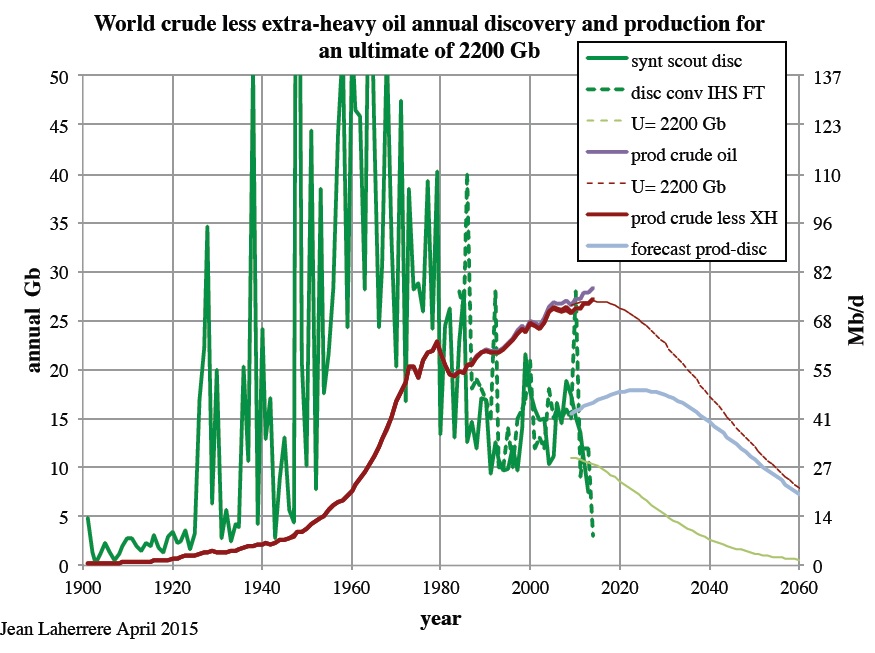
By integrating the actual production rate-per-year curve (the “Hubbert curve” for world production, in GB/yr) given by Laherrere (2), I find the actual accumulated production up to 2015 to be:

Q(2015) = 1258Gb, (actual).

The rate of oil production is now likely at its peak of between 25 Gb/yr to 35 Gb/yr during this 20 year interval between 2005 and 2025, (2),(4). Thereafter, it should drop rapidly since current oil fields have diminishing production, there have been no major oil field discoveries since the 1970s and the frequency of discovery has steadily diminished since then. That means that over half of Earth’s original total reserves, estimated at 2,200Gb (2), have already been extracted. The “end-of-oil” seems destined for the last two decades of the 21st century.

Assuming all that oil was burned, up to the year 2015 (115 years since 1900), civilization would have used 7,674GGJ, (7,674 x 10^18 Joules), equivalent to 2,139GMWh, (2,139 x 10^15 Watt-hours) of energy, derived from that 1258Gb of petroleum, to power itself.

That burning would have released 398,786Gkg (~4 x 10^14 kg = ~400 giga tonnes) of CO2, (5). At present (May 2019) there are about 3,250 giga tonnes of CO2 in the atmosphere, with an average concentration of 415 parts per million by volume (415ppmv), (6). 1228 G tonnes of that CO2 is excess above the pre-industrial amount in the atmosphere. The ~400 G tonnes estimated here as the accumulated emissions from the prior burning of petroleum (up to about 2015) is only about one-third of the excess atmospheric CO2.

There are numerous other processes in our civilization, as well as in the natural world, that cause the emission of carbon-dioxide and its atmospheric retention in excess amounts. The main sources of CO2 emissions are the exhalations from aerobic respiration by all of Earth’s living heterotrophs, decaying plants, and volcanic eruptions. Other sources include: the burning of coal and natural gas, forest and vegetation fires caused naturally and by slash-and-burn agriculture, the bubbling out of CO2 from warming oceans no longer able to dissolve as much of that gas as before, and the massive amount of past and continuing forest clearing that has reduced Earth’s natural system of CO2 uptake — photosynthesis. The cement industry is one of the two largest producers of anthropogenic carbon dioxide, creating up to 5% of worldwide man-made emissions of this gas, of which 50% is from the chemical process and 40% from burning fuel, (7).

Methane (CH4) is a very potent greenhouse gas, being 30 times more effective than CO2 at trapping heat. “For each degree that Earth’s temperature rises, the amount of methane entering the atmosphere from microorganisms dwelling in lake sediment and freshwater wetlands — the primary sources of the gas — will increase several times. As temperatures rise, the relative increase of methane emissions will outpace that of carbon dioxide from these sources.” (8) Other sources of methane emissions are: rotting organic wastes, termite colonies, and bovine flatulence from industrialized agricultural sites. The globally warmed thawing Arctic tundra is now a region of major methane eruptions.

Up until 1974, when the human population had reached 4B, Earth’s climate system had yet to become feverish over the previous 200,000 years of collective human activity. However, at about that time the average global temperature began increasing at a historically unprecedented rate because of civilization’s heated and organic outgassing, a process which continues today as anthropogenic global warming, (9).

In fact, the date at which collective human activity began to affect and alter Earth’s climate system has now been pinpointed to somewhere between October to December 1965. That date marks the end of the Holocene Epoch of geologic history (which began 11,700 years previously, after the last Ice Age), and the beginning of the Anthropocene Epoch — the epoch of human-affected climate, globally. The physical phenomenon marking this transition is that Carbon-14, a radioactive isotope released during open-air atomic and nuclear bomb explosions between 1945 and 1963, had finally dispersed uniformly around the globe, and become absorbed into tree tissues even in the remotest parts of the world, thus recording that uniformity (10).

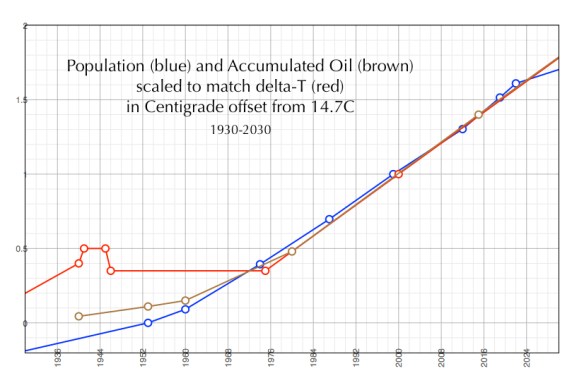
Between 1960 and 2025, the three rising trends of: population (P), cumulative oil production (Q), and increase of average global temperature above baseline (T – 14.7C = delta-T), are all uniformly proportional to one another.

Specifically (for years between 1960 and 2025) T, P and Q are related to each other as follows:

[T(year) – 14.7C] = [P(year) – 2.7B]/3.3B = [Q(year)/(900 Gb)],

where the forms above are each equivalent to a temperature difference relative to the baseline of 14.7C (delta-T, in degrees C).

Notice that if T = 15.7C, and P = 6B, and Q = 900 Gb, then the equality above holds, with: 1 = 1 = 1. This particular condition actually occurred during 1999.

During this 65 year interval, a 1 degree C rise in temperature (above 14.7C) is coincident with a 3.3B increase in population (above its 1953 level of 2.7B), which in turn is coincident with a production (and use) of 900Gb of petroleum.

The population is growing from 3B in 1960 to an expected 8B in 2028 during this 68 year interval, with an average population increase of +73.5M/yr. Within these 68 years, and especially during the 55 years from 1970 to 2025, the rising trends of (T – 14.7C), (P – 2.7B)/3.3B, and Q/(900Gb) are in lockstep. This period — with explosive population growth, depletion of over half of the Earth’s petroleum endowment, and with an unprecedented rate of global warming — began in the last year of the Eisenhower Administration, 1960, when John Kennedy was elected US President, and extends right up to the present (and beyond it).

The average global temperature will have climbed up from ~15C to ~16.2C during this interval, a relative rise of 1.4C, and a rise of ~1.5C (delta-T = ~1.5C) above the pre-industrial temperature, defined here as 14.7C (58.46 degrees Fahrenheit). That 1.5C (2.7F) warming above the pre-industrial temperature represents a tremendous amount of heat energy diffused throughout the biosphere, and the deleterious effects of that excess heat are self-evident to all: the altering of climate; the powering of violent weather; the heating and acidifying (with absorbed CO2) of the oceans, sterilizing them of marine life; the melting of glaciers and thawing of tundras; the causing of carbon dioxide and methane to bubble out of solution and frozen capture in the natural world (in a vicious feedback loop); the expansion of disease pathogens and tropical parasites; and the added stresses to both wild and farmed vegetation, and increased desertification, which result in human hunger and desperate migrations of impoverished refugees.

Now, our civilization is starting to suffocate in the lingering heat of its previous exhalations. The singular challenge to our species and to our political economies is what to do, collectively, about global warming. That challenge remains largely unanswered, and tragically denied by too many people .

Notes

1. World population is estimated to have reached one billion for the first time in 1804. It was another 123 years before it reached two billion in 1927, but it took only 33 years to reach three billion in 1960. The global population reached four billion in 1974 (14 years later), five billion in 1987 (13 years later), six billion in 1999 (12 years later), and seven billion in October 2011 (12 years later), according to the United Nations, or in March 2012 (13 years later), according to the United States Census Bureau.
https://en.wikipedia.org/wiki/World_population

World population by year
https://www.worldometers.info/world-population/world-population-by-year/

2. Jean Laherrere, World Crude Oil Production, (brown line), April 2015
https://upload.wikimedia.org/wikipedia/commons/4/46/World_crude_discovery_production_U-2200Gb_LaherrereMar2015.jpg

3. The energy released from combusting 1 barrel of oil is 6.1 giga-joules (6.1 GJ), which equals 1.7 MWh (1.7 mega-watt-hour).
https://en.wikipedia.org/wiki/Barrel_of_oil_equivalent

4. Worldwide, around 92.6 million barrels of oil were produced daily in 2017.
https://www.statista.com/statistics/265203/global-oil-production-since-in-barrels-per-day/
~73 million barrels/day in 1998, rising since.
73 Mb/day = 26.7 Gb/yr (1998)
93 Mb/day = 34.0 Gb/yr (2017)
During 20 years of production (1998-2017) the rate rose 20 Mb/day = +1 MB/day/year

5. Burning one barrel of petroleum can produce between 317kg (realistically) to 433kg (theoretically) of CO2:
Realistic
http://numero57.net/2008/03/20/carbon-dioxide-emissions-per-barrel-of-crude/
Theoretical
https://www.answers.com/Q/How_much_CO2_produced_by_burning_one_barrel_of_oil
Therefore, the CO2 emitted by combusting 1b = 317kg CO2.

6. As of January 2007, the earth’s atmospheric CO2 concentration is about 0.0383% by volume (383 ppmv) or 0.0582% by weight. This represents about 2.996×10^12 tonnes (1 tonne = 1000kg), and is estimated to be 105 ppm (37.77%) above the pre-industrial average (~278 ppmv).
https://micpohling.wordpress.com/2007/03/30/math-how-much-co2-by-weight-in-the-atmosphere/

415 ppmv of atmospheric CO2, as of May 2019
https://en.wikipedia.org/wiki/Carbon_dioxide_in_Earth%27s_atmosphere

Therefore:
(415/383) x 3000 G tonnes = 3,250 G tonnes, (May 2019).

7. Environmental impact of concrete
https://en.wikipedia.org/wiki/Environmental_impact_of_concrete

8. Methane is roughly 30 times more potent than CO2 as a heat-trapping gas
https://www.sciencedaily.com/releases/2014/03/140327111724.htm

9. I first constructed the simplified plot of average global temperature in 2004, using data from public sources. Details about that construction and the data used are given at:
Population, Oil and Global Warming, 31 May 2019 (15 March 2004)
https://manuelgarciajr.com/2019/05/31/population-oil-and-global-warming/

10. The Anthropocene Epoch began sometime between October and December 1965.
https://manuelgarciajr.com/2018/02/23/the-anthropocenes-birthday/

<><><><><><><>

Population, Oil and Global Warming

Our ignorance is not so vast as our failure to use what we know.
—M. King Hubbert (1903-1989)

<><><><><><><><><><><><><><>
This article is identical to:

Oil, Population And Global Warming
15 March 2004
http://www.swans.com/library/art10/mgarci10.html

The only change is the addition of the graphs (below), which I made today (30 May 2019).

Numbers beyond the year 2020 are speculative (by the sources cited). Numbers for oil used to date (globally) are less certain than the numbers for population and average global temperature. The temperature history has been simplified (you can find very detailed data if you wish). Oil extraction by fracking since ~2000 (and since this article was originally published, in 2004), has drastically changed the numbers for oil production in the United States.

<><><><><><><><><><><><><><>
Future historians will look back on the 200 years of the 20th and 21st centuries as the Oil Period in world history. During this time, the latent heat of buried petroleum will have been mined and released into a dramatically warmed and crowded planetary surface. In the century from 1950 to 2050, the world will have shifted from one with 2.7 billion people, 96% of its petroleum reserves intact, and insignificant global warming, to one with perhaps over 9 billion people, less than 10% of its petroleum reserves left and a 2 °C average global temperature rise. For perspective, during the last Ice Age — about 16,000 years ago — the average global temperature was 4 °C (7 °F) below the 1860 to 1920 average of 14.7 °C (58.5 °F).

What will be the politics of a hot, crowded world without oil, and possibly on the brink of abrupt climate change?

Oil

Within the sixty years from 1970 to 2030, we will have used up about 80% of the world’s oil, the peak rate of production occurring now, during these few years about the turn from 20th to 21st century. Half of the world’s oil endowment has already been used. Efforts at conservation and improved extraction technology may extend till the years 2007 to 2013 when the oil production rate will peak (at about 26 billion barrels/year, or 70 million barrels/day). Inevitably, beyond this time the rate of oil extraction will diminish.

The bell-shaped curve of oil production rate variation over time is called the Hubbert Peak, in honor of the late geophysicist who — in 1949 — first predicted the brevity of the fossil fuel era. Hubbert’s 1956 prediction that US oil production would peak in 1970 and then decline was scoffed at, but he was proven exactly correct. (1), (2)

Today [15 March 2004], over 87% of the oil endowment in the continental U.S., and over 95% of that in Alaska have been consumed. America uses 28% of the world’s yearly oil production, producing 12% domestically, and importing the remaining 16%. Americans consume oil at six times the rate of the world average (25 versus 4 barrels/person/year). America imports oil to supply 29% of the energy it consumes, domestic oil supplying another 12%, so that 41% of our energy comes from oil. This fact is fundamental to national planning. (3), (4)

Oil used (accumulated giga-barrels, GB) by a given year (estimated)

People

World population increased at an accelerating rate until 1990 (when 85 million people joined us), and has continued increasing at a diminishing pace since. The world family was 2 billion people in 1930, 3 billion in 1959, 4 billion in 1974, 5 billion in 1987, and 6 billion in 1999. Estimates published by the US Census Bureau show a potential world population of 7 billion by 2013, 8 billion by 2028, and 9 billion by 2048. The future US population is estimated to be 4.5% of the world total, as it is today. (5)

World population (billions, B) vs. year

Temperature

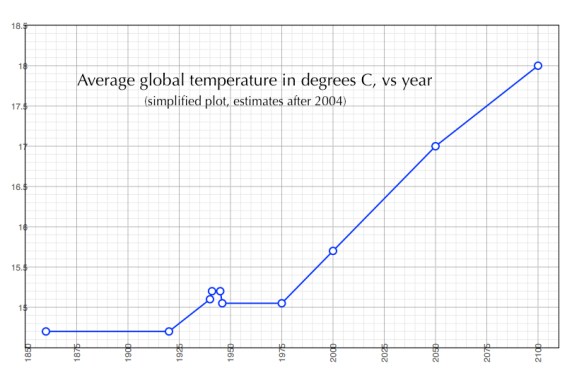
Instrumental records of global surface temperature begin in 1860. The average global surface temperature for the period between 1961 and 1990 was 15 °C (59 °F). The deviations of global surface temperature, relative to the reference temperature of 15 °C, are — very generally! — as follows: -0.4 °C prior to 1920, a rise to 0 °C by 1940 (being at 15 °C), a plateau at +0.1 °C during 1940-1945, a lower plateau at -0.05 °C during 1945-1975, a rise to +0.6 °C by 2000. The actual year-to-year variations within each of these five periods are within a swing of 0.2 °C either way. (6), (7)

The temperature rise after 1975 is unprecedented (averaging +0.03 °C/year). The temperature today is 1°C (1.8 °F) warmer than in the late 19th century. The initial 40% of this temperature rise took 55 years, while the final 60% only required 25 years.

It is interesting to view the finely-detailed temperature history presented by the United Nations Environment Programme, and to imagine the warming trend beginning in 1920 as reflective of the oil boom then underway, as the industrialized nations moved from coal to petroleum for their energy; and to the warmth during WWII, which was not equaled until the 1980s.

Predictions of global warming above the early 20th century temperature of 14.7 °C are +2.3 °C in 2050 (between +1.5 °C and +3 °C), and +3.3 °C in 2100 (between +2.1 °C and +6.5 °C). (8)

Average global temperature (degrees Centigrade, C) vs. year (simplified)

Is it possible to directly relate temperature rise with human activity? For example, linking fossil energy, greenhouse gases, and global warming? What about fossil energy, industrialized agriculture, energy-intensive social systems and human population? Finding causal links to global warming is a scientific problem of great complexity, and one that has engaged many scientists for at least two decades. (9), (10)

However, without appealing to causal arguments, it is sometimes possible to show that trends for two phenomena coincide. If so, some limited insight might be found by contemplating this.

Proportionality, people and oil

The growth of human population, the depletion of oil resources and the rise of global temperature each mirror one another to a remarkable degree, a result that can be arrived at from the data and projections already described.

The world population of 2.7 billion by 1953 can be taken as a base that required negligible petroleum energy to produce. The addition of people beyond this level is fueled at a rate of 264 barrels of oil per person.

So, population minus the base equals cumulative oil production in barrels divided by 264 (equation 1).

For example, today’s population of 6 billion required the expenditure of 871 Gb (Gb is for Giga-barrel, or 1 billion barrels); the actual consumption by January 1999 was 857 Gb. Similarly, a projected population in 2050 of 9 billion would coincide with an accumulated depletion of 1,663 Gb, or 95% of the estimated 1,750 Gb of the world’s oil endowment.

The actual population and cumulative oil production data between 1950 and 2000 correlate startlingly well with the proportionality and offset (base population) given here. The projections to 2050 also correlate extremely well, but of necessity they contain uncertainties only time can clarify.

Proportionality, people and temperature

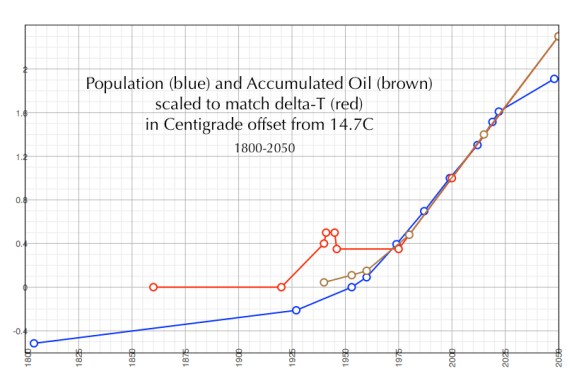
By direct comparison, the trends of temperature rise above 14.7 °C (the pre-1920 plateau) and population growth mirror each other after 1975 with a proportionality of 3.3 billion people per °C.

So, the difference of population minus base, divided by 3.3 billion equals the temperature difference above 14.7 °C (equation 2).

For example, the 6 billion people of today coincide with a rise of 1 °C to 15.7 °C (60.3 °F), and the projected 9 billion people of 2050 would coincide with a rise of 1.9 °C to 16.6 °C (61.9 °F).

Proportionality, temperature and oil

By a ratio of the previous two proportionalities, one finds that for each 870 Gb of oil produced, the global surface temperature rises by 1 °C.

So, cumulative oil production in barrels divided by 870 Gb equals temperature rise above 14.7 °C (equation 3).

It has already been noted that today we have a global warming of about 1 °C above the 19th century level of 14.7 °C, and that just over 857 Gb of oil have been extracted; this matches the proportionality of 870 Gb/°C. The anticipated global warming in 2050, with 1663 Gb of oil having been extracted, would be 1.9 °C, for a temperature of 16.6 °C (61.9 °F).

Summary of proportionalities

Three proportionalities: 264 barrels/person, 3.3 billion people/°C, and 870 Gb/°C, correlate the data and projected trends in world population (above a base of 2.7 billion), cumulative oil production and global warming (above 14.7 °C). Population and oil production are correlated from 1950, while all three quantities are correlated after 1975.

Population (blue), oil (brown) scaled to match temperature rise (red) above 14.7 C, 1850-2050, (see text, proportionalities)

Population (blue), oil (brown) scaled to match temperature rise (red) above 14.7 C, 1950-2050, (see text, proportionalities)

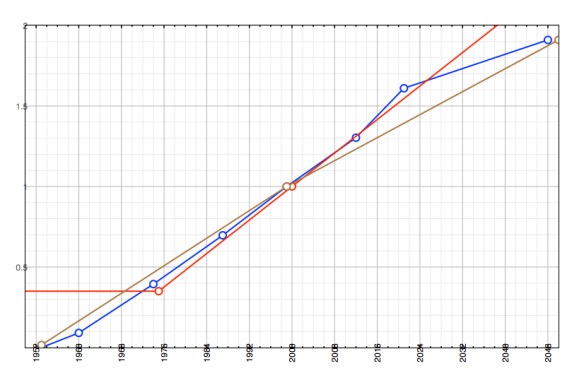
Population (blue), oil (brown) scaled to match temperature rise (red) above 14.7 C, 1950-2020, (see text, proportionalities)

What’s Next?

Are we to believe that these correlations will remain intact until the world’s oil is exhausted? Will we really age to 2050 with an accumulation of 9 billion people, no petroleum, and unchanged climate despite a heating of unprecedented magnitude, comparable to the cooling of the Ice Ages?

Many find it easy to fantasize from this point: ice caps melt, oceans swell, shorelines recede so that countries like the Netherlands and Bangladesh disappear; jungles and deserts expand but in different locations than at present, waves of extinction and population-drop sweep the animal kingdom, equatorial zone agriculture collapses, massive migrations spark wars; America, Europe and Japan militarize heavily, including space, to capture foreign resources and repel invaders and refugees; America invades Canada because the ‘corn belt’ has moved north to the former tundra; the exploding price of oil spurs a frenzy of invention into synthetic fuels and alternate forms of energy, as well as a return to coal and a depletion of timber; sunny territory is invaded and conquered by foreign armies, and used for solar energy plantations by a colonial elite who export the accumulated energy to their imperial homelands.

Politics (finally!)

In fact, we don’t know what will happen, or when. But, we can “use what we know” to begin rational planning now for a transition to a new method of powering our society (particularly transportation systems), and of weaning ourselves from imported energy and the imperialism it seems to require. It would also be wise to rearrange our politics, that is to say remove the inequities between economic classes, so that our nation can retain its integrity while facing the environmental, economic and political pressures to be expected with a shift to a post-petroleum world. The added stress of a civil war during such a time would be tragically cruel.

Such planning is unlikely — at best very difficult — in America, because business has a quarterly-profits myopia, and the electorate in the suburban American “heartland” is thoroughly indoctrinated in capitalist ideology, with an anti-socialist “every man for himself (and women too)” attitude. The world’s revenge for our past imperialism may well be realized by our lack of social planning for the inevitable shocks of the collapse of the oil-powered economy, accompanied by a climate shift.

There are no physical reasons, no “laws of nature” that prevent us from devising an alternative way of organizing and powering our American society. There would certainly be many technical problems and intellectual challenges, but we have the means to prepare for what we can predict is likely to unfold. An enduring society would do this on a continuing basis. To me, that is socialism. Sometimes it’s as simple as seeing that everyone is in the boat, and they’re all rowing in the same direction.

In looking at our political figures, which ones seem to concern themselves with just the self-interest of one or another faction, and which ones seem to concern themselves with the good of the “whole boat?” We need leadership that can draw our involvement into long-term, democratic, social planning that achieves dependable commitments. We need such a process to bear fruit this decade, and we need a well-understood general plan for embarking on an intentional social transformation. If not, we will be the witless victims of a foreseeable catastrophe of our own making.

Notes

1.  “Hubbert Peak of Oil Production” – http://www.hubbertpeak.com (as of 29 February 2004).

2.  James M. MacKenzie, “Oil as a finite resource: When is global production likely to peak?” World Resources Institute, 1996 & 2000 – http://www.wri.org/climate/jm_oil_000.html (as of 24 February 2004).

3.  Energy Information Administration, U.S. Department of Energy – http://www.eia.doe.gov (as of 28 February 2004).
“Energy in the United States: 1635-2000” – http://www.eia.doe.gov/emeu/aer/eh/frame.htm
“25th Anniversary of the 1973 Oil Embargo” – http://www.eia.doe.gov/emeu/25opec/anniversary.htm
“U.S. Total Petroleum Consumption” – http://www.eia.doe.gov/emeu/25opec/sld007.htm
“Imported Oil as a Percent of Total U.S. Consumption” – http://www.eia.doe.gov/emeu/25opec/sld002.htm

4.  U.S. Department of Interior, Press Release, 19 March 2003 – http://www.doi.gov/news/030319.htm (as of 28 February 2004).

5.  Bureau of the Census, U.S. Department of Commerce “Population Clock,” – http://www.census.gov/main/www/popclock.html (as of 28 February 2004).
“World Population Information” – http://www.census.gov/ipc/www/world.html
“Total Midyear Population for the World: 1950-2050” (table) – http://www.census.gov/ipc/www/worldpop.html
“World Population: 1950-2050” (graph) – http://www.census.gov/ipc/www/img/worldpop.gif
“Historical Estimates of World Population” – http://www.census.gov/ipc/www/worldhis.html
“Annual World Population Change: 1950-2050” – http://www.census.gov/ipc/www/img/worldpch.gif
“Methodology and Assumptions for the Population Projections of the United States: 1999 to 2100” – http://www.census.gov/population/www/documentation/twps0038.html

6.  “Trend in global average surface temperature,” United Nations Environment Programme / GRID-Arendal – http://www.grida.no/climate/vital/17.htm (as of 24 February 2004).

7.  Intergovernmental Panel on Climate Change (IPCC) of the United Nations Environment Programme (UNEP) – http://www.unep.ch/ipcc (as of 28 February 2004).
“Variations of Earth’s surface temperature for the past 140 years (global), and the past 1000 years (Northern Hemisphere)” – http://www.unep.ch/ipcc/present/graphics/2001syr/large/05.16.jpg
“Variations of the Earth’s surface temperature: years 1000 to 2100” – http://www.unep.ch/ipcc/present/graphics/2001syr/large/05.24.jpg

8.  The reference temperature in [6] is 15.08 °C (the 1961-1990 average), while in [7] it is 15.43 °C (the 1990 value). This article uses the 1860-1920 plateau (estimated average) of 14.7 °C as the reference for global warming. So, the data and projections of temperature “deviations” and “variations,” from [6] and [7], have been adjusted to ensure consistency in describing global warming.

9.  “Global Warming,” National Oceanic and Atmospheric Administration – http://lwf.ncdc.noaa.gov/oa/climate/globalwarming.html (as of 24 February 2004)

10.  “What is Climate Change,” Government of Canada – http://www.climatechange.gc.ca/english/issues/what_is/index.shtml (as of 24 February 2004).

<><><><><><><>

DC Planar Magnetron Cathode 2D Fluid Model

<><><><><><><>
Related post:

https://manuelgarciajr.com/2017/10/28/proton-beam-driven-electron-mhd/

<><><><><><><>
Climate Change Action Would Kill Imperialism


<><><><><><><><><><><><><><><><><><><><><><><><><><><><><><><><>
Climate Change Action Would Kill Imperialism

Climate change action would kill imperialism, and that is why we can’t have it in America.

American political power is based on fossil fuels, and the US military is the engine that consumes those fuels to produce that power. So long as there is an American political elite that craves lucrative personal prestige and the ability to dominate internationally, the US economy will be fossil-fueled capitalism that maintains the military colossus that enables and protects those elite ambitions.

US military-enabled imperial power is of two varieties:

first: the hard power that overtly invades and seeks to control territory to impose American capitalist domination, as for example capturing pipeline routes south through Afghanistan and Pakistan – away from China – out of Central Asian oil fields; the guarding of sea lanes crucial for petroleum transport west, as at Suez and the Strait of Hormuz, and east to Japan, Korea and Australia (if they behave); and the securing of scarce metal ore and rare earth deposits in Afghanistan and Africa (for elements used in solid state electronics); and

second: the soft power of buying compliance to US hegemony from client states by gifting them with arms sales that enable them to exercise their own mini-imperialistic ambitions, as with Israel’s threat-projection in the Levant that is consistent with US aims of regional control, and Zionism’s own manifest destiny colonialist mania of persecuting the occupied Palestinians and shrinking their reservations; and with arms sales to Saudi Arabia enabling its genocidal war against Yemen, and giving the U.S. leverage to induce the opulent Saudi royalty to keep oil production high and oil prices low on the world market, so as to grease Western capitalism and also undercut the revenue streams supporting Venezuelan socialism and Iranian economic development.

Because of the fracking (oil shale) boom of the last two decades, the U.S. now produces as much oil as Saudi Arabia and is energy independent as a fossil fueled economy, but hegemonic ambition compels it to seek global control of petroleum distribution because to control the flow of oil around the globe is to throttle the imperial ambitions and economic development plans of all others.

American imperialism, mediated by its military, is intrinsically fossil fueled. It is impossible to power the trucks, tanks, gun-carriages, helicopters, airplanes, missiles, drones, ships and submarines of the US military with solar and wind power; only fossil fuels will do. Nuclear power – also based on a fossil fuel, fissile uranium – is used to propel particularly large destruction-projection platforms, specifically missile-carrying submarines and aircraft carriers. Military vehicles require high energy-density fuels, to provide a high amount of energy at a high rate of delivery from relatively small volumes of fuel-matter, in order to propel them quickly (and inefficiently) despite the weight of their armaments.

“Green” forms of energy – solar, wind, hydroelectric – are intrinsically of low energy-density; they are spread out over large areas from which they are collected rather slowly, rather than being chemically concentrated into relatively compact masses, like coal, petroleum, natural gas and fissile uranium, which can be ignited to release their stored energy explosively.

Local sources of “green” electrical energy can power civilian infrastructure almost anywhere, because solar, wind and even hydro power are widely available around the globe. All that is required is investment in and installation of appropriate energy collection technology, and a local area distribution network for electrical power. Green energy is intrinsically a socialist form of powering civilization, because the energy to be used locally can be collected locally, which frustrates the capitalist impulse to monopolize narrowly-defined sites of high energy-density fuel deposits – like coal and uranium mines, and oil and gas wells – and tightly confined electrical generation plants that meter out their electrical power through a web of long distance transmission lines.

The United States can only address the existential threat of global climate change by disavowing the imperialistic and self-aggrandizing ambitions of its political and corporate elite. That means deflating American militarism and its vast war industries complex by abandoning capitalism, which is exclusionary (privatized, extractive) fossil-fueled and speculation-dominated economics, and transforming the US economy to nationally and rationally planned green energy socialism: people over profits, an equalizing domestic solidarity over classist international gamesmanship.

Transforming the American political economy to green energy socialism would be very good for the American people, but it would be the death of American fossil-fueled capitalism, and thus of America’s rulers’ ambitions and privileges.

What we know today is that America’s political and corporate elite would rather see humanity end within a century than disavow its imperialistic and self-aggrandizing ambitions. Their obsession is to rule to the bitter end, a bitter end hastened by their obsession to remain in control. America does not have a robust permanent national commitment to contain, ameliorate and possibly reverse climate change and ecological deterioration because that would necessarily require the overthrow of Imperial America’s capitalist elite and its classist and racist mentality.

The revolution necessary to overthrow American capitalism and enable a national response to the climate change crisis would first require an amazing degree of popular consensus, psychological and intellectual maturity, moral courage, popular solidarity and personal commitment throughout the public, to sustain it through whatever struggle would be necessary to overpower its ruling capitalist paradigm.

Will this ever be possible?, or would any popular American eco-socialist uprising be snuffed out as pitilessly as was the Syrian Revolution? Regardless, is CO2-propelled climate change now so far advanced that it is beyond any human ability to stop? No one can really say.

We are each left with a choice between: defeatist acquiescence to capitalist-dominated climapocalypse, or the dignity of rebellious aspiration and activism for green socialism, regardless of whether or not it will ever be realized politically, and even if it is now precluded by Nature’s implacable geophysical forces that humanity’s blind self-absorption has set into karmic motion.

<><><><><><><>

Hurricane Florence, 9-11 Climate Change Terrorism

<><><><><><><><><><><><><><><><><><><><><><><><><><><><><><><><>
Hurricane Florence, 9-11 Climate Change Terrorism

NEW 9-11 TERRORIST ATTACK!! Yes, it’s true! Today (11 September 2018), terrorists based in Washington D.C., and sponsored by the dinosaur bones mining, pumping and burning industries, have relaxed rules restricting methane emissions from mines and oil and gas wells (for privatized profits at socialized costs), which will result in enhanced hydrocarbon atmospheric pollution that will accelerate Global Warming.

AND JUST IN TIME! Because Hurricane Florence, currently a Category 4 hurricane (and possibly strengthening toward the maximum possible, Category 5) is barreling down on North Carolina (a good choice, they voted for Trump), and 1.5 MILLION people have been urged/ordered to evacuate from coastal areas.

Hurricane Florence is being amplified by Climate Change (Global Warming) because:

1) the sea level is now higher (by about 1 foot in the western Atlantic near the Carolinas) because of previous ice cap melting and runoff (and heat-induced expansion of seawater), so the “storm surge” (like an extra super duper high tide) flooding of coastal lowlands, swept in by the hurricane, will be more extensive (i.e. worse); and

2) because the ocean is warmer (by Global Warming) and thus has much more energy (heat) available to pump up wind speed/energy in hurricanes, and so they have more capacity to destroy structures and infrastructure (like telephone and power poles, and fallen power lines start fires; also to uproot trees, smash houses and lift off roofs); and

3) because Global Warming/Climate Change has altered the path of the Jet Stream —

the high-latitude, high-speed, high-altitude, west-to-east ring of wind current that normally pushes Atlantic hurricanes eastward back out into the Atlantic Ocean, away from the US East Coast —

(has altered the path of the Jet Stream) farther to the north, so it now DOES NOT push Atlantic hurricanes toward the east, away from the US East Coast. So Hurricane Florence will stall when it makes landfall, and dump humongous amounts of rain in the same spot (same localized region) of mainly North Carolina, which will cause huge inland flooding. This is exactly what happened last year (2017) with Hurricane Harvey over Houston, which resulted in the largest flooding event in US history.

We can expect fatalities of American citizens.

Since:

– all these coming effects of Hurricane Florence (and Hurricanes Helene and Isaac, right behind) were known to be inevitable, and

– since Global Warming/Climate Change is known to be the “natural” culprit (super-charging an already dangerous natural weather event), and

– since pollution by greenhouse gases is known (and has been known for over half a century) to be the human action producing the super-charged “natural culprit” of this approaching Climate-Weather Catastrophe, and

– since it is known that this human action has been committed by high U.S. government officials solely for the pecuniary advantage of the fossil fuels industries (who fund these pols’s kick-backs), and

– as it is known such action will directly harm — even kill — American citizens,

– then it is directly clear that said high U.S. government officials are committing premeditated murder (and at the very very minimum reckless endangerment including manslaughter).

This is all-out terrorism against millions of Americans on US soil.

The US War On Terror needs to focus all its forces on Washington D.C., and Wall Street, New York City (and its satellite corporate terrorist base camps, cash dumps and training centers lurking deep in the Uncle Sam Homeland), and capture and liberate that currently occupied — by neo-fascists — national capital city.

At this moment, murder charges could be filed in any state court against these still-at-large-criminals (hiding out in bought-elected federal and state offices) because of the direct linkage between their premeditated actions, their criminal intent to harm rather than protect American citizens (a direct violation of their oaths for government service, and their primary duty as members of American government: protecting the public) and the past and now impending and inevitable harm to be suffered by many members of the American public.

9-11 terror is here now, but on a continental scale, not just a citywide scale — with Hurricane Armageddon on the East Coast and Gulf Coast, Wildfire Armageddon west of the Great Plains, and more and bigger tornadoes inevitable for the Mississippi Watershed and Great Plains.

We are having our continent-wide mainland USA “Pearl Harbor” attack by Climate Change-amplified weather, which is state-sponsored terrorism that is caused directly by the fossil fuel industry-owned terrorist-capitalist network of Republican Party and corporatist Democratic Party pretenders and occupiers of U.S. Government (and states’ governments) Executive, Congressional and Judicial public offices.

This is treason, and demands a complete and thorough revolution.

Exhibit A (thanks to Norman T.):
https://www.democracynow.org/2018/9/11/climate_change_supercharges_hurricane_florence_as

<><><><><><><>

More about the image at the top:

<><><><><><><>

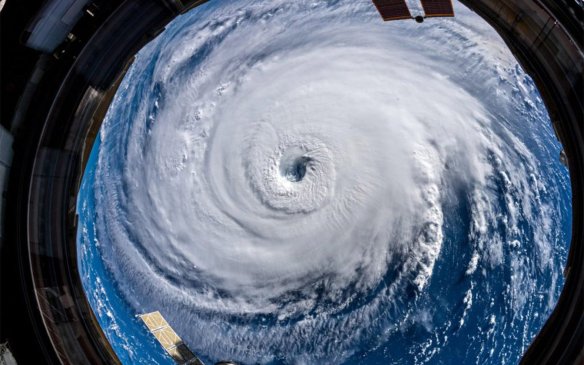
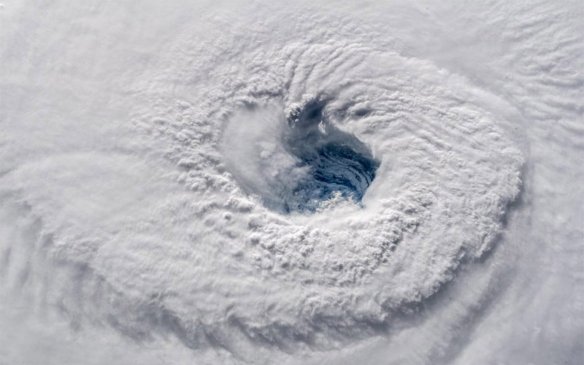
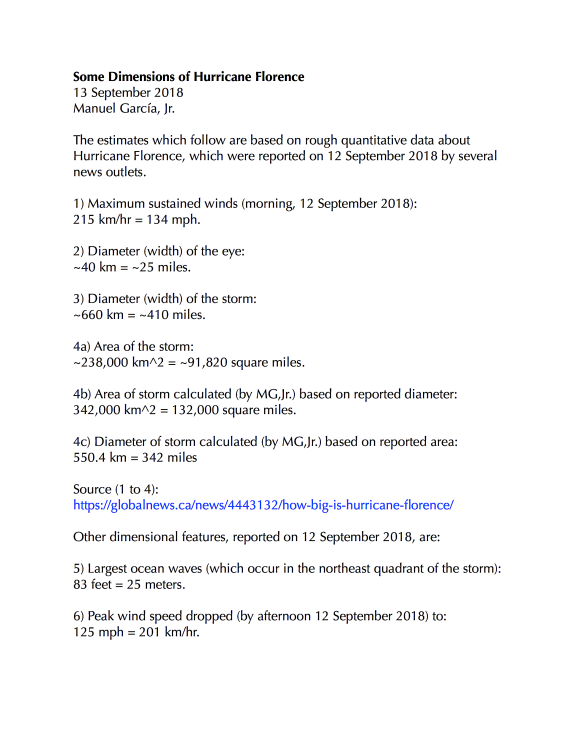
The eye of Hurricane Florence, photographed from the International Space Station (at 410km, 255 mile elevation), on 12 September 2018, by German astronaut Alexander Gerst.

<><><><><><><>

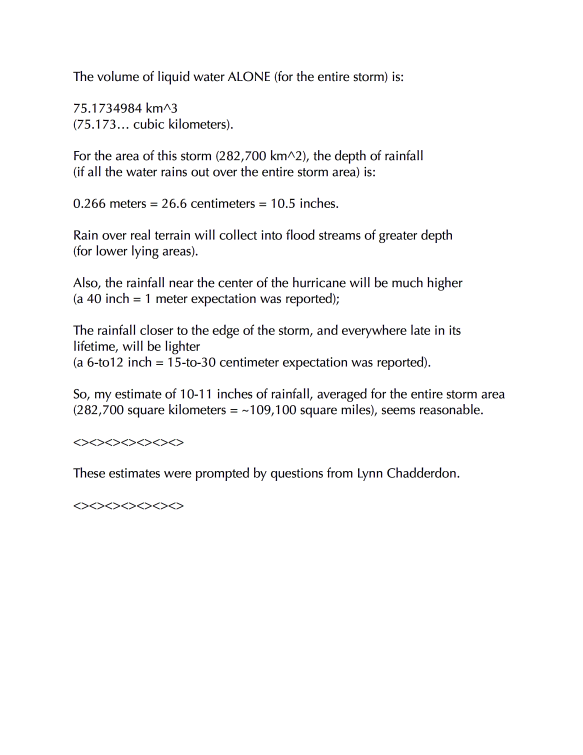
See comments (below) for additional/later estimates (calculations by MG,Jr.).

<><><><><><><>

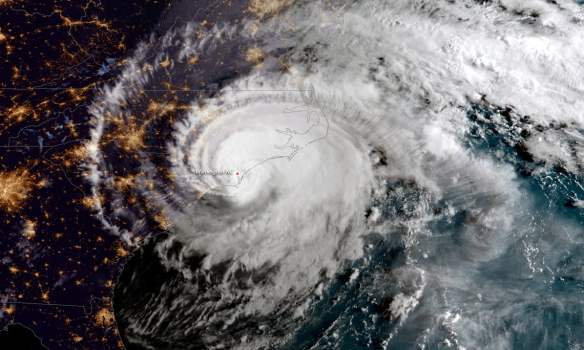
A NOAA satellite image shows Hurricane Florence as it made landfall near Wrightsville Beach, North Carolina.

This is how the world ends: will we soon see category 6 hurricanes?
16 September 2018
https://www.theguardian.com/us-news/2018/sep/15/hurricane-category-6-this-is-how-world-ends-book-climate-change

Publicly Subsidized Climate Change Insurance for Big Oil

“Whom the gods would destroy they first make mad”
— Henry Wadsworth Longfellow

My 14 August 2018 article, “Climate Change Bites Big Business” (https://www.counterpunch.org/2018/08/14/climate-change-bites-big-business/), described the now evident large financial impacts on Big Business caused by climate change, for example:

— the bankrupting-level liabilities to one California electric utility company (PG&E) for causing massive wildfires in 2017,

— the threat of similar future liabilities to the entire electric utility industry, especially in Western America,

— huge losses to fire insurance companies in California during 2017-2018 (and similar possibilities wherever drought occurs in highly developed areas),

— huge losses to flood, hurricane and tornado insurance companies, because of the more violent rain-and-wind storms of recent years (like Hurricane Sandy in 2012, and the hurricanes since),

— the possible throttling of future commercial and real estate investment if insurance rates and bank loan interest rates increase sharply because wildfire and weather related destructive events are now permanently amplified by climate change.

In the article cited above, I concluded:

“I think that the pretense of climate change denialism by the Big Money has crumbled, and we are now entering a period of overt climate change acknowledgment coupled with fanatical efforts to gain public subsidies for private interests to both insure and indemnify them against climate change-related financial losses, and to also preserve the nature of their businesses even if they are major CO2 and organic vapor polluters, like the petrochemical and coal companies.”

Confirmation of the above conclusion is provided by The Associated Press article of 22 August 2018, “Big oil asks government to protect its Texas facilities from climate change” (https://www.cbsnews.com/news/texas-protect-oil-facilities-from-climate-change-coastal-spine/), which describes:

“An ambitious proposal to build a nearly 60-mile ‘spine’ of concrete seawalls, earthen barriers, floating gates and steel levees on the Texas Gulf Coast… to shield some of the crown jewels of the petroleum industry, which is blamed for contributing to global warming and now wants the federal government to build safeguards against the consequences of it. The plan is focused on a stretch of coastline that runs from the Louisiana border to industrial enclaves south of Houston that are home to one of the world’s largest concentrations of petrochemical facilities, including most of Texas’ 30 refineries, which represent 30 percent of the nation’s refining capacity. Texas is seeking at least $12 billion for the full coastal spine, with nearly all of it coming from public funds. Last month, the government fast-tracked an initial $3.9 billion for three separate, smaller storm barrier projects that would specifically protect oil facilities.”

Capitalism is a combustion engine that burns fossil fuels to churn out privatized financial wealth, government power (by fueling the military) and socialized waste heat and greenhouse gas pollution whose accumulation in Nature creates and accelerates global warming-induced climate change.

The bald fact of the oil industry seeking to have the public subsidize the protection of its facilities — and its profitability — from the natural climate-changing consequences of its own operations must rank as one the most colossal combinations of blind greed, chutzpah, cognitive dissonance and inertia during this Oil Age.

But, this is where we are today in our collective response (if you can call it that) to the advancing threats posed by climate change to organized human life.

More polemics are pointless, and our existing politics is madness.

Note:

The phrase “Whom the gods would destroy they first make mad” is spoken by Prometheus in Henry Wadsworth Longfellow’s poem “The Masque of Pandora” (1875).

<><><><><><><>

Climate Change Bites Big Business
14 August 2018
https://manuelgarciajr.com/2018/08/14/climate-change-bites-big-business/

<><><><><><><>
Now also at Counter Punch;

Publicly Subsidized Climate Change Insurance for Big Oil
27 August 2018
https://www.counterpunch.org/2018/08/27/publicly-subsidized-climate-change-insurance-for-big-oil/

<><><><><><><>

You Can’t Sue Fossil Fuel Industry Over Climate Change

”Turns out cities can’t sue oil companies for climate change” reads the title of an article in Wired.Com magazine (https://www.wired.com/story/climate-lawsuits-dismissed/).* Well, obviously; the purpose of the US judiciary is to protect massed capital from popular democracy.

The truth is that climate change denial is primarily a failure of the U.S. Government (and other governments), from – at a minimum – the Reagan and then George H. W. Bush Administrations. Government scientists as well as government supported academics in the meteorological/atmospheric, oceanic, geological, and energy sciences all had combinations of observational data and computer models that clearly showed the advance and effects of global warming/climate change. The first definitive modern peer-reviewed scientific publication (in the journal Nature) describing the mechanism of CO2-caused global warming (the inability of the oceans to absorb all the CO2 being emitted, hence its buildup in the atmosphere, hence the growing heat retention by the CO2-laced atmosphere, hence the continuing rise in average air-ocean-earth temperature) was published in 1955.

By 1988, when James Edward Hansen (NASA’s chief scientist on atmospheric modeling and global warming at that time) gave his testimony to Congress – stating that global warming was man-made by CO2 emission – essentially all physically and mathematically reasonable computer models of the atmosphere and/or oceans, internationally, gave the same overall result: the more CO2 in the atmosphere, the higher the global average temperature; and the observed rise in global average temperature with time tracked the rate of increase of CO2 (and other organic gases and vapors) in the atmosphere. The National Academy of Sciences, as well as every real scientific and engineering professional society also agrees with this conclusion and states so.

The failure of protecting the public interest falls squarely on the political leadership class, who populate succeeding administrations of the USG and who collectively chose not to face the obvious facts presented by America’s (and the world’s) scientists, because that political leadership class did not want to accept or act on the clear societal implications of the scientific facts. Why? because the political leadership was more concerned to protect the financial self-interests of currently entrenched and very wealthy capitalist combines (in particular fossil fuel industries and the financial industries associated with them) than it was concerned to protect the long-term interests of the majority of the public for survival and well being (workers, wage earners, “ordinary people” relatively few of whom one could consider as “investors” in stocks, bonds and paper securities).

In brief, our politicians have for decades preferred to sell out the long term survival (and sustainable prosperity) of “the people” in favor of protecting the exploitative profitability of capital-intensive CO2-polluting industry and economic gamesmanship, and the super-wealthy (who are invariably corporatists and investor/speculators banking on those capital-intensive CO2-polluting industries). So, while it is true that the energy companies were very deceitful in funding P.R. campaigns of climate change denial while their own scientists/technologists knew that climate change was real and caused as a result of using their fossil fuels – just to keep raking in huge short-term profits – we had ample ways of knowing the truth without needing the fossil fuel companies to admit it, because we have had the publicly funded and publicly available scientific results of world-wide modern geo-science for decades.

American cities trying to sue energy companies for lying about climate change and hence “causing” damage to such municipalities has some legal logic to it as a way for these cities to “recover” financial compensation for their climate change-related “damages.” However, as noted here that is really a rather limited, petty, and at least partly hypocritical finger-pointing response to the accelerating climate change crisis, because that crisis is essentially the direct consequence of a willful (intentional!) failure of American (and other national) government, which was in cahoots with the CO2 polluter industries (and especially the Pentagon) and related finance capital industries.

Basically, capitalism is a fossil-fueled political-economic parasite feeding off the public good, both in its societal and environmental dimensions, and the US government (and others with similar energy and finance capital policies) is entirely in the business of protecting capitalism (the economic parasites) against the personal and societal interests of the majority of the national population (e.g., the ensuring of sustainable environmental security and long-term habitability, and having national political power controlled by popular and populist democracy rather than institutions of concentrated wealth).

And that’s where it stands today. We are on an accelerating plunge into extinction by climate change induced disasters (vast wildfires, collapsing agriculture, desertification and the poisoning of aquifers, the expanding range of disease pathogens, very destructive wind and rain storms) from the bottom up (first the poorest, last the richest) driven by a mad obsession to further concentrate the financial wealth of the wealthiest. It’s really all just a mass psychosis, and all our wars and military rivalries (nuclear armed no less) and political forms of oppression, repression and cruelty, and all our myopically fanatical exercises for maintaining control of factional and personal advantages parasitic to the public good are just ripples on the surface of the one great oceanic reality of our time: the survival of organized human life in the face of accelerating (and still out of our control) climate change.

Collectively, we humans just don’t want to face the fact that to have any useful (for our survival, and for social equity) impact on the present course of climate change we would have to change EVERYTHING, and NOW. Hypothetically, humanity has the capacity to do this, but realistically, based on the observation of past human behavior, it seems that the high degree of long-term cooperative altruism required to make such a complete change of world society (i.e., “the revolution,” or the “instant” conscious evolution of humanity’s super-ego) may be beyond the capacity of our collective social psychology. For now we each remain the randomly surprised victims of the sporadic disasters that erupt from our accumulating karma of obsessive-compulsive fossil-fueled climate change denial.

As an engineer, the only wild-ass guess of a solution that I can think of today is to hope for a miraculous “world satori” – a collective spontaneous and consensus-forming waking up of “everyone” to the same new vision of world society – and this then leading to our world buckling down to doing the numerous (and monumental) technical tasks of transforming all the structures of our civilization into a new paradigm in harmony with nature. Admittedly, this is an extremely fuzzy and rarefied engineering solution. What’s your idea?

*(Thanks to Michael Huff of Philadelphia, for the reference to the Wired article.)

See also:

Noam Chomsky: Survival of Organized Human Life is at Risk Due to Climate Change & Nuclear Weapons
30 July 2018
https://www.democracynow.org/2018/7/30/noam_chomsky_survival_of_organized_human

<><><><><><><>

The Obvious Paradigm

Solar Powered Desalinator, homemade

<><><><><><><><><><><><><><><><><><><><><><><><><><><><><><><><>

The Obvious Paradigm

The American consensus: a demise under capitalism is preferable to a continuation under socialism.

Fracking has made coal mining unnecessary. The upkeep of nuclear wastes makes nuclear power pointless. GPS guided missile technology makes nuclear weapons obsolete. The abundance of freely available solar energy and the great expanse of publicly held sunny lands makes privately metered and polluting fossil-fuel energy unnecessary, both for the power and as an expense. Fossil fuel energy is only necessary for the maintenance of militarism, and only for those who consider militarism necessary. Global warming is Earth’s fever from its infection with fossil-fueled capitalism. Solar-powered socialism is the obvious paradigm for a just and prosperous humanity in balance with Nature.

9 January 2018

<><><><><><><>

The Thermodynamics of 9-11

When hijacked airliners crashed into the tall Towers of the World Trade Center, in New York City [on 11 September 2001], each injected a burning cloud of aviation fuel throughout the 6 levels (WTC 2) to 8 levels (WTC 1) in the impact zone. The burning fuel ignited the office furnishings: desks, chairs, shelving, carpeting, work-space partitions, wall and ceiling panels; as well as paper and plastic of various kinds.

How did these fires progress? How much heat could they produce? Was this heat enough to seriously weaken the steel framework? How did this heat affect the metal in the rubble piles in the weeks and months after the collapse? This report is motivated by these questions, and it will draw ideas from thermal physics and chemistry. My previous report on the collapses of the WTC Towers described the role of mechanical forces (1).

Summary of National Institute of Technology and Standards (NIST) Report

Basic facts about the WTC fires of 9/11/01 are abstracted by the numerical quantities tabulated here.

Table 1, Time and Energy of WTC Fires

ITEM                              WTC 1           WTC 2
impact time (a.m.)          8:46:30          9:02:59
collapse (a.m.)               10:28:22        9:58:59
time difference               1:41:52          0:56:00
impact zone levels          92-99            78-83
levels in upper block       11                 27
heat rate (40 minutes)     2 GW            1 GW
total heat energy             8000 GJ       3000 GJ

Tower 1 stood for one hour and forty-two minutes after being struck between levels 92 and 99 by an airplane; the block above the impact zone had 11 levels. During the first 40 minutes of this time, fires raged with an average heat release rate of 2 GW (GW = giga watts = 10^9 watts), and the total heat energy released during the interval between airplane impact and building collapse was 8000 GJ (GJ = giga-joules = 10^9 joules).

A joule is a unit of energy; a watt is a unit of power; and one watt equals an energy delivery rate of one joule per second.

Tower 2 stood for fifty-six minutes after being struck between levels 78 and 83, isolating an upper block of 27 levels. The fires burned at a rate near 1 GW for forty minutes, diminishing later; and a total of 3000 GJ of heat energy was released by the time of collapse.

WTC 2 received half as much thermal energy during the first 40 minutes after impact, had just over twice the upper block mass, and fell within half the time than was observed for WTC 1. It would seem that WTC 1 stood longer despite receiving more thermal energy because its upper block was less massive.

The data in Table 1 are taken from the executive summary of the fire safety investigation by NIST (2).

The NIST work combined materials and heat transfer lab experiments, full-scale tests (wouldn’t you like to burn up office cubicles?), and computer simulations to arrive at the history and spatial distribution of the burning. From this, the thermal histories of all the metal supports in the impact zone were calculated (NIST is very thorough), which in turn were used as inputs to the calculations of stress history for each support. Parts of the structure that were damaged or missing because of the airplane collision were accounted for, as was the introduction of combustible mass by the airplane.

Steel loses strength with heat. For the types of steel used in the WTC Towers (plain carbon, and vanadium steels) the trend is as follows, relative to 100% strength at habitable temperatures.

Table 2, Fractional Strength of Steel at Temperature

Temperature, degrees C      Fractional Strength, %
200                                     86
400                                     73
500                                     66
600                                     43
700                                     20
750                                     15
800                                     10

I use C for Centigrade, F for Fahrenheit, and do not use the degree symbol in this report.

The fires heated the atmosphere in the impact zone (a mixture of gases and smoke) to temperatures as high as 1100 C (2000 F). However, there was a wide variation of gas temperature with location and over time because of the migration of the fires toward new sources of fuel, a complicated and irregular interior geometry, and changes of ventilation over time (e.g., more windows breaking). Early after the impact, a floor might have some areas at habitable temperatures, and other areas as hot as the burning jet fuel, 1100 C. Later on, after the structure had absorbed heat, the gas temperature would vary over a narrower range, approximately 200 C to 700 C away from centers of active burning.

As can be seen from Table 2, steel loses half its strength when heated to about 570 C (1060 F), and nearly all once past 700 C (1300 F). Thus, the structure of the impact zone, with a temperature that varies between 200 C and 700 C near the time of collapse, will only have between 20% to 86% of its original strength at any location.

The steel frames of the WTC Towers were coated with “sprayed fire resistant materials” (SFRMs, or simply “thermal insulation”). A key finding of the NIST Investigation was that the thermal insulation coatings were applied unevenly — even missing in spots — during the construction of the buildings, and — fatally — that parts of the coatings were knocked off by the jolt of the airplane collisions.

Spraying the lumpy gummy insulation mixture evenly onto a web of structural steel, assuming it all dries properly and none is banged off while work proceeds at a gigantic construction site over the course of several years, is an unrealistic expectation. Perhaps this will change, as a “lesson learned” from the disaster. The fatal element in the WTC Towers story is that enough of the thermal insulation was banged off the steel frames by the airplane jolts to allow parts of frames to heat up to 700 C. I estimate the jolts at 136 times the force of gravity at WTC 1, and 204 at WTC 2.

The pivotal conclusion of the NIST fire safety investigation is perhaps best shown on page 32, in Chapter 3 of Volume 5G of the Final Report (NIST NCSTAR 1-5G WTC Investigation), which includes a graph from which I extracted the data in Table 2, and states the following two paragraphs. (The NIST authors use the phrase “critical temperature” for any value above about 570 C, when steel is below half strength.)

<><><>

“As the insulation thickness decreases from 1 1/8 in. to 1/2 in., the columns heat up quicker when subjected to a constant radiative flux. At 1/2 in. the column takes approximately 7,250 s (2 hours) to reach a critical temperature of 700 C with a gas temperature of 1,100 C. If the column is completely bare (no fireproofing) then its temperature increases very rapidly, and the critical temperature is reached within 350 s. For a bare column, the time to reach a critical temperature of 700 C ranges between 350 to 2,000 s.

“It is noted that the time to reach critical temperature for bare columns is less than the one hour period during which the buildings withstood intense fires. Core columns that have their fireproofing intact cannot reach a critical temperature of 600 C during the 1 or 1 1/2 hour period. (Note that WTC 1 collapsed in approximately 1 1/2 hour, while WTC 2 collapsed in approximately 1 hour). This implies that if the core columns played a role in the final collapse, some fireproofing damage would be required to result in thermal degradation of its strength.” (3)

<><><>

Collapse

Airplane impact sheared columns along one face and at the building’s core. Within minutes, the upper block had transferred a portion of its weight from central columns in the impact zone, across a lateral support at the building crown called the “hat truss,” and down onto the three intact outer faces. Over the course of the next 56 minutes (WTC 2) and 102 minutes (WTC 1) the fires in the impact zone would weaken the remaining central columns, and this steadily increased the downward force exerted on the intact faces. The heat-weakened frames of the floors sagged, and this bowed the exterior columns inward at the levels of the impact zone. Because of the asymmetry of the damage, one of the three intact faces took up much of the mounting load. Eventually, it buckled inward and the upper block fell. (1)

Now, let’s explore heat further.

How Big Were These Fires?

I will approximate the size of a level (1 story) in each of the WTC Towers as a volume of 16,080 m^3 with an area of 4020 m^2 and a height of 4 m (4). Table 3 shows several ways of describing the total thermal energy released by the fires.

Table 3, Magnitude of Thermal Energy in Equivalent Weight of TNT

ITEM                                  WTC 1              WTC 2
energy (Q)                          8000 GJ           3000 GJ
# levels                              8                       6
tons of TNT                       1912                 717
tons/level                           239                  120
lb/level                               478,000           239,000
kg/m^2 (impact floors)       54                    27
lb/ft^2 (impact floors)         11                    6

The fires in WTC 1 released an energy equal to that of an explosion of 1.9 kilotons of TNT; the energy equivalent for WTC 2 is 717 tons. Obviously, an explosion occurs in a fraction of a second while the fires lasted an hour or more, so the rates of energy release were vastly different. Even so, this comparison may sharpen the realization that these fires could weaken the framework of the buildings significantly.

How Hot Did The Buildings Become?

Let us pretend that the framework of the building is made of “ironcrete,” a fictitious mixture of 72% iron and 28% concrete. This framework takes up 5.4% of the volume of the building, the other 94.6% being air. We assume that everything else in the building is combustible or an inert material, and the combined mass and volume of these are insignificant compared to the mass and volume of ironcrete. I arrived at these numbers by estimating volumes and cross sectional areas of metal and concrete in walls and floors in the WTC Towers.

The space between floors is under 4 meters; and the floors include a layer of concrete about 1/10 meter thick. The building’s horizontal cross-section was a 63.4 meter square. Thus, the gap between floors was nearly 1/10 of the distance from the center of the building to its periphery. Heat radiated by fires was more likely to become trapped between floors, and stored within the concrete floor pans, than it was to radiate through the windows or be carried out through broken windows by the flow of heated air. We can estimate a temperature of the framework, assuming that all the heat became stored in it.

The amount of heat that can be stored in a given amount of matter is a property specific to each material, and is called heat capacity. The ironcrete mixture would have a volumetric heat capacity of Cv = 2.8*10^6 joules/(Centigrade*m^3); (* = multiply). In the real buildings, the large area of the concrete pads would absorb the heat from the fires and hold it, since concrete conducts heat very poorly. The effect is to bath the metal frame with heat as if it were in an oven or kiln. Ironcrete is my homogenization of materials to simplify this numerical example.

The quantity of heat energy Q absorbed within a volume V of material with a volumetric heat capacity Cv, whose temperature is raised by an amount dT (for “delta-T,” a temperature difference) is Q = Cv*V*dT. We can solve for dT. Here, V = (870 m^3)*(# levels); also dT(1) corresponds to WTC 1, and dT(2) corresponds to WTC 2.

dT(1) = (8 x 10^12)/[(2.8 x 10^6)*(870)*8] = 410 C,

dT(2) = (3 x 10^12)/[(2.8 x 10^6)*(870)*6] = 205 C.

Our simple model gives a reasonable estimate of an average frame temperature in the impact zone. The key parameter is Q (for each building). NIST spent considerable effort to arrive at the Q values shown in Table 3 (3). Our model gives a dT comparable to the NIST results because both calculations deposit the same energy into about the same amount of matter. Obviously, the NIST work accounts for all the details, which is necessary to arrive at temperatures and stresses that are specific to every location over the course of time. Our equation of heat balance Q = Cv*V*dT is an example of the conservation of energy, a fundamental principle of physics.

Well, Can The Heat Weaken The Steel Enough?

On this, one either believes or one doesn’t believe. Our simple example shows that the fires could heat the frames into the temperature range NIST calculates. It seems entirely reasonable that steel in areas of active and frequent burning would experience greater heating than the averages estimated here, so hotspots of 600 C to 700 C seem completely believable. Also, the data for WTC Towers steel strength at elevated temperatures is not in dispute. I believe NIST; answer: yes.

Let us follow time through a sequence of thermal events.

Fireball

The airplanes hurtling into the buildings with speeds of at least 200 m/s (450 mph) fragmented into exploding torrents of burning fuel, aluminum and plastic. Sparks generated from the airframe by metal fracture and impact friction ignited the mixture of fuel vapor and air. This explosion blew out windows and billowed burning fuel vapor and spray throughout the floors of the impact zone, and along the stairwells and elevator shafts at the center of the building; burning liquid fuel poured down the central shafts. Burning vapor, bulk liquid and droplets ignited most of what they splattered upon. The intense infrared radiation given off by the 1100 C (2000 F) flames quickly ignited nearby combustibles, such as paper and vinyl folders. Within a fraction of a second, the high pressure of the detonation wave had passed, and a rush of fresh air was sucked in through window openings and the impact gash, sliding along the tops of the floors toward the centers of intense burning.

Hot exhaust gases: carbon monoxide (CO), carbon dioxide (CO2), water vapor (H2O), soot (carbon particles), unburned hydrocarbons (combinations with C and H), oxides of nitrogen (NOx), and particles of pulverized solids vented up stairwells and elevator shafts, and formed thick hot layers underneath floors, heating them while slowly edging toward the openings along the building faces. Within minutes, the aviation fuel was largely burned off, and the oxygen in the impact zone depleted.

Thermal Storage

Fires raged throughout the impact zone in an irregular pattern dictated by the interplay of the blast wave with the distribution of matter. Some areas had intense heating (1100 C), while others might still be habitable (20 C). The pace of burning was regulated by the area available for venting the hot exhaust gases, and the area available for the entry of fresh air. Smoke was cleared from the impact gash by air entering as the cycle of flow was established. The fires were now fueled by the contents of the buildings.

Geometrically, the cement floors had large areas and were closely spaced. They intercepted most of the infrared radiation emitted in the voids between them, and they absorbed heat (by conduction) from the slowly moving (“ventilation limited”) layer of hot gases underneath each of them. Concrete conducts heat poorly, but can hold a great deal of it. The metal reinforcing bars within concrete, as well as the metal plate underneath the concrete pad of each WTC Towers floor structure, would tend to even out the temperature distribution gradually.

This process of “preheating the oven” would slowly raise the average temperature in the impact zone while narrowing the range of extremes in temperature. Within half an hour, heat had penetrated to the interior of the concrete, and the temperature everywhere in the impact zone was between 200 C and 700 C, away from sites of active burning.

Thermal Decomposition — “Cracking”

Fire moved through the impact zone by finding new sources of fuel, and burning at a rate limited by the ventilation, which changed over time.

Heat within the impact zone “cracks” plastic into a sequence of decreasingly volatile hydrocarbons, similar to the way heat separates out an array of hydrocarbon fuels in the refining of crude oil. As plastic absorbs heat and begins to decompose, it emits hydrocarbon vapors. These may flare if oxygen is available and their ignition temperatures are reached. Also, plumes of mixed hydrocarbon vapor and oxygen may detonate. So, a random series of small explosions might occur during the course of a large fire.

Plastics not designed for use in high temperature may resemble soft oily tar when heated to 400 C. The oil in turn might release vapors of ethane, ethylene, benzene and methane (there are many hydrocarbons) as the temperature climbs further. All these products might begin to burn as the cracking progresses, because oxygen is present and sources of ignition (hotspots, burning embers, infrared radiation) are nearby. Soot is the solid end result of the sequential volatilization and burning of hydrocarbons from plastic. Well over 90% of the thermal energy released in the WTC Towers came from burning the normal contents of the impact zones.

Hot Aluminum

Aluminum alloys melt at temperatures between 475 C and 640 C, and molten aluminum was observed pouring out of WTC 2 (5). Most of the aluminum in the impact zone was from the fragmented airframe; but many office machines and furniture items can have aluminum parts, as can moldings, fixtures, tubing and window frames. The temperatures in the WTC Towers fires were too low to vaporize aluminum; however, the forces of impact and explosion could have broken some of the aluminum into small granules and powder. Chemical reactions with hydrocarbon or water vapors might have occurred on the surfaces of freshly granulated hot aluminum.

The most likely product of aluminum burning is aluminum oxide (Al2O3, “alumina”). Because of the tight chemical bonding between the two aluminum atoms and three oxygen atoms in alumina, the compound is very stable and quite heat resistant, melting at 2054 C and boiling at about 3000 C. The affinity of aluminum for oxygen is such that with enough heat it can “burn” to alumina when combined with water, releasing hydrogen gas from the water,

2*Al + 3*H2O + heat -> Al2O3 + 3*H2.

Water is introduced into the impact zone through the severed plumbing at the building core, moisture from the outside air, and it is “cracked” out of the gypsum wall panels and to a lesser extent from concrete (the last two are both hydrated solids). Water poured on an aluminum fire can be “fuel to the flame.”

When a mixture of aluminum powder and iron oxide powder is ignited, it burns to iron and aluminum oxide,

Al + Fe2O3 + ignition -> Al2O3 + Fe.

This is thermite. The reaction produces a temperature that can melt steel (above 1500 C, 2800 F). The rate of burning is governed by the pace of heat diffusion from the hot reaction zone into the unheated powder mixture. Granules must absorb sufficient heat to arrive at the ignition temperature of the process. The ignition temperature of a quiescent powder of aluminum is 585 C. The ignition temperatures of a variety of dusts were found to be between 315 C and 900 C, by scientists developing solid rocket motors. Burning thermite is not an accelerating chain reaction (“explosion”), it is a “sparkler.” My favorite reference to thermite is in the early 1950s motion picture, “The Thing.”

Did patches of thermite form naturally, by chance, in the WTC Towers fires? Could there really have been small bits of melted steel in the debris as a result? Could there have been “thermite residues” on pieces of steel dug out of the debris months later? Maybe, but none of this leads to a conspiracy. If the post-mortem “thermite signature” suggested that a mass of thermite comparable to the quantities shown in Table 3 was involved, then further investigation would be reasonable. The first task of such an investigation would be to produce a “chemical kinetics” model of the oxidation of the fragmented aluminum airframe, in some degree of contact to the steel framing, in the hot atmosphere of hydrocarbon fires in the impact zone. Once Nature had been eliminated as a suspect, one could proceed to consider Human Malevolence.

Smoldering Rubble

Nature is endlessly creative. The deeper we explore, the more questions we come to realize.

Steel columns along a building face, heated to between 200 C and 700 C, were increasingly compressed and twisted into a sharpening bend. With increasing load and decreasing strength over the course of an hour or more, the material became unable to rebound elastically, had the load been released. The steel entered the range of plastic deformation, it could still be stretched through a bend, but like taffy it would take on a permanent set. Eventually, it snapped.

Months later, when this section of steel would be dug out of the rubble pile, would the breaks have the fluid look of a drawn out taffy, or perhaps “melted” steel now frozen in time? Or, would these be clean breaks, as edge glass fragments; or perhaps rough, granular breaks as through concrete?

The basements of the WTC Towers included car parks. After the buildings collapsed, it is possible that gasoline fires broke out, adding to the heat of the rubble. We can imagine many of the effects already described, to have occurred in hot pockets within the rubble pile. Water percolating down from that sprayed by the Fire Department might carry air down also, and act as an oxidizing agent.

The tight packing of the debris from the building, and the randomization of its materials would produce a haphazard and porous form of ironcrete aggregate: chunks of steel mixed with broken and pulverized concrete, with dust-, moisture-, and fume-filled gaps. Like a pyramid of barbecue briquettes, the high heat capacity and low thermal conductivity of the rubble pile would efficiently retain its heat.

Did small hunks of steel melt in rubble hot spots that had just the right mix of chemicals and heat? Probably unlikely, but certainly possible.

Pulverized concrete would include that from the impact zone, which may have had part of its water driven off by the heat. If so, such dust would be a desiccating substance (as is Portland cement prior to use; concrete is mixed sand, cement and water). Part of the chronic breathing disorders experienced by many people exposed to the atmosphere at the World Trade Center during and after 9/11/01 may be due to the inhalation of desiccating dust, now lodged in lung tissue.

Did the lingering hydrocarbon vapors and fumes from burning dissolve in water and create acid pools? Did the calcium-, silicon-, aluminum-, and magnesium-oxides of pulverized concrete form salts in pools of water? Did the sulfate from the gypsum wall panels also acidify standing water? Did acids work on metal surfaces over months, to alter their appearance?

In the enormity of each rubble pile, with its massive quantity of stored heat, many effects were possible in small quantities, given time to incubate. It is even possible that in some little puddle buried deep in the rubble, warmed for months in an oven-like enclosure of concrete rocks, bathed in an atmosphere of methane, carbon monoxide, carbon dioxide, and perhaps a touch of oxygen, that DNA was formed.

Endnotes

[1] MANUEL GARCIA, Jr., “The Physics of 9/11,” Nov. 28, 2006, [search in the Counterpunch archives of November, 2006 for this report and its two companions; one on the mechanics of building collapse, and the other an early and not-too-inaccurate speculative analysis of the fire-induced collapse of WTC 7.]

[2] “Executive Summary, Reconstruction of the Fires in the World Trade Center Towers,” NIST NCSTAR 1-5, , (28 September 2006). NIST = National Institute of Standards and Technology, NCSTAR = National Construction Safety Team Advisory Committee. https://www.nist.gov/topics/disaster-failure-studies/world-trade-center-disaster-study

[3] “Fire Structure Interface and Thermal Response of the World Trade Center Towers,” NIST NCSTAR1-5G, (draft supporting technical report G), http://wtc.nist.gov/pubs/NISTNCSTAR1-5GDraft.pdf, (28 September 2006), Chapter 3, page 32 (page 74 of 334 of the electronic PDF file).

[4] 1 m = 3.28 ft;    1 m^2 = 10.8 ft^2;    1 m^3 = 35.3 ft^3;    1 ft = 0.31 m;    1 ft^2 = 0.93 m^2;    1 ft^3 = 0.28 m^3.

[5] “National Institute of Standards and Technology (NIST) Federal Building and Fire Safety Investigation of the World Trade Center Disaster, Answers to Frequently Asked Questions,” (11 September 2006). https://www.nist.gov/topics/disaster-failure-studies/world-trade-center-disaster-study

<><><><><><><>

This article originally appeared as:

The Thermodynamics of 9/11
28 November 2006
https://www.counterpunch.org/2006/11/28/the-thermodynamics-of-9-11/

<><><><><><><>