
What Should You Do About Climate Change?

<><><><><><><><><><><><><><><><><><><><><><><><><><><><><><><><>

Earth’s climate is changing before our eyes, and at a faster rate than given by all previous scientific predictions. The melting of glaciers and permafrost, and the methane burping from tundras and the Arctic Sea; the enhanced power of hurricanes, rain and snow storms, and floods; the swelling of the oceans and the creeping inundation of shorelines worldwide; the unrelenting severity of droughts and wild fires; the acidification of the oceans, die-off of corals and reduction of marine life; and the havoc all these geophysical phenomena play on food production and on the habitability of the many environments both humans and wildlife call home, are all startling clear to see.

The present form of our climate change is global warming, which is caused by the greenhouse gas emissions (carbon dioxide, carbon monoxide, methane, oxides of nitrogen, and volatile organic compounds), from our fossil-fueled economic activity, which is capitalist in either a “free market” or command economy format.

The only way to reduce the geophysical stimulation enhancing and accelerating global warming is to reduce and ideally halt the burning of fossil fuels. Humanity has not had the willpower to do this because it is from fossil fuels that we derive almost all of the power — and wealth — we use continually to each maintain our personal activity, and for us all to power our societies and civilization on every scale of their structures. While there are still people who live “off the grid” within the enchantment of nature as human wildlife, and who do not use fossil fuels at all, they are only a minority of Earth’s people. Humanity, 7.74B souls (25 November 2019) and growing by about 200,000 people a day (350,000 births, 150,000 deaths) burns fossil fuels to live.

The many poor and disadvantaged people around the world would like greater access to fossil fuels and electricity, which would allow them to increase their expenditure of external energy (exosomatic energy, outside their metabolism) in order to work themselves up from the drudgery and terror of surviving at a subsistence level, to safer more secure and comfortable modes of living. Many of the fortunate people experiencing relatively secure lives within the advanced highly developed economies of the First World would like greater access to, and cheaper prices for, exosomatic energy so as to extend the scope of their materialistic pleasures. Whether justified or unjustified, most people want more exosomatic power, and that demand drives the relentless expansion in the use of fossil fuels; and so global warming advances.

What should you do about climate change? There are as many answers to this question as there are commentators, critics, charlatans, careerists, environmentalists, philosophers, politicians, preachers, scientists, sages, saviors, speculators, know-it-alls and know-nothings with an axe to grind. The purpose of this essay is to whet your Occam’s Razor to slice through it all.

Consider the following Bayesian Statistics model problem, “Four Societies,” an abstraction of an extremely complex ‘what to do about climate change’ reality, to help organize our thoughts in hopes of eventually pointing to the correct actions we, individually, should take.

The purpose of Bayesian analysis is to logically select the best course of action from a set of available options, despite uncertainties about the probabilities of the outcomes that may occur, and where the decision-making process takes into account your own personal preferences regarding those outcomes. You can easily learn the mechanics of basic Bayesian analysis by looking up articles on the Prisoner’s Dilemma. Also, I give a patient explanation of decision-making using Bayesian statistics, with examples, at [1].

Four options for configuring our society are presented above (Bayesian outcomes), two capitalist and two socialist. For each of the capitalist and socialist formats there are two economic modes: politically unrestricted economic growth, and highly regulated and politically programmed economic contraction. Each is labeled somewhat fancifully to suggest its characteristics.

The “Billionaire Boys & Girls Club” (BB&GC) is the unrestricted capitalism of Ayn Randian dreams, and such dreamers as Milton Friedman, Alan Greenspan, Donald Trump, the Republican Party, and the many millions of people enthralled by their income-generating activities. These are people who see their life’s blood as issuing from their successful dog-eat-dog competition within a growing economy under capitalism.

The “Green New Deal,” (GND) as used here, is the idea of a 21st century interpretation of the Franklin Roosevelt Administration public works programs of the 1930s, and the military Keynesianism of the 1940s, to combine economic stimulation for the uplift of the bottom two-thirds of America’s standard-of-living pyramid, with a revolutionary revamping of American energy, housing, transportation, healthcare and social services infrastructure, that in sum total aggressively acts to minimize the further stimulation of global warming. The popular idea here is that America’s existential threat from climate change had its analog 80 years ago as the existential threat from the Great Depression and World War II, and that a Rooseveltian-style socialism now would be just as effective as it was then for overcoming the threat.

“Carbon Limited Capitalism” (CLC) is my term for the regulation and carbon-emission taxing of capitalism to significantly, if not entirely, eliminate its reliance on fossil fuels. Objectively, this would mean a contraction of economic activity for quite a while (perhaps forever) since green energy technology, though growing, is still too insufficient to supply the entire quantity of power consumed by our industrialized civilization — as we presently choose to wastefully conduct it.

“Enviro Co-op Simplification” (ECS) designates an intentional simplification of every aspect of American life so as to eliminate any reliance on fossil fuels. This format of American life would be centered on environmentalism, rather than gargantuan consumerism, and of necessity be a tightly interwoven network of cooperative associations and groupings — lots of socialism. It would be the “Certified Organic” model of American life and work, instead of our current ‘Fast Junk Glitz-o-tainment’ isolation-in-parallel format.

Each one of us will have preferences for or against residing in each of these four possible societies, and those preferences can be quantified on a purely subjective basis, as desirabilities D1, D2, D3 and D4, and assigned as follows.

A person primarily concerned with wealth accumulation might choose desirabilities as D1=100, D2=20, D3=10, D4=0.

A person primarily concerned with minimizing climate change and revitalizing Earth’s environments might choose desirabilities D1=0, D2=10, D3=20, D4=100.

There are as many possible sets of choices (D1, D2, D3, D4) as there are choosers. I will lead this presentation toward some general results, eventually.

What I (and you) — as the person in this model problem asking “what should I do about climate change?” — have to do is to decide: what am I going to commit myself to, both in my personal life and in any social and political activism I may engage in?

The two choices given here are for either economic growth or economic contraction.

What is unknown is whether our society will remain in its current capitalist format or transition into socialism because of the force of geophysical and sociological pressures. Let the quantity p designate the probability that socialism will arise in the historical near future in time to organize American society’s response to climate change. The quantity p is a number between 0 and 1. Thus, the probability that capitalism will remain the societal paradigm is the quantity (1-p).
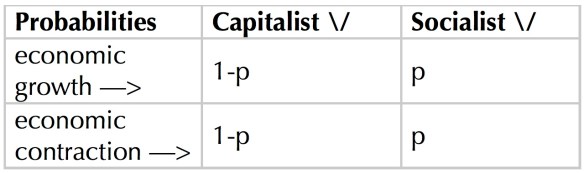
Given “my” desirabilities (D1, D2, D3, D4) for the four potential outcomes (BB&GC, GND, CLC, ECS), and the probability, p, of uncertain magnitude (between 0 and 1) for a socialist transformation, how would I nevertheless quantify my expectations — or utility values — regarding my two possible courses of action: committing to economic growth or committing to economic contraction? As follows.
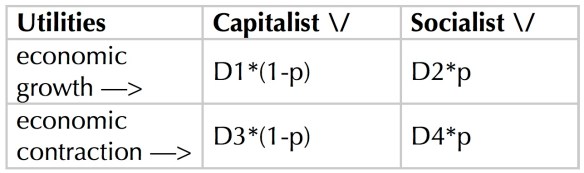
Here, the symbol * designates multiplication.

Given my subjectively quantified desirabilities (D1, D2, D3, D4) for the four potential societal outcomes, along with the as yet unknown probability p for a near-term socialist transformation, the utility value or expectation (a quantification of my potential satisfaction or dissatisfaction) for committing to economic growth is

Eg = D1*(1-p) + D2*p.

Similarly, the utility value or expectation for committing to economic contraction is

Er = D3*(1-p) + D4*p.

While “I” can pick desirabilities out of my own subjective preferences, feelings and biases, I can only guess — or ‘guesstimate’ — at what p might be. So, making such a guesstimate, I can then actually calculate a numerical value for each of Eg and Er. Comparing these, I would then choose to act according to whichever expectation quantity had the higher value. This is Bayesian decision-making, you choose the action that is subjectively of higher value to you, given your estimate of the probabilities of the uncertainties.

For example, the wealth seeker whose desirabilities are D1=100, D2=20, D3=10, D4=0, and who estimates the likelihood of a socialist transformation at p=0.5 (50%), would have utility values of

Eg = 50 + 10 = 60.

Er = 5 + 0 = 5.

Obviously, this capitalist bull would choose to devote himself to economic growth.

Similarly, the “Earth First” environmentalist whose desirabilities were listed earlier as D1=0, D2=10, D3=20, D4=100, and who estimated the probability of a socialist transformation at p=0.5 would have utility values of

Eg = 0 + 5 = 5.

Er = 10 + 50 = 60.

Obviously this environmentalist would choose to devote herself to economic contraction.

But not everybody is so lopsided in their preferences. An individual pulled in different directions by the need to make a living and enjoy a bit of consumerism, a yearning for greater social solidarity, a concern about global warming, and who has few ideological rigidities might select desirabilities D1=3, D2=8, D3=2, D4=10.

For this mild liberal

Eg = 3*(1-p) + 8*p,

Er = 2*(1-p) + 10*p.

It turns out that for this individual Eg=Er when p=1/3 (33%).

So, for the probability of socialism, p, estimated at greater than 1/3, Er is greater that Eg; committing to economic contraction will have more personal value that committing to economic expansion.

Obversely, for the probability of socialism, p, estimated at less than 1/3, Eg is greater than Er; and committing to economic expansion will have more personal value than committing to economic contraction.

For this mild liberal individual, if they believe that socialism has a better than 33% chance of happening, they should commit to economic contraction, environmentalism and consequently socialism. If they believe that socialism has less than a 33% chance of occurring then they should commit to being an economic growth capitalist. All this is based on personal subjectivities that arise from the confrontation with the objective realities of this American’s life in a world of climate change, and an assumed probability of future political change.

How would you quantify your preferences and inclinations into a set of numbers D1, D2, D3, D4 and p, and then what would your utility values be for the two actions of: working for economic growth, or working for economic contraction? How much are you willing to give up in order to forestall climate change? It might take more than you imagine. [2]

Now, I’ll state some general results for this model problem, and spare you the mathematical details.

For the probability, p, of socialist transformation to be a positive number between 0 and 1 (where any real probability must be within), the desirabilities must satisfy the following conditions.

Both (D1-D3) and (D4-D2) are greater than 0, or both (D1-D3) and (D4-D2) are less than zero.

Given these conditions, the value of probability at which Eg is equal to Er is designated as q, and has the value

q = (D1-D3)/[(D1-D3)+(D4-D2)].

For p less than q, one of either Eg or Er will dominate; and for p greater than q that dominance will switch. The “mild liberal” example shown earlier exhibited all this.

Another general result is that individuals with positive (D1-D3) and (D4-D2) — or D1 greater than D3, and D4 greater than D2 — can be ideologically capitalist and not really concerned about climate change; wanting economic growth under capitalism to strengthen it, and economic contraction under socialism to weaken it.

Similarly, individuals with negative (D1-D3) and (D4-D2) — or D3 greater than D1, and D2 greater than D4 — can be ideologically socialist and not primarily concerned about climate change; wanting economic contraction under capitalism to weaken it, and economic expansion under socialism to strengthen it.

Individuals who only care about economic expansion without regard to either capitalist or socialist ideology, and obviously don’t care about climate change, will have D1 greater than D3, and D2 greater than D4. Their utility value for economic growth, Eg, is always dominant regardless of any numerical value of probability p (which is in fact irrelevant to them).

Similarly, individuals who only care about economic contraction — our deeply committed climate change-confronting environmentalists — will have D3 greater than D1, and D4 greater than D2. Their utility value for economic contraction, Er, is always dominant regardless of any numerical value of probability p (which is only of interest as a political indicator of a national shift to economic contraction).

Finally, for both totally committed economic expansionists and economic contractionists, those who are inclined to favor capitalist ideology will see a decrease in the happiness of their unwavering efforts as the probability, p, of the transformation to socialism increases; and conversely, those inclined to favor socialist ideology will see an increase in the happiness of their unwavering efforts as the probability, p, of the transformation to socialism increases.

Those of you who are charter members or committed aspirants of the Billionaire Boys & Girls Club, or the Enviro Co-op Simplification Movement have no need for this Bayesian analytical method of making the emotional decision of how to conduct your life in the presence of climate change. But for us “regular people” this kind of theoretical exercise can help clarify the mind on what one’s priorities and concerns really are, and how best to focus your limited energies in the face of uncertain political shifts in a world of advancing climate change. What are you and I willing to accept — and sacrifice — in order to forestall climate change? Bayesian analysis is one way to personally come to grips with that question.

My wish would be for a socialist Green New Deal that miraculously disappeared fossil fuel usage without a loss of the exosomatic energy we now enjoy — achieved by some combination of energy conservation and the use of renewable energy (solar, wind and gravity derived) — and that such a transformation of the energy technologies powering our society and civilization were accomplished without further greenhouse gas emissions. In other words, that the required rapid contraction of fossil fueled economies, to forestall climate change, was also simultaneously a societal transformation to a new highly equitable economic paradigm operating harmoniously within the limits of nature. But I know that is impossible. Even the best effort in that direction will necessarily be an approximation to the ideal that is deficient to some degree, perhaps significantly. Climate change may now be beyond the ability — and the willingness — of humanity to avert; the best we can likely do is to minimize our further exacerbation of it. [3], [4]

Personally, I think that Enviro Co-op Simplification Socialism could be alright if we all made an effort for it.

Notes

[1] Bayesian Bargains: Jail, Shopping, Debt, And Voting
MG,Jr., (30 January 2012)
http://www.swans.com/library/art18/mgarci39.html

[2] That Green Growth at the Heart of the Green New Deal? It’s Malignant
Stan Cox, (13 January 2019)
http://greensocialthought.org/content/green-growth-heart-green-new-deal-it%E2%80%99s-malignant

[3] End-of-life anxiety and finding meaning in a collapsing climate
Leonie Joubert (20 November 2019)
https://www.dailymaverick.co.za/article/2019-11-20-end-of-life-anxiety-and-finding-meaning-in-a-collapsing-climate/

[4] Choosing Dignity During Climapocalypse
MG,Jr., (26 May 2018)
https://manuelgarciajr.com/2018/05/26/choosing-dignity-during-climapocalypse/

<><><><><><><>
Climate Change is a War Crime

Climate change is a war crime.

International jurisprudence recognizes the supreme crime as the making of aggressive war. This principle formed the basis of and justification for the Nuremberg and Tokyo War Crimes Tribunals (held variously from 1945 to 1949). Aggressive war is the supreme crime because all other possible crimes can occur in parallel, in association with, and as a consequence of the making of aggressive war; the perpetrators of war having opened a Pandora’s Box of destruction, death and evil. Also, the making of aggressive war is necessarily of international scope even if the combat is confined to one nation as a “civil war,” because any war causes disruptions, displacements and involvements that affect and include other nations.

Aggressive war is a drive to power by its perpetrators to gain dominion over other lands and people, and to consolidate dictatorial power within their own countries, all for the most-desired purposes of: structuring the national economies to enrich themselves exorbitantly; to compress the free will and independent thinking in the dominated societies into a monolithic and slavish obedience to, and adoration of the egos of, the war leaders; and to be able to crush opponents without mercy and to pass judgments and issue punishments without legal restraints or personal hazard.

Throughout history there have been many individuals who have sought success by pouring themselves into warmongering activity. As with any field of endeavor, some succeed spectacularly, some only achieve partial mediocre results, and many are utter failures — in this last case fortunately for humanity. Warmongering is always an activity that is anchored in a socio-political hierarchy, which the warmongers exploit. The job-seeker flunkies, technicians, thugs and bureaucrats — the Class B war criminals, if you will — who seek places in a warmonger-leader’s ideology and hierarchical movement so as to advance their own personal circumstances and social status, form the gear-train between the leadership and the herded masses; they transform the leaders’ intent into actions and forces that compel the movements and work of the masses.

Wars can be prosecuted along many dimensions of social activity. The most obvious is the violent use of technology — guns, bombs, armaments and war vehicles — provided by war-oriented industries. Another is by economic warfare: boycotts, embargoes, sanctions, industrial and agricultural sabotage. A nation with a large, strong and diversified economy can more easily intimidate a nation with a smaller, more primitive and narrowly defined economy. Other aspects of economic warfare are currency manipulation, and the selling of indebtedness to weaker nations under stress. Our early 21st century world is one in which the technology and use of electronic telecommunications have embedded themselves into the moment-by-moment operations of: military coordination; trade and economic transactions; the diffusion of news, entertainment and propaganda; and the transmission of personal messages. Warmongers who can control, manipulate and deny the use of communications infrastructure to an enemy population will have a powerful advantage.

Any warmonger’s drive to political power will require two essential ingredients: sources of physical energy for producing chemical and electro-mechanical power, and money. The most concentrated and transportable sources of such physical power today are fossil fuels, which are provided by petrochemical industries. Fossil fuels are the most easily used substances for powering the transport of the full spectrum of military vehicles; and petrochemicals are essential ingredients in the fabrication of explosives and propellants used in armaments. Money is essential to the schemes of a warmonger in order to purchase the hardware for prosecuting war, to buy the allegiance through employment of the lower level flunkies (patronage), and to sprinkle the herded masses with some minimal palliatives (bread and circuses).

Fossil fuels are how almost all of us acquire the external physical power we use in our daily lives. It powers our automobiles, our airplane and marine transportation; and the combustion of fossil fuels is the major source of the mechanical power used to turn the electric generators that supply our homes and businesses with electricity. It is technically possible to use solar, wind and hydro (gravity) sources of energy to crank our electric generators for civilian electrical power, but those ‘green’ sources are all of low concentration and require large collection areas (solar farms, windmill arrays, rivers and reservoirs and ocean tidal flows), so they are useless for mobile military purposes. Because fossil fuels — and in particular petroleum — are such potent and convenient sources of physical power, they are very highly desired worldwide, and that means that fortunes can be made by producing and selling them, and no serious war-making scheme can advance without them.

The most efficient engine of war that human ingenuity has ever devised is called capitalism. This engine is designed as an economic system that generates money — distributed hierarchically within the system to grease its own operation through cupidity — from the extraction of natural resources that are industrially processed into: fossil fuels, metals and plastics, solid state materials used in our electro-optical and telecommunications infrastructure, and industrialized agriculture. One type of industry that processes raw materials into technological products is that which supplies and maintains military forces. Politics in any society is how the economy is administered, how the costs and the benefits are distributed. Most of us will see a society as “militarist” if the military forces and their associated industries dominate the nation’s politics and the national economy, paying few of the public costs and extracting huge targeted benefits. Similarly, most of us will see a society as “socialist” (or democratic socialist, or capitalist welfare state) if the public costs required and personal benefits produced by its economy are very evenly and equitably distributed throughout the population, and military forces and war industries are only as large as prudent for national self-defense, and represent only minor parts of the economy and the political power-structure.

Capitalist societies (and which ones today aren’t?) that are misshaped to fit the schemes of warmongering elites will be those seeking “to gain dominion over other lands and people and to consolidate dictatorial power within their own countries.” This is aggressive war by a combination of military force, economic intimidation and cyber warfare, as described earlier. These aggressive wars — against the international public — are fossil-fueled, and are the primary sources of the CO2, methane (and hydrocarbon) and NOx emissions that cause global warming (climate change). Now, the globally accepted euphemisms for categorizing these wars are “competitiveness” and “economic competition.” The idea here is that “our” efforts to gain economic and physical advantages (money, resource extraction and privileged use of territory) over “them” is part of an economic-sport competition (“trade,” “free market,” “world market,” “the great game”). But in this arena of competition “it’s not how you play the game, but whether you win or lose,” and “nice guys finish last,” are the attitudes of choice. This is unregulated capitalism, it is war, and this is the source of global warming and its associated environmental degradation.

Therefore, since war in all its forms against the international public interest is always a crime: climate change is a war crime.

The ending of today’s many climate change-producing wars will require — as with so many earlier wars — an international alliance of the “regular people” outside the warmongering political-economic elites, in this case to support each other’s efforts to gain domestic political power to green-socialize their national economies, and to bring to justice in national and international tribunals the leading militarists, industrialists, bankers-financiers and authoritarian politicos whose supremely egotistical drives to power and wealth are withering the humanity, spirits and intellects of the societies they exploitatively herd, and are poisoning the habitability of Planet Earth.

I realize that this monumental task of popular revolutionary transformation will seem politically impossible to most “rational” people. But isn’t the achievement of a just management of national and international economics on an environmentally revitalized Planet Earth with sustainable energy production and use, with less exacerbation of global warming, with internationally cooperative forms of ameliorating the unavoidable effects of advancing localized changes of climate, and with no aggressive wars — both bloody and of “economic competition” — a vision worth investing political activity towards? Such political activity can gain some passion with the realization that:

climate change is a war crime.

<><><><><><><>

Heartrending Antiwar Songs

What makes for a heartrending antiwar song? Is it a doleful poetic and folkloric lament, or is it a driving martial beat with piercing raging lyrics of protest? Does it need a woman’s plaintive voice to make your heart ache with pain, or a man’s fierce growl to give you that gut-wrenching sinking feeling? I suppose it all depends on your kind of musical ear, and on your own situation with regard to the hazards of war.

I will offer a sequence of antiwar songs here, which for one reason or another have given me pause. Why do this?: because I like music, and because I think it important that none of us ever forget the proper attitude towards war and the prospect of war: rejection and rebellion. Peace is emotionally and politically turbulent when you are stubbornly antiwar, because war is the grease of imperialist capitalism.

The nuclei for this project are the first two songs listed, which both pull on my heartstrings. High Germany is a Celtic song where a Scottish lass laments the loss of her soldier lad to the First World War. This particular song really gets me because the lyrics are so poignant, and because the singer — my younger daughter — does such a good job of conveying the emotion that was very real 100 years ago in Scotland, and, sadly, remains just as real all over the world today.

High Germany
https://youtu.be/2QybAQVv6jE

Soldier, We Love You is an original composition by Rita Martinson, who performed it so eloquently and memorably in the 1972 movie F.T.A. (officially “Free The Army,” and understood to be “Fuck The Army”). F.T.A. starred Jane Fonda, Donald Sutherland and a collection of performers and musicians banded together in a touring satirical revue performing at coffeehouses and parks near American army bases, for G.I.’s opposed to the war in Vietnam. Though I was never a soldier (by pure luck) I have been so touched by Rita Martinson’s performance, and I gratefully wish her a happy life and satisfying career, wherever she is.

Soldier, We Love You
https://youtu.be/7iMusPYq83g

As you will see below, I quote some of the commentary on these songs by people I found on the Internet, many of them veterans, who had offered their suggestions.

“The Robert Shaw Chorale sing Shenandoah, a heartrending soldier’s lament from the American Civil War. The very first, and among the very best of antiwar songs ever… We lost a lot of relatives and close family friends in WW1, WW2 and in Vietnam.” — Fred Wilson

Shenandoah – The Robert Shaw Chorale
https://youtu.be/IBH2QrUyz7o

Eva Cassidy was a gift to us from the universe, of pure soulful heart through song. She left us far, far too early. Her rendition of Danny Boy unfolds the sheer tragedy carried by the lyrics with a radiant vocal eloquence (self accompanied on guitar), and most admirably without any showy attention-seeking bombast. The lyrics present a dead soldier’s call for remembrance and love, from his grave, and Eva had the grace and the perception to honor that sentiment.

“As a full blooded Irish man who has heard this song sung hundreds of times by family and friends at weddings, funerals and every other occasion when Irish people gather together to sing, I can honestly say I have never heard it sung better and with more feeling than sung here by Eva.” — Belfastsoul

Eva Cassidy – Danny Boy
https://youtu.be/oSKM0YiU8LU

War rips apart families, and mothers, who are the hub of their family wheels, are heavily burdened with those painful losses. So it is natural for a woman’s voice to express that universal pain, and to this Joan Baez has lent her beautiful artistry and passion.

Joan Baez – Weary Mothers
https://youtu.be/hqQcaWpwCrM

If war is so bad why does it exist? Why does anyone allow themselves to become a soldier, a lethal tool and sacrificial victim in the war-schemes of the Big Money? Who, ultimately, is responsible for inflicting the scourge of war on humanity? Buffy Sainte-Marie plunges to the core of this question, and arrives at the painful truth (Pogo’s realization).

Buffy Sainte-Marie – Universal Soldier
https://youtu.be/VGWsGyNsw00

Many of the antiwar songs here are from the 1960s, during the Vietnam War, “a time I remember oh so well” since I was nearly swallowed up in it. The songs of that time which I list either had a sound or some turn of phrase that imprinted on my mind either because I heard them so many times during those bright days of hopeful youth, and stoned drunk nights of dreams or despair, or because hearing them coincided with moments of incredible euphoria or tension. Basically, this song-listing exercise is neither a scholarly assemblage of the historically significant, nor a production based on logic. It’s about visceral memories and their reverberations in songs.

Barry McGuire and Buffalo Springfield gave us clues, in 1965 and 1967, of what we high school boys in those years were in for. I was not looking forward to facing the draft when I reached 18.

Barry McGuire – Eve Of Destruction
https://youtu.be/qfZVu0alU0I

Buffalo Springfield – For What It’s Worth
https://youtu.be/gp5JCrSXkJY

Country Joe McDonald spelled out rather explicitly why I did not like being 1A during 1969. The Doors punctuated that feeling of dread all too perfectly.

Country Joe McDonald – I Feel Like I’m Fixin’ To Die Rag
https://youtu.be/3W7-ngmO_p8

The Doors – The Unknown Soldier
https://youtu.be/6LSCoBk8hgU

“I remember the nightly ‘kill’ numbers on the news.” – Andre R. Newcomb. The evening television news broadcasts would give the awful weekly totals of U.S. soldiers killed. Totals of enemy dead issued by the U.S. military were complete fabrications, but the unknown quantities of Vietnamese dead were definitely very very high; America had the most superior firepower. Three Five Zero Zero, a song from the musical, Hair, takes off from its initial reference to a body count. Have you heard as scathing an antiwar song in recent years? And it no, why do you think that is?

Hair – Three Five Zero Zero
https://youtu.be/FAdq3Z-9bsg

As we know from President “Bone Spurs” Trump, Dick “Too Busy Four Deferments” Cheney, George “AWOL” W. Bush, and others of our immune ‘privilatti’ class who breezed past the Vietnam War, “getting out of the draft” in a culture dedicated to materialism and the instinctive worship of power is more easily arranged the more elevated your association to the economic and political hierarchy. Creedence Clearwater Revival give a spirited expression of this class-war truth.

Creedence Clearwater Revival – Fortunate Son
https://youtu.be/ec0XKhAHR5I

For the callow petit bourgeois youth of the time, like me, who felt a continuous sinking feeling of “circling the drain” before ever really stepping into adulthood and savoring the sweet fruits of life, there arose an intense desire to find somebody to love and be loved by, at least for a while before “the end.”

Jefferson Airplane – Somebody to Love
https://youtu.be/5Jj3wZVc7nw

Phil Ochs was a songwriter and political activist of sharp wit, sardonic humor and earnest humanism, whose songs were graced by insightful lyrics of literate elegance. He wrote hundreds of songs in the 1960s and 1970s. In 1976 at the age of 35 he succumbed to his own demons, and left us. Phil Ochs was a man of very keen perception, and immersed in the bubbling cauldron of intense antiwar activism during the Vietnam War, I think his psyche was eventually overwhelmed by that searing experience. I think the reason more of us “ordinary people” — those with reasonably decent moral character — don’t go completely mad over the poisonous nature of American politics and national character is because we are shielded by duller wits from perceiving the full reality of the kind of society we live in. There are hazards to being a seer.

Phil Ochs – Draft Dodger Rag
https://youtu.be/tFFOUkipI4U

“Funny thing is I’m in the Army and I don’t know anyone in my unit over 30 years old who doesn’t know all the words to this song [I Ain’t Marching Anymore]” – ‘Joe Blow’

Phil Ochs – I Ain’t Marching Anymore
https://youtu.be/gv1KEF8Uw2k

Phil Ochs – The War Is Over
https://youtu.be/ZOs9xYUjY4I

The Reverend Martin Luther King, Jr. was assassinated on 4 April 1968, and many large, deadly and terribly destructive urban riots broke out and continued for weeks. Federal troops were called out, and the television images of them patrolling the streets of burning cities was a hellacious realization of “bringing the war home.” Up to 1968 half of the American casualties in the war were made up of ethnic minorities, mainly Blacks and Latinos, despite their much lower proportions of the national population. This was a rather ugly manifestation of America’s formative — and apparently forever — race and class war. Edwin Starr gave voice to the deep resentments by Blacks over their exploitation as cannon fodder, in his song War.

Edwin Starr – War
https://youtu.be/dQHUAJTZqF0

On 4 May 1970 the Ohio National Guard, called out to Kent State University during a mass protest by unarmed college students against the bombing and invasion of neutral Cambodia by United States military forces, fired approximately 67 rounds over a period of 13 seconds at the demonstrators, killing four students and wounding nine others, one of whom suffered permanent paralysis.

Crosby, Stills, Nash & Young – Ohio (1970, Kent State University)
https://youtu.be/68g76j9VBvM

The Vietnam War ended with the fall of Saigon on 30 April 1975. The Vietnamese would then continue to sort out their politics without the overt highly destructive interference of the United States (the covert interference would continue). What did any of all this mean to a young American war widow? Was it worth her pain and sacrifices? Of course not, but this was always a knowable truth. So where was justice?

Steve Goodman – Penny Evans
https://youtu.be/K0I59AN_z2k

It is important to realize that the most significant reason the American government withdrew from its Vietnam War effort was because of the widespread and persistent rebellion against it by active duty military personnel, and the ferocious activism of the antiwar veterans who had returned from that war. The civilian antiwar activism and public demonstrations helped to increase a public consciousness in sympathy with the military rebellions, most ad hoc and personal. Rank-and-file soldiers who had come face-to-face with the realities of that war, and who took their Soldier’s Oath seriously, realized that their duty to protect and defend the United States was actually at odds with the dictates from their military chains of command and from their country’s political leadership. Their duty was to the people of the United States, not to one of its transitory government administrations whose policies were clearly not in the interests of the American people, even though there were special interests who profited from them.

The British Soldier is a “song about the troubles in Northern Ireland. It was written and performed by folk singer Harvey Andrews, and banned when it was released. It is based on an actual event which occurred in the early ’70s.” — SuperNutty23. “Remember Sgt Michael Willets GC of 3rd Battalion the Parachute Regiment whose sacrifice inspired this song.” — Archie Carter

Harvey Andrews – The British Soldier (1972)
https://youtu.be/8NpaT5LDFgM

Eric Bogle wrote and performed the song My Youngest Son Came Home Today. “When I played this during an interview on Cairns FM89.1, Eric asked me if I had heard Mary Black sing the song. When I said I hadn’t he said her version was far better, as a woman can put more emotion into a song.” — Johnson28316

Mary Black – My Youngest Son Came Home Today
https://youtu.be/1H6-OrLpiPk

99 Luftballons is a German protest song against nuclear war, written in 1983. “The premise was that 99 balloons crossing over the Berlin Wall would be mistaken by radar as an attack, causing jets to scramble, starting a war that would leave both sides in ruins. The singer, walking through the ruins, finds one balloon, is reminded of her lover and lets it slowly fly away.” – TheJenr8tr

This song, band and performance are from before the Berlin Wall fell (9 November 1989), when tactical nuclear-tipped U.S. missiles stationed in Western Europe, and similar Soviet Russian missiles poised in Eastern Europe, had Germany between them under the potential arcs of their flight paths, and also very obviously in the crosshairs of their targeting in the event of a boiling over of the Cold War.

An English translation of the German lyrics of 99 Luftballons is given immediately below; it was made by my wonderful daughter-in-law, Sabrina García, from the Black Forest.

Nena ‎- 99 Luftballons
https://youtu.be/La4Dcd1aUcE

99 Luftballons
(translation by Sabrina García)

Do you have some time for me?
Then I’ll sing a song for you
About 99 air balloons
On their way to the horizon
Do you perhaps think of me just now?
Then I’ll sing a song for you
About 99 air balloons
And how one thing comes from another

99 air balloons
On their way to the horizon
Mistaken for UFOs from space
Therefore a general sent
A squadron after them
To raise the alarm if they had to
Yet there on the horizon were
Just 99 air balloons

99 fighter pilots
Each one was a great warrior
Regarding themselves as Captain Kirk
There were great fireworks
The neighbors didn’t understand anything
And thought they were under attack
Yet there on the horizon they fired
At 99 air balloons

99 War Minister
Matches and gasoline cans
Regarding themselves as smart people
Already smelling a big fat prey
Crying “War!” and wanting power
Man, who would have thought
That it would ever get this far?
Because of 99 air balloons
99 air balloons

99 years of war
Left no room for winners
There are no more War Minister
And no fighter pilots either
Today I’m doing my rounds
I see the world in ruins
I’ve found a balloon
I think of you and let it fly….

A classic antiwar song is Where Have All The Flowers Gone?, by Pete Seeger. Marlene Dietrich, who was deeply and very visibly committed to antifascist activity during World War II, included Seeger’s song in her one-woman musical show, which toured the world. Burt Bacharach had arranged many songs of interest to Marlene, to accommodate the limited vocal range of her contralto voice. This enabled Marlene to continue as a singer during her later years, and she was quite open about gratefully giving Bacharach credit for this.

“Marlene Dietrich performed a German language version of Where Have All the Flowers Gone? during her 1960s tour of Israel. She sang in German only after receiving the consent of the audience, thus breaking the unofficial taboo against the use of that language in Israel. Many in the audience were German expatriate Holocaust survivors.” — Hollie Willetts

Marlene Dietrich – Sag Mir Wo Die Blumen Sind – with English Subtitles
https://youtu.be/YIoF-Q6yGpk

Well, the political management class of the United States managed to survive the “Vietnam Syndrome” years of popular distaste for war and opposition to foreign adventures that might require the use of military forces, mainly from 1975 to 1979, during the Gerald Ford and Jimmy Carter administrations. But Zbigniew Brzezinski, President Jimmy Carter’s National Security Advisor from 1977 to 1981, was able to convince Jimmy Carter to initiate the first action of what would become our current Forever War in Central Asia: the covert arming of the mujahideen in Afghanistan after the Soviet invasion there in January 1980. And so Osama Bin Laden got his start.

As the US and allied wars of the 1980s and 1990s metastasized into our Forever Wars, new antiwar songs sprouted from the dragon’s teeth of pain and death sown in the wake of those wars.

Dire Straits – Brothers in Arms (1985)
https://youtu.be/Dqok5m4lqeE

Scorpions – Wind Of Change (1990)
https://youtu.be/n4RjJKxsamQ

“The video of ‘Smile Empty Soul – This Is War’ hits me very hard. I am a combat veteran who now advocates for peace. I took part in the bloodiest battle of the Iraq War, Fallujah 2004. My heart broke in that place, though it took me years to realize it.” — Lucas B.

Smile Empty Soul – This Is War
https://youtu.be/-PFk4SXpb-8

And so it goes. There will certainly be antiwar songs from other times, from many cultures and in other languages, which I would not know about. I am sure that the fundamental sentiments of all such songs are universal, because they spring from the deepest and most fundamental aspirations and disappointments of the human experience.

The antiwar songs of the pop music supernovas Bob Dylan (Blowin’ in the Wind, Masters of War, The Times They Are A-Changin’) and John Lennon (Give Peace a Chance, Imagine, Happy Christmas, I Don’t Want To Be A Soldier) are so well known that I feel no need to say more about them.

Every instance of war is a failure of political leadership. Good antiwar songs can help us all see this, and motivate us to find better leaders, to devise better politics, and to reawaken feelings in our hearts of genuine human connection to everyone.

<><><><><><><>

I Rebel, Therefore We Exist, 2019

<><><><><><><><><><><><><><><><><><><><><><><><><><><><><><><><>

I Rebel, Therefore We Exist, 2019

When Alexandria Ocasio-Cortez spoke of her origins and family today (19 October 2019), I remembered my own story because they are so similar. My mother, too, is a lovely Puertorriqueña; I too was born in the Boogie-Town island stolen from the American Indians (Manhattan); we too lived in Parkchester, in the Bronx, in a basement apartment (concrete floor, concrete walls, tiny windows at the top at shoe-level to the sidewalk); I too have felt the glass ceiling pushing me down (my whole career), along with other melanin-rich talent.

My rebellion was never as brilliantly insightful nor as spectacularly successful as Alexandria Ocasio-Cortez’s, but it still goes on in my own idiosyncratic and annoying way (my unpopularity is deserved, and I’m proud of it). So I can easily bypass the cynicism and miffed sense of superiority of the self-regarding left intelligentsia who are so obviously jealous of the genuine popularity — and political effectiveness — of Alexandria and Bernie.

I can relish the first possibility for a real change in American politics, economics and life that I’ve seen since my heart sank on November 8, 1980, when Ronald Reagan was elected president, defeating Jimmy Carter, and since December 8, 1980, when John Lennon was murdered and Ronald Reagan went on the air to defend guns and the NRA. It was so clear America was plunging into an abyss as blithely and stupidly as the British, French and Germans marched into World War I in 1914; and America has in every way, hasn’t it?

Maybe now, 39 years later, enough people have been hurt by the institutionalized criminality of the American political economy that many of the survivors of those times — the workers, not the parasites — and our new, younger generations are really ready to join up and actually create a successful revolution. I have no shame in appearing to be “utopian” or “dreamy” or “immature” or “foolish” or “naïve” in holding and vocally proclaiming such a hope and such a wish. Bernie’s got 9 years on me, so I’ve seen almost as much as he has of 20th and 21st century American and world history; and I know what can be because it already was once, I lived in it. And I want the best of the past for my three children (two older than AOC). And for their children if they have them, and for everybody’s children, and all children everywhere.

I want the thieves robbing today’s youth of their futures — as they rob and have robbed their wage-slave parents and grandparents — along with the unctuous slimy hypocritical bottom-feeding careerist political ass-kissers (you see them daily on TV) — who tell you a decent life for you is impossible, or costs too much, and who pimp justice to claw their way to the top — to rot in a hell for them where they are discarded, ignored, profitless and robustly taxed: a new American society that is socialist, and democratic, and universally just, and enthusiastically ethical and intelligent.

Vision must precede any reality that one wants to realize, and so in these times don’t repress your vision out of fear of the future or (worse yet) fear of your public image being ridiculed. Let your vision be grand, let it soar, because we want that vision to take us as far as the yet unknown political opportunities of the next year may allow us to go. Don’t be so fearful of being disappointed by the “imperfections” of whatever the political outcome is in 2020 and beyond, that you repress your thinking and emotions in favor of the entirely possible “impossible dream” that Bernie Sanders (above all others) has articulated to the nation.

The “revolution,” as Bernie calls it, will never be perfect, no revolution ever is, but that is not the point. The goal is to get as much revolution as American politics, physical reality, and the inherent chaos of the universe will allow the American people, united in both uplifting aspiration and just purpose, to achieve. And not just in 2020, but continually from this moment on.

So, again, I don’t care how foolish I look or sound. Over my life I’ve seen too much lying, betrayal and exploitation palmed off as “the way things must be,” and I also know the opportunity of a lifetime when I see it. We blew it in 2016, but by now it should be obvious to everybody that a tsunami of change must drown the cold dead vampire of American capitalism, beginning with the ballot boxes on November 3, 2020, and then continuing far beyond electoral politics into every aspect of American society and American life.

So go ahead, be “foolish,” have a dream, have vision, pump out the vibes, because every revolution is powered by a unity of human aspirations, and every advance of civilization occurs as a jolt along the fault-lines of human society: by revolution. “I rebel, therefore we exist.” (Thank you, Albert Camus.)

Videos of Bernie and AOC, 19 October 2019

“Bernie’s Back” Rally with AOC in New York
19 October 2019
[complete speeches by all, at the rally today]
1:31:50 Alexandria Ocasio-Cortez
1:51:10 AOC ->to-> Bernie
2:52:04 end of Bernie’s speech.
https://youtu.be/0HbS65oiN18

Rep. Alexandria Ocasio-Cortez Endorses Bernie For President
19 October 2019
[Solo studio video appearance, 3:05]
https://youtu.be/DDGf39NkZe0

AOC’s Bernie Endorsement: HIGHLIGHTS
[Excerpts of AOC’s address at the 19 Oct. 2019 rally, 5:54]
https://youtu.be/QW-Nx1g8EpI

<><><><><><><>

Black Gold, Maximum Entropy (Redux)

The following article is about fossil fueled (‘fracking’ fueled) global warming climate change. It was written in 2013 and remains completely up to date because nobody has done anything to change the situation — except perhaps to make it worse. This article contains a little bit of science, a little bit of Marxism from John Bellamy Foster, some criticisms of Mr. Foster’s views from me, and one of my better rants on society’s negligence regarding climate change (or, some pointed suggestions for social change). By 2013, I had reached pessimistic conclusions about humanity’s willingness to seriously address global warming, and also about the value of my continuing to write about it. That I do and continue to make positive and “utopian” suggestions for socio-political change is entirely to express my solidarity with today’s youth (I have children), because otherwise I have no faith whatsoever in “the adults.”

<><><><><><><><><><><><><><><><><><><><><><><><><><><><><><><><>

Black Gold, Maximum Entropy (Redux)
20 June 2019 (21 October 2013)

In his extensive article “The Fossil Fuels War” in Monthly Review, John Bellamy Foster writes about the new expansion of oil exploration and production — the demise of Peak Oil — made possible by the development of technology to extract oil from “unconventional” sources, known variously as “shale oil” and “tar sands oil,” and he points to the inevitable consequences on climate. (1)

Those scheduled climatic effects are vividly presented in a new scientific report in which:

Scientists from the University of Hawaii at Manoa calculated that by 2047, plus or minus five years, the average temperatures in each year will be hotter across most parts of the planet than they had been at those locations in any year between 1860 and 2005. To put it another way, for a given geographic area, “the coldest year in the future will be warmer than the hottest year in the past,” said Camilo Mora, the lead scientist on a paper published in the journal Nature. (2)

John Bellamy Foster also notes that there have been recent improvements in renewable energy technologies, whose use could be expanded to replace a portion of the power generation infrastructures based on fossil fuels. However, he is pessimistic that such replacements could form a prompt and complete transformation of national and global power generation systems.

No less remarkable technological developments, however, have arisen at the same time in relation to renewable energies, such as wind and solar, opening up the possibility of a more ecological path of development. Since 2009 solar (photovoltaic) module “prices have fallen off a cliff.” Although still accounting for a tiny percentage of electric-generating capacity in the United States, wind and solar have grown to about 13 percent of total German electricity production in 2012, with total renewables (including hydroelectric and biomass) accounting for about 20 percent. As the energy return on energy investment (EROEI) of fossil fuels has declined due to the depletion of cheap crude-oil supplies, wind and solar have become more competitive – with EROEIs above that of tar-sands oil, and in the case of wind even above conventional oil. Wind and solar, however, represent intermittent, location-specific sources of power that cannot easily cover baseload-power needs. Worse still, a massive conversion of the world’s energy infrastructure to renewables would take decades to accomplish when time is short.

I disagree with this pessimism and believe a massive conversion to renewable energy technologies can be accomplished much more quickly than started in mass media and John Bellamy Foster’s article. I made my case with numerous suggestions, estimates and examples in an article, “The Economic Function Of Energy,” intended to spur positive, creative and practical thinking about such a near-future conversion of energy infrastructure on a national scale. For example, I described a solar-powered system for generating the total electrical power consumed in the United States, which would be publicly owned and thus provide “free” electricity. (3)

Foster notes the foundational motivation of the fossil energy industry as stated by one of its leading CEOs, “my philosophy is to make money.” Concerns over possible environmental damage (from exploration or spills) and climate change (from carbon dioxide and methane emissions) are seen as unfortunate collateral inevitabilities to be minimized as possible, but without delaying extractive operations or seriously diminishing profitability.

Foster gives a good general summary of what is required to make a complete conversion nationally (say for electrical power) from fossil fuels to renewables (solar, wind, hydro), but he sees such a conversion as too monumental a project for our time, while I see it as an exciting and feasible technical challenge, an inspiring project for technophiles that would be liberating for society. Foster writes:

It follows that building an alternative energy infrastructure — without breaking the carbon budget — would require a tectonic shift in the direction of energy conservation and energy efficiency. However, stopping climate change and the destruction of the environment in general requires not just a new, more sustainable technology, greater efficiency, and the opening of channels for green investment and green jobs; it requires an ecological revolution that will alter our entire system of production and consumption, and create new systems geared to substantive equality, and ecological sustainability — a “revolutionary reconstitution of society at large.”

Yes, developing a mass consciousness of energy conservation and energy efficiency in an American society of unthinking wastefulness may indeed seem like a “revolutionary reconstitution of society at large.” But the real revolution here would be in the awakening of greater thought among the masses, to displace the unthinking aspects of behavior that enable wastefulness. That apparent barrier to the energy revolution would dissolve if confronted with forthright and consistent effort by the political leadership. The unappealing aspects of continuing climate change will undoubtedly increase the popularity of the idea of making such a revolutionary transition. As Foster says: “In today’s world, the undermining of the lifeworld of the great majority of the population is occurring in relation to both economy and environment.”

John Bellamy Foster sees the conversion of most power generation infrastructure from a reliance on fossil fuels to renewables as too daunting a technical challenge for the near term, and he believes that worsening climate change will spur the rise of popular movements that could revolutionize society so that it meets the energy conversion challenge in the long term.

We can therefore expect the most radical movements to emerge precisely where economic and ecological crises converge on the lives of the underlying population. Given the nature of capitalism and imperialism and the exigencies of the global environmental crisis, a new, revolutionary environmental proletariat is likely to arise most powerfully and most decisively in the global South.

I believe just the opposite, that the technical challenge is well within present capabilities and has been for many years, but that the conversion to renewables will never occur because most people operate from mental inertia that is programmed to keep them on the rails of the capitalist economics and environmental exploitation we see today.

People everywhere want to replicate and experience the advantages of the colonial powers of the 19th century (e.g., Britain) and the industrial-consumerist powers of the 20th century (e.g., the U.S.A.). This is why China builds huge dams and burns enormous quantities of coal, fatally fouling its air; and why southern Europe and the southern U.S. are flooded with economic refugees from the “global South.”

James Hansen is quoted in Foster’s article saying “It is not an exaggeration to suggest, based on the best available scientific evidence, that burning all fossil fuels could result in the planet being not only ice-free but human-free.”

And this is precisely what will happen, because “my philosophy is to make money” is the end-all-and-be-all everywhere, whether in rich northern capitalist states or the impoverished global south seeking “to develop.”

Foster concludes his article with lyrically wishful Marxist romanticism.

Under these conditions what is needed is a decades-long ecological revolution, in which an emergent humanity will once again, as it has innumerable times before, reinvent itself, transforming its existing relations of production and the entire realm of social existence, in order to generate a restored metabolism with nature and a whole new world of substantive equality as the key to sustainable human development. This is the peculiar “challenge and burden of our historical time.”

There is no objective evidence to suggest this is anything other than a fantasy. Instead, it seems realistic to conclude that humanity’s conceptual and social limitations will lead to its premature extinction sooner than need be the case because of the onset of hostile environmental conditions due to the sun expanding into a red giant. Such a premature extinction would not be a “bad thing” for Planet Earth, which would continue unperturbed without another of the millions of species that have appeared and disappeared during the course of life on Earth. Other forms of life will continue; why should we imagine that humanity is so special that it deserves particular concern as regards continuing to be one of the carriers of life on this planet?

Many people besides archeological scholars have wondered why the Maya people in the southern lowlands of Central America abandoned their splendid stone ceremonial cities and pyramids about 1000 years ago, and which now lie in ruins under jungle vegetation. (4) The basic reason was that the ancient Mayan public dumped the excessive overhead of a top-heavy oppressive and burdensome culture during a time of environmental stress (droughts) so as to better attend to personal survival. Manning wars of rivalry between royal elites did not ultimately satisfy the basic needs of the “proletariate.” They did not so much revolt to establish a new social order as simply walk away into the jungle to disappear from the existing order, letting it collapse from lack of support. If a similar disorganized mass movement of abandonment of the organized economy and socio-political class structure were to take hold for most of the “proletariate” today then one could begin to speculate about the possibilities for the emergence of alternative types of post-capitalist societies, and following that to speculate on a new relation of humanity to the environment and the prospects for an extended period of highly developed human culture on Planet Earth.

Humanity is terminally delirious with fossil fuel fever. “Climate change will proceed unhindered, as will the uninterrupted rush by humanity to exploit all sources of fossil fuels. The moral choice between restraint for the good of all life versus gaining an immediate boost to private power will always be won by the latter.” My conclusion is not what I want, but what I see as the inevitable consequence of what is. (5)

Matthew Auzanneau has written about one example of humanity’s fossil fuel delirium, the necessarily short-lived shale oil boom in North Dakota and the avid involvement of the investment banking firm of Goldman Sachs in it, putting their philosophy into practice “to make money.” I see Auzanneau’s article as support for my gloomy conclusion, and it was the launching point for my concluding rant. (6)

I think that people will overwhelmingly do nothing in the form of restraint on CO2 emissions and yet be frantic about gouging out every ounce of oil and coal they can get to ASAP (e.g., China, North Dakota), to burn it up and drive whatever power and money schemes they are pushing. As a result, I no longer have any enthusiasm for writing about alternative energy systems. Most people simply want to maintain the inertia of their current thinking and economic activity, to maintain their present forms of exploitation (businesses). They do not want any changes to their existing modes of energy waste and financial accumulation (e.g., fracking for domestic-use oil, mining shale oil and coal for export, big engines in oversized truck-like cars for mindless driving, suburbia, capitalism commodifying and discounting the environment), just more of the same so they can “get their share,” especially “before it runs out.” Hurricanes, tornadoes, rising seas, droughts, months-long wildfires, the spread of tropical diseases and parasites to temperate latitudes, none of that matters in comparison to keeping on with getting “more.” We have a quarterly profits expectation, long-term attention-deficit syndrome, infantile hyperactive, selfish spoiled-brat economic mentality. Nobody but nobody wants to be the first person, or in the first class or generation to “make the sacrifice” to “give up the advantages” of our eco-catastrophic ways in order to shift a nation, and humanity, to a sustainable alternative. Planet Earth could care less, it will shrug us off as just one more ephemeral slime mold, and our dust will be ground into the grains of future rocks over which advanced cockroaches will stride, perhaps as rulers of Planet Earth.

Actually, the disintegration we see and can anticipate fits in well with the trend to be expected from the Second Law of Thermodynamics, the relentless increase of entropy — disorder — with the widest dispersal of energy and structure (into lack of structure) as the ultimate end.

Any physical system that can absorb and emit energy, and perform work on other physical systems external to it, is a thermodynamic system (e.g., the combustible gas mixture within a piston engine cylinder). The Second Law of Thermodynamics states that any isolated thermodynamic system must ultimately degrade; such degradation is quantified as an increase in the thermodynamic property of the system called its entropy. Consequently, all real engines convert energy (e.g., heat) to work (e.g., torque) with less than 100% efficiency, perpetual motion machines are impossible, and the entropy of the entire universe relentlessly increases.

The great physicist Ludwig Boltzmann committed suicide (in 1906) while in a state of clinical depression it is said after contemplating the implacable increase of universal entropy, his most penetrating discovery about statistical (many particle) thermodynamic systems. Clearly, he had a strong belief that humanity mattered. Perhaps if he had been able to overcome that misconception he would not have fatally despaired. His gravestone in the Central Cemetery in Vienna is inscribed with his famous formula for the entropy of a statistical thermodynamic system, S = k·Ln(W), where S is the entropy of a thermodynamic system, k is Boltzmann’s constant (1.38065 x 10^-23 joules/degree-Kelvin), Ln is the mathematical function called the natural logarithm, and W is Wahrscheinlichkeit, a German word meaning the number of (unobservable) “ways” in which the (observable) thermodynamic state of a system can be realized by assigning different positions and momenta to the many molecules of that system. (7)

W can be thought of as the number of ways the system can arrange itself microscopically (its multitude of molecular positions and velocities) so as to exhibit a specific set of values of observable macroscopic properties (a thermodynamic state), like: temperature at 70 degrees Celsius, pressure at 101,325 Pascals or equivalently 14.696 pounds per square inch (psi). A thermodynamic state that can only be achieved by any of a small number of possible microscopic arrangements is one of high order and has low entropy. A thermodynamic state that can be achieved with any of a large number of possible microscopic arrangements is one of low order, that is to say of disorder, and has a high entropy. At the inception of the Big Bang, the universe was a point of energy and its entropy was very low. Today, 13.8 billion years later, the universe is an expanse of perhaps 1.3 x 10^23 km that is largely void with a sparse scattering of matter and radiation, and historically maximum entropy.

Here on Earth the black gold rush will eventually burn itself out and bequeath us a state of increased disorder that devoured opportunities for transformation.

Acknowledgment: Gilles d’Aymery brought my attention to Notes 1 and 6, which spurred me to write this article.

Notes
[except for more recent re-postings in 3 and 5, websites were active on 21 October 2013]

1.  John Bellamy Foster, “The Fossil Fuels War,” Monthly Review, 2013, Volume 65, Issue 04 (September), http://monthlyreview.org/2013/09/01/fossil-fuels-war

2.  Justin Gillis, “By 2047, Coldest Years May Be Warmer Than Hottest in Past, Scientists Say,” The New York Times, October 9, 2013,
http://www.nytimes.com/2013/10/10/science/earth/by-2047-coldest-years-will-be-warmer-than-hottest-in-past.html?_r=0

3.  Manuel García, Jr., “The Economic Function Of Energy,”
Swans, 27 February 2012,
http://www.swans.com/library/art18/mgarci41.html
updated re-posting:
Energy For Society In Balance With Nature
8 June 2015
https://manuelgarciajr.com/2015/06/08/energy-for-society-in-balance-with-nature/

4.  “Classic Maya Collapse”
http://en.wikipedia.org/wiki/Classic_Maya_collapse

5.  Manuel García, Jr., “Winter Reflections, 2012,” Swans, 17 December 2012,
http://www.swans.com/library/art18/mgarci59.html
updated re-posting:
Winter Reflections (recycled)
31 December 2016
https://manuelgarciajr.com/2016/12/31/winter-reflections-recycled/

6.  Matthew Auzanneau, “The short future of oil shale boom seen by Goldman Sachs,” October 8, 2013,
http://translate.google.com/translate?hl=en&sl=fr&u=http://petrole.blog.lemonde.fr/2013/10/08/le-court-avenir-du-petrole-de-schiste-vu-par-goldman-sachs/&prev=/search%3Fq%3Dle-court-avenir-du-petrole-de-schiste-vu-par-goldman-sachs
[A Google translation of Matthew Auzanneau’s blog in French, which focuses on oil. This post is about the Goldman Sachs involvement with the shale oil boom in North Dakota.]

7.  “Ludwig Boltzmann”
http://en.wikipedia.org/wiki/Ludwig_Boltzmann

<><><><><><><>

Originally published as:

Black Gold, Maximum Entropy
21 October 2013
http://www.swans.com/library/art19/mgarci73.html

<><><><><><><>

Oil, Population, Temperature, What Causes What?

<><><><><><><><><><><><><><><><><><><><><><><><><><><><><><><><>

Oil, Population, Temperature, What Causes What?

In statistics, correlation is not proof of causation. Causation between coincidences has to be established by deeper investigation. Three trends that are tightly coincident, between the years 1960 to 2025, are: the increase in global population above its 1953 total of 2.7 billion (2.7B), the accumulated petroleum production since 1900 (in giga-barrels, Gb), and the increase in average global temperature, T, above a baseline of 14.7 degrees Centigrade (T – 14.7C).

No one, except lying hypocritical ideologues, denies that causal links exist between these three trends, but what are they? Let’s explore the possibilities.

P1: Increases in oil production could cause increasing population and global warming.

P2: Increases in population could cause more oil production and global warming.

P3: Increases in global warming could cause increases in population and more oil production.

Possible causal links in P1 are: fossil fuel energy made available through continuing oil production could support human reproductive activity and the increase of existing families, and it could support and expand existing industrial activity that emits carbon dioxide (CO2) and methane (CH4) gases.

Possible causal links in P2 are: the genetically programmed impulse to gather all resources possible in order to reproduce as much as possible could cause the continuation of oil production to garner fossil fuel energy, and it could cause global warming by expanding the mass of CO2 exhaling human life.

Possible causal links in P3 are: the increase in the temperature of the biosphere could cause continuing and expanded human reproductive activity, and the continuing production of oil.

Because the biosphere is not heating up independently of human activity, we can dismiss P3. This dismissal would only be argued against by lying hypocritical ideologues, who are irrelevant to the good of humanity and Planet Earth, so we ignore them and move on.

We are left then with oil production (P1) and population growth (P2) as fundamental drivers of global warming. Still to determine is whether oil production fuels population growth, or population growth spurs oil production, and we can suspect that they amplify each other.

Homo sapiens are one species of life on Planet Earth, and they are also one variety of primates. Since the inception of the species over 2,000 centuries ago, a sole human being without any other support has had little chance of survival, and this was also true of humanity’s precursor primate species.

All living creatures have an instinct to survive, and the strongest outlets for that instinct are: finding food and water, securing shelter and defending territory, and reproducing. Territory is defended because it offers food and water gathering and reproductive opportunities. One strategy for individual survival is to associate in groups that cooperate for mutual survival: families, packs, herds, monkey troops, clans, and human societies. Racism among humans is a degeneration of this survival strategy.

Family is the most reliable — and most genetically linked — association an individual can form to support their survival. This is why the urge to reproduce is innate, and that is why Life on Earth continues.

A larger family provides the individual with more loyal associates for water and food gathering, for defense against predators, and for protection and care when aged and ill. For individual humans, this primitive survival strategy becomes more important the less they have social welfare networks and social welfare societies to rely on.

The purpose of social welfare societies — socialism — is to provide its individuals with sufficient quantities of water, food, shelter and energy to carry on fulfilling lives, without subjecting those individuals to lonely struggles for precarious survival. This is why mortality rates are lowest in highly socialized prosperous societies, and why the consensus of individuals living in them is for low rates of reproduction, even to the point of birth rates below 2.1 per woman, the replacement rate necessary to maintain the existing size of a society’s population. It is entirely logical for individuals living without reliable socialized guarantees of getting sufficient access to water, food, shelter and energy to conduct safe and decent lives, to procreate larger families. This is why population growth is greatest among the poorer people on Earth, whether in the Industrialized Societies, the Developing World, or the impoverished Third World.

Clearly, the single best strategy to slow, and perhaps even reverse global population growth, is to provide a global system of reliable socialized security to completely support individual healthcare for life, obviously including: maternity care; safe birthing; safe abortion; child survival, healthcare, education and launching into “independent” living; elder care; and humane natural and self-willed dying. There is simply less incentive to have more children if more of them are guaranteed to survive and experience full and decent lives, and if the individual has a socially guaranteed protection of their own survival.

So, failure to provide reliable socialized protection for individual survival amplifies the innate urge to procreate, which then fuels a population explosion, whose consequence is continued global warming: because of a continuing and expanded use of fossil fuel energy that is very inequitably controlled and shared out; and because of a larger mass of humanity exhaling carbon dioxide gas (CO2), creating organic wastes that emit methane (CH4), and then these two entering geophysical positive feedback loops that amplify such subsequent emissions.

However, the population explosion alone — which is concentrated among Earth’s darker and poorer people — is not the sole cause of global warming. The continuing and expanded drive by individuals to acquire fossil fuel energy in order to accumulate more personal wealth, more personal power, more social status, and more ego gratification, is the other — and I think predominant — fundamental cause of global warming. As already noted, the control and exploitation of fossil fuel energy is very inequitably shared. Rich and politically powerful countries and individuals have overwhelming control over fossil fuel energy resources, and they are in the best positions to exploit those resources for their own aggrandizement. This is pure capitalism. Those of our fellow homo sapiens primates who are “left out” of wealth society’s fossil-fueled economic positive feedback loop will apply “monkey see, monkey do” in attempted emulation of that fossil-fueled economic growth strategy. This is why there is contention, exploitation and war within poor societies and impoverished populations. The desperate eat each other to claw to the top of their heaps.

So, the production and use of petroleum is driven by the will for selfish gain by rich and poor alike — the rich having much greater advantages in doing so — and by the legitimate needs of individuals and their societies to acquire sufficient energy to sustain their survival and that of their children in safe and decent lives. As population grows so does the need for greater amounts of energy: energy for human development, (1), (2).

Clearly, the single best strategy to slow, and maybe even someday reverse global warming, is to replace fossil fuel energy with solar and “green” energy, whose production and use does not emit CO2, CH4, and other organic “greenhouse” vapors.

While access to greater amounts of heat and electrical energy — whether from green or from fossil fuel sources — can make it easier to accommodate increased human fertility, the presence of reliable, global, equitable socialized protections of individual and family survival, health and well-being will act to limit (and ultimately decrease) population growth, and as a consequence throttle the need for an ever expanding grasp for energy.

So, the entwined trends of a population explosion concentrated among the “have nots,” with a highly inequitable expansion and use of energy — primarily from fossil fuels — controlled by the “haves,” combines to form our current world crisis of: global warming; environmental degradation; biodiversity, habitat and survivability losses; and inequitably distributed socio-economic decay. The cure for this world illness is the combination of a conversion from fossil fuel energy to green energy, along with the establishment of a global system of socialized security for individual and family survival, health and welfare.

The continuation of our globally feverish illness is simply a reflection of the continuation of selfishness and egotism applied on top of the genetically implanted instinct for survival, in our highly inequitable human societies and human civilization. The great barrier to curing this illness is overcoming the resistance to relinquishing the grasping for primitive personal advantage by the weakening and exploitation of others; and replacing it with: individual commitments to ethical living; mutual trust among all people; and economic leveling and universal human welfare as matters of government policy.

The combination of the last three would help to form a world solidarity that is in balance with Nature. This would be a consciously willed evolutionary advance of our species, a victory of frontal lobe cognition over limbic system reactivity. The unwillingness and “inability” to form such a green, world solidarity would be acquiescence to a near-distant, unnatural and unnecessary human extinction.

The cure is as immensely impractical and as trivially easy as all of us homo sapiens simply choosing to consciously change our ways, with trust in each other for fair dealing and mutual protection. Call it green socialism if you like.

Notes

1. Energy For Human Development,
https://manuelgarciajr.com/2011/11/09/energy-for-human-development/

2. Energy For Society In Balance With Nature
https://manuelgarciajr.com/2015/06/08/energy-for-society-in-balance-with-nature/

<><><><><><><>

The Melting of the Fortress of Solitude

<><><><><><><><><><><><><><><><><><><><><><><><><><><><><><><><>

The Melting of the Fortress of Solitude

The American dream is the eternal one: wealth by luck, power by wealth, and freedom from responsibility by power. The American nightmare is our most democratized experience: impoverishment by design, powerlessness by impoverishment, and the shackling of the powerless to responsibility for the crimes of wealth.

We live in a mediocracy, the mark of failure is success. To be fully human is to fail at being a successfully commodified robot.

The orgy of gun violence we live with daily is the product of a complete failure to craft and make universally available systems of genuine education. It is because minds are depreciated and discarded en masse to facilitate the obsession for accumulation that our mass consumption and massive violence are so pervasively mindless. We are drowning in the blood of our own unacknowledged denial, our own decapitated awareness of responsibility.

Genius for social uplift and human enlightenment are quarantined as diseased, as deadly infectious threats to the barbaric insanity of our approved nationalist ideology — as they rightly are. Ours is a society of blithe mad mediocrity, which is only confused by the continuing urge of the excluded to resist their impoverishment and disappearance. The ploughing under from public visibility of the exploited disfavored and the powerless meritorious is our greatest and most assiduously censored tragedy; but the coincident creeping destruction of a species that lusts for its viral affliction to sociopathic degeneracy, and its own ultimate extinction, is not. Whom the gods would destroy they first make mad. Character is fate.

Some would say it has always been so throughout human history, and others would say that today’s American societal rot is of recent origin: since Trump?, since Bush?, since Reagan?, since Nixon?, since the defeat of Henry Wallace?, since the end of World War I and the death of Eugene V. Debs?, since the betrayal of Lincoln’s last hopes by the tawdry Grant administration and in the fatal corruption of Reconstruction after the Civil War? Regardless, it is our tolerance for that rot today and our obliviousness to history before yesterday that is our fundamental civic sin. The scrawny weed poking through the cracks in that blanketing obliviousness is hope.

Hope is a delusion that makes it possible to get through life day by day, and so it is immensely valuable. Perhaps by the unpredictable quantum fluctuations of the physical universe, and the unknowable future emergent variants of genetic succession, hope will percolate through the obstacles of our times to decisively kill off the obdurate fearful bigotries that collectively imprison us, and to miraculously deliver us — more likely our descendants, should we have any — into a humane form of advanced civilization.

And while the despairingly idealistic and fearfully materialistic will mock the popular yearnings for liberation as stupid millennialist naïveté, those yearnings will persist as long as they are denied realization, whether that end-of-history is the improbable and transcendent enlightenment of our species, or the implacable iron socialism of extinction brought about by Nature’s indifferent abandonment of us all.

Our compulsions are willed, not pre-ordained. Our particular isolations are the triumph of mediocrity over the potential of humanity. It is our coldness of heart that is melting our finest dreams.

<><><><><><><>

What’s Wrong With The United States?

<><><><><><><><><><><><><><><><><><><><><><><><><><><><><><><><>

What’s Wrong With The United States?

In his 1995 book, The Demon-Haunted World, Science As A Candle In The Dark, Carl Sagan wrote:

I have a foreboding of an America in my children’s or grandchildren’s time — when the United States is a service and information economy; when nearly all the key manufacturing industries have slipped away to other countries; when awesome technological powers are in the hands of a very few, and no one representing the public can even grasp the issues; when the people have lost the ability to set their own agendas or knowledgeably question those in authority; when clutching our crystals and nervously consulting our horoscopes, our critical faculties in decline, unable to distinguish between what feels good and what’s true, we slide, almost without noticing, back into superstition and darkness. The dumbing down of America is most evident in the slow decay of substantive content in the enormously influential media, the 30-second sound bites (now down to 10 seconds or less), lowest common denominator programming, credulous presentations on pseudoscience and superstition, but especially a kind of celebration of ignorance. *

Isn’t this all true today? We have Ubu Roi Trump as US President and officially in control of the most awesome nuclear annihilation button on Earth. We are mostly galley slaves chained to our capitalistic economic and perceptual oars, implacably driving ourselves into the geophysical tempest of climate change. We have cracked the secrets of genetic modification and have let this incredible power be held by tight-fisted corporations only interested in their own financial gain. We have a growing infestation of measles, a disease that in 2014 was thought to be nearing extinction but which has since 2017 expanded due to a decrease in immunization, reflecting an idiotic anti-vaxxer superstition justified as a “protect-my-child” panic. Our infotainment media is a wholly-owned subsidiary of plutocracy, for the electronic diffusion of corporate propaganda against the public interest, and for the mass virtual pithing of the public mind.

What is wrong with the United States? It is the failure of its people to unite with the vision of “with charity — and justice — for all, and malice toward none,” but instead to debase themselves into passive entertainment-dependent robots, or into ambitious careerists “led by their materialism and instinctive worship of power.”

The United States Of America is both classist and tribal. These are the fault lines of American greed and politics. The varieties of American bigotry arise out of envy and resentment, from within our classes and tribes. The nation itself is big and powerful, but greatness eludes it because its people are unwilling to overcome their pettiness. Internally, the classes and tribes are fragmented by ageism and sexism, as well as by racism where a class or tribe happens to be multi-racial.

As is always true when speaking about society, all generalizations are formally wrong because one can always find individual counterexamples. However, what is wrong with the United States is that the number of such counterexamples to the sweeping criticisms made here do not count up to an overwhelming majority of the American people. If they did then everything in our society would be different, as would everybody who is now “in charge.”

The decadent nature of our society is a mirror of our cowardly denied national consensus for a pathetic tolerance of anti-intellectualism, ignorance, superstition, moral irresponsibility within our particular class and tribe, shameless sociopathic egotism, criminality labeled as capitalism, bigotry labeled as religion, and religion practiced as hate-crime.

There is no sociological fix that can come down to us, externally, from our political and judicial systems — whose only functions are to protect capitalism from popular democracy and to mediate capitalistic disputes — nor from organized religions, which arrogantly claim to hold the answers to ultimate questions (they don’t), and which demand to regulate and compel social morality.

The only possible fix is the combination of attitudes and behaviors that emerge individually out of personal commitments to principled and thoughtful living, and then merge into a mass socialist consciousness, from which collective economic, social-humanitarian, technological and self-defense actions can be logically organized.

To say that this emergent (as opposed to external) sociological fix is “utopian” is simply to dismiss the possibility of ever seeing it achieve any degree of reality, however modest. I think it better to be realistic than defeatist: our “utopia” is easily possible if we “all” want it, and though that is highly improbable it is better to align our intentions for personal conduct with this vision than to acquiesce to a personal debasement of becoming another trivial mind-numbed soul-dead unit in the official hypocrisy of decadent materialism.

Why is it better? Because you would develop and realize more of your human potential, and because you would acquire greater lived experience that would justify an authentic and satisfying sense of freedom and self-respect. Also, you would have a greater positive effect on the people you personally come in contact with, most importantly your family. I believe the abstractions we apply to the masses and label as “socialism” and “utopia” and “green new deal,” and so on, can only materialize by bleeding out of the realities of individual lives of integrity, and then mixing into a rising tide of socialist revolution.

So, what movement should you join?, politician should you vote for?, petitions should you sign?, charities should you contribute to?, job should you try to get?, sect should you fight in in our sectarian wars for political purity?, in short what is “the right way?”

How do I know? All my specific choices to these questions can be argued with — even by people who agree with me in the global abstract — because every person’s experience of life is different. Our individual templates for personal action will inevitably be ill-suited for most of each other. The persistence of people pushing their own “right way” orthodoxies onto others, whom they share a grand fuzzy vision with, is what dissipates popular energy that could otherwise propel a worthwhile — if fuzzy — collective purpose, and which instead thus leads to an enervating argumentative fragmentation of the original socialist unity.

So, at this point I am left with only platitudes and a reliance on high-minded innuendo, if tasked to spell out a detailed program to fix our society “once and for all,” to wrest it from it’s late-stage capitalist Kali Yuga.

What I believe is that the effort to do this is and will always be never-ending and myriadly multifaceted, and that any worthwhile elements of socialism that successfully make the transition from popular aspiration to realities that can be experienced, will have had to emerge atomistically from individual lives of integrity — rather than being imposed deus ex machina — in order to blend and bond organically into the humane, compassionate and intelligent future society we can so easily imagine.

All I can offer here are recommendations for aspirational solidarity, such as expressed by Albert Camus: “I rebel, therefore we exist,” and for intentional moral character, such as expressed by Thucydides as a quote by Pericles: “Honor is the only thing that does not grow old.”

Maybe from such airy notions, and a bit of personal pride, we can surprise ourselves into finally making America decent for everybody. And that would be great.

* [Thanks to Dan Kaminsky and Ivan Sudofsky for pointing me to the Carl Sagan reference and passage.]

<><><><><><><>

Two Worlds

<><><><><><><><><><><><><><><><><><><><><><><><><><><><><><><><>

Two Worlds

There are only two worlds now: the Included and the Excluded; and there are only two kinds of people: those who care about it, and those who don’t.

The Included World hastens to fortify its walls, gunmen, and accountants enclosing its select archipelago of oases defining its territory of secure consuming obliviousness, against the straining pressure of the rising flood from bursting Exclusion, compressed against its own outflow by Inclusion’s higher thicker dams holding back that impoundment of anguish swelling with frigid impoverishment and churning into boiling panicked stampedes toward the fabled cervixes of Inclusion, like turbulent torrents of delirious sperm racing up narrow clogged fallopian tubes, hurling themselves toward feverish beatific visions of higher bountiful fruition, while all around everywhere those exhausted in body, mind and spirit by the blind rush for survival fall out unseen to stagnate in the worlds’ gutters littered with the failures of luck and the refuse of compassionless inattention, to wither in the open, waste away in the dark, and be picked off by soulless scavengers.

Beyond the age of three, unless they thereafter ferociously resist the dissolution of their personal integrity by the ambient mass psychosis, the potentially Included increasingly devolve into zombies absorbed into generic personal fogs of indoctrinated illusions roboticizing them to mesh into enslaving gear trains of unconscious commercialized self-absorption as redundant units in the anthill pyramids of petty-minded potentates contending for greater leadership in Inclusion’s assault on the future. The waste heat of Included thoughtless excess rains down a desiccating coldness of heart onto the Excluded whose wellsprings of vitality are parasitically sucked out by remote greed, inundating the castaways with a desolation of uncaring, and garrotting them by the concentration of their bombarded fecundity.

Day after day the buoyant Included step with practiced ignorance over the unnoticed corpses of expired Excluded, fallen in their parallel isolation from within the descending crowd, across the pathways of Inclusion’s unrelenting drives of politicked ascendancy toward higher rungs of privilege and prestige, toward ampler harvests of enriching sales, toward wider presences of blaring advertisement in the electronic fields of automated rent-seeking, and toward grander delusions of self-worth measured by volumes of automated vapid exaltation, and looted cash.

In time the violent dams erected by Inclusion will collapse like the ice dams of the Pleistocene, with ensuing floods scouring to scablands the now plump islands of contentment, homogenizing the muddy sea of humanity. When? How? Who knows? But Nature eventually balances opposing forces, levels steep-sided heights, and equates differences in the time-unravelling chaos of entropy. The personal you, and all of your stuff, will be carried off by time’s unceasing undercurrent of dissipation. All your scheming and all your dreaming will be dissolved away, like everyone else’s, and the only fleeting remnant of any real worth you as a conscious organism may have had will be the fading memories in succeeding generations of if you had cared and how you had shared. Be happy, this is good, it means we each can know how to live enlightened and then come to die with an honest self-respect free of regrets.

Indifferent Nature dictates the Two Worlds must merge into One, but by the whimsical randomness of evolution our human species has uniquely been granted the limited power of deciding, soon, if that future One will be alive for all, or dead for us. Be happy, this is good, it means we can collectively know how to live as a socially enlightened species in harmony with all life, and with honest self-respect free of regrets — if we chose to.

<><><><><><><>

Climate Crisis, Elite Panic, and Mass Exclusion

John Davis’s interesting article in Counterpunch,

Are We Moderns Or Terrestrials?
7 February 2019
https://www.counterpunch.org/2019/02/07/are-we-moderns-or-terrestrials/

Describes the idea of “social triage” practiced by a global wealth elite, to exclude the mass of Earth’s people from the finite natural bounty our planet can supply to humanity; this drive being accelerated by the obvious threats of the accelerating Climate Crisis. Davis writes:

In [the book] Down to Earth: Politics in the New Climatic Regime, 2018, Bruno Latour, the French philosopher and sociologist, writes, “To the migrants from outside who have to cross borders and leave their countries at the price of immense tragedies, we must, from now on, add the migrants from inside who, while remaining in place, are experiencing the drama of seeing themselves left behind by their own countries”.

Davis’s article reminds me of earlier sallies on this topic.

The most prescient, to my mind, was Tony Judt’s essay The Social Question Redivivus, which appeared in the journal Foreign Affairs in 1997 (and is still behind a paywall) and was reprinted as the last selection in Judt’s book Reappraisals, Reflections On The Forgotten Twentieth Century (Penguin Books, 2008). Except for the mention of Climate Change, Judt’s 1997 article laid out a very detailed exposition of the same form of triage as Davis (and Latour) now describe 22 years later.

I wrote a short gloss on Judt’s books and this topic in particular as

Tony Judt, Edward Snowden, And “The Excluded”
1 July 2013
http://swans.com/library/art19/mgarci66.html

Also, on the idea of triage being practiced by the global wealth elite to separate “the excluded” from the finite bounty of the Earth, a very similar idea formed the core of Joseph Heller’s 1994 novel Closing Time (Simon and Schuster, 1994), which is both a reminiscence of their youth by WWII generation Brooklyn NY Jews, and a scathing satire of late 20th century American political attitudes. In the novel, a nitwit President of the U.S. plays a video game called Triage, which is actually a command console connected to an underground technological complex (based on the Reagan Administration idea of an underground mobile MX missile complex) for secretly controlling the day-to-day process of manipulating both selected individuals and the population as a whole, and ultimately of mass exclusion by nuclear war.

Davis notes that the basic practice by wealth elites of working hard to exclude the mass of people from prosperity, and to enslave them, is ancient. His (and Latour’s) point is that climate change is adding pressure to that elite drive for mass immiseration.

The implication of the above is that some form of serious and vigorous populist movement that successfully addresses climate change despite elite opposition (combining geo-technical strategies of direct mitigation, individual and societal adaptation, and — obviously — economic justice, a.k.a. “socialism”) is necessary for an organized human survival with decency.

We all know the problem. Our challenge (which may be tragically beyond us) is to triumph over the Climate Crisis and the elite selfishness driving it.

<><><><><><><>