Death-Grip by Fungal Ideas

Ants biting the underside of leaves as a result of infection by O. unilateralis. The top panel shows the whole leaf with the dense surrounding vegetation in the background and the lower panel shows a close up view of dead ant attached to a leaf vein. The stroma of the fungus emerges from the back of the ant’s head and the perithecia, from which spores are produced, grows from one side of this stroma, hence the species epithet. The photograph has been rotated 180 degrees to aid visualization.

<><><><><><><><><><><><><><><><><><><><><><><><><><><><><><><><>

Death-Grip by Fungal Ideas

On 4 November 2020, Jeffrey St. Clair wrote:

“I keep hoping that one day there’ll be a presidential candidate who just says very plainly: I don’t want to invade anyone else’s country or drone their wedding parties; I don’t want to torture anyone; I don’t want your family to go bankrupt from the bills for your daughter’s chemo; I want you to be paid fairly for the work you do and not be preyed upon by bill collectors when you’re unemployed; I want you to have a roof over your head and clean water to drink; I don’t want your kids to go hungry at school or be thrown in jail for smoking grass or be shot by the police while walking home from the 7/11; I want you to have time off to enjoy your life and not worry about your house burning down in a wildfire or being swept away in a hurricane. Is that too much to ask? Where is this person?”
— Jeffrey St. Clair (4 November 2020)

“People in hell want ice water, too.”
— Wendell “Moe” Beecher (1974, Gas Dynamics Lab, Princeton University)

Ophiocordyceps unilateralis fungus

A Scientific American article from 2009 describes the following [1]:

The Ophiocordyceps unilateralis fungus infects Camponotus leonardi ants that live in tropical rainforest trees. Once infected, the spore-possessed ant will climb down from its normal habitat and bite down on a leaf, with what the authors call a “death grip,” and then die.

After the ant death, the fungus begins growing hyphae inside the insect’s body; in a few days, the hyphae would emerge from the exoskeleton—”always … from a specific point at the back of the head,” write the authors of the study, which was led by Sandra Andersen of the Center for Social Evolution at the University of Copenhagen in Denmark. Within a week, the fungus had grown to about twice the length of the host ant’s body and had started sexual reproduction. Meanwhile, “the ant cuticle is … remodeled into a protective case by reinforcing the weaker parts,” and the parts of the fungus inside the ant’s body appear to differentiate into separate functions, write the researchers.

When the fungus releases spores, it creates what the authors describe as “an infectious ‘killing field'” about one square meter below the ant body that could infect C. leonardi ants or similar species that are unlucky enough to walk there.

Much more about the Ophiocordyceps unilateralis fungus is given in [2].

Alcon Blue Butterfly

Caterpillars of the Alcon Blue Butterfly have developed an outer coat that tricks ants into believing the young are their own because it smells like ant grubs, duping the ants into carrying the larvae back to their colonies to feed and care for, even at the expense of their own grubs since the Alcon Blue caterpillars smell like queen ant grubs, so the worker ants feed them preferentially. The Alcon Blue caterpillars grow fat in their ant nests, pupate, and then fly away to reproduce and continue their species’s parasitic life cycle.

Alcon Blue Butterflies are found in Europe and across the Palearctic to Siberia and Mongolia. They occur on damp meadows where Gentiana (Marsh Gentian, a purple 5-petal flower) grows; they are plentiful in such places, sometimes even in abundance, from the end of May into July, but in the North not before the end of June. [3]

SARS-CoV-2

The SARS-CoV-2 coronavirus that was first identified in Wuhan, China, in December 2019, has blindly evolved an ingenious strategy for perpetuating itself — perhaps indefinitely — through its host population: riding on human stupidity, impatience and selfishness.

Were people everywhere to follow the anti-pandemic protocols of:

– maintaining a greater than 2 meter distance from other individuals in public;

– self-quarantining for 2 weeks to ensure they are not infected before entering a new household or social environment since much viral spread is by asymptomatic carriers;

– wearing masks over their mouths and noses to prevent their breath-plumes, sneezes and coughs from spewing possibly infected droplets into the meters of airspace around them;

– thoroughly washing their hands often with soap and water (preferably hot), especially after contact with strange objects or people;

– avoiding gatherings, especially large ones, and especially for lengthy periods;

then the SARS-CoV-2 virus particles would have much greater difficulty finding and infecting hosts, and that virus species would eventually die out because of the decay and rupture of its particles’s outer lipid (fat) casings exposed to atmospheric oxygen and environmental heat.

Following this protocol requires discipline, patience and intelligence, because it is annoying. Our lack of discipline (to so regulate our personal behaviors), patience (to stick with the protocol for the duration of the pathogen species’s lifespan), and intelligence (to recognize the reality we must grapple with rationally, which has been exposed by scientific research), in aggregate is SARS-CoV-2’s winning strategy. It eats us out through our undisciplined emotionalism and our preferential fantasy ideas.

Capitalism

Capitalism — as championed by the United States and the high-carbon-footprint part of the International Community that surrenders all its mental capacity and moral character into the logic-bubble of Free Market speculation and finance — is a fungal idea among homo sapiens that causes them to destroy the environments and biodiversity of Planet Earth in frenzies of mineral extraction, overfishing, forest clearing, wildlife extinctions and soil depletion, so as to monetize these bites out of Nature for immediate short-term gains, while in the process spewing out enormous quantities of carbon dioxide and methane gases into the atmosphere (~12GtC/y, or ~42GtCO2/y, [4]) as the exhaust pollution of their so-called “economy.” All of this is hidden under the phrase “global warming” (“anthropogenic global warming” if you want to be a smarty-pants).

The rate of humanity’s CO2 and methane emissions is increasing annually, and global warming and ocean acidification (killing the marine food chain) are accelerating. If left unchecked, anthropogenic global warming will ultimately warm the planet and sterilize the oceans, so that the climate is too hot, too parched and Earth too food-depleted for our species to continue in its current numbers, and ultimately at all (if still here, we will know the ultimate trajectory of our fate within 2 centuries).

Is capitalism our Ophiocordyceps unilateralis, a mass psychosis causing our species to self-limit or even self-destruct, to open evolutionary space for other species (probably of bacteria) to evolve and explode their populations to dominate Life-On-Earth? Is it all part of Nature’s unfolding — or “God’s Plan” as the ‘intelligent design’ religious cultists would call it — to prod homo sapiens off the stage of Life-On-Earth after its scripted 200,000 year scene?

Why not? It is certainly hard to see humans as entirely self-actualizing rational beings who make logical decisions on the basis of scientifically verified facts, given the obvious zombification of so many of them by the mere presence of SARS-CoV-2 virus particles in the environment, and by the immateriality of the idea of ego-centric capitalist wealth that drives them wild.

Democratic Party

Tracing its heritage back to Thomas Jefferson and James Madison’s Democratic-Republican Party, the modern-day Democratic Party was founded around 1828 by supporters of Andrew Jackson, making it the world’s oldest active political party.

The wikipedia entry for the Democratic Party gives this capsule summary of its history:

Before 1860, the party supported limited government and state sovereignty while opposing a national bank and high tariffs. In the late 19th century, it continued to oppose high tariffs and had bitter internal debates on the gold standard. In the early 20th century, it supported progressive reforms and opposed imperialism. Since Franklin D. Roosevelt and his New Deal coalition in the 1930s, the Democratic Party has promoted a social liberal platform. Well into the 20th century, the party had conservative pro-business and Southern conservative-populist wings; following the New Deal, however, the conservative wing of the party largely withered outside the South. The New Deal coalition of 1932–1964 attracted strong support from voters of recent European extraction — many of whom were Catholics based in the cities. After the Civil Rights Act of 1964 and the Voting Rights Act of 1965, the core bases of the two parties shifted, with the Southern states becoming more reliably Republican in presidential politics and the Northeastern states becoming more reliably Democratic. The once-powerful labor union element became smaller after the 1970s, although the working class remains an important component of the Democratic base. People living in urban areas, women, college graduates, and millennials, as well as sexual, religious, and racial minorities, also tend to support the Democratic Party. [5]

The resentments over the diminished impunity of White Supremacy because of the Civil Rights Movement and Civil Rights legislation in the 1960s, along with the societal trauma of the Vietnam War, and the reactionary backlash to the law-and-order chaos spawned by antiwar sentiment and the massive routine racial discrimination, economic privation and violence against Blacks (e.g., the assassination of Rev. Martin Luther King, Jr. in April of 1968), which sparked major rioting in numerous cities, along with the economic recession of the 1970s, fueled the expansion of a reactionary, or “conservative” mindset that exploded out of the head of the body politic and into full view like an Ophiocordyceps unilateralis hyphae in the person of Ronald Reagan, the U.S. President inaugurated on 20 January 1981.

The neoliberal regime established by Margaret Thatcher in the United Kingdom in 1979, and Ronald Reagan in the United States in 1981, continues to this day: few restraints on corporate capitalist exploitation of the public commons (and human misery), with always diminishing support for human needs, and with economic austerity imposed on the wage-dependent public to pay for the enrichment of the wealthy.

To compete against the Republican Party — the shining knights of neoliberalism — in U.S. electoral jousts, the Democratic Party turned to new young leaders, beginning with Bill Clinton (U.S. President from 1992 to 2000), who led it away from concentrating on the defense and representation of the wage-dependent public and instead to seek corporate funding to underwrite the political campaigns and lush careerism of its leadership elite, who instead devoted themselves to facilitating the capitalist ambitions of their patrons.

So, the Democratic Party became the Republican Party of Dwight D. Eisenhower (U.S. President from 1952 to 1960, when the top income tax rate was 90%), while the Republican Party of Eisenhower hardened into the neofascist party of Ronald Reagan (1980-1988), George H. W. Bush (1988-1992), George W. Bush (2000-2008), and Donald Trump (2016-?).

The continuity of the neoliberal regime in the U.S. since 1980 was maintained by the post-1990 corporatist Democratic Party during its command of the White House during the administrations of Bill Clinton (1992-2000) and Barack Obama (2008-2016). In fairness to the Democrats, they were sometimes a little less rabid about forcing socially and behaviorally oppressive policies on the public (of AIDS-denial, and on: birth control, abortion, pollution and unionization, for example).

But, the electoral successes of the Democratic Party steadily declined — despite their acceptability to (or tolerance by) a wider range of Americans beyond Paled-Faced Capitalists — as they became less distinct from the Republican Party by their adherence in both word and deed to the neoliberal orthodoxy. Barack Obama even cited Ronald Reagan as one of his heroes and role models, instead of pissing on the memory of Reagan’s public evil (e.g., PATCO, Nicaragua, El Salvador, Guatemala, Grenada, South Africa, Iran-Contra) as any truly decent socially-conscious human being would want to do.

So, is the Democratic Party of the last 30 years a political Ophiocordyceps unilateralis fungal agent whose purpose is to zombify the struggling and not-always-alert wage-dependent American public to allow itself to be remorselessly eaten out for the perpetuation of neoliberal capitalism, which is only enjoyed by a select population of privileged societal Alcon Blue Butterflies (until Biosphere Environmental Collapse occurs)?

If the Democratic Party is intent to continue as a reliable electoral failure, despite toadying zealously for the corporatocracy (e.g., Hillary Clinton, Joe Biden, Kamala Harris, Nancy Pelosi, Chuck Schumer, Diane Feinstein), then the very least it could do would be to regain its self-respect and fight vigorously in the defense of the wide spectrum of individuals in the wage-dependent public whom it has long abandoned.

As the reelection yesterday (3 November 2020) of Alexandria Ocasio-Cortez, Ilhan Omar, Rashida Tlaib, and Ayanna Pressley, along with the election of Cori Bush in Missouri clearly shows, the championing of that public and their human needs against the predations of neoliberal capitalism and its attendant racism can have resounding electoral successes, because: “When you stand for nothing, you fall for everything.” [6]

Once an American mind has been seized by the brain-fever of neoliberal economics, why would it vote for its feeble imitation as the Democratic Party when it can get “the real thing” from the Republican Party, with the added bonus of being able to happily liberate repressed bigotries into the expansive shit-hole of Trumpofascism?

Death-Grip by Fungal Ideas

Our climb to escape from geophysical and socio-economic realities to latch onto self-terminating delusions, with both personal and societal death-grips, is caused by the zombification of people, our societies and our species into self-destructive behaviors for the benefit of external parasites, by the action of fungal ideas — mindless and non-material — : our fantastical and selfish ideas about the COVID-19 pandemic, about capitalism and neoliberal economics with its global warming denial, and about acquiescing to the shameless careerism and anti-democratic machinations of the corporatist ideologues of the Democratic Party.

Because those parasitic agents plaguing us can only infect us virtually — through ideas — unlike the actual materiality of the Ophiocordyceps unilateralis fungus and the SARS-CoV-2 virus particles, they can be most easily defeated by simply changing our thinking, which is done without fuss by people of rational mind who are disciplined, patient and intelligent. Unfortunately, not everybody is so constituted, and many people are purely reactive, as stated by Harmless’s Principle: “People don’t change until they feel pain.” [7] But this is not physiologically necessary, to the extent that cognition is free of disease and free-will has scope to operate.

We can act in our own best self-interests in ways that blend into decent life-affirming people-centric societies and political-economic government policies, that in turn mesh harmoniously with the workings of Nature to continue our species indefinitely, with sustainable energy and food production (e.g., Regenerative Agriculture [8]) in collaboration with the continuation of a bounteously biodiverse Life-On-Earth; at least until geophysical or astrophysical forces that are truly beyond human influence (e.g. another Chicxulub Meteor, or the Sun’s expansion into a Red Giant) dictate otherwise.

So I ask that you look upon the old saying “clearing the cobwebs from my mind” with a new more critical and motivated intent.

Notes

[1] Fungus Makes Zombie Ants Do All the Work
[A tropical fungus has adapted to infect ants and force them to chomp, with surprising specificity, into perfectly located leaves before killing them and taking over their bodies]
31 July 2009
Katherine Harmon
https://www.scientificamerican.com/article/fungus-makes-zombie-ants/

[2] Ophiocordyceps unilateralis
https://en.wikipedia.org/wiki/Ophiocordyceps_unilateralis

[3] Phengaris alcon
https://en.wikipedia.org/wiki/Phengaris_alcon

[4] GtC/y and GtCO2/y
GtC/y = giga metric tons of carbon per year = 10^9 tonnes/y of C;
GtCO2/y = giga metric tons of carbon dioxide per year = 10^9 tonnes/y of CO2.

[5] Democratic Party (United States)
https://en.wikipedia.org/wiki/Democratic_Party_(United_States)

[6] “If You Don’t Stand for Something, You’ll Fall for Anything”
https://quoteinvestigator.com/2014/02/18/stand-fall/

[7] Ann Harmless

[8] Kiss The Ground
https://kisstheground.com/

<><><><><><><>

Non-Violent Protest vs. Riot Violence, to Change Society

Grace Hudson sketched this amazingly subtle and detailed portrait of an expert Pomo basket weaver, and friend, with bitumen (which I think of as a coal/tar crayon).

<><><><><><><><><><><><><><><><><><><><><><><><><><><><><><><><>

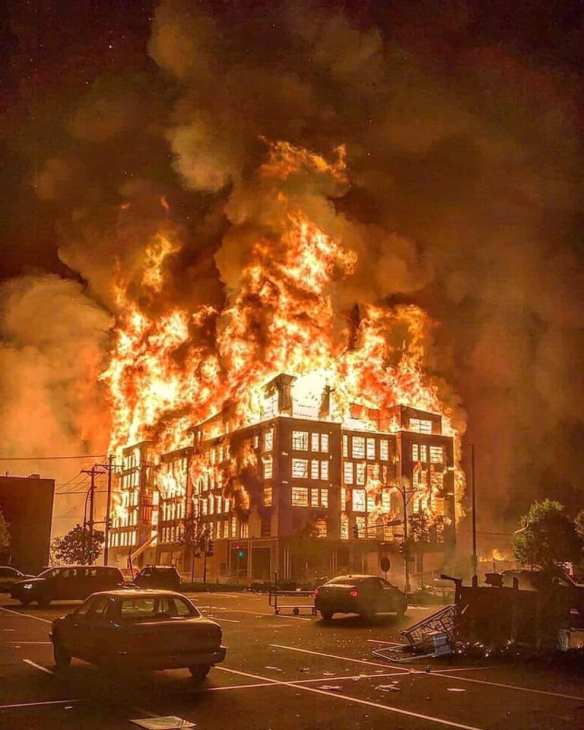
Non-Violent Protest vs. Riot Violence, to Change Society

Some say: “Promote non-violent civil disobedience. Violence is hurting the George Floyd protests at this point.” Well, yes and no. Without violence the U.S. media won’t cover protests against our neoliberal paradigm and its occupation forces. Look at the Bernie Sanders campaign and his huge “unseen” rallies; and the large protest marches by Rev. William Barber’s Poor People’s Campaign, also “unseen.” “A riot is the language of the unheard” (MLK,Jr.).

By some Cheyenne accounts, when the U.S. Army of 1876 found the bodies of the dead 7th Cavalry soldiers at the Little Big Horn two days after the battle, General George Armstrong Custer’s eardrums would have been found to have been punctured (by two Cheyenne women) with awls so he could hear better in the next life. Custer (whose body was found with two gunshot wounds: one to his left chest and from which he had bled, and the other to his left temple and likely due to a post-mortem stray bullet), and the many American non-Indians like him, were so intransigently deaf to the cries of pain and pleas for peace and freedom from the Sioux, the Cheyenne, and all the other Indian nations and tribes, that the ear-piercing symbolism may rest on now-unrecoverable historical fact. That symbolism was certainly not recognized in 1876 nor heeded if it was, as the corralling of Indians and the murder of Crazy Horse in 1877, and the continuing Indian Wars all the way to the ‘final’ massacre at Wounded Knee in 1890, showed.

Non-violent protests and waiting for “inevitable” social change didn’t do anything for the American Indians between 1492 and 1890 (the American Indian population reached its nadir in 1900). So, I understand where violent protest can come from with some anti-Trumpers. But I think most of the tide of violence comes in from the right, from cops desperate to keep exerting their Custer-like dominance (for, what else have they got in life to feel “big” about, being mere enforcers just like the legally deputized Lincoln County Regulators of 1878 in New Mexico, and which Billy the Kid was a member of), and from Trump-allied provocateurs and violence-hero wannabes, and certainly also some assholes just taking advantage of disorder. All that surrounding and threatening violent agitation during these May-June protest marches, plus well-justified and long-standing grievances, push some protestors over the edge of polite behavior.

Remember that Trump — our illustrious genius president — has repeatedly called for violence by his goon squads because the idiot thought it would only be inflicted on an eternally cowering “untermensch” population that he despises, and that he could control that violence. Well, now he’s got his violence and it’s out of his control, and it doesn’t seem to be helping his reelection campaign. An increasing number of mainline Republican “intellectuals” are now openly calling for a Biden electoral near-sweep (of Trumpy ideologues only), which I guess means they are completely confident that Biden and the usual gang of DNC-Democrats are seen as reliably loyal partisans to the preservation of corporate capitalism, which is what they all really only care about anyway. So, they’re looking to Slow Joe as their savior-of-the-year for their precious neoliberalism.

I hate violence — with its resulting injuries, deaths and destruction — and never encourage any of it; but how else do the poor, oppressed, disorganized and unmilitarized “lower classes” (everywhere and throughout history) frighten their rich and disdaining overlords to get those Big Brother boot-heels off their necks, and give them decent chances of living in physical safety and economic security?

I think of the American Indians, the Palestinians, and the Jewish fighters of the Warsaw Ghetto Uprising in 1943 (against the Nazis, who were immune to non-violent protests) for historical perspective. You can also throw in the American Civil War to that list, because in essence we are still fighting it.

As many wise commentators have already said: the only redemptive outcome of riot violence today would be if it sparks the creation of a large, organized and self-sustaining mass social and political movement against the entire neoliberal regime (and takes it down!) — a substantial, continuing, non-violent and effective socio-political force that aims far beyond just cop-reforms, Trump-tumbling, and the electoral reining in of Republican politicians for a couple of years.

The riot injuries, deaths and destruction that Americans are suffering today are at best a societal forward payment — like a first month’s advanced rent deposit — before we get the chance to “move in” to a better paradigm of American society.

May the battles and bleeding in the streets stop as soon as possible, and the sweeping transformation (and rebirth) of our society commence immediately.

See also:

Thoughts on the George Floyd Riots
2 June 2020
https://manuelgarciajr.com/2020/06/02/thoughts-on-the-george-floyd-riots/

<><><><><><><>

On “Good Cops” and “Bad Cops”

I posted the following comments on a public access blog of a long-term policeman and high-level police instructor of arrest techniques, where he excoriated the Minneapolis cops who killed George Floyd, but also said that 99% of cops are good and he asked that the public not judge them all by the 1% who are bad. The classic “bad apples” pose. I replied as will follow. The Counterpunch article linked after these comments says it much better.

Well said, but…

99% of all cops are not good, it only takes a few minutes of viewing all the videos being posted from around the nation to see that. Doing research back through time (even only from Eric Garner forward) makes that impression worse. By eyeballing the videos, the proportion of bad cops seems very, very, very high.

“No one hates a dirty, piece of shit cop more than a good cop who does this job with honor and pride. I beg you, do not judge the 99% of good police officers based on the actions of an ignorant and evil few.”

I know you have to believe that – if you are a good cop – in order to be able to do a cop’s job (which is what? and for whom?) and not lose all sense of self-respect or go insane. But…

The most likely fate of “good police officers” who turn in “a dirty, piece of shit cop” is to get disciplined, fired or worse, for ‘betraying’ the cop fraternity, while the “dirty, piece of shit cop” goes on unperturbed and free to continue exerting dominance over and wreaking havoc on the public (the part of the public he/she is most prejudiced against). Look what happened to Serpico.

“A policeman’s first obligation is to be responsible to the needs of the community he serves … The problem is that the atmosphere does not yet exist in which an honest police officer can act without fear of ridicule or reprisal from fellow officers. We create an atmosphere in which the honest officer fears the dishonest officer, and not the other way around.” — Frank Serpico (in 2003).

So, it’s like opening a crate of oranges and seeing all the top ones moldy. You don’t think: ‘well, the bottom ones are probably okay, so I’ll take it.’ No, you throw them all away.

As another person said: if there are 10,000 good cops, and 10 bad ones, and the ten thousand good ones don’t kick out the bad ten, then you have 10,010 bad cops.

And finally, the municipalities and agencies that keep “dirty, piece of shit cops” on the payroll, and that do not prosecute them for their cop-crimes, are equally complicit in those crimes. They are the “institutions” of institutionalized racism and institutionalized oppression, and their cops are their bullying occupation troops stomping down on a victimized public.

The Fires This Time and Next
8 June 2020
John G. Russell
https://www.counterpunch.org/2020/06/08/the-fires-this-time-and-next/

<><><><><><><>

Thoughts on the George Floyd Riots

<><><><><><><><><><><><><><><><><><><><><><><><><><><><><><><><>

Thoughts on the George Floyd Riots

Yesterday, a friend wrote me: “I really don’t know how we are going to come out of this. For a while I was okay. Over the last week I have grown more desperate with each day as the news develops.” I am trying to answer him here.

Many of my social media friends have expressed their anger, outrage, sadness and disgust at the lynching of George Floyd by a white supremacist cop in Minneapolis on May 25th (8 days ago as I write this). That lynching was carried out by an arresting cop kneeling for 8 minutes and 46 seconds on the right side of George Floyd’s neck while the handcuffed Floyd was lying face down on a city street. Floyd kept pleading for relief because he could not breathe, but the killer cop continued his kneeling choke-hold for 2 minutes and 53 seconds after Floyd had become unresponsive. Three other cops participated in the lynching: one holding Floyd’s back, another holding his legs, and the third looking on and preventing intervention by a person who stood nearby, watching in horror. (https://en.wikipedia.org/wiki/Killing_of_George_Floyd)

The country has blown up, large protests and riots now fill the streets of many cities and towns in America, and have for the last week. “A riot is the language of the unheard,” as Martin Luther King, Jr. said about the expressions of that truth in 1965 (Watts, Los Angeles CA) and 1967 (Newark NJ, Detroit MI, and 157 other places). That truth again erupted into view in over 100 cities in the United States after Martin Luther King, Jr. was assassinated on 4 April 1968, with “the greatest wave of social unrest the United States had experienced since the Civil War,” before it finally flamed out on 27 May 1968. And that truth was again acted out during 6 days of riots (29 April to 4 May) in Los Angeles CA in 1992, after the four cops who had savagely beat Rodney King in 1991 were acquitted of any crime.

“We are witnessing America as a failed social experiment,” Dr. Cornell West said on 29 May, as he preached on CNN television with crystal clarity on the massive and systemic failure of America — as a society, an economy and a tangle of governments — to protect and defend all of its people. Listen to Cornell West for yourself to unflinchingly face the reality of America (https://youtu.be/cs3jdyfx_fo), a reality that had been made plain by Malcolm X by 21 February 1965, when he was assassinated.

People are in the streets because the George Floyd murder was the last straw on their unbearably strained patience in waiting for justice in America. They blew up because they saw that justice in America will never arrive. Their many pent-up disappointments and frustrations came to a head on seeing the video of the George Floyd murder. Those disappointments and frustrations include experiences of victimization — many fatal — by racist policing, as well as economic victimization by a structurally racist and fundamentally rigged economy.

So, the victim populations of the race war against Blacks, Latinos, American Indians, and others disfavored by white supremacists; and the class war by the rich and powerful against: wage slaves, the unemployed, youth without prospects, and the 99% of Americans who are outsiders from the con games and self-aggrandizing capers of the economic insiders, just went ape-shit on seeing the Floyd murder and its obvious acceptability to the Trump-led bipartisan power structure. That is why I call it a lynching.

All this is happening during the COVID-19 pandemic, which has paralyzed society with its obvious deadliness, and that in turn has collapsed any hope of financial security for so many people who were already in the bottom tiers of the fundamentally heartless American economic system.

Many of these people are faced with sudden devastating losses: of health and life to the SARS-CoV-2 virus, and of being cast into bankrupting debt by the medical bills for having survived COVID-19; of confidence in remaining healthy while on jobs they need for economic survival; of income when their jobs disappear, and with it their health insurance if those jobs even provided it; of housing with the inability to pay rent; and even of ready access to food. The pandemic has also interfered with the most fundamental source of solace we all rely on in our times of despair: sharing the company of our families and true friends. So going out into the streets now to protest is natural for many who want relief from the unbearable suffocation of the choke-holds on them, and for some of those people who feel they have nothing left to lose, to even riot.

Unfortunately, there are rotten malevolent scumbag bigots who are taking advantage of the street protests to act violently and destructively in the hopes of provoking a much wider race war of oppression by white supremacy. And there are too many cops and government people (the cop employers) who are obsessed with control and domination instead of public and individual welfare, and they too create more hurt and provoke more reactive rioting by their heavy-handed cop-riot “law enforcement” actions.

So we get a vicious cycle of violence begetting violence. The best way to break that cycle is to quickly legislate substantive social and economic improvements that clearly address the underlying distresses of the people protesting visibly, and the people despairing silently and invisibly. The blinded-by-bigotry Trump-type people don’t want to enact those long-needed reforms because it would mean cutting back on their money-making schemes and their biased administrative actions.

I am guessing the current cycle of unrest will wind down simply because of exhaustion on the part of most of the people in the streets, coupled with heavy suppression by militarized police and federal troops. That won’t end the problem, but just make it more “invisible” to the authorities and simply delay its resolution, which if not forthcoming will simply mean another outbreak is inevitable.

I think things will get back to “normal” in time (within weeks?), but the “normal” that we had before late May was toxic. It carries within it the makings of more, longer and worse future riots if we let it return and continue unchanged.

A Bernie Sanders presidency aided by a helpfully supportive Congress would have been a potentially mild reform of our toxic “now,” but that reform was forbidden by the corporate-owned bipartisan power structure through its Democratic Party wing, with the full concurrence of its Republican Party wing. So now we have the George Floyd riots because people don’t feel like compromising any more, or of waiting for the Godot of American justice, or of turning the other cheek of a failed Christianity.

I don’t know and can’t really guess what’s coming next, or of how things will play out for the rest of this year.

We need a lot of wise leadership — which is obviously entirely lacking from the Trump Administration, from the U.S. Congress, and from many governors and elected politicians — and we need a lot of steady confident calmness that holds off from violent actions, by governors, mayors and police forces, who would in turn all be supported in that type of compassionately wise response by those wished-for intelligent and unbiased Federal authorities, for this national crisis to be calmed down quickly and humanely; and to then be permanently resolved by essential social and economic reform legislation, which was assiduously enforced thereafter.

The slogan “no justice, no peace” says it all. We’ve always known that, and the Kerner Commission Report spelled it all out after the riots in 1967 (https://en.wikipedia.org/wiki/Kerner_Commission), but it was ignored.

This crisis will be fixed for real when justice in America is established for real. I don’t know when or if that will ever happen. But I just wish it would soon.

<><><><><><><>

<><><><><><><>

For America today: shamrock = lily; Erin = Freedom.

The Prospect of Death Concentrates the Mind Wonderfully to Socialism

<><><><><><><><><><><><><><><><><><><><><><><><><><><><><><><><>

The Prospect of Death Concentrates the Mind Wonderfully to Socialism

Many people are now writing that COVID-19 has “awakened us” to the realization of how inhumane the entire economic paradigm of the U.S. is, and how structurally weak in its lack of diversification and rootedness in domestic assets (‘native species’), in the same way as vast fields of monoculture agriculture of genetically weak hybridized crops (for “high yield” and easy harvesting). Both the economic and plant monocultures can be devastated by disease germs finely targeted to those highly exposed monolithic weaknesses.

This sounds like an epidemiological Pearl Harbor argument: viral surprise attack on huge vulnerabilities we should have realized long ago, the eruption of fear that we were unknowably living in a house of cards that the surprise viral attack has caused to collapse around us. But in this case the falling cards of our once intact economic erection, though now so apparently flimsy in collapse, are nevertheless so massive as to easily crush us all in this ongoing demolition.

That previous image has become quite popular in the commentariat during the last few days. However, I think it is more of a cover for chagrin over having avoided acknowledging the truth previously. And that truth is simply that the U.S. economic paradigm has always been thoroughly inhumane, and a complete monoculture of capitalist obsession, with its least barbaric period extending from the Franklin Roosevelt Administration to the first half of the Jimmy Carter Administration.

During that milder interregnum the claws of American capitalism were clipped and rounded somewhat by the social programs softening the bitter disappointments Americans bore through the Great Depression, World War II and the Korean War, and which social programs offered the prospects of greater popular comfort, entertainment and consumerist happiness, and somewhat assuaging the stresses and agonies of civil rights aspirations and the stings of the various wars of empire of the 1960s and 1970s, most notably in Vietnam.

I think that the years 1976-1977 was the time of peak American peace, popular prosperity, and general societal wellbeing; this was post-Nixon and pre-Reagan. In 1978 Zbigniew Brzezinski, President Carter’s National Security Advisor, steered Carter rightward away from his more humanitarian inclinations and towards Cold War vengeance and Vietnam War payback by suckering the Soviet Union (the Russians) into their Afghan War quagmire. With the rise of Margaret Thatcher in the U.K. in 1979, and Ronald Reagan in the U.S.A. in 1980, neoliberal economic and nationalist ideology came to dominate our paradigm, and capitalism’s claws were lengthened, sharpened and dug in much deeper into the tender flesh of civilization. That cruel regime has continued in the U.S. to the present.

So, there is no logical reason why it should now come as a surprise to any honest commentator that our economic paradigm is so structurally and operationally inhumane. You didn’t need COVID-19 to suddenly awaken you to this long evident fact. What has actually happened is that the entire pandemic crisis, even catastrophe, has made it impossible for anybody to hide themselves from the undeniable fully exposed truth of our economic and societal inhumanity. Any well-educated thinking person, like the members of the professional commentariat, can only feel somewhat embarrassed (the most decent ones would feel ashamed) at having consistently avoided stating the socio-political facts-of-life to their public audiences in the past, but of course that camouflaging avoidance was precisely what they were being paid to do.

And so, “the best and the brightest” were surprised by the appearance of COVID-19 to the structural weakness of inhumanity in our economic system, and we their grateful audiences are now instructed to be surprised as well. And this surprise leads perforce to fear: how else can we preserve our hierarchical system of rigged prosperity from destruction by pandemic economic collapse, than by implementing socialist financial relief measures of the Bernie Sanders and FDR type that we can’t allow ourselves to make permanent, since that would in itself be a collapse of our raw capitalist paradigm into redistributive socialism.

Notice, that of ideological necessity the “surprise” leads to the realization of a needed socialist correction as a “fear,” because the inhumane truth was always out there in plain view, and the recognition of that truth at any time could have been the source of great joy: we don’t have to suffer, we can change this now!

It is easy to see the personification of this ideological duel in the persons of Donald Trump and Joe Biden, who are the Tweedledum and Tweedledee of an essentially unified presidential campaign championing the preservation of the neoliberal paradigm (“surprise” by COVID-19 and “fear” of chronic socialism); and presidential aspirant Bernie Sanders and his many young acolytes, who champion the socialist correction of the long-standing — and by Sanders long recognized and decried — economic inhumanities.

COVID-19 is only authentically a surprise in the sense that any new infection is a surprise to a person who finds themselves suddenly miserably ill, and the societies that find themselves infused with new runaway contagion. But the long-known truth is that such diseases erupt periodically, inconveniently, and with damaging and deadly consequences, so any humane economic paradigm must include persistent scientific efforts to anticipate, prepare for and effectively respond to epidemics. Obviously, this is (or would be) a socialist element of any government and international association of governments.

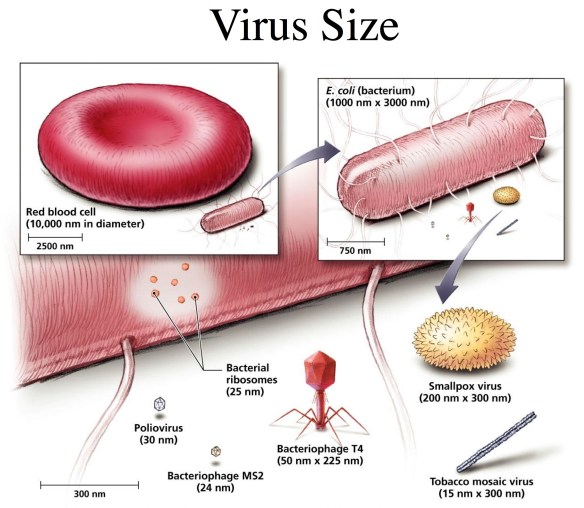
Surprise that the COVID-19 pandemic has exposed the economic frailties of our capitalist economies is really fear by the capitalist elite, and their fake-tough toady flunkies, that socialism will be seen by the masses as the obvious best format for the economic paradigm going forward, because it is the self-evident solution to the immediate problem of preserving society from collapse because of the onslaught of an uncountable number of teeny tiny viruses, each perhaps only tens to hundreds of nanometers in extent, but with embedded programming for eating away your lungs.

According to Boswell, Samuel Johnson said: “Depend upon it, sir, when a man knows he is to be hanged in a fortnight, it concentrates his mind wonderfully.” And so with us, the people of Planet Earth in the year 2020, the possibility of death by highly contagious viral disease overrunning the world has wonderfully concentrated our minds on a sought-for safe harbor for protection and salvation, and — surprise! — that safe harbor is socialism. What happens beyond this point is entirely a reflection of our individual and collective moral characters.

<><><><><><><>

I Rebel, Therefore We Exist, 2019

<><><><><><><><><><><><><><><><><><><><><><><><><><><><><><><><>

I Rebel, Therefore We Exist, 2019

When Alexandria Ocasio-Cortez spoke of her origins and family today (19 October 2019), I remembered my own story because they are so similar. My mother, too, is a lovely Puertorriqueña; I too was born in the Boogie-Town island stolen from the American Indians (Manhattan); we too lived in Parkchester, in the Bronx, in a basement apartment (concrete floor, concrete walls, tiny windows at the top at shoe-level to the sidewalk); I too have felt the glass ceiling pushing me down (my whole career), along with other melanin-rich talent.

My rebellion was never as brilliantly insightful nor as spectacularly successful as Alexandria Ocasio-Cortez’s, but it still goes on in my own idiosyncratic and annoying way (my unpopularity is deserved, and I’m proud of it). So I can easily bypass the cynicism and miffed sense of superiority of the self-regarding left intelligentsia who are so obviously jealous of the genuine popularity — and political effectiveness — of Alexandria and Bernie.

I can relish the first possibility for a real change in American politics, economics and life that I’ve seen since my heart sank on November 8, 1980, when Ronald Reagan was elected president, defeating Jimmy Carter, and since December 8, 1980, when John Lennon was murdered and Ronald Reagan went on the air to defend guns and the NRA. It was so clear America was plunging into an abyss as blithely and stupidly as the British, French and Germans marched into World War I in 1914; and America has in every way, hasn’t it?

Maybe now, 39 years later, enough people have been hurt by the institutionalized criminality of the American political economy that many of the survivors of those times — the workers, not the parasites — and our new, younger generations are really ready to join up and actually create a successful revolution. I have no shame in appearing to be “utopian” or “dreamy” or “immature” or “foolish” or “naïve” in holding and vocally proclaiming such a hope and such a wish. Bernie’s got 9 years on me, so I’ve seen almost as much as he has of 20th and 21st century American and world history; and I know what can be because it already was once, I lived in it. And I want the best of the past for my three children (two older than AOC). And for their children if they have them, and for everybody’s children, and all children everywhere.

I want the thieves robbing today’s youth of their futures — as they rob and have robbed their wage-slave parents and grandparents — along with the unctuous slimy hypocritical bottom-feeding careerist political ass-kissers (you see them daily on TV) — who tell you a decent life for you is impossible, or costs too much, and who pimp justice to claw their way to the top — to rot in a hell for them where they are discarded, ignored, profitless and robustly taxed: a new American society that is socialist, and democratic, and universally just, and enthusiastically ethical and intelligent.

Vision must precede any reality that one wants to realize, and so in these times don’t repress your vision out of fear of the future or (worse yet) fear of your public image being ridiculed. Let your vision be grand, let it soar, because we want that vision to take us as far as the yet unknown political opportunities of the next year may allow us to go. Don’t be so fearful of being disappointed by the “imperfections” of whatever the political outcome is in 2020 and beyond, that you repress your thinking and emotions in favor of the entirely possible “impossible dream” that Bernie Sanders (above all others) has articulated to the nation.

The “revolution,” as Bernie calls it, will never be perfect, no revolution ever is, but that is not the point. The goal is to get as much revolution as American politics, physical reality, and the inherent chaos of the universe will allow the American people, united in both uplifting aspiration and just purpose, to achieve. And not just in 2020, but continually from this moment on.

So, again, I don’t care how foolish I look or sound. Over my life I’ve seen too much lying, betrayal and exploitation palmed off as “the way things must be,” and I also know the opportunity of a lifetime when I see it. We blew it in 2016, but by now it should be obvious to everybody that a tsunami of change must drown the cold dead vampire of American capitalism, beginning with the ballot boxes on November 3, 2020, and then continuing far beyond electoral politics into every aspect of American society and American life.

So go ahead, be “foolish,” have a dream, have vision, pump out the vibes, because every revolution is powered by a unity of human aspirations, and every advance of civilization occurs as a jolt along the fault-lines of human society: by revolution. “I rebel, therefore we exist.” (Thank you, Albert Camus.)

Videos of Bernie and AOC, 19 October 2019

“Bernie’s Back” Rally with AOC in New York
19 October 2019
[complete speeches by all, at the rally today]
1:31:50 Alexandria Ocasio-Cortez
1:51:10 AOC ->to-> Bernie
2:52:04 end of Bernie’s speech.
https://youtu.be/0HbS65oiN18

Rep. Alexandria Ocasio-Cortez Endorses Bernie For President
19 October 2019
[Solo studio video appearance, 3:05]
https://youtu.be/DDGf39NkZe0

AOC’s Bernie Endorsement: HIGHLIGHTS
[Excerpts of AOC’s address at the 19 Oct. 2019 rally, 5:54]
https://youtu.be/QW-Nx1g8EpI

<><><><><><><>

Remembering R. P. Kroon

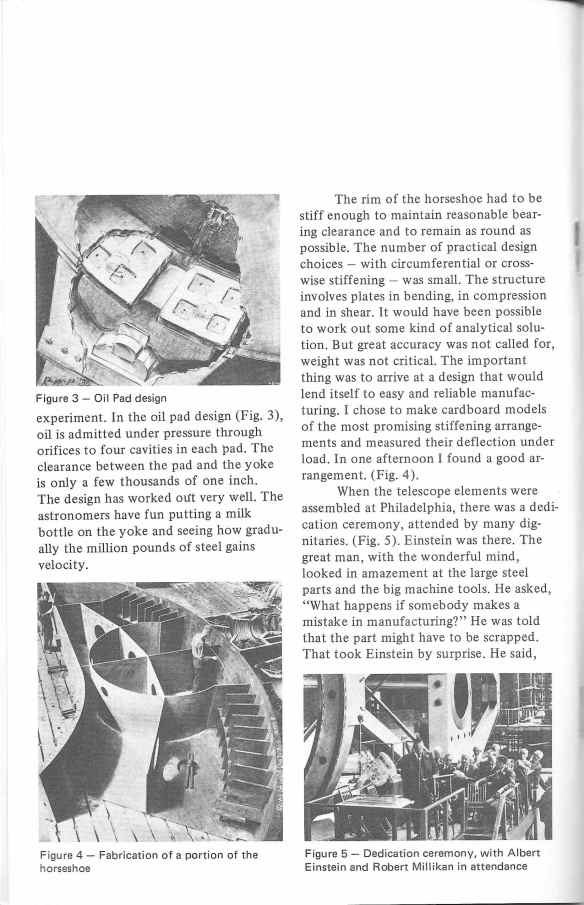
Rein Kroon and another Westinghouse engineer testing strain on celluloid model of mount for Hale Telescope. (Hagley)


Reinout Pieter Kroon (4 August 1907 – 4 August 1992) was my professor for turbomachinery during my Mechanical Engineering undergraduate years (1968-1972) at the Towne School of Engineering at the University of Pennsylvania (which is in Philadelphia). He was a kind, intelligent, witty and perceptive man, with great insights into what engineers — as public-minded, socially conscious citizens — could and should be. This web-page is my appreciative memorial for him.

“Reinout P. Kroon (1907 – 1992) was a Dutch mechanical engineer who immigrated to the United States in 1931 after earning his M.S. degree from the Federal Technical Institute in Zurich, Switzerland. Joining Westinghouse Corporation that year, he soon became a development engineer in the Steam Division.

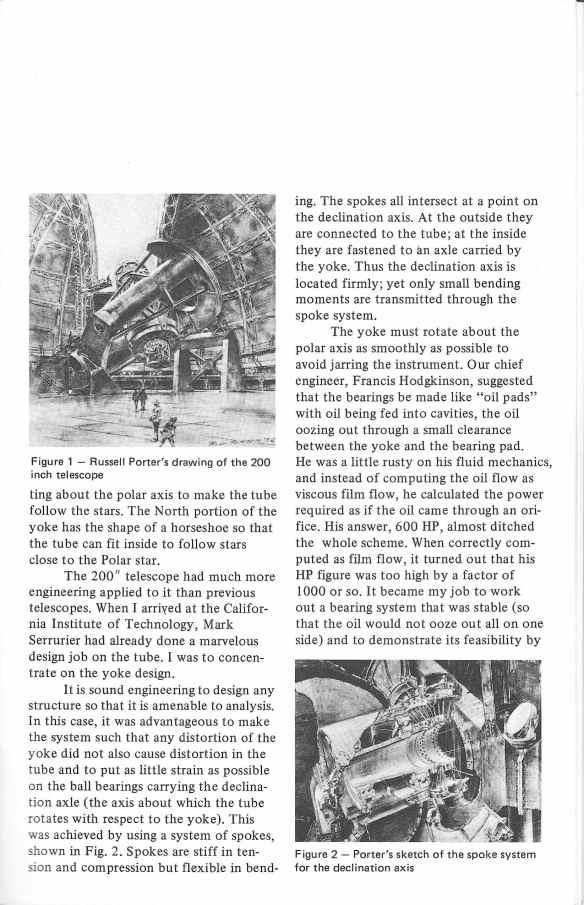
“In late 1935, Westinghouse sent Kroon to Pasadena to work on the details of the mounting of the 200-inch telescope. During his six-month assignment, Kroon solved three major design issues. First, he designed the hydrostatic pressure system with which the telescope turns in right ascension on a thin film of oil. Second, he designed the horseshoe and ball bearings for the north and south ends of the yoke. Finally, he designed the spoked declination bearings that allow the telescope to travel north and south.

“Later, Kroon became head of engineering research at Westinghouse where he managed a team that in 1945 developed the first commercially viable American jet engine. In 1960, he joined the engineering faculty at the University of Pennsylvania where he rose to the position of chairman of the graduate division of mechanical engineering.” (http://www.astro.caltech.edu/palomar/about/personalities.html)

Reinout Kroon was the Team Leader at Westinghouse in the making of the first American jet engine. The story of that effort during the World War II years is described by Kroon in his lecture-pamphlet “What’s Past Is Prologue” (shown below), and the unsuccessful effort to commercialize the initial technical triumph of making that turbojet, during the years 1950-1960, is given in detail by Paul D. Lagasse in his 1997 Master’s thesis in American History (http://enginehistory.org/GasTurbines/EarlyGT/Westinghouse/WestinghouseAGT.pdf).

Professor Kroon was a tall, elegant and personable man; he was a fabulous instructor and an inspiring example of an engineer’s engineer. From him I learned more about fluid mechanics and thermodynamics, specifically about turbomachinery, and — most elegantly — dimensional analysis; he was very adept mathematically. A field trip to the Westinghouse plant where huge turbines (for steam turbine electric generators) were built, was memorable. The stamping machines for fashioning the turbine blades were awesome, and loud!

Reinout had one brother, Berend Jan Gerhard (Bert) Kroon; and he was married to Dora Kroon (born Kaestli, on 25 May 1910, in Bern, Switzerland) with whom he had children, one son being Berend Walter Kroon. Reinout Kroon lived in Kennett Square, Pennsylvania. Professor Kroon died tragically in 1992, on his 85th birthday, as a result of injuries sustained some days earlier in an automobile accident.

What’s Past Is Prologue

Kroon, Dimensional Analysis

PDF files of the two pamphlets displayed below are available from the web-links above.

<><><><><><><>

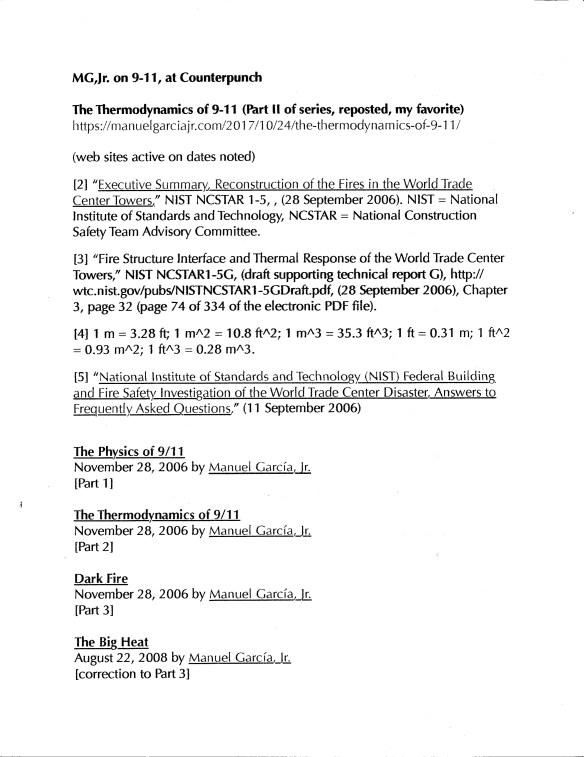
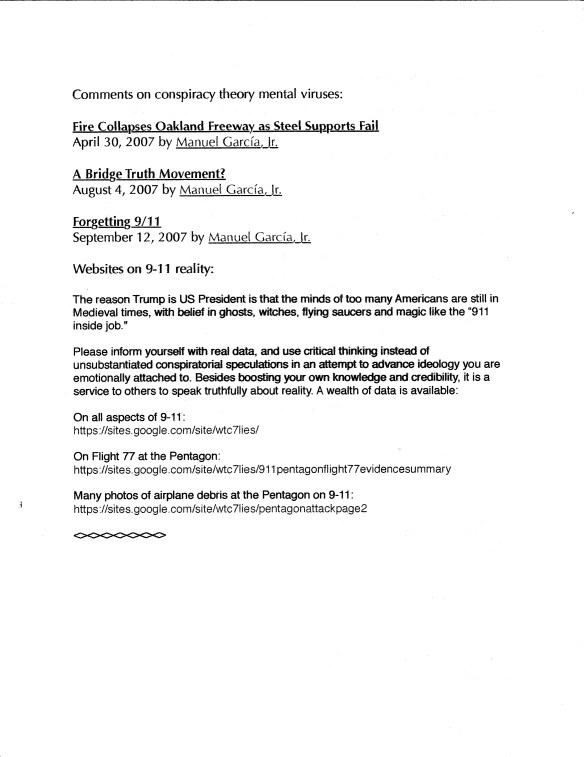
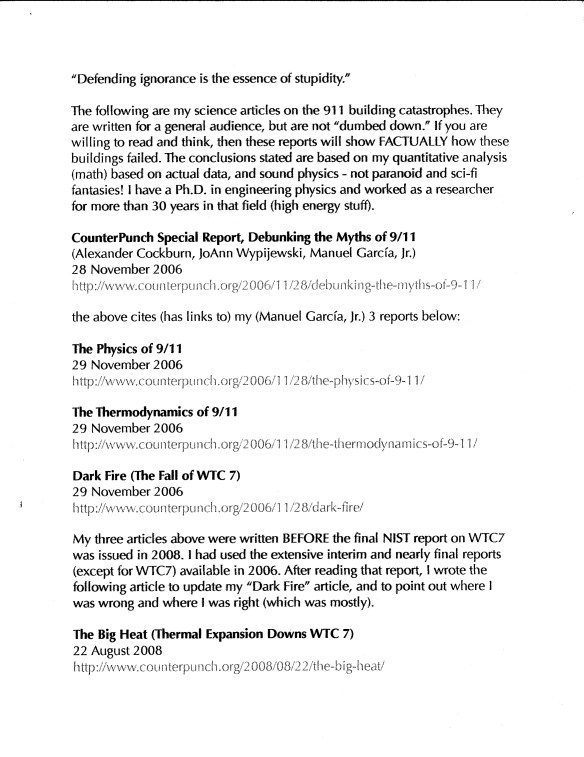
MG,Jr 9-11 Physics Reports Originals

<><><><><><><>

MG,Jr 9-11 (physics reports)

MG,Jr 9-11 (web listing 2)

MG,Jr 9-11 (web listing 1)

all shown below

<><><><><><><>

<><><><><><><>

The Changing American Population, 1610-2010

The population of English colonists on the eastern shores of what would eventually become the United States of America numbered 350 in 1610. Their descendants, along with those of the subsequent imported Black slaves, many immigrants (legal and illegal), and later remnants of the Native American population whose ancestors had populated this continent since as early as 14,000 years ago, reached a cumulative population of 308,745,538 individuals in 2010, within the political boundaries of the U.S.A.

This essay is a very general and simplified overview of how the population within the territory of the United States has grown over the 400 years between 1610 and 2010. While there is a very wide spectrum of “races” and ethnicities in the U.S.A., this essay will focus on only three groups: White people, Black people and Latino (a.k.a. Hispanic) people. Both White and Black people are thought of as two racial groups; while Hispanic people have Spanish as their original language, and their cultures are based on it, and they can be of any race: White, Black, Red, Yellow, and any mix of these. The summation of the White, Black and Hispanic populations in the U.S. makes up nearly the total US population. Asian and Pacific Islander people make up only 4.9% of the US population (in 2010); and American Indian, Eskimo and Aleut people make up only 0.9% of the US population (in 2010).

An aside on “races”: Based on genetics there is only one race of humans, but the concept of human races — popularly treated as species! — based on skin color, facial and physiological features, is still too widespread and embedded in popular culture to be dispensed with here. Also, race is tabulated in U.S. Census data, upon which this essay is based.

What I am interested to learn is if I can understand the politics of a period from the demographics of that time.

I have made a few simple charts of the racial and ethnic population fractions in the United States for Whites, Blacks and Latinos, based on historical census data spanning the years 1610 to 2010 (https://en.wikipedia.org/wiki/Historical_racial_and_ethnic_demographics_of_the_United_States).

The first pair of charts (quantitatively identical, just with different data-set color schemes, for ease of viewing) show fractional populations as percents of the total US population, from 1610 to 2010. The top curve is for White people, the longer lower curve is for Black people, and the shorter lower curve, which begins at 1850, is for Latino (Hispanic) people.

This census data is not perfect. The United States Census has enumerated Whites and Blacks since 1790. Asians and Native Americans have been enumerated since 1860, though all Native Americans were not enumerated until 1890. A category enumerated since 1950 is “some other race,” and a category enumerated since 2000 is “two or more races.” Hispanics have been enumerated since 1940, with the exceptions of 1950 and 1960, but some estimates for the Hispanic population were made for certain years before 1940 as well as for 1950 and 1960.

The recorded percentages over time of the US population made up of Asian and Pacific Islander people are: 0 for 1610-1850; under 1% for 1860-1970; 1.5% for 1980; 2.9% for 1990; 3.8% for 2000; 4.9% for 2010.

The number of Native Americans in 1492 within the territory of the present day United States probably numbered 5 million people. By 1900 this population had dwindled to 237,196 (its minimum). It grew subsequently, reaching 1,420,400 in 1980, and 2,932,248 in 2010.

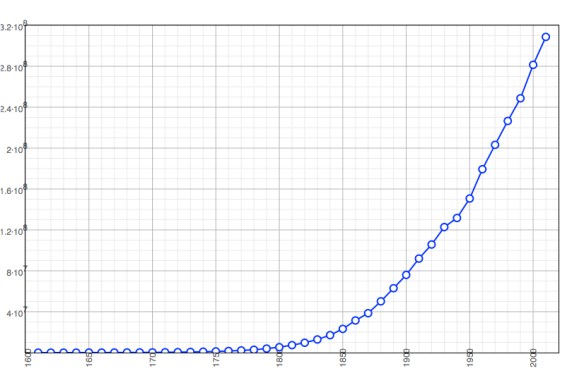
The growth of the total US population — as recorded by the imperfect census data — is shown in this next pair of charts.

The first chart of this second pair of graphics is best for visualizing the grow of population above 5 million people, after 1800. The recorded population grew from 350 in 1610 to about 5 million in 1800. The second chart of this pair of graphics is a logarithmic (linear-log) representation of the data, and makes it possible to see the quantitative trend, especially prior to 1800.

Returning to the fractional population charts, notice the following features:

1610-1770

The fractional population of Whites dropped from 100% in 1610, to under 80% in 1770; with a corresponding rise in the fractional population of Blacks from 0% (a relatively small number in actuality) in 1610, to over 20% in 1770. In the Colonial America of 1770, 1 out of very 5 people was Black (remember, Native Americans were not counted). This (20%) is the maximum that the fractional population of Blacks ever achieved in American history (but of course, the absolute Black population has grown throughout US history). This growth in Black population was a result of the importation of enslaved Blacks from Africa. The total Colonial American population during this period grew from 350 to 2,148,076.

1770-1850

The fractional population of Whites rose from its local minimum of less than 80% in 1770, to almost 85% in 1850. The fractional Black population dropped from its local maximum of over 20% in 1770, to about 16% in 1850. A law banning the importation of slaves into the United States took effect in 1808, but slavery itself was not outlawed. Blacks were born into slavery if their parents were enslaved, and the absolute population of Blacks in the U.S. grew. This period of 1770 to 1850 corresponds to the Industrial Revolution, which was the transition to new manufacturing processes in the period from about 1760 to sometime between 1820 and 1840. This transition included going from hand production methods to machines, new chemical manufacturing and iron production processes, the increasing use of steam power, the development of machine tools and the rise of the factory system. Immigrants from Europe added to the White population in the U.S., for example Irish people seeking escape from their Great Famine of 1845 to 1852. The total American population during this period grew from 2,148,076 to 23,191,876.

1850-1900

The recorded (estimated) percentage of the US population made up of Hispanic people was under 0.8% between 1850 and 1900. In 1845, the United States annexed the “Republic of Texas” (Mexican territory occupied by “illegal immigrant” American slave owners seeking to expand the slave plantation system of the Southern U.S., westward). Mexico’s defeat in the subsequent Mexican-American War of 1846-1848, resulted in the loss of one-third of its territory to the U.S. That new US territory is the present day American states of Texas, New Mexico, Colorado, Arizona, Utah, Nevada and California.

The fractional population of Whites rose from nearly 85% in 1850, to about 87% in 1900; while the fractional population of Blacks dropped from about 16% in 1850, to about 13% in 1900. This half-century period encompassed the Civil War, the Indian Wars in the American West, and the Spanish-American War, when the United States became an overseas empire. The total American population during this period grew from 23,191,876 to 75,994,575.

1900-1930

Between 1900 and 1930, the fractional White population rose from 87% to 90%, while the fractional Black population dropped from 13% to under 10%. This thirty year span included the latter Gilded Age, World War I, the Roaring Twenties, and the Crash of 1929, which was the beginning of the Great Depression. The total American population during this period grew from 75,994,575 to 122,775,046.

1930-1940

The years 1930 to 1940 spanned most of the Great Depression (which actually occurred from 1929 to 1942), and are a local maximum of fractional White population (~90%), and a local minimum of fractional Black population (~9%). The fractional Hispanic population during 1930 to 1940 rose from about 1.3% to 1.5%. The total American population during this period grew from 122,775,046 to 131,669,275.

1930-1950

Between 1930 and 1950, the fractional White population remained at close to 90%, while the fractional Black population remained at close to 10%. This twenty year period included the Great Depression, World War II, and the brief Cold War period just after World War II and just prior to the outbreak of the Korean War in 1950. The fractional population of Hispanics rose from about 1.3% to 2.1% during 1930 to 1950. The total American population during this period grew from 122,775,046 to 150,697,361.

1950-1970

Between 1950 and 1970, the fractional White population dropped from its highest proportion since 1700 (about 90%) to nearly 88%. The fractional Black population rose from 10% to 11%; and the fractional Hispanic population grew at an accelerating pace — more than doubling — from 2.1% to over 4.4%. The rapid increase in US Latino population was a result of their higher fertility, and increased immigration from Mexico, Central and South America, and the Caribbean.

The people on the island of Puerto Rico, captured during the Spanish-American War of 1898, were given US citizenship in 1917, but not the right to vote in US national elections, nor were Puerto Rico’s elected representatives allowed to vote in the U.S. Congress (to this day). But, that extension of US citizenship for Puerto Rico came just in the nick of time for the Wilson Administration to draft men from Puerto Rico to fight (and presumably some die) in World War I, and similarly in the subsequent wars of the United States. Puerto Ricans who want to vote in US elections have to migrate to the US mainland and settle there, which many did during the 1940s and 1950s, primarily to seek better economic opportunities. The musical “West Side Story” is an artistic artifact inspired by this wave of immigration from Puerto Rico to the US mainland.

The twenty year span of 1950 to 1970 included: most of the postwar boom (occurring primarily from 1948 to 1971), which encompassed the last two years of the Truman Administration, and the Eisenhower, Kennedy and Johnson Administrations, and the first two years of the Nixon Administration, as well as the Vietnam War up through the time of the American invasion of Cambodia, ordered by the Nixon-Kissinger Administration. The total American population grew from 150,697,361 in 1950, to 203,210,158 in 1970.

1970-2010

The total American population grew from 203,210,158 in 1970, to 308,745,538 in 2010.

During the 40 years between 1970 and 2010, the fractional White population dropped significantly from 88% to 72%. The fractional Black population rose modestly from 11% to 12.6%; and the fractional Hispanic population zoomed from 4.4% to 16.3%. In the year 2000, the fractional Black and fractional Hispanic populations were essentially equal (12.3% and 12.5%, respectively), and subsequently the fractional Hispanic population became larger, and continued growing faster.

The rapid rise of the fractional Hispanic population subsequent to 1950, and especially since 1970, is responsible for the accelerating drop in the fractional White population (since the fractional Black population has changed little, and other fractional populations, as for Asians, are still relatively small).

The increase of the Hispanic population beyond that of the Black population after 2000, along with the corresponding drop in the fractional White population, has fueled the racial tensions expressed today as the Trump Administration: widespread Black resentment of Latinos (“Mexicans”), and the overt exercise of political power by White Supremacy: anti-immigrant and deportation policies against “illegal” Mexicans and people from Muslim-dominant countries, as well as voter suppression efforts aimed at Blacks and poorer Hispanics (many ethnically Mexican and Central American).

Trumpism is the combination of fear of demographic dilution — held by previously dominant racial-ethnic sub-populations; and of insatiably desperate exclusionary avarice seeking climax before our Pompeii-like climapocalyptic termination — held by the traditional, dominant and uppermost classes of American wealth.

Most of the undocumented (“illegal”) Central American immigrants to the United States were and are actually refugees from countries whose economies have been withered by US corporate vampirism backed by both direct and indirect US military interventions propping up corrupt and viciously cruel oligarchic client regimes. This predatory US imperialism “south of the border” stretches back to the Mexican-American War of 1846-1848, and includes many US Marine invasions and occupations prior to World War II, as famously condemned by General Smedley Butler (who was awarded several Medals of Honor for his heroism during such actions, in his earlier years when he commanded troops in them).

During World War II, President Franklin Roosevelt instituted the “Good Neighbor Policy,” which amounted to the U.S. being nice to Latin America and buying its export products at good prices for the producers (for example buying the entire Cuban sugar output during the war years), so as to induce the countries of the Caribbean and Central and South America to remain neutral in that war, instead of cashing in by provisioning Germany, and allowing its submarines to harbor safely in Latin American ports, and thus be able to hunt for Allied (i.e., American) war supply ships close to US shores.

After World War II, the Good Neighbor Policy disappeared and it was back to the Monroe Doctrine modus operandi. And, Central American peasants fleeing economic starvation and political murder would go north (to this day). A particularly bad period in this regard was during the Nicaraguan Revolution (1962-1990), and during the Reagan Administration (1981-1988), which massively, overtly and surreptitiously prosecuted its proxy Contra War in Nicaragua, in support of the remnant army and police forces of the Somoza dictatorship, which had been deposed by Nicaraguan socialists during 1978-1979.

The Reagan Administration also carried on similar proxy wars in Guatemala and El Salvador. The neofascist forces the Reagan Administration backed and supplied were responsible for many excessively cruel and massively bloody deeds, which many people — including me — considered genocidal. After 1990, the Central American wars tapered off, but the fundamental struggle — of a peasantry seeking political freedom, economic control of their lives, social justice, and physical security from arbitrary exploitation, torture and murder by the death squads and militarized police forces employed by corrupt oligarchic client regimes — still continues in some Central American countries.

And so, streams of impoverished displaced living victims of American profiteering in Central America go north, hoping to find their personal salvations in the United States. Those that make it (legally or illegally) add to the Latino Population Tsunami that is altering the demographic layering of the US population.

How will our changing demographics change our future politics? Good question.

<><><><><><><>

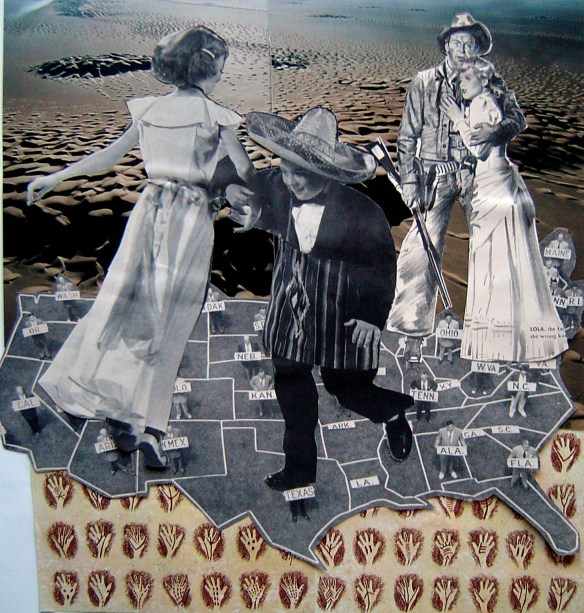
Collage image “Xenophobia,” by Thomas Calderon, sent on 30 September 2018

<><><><><><><>

ADDENDUM, 2 October 2018

TRUMPISM is the combination of fear of demographic dilution — held by previously dominant racial-ethnic sub-populations; and of insatiably desperate exclusionary avarice seeking climax before our Pompeii-like climapocalyptic termination — held by the traditional, dominant and uppermost classes of American wealth. Between 1970-2010 (census years) White population dropped 15.3% (from 87.7% to 72.4%, of which 8.7% was Hispanic), Black population rose 1.5% (from 11.1% to 12.6%) and Hispanic population nearly QUADRUPLED (from 4.4% to 16.3%).

The trends shown above are what fuel U.S. white supremacy, both in sentiment and in political action. The growth of the US Hispanic population is driven overwhelmingly by a higher fertility rate, not immigration. White people, worldwide, are the richest “racial” population, and they have the lowest fertility rate (more money, less kids). “Darker” and poorer populations have higher fertility rates. Trumpism (which includes anti-abortionism for white people too), the Israeli occupation of Palestine, and the former apartheid by and for white South Africa were/are wars against demographic dilution, perpetrated by the wealthy white low ‘fertiles’ (WWLFs) against poor dark high ‘fertiles’, (PDHFs). These “heart of whiteness” wars against demographic dilution are also wars for exclusionary capital hoarding (“race capitalism”). Also, these wars are the echoes of the white slave owner fears of the 17th through 19th centuries (over slave revolts), and the European imperialism of the 18th through 20th centuries (colonial wars). There is a lot of resistance among the world’s people to tolerate each other, and share the Earth (for doing so would tumble capitalism, authoritarianism, patriarchy and religion).

<><><><><><><>

“Fifty-Year” Look Back At Lived History, 1963-2013

This essay is a summary of U.S. history, which I lived through from 1963 to 2013 (primarily during the 1960s and 1970s). This essay is simply a combination of two of my items published by Swans (now gone) in 2013. I wrote them for the benefit of younger people. In writing these essays, I did make an effort (research) to verify my statements of fact. I am posting this compendium here because 2018 is the half-century mark after 1968, which I consider the most consequential year in U.S. history since 1945.

Fifty-Year Look Back 1963-2013, Part I: 1963-1968
18 November 2013
http://www.swans.com/library/art19/mgarci75.html

Fifty-Year Look Back 1963-2013, Part II: 1968-2013
2 December 2013
http://www.swans.com/library/art19/mgarci76.html

<><><><><><><><><><><><><><><><><><><><><><><><><><><><><>

“Fifty-Year” Look Back At Lived History, 1963-2013
(Part I, 1963-1968)

(November 18, 2013)   November 22, 2013, is the fiftieth anniversary of the assassination of US president John Fitzgerald Kennedy. We can expect many commentaries on, remembrances of, and uses and misuses made of this anniversary during this month of November. My contribution to that chatter is this look back at the last fifty years in American history, from my personal perspective. I make no claims of scholarship, inclusiveness, balance, or attitudinal and interpretive “correctness,” only that the following characterizes how I remember what I’ve chosen to focus on with respect to the “big picture” of American history that I have lived through.

Before 1963

The America of November 1963 was a country that had seen the collapse of European colonialism in Asia and Africa during the post World War II period of 1945-1960. America’s own imperialistic Monroe Doctrine presumptuousness was sorely tried by the Cuban Revolution of 1959, which openly declared itself communist in 1961. The Cuban Missile Crisis of October 1962 had brought the United States and the Union of Soviet Socialist Republics (Soviet Russia) dangerously close to nuclear war, but was fortunately defused, and subsequent diplomacy led to a treaty limiting nuclear weapons testing.

There had been about 100 atmospheric nuclear weapons tests, primarily by the U.S. and the USSR, during the period 1951-1956 (there had been about 9 between 1945 and 1950). The annual number of nuclear tests jumped to over 40 in 1957, and over 100 in 1958. There was a voluntary halt to testing during 1959-1960 (except for a few tests by France) in response to public fears about the radioactive fallout contamination of the milk supply. The peace symbol, which is now an icon of our culture, was designed by Gerald Holtom in 1958, and first popularized as a badge by Eric Austen, both nuclear disarmament advocates in Britain. In 1961 — John Kennedy’s first year as US president — the USSR launched a major series of over 30 nuclear tests, and the U.S. mounted about half that number. This weapons race accelerated wildly to a frenzied peak in 1962, with 140 tests performed (over 90 for the U.S. and nearly 40 for the USSR). Except for 1958 and 1962, there have never been more than about 90 nuclear tests in any year (and from 1971 usually under 60), and only very few since 1992, the last year of US testing (post 1992 testing has been by France, China, India, Pakistan, and North Korea). The numbers I quote for nuclear tests in a given year are read off a chart and rounded. (1)

The environmental movement was born on September 27, 1962, with the publication of Rachel Carson’s book, Silent Spring, on the ecological devastation caused by pesticide pollution.

In 1963

The negotiations initiated in October 1962 to defuse the Cuban Missile Crisis blossomed into the crafting of, signing (August 5, 1963), US ratification (September 24, 1963), and implementation (October 10, 1963) of the Limited Nuclear Test Ban Treaty of 1963, which banned nuclear weapon tests in the atmosphere, in outer space, and under water.

The Civil Rights (anti-apartheid or anti-segregation) movement for black Americans had been very vigorous in the southern U.S. from the beginning of John Kennedy’s presidency in 1961. The Reverend Martin Luther King, Jr. gave his famous “I have a dream speech” from the steps of the Lincoln Memorial in Washington, D.C. on August 28, 1963.

From 1961, John Kennedy had sent US military advisors to aid the anti-communist Ngô Ðình Diêm regime of South Vietnam in its fight against a communist insurgency (the will of the peasantry) allied with communist North Vietnam. By late 1962, there were 12,000 US soldiers in South Vietnam. Disappointed with Diem as an anti-communist unifier for North and South Vietnam, Kennedy approved a CIA program to aid Diem’s generals in a coup to produce new leadership, which occurred on November 2, 1963, with the deposed Diem summarily executed.

Lee Harvey Oswald, a disaffected American seeking glorious recognition as a leftist hero, acted as a freelancing James Bond (the world’s favorite fictional Tory) to impress the Dirección General de Inteligencia de Cuba (DGI, the Cuban intelligence service) by assassinating President Kennedy on November 22, 1963. The DGI had been locked in a battle with the CIA to keep Fidel Castro from being assassinated, a project pushed hard by the Kennedy brothers, John and Robert. Lyndon Baines Johnson, John Kennedy’s successor, stopped the CIA’s Fidel assassination program shortly after taking office. The Soviet Russian intelligence service (KGB) had found Oswald too unstable to rely on as an agent, and happily let him return to America from his self-imposed exile in Russia (October 1959 to June 1962). The DGI had the difficulty of being a much less powerful organization situated far closer to its small nation’s overwhelmingly superior enemy. Thus, the DGI unlike the KGB might be willing to exploit the improvisations of a volunteer useful idiot. Oswald spent the last week of September 1963 in Mexico City, visiting the Cuban and Russian consulates seeking a visa to travel to Cuba, and as a consequence met DGI agents. The DGI was too professional to compromise itself by inducting a delusional American outcast into its ranks, but the DGI seems to have been either gutsy enough or desperate enough to allow Oswald to imagine he would be welcomed in Cuba should he accomplish something of significant value for the Cuban Revolution. Oswald returned to Dallas on October 14, 1963. (2)

During 1964-1968

1964:

The Beatles conquer America by capturing the hearts of its teenage girls. We boys had no choice but to follow.

Lyndon Baines Johnson wins a landslide electoral victory over conservative Republican Barry Goldwater (Au-H2O), who had said in his nomination acceptance speech, “I would remind you that extremism in the defense of liberty is no vice.” The Johnson campaign exploited Goldwater’s strident public image with the most explosive political advertisement ever devised, the famous Daisy commercial. (3)

The Johnson administration bequeathed America the national tragedy experienced as the Vietnam War (between 1964 to 1968, after which the Republican administration continued it till 1975), but also the towering civil rights triumphs codified by three laws:

– Civil Rights Act of 1964 prohibits discrimination based on race, color, religion, sex, and national origin by federal and state governments as well as some public places.

– Voting Rights Act of 1965 prohibits states and local governments from imposing any “voting qualification or prerequisite to voting, or standard, practice, or procedure … to deny or abridge the right of any citizen of the United States to vote on account of race or color.”

– Civil Rights Act of 1968, also known as the Fair Housing Act, prohibits discrimination in the sale, rental, and financing of housing based on race, creed, and national origin.

1965:

Unsafe At Any Speed, Ralph Nader’s book about deficiencies of automotive design as regards passenger safety, launches the consumer product safety movement.

President Lyndon Johnson sends American troops into South Vietnam; by July there are 75,000. On July 28, Johnson announces he is increasing the troop level to 125,000 and doubling the monthly draft calls (from 17,000 to 35,000). A gradual and sustained aerial bombardment of the Democratic Republic of Vietnam (North Vietnam), Operation Rolling Thunder, had begun on March 2, 1965, and would continue until November 2, 1968.

1967:

Positive Crankcase Ventilation (PCV) valves, which are simple pollution control devices, are mandated for internal combustion engines. This was the first regulation for automobile exhaust pollution control. Since Silent Spring in 1962, numerous concerns had combined into a broad environmental movement: the flooding of Glen Canyon on the Colorado River in 1963 behind the new Glen Canyon Dam, the logging of old growth redwood trees, air pollution — smog — caused by auto and truck exhaust gases, river and coastal pollution from industrial and farm wastes, and the danger of ecological damage by oil spills from offshore drilling platforms, which infamously occurred at Santa Barbara, California, in 1969.

The Six Day War, between Israel and the combined forces of Egypt, Jordan and Syria, takes place in early June. Israel is victorious, and the present Palestinian crisis of Israeli occupation begins.

Ernesto “Che” Guevara is captured and executed on October 9, 1967, by the Bolivian military aided by the CIA. One of many blows by a perpetually petulant US establishment vainly seeking a satisfying vengeance for the Kennedy hit.

1968:

The Tet Offensive, launched by the Communist Party of Vietnam on January 30, stuns the Johnson administration as well as the US public. It was now clear that the American war for South Vietnam was futile, but nevertheless it would continue till 1975.

On March 31, Lyndon Baines Johnson announces that he will not seek reelection; it is a presidential election year. Robert F. Kennedy (John Kennedy’s younger brother and attorney general) was a senator at that time, and had announced his own bid for the presidency on March 16.

Martin Luther King, Jr. is assassinated on April 4, in Memphis, Tennessee. Major rioting breaks out in many cities. Because of the extensive damage and fires caused during these urban riots, and the deployment of National Guard troops to restore order, the television images of these scenes on US soil had an eerily disquieting resemblance to images of Stalingrad in 1943, Berlin in 1945, and Hue and other Vietnamese cities besieged during the previous three months during the Tet Offensive. Many Americans became very frightened, and a diversity of Americans had their various prejudices deepened.

Robert Kennedy is assassinated after a campaign speech in Los Angeles on June 6 by a resentful Palestinian with Jordanian citizenship, Sirhan Sirhan, who is still serving a life sentence for that crime. Robert Kennedy had captured the imagination of liberals, especially young ones, who were ignorant of his earlier political career (as a McCarthy-type commie chaser, and the zealous prosecutor of the Fidel assassination project) and crushed by his loss. Robert Kennedy had been deeply affected by John Kennedy’s death and the politics behind it, and as a result he had undoubtedly become much more sympathetic to the aspirations and suffering of marginalized populations, like the Mexican-American farm workers that Cesar Chavez was organizing in California’s Central Valley. However, the degree to which Robert Kennedy had become more “revolutionary,” or “socialist,” or just moral after 1963, and how such a presumed deepening of compassion and conviction might express itself politically, are matters of pure speculation mooted by his death. Hubert Humphrey, the vice president and eventual 1968 Democratic nominee for President, was the quintessential mainstream liberal politician of the 1960s.

Richard Milhous Nixon, a Republican from California, wins the 1968 presidential election with a campaign promoting “law and order” and appealing to anti-civil rights southern white resentment (Dixiecrats become Republicans). Nixon’s winning concept was called “the southern strategy.” It would become the formula applied by all subsequent Republican presidential contenders to this day, very effectively by Ronald Reagan in the 1980s, who vastly increased the formula’s content of rhetoric and cant on fiscal soundness and the evils of taxation, but unsuccessfully by Willard Mitt Romney in 2012 because of the changed demographic composition of the American electorate since 1968 and 1988.

Notes to Part I

1.  Nuclear Weapons Testing,
http://en.wikipedia.org/wiki/Nuclear_weapons_testing

2.  Manuel García, Jr.,
“Castro And The Kennedy Image After The Checkmate”
Swans, 23 April 2012,
http://www.swans.com/library/art18/mgarci46.html

Some Words About JFK,
see the section “Castro And The Kennedy Image After The Checkmate”
https://manuelgarciajr.com/2017/11/20/some-words-about-jfk/

3.  Daisy Commercial (1964),
http://www.youtube.com/watch?v=9Id_r6pNsus

<><><><><><><>

“Fifty-Year” Look Back At Lived History, 1963-2013
(Part II, 1968-2013)

(December 2, 2013) This two-part series is a look back at the last fifty years in American history, from my personal perspective. The thread of my historical narrative begins in Part I (1963-1968). (1)

Enjoy the show.

The Vietnam War and the US Presidential Election in 1968

On January 30, the Communist Party of Vietnam launched its stunning though costly and ultimately stymied Tet Offensive across all of South Vietnam. For the Vietnamese Communist Party, the Tet Offensive was a propaganda victory and foreign relations coup; for the Johnson administration and the American public it was a crippling blow to self-confidence about the conduct of the war. The number of American troops in Vietnam peaked at 543,482 in late April.

The year was the most expensive in the Vietnam War with America spending US$ 77.4 billion (US$ 519 billion in 2013) on the war. The year also became the deadliest of the Vietnam War for America and its allies with 27,915 South Vietnamese (ARVN) soldiers killed and the Americans suffering 16,592 killed compared to around two hundred thousand of the communist forces killed. The deadliest week of the Vietnam War for the USA was during the Tet Offensive, specifically February 11-17, 1968, during which 543 Americans were killed in action and 2,547 were wounded. (2)

On March 31, Lyndon Johnson announced in a nationally televised address that he would not seek reelection as US president in the November election. That same month, to encourage the North Vietnamese to begin negotiations, he halted the aerial bombing of the northern portion of North Vietnam, which includes those regions surrounding the capitol city Hanoi but not those areas bordering the 10 kilometer-wide 1954 treaty line — the DMZ or demilitarized zone — marking the separation into North and South Vietnam. The parties agreed to conduct the negotiations in Paris, and met for the first time on May 10. However, the North Vietnamese were adamant in demanding the Americans halt all aerial bombing in the North before discussing anything else, which Johnson finally acceded to on October 31, after which serious negotiations began. (3)

On November 5th, Richard Milhous Nixon, a Republican from California, won the 1968 presidential election with a campaign promoting “law and order” and appealing to anti-civil rights southern white resentment (Dixiecrats become Republicans). Nixon’s winning concept was called “the southern strategy.” It would become the formula applied by all subsequent Republican presidential contenders to this day, very effectively by Ronald Reagan in the 1980s, who vastly increased the formula’s content of rhetoric on fiscal soundness and cant on the evils of taxation, but unsuccessfully by Willard Mitt Romney in 2012 because the demographic composition of the American electorate had changed significantly since 1968, and 1988.

The Arc Of American Liberalism

The years 1964 through 1980 spanned the arc of American liberalism, arising out of the optimism of the Kennedy administration and plunging into the sour witless eruption of neo-liberalism: Thatcherism (1979) and Reaganism (1981)
.
The legislative triumphs of civil rights occurred during the same years as the vast expansion of the Vietnam War, 1964 to 1968. The accumulating costs of that war combined with the growing costs of social welfare programs to cause fiscal problems and a mild recession in late 1969 through 1970, and a monetary crisis in 1971 (the Nixon Shock, the end of the Bretton Woods system of international financial exchange, and the beginning of the present situation of freely floating currencies).

The Oil Crisis of 1973 (the Arab Oil Embargo in retaliation for the US support of Israel during its October 1973 war with Egypt and Syria) introduced Americans to the energy crisis: shortages of gasoline and fuel oil, with a quadrupling of prices. The recession triggered by the 1973 oil crisis lasted until 1975. By that time, American economic productivity (or profitability) had fallen from its peak levels during the previous thirty years of the post World War II boom (Les Trente Glorieuses), in part because advanced automation could now replace more human labor, and in part because of increased foreign competition, since the post WWII recovery of Europe and Japan had advanced rapidly though the 1950s and matured in the 1960s.

The reductionist quest for profitability led to the “outsourcing” and “offshoring” practices of seeking minimum cost foreign labor (with minimum investment in foreign health, safety, environment, and taxation) to produce products for sale and consumption in the United States. The inflation of the 1970s coupled with slow economic growth (“stagflation”) spurred the intensification of well-financed campaigns by corporate interests to acquire political influence, which could be used to lower corporate taxes, eliminate or loosen government regulations on business practices, and break unions. This neo-liberal ideology of corporatism above all considerations of social democracy became the American paradigm with the arrival of the Reagan administration (1981-1988), and continues to the present despite its destruction — catastrophically in 2008 — of the American economy for over 90% of the population.

The long, horrible, drawn-out bleeding of the Vietnam War was totally unnecessary. The 1973 Oil Crisis was never addressed as it should have been, by the development of sustainable, non-nuclear energy and power sources not based on fossil fuels (or combustion). I think of how much better off Americans and the world would be today if these two problems had been solved compassionately and intelligently. The successors of the Vietnam War have been briefer, more streamlined, and far too numerous. The newest American wars are now carried out as computer games of automated assassination, equipped with real remotely-controlled unmanned bomber aircraft and missiles, and programmed directly from the White House. The energy crisis that erupted in 1973 has now metastasized into the anthropogenic global warming problem. To my mind, the way to move the United States beyond its present glut of drone wars and military adventurism and wastefulness, as well as most effectively address the energy and global warming dilemma, is to be found by abandoning neo-liberalism and embracing its exact opposite, social democracy.

Vietnamization For “Peace With Honor,” Mega-Death For “Credibility”

For Americans, the Vietnam War had a slow buildup. It began during the Harry S. Truman administration with the behind-the-scenes provisioning with military equipment for, and the financing of, the French colonial forces in Indochina in 1945-1952. The Dwight D. Eisenhower administration (1953-1960) continued this support after the French defeat in 1954, with the propping up of anti-communist regimes in the southern half of Vietnam, and supporting anti-communist factions in Laos.

The forces of communist North Vietnam completed the north-south Ho Chi Minh Trail in 1959, along the eastern margins of the countries west of Vietnam: Laos in the north, and Cambodia in the south. This route for the clandestine re-supply of communist forces in South Vietnam would be the key to the eventual communist victory in 1975. The trail was camouflaged to evade aerial surveillance and bombardment. American aerial bombardment along the Ho Chi Minh Trail between 1964 and 1973 was so intense that Laos has the sad distinction of being the most bombed country on a per capita basis.

During the Richard M. Nixon administration (1969-1974), the American bombardment of North Vietnamese military activities in eastern Cambodia was secretly expanded to include an invasion with ground forces (in 1970). The officially neutral Cambodian government, led by Prince Sihanouk, had publicly protested the violations of its territory in the east, but quietly accepted both: the North Vietnamese infiltration, in order to maintain the possibility of good relations with the Vietnamese communists who Sihanouk saw as the inevitable victors; and Sihanouk accepted some of the American bombardment of the North Vietnamese in Cambodia’s east so as to placate the Americans, discourage the Vietnamese communists from openly invading and occupying Cambodia, and to keep the small Cambodian communist factions from gaining popular support. Unfortunately, the American bombardment was so massive, unrelenting, and deadly, that many survivors among the rural population in both Laos and Cambodia became radicalized and joined the communist forces in their countries, who all swept to victory in 1975.

Richard Nixon knew the Vietnam War was a lost cause, and his plan to gain “peace with honor” and extricate the United States from the meat grinder of war-making was to build up the military forces of the anti-communist regime in South Vietnam while simultaneously withdrawing American personnel. This was called “Vietnamization.” From a certain distance, Nixon’s plan had a reasonable cast to it. The idea was to prosecute the war by substituting well-trained and amply equipped South Vietnamese troops for American troops, and in so doing show the world that the United States “kept its promises” to allies, and it would thus retain its “credibility.”

You have to hear Henry Kissinger’s leaden intonation of “American credibility” to understand why an additional 21,257 deaths of Americans in Vietnam, and over a million Vietnamese deaths, and hundreds of thousands of combined Laotian and Cambodian deaths had to be sustained between 1969 and 1975. The arc of American mortality because of the Vietnam War, grouped by presidential administration, was a follows: 9 Eisenhower (1956-1960), 191 Kennedy (1961-1963), 36,756 Johnson (1964-1968), 21,195 Nixon (1969-1974), 62 Ford (1975-1976), and 7 during 1987-2006. (4)

The Vietnamization process to retain “American credibility,” that is to say the international reputation of the American foreign policy-making elite, was based on thinking in which individual American lives were mere ciphers to be churned in the calculations of force projection to gain diplomatic advantage for elite geo-strategic gamesmen, while the individual lives of Vietnamese, Laotians, and Cambodians were not even considered up to the level of ciphers. A ceasefire, truce, declaration of defeat, withdrawal of American forces, and less violent consolidation of communist power in Indochina could have been accomplished much sooner, with the stated goal of stopping bloodshed and limiting casualties by accepting the inevitable. That course of action would have lost the United States one form of “credibility” but it would have gained it another I think far more valuable.

The Nixon-Kissinger Vietnamization policy was an egotistical face-saving crime of genocidal proportions. Thinking back to it leaves me wondering if human history is farcical tragedy or a tragic farce.

Some Incidents In The History Of My Times

The following incidents made impressions on me, for one reason or another.

20 July 1969. Neil Armstrong lands on the Moon, and a gesture is fulfilled. The other side of the coin was the CIA-sponsored killing of Ernesto “Che” Guevara in Bolivia on 9 October 1967. The American Gods must be propitiated. (5)

1 December 1969. The first Draft Lottery, and the beginning of the end for antiwar protests in the U.S. For my little story about that see (6).

22 April 1970. The first Earth Day, the environmental movement at its height, the most radiantly hopeful day I ever had dreaming about the future. It was pure bliss, and I was also in love.

7 November 1972. Richard M. Nixon wins a landslide presidential electoral victory against antiwar Democrat George Stanley McGovern. I liked McGovern.

11 September 1973. Chile’s Marxist president, Salvador Allende, dies and his government falls in a very violent coup led by a fascist Chilean general, Augusto Pinochet, aided by the CIA as directed with disgusting enthusiasm by Henry Kissinger, National Security Advisor to Richard Nixon, and then Secretary of State (from 22 September 1973).

17 June 1972 – 9 August 1974. The Watergate scandal unfolds, Nixon resigns, and his former vice president, Gerald Ford, advances to the presidency and pardons Nixon, immunizing him from all Watergate-related prosecution, making Ford unelectable in 1976.

20 November 1975. Francisco Franco, the pseudo-fascist monarchist-authoritarian Spanish dictator, dies, and Spain carefully emerges out of its enforced medieval slumber of 36 years.

1977-1980. The Jimmy Carter administration is the twilight of American political liberalism (the unifying concept being the social welfare state), which effectively ends in 1978 as Carter’s initiatives became more militarized.

18 April 1977. Jimmy Carter addresses the nation on energy. This could have been the start of the sustainable and solar energy revolution in America, but it wasn’t. Think of how much better served and secure we would be today if it had.

28 March 1979. Three Mile Island nuclear accident, a partial meltdown of a commercial nuclear reactor at a power station in Pennsylvania. The worst such accident in the U.S.

15 July 1979. President Jimmy Carter addresses the nation on its “crisis of confidence” during its 1979 energy crisis (oil and gasoline shortages and high prices, consequences of the Iranian Revolution). This address would become known as the “malaise speech,” though Carter never mentioned “malaise.”

August 1979. Paul Volcker is appointed chairman of the Federal Reserve by President Jimmy Carter, and his monetary policies cure the persistent inflation of the 1970s and early 1980s.

1979. Zbigniew Kazimierz Brzezinski, the National Security Advisor to President Jimmy Carter, initiates the covert transfer of billions of dollars in arms to the Afghan mujahideen militants opposed to the Soviet military forces that had invaded in support of the allied central government, which itself faced insurrection. Osama Bin Laden, from Arabia, led one such mujahideen group in the ensuing Afghan War prosecuted by the Soviets. That war proved to be a quagmire for the Union of Soviet Socialist Republics, and drained sufficient resources and caused enough human suffering and resentment among Russians that it initiated the political instability that eventually led to the collapse of communism in the USSR.

4 November 1980. Ronald Reagan is elected president, and the neo-liberal shredding of the 1945 postwar social contract begins. My heart sank that day, and of Americans I thought: “Whom the gods would destroy, they first make mad.” (An anonymous ancient proverb wrongly attributed to Euripides. This variant is spoken by Prometheus, in The Masque of Pandora (1875) by Henry Wadsworth Longfellow.)

1980-1988. The Shah of Iran is deposed by the Shiite theocratic Iranian Revolution of 1979, and American embassy personnel are held as hostages for 444 days, being released shortly after Reagan’s inauguration. Iraq under the control of its dictator, Saddam Hussein, attacks Iran in 1980, initiating an eight year Iran-Iraq War during which the United States government aides Iraq by providing satellite reconnaissance information about Iran to the Iraqis, and eases the transfer of materials and technology that Iraq uses to fabricate and then deploy chemical weapons against Iranian troops, and later dissident Iraqi populations. It is estimated one million lives were lost in the Iran-Iraq War.

1981-1989, The Reagan Administration launched proxy wars against the peasantry in Central America (Nicaragua, Guatemala, El Salvador, Honduras). The underlying conflicts between an impoverished peasantry and a wealthy land-owning elite that sponsored the national military and police establishments had erupted into armed struggle (again) after 1959, becoming ferocious by the late 1970s. Using the excuse of fighting communism putatively infiltrated into Central America by Cuba, the Reagan administration supplied and funded local anti-communist and reactionary militias as proxy military forces, to destroy popular social democracy by despicable terrorism. These proxy militias, or “contras” (“against” the revolutions), were usually police and army personnel acting out of uniform in Guatemala, El Salvador, or Honduras, or in Nicaragua they were former police and army personnel of the Somoza regime, which had been deposed by the Sandinista Revolution of 1979. The savage cruelty inflicted on the ethnic Mayan peasantry by the contra forces reached their crests of genocidal magnitude under Reagan Administration sponsorship. These Central American Wars all trailed off in the 1990s.

20 August 1985 – 4 March 1987. Iran-Contra Scandal. (7)

26 April 1986. A nuclear reactor at the Chernobyl power station in the Ukraine explodes, spewing radioactivity far and wide, and the fuel core melts down. The Chernobyl disaster was the worst nuclear power plant accident until the Fukushima Daiichi nuclear disaster of March 11, 2011. Also during 1986, Ronald Reagan has the solar hot water system removed, which had been installed on the roof of the White House during the Carter Administration. The spirit of Earth Day 1970 had been executed.

17 October 1987. “Black Monday” stock market crash. The Dow Jones Industrial Average experienced a drop of 22%. Alan Greenspan had just been appointed as chairman of the Federal Reserve by Ronald Reagan, replacing Paul Volcker. This crash occurred during the midst of the Savings and Loan Crisis of the 1980s.

23 June 1988. In testimony before the US Senate, NASA scientist James Hansen stated that anthropogenic global warming had begun.

22 November 1988. Twenty five years since the assassination of John Kennedy, and twenty five years before today [2013].

9 November 1989. The Berlin Wall falls, communism in Eastern Europe crumbles. I was elated and exhausted. I believed nuclear disarmament was now immanent, as well as a revamping of the US war economy (Defense Department funding) into a robust “peace” and “green” economy. Clearly, I was naively delusional.

2 August 1990 – 28 February 1991. The Gulf War (Persian Gulf War, First Iraq War) is successfully prosecuted by a NATO combined force under US direction, acting to reverse the annexation of Kuwait by the Iraqi regime of Saddam Hussein. America’s ally to punish Iran during 1980-1988 had since fallen out of favor. The chemical and biological weapons, and some nuclear technology held by the Saddam Hussein regime were now seen as intolerable threats to American interests.

26 December 1991. The USSR formally ceased to exist. The twelve republics that had comprised the USSR were declared independent.

Into The 21st Century

William Jefferson Clinton Administration (1991-2000)

Bill Clinton is a 1960s center-right Republican dressed up as a 1960s liberal Democrat. He went along with deregulating the banks (repeal of the Glass-Steagall Act of 1933) and financial industry (signing the Commodity Futures Trading Act of 2000, allowing easy trading in derivatives), which together set up the casino environment that would lead to the publicly-damaging financial collapse of 2008.

George Walker Bush Administration (2001-2008)

G. W. Bush spent profligately on tax cuts for the rich, and the Iraq War (20 March 2003 – 15 December 2011), using the 11 September 2001 attacks as an excuse. The loose money policy of Alan Greenspan, chairman at the Federal Reserve, fed a housing bubble that peaked in 2006, deflating into an expanding financial crisis in late 2007, and a catastrophic banking collapse in October 2008.

Barack Hussein Obama Administration (2009-2016)

Barack Obama is a corporatist Democrat in the Clinton mold, and shepherds the financial industry’s interests by managing the economy with a bias for public austerity maintained to preserve speculator (a.k.a. investor) accumulations (gains), and the continuing regime of insufficient regulations and taxes on trading. Keynesianism to lift the economy out of its chronic joblessness is denied. The current official unemployment rate (based on definitional sophistry) is about 7%, the real unemployment rate is about 23%. (8)

Obama is a master of symbolism, and much of a wishful-thinking public allows that symbolism to distract them from reality.

Hillary Rodham Clinton, today’s [2013] leading Democratic Party contender for president

Hillary Clinton is the presumed frontrunner in the race to become the Democratic Party’s nominee for president in the 2016 election. She has already captivated the attention of those Americans for whom the symbolism of “the first female US president” overwhelms all rational considerations. So, perhaps the underwriting of her presidential campaign will pay off for corporate America, in giving the first female president the historic privilege of privatizing Social Security, and staking multi-millionaire Wall Street gamblers with an abundance of other people’s money they can play with risk-free. The symbol-awed will never notice.

Notes to Part II

1.  Fifty Year Look Back 1963-2013,
(Part I: 1963-1969)
 [above here]

2.  1968 in the Vietnam War
http://en.wikipedia.org/wiki/1968_in_the_Vietnam_War

3.  Paris Peace Accords
http://en.wikipedia.org/wiki/Paris_Peace_Accords

4.  Statistical Information about Fatal Casualties of the Vietnam War
U.S. National Archives
http://www.archives.gov/research/military/vietnam-war/casualty-statistics.html

5.
“Castro And The Kennedy Image After The Checkmate”
Swans, 23 April 2012,
http://www.swans.com/library/art18/mgarci46.html

Some Words About JFK,
see the section “Castro And The Kennedy Image After The Checkmate”
https://manuelgarciajr.com/2017/11/20/some-words-about-jfk/

6.  The Promise Of Remembered Soundtracks
7 October 2013
http://www.swans.com/library/art19/mgarci72.html

7.  Iran-Contra Affair
http://en.wikipedia.org/wiki/Iran%E2%80%93Contra_affair

8.
“Official” US Unemployment Rate
http://data.bls.gov/timeseries/LNS14000000

“Real” US Unemployment Rate
http://www.shadowstats.com/alternate_data/unemployment-charts

<><><><><><><>
Why I Am Leftist (Vietnam War)

Tet Offensive
Phase 1: 30 January – 28 March, 1968
Phase 2: 5 May – 15 June, 1968
Phase 3: 17 August – 23 September 1968.

Martin Luther King, Jr.
assassinated in Memphis, TN
4 April 1968
Riots broke out in about 100 US cities and towns over many weeks.

Robert F. Kennedy
assassinated in Los Angeles, CA
6 June 1968
RFK had won the CA primary election for DP presidential nominee that day.

Richard M. Nixon
elected US president
5 November 1968

In the fall (October-November) of 1968 during his election campaign as the Republican Party’s nominee for US president, Richard Nixon sabotaged the Paris Peace Talks between the Johnson Administration and the Communist Party of Vietnam (“North Vietnam”), by using Anna Chennault (of the deposed Nationalist Chinese regime) as a secret agent to contact the South Vietnamese regime of Nguyen Van Thieu and have him renege on his commitment to send a delegation to the scheduled Paris peace negotiations (Nixon promised Thieu a better deal, if Nixon became President), so the peace talks failed by not even starting.

This was an act of treason by Nixon during a time of war.

Nixon used the “failure” of the Johnson Administration to either “win the war” (militarily) or bring the four combatants (North Vietnam and the ‘Viet Cong’ versus South Vietnam and the U.S.A.) into serious armistice and peace negotiations, as an electoral issue justifying voting for him. Nixon won (over the DP’s Hubert Humphrey) by less than 1% of the popular vote.

Nixon and Henry Kissinger (National Security Advisor, then Secretary of State) then expanded the war (into Laos and Cambodia), and only in 1973 – 5 years later – were they able to get the Hanoi government (the Communist government of North Vietnam, and their allied popular forces in South Vietnam: the ‘Viet Cong’) back to the negotiating table in Paris, with the Communists finally agreeing once again to the concessions they had originally made in 1968.

During the interim, 22,000 additional Americans had died in the war, and perhaps a million more people of Vietnam (north and south) as well as Laos and Cambodia. This is all described in Episode 7 of Ken Burns’ 10 episode TV series, “The Vietnam War” (2017).

It was 50 years ago this month (during Phase 1 of the Tet Offensive) that I registered for the draft. My college deferment was cancelled at the end of 1968, and I was 1-A all of 1969. Bureaucratic delaying tactics and luck kept me from being inducted, and I drew a very high number in the Draft Lottery of December 1969, and so was passed up.

A tense time, and one that ensured I would forever be some kind of leftist.

The Lyndon Johnson tapes: Richard Nixon’s ‘treason’
http://www.bbc.com/news/magazine-21768668

<><><><><><><>