Can COVID-19 Save Lifeboat Earth?

<><><><><><><><><><><><><><><><><><><><><><><><><><><><><><><><>

Can COVID-19 Save Lifeboat Earth?

Harbhajan Singh asks [6 April 2020]: “Could COVID-19 save Lifeboat Earth?”

Many realize that eliminating humanity would make Earth healthier for Nature, plants and animals.

Many also realize that without profound changes to human behavior — by everybody, everywhere; including limiting population growth and ending greenhouse gas emissions — that humanity can not exist in balance with Nature, and both will increasingly suffer, eventually — in a few lifetimes? — fatally.

It is well documented that as human encroachment and destruction of Nature (e.g., environments and biodiversity) advances, that habitability decreases.

That decrease is due to a combination of:

— pollution (bad air, ocean plastic, dead seas, lost topsoil, lost forests, toxic land);

— climate change (and more violent weather, floods, droughts, wildfires);

— food source degradation (inorganic industrial farming, loss of natural varietals, loss of seafood), and

— greater hazards of releasing viruses (epidemics and pandemics) fatal to people.

The scientific reports get very specific on ‘this particular negative effect has this particular [human stupidity] cause’, but in aggregate they show what I’ve just outlined.

More people are realizing that humanity’s accelerating encroachment and destruction of Nature can only cause more deadly virus pandemics to plague us. Hotter environmental temperatures from global warming, and greater particulate and noxious gases pollution from human activity (industrialization, capitalism, militarism) aggravate the severity and lethality of all respiratory illnesses, like COVID-19.

I prefer that humanity became vastly more intelligent, and cooperative, and altruistic, and balances its existence (both individual and collective) with Nature’s timeless rhythms and geophysical limits.

The most important aspect of that wished-for cooperativeness is that we cease viewing each other as deadly rivals in a grim zero-sum game of making-money one-upmanship and competing narcissistic schemes of enslaving others.

Miraculously, the Earth is the most wonderful Paradise we know of in the entire Universe. If we treated it as such, instead of treating it like a garbage dump and sewer, it would return that appreciation, and we would knowingly experience life in this actual Paradise, for ourselves and for endless future generations.

This is not just poetry, it is fact.

<><><><><><><>

The Conquerors Of America

<><><><><><><><><><><><><><><><><><><><><><><><><><><><><><><><>

The Conquerors Of America

Patrick Weidhaas, a colleague of mine from the Lawrence Livermore National Laboratory, and also a colleague from the union group there (Society of Professional Scientists and Engineers) sent me a note saying:

You may remember Ben Santer from the Lab, one of the foremost climate scientists. He just published an article in the online Scientific American:

How COVID-19 Is like Climate Change
(Both are existential challenges—and a president who belittles and neglects science has made them both tougher to address)
https://blogs.scientificamerican.com/observations/how-covid-19-is-like-climate-change/

García’s reactions to Santer’s article follow, as responses to some of Santer’s entirely accurate and admirable statements:

“In the Trump administration, the buck never stops at the top.”

Because Trump does not care about the masses of people anywhere. He is merely the figurehead of a plutocratic-oligarchic faction that sees themselves occupying — not representing — the people of the United States, as in a hostile takeover, as in the Israeli occupation of Palestine. It is all about them: their wealth, their take, their bigotry, their personal aggrandizement and their personal safety. All other people are merely impediments, or at best temporarily exploitable resources, like slave labor. As Don Michael Corleone said in “The Godfather,” “It’s not personal…it’s strictly business.” (https://youtu.be/0qvpcfYFHcw) As Don Trump said when he wacked the U.S. pandemic response team: “I’m a business person.”

“And a leader cares more about saving lives than winning reelection.”

Trump, and Biden, are not leaders; they are conquerors. They are on campaigns of conquest for plunder. The lives of the people conquered are not of interest, they are impediments beyond their utility for profitable exploitation. “Reelection” is entirely about maintaining the conquerors’ reign of plunder. That is it.

“And in an abundance of concern for public health, members of the Trump administration should have corrected the President’s misstatements on the seriousness of the coronavirus. Instead, they largely remained silent.”

They made sure to get accurate information for their own safety, and for their insider advantages in stock trading. Their prime directive is: “make money at the expense of everybody else.” Obfuscation and deception to the public are essential to the successes of their conspiracies of plunder. There is no limit to how many “other” people can die to achieve the conquerors’ unquenchable selfishness.

“After years of belittling and neglecting science, Donald J. Trump is suddenly discovering that science is imperative to human survival, and perhaps even to his own political survival.”

For the Conquerors Of America (currently led by Trump and Biden) science is entirely a means for finding patentable items needed and wanted by the masses, so the conquerors can own the exclusive rights to these items and then sell the use of them “at the highest prices that the market will bear.” It is about getting rich off the fears of death by the people, and getting rich off the people’s addictions to drugs and electronics of all kinds. The items the conquerors want their science minions to provide are life-saving and life-extending drugs (“your money or your life” is the supreme moneymaker); and better, faster, more powerful weapons, which can boost the conquerors’ ability to cow and kill rivals and enemies. Their purposes for science are to keep death further away from themselves, to find them novel ways of furthering personal enrichment, and to make it easier for them to rain death down on all others.

“If we truly care about the health of our communities, countries and global commons, we must find ways of powering the planet without relying on fossil fuels.”

“We” might care about that, but our overlords, the Conquerors Of America do not. The conquerors weave their imagined-eternal cocoons of invulnerability out of personal wealth vampire-drawn from the masses, and from their orgasmic fantasies of invincibility.

When all this will change, I do not know; but I fear that if that change ever does occur it will be preceded by a tsunami of blood. It may well be that Pandemic 2020, or a subsequent one, if it readjusts human orientation and behavior across our species for the better thereafter, would be a blessing in comparison to that now-gathering tsunami.

<><><><><><><>

The Prospect of Death Concentrates the Mind Wonderfully to Socialism

<><><><><><><><><><><><><><><><><><><><><><><><><><><><><><><><>

The Prospect of Death Concentrates the Mind Wonderfully to Socialism

Many people are now writing that COVID-19 has “awakened us” to the realization of how inhumane the entire economic paradigm of the U.S. is, and how structurally weak in its lack of diversification and rootedness in domestic assets (‘native species’), in the same way as vast fields of monoculture agriculture of genetically weak hybridized crops (for “high yield” and easy harvesting). Both the economic and plant monocultures can be devastated by disease germs finely targeted to those highly exposed monolithic weaknesses.

This sounds like an epidemiological Pearl Harbor argument: viral surprise attack on huge vulnerabilities we should have realized long ago, the eruption of fear that we were unknowably living in a house of cards that the surprise viral attack has caused to collapse around us. But in this case the falling cards of our once intact economic erection, though now so apparently flimsy in collapse, are nevertheless so massive as to easily crush us all in this ongoing demolition.

That previous image has become quite popular in the commentariat during the last few days. However, I think it is more of a cover for chagrin over having avoided acknowledging the truth previously. And that truth is simply that the U.S. economic paradigm has always been thoroughly inhumane, and a complete monoculture of capitalist obsession, with its least barbaric period extending from the Franklin Roosevelt Administration to the first half of the Jimmy Carter Administration.

During that milder interregnum the claws of American capitalism were clipped and rounded somewhat by the social programs softening the bitter disappointments Americans bore through the Great Depression, World War II and the Korean War, and which social programs offered the prospects of greater popular comfort, entertainment and consumerist happiness, and somewhat assuaging the stresses and agonies of civil rights aspirations and the stings of the various wars of empire of the 1960s and 1970s, most notably in Vietnam.

I think that the years 1976-1977 was the time of peak American peace, popular prosperity, and general societal wellbeing; this was post-Nixon and pre-Reagan. In 1978 Zbigniew Brzezinski, President Carter’s National Security Advisor, steered Carter rightward away from his more humanitarian inclinations and towards Cold War vengeance and Vietnam War payback by suckering the Soviet Union (the Russians) into their Afghan War quagmire. With the rise of Margaret Thatcher in the U.K. in 1979, and Ronald Reagan in the U.S.A. in 1980, neoliberal economic and nationalist ideology came to dominate our paradigm, and capitalism’s claws were lengthened, sharpened and dug in much deeper into the tender flesh of civilization. That cruel regime has continued in the U.S. to the present.

So, there is no logical reason why it should now come as a surprise to any honest commentator that our economic paradigm is so structurally and operationally inhumane. You didn’t need COVID-19 to suddenly awaken you to this long evident fact. What has actually happened is that the entire pandemic crisis, even catastrophe, has made it impossible for anybody to hide themselves from the undeniable fully exposed truth of our economic and societal inhumanity. Any well-educated thinking person, like the members of the professional commentariat, can only feel somewhat embarrassed (the most decent ones would feel ashamed) at having consistently avoided stating the socio-political facts-of-life to their public audiences in the past, but of course that camouflaging avoidance was precisely what they were being paid to do.

And so, “the best and the brightest” were surprised by the appearance of COVID-19 to the structural weakness of inhumanity in our economic system, and we their grateful audiences are now instructed to be surprised as well. And this surprise leads perforce to fear: how else can we preserve our hierarchical system of rigged prosperity from destruction by pandemic economic collapse, than by implementing socialist financial relief measures of the Bernie Sanders and FDR type that we can’t allow ourselves to make permanent, since that would in itself be a collapse of our raw capitalist paradigm into redistributive socialism.

Notice, that of ideological necessity the “surprise” leads to the realization of a needed socialist correction as a “fear,” because the inhumane truth was always out there in plain view, and the recognition of that truth at any time could have been the source of great joy: we don’t have to suffer, we can change this now!

It is easy to see the personification of this ideological duel in the persons of Donald Trump and Joe Biden, who are the Tweedledum and Tweedledee of an essentially unified presidential campaign championing the preservation of the neoliberal paradigm (“surprise” by COVID-19 and “fear” of chronic socialism); and presidential aspirant Bernie Sanders and his many young acolytes, who champion the socialist correction of the long-standing — and by Sanders long recognized and decried — economic inhumanities.

COVID-19 is only authentically a surprise in the sense that any new infection is a surprise to a person who finds themselves suddenly miserably ill, and the societies that find themselves infused with new runaway contagion. But the long-known truth is that such diseases erupt periodically, inconveniently, and with damaging and deadly consequences, so any humane economic paradigm must include persistent scientific efforts to anticipate, prepare for and effectively respond to epidemics. Obviously, this is (or would be) a socialist element of any government and international association of governments.

Surprise that the COVID-19 pandemic has exposed the economic frailties of our capitalist economies is really fear by the capitalist elite, and their fake-tough toady flunkies, that socialism will be seen by the masses as the obvious best format for the economic paradigm going forward, because it is the self-evident solution to the immediate problem of preserving society from collapse because of the onslaught of an uncountable number of teeny tiny viruses, each perhaps only tens to hundreds of nanometers in extent, but with embedded programming for eating away your lungs.

According to Boswell, Samuel Johnson said: “Depend upon it, sir, when a man knows he is to be hanged in a fortnight, it concentrates his mind wonderfully.” And so with us, the people of Planet Earth in the year 2020, the possibility of death by highly contagious viral disease overrunning the world has wonderfully concentrated our minds on a sought-for safe harbor for protection and salvation, and — surprise! — that safe harbor is socialism. What happens beyond this point is entirely a reflection of our individual and collective moral characters.

<><><><><><><>

Climate Change and Voting 2020

<><><><><><><><><><><><><><><><><><><><><><><><><><><><><><><><>

Climate Change and Voting 2020

Today, humanity faces a situation unique in the 200,000 year existence of our species Homo sapiens sapiens, and unique in the 2 million year existence of our genus, Homo: the unprecedented steady linear advance of global warming since 1970, which is making our planet irreversibly less habitable as time progresses, and which is driven entirely by the emission of greenhouse gases as waste products of human activity, particularly the extraction and combustion of fossil fuels. If this human-caused global warming remains unchecked it could ultimately lead to our extinction.

Global warming is intimately coupled with population growth (see Note). The universal desire for a better life leads people everywhere to try to acquire and use more energy to reduce the drudgery of daily survival, and beyond that to increase their security, comfort and enjoyment. Food is the source of our internal energy, that which powers our metabolism. The most popular source of our external energy today is fossil fuels: the burning of refined petroleum fuels, natural gas, and coal. From these we derive most of the heat and electricity we generate and use both industrially and personally, as well as for propelling our transportation. It is the increasing energy demand per person of a growing world population that drives the unprecedented rate of global warming we are experiencing.

Motivating people everywhere to see global warming as the fundamental cause of their local disasters of severe weather, drought, failed agriculture and fishing, habitat loss and resource scarcity wars, and then motivating them to cooperate internationally to immediately reduce the rate of global warming as much as geophysical conditions will allow, is the singular political problem of our time for our species.

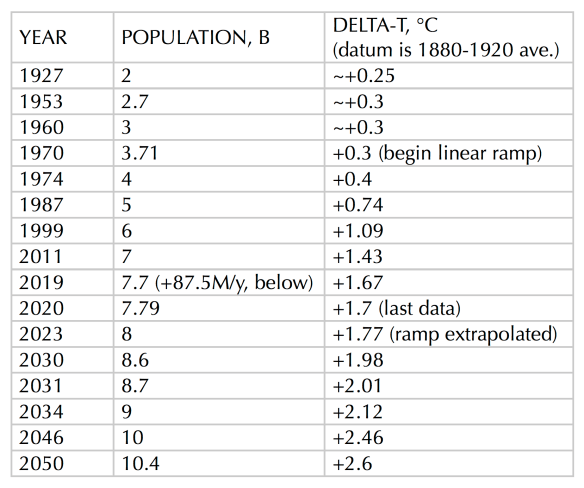
The trends of population (in billions) and global warming (in degrees °C increase relative to the average global temperature during 1880-1920, the datum) are given in the table shown. The quantities listed up to the years 2019-2020 are based on data. The populations listed after 2019 are extrapolations based on an assumed linear population increase of +87.5 million per year (M/y), which was the average rate of increase from the years 2011 to 2019. The temperature increase above datum (delta-T) for years after 2020 are linear extrapolations based on the temperature ramp observed between years 1970 and 2020 (a +1.4°C increase over 50 years).

What is not yet known is if and when global warming will accelerate beyond the linear trend assumed after the year 2020, in the table. Such acceleration would be caused by the appearance of new physical conditions such as:

the transition of tropical forests from being carbon absorbers and sinks to becoming carbon emitters because of their severe degradation brought about by logging, drought and wildfires;

a massive methane release from the thawing Arctic;

sudden and massive glacial calving and melt in Greenland and Antarctica baring more ground for the absorption of solar radiation and the release of formerly trapped methane and carbon dioxide;

methane released from warmed oceans because of the breakdown by heat of methane clathrates (solid methane hydrate “ices” formed under cold high pressure at ocean depths).

Because of the unprecedented pace of our current global warming, we do not have the luxury of unlimited time — as was true in prior millennia — to physically evolve adaptively or escape by migration in response to climate change. (Migrate to where?, a billionaire’s habitat bubble on Mars? We already have a worldwide climate change and environmental collapse refugee crisis, and it will only get worse without a civilization-transforming response to climate change.)

To slow global warming to the minimum rate now limited by geophysics (the carbon load of the atmosphere) will require a species-wide change of human behavior as regards how energy is generated, conserved and used; how we steward the environment; and how the growth of human population is to be limited and people cared for everywhere. It takes Nature 200,000 years to clear a massive excess of carbon dioxide in the atmosphere (such as we have injected over the previous century), and this occurs through a sequence of increasingly longer term processes: CO2 uptake by the oceans (years to decades), dissolution of seafloor sediments (the dissolving of chalk acidifying the oceans over decades to centuries), the weathering of carbonate rocks (centuries to millennia), and silicate weathering (tens to hundreds of millennia). CO2 uptake by photosynthesis is blunted by the ‘torrential rain-flooding plant-growth punctuated drought-wildfire’ cycle.

We can only attenuate global warming by species-wide willpower, and the sooner we develop and apply that willpower the greater will be the degree of that attenuation, and the further the likelihood of our causing our own extinction.

Without an internationally coordinated climate change response effort within the next dozen years that is 70% larger than the combined war efforts of World War II (to account for the +5.5B population increase between 1939 and 2020), global warming will reach and then exceed 2°C above the 1880-1920 datum. Warming beyond that point will likely be impossible to counteract by any human actions, and the climatic and weather-disaster consequences will be dire and unrelenting.

We have lost the luxury of unlimited time to dawdle in our many egocentric obsessions and illusions — waiting for the ideologically “perfect” revolution; seeking the most ethnically pure nationalism; the ideal theocracy; the maximization of our wealth; the complete destruction and disappearance of those “other types” of people whose savings, lands, resources and lives we want to steal; mindless absorption in superficial consumerism and ‘electronic comic book video game TV internet social media entertainment’ — before collectively reforming ourselves into better futures. Nature has made our old awareness-blunting time-wasting games obsolete by becoming feverish over its infection from our greenhouse gas toxicity. Our last chance for civilizational transformation that can alter the course of climate change is now, this next decade.

Clearly, the single best strategy to slow global warming is to replace fossil fuel energy with solar and “green” energy, whose production and use does not emit CO2, CH4 (methane), and other organic greenhouse gases and vapors.

Everything I have described up to this point has been said before by many people in many ways over many years. Now, about voting.

The only way we can achieve the civilizational transformation required to have any ameliorating effect on the course of global warming, and tackle the singular political problem of our time for our species, is to wrest control of governments from oligarchic, neoliberal, capitalism-obsessed, theocratic, nativist, and climate change ignoring elites — especially in countries having disproportionate political-economic-military power, expelling disproportionate quantities of greenhouse gases, and causing disproportionate environmental destruction — and then establishing regimes committed to real and immediate climate change response. Such real climate change response naturally subsumes all narrowly defined issues of economic equity and social justice.

In countries that offer some degree of democracy to their people, it is necessary to vote for politicians — now — whose prior history indicates they would be most reliable at vigorously pursuing a maximal climate change response, locally, nationally and internationally. For U.S. voters in 2020 that means electing Bernie Sanders to lead the Democratic Party ticket for the presidency, and then voting to ensure he wins the November general election. It is also necessary to elect people who would be Congressional representatives and Senators allied with Bernie Sanders. It does not matter whether sweeping the Sanders socialist-populist groundswell youth-quake “revolution” into power fits in with your ideal of an American government regime, however intellectually refined, or crudely simplistic, or myopically and corruptly partisan, or vainly and egocentrically identity political your ideal regime would be. We no longer have time to put off making partial gains in the direction of our goal, in order to wait for anyone’s variety of personally tailored political perfection.

The burden of responsibility on the citizens of the politically powerful, economically rich, profligate greenhouse gas emitting countries is to agitate and vote for, and vigorously implement, the real type of climate change response that is being described here. The burden of responsibility on the older citizens and older non-citizens is to put their time, money and energy into creating and protecting a good world with a decent future for the young. That has always been the responsibility on adults, and in our time — now — that responsibility must be discharged by implementing a real climate change response which is intrinsically a revolution of: economic equity, social justice, energy conservation and efficiency, rapid transition of energy sources and infrastructure from fossil fuels to green energy, and demilitarization.

In countries whose governing elites do not offer the people an effective political voice, it is necessary that those people find ways to change the nature of their governments. Risky, I know, but essential in order to respond to the looming threats of climate change.

I know that everybody can easily rationalize continuing to drift along with the mindsets they have now. But that will only keep us as distracted, delusional and disunited as we are now, and convey us all haplessly into the implacable civilization-chewing grinder of runaway climate change. We do not have the luxury of preferences anymore if we are to prevent the worst, especially for our children and grandchildren.

As I write this during a warm rainless mid-February spring in Northern California, with whitish pink-tinged apple, cherry and plum blossoms; magnolias flowering; purple florets of vinca; yellow tufts of eucalyptus; small purplish rosy globular flowers of polygonum, light blue florets of rosemary, bright orange California poppies, yellow flowers of oxalis and daffodils; and many other varieties of flowers blooming two months early, I wonder if the dry season October wildfires will now flare up in August, or even July. There has been no rain this February, “normally” the wettest month of the year for California; it appears we are entering a new drought.

And I wonder if the slow, tentative awakening in the public mind to the reality of increasingly inhospitable climate change, which awakening I observed during the course of 2017, 2018 and 2019, will accelerate and coalesce into the national and world “cosmic consciousness” that I know is essential if we Homo sapiens sapiens are to have any chance of actually protecting ourselves (all of us everywhere), within the next decade, from the worst possibilities of runaway climate change.

Note

The purpose of social welfare societies — socialism — is to provide their individuals with sufficient quantities of water, food, shelter and energy to carry on fulfilling lives, without subjecting those individuals to lonely struggles for precarious survival. This is why mortality rates are lowest in highly socialized prosperous societies, and why the consensus of individuals living in them is for low rates of reproduction, even to the point of birth rates below 2.1 per woman, the replacement rate necessary to maintain the existing size of a society’s population.

Clearly, the single best strategy to slow, and perhaps even reverse global population growth, is to provide a global system of reliable socialized security to completely support individual healthcare for life, obviously including: maternity care; safe birthing; safe abortion; child survival, healthcare, education and launching into “independent” living; elder care; and humane natural and self-willed dying. There is simply less incentive to have more children if more of them are guaranteed to survive and experience full and decent lives, and if the individual has a socially guaranteed protection of their own survival.

The above Note is from:

Oil, Population, Temperature, What Causes What?
9 June 2019
https://manuelgarciajr.com/2019/06/09/oil-population-temperature-what-causes-what/

<><><><><><><>

Manuel García, Jr.’s Worldview, 2020

<><><><><><><><><><><><><><><><><><><><><><><><><><><><><><><><>

Manuel García, Jr.’s Worldview, 2020

I am just over one-eighth of a billionth of humanity, and I think that the impact and value of my thoughts and ideas are about as significant. This year, 2020, I will be 70 years old, and I think that I have probably said everything original that I was capable of saying. I am sure that I will write more of my little essays, and put them out there, but they are more than likely to be repetitions and rehashes of what I have previously written. Right now I cannot imagine squeezing any new insights out of all the reading and studying (and living) I have done in physics, science, history, psychology, Buddhism, and literary fiction.

So, I have compiled a list of 20 of my essays (of recent years), which as a group I offer as representative of my “worldview,” as of 20 January 2020. I post that list here, “for the record,” and for the ‘benefit’ of people new to my web-pages. All of this represents my annual (in January) “state of the world” message.

I have no ego regarding my Internet publications; if they are useful and encouraging to you then great, if not then I think at least they have done no harm.

My plans are to continue absorbing things that interest me, learning as I can, and expressing myself as feels right and enjoyable. I am satisfied that at the very minimum I have improved just over one-eighth of a billionth of humanity.

~~~~~~~~~~~~~~~~~~~~~~~~~~~~~~~~~~~~~~~~~~~~~~~~~~~~~~~

Eight Categories, and Numbers of Articles in Each:

1 TRANSFORMING U.S. AND WORLD SOCIETIES (3)
2 CLIMATE CHANGE ACTION VERSUS CAPITALISM AND MILITARISM (4)
3 THE PHYSICAL REALITY OF GLOBAL WARMING (2)
4 WAR IS A CRIME, AND THE FOLLY OF WAR WITH IRAN (2)
5 POPULATION GROWTH + CLIMATE CHANGE + ENERGY USE (3)
6 CLIMATE CHANGE FACTS AT THE MOVIES (2)
7 THE TRUE PURPOSE OF A HUMAN LIFE (2)
8 HOW TO FACE THE FUTURE: ENJOY, AND BE KIND (2)

3+4+2+2+3+2+2+2=20

Article titles are within their respective web-links

~~~~~~~~~~~~~~~~~~~~~~~~~~~~~~~~~~~~~~~~~~~~~~~~~~~~~~~

TRANSFORMING U.S. AND WORLD SOCIETIES (1/3)
https://manuelgarciajr.com/2019/04/09/whats-wrong-with-the-united-states/

TRANSFORMING U.S. AND WORLD SOCIETIES (2/3)
https://manuelgarciajr.com/2018/10/16/the-inner-dimensions-of-socialist-revolution/

TRANSFORMING U.S. AND WORLD SOCIETIES (3/3)
https://manuelgarciajr.com/2019/05/13/too-many-people-or-too-much-greed/

~~~~~~~~~~~~~~~~~~~~~~~~~~~~~~~~~~~~~~~~~~~~~~~~~~~~~~~

CLIMATE CHANGE ACTION VERSUS CAPITALISM AND MILITARISM (1/4)
https://manuelgarciajr.com/2018/11/19/climate-change-action-would-kill-imperialism/

CLIMATE CHANGE ACTION VERSUS CAPITALISM AND MILITARISM (2/4)
https://manuelgarciajr.com/2017/09/09/climate-change-denial-is-murder/

CLIMATE CHANGE ACTION VERSUS CAPITALISM AND MILITARISM (3/4)
https://manuelgarciajr.com/2019/06/27/american-climate-change-policy-you-dont-matter/

CLIMATE CHANGE ACTION VERSUS CAPITALISM AND MILITARISM (4/4)
https://manuelgarciajr.com/2019/11/20/climate-change-is-a-war-crime/

~~~~~~~~~~~~~~~~~~~~~~~~~~~~~~~~~~~~~~~~~~~~~~~~~~~~~~~

THE PHYSICAL REALITY OF GLOBAL WARMING (1/2)
https://manuelgarciajr.com/2019/07/15/ye-cannot-swerve-me-moby-dick-and-climate-change/

THE PHYSICAL REALITY OF GLOBAL WARMING (2/2)
https://manuelgarciajr.com/2019/12/20/co2-and-climate-change-old-and-new/

~~~~~~~~~~~~~~~~~~~~~~~~~~~~~~~~~~~~~~~~~~~~~~~~~~~~~~~

WAR IS A CRIME, AND THE FOLLY OF WAR WITH IRAN (1/2)
https://manuelgarciajr.com/2020/01/05/war-the-unending-theft/

WAR IS A CRIME, AND THE FOLLY OF WAR WITH IRAN (2/2)
https://manuelgarciajr.com/2020/01/05/attacking-iran-will-save-the-world-redux/

~~~~~~~~~~~~~~~~~~~~~~~~~~~~~~~~~~~~~~~~~~~~~~~~~~~~~~~

POPULATION GROWTH + CLIMATE CHANGE + ENERGY USE (1/3)
https://manuelgarciajr.com/2019/06/02/our-globally-warming-civilization/

POPULATION GROWTH + CLIMATE CHANGE + ENERGY USE (2/3)
https://manuelgarciajr.com/2019/06/09/oil-population-temperature-what-causes-what/

POPULATION GROWTH + CLIMATE CHANGE + ENERGY USE (3/3)
https://manuelgarciajr.com/2019/06/09/linking-energy-use-and-human-development/

~~~~~~~~~~~~~~~~~~~~~~~~~~~~~~~~~~~~~~~~~~~~~~~~~~~~~~~

CLIMATE CHANGE FACTS AT THE MOVIES (1/2)
https://manuelgarciajr.com/2019/12/12/climate-from-catastrophe-to-cataclysm/

CLIMATE CHANGE FACTS AT THE MOVIES (2/2)
https://manuelgarciajr.com/2019/12/31/climate-change-at-the-movies/

~~~~~~~~~~~~~~~~~~~~~~~~~~~~~~~~~~~~~~~~~~~~~~~~~~~~~~~

THE TRUE PURPOSE OF A HUMAN LIFE (1/2)
https://manuelgarciajr.com/2017/12/29/being-alive/

THE TRUE PURPOSE OF A HUMAN LIFE (2/2)
https://manuelgarciajr.com/2017/08/04/what-is-the-purpose-of-life/

~~~~~~~~~~~~~~~~~~~~~~~~~~~~~~~~~~~~~~~~~~~~~~~~~~~~~~~

HOW TO FACE THE FUTURE: ENJOY, AND BE KIND (1/2)
https://manuelgarciajr.com/2015/12/11/living-confidently-in-times-of-climate-change/

HOW TO FACE THE FUTURE: ENJOY, AND BE KIND (2/2)
https://manuelgarciajr.com/2017/05/04/what-can-i-do-about-climate-change/

~~~~~~~~~~~~~~~~~~~~~~~~~~~~~~~~~~~~~~~~~~~~~~~~~~~~~~~

A Measure of Societal Vitality

Figure 1, HDI vs. kWh/c, data points and statistical average,
linear plot, from 10 kWh/c to 29,247 kWh/c, (2002 data)

Figure 2, HDI vs. kWh/c, data points and statistical average,
logarithmic plot, from 10 kWh/c to 29,247 kWh/c, (2002 data)

<><><><><><><><><><><><><><><><><><><><><><><><><><><><><><><><>

A Measure of Societal Vitality

Following is my response to Robert Hunziker’s article “Kill GDP to Help Save the Planet,” published in Counterpunch on 2 January 2020. [1]

Robert Hunziker describes why the economic statistical measure known as GDP — Gross Domestic Product — is a deeply flawed indicator of the actual economic health and societal wellbeing of the United States, and really of any nation. As Hunziker notes, it is based purely on “the monetary value of all finished goods and services,” and as Joseph Stiglitz has shown (as pointed out by Hunziker): “The world is facing three existential crises: (1) a climate crisis, (2) an inequality crisis and (3) a crisis in democracy… Yet the accepted ways by which we measure economic performance gives absolutely no hint that we might be facing a problem.” I agree.

Is there a statistical measure that overcomes these objections? Yes: the Energy-HDI Efficiency Number. Explanation follows.

The United Nations uses an economic parameter called the Human Development Index (HDI) to characterize the typical standard of living of every nation. [2]

It is observed that affluent nations have high HDI scores (they range from 0 to 1) and a high use of electrical energy per year per capita (in kilowatt-hours/year/person the range is from 0 to 30,000), while poor nations have relatively low values for both quantities. In 2006, I made a study of the correlation of national HDI to the electrical energy use per capita, for 177 nations. [3]

The Human Development Index

The UN Human Development Index (HDI) is a comparative measure of poverty, literacy, education, life expectancy, childbirth, and other factors for countries worldwide. It is a standard means of measuring well-being, especially child welfare.

The index was developed in 1990 by the Pakistani economist Mahbub ul Haq, and has been used since 1993 by the United Nations Development Programme in its annual report.

The HDI measures the average achievements in a country in three basic dimensions of human development:

1. A long and healthy life, as measured by life expectancy at birth.

2. Knowledge, as measured by the adult literacy rate (with two-thirds weight) and the combined primary, secondary, and tertiary gross enrolment ratio (with one-third weight).

3. A decent standard of living, as measured by gross domestic product (GDP) per capita at purchasing power parity (PPP) in USD.

Each year, UN member states are listed and ranked according to these measures. Those high on the list often advertise it, as a means of attracting talented immigrants (economically, individual capital) or discouraging emigration.

The Human Development Index is the average of three indices: the Life Expectancy Index (LEI), the Education Index (EI) and the GDP Index (GDPI).

The Education Index is itself a weighted sum of: the Adult Literacy Index (ALI, weight = 2/3) and the Gross Enrollment Index (GEI, weight = 1/3).

All of these measures have minimum and maximum values, which appear in the differences and normalizations used to construct the three major indices. The formulas are as follows:

LEI = (LE – 25)/(85 -25),
LE = life expectancy in years;

EI = (2/3)*ALI + (1/3)*GEI;

ALI = (ALR – 0)/(100 – 0),
ALR = adult literacy rate;

GEI = (CGER – 0)/(100 – 0),
CGER = combined gross enrolment ratio;

GDPI = [log(GDPpc) – log(100)]/[log(40000) – log(100)],
GDPpc = GDP per capita at PPP in USD;

HDI = [LEI + EI + GDPI]/3.

The Human Development Index is a measure that helps to capture the overall socio-economic health of a country, and a measure that allows for useful comparisons whether by international bodies like the UN or concerned individuals.

Linking Energy Use And Human Development

It is evident that a higher standard of living, as indicated by HDI, will obtain when a greater quantity of electrical energy per capita (kWh/c/yr) is available. Yet, in 2002 Ireland expended 6560 kWh/c/yr to provide its people with an HDI of 0.946, ranking 8th in the world; while Saudi Arabia expended 6620 kWh/c/yr (essentially the same as Ireland) to only provide its people — on average — with an HDI of 0.772, ranking 77th in the world.

It is obvious that Ireland made much more efficient use of the energy it expended in order to support the wellbeing of its people. That wellbeing must necessarily include caring for the natural environment within which the national population lives. The statistical measure that I propose for indicating the degree to which a nation’s energy consumption provides for a healthy society is the Energy-HDI Efficiency Number. In 2002, Ireland’s Energy-HDI Efficiency Number was +21 (the world leader), while Saudi Arabia’s was -50, ranking at best 38th in the world (in 2002, the year of the HDI data available for my 2006 study).

In 2002, the U.S.A. expended 13,456 kWh/c/yr to provide its people with an HDI of 0.944, ranking 10th in the world, with an Energy-HDI efficiency number of -1, a level of overall performance behind 21 other nations despite having the 9th highest per capita energy expenditure.

What makes for Energy-HDI efficiency?: low GDP waste on a military establishment, an arms industry, and unproductive government subsidies as with underwriting Wall Street bankster gambling losses; wide use of energy efficient equipment, methods and attitudes; minimal income and wealth inequality; robust national social welfare programs; and diligent stewardship of a healthy natural environment, which naturally contributes to healthy human longevity. [4]

Some nations do a great deal with very little, like Cuba, with an HDI of 0.817 and an HDI rank of 52 out of 177 with an expenditure of only 1395 kWh/c/yr (in 2002). In my study I found that, statistically, a nation would have had to use 2425 kWh/c/yr in order to provide an HDI of 0.817. It is as if Cuba had generated its social benefits with only 57.5% of the electrical energy one would expect. [3]

Societal Vitality

Regardless of what anyone says, all national economies are exercises in intentional social engineering, and as such their features and their degrees of success at providing popular wellbeing can be characterized numerically. GDP alone is a poor indicator of societal health and vigor, but HDI and the Energy-HDI Efficiency Number are much better indicators of societal vitality.

The value of any such indicator, like the temperature shown on an air thermometer outside your window, and the speedometer in your automobile, is to apprise you quantitatively of your current reality so that you can then go and do something intelligent and useful in dealing with it. That is what we have to do about the societal vitality of our national economies and the natural environments they reside within: characterize their overall performances truthfully, and then fix them.

Notes

[1] Kill GDP to Help Save the Planet
Robert Hunziker
https://www.counterpunch.org/2020/01/02/kill-gdp-to-help-save-the-planet/

[2] Human Development Index
http://en.wikipedia.org/wiki/Human_Development_Index

[3] An Introduction Linking Energy Use And Human Development
28 April 2006
https://manuelgarciajr.com/2019/06/09/linking-energy-use-and-human-development/

[4] TABLE: Country Ranking by Energy-HDI Efficiency Number
9 June 2019
https://manuelgarciajr.com/wp-content/uploads/2019/06/table-a.jpg
AND
https://manuelgarciajr.com/wp-content/uploads/2019/06/table-b.jpg

<><><><><><><>

I Rebel, Therefore We Exist, 2019

<><><><><><><><><><><><><><><><><><><><><><><><><><><><><><><><>

I Rebel, Therefore We Exist, 2019

When Alexandria Ocasio-Cortez spoke of her origins and family today (19 October 2019), I remembered my own story because they are so similar. My mother, too, is a lovely Puertorriqueña; I too was born in the Boogie-Town island stolen from the American Indians (Manhattan); we too lived in Parkchester, in the Bronx, in a basement apartment (concrete floor, concrete walls, tiny windows at the top at shoe-level to the sidewalk); I too have felt the glass ceiling pushing me down (my whole career), along with other melanin-rich talent.

My rebellion was never as brilliantly insightful nor as spectacularly successful as Alexandria Ocasio-Cortez’s, but it still goes on in my own idiosyncratic and annoying way (my unpopularity is deserved, and I’m proud of it). So I can easily bypass the cynicism and miffed sense of superiority of the self-regarding left intelligentsia who are so obviously jealous of the genuine popularity — and political effectiveness — of Alexandria and Bernie.

I can relish the first possibility for a real change in American politics, economics and life that I’ve seen since my heart sank on November 8, 1980, when Ronald Reagan was elected president, defeating Jimmy Carter, and since December 8, 1980, when John Lennon was murdered and Ronald Reagan went on the air to defend guns and the NRA. It was so clear America was plunging into an abyss as blithely and stupidly as the British, French and Germans marched into World War I in 1914; and America has in every way, hasn’t it?

Maybe now, 39 years later, enough people have been hurt by the institutionalized criminality of the American political economy that many of the survivors of those times — the workers, not the parasites — and our new, younger generations are really ready to join up and actually create a successful revolution. I have no shame in appearing to be “utopian” or “dreamy” or “immature” or “foolish” or “naïve” in holding and vocally proclaiming such a hope and such a wish. Bernie’s got 9 years on me, so I’ve seen almost as much as he has of 20th and 21st century American and world history; and I know what can be because it already was once, I lived in it. And I want the best of the past for my three children (two older than AOC). And for their children if they have them, and for everybody’s children, and all children everywhere.

I want the thieves robbing today’s youth of their futures — as they rob and have robbed their wage-slave parents and grandparents — along with the unctuous slimy hypocritical bottom-feeding careerist political ass-kissers (you see them daily on TV) — who tell you a decent life for you is impossible, or costs too much, and who pimp justice to claw their way to the top — to rot in a hell for them where they are discarded, ignored, profitless and robustly taxed: a new American society that is socialist, and democratic, and universally just, and enthusiastically ethical and intelligent.

Vision must precede any reality that one wants to realize, and so in these times don’t repress your vision out of fear of the future or (worse yet) fear of your public image being ridiculed. Let your vision be grand, let it soar, because we want that vision to take us as far as the yet unknown political opportunities of the next year may allow us to go. Don’t be so fearful of being disappointed by the “imperfections” of whatever the political outcome is in 2020 and beyond, that you repress your thinking and emotions in favor of the entirely possible “impossible dream” that Bernie Sanders (above all others) has articulated to the nation.

The “revolution,” as Bernie calls it, will never be perfect, no revolution ever is, but that is not the point. The goal is to get as much revolution as American politics, physical reality, and the inherent chaos of the universe will allow the American people, united in both uplifting aspiration and just purpose, to achieve. And not just in 2020, but continually from this moment on.

So, again, I don’t care how foolish I look or sound. Over my life I’ve seen too much lying, betrayal and exploitation palmed off as “the way things must be,” and I also know the opportunity of a lifetime when I see it. We blew it in 2016, but by now it should be obvious to everybody that a tsunami of change must drown the cold dead vampire of American capitalism, beginning with the ballot boxes on November 3, 2020, and then continuing far beyond electoral politics into every aspect of American society and American life.

So go ahead, be “foolish,” have a dream, have vision, pump out the vibes, because every revolution is powered by a unity of human aspirations, and every advance of civilization occurs as a jolt along the fault-lines of human society: by revolution. “I rebel, therefore we exist.” (Thank you, Albert Camus.)

Videos of Bernie and AOC, 19 October 2019

“Bernie’s Back” Rally with AOC in New York
19 October 2019
[complete speeches by all, at the rally today]
1:31:50 Alexandria Ocasio-Cortez
1:51:10 AOC ->to-> Bernie
2:52:04 end of Bernie’s speech.
https://youtu.be/0HbS65oiN18

Rep. Alexandria Ocasio-Cortez Endorses Bernie For President
19 October 2019
[Solo studio video appearance, 3:05]
https://youtu.be/DDGf39NkZe0

AOC’s Bernie Endorsement: HIGHLIGHTS
[Excerpts of AOC’s address at the 19 Oct. 2019 rally, 5:54]
https://youtu.be/QW-Nx1g8EpI

<><><><><><><>

Letter to a Man Dejected by a Woman’s Leaving

Mother and Boy-Child

We received your “fish out of water” poem today, and each read it. I know how disappointed you are, and we are each sorry for you.

I can’t offer any advice, because that’s always unwise, and because I wouldn’t have the faintest idea of what to suggest that might do any good. I think it’s all a matter of luck.

Over time I have observed that every woman is the hub of a wheel, and that wheel is a family. The family can be real in the sense of actually existing children, or perhaps other emotional dependents to whom she is “necessary” (as Ralph Waldo Emerson defined it), and at the pathetic extreme maybe just house cats or a husband-on-a-leash dog.

For most younger women their family-wheel — beyond their parents, grands and uncles and aunts — is potential. It may be the conscious thoughts and plans for the future application of their fertility, or (more likely) the unconscious behaviors that work toward the accumulation of resources and the “building of the nest,” which in our capitalist society is conceived of as “security.”

We males are merely pollinating drones to these queen bees, so they can sprout the entangling vines of their family-wheel potentialities, regardless of whether we are lovingly used over a long period, or briefly squeezed like a travel-size tube of toothpaste then immediately discarded. It’s just nature’s way. Romantic love for a man is nature’s way of short-circuiting his intellect so he will enjoy falling for the mating interaction long enough to possibly help fulfill the statistical necessities of maintaining the species by reproduction.

As I said, whether the experience of any man’s use by a woman to fulfill her biological (including psychological) imperative (whether overtly conscious, or unconsciously instinctive) is a happy or unhappy expenditure of a portion (or all!) of his life-force, is a matter of luck, pure luck.

So poetry is an excellent tonic to accompany, or wake, the experience.

Specifically about the family-wheel, I observe that any man wooing a women with children is doomed to fail unless and until those children become enthusiastic supporters of his aims. This is not usual. The children (regardless of age) always want primary access (and for some even control) of their mother (biological or not). This grows out of their dependency/survival psychology, as I’m sure you can see (the needy id).

Also, as already noted, mother’s first allegiance (except for sociopath and deep narcissist moms, like drug addicts) is always to her “children,” whether human, animal or imaginary. It is a foolish man who tries to separate a mother from her children in order to capture her love for himself. The good quality or dysfunctionality of these children is irrelevant. Little Red Mother Hen will always clutch her chicks under her wings rather then strut off with Rooster Cockburn no matter how long and loudly he crows. That Rooster Cockburn does get in every now and then is purely a matter of luck and on the run.

My own sweetie has recently been renting a lot of “modern” movies of old people finding love even as they and their best friends are dying off. It makes some sense that after one is retired (these movies are about white people with more than adequate financial means living in advanced countries — like the well-paid actors playing the parts), and the kids are grown and “gone” that senior citizens who would like some canoodling could find each other for some periods of enjoyable shared company.

But these movies would not be nearly as enjoyable if they included the many dreary realities and personal compromises that are necessary to keep two mature adults in an extended romantic haze. Older people have their ways, their quirks, their likes and dislikes pretty well cemented in, and it is not such an easy thing for any two oldsters to mesh these without serious compromise. It would seem to me that “dating” for old people would work best as a smattering of sequential quickies. For me of course this aspect of love remains theoretical, and I have no inclination whatever to engage in experimentation to verify my theoretical analysis of senior citizen romance.

I think the best we can do at any point in our lives is to work and play at those activities and tasks that give us our sense of fulfillment. I’m thinking of artistic, intellectual, manual and body-active, and social activities — not “work” or “business” activities — that just absorb you and make you feel alive. Things that are the best use of your irreplaceable time; things that may seem “boring” and “trivial” and “selfish” to others because such personal activities don’t make you an accessory to fulfilling the desires of these “friends” for receiving unearned entertainment and attention. You act out of a sense of appreciation and enjoyment in being alive — almost autistically, rather than acting so as to define yourself by the approval of others, and in the hope of happiness coming from the outside world into you: independent centeredness versus a hollowness of dependency at the mercy of a fundamentally selfish and uncaring world.

Anyway, a man of independent centeredness (emotionally, psychologically) toodling away happily in whatever his form of engaging craziness may be, could bump into another independently centered person (possibly female) who shares enough of his interests that the idea of sharing company for a while seems appealing. I think this is the best way to luck into love. It requires a light touch, as regards pressing requirements on the other person’s way of life so as to make it “better” for you. I think the required light touches are more likely to occur with partners (it’s always “temporary” but of unknown duration) who meet in this independently centered way.

Don’t misunderstand me, I don’t discount the possibility of deep love and strong long-term emotional (and financial) commitments between couples. It’s just that I think they are best, and most likely to succeed (be fulfilling to both), when the individuals are independently centered and aware to relate — and extend their caring — with a light touch. Even so, whether if turns out “good” or “bad” is mostly luck.

I suppose this is all just a theory of karma. If I’m just leading a fulfilling life in an honest way then I’m more likely to find myself in the company of another person (or persons) who are doing the same thing in their own way. Maybe there will be enough overlap of interests to make it attractive for both to share (some of, all of?) the doing. Even in this ideal though, you know that “the other” is always an independent life-force entity whose flight plans and orbits are never slavishly determined by the gravity of your being (or at worst your self-centeredness).

So, like you I have at times both surfed the waves of love with incredible exhilaration (1), and I have also been dashed to smithereens against the rocks of bitter dejection, by catastrophes of ruptured love (2). What I’ve learned is that it is pointless for me to even pretend I now know something about romantic love (even though I may assume this pretense to write a novel), or “relationships,” or “women,” or (gulp!) “sex.” But I do think I know a little bit about “people,” and my talk about “independent centeredness” and “light touch” reflects that (3), and goes far beyond the confines of romantic and sexualized love, which for most people is merely desire labeled as “love” (4).

Finally, time and your own good sense to keep busy doing what you love doing, what you are good at doing and gives your time alive its sparkle and zest, are the best balms to soothe the tenderness of a broken heart. Your true friends will give you the space you need to work out your new accommodation with reality at your own pace, and they will be happy to know that you’re still here in our wild and woolly life-zone, toodling away at your unique line of creative independently centered insanity.

My only advice: keep writing poems.

Over and out,
Mangogarcia.

(1) Fuck Yeah!
https://manuelgarciajr.com/2017/12/23/fuck-yeah/

(2) Pre-Traumatic Stress Syndrome
https://manuelgarciajr.com/2016/11/30/pre-traumatic-stress-syndrome/

(3) The Touch of the Open
https://manuelgarciajr.com/2017/08/31/the-touch-of-the-open/

(4) Love and Desire
https://manuelgarciajr.com/2018/08/28/love-and-desire/

<><><><><><><>

Through My Lens, Clearly

<><><><><><><><><><><><><><><><><><><><><><><><><><><><><><><><>

Through My Lens, Clearly

For me, the 1950s ended in 1962 with the Cuban Missile Crisis, and the 1960s began in 1959 with the Cuban Revolution. I remember the elation in my family, in New York City’s Upper West Side (136th Street, and Broadway), when the Batista Regime in Cuba collapsed in January 1959; and I remember our dumbstruck terror in October 1962, listening to President John Kennedy speaking on our black-and-white TV, wondering if my grandparents would be radioactively incinerated in Havana before we were similarly dematerialized in New York City, or vice versa.

That is how my political consciousness was born; its coming-of-age and definitive molding was done later by the Vietnam War, and the many insistent demands by my government that I sacrifice myself to it. I escaped by dumb luck, for which I am eternally grateful. With the particular curvature and polish of my own idiosyncratic lens for political consciousness, I have come to resolve images of our collective reality that I sometimes feel a need to project, as here today.

People can’t be changed, they either evolve on their own, or they persist as they are to the death. The best you can do, for the rare few, is tell them the truth if they ask.

We live in a world rich in its diversity of intolerance of independent thought and self-directed living. Expressions of personal independence and creativity are threats to the slavish conformity of the mass of fearful repressed people hiding in their submissiveness to traditional ideologies that give them status in social hierarchies that limit the full human potential of the individual. This maintains, without merit, the elevation of patriarchs and power-hungry mediocrities who clip the wings of the human spirit and direct the enforcement of their systems of mental and physical imprisonment of the masses serving them.

Bigotry is popular because it makes stupid people feel intelligent, and weak people feel strong. President (sic!) Donald Trump’s popularity rests on people’s desire to be bigoted and respected for it. Bigotry will exist as long as there are ignorant people who are fearful. Such bigoted people love fascism because under it they can stay bigoted and be proud of it. Fascist bigots, like Trump, don’t want to hear the truth because they don’t want to be made to feel ashamed. That is why publicly recognized fascist power-seekers always try to silence their critics: first by ignoring them, then by ridiculing them, then by judicial attacks against them, or by veiled calls to their followers to sprout proxies who will make illegal attacks on their critics, and ultimately if they gain dictatorial power they have their critics killed.

Evangelical Christianity is a cult of fear, and for its men also a cult of patriarchy. Politically, it is irrational Republicanism; socially, it is white supremacy and the subjugation of women. Why do such Republican women remain Republican? Because their bigotry, which is fear, is so embedded that it overpowers their self-respect, which is courage. Evangelical Christianity sees Islam as its reflection and its rival, which is why it hates Islam. In practice, their religion is a hate crime. Heraclitus was so perceptive to write, in about 500 BC, that “bigotry is the disease of the religious.”

The problem of race bigotry in America is like the problem of climate change. It is of our making, and we know how to fix it, but we never will. People are too invested in their ignorance for that to ever happen, and afraid if they let it go they will be weak in a changed world.

Arresting climate change would require the universal application of human intelligence, indiscriminate compassion, worldwide solidarity instead of personal selfishness, and thoughtful discipline instead of thoughtless waste. We are doomed. Climate Change is only a problem for the young, bequeathed to them by the old, who won’t notice it anyway because they’re comfortably done, and will be gone soon (geologically speaking).

I probably should not bother writing about the Climate Change Crisis anymore. Everyone everywhere now knows that it is real, and most have felt its first unpleasant effects. So, some Green Energy actions will now happen in response, probably too few, too weak and too late, but at least a start now that the Global Mind has opened to the truth.

Also, I really don’t need to write any more Jeremiads against Republican Party partisans (there are plenty of others to do that nicely), because it is now obvious to everyone everywhere — even the U.S. corporate media (though it puckers their sphincters to mouth it) — that the Republican Party is just a fascist conspiracy to eliminate democracy in the United States of America, and replace it with an authoritarian corporatized xenophobic bigoted Fundamentalist Christian White Supremacy theocratic oligarchy, to drive us all expeditiously to extinction under their self-satisfied obsessively avaricious command. Thieves lie, and liars steal. For them, it is better for humanity to die out badly than for the stupid, bigoted and greedy to be bypassed. Capitalism is fossil-fueled greed with a total lack of imagination, and a bodacious military. Capitalism is the ideology of parasites.

Who built the United States of America into the richest country in world history?: enslaved and exterminated Native Americans, enslaved Africans, dispossessed Mexicans, and exploited European and Asian immigrant laborers. Who produces American wealth today?: the wage-slave descendants of all of these, who only gain a pittance from their harvested labors. What salve are these squeezed working people given for the bruising sacrifices they make of their humanity into the endlessly grinding engines of obsessive greed?: a patriotism deficient in human solidarity but voracious for taxes. But, don’t think of it as taxes, think of it as tithing to the War Religion.

So in my lens’s focus today I find the following: For the world: Capitalism must die for the World to live. For my country: Tribalism is America’s fatal flaw. Resentment, envy and a fanatical sense of entitlement are its corrosive agents. A generational overturning led by socialist youth is its only hope. For myself and every other person: It’s not what happens to you that determines whether you are a success or failure at life, but how you deal with it. As Thucydides quoted Pericles: “Honor is the only thing that does not grow old.”

And now, back to the bread and circuses.

<><><><><><><>

Ye Cannot Swerve Me: Moby-Dick and Climate Change

“Come, Ahab’s compliments to ye; come and see if ye can swerve me. Swerve me? ye cannot swerve me, else ye swerve yourselves! man has ye there. Swerve me? The path to my fixed purpose is laid with iron rails, whereon my soul is grooved to run. Over unsounded gorges, through the rifled hearts of mountains, under torrents’ beds, unerringly I rush! Naught’s an obstacle, naught’s an angle to the iron way!”
— Herman Melville (1819-1891), Moby-Dick, Chapter 37.

This is one of many passages, in Herman Melville’s 1851 novel, Moby-Dick, describing Captain Ahab’s monomaniacal obsession to hunt down and kill the white bull sperm whale whose name is the novel’s title. (1) Ahab sought vengeance for being scarred — with curved conical teeth up to 20 cm (8 in) long and weighing up to 1 kg (2.2 lb) each — from head to knee and having his leg torn off, against Moby Dick, who had fought off a pursuit by whalers led by Ahab on a previous voyage:

“Aye, Starbuck; aye, my hearties all round; it was Moby Dick that dismasted me; Moby Dick that brought me to this dead stump I stand on now… Aye, aye! it was that accursed white whale that razed me; made a poor pegging lubber of me for ever and a day!… and I’ll chase him round Good Hope, and round the Horn, and round the Norway Maelstrom, and round perdition’s flames before I give him up. And this is what ye have shipped for, men! to chase that white whale on both sides of land, and over all sides of earth, till he spouts black blood and rolls fin out.”

But Starbuck, the First Mate aboard their ship, the Pequod, was having none of it. Starbuck was a devout Christian, a Quaker, eschewing all violence except for the hot bloody rush of catching and killing whales to boil their blubber down to the fine oil that would fetch handsome profits at the Nantucket market. Starbuck objects to his commander’s private scheme hijacking the Pequod and her crew from “the business we follow… I came here to hunt whales, not my commander’s vengeance.” To Starbuck, Ahab’s obsession is not only a derailment of their business but even an affront to God, because Ahab is intent to avenge himself on Nature itself through its organic manifestation as this one mighty white whale:

“Vengeance on a dumb brute!” Starbuck replies to Ahab, “that simply smote thee from blind instinct! Madness! To be enraged with a dumb thing, Captain Ahab, seems blasphemous.”

As regards human activity, Starbuck was right, but we now know that sperm whales are intelligent animals, like all cetaceans, and not purely dumb brutes: they have both memory and intent. The sperm whale brain is the largest known of any modern or extinct animal, weighing on average about 7.8 kilograms (17 lb), more than five times heavier than a human’s, and has a volume of about 8,000 cm^3. The sperm whale’s cerebrum is the largest in all mammalia, both in absolute and relative terms. (2)

The story, Moby-Dick, is famous around the world and most people know that Ahab and all his crew except one, Ishmael, perished in a failed attempt to wreak Ahab’s vengeance, which even cost the sinking of the Pequod, stove in by Moby Dick’s ramming. The novel is much much more than merely its sea adventure plot, and description of 19th century whaling. It is a roving philosophical inquiry into the nature of character, faith and perception; as well as a metaphor for Melville’s ruminations on American democracy, which was shifting from a free association of agrarian ruralists to an increasingly industrialized regimentation of expansionist outlook. Melville’s Moby-Dick, along with Mark Twain’s Huckleberry Finn (1885), are the quintessential American novels (in my opinion, at least).

A key point in Moby-Dick is that the crew willingly joined into Ahab’s scheme, and despite Starbuck’s opposition to it. By rights, and whaling industry regulations and customs, the officers and crew of the Pequod were duty-bound to wrest control of the ship from Ahab because he was usurping the use of the vessel and its personnel for his private ends, and away from its intended purpose. The fully outfitted Pequod, bound on a three year hunting expedition, represented the investments of the owners and many shareholders, including widows and orphans of lost Nantucket whalers, as well the ongoing labor investments of the Pequod’s crew, which were to be paid out of the expected harvest of whale oil.

Maximizing that harvest was the whalers’ business, and it was intended to be pursued as a voluntary association of men into a hierarchical organization glued together by a commonality of personal financial interests. Ahab used his fearsome magnetic personality, like witchcraft, to steal the souls of his men and make them instruments for the implementation of his own personal hatred. Carl Gustav Jung (1875-1961), the great Swiss psychiatrist and psychoanalyst, made this exact diagnosis of Adolph Hitler (1889-1945) and the German nation under his dictatorship during 1933 to 1945. (3) That same diagnosis can be applied, in varying degrees, then and now, here and abroad, to many political “leaders.” The eternal question for the many laboring crews of the many workshops of this world — agrarian and industrial — is: do we work dutifully to the death, or till cast adrift as expendable, and do we willingly follow the leader to perdition if he is hellbound and determined for it; or do we rebel, overturn the structure of command, and lead ourselves even if such freedom entails a hard life?

And this brings me to global warming climate change: fossil fuels are the opiates in the addiction to war that would be the death of humanity by Planet Earth’s rejection of it.

Do we work dutifully to the death, or till cast adrift as expendable, and do we willingly follow the leader to perdition if he is hellbound and determined for it; or do we rebel, overturn the structure of command, and lead ourselves even if such freedom entails a hard life? Is humanity as a whole worth our individual pains in this effort? Or, is the idea of restructuring human civilization — and soon — to jettison capitalism, authoritarianism, and their enabling fossil-fueled militarism and marbling corruption, just a chimera that would use up our individual life forces to no avail; is it simply better to accept the inevitability of inequitable finalities and “Gather ye rosebuds while ye may,” as Robert Herrick (1591-1674) wrote? (4)

I, personally, rebel at this surrender because I see it as a betrayal of our young people, and an insult to our honor and to our fully liberated frontal lobe intelligence (though much of that is neglected and unused, I’ll grant) and our technical capabilities. But I don’t dismiss the question: I guess I’ve gotten old.

It has been 31 years since climatologist James E. Hansen, in testimony to the U.S. Congress in June 1988, made one of the first assessments that human-caused warming had already measurably affected global climate. Shortly after, a “World Conference on the Changing Atmosphere: Implications for Global Security” gathered hundreds of scientists and others in Toronto. They concluded that the changes in the atmosphere due to human pollution “represent a major threat to international security and are already having harmful consequences over many parts of the globe,” and declared that by 2005 the world should push its emissions some 20% below the 1988 level. (5)

Since then, basically, nothing substantive has been done by our governments to combat this existential threat. And today the reality of global warming climate change — the crisis of continuing existence — is known, viscerally, to everybody (even the liars).

Our geophysical problem is the slowing of the advance of global warming, by drastically reducing the rates of continuing accumulation in the atmosphere of carbon dioxide, methane, and other greenhouse gases (like volatile organic compounds, VOCs) whose aggregate heat-trapping mass could push Earth’s climate system past an unknown threshold or “tipping point,” triggering a sudden and catastrophic transition to climatic conditions significantly more hostile to human survival.

What may not be fully appreciated is that our geophysical problem may be far beyond human capabilities to ever be resolved even were humanity to metamorphose itself through a rapid social evolution producing a miraculous reformulation of human civilization into an enlightened temporal Nirvana liberally powered entirely by green energy.

Will climate change drive humanity to extinction? If so, how much time have we got?, and how will it happen? These questions are on the minds of many people today. In this essay, I will follow paleontologists deep into the geological past to see if it can offer any analogs to the evolving climatic conditions of today, and in that way give us a window into our future.

Average Global Surface Temperature History

The trend of average global surface temperature between 1900 and 2100 — relative to the average temperature during 1951 to 1980 (the “datum” for our temperature scales here) — is shown in the following figure (6).
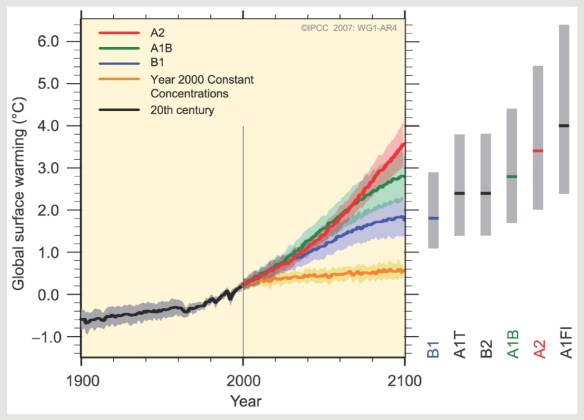
Projections (colored lines), with uncertainty bounds of ±1 standard deviation (shading), for future surface temperature rise from models that use different economic scenarios. Scenario A2 (in red) represents “business as usual” where temperature is projected to rise by the end of the century between 2°C and 5.5°C if no effort is made to constrain the rise of CO2 concentration in the atmosphere, which by 2100 could range between 525ppm and 1000ppm (ppm = parts per million of the air volume). The solid bars at right indicate the best estimate (solid line) and possible ranges (grey shading) for each scenario. (6)

A view of this relative temperature history between 1880 and 2016 follows.

Notice that the temperature distance from the 1951-1980 average global surface temperature ranges from -0.8°C (1917) to +1.3°C (February 2016). Planet Earth today is about 1.5°C warmer than it was in the 19th century. What was the global surface temperature at earlier times?

Planet Earth has gone through many cycles of glacial and interglacial intervals over the previous 800,000 years. During those Ice Age climatic oscillations, the concentration of carbon dioxide gas (CO2) in the atmosphere cycled between about 170ppm and 300ppm, and temperature cycled between about +4°C and -10°C about our mean global surface temperature datum. (7)

Climate change during the previous 65 million years has been charted as follows. For the details of this image, see note (8).

The green trace shows oxygen isotope measurements (for the oxygen-18 isotope as a fraction of the oxygen present in the sample) on the stacked layers of carbonate (chalk) deposits down through the seafloor (obtained by core drilling), formed from the compacted shells of ancient foraminifera. Temperatures later than 13Mya (Mya = million years ago) are shown in the box at the lower right of the above image; the dashed horizontal line indicates the datum. Temperatures (relative to the datum) between 65Mya and 35Mya are shown in the box in the upper left of the image. Antarctica was glaciating, thawing and reglaciating between 35Mya and 13 Mya, and science has insufficient data to determine the temperature history for that complicated interval. (8)

Notice the little spike labeled PETM, at 56Mya in the image above. This is the Paleocene-Eocene Thermal Maximum, a very short-lived (200,000 years) high temperature excursion. The height of this temperature spike is likely underestimated by a factor of 2 to 4 because of the coarse sampling and averaging involved in this record.

At least since 1997, the Paleocene–Eocene Thermal Maximum has become a focal point of considerable geoscience research because it probably provides the best past analog by which to understand impacts of global climate warming and of massive carbon input to the ocean and atmosphere, including ocean acidification. Although it is now widely accepted that the PETM represents a “case study” for global warming and massive carbon input to Earth’s surface, the cause, details and overall significance of the event remain perplexing. (9)

Paleocene–Eocene Thermal Maximum (PETM)

The paleogeography of 56Mya was not that different from today; there was no ice at the poles, the Atlantic Ocean was not as wide as it is now, and India was only just beginning to collide with the rest of Asia. The climate during the Eocene Epoch (56Mya to 34Mya) was much warmer then today: Redwood trees grew in the Canadian Arctic, and the environment of that polar region looked like Okefenokee Swamp (straddling the state boundaries of present-day Florida and Georgia); mid-latitude continental interiors were warm through the winter, with giant palms growing in Wyoming and crocodiles ranging through the swamps and rivers. The poles remained ice-free during the entire interval spanning the Paleocene Epoch (66Mya to 56Mya) and the Eocene Epoch (56Mya to 34Mya).

The expected rise in average global surface temperature during the 90 years between 2010 and 2100 is like the rise in global temperature, going backwards in time, from ‘now’ to 35Mya: about 4°C to 5°C above the datum. “In just a few human lifetimes we’re going to change conditions in the atmosphere to a state that hasn’t been seen in 35 million years” commented Dr. Scott Wing (Curator of Fossil Plants, Smithsonian Museum of Natural History, Washington, DC) in his detailed lecture on the PETM. (10)

During the Paleocene, CO2 concentration in the atmosphere (also called “partial pressure”) was estimated to have been at 380ppm to 400ppm, and then rose to 800ppm just prior to the onset of the PETM (56Mya), producing a global temperature about 4°C warmer than our datum. The CO2 concentration then doubled or more to at least 1600ppm to 2000ppm within a few millennia at the start of the PETM, ‘quickly’ (in geological terms) producing an additional temperature rise of 4°C to 8°C.

Between 4,000 and 7,000 billion tons of carbon were injected into the atmosphere within the initial millennia of the PETM; the first (and biggest?) pulse lasting less than 2,000 years, and the emissions ending within 20,000 years. It would take the natural processes of CO2 removal 200,000 years to return the CO2 concentration and the global temperature to their levels prior to the onset of the PETM.

The amount of carbon injected into the atmosphere during the PETM is about the size of the carbon burp that would (will?) be realized by burning the entire fossil fuel reservoir humanity has at its disposal. However, the rate at which atmospheric carbon (CO2 and CH4) was emitted during the PETM is at least 10 times slower than today’s anthropogenic emissions! What may have taken 3,000 years during the PETM, we are accomplishing within 300 years; in fact 200 million years of fossil fuel accumulation has been burned in about 160 years.

The essential point here is that it will take 100,000 to 200,000 years to get back to the “normal” climate we left behind us in the middle of the 20th century. On this, Dr. Scott Wing commented: “The effects last for 200,000 years. So this is a global shift, which to a geologist looks like a transient change, like a perturbation, like a blip, but to any sane human it’s forever.”

Where did PETM carbon emissions come from? Science does not have a definitive answer, but its four estimates, ranked from most likely to least likely are:

— methane bubbling up out of warmed deep ocean methane hydrates (ice-like solids trapping methane, produced by microbes feeding on decaying organic matter, and formed in the cold and high pressure at the bottom of oceans) and then oxidizing in the atmosphere (CH4 combining with oxygen to produce CO2 and water vapor);

— extensive wildfires that included the burning of peat deposits (because the burning of all terrestrial vegetation alone would have produced insufficient carbon, so the burning of peat would also have been necessary);

— volcanic intrusions into organic-rich sediments at the floor of North Atlantic off Scandinavia (a region of very active volcanism at the time) cooking the sediments to release CO2 and methane;

— the warming and oxidation of any permafrost that may have remained, and it giving up lots of carbon.

It is possible that a combination of these four effects may have occurred.

All the soils formed in the Big Horn Basin of Wyoming during the 200,000 years of the PETM have been compacted to stacked layers of sediments 40 meters thick in total. During the PETM that region had a warm dry tropical climate; bean plants proliferated. Before and after the PETM the climate was temperate and bean plants were absent from the Big Horn Basin (at least in the respective fossil records). During the first 150,000 years of the PETM, warm climate plants (like beans) moved north even to the Arctic, and then retreated south during the last 50,000 years of the PETM, with temperate climate plants reappearing.

Plants growing in a high CO2 environment make less green pigment and have lower nutritive value, so plant eaters have to eat more to sustain themselves, or evolve to smaller sizes to reduce their metabolic requirements. Animals and insects did both during the PETM. Ancient horses first appeared in America at the very beginning of the PETM, and they ‘quickly’ shrank in size by about 30% — to the size of domesticated cats today. With the uptake of CO2 at the close of the PETM and the return to ‘normal’ Eocene conditions, this species of tiny horses increased in size by 76%. A similar shrinkage of body size during the PETM occurred for the other mammal species present at the time, including primates.

The four major scientific lessons of the PETM are:

— big emissions of carbon into atmosphere result in warmer climate and more acidic oceans, and that acid seawater dissolves deep marine chalk (and kills marine organisms living in the lower few kilometers of the oceans because dissolved oxygen has been scavenged — hypoxia — and because shell formation, for the protective casings required by many marine organisms, is impossible because of the acidity);

— there are self-reinforcing cycles of carbon release with increased temperature: CO2 and CH4 capture and retain heat and warm the atmosphere; that warms the oceans and results in intermittent rainfall on the continents (heavy rains with long dry spells between); that causes an abundant growth of vegetation, which parches during the droughts and dry spells and feeds wildfires releasing more CO2, heating the atmosphere and oceans further; that leads to the dissociation of marine methane hydrates, which release methane gas and heat the atmosphere and oceans even further; a sequence of vicious cycles;

— rapid global warming changed where plants and animals lived and how they interacted (this is affecting 21st century people, too), and drove rapid evolution in the body sizes (shrinkage) of mammals;

— and the effects last for 200,000 years because it takes Nature that long to clear out the excess CO2 from the atmosphere and oceans.

What brought the CO2 concentrations down and ended the PETM? The process of photosynthesis in growing plants pulled CO2 out of the air and bound it into nutrients (sugars, glucose, plant tissues), which partially migrated into animal tissues as food. CO2 was also absorbed by the surfaces of the oceans, and reacted at depth with carbonate compounds to dissolve the sea floor chalk and acidify the seawater. Over a longer term, 10% to 30% of the excess CO2 was removed by weathering reactions in soils, and the erosion by rain and streams of rocks imprisoning CO2 carried sediments back to the oceans, where they settled out on the sea bottom. Long after the time scale of the PETM, those seafloor sediments would be interred by subduction at tectonic plate boundaries.

Carbon uptake is slow. A computer simulation of the instantaneous dumping of 5,000 billion tons of carbon into atmosphere (producing an atmospheric concentration of 2,500ppm of CO2, by volume) showed that:

— roughly half of the CO2 comes out in first 1,000 years;

— 30% to 40% still remains at 10,000 years;

— and it isn’t all removed until after 100,000 years, so by about 150,000 to 200,000 years as occurred with the PETM.

A visual representation of CO2 uptake follows (11)

For a detailed description of the CO2 uptake processes, see note (11).

Similar computer modeling has been done for our climate future out to year 3000. Assuming that the entire fossil fuel reservoir is burned up by year 2100, injecting 5,000 billion tons of carbon into the atmosphere, the global temperature will rise to 4.5°C above datum by 2100 and remain there. Among the expected effects are a sea level rise of 1 meter by 2100, and 7.5 meters (25 feet) by year 3000 because the Greenland Ice Cap will have melted.

The major problem of having elevated global temperature for a long time — and it will be long since Nature takes “forever” to reabsorb atmospheric CO2 — is that major melting will eventually occur. As we are learning from direct observation today, that major melting may occur more rapidly than scientists were at first led to believe on the basis of their earlier computer modeling. If the Antarctic Ice Cap were also to entirely melt, sea level would be 66 meters (216 feet) higher in an ice-free world.

Could humanity today go on a furiously massive campaign to plant more trees and vegetation, so as to suck out excess CO2 from the atmosphere and stop global warming? No. We just can’t emplace enough plants to accomplish this, the rate of CO2 removal implied by this question is beyond the capability of Earth’s biosphere however lush. However, increasing the mass and area of vegetation (plants, trees) would slow the rates of CO2 accumulation and temperature increase, and help us lose ground (against the advance of global warming) less rapidly. So yes, plant!; it would also be a relief to wildlife sorely pressed with habitat losses.

Life in the Anthropocene

Geologists have recognized that we are now living in an epoch whose climate is fundamentally affected by human activity. That epoch has been termed the Anthropocene (12), and it was officially designated to have begun in the 4th quarter of 1965. (13)

“We have started the Anthropocene but the things that we think are untrammeled nature are already trammeled by us. There’s no eco-system on this planet that hasn’t had the human fingerprint on it some way or another. And many of the things that we think are beautiful and natural have already been modified by our ancestors, in ways that may not be obvious to us… What the Anthropocene perspective does is it helps us recognize that with [over] 7 billion people on the planet, and thousands of years, tens of thousands of years-long history already of modifying the planet, that it’s really too late to think about putting anything back the way it was,” Dr. Scott Wing.

I can think of 9 possible negative effects (mainly on human civilization) from severe global warming:

— reduced food production on land because of droughts and desertification, and a reduction of the nutritive value of crops because of high CO2 concentration;

— increased scarcity of fresh water, because of hot dry climatic conditions, intermittent rainfall, and huge population;

— the global spread of disease germs and usually tropical parasites, in a hotter world;

— loss of seafood with acidic seas, and increased starvation for animals and people;

— habitat losses for people, given significant coastal inundation and excessive heat and desertification in continental interiors;

— habitat losses for terrestrial wildlife as with humans, but also for marine life because of the reduced dissolved oxygen and increased acidity of the oceans;

— climate disaster-sparked mass migrations, which among humans will undoubtedly lead to clashes and even wars;

— resource scarcity wars (for basics like water, and for rarities like the semiconductor materials and metals essential to high tech electronics, and maybe in the extreme even for uranium deposits);

— increasingly heartless exclusion of the poor by the rich and powerful (a worldwide ‘Gazafication’ of the hapless poor).

We see some of each of these today, but the questions are: how much worse could it get?, and by when?

The development of human civilization over the last 10,000 years or so was aided by the benevolence of a very stable and moderate interglacial climate. In this new Anthropocene Epoch of increasing climate instability, we can anticipate major disruptions in human affairs, and given the socio-economic disparities and hostilities built into our human societies, we can anticipate the burdens of those disruptions to fall inequitably on poorer people. Misery will pushed down the gradient of wealth towards the destitute. In an extreme projection of pessimism, one could imagine conflicts of immiseration avoidance to devolve into extinction events, like a nuclear war.

However, the anticipated climate variations, like those of the PETM, will not in themselves be sufficiently extreme to force the actual physical extinction of humanity. In 7.95 billion years, when the Sun expands into a Red Giant star, then life on Planet Earth will be evaporated. But until such time, the most likely cause of a premature human extinction would be bad human behavior in response to the climate changes confronting humanity, and which we have caused.

It would be good for us to become familiar with how life is distributed in the Anthropocene, the epoch whose gallop we are spurring, so we can lead it more thoughtfully.

Humanity today comprises only 0.01% of all life on Planet Earth, but over the course of human history our species has destroyed 83% of wild mammal species. (14)

“The world’s 7.6 billion people [in May 2018] represent just 0.01% of all living things, according to the study. Yet since the dawn of civilisation, humanity has caused the loss of 83% of all wild mammals and half of plants, while livestock kept by humans abounds. The new work is the first comprehensive estimate of the weight of every class of living creature and overturns some long-held assumptions. Bacteria are indeed a major life form – 13% of everything – but plants overshadow everything, representing 82% of all living matter. All other creatures, from insects to fungi, to fish and animals, make up just 5% of the world’s biomass. Farmed poultry today makes up 70% of all birds on the planet, with just 30% being wild. The picture is even more stark for mammals – 60% of all mammals on Earth are livestock, mostly cattle and pigs, 36% are human and just 4% are wild animals.” Where is all that life to be found?: 86% on land, 1% in the oceans, and 13% as deep subsurface bacteria. (14)

One suggested marker for the Anthropocene are the bones of domestic chickens, which are now ubiquitous around the globe. The marker recognized has having achieved complete coverage over the surface of Planet Earth by late 1965 is radioactive fallout from atmospheric atomic and nuclear bomb explosions.

Our Challenge

Remember that the biggest threat to humanity’s survival is anti-social human behavior; climate change alone can’t kill us.

If we choose to experience our present and future of changing climate as a competitive war game — with actual killing and willful destruction — to gain class, factional and ideological advantages in terms of physical security, habitability, food production, natural resource availability, standard of living and social status (ego gratification), then that species-wide dysfunctional response could ultimately lead to a collapse of civilization, and at its worst to a global nuclear war and then actual human extinction.

If we choose to experience our present and future of changing climate as an intellectual challenge to human ingenuity for technical innovation, and as a moral challenge for social organization and for the elimination of socio-economic disparities, then such a species-wide response would improve the human condition regardless of the degree of future climate variability and the geographical distribution of its effects on habitability.

Regardless of what we do or don’t do, the climate will change in ways governed by majestic and interlocking geophysical cycles spanning millennia. Our individual and species-wide experiences of living within this implacable reality will be set by how we choose to interact with each other. Nirvana or perdition are choices entirely within our grasp.

Many will say that obviously climate change as competitive war game is the only realistic alternative because it requires no behavioral changes from our over 10,000 years of “civilized” human history, and because eco-socialism is pure utopianism and thus beyond all realistic actualization. And of course, eco-socialism is impossible in a world of Ahabs and fanatical Ahab followers. But all that is just an excuse to continue with bad behavior. There are no actual physical or biological constraints preventing people from choosing to associate in an eco-socialist manner. The current societal improbability for deeply cooperative behavior does not make future species-wide collective cooperation an impossibility. Responding to climate change could provide a framework on which to build such a species-wide socialist civilization.

So, how would I respond to the Ahabs out there who would tell me: “Everything you say is wrong! God is White! Trump is Christ! Capitalism is Salvation! Ye cannot swerve me!” From me: You can’t accept it because then you wouldn’t be the person you are. You can’t learn if you are unwilling to change. And that, ultimately, is what climate change will be for us: a challenge to learn.

And finally, Nature to Ahab: Ye cannot swerve me! Your world may return in 200,000 years.

Notes

(1) Herman Melville, Moby-Dick or, The Whale, (1851), Penguin Books, 1992.

(2) Sperm Whale,
https://en.wikipedia.org/wiki/Sperm_whale

(3) Carl Gustav Jung, C. G. Jung Speaking: Interviews and Encounters, Princeton University Press, 21 February 1987, edited by: William McGuire and R. F. C. Hull; “Diagnosing the Dictators” 1938, pages 115-135; “Jung Diagnoses the Dictators” 1939, pages 136-140; (dictators = Hitler, Stalin Mussolini).

(4) “To the Virgins, to Make Much of Time,” (Robert Herrick)
https://en.wikipedia.org/wiki/To_the_Virgins%2C_to_Make_Much_of_Time

(5) History of climate change science
https://en.wikipedia.org/wiki/History_of_climate_change_science

(6) Global Surface Temperature, 1900-2100
(relative to 1951-1980 average global surface temperature)
National Research Council 2011. Understanding Earth’s Deep Past: Lessons for Our Climate Future. Washington, DC: The National Academies Press.
Figure 1.1, page 35 of the PDF file, page numbered 20 in the text.
Figure 1.1 SOURCE: IPCC (2007, Figure SPM.5, p. 14).
https://doi.org/10.17226/13111

(7) Global view answers ice age CO2 puzzle
April 4, 2012 — andyextance
https://simpleclimate.wordpress.com/2012/04/04/global-view-answers-ice-age-co2-puzzle/

The 800,000 year record of atmospheric CO2 from Antarctic ice cores, and a reconstruction of temperature based on hydrogen isotopes in the ice. The current [2012] CO2 concentration of 392 parts per million (ppm) is shown by the blue star. Credit: Jeremy Shakun/Harvard University

(8) 65 Million Years of Climate Change
(wikipedia, 13 July 2019)
https://commons.wikimedia.org/wiki/File:65_Myr_Climate_Change.png

This figure shows climate change over the last 65 million years. The data are based on a compilation of oxygen isotope measurements (δ18O) on benthic foraminifera by Zachos et al. (2001) which reflect a combination of local temperature changes in their environment and changes in the isotopic composition of sea water associated with the growth and retreat of continental ice sheets.

Because it is related to both factors, it is not possible to uniquely tie these measurements to temperature without additional constraints. For the most recent data, an approximate relationship to temperature can be made by observing that the oxygen isotope measurements of Lisiecki and Raymo (2005) are tightly correlated to temperature changes at Vostok as established by Petit et al. (1999). Present day is indicated as 0. For the oldest part of the record, when temperatures were much warmer than today, it is possible to estimate temperature changes in the polar oceans (where these measurements were made) based on the observation that no significant ice sheets existed and hence all fluctuation in (δ18O) must result from local temperature changes (as reported by Zachos et al.).

The intermediate portion of the record is dominated by large fluctuations in the mass of the Antarctic ice sheet, which first nucleates approximately 34 million years ago, then partially dissipates around 25 million years ago, before re-expanding towards its present state 13 million years ago. These fluctuations make it impossible to constrain temperature changes without additional controls.

Significant growth of ice sheets did not begin in Greenland and North America until approximately 3 million years ago, following the formation of the Isthmus of Panama by continental drift. This ushered in an era of rapidly cycling glacials and interglacials.

Also appearing on this graph are the Eocene Climatic Optimum, an extended period of very warm temperatures, and the Paleocene-Eocene Thermal Maximum (labeled PETM). The PETM is very short lived high temperature excursion possibly associated with the destabilization of methane clathrates and the rapid buildup of greenhouse gases in the atmosphere. Due to the coarse sampling and averaging involved in this record, it is likely that the full magnitude of the PETM is underestimated by a factor of 2-4 times its apparent height.

(9) Paleocene–Eocene Thermal Maximum (PETM)
https://en.wikipedia.org/wiki/Paleocene%E2%80%93Eocene_Thermal_Maximum

(10) Global Warming 56 Million Years Ago, and What it Means For Us
30 January 2014
Dr. Scott Wing, Curator of Fossil Plants,
Smithsonian Museum of Natural History
Washington, DC
[1:44:12]
https://youtu.be/81Zb0pJa3Hg

(11) CO2 “lifetime” in the atmosphere
National Research Council 2011. Understanding Earth’s Deep Past: Lessons for Our Climate Future. Washington, DC: The National Academies Press.
Figure 3.5, page 93 of the PDF file, page numbered 78 in the text.
https://doi.org/10.17226/13111

CO2 Sweepers and Sinks in the Earth System
The carbon fluxes in and out of the surface and sedimentary reservoirs over geological timescales are finely balanced, providing a planetary thermostat that regulates Earth’s surface temperature. Initially, newly released CO2 (e.g., from the combustion of hydrocarbons) interacts and equilibrates with Earth’s surface reservoirs of carbon on human timescales (decades to centuries). However, natural “sinks” for anthropogenic CO2 exist only on much longer timescales, and it is therefore possible to perturb climate for tens to hundreds of thousands of years (Figure 3.5). Transient (annual to century-scale) uptake by the terrestrial biosphere (including soils) is easily saturated within decades of the CO2 increase, and therefore this component can switch from a sink to a source of atmospheric CO2 (Friedlingstein et al., 2006). Most (60 to 80 percent) CO2 is ultimately absorbed by the surface ocean, because of its efficiency as a sweeper of atmospheric CO2, and is neutralized by reactions with calcium carbonate in the deep sea at timescales of oceanic mixing (1,000 to 1,500 years). The ocean’s ability to sequester CO2 decreases as it is acidified and the oceanic carbon buffer is depleted. The remaining CO2 in the atmosphere is sufficient to impact climate for thousands of years longer while awaiting sweeping by the “ultimate” CO2 sink of the rock weathering cycle at timescales of tens to hundreds of thousands of years (Zeebe and Caldeira, 2008; Archer et al., 2009). Lessons from past hyperthermals suggest that the removal of greenhouse gases by weathering may be intensified in a warmer world but will still take more than 100,000 years to return to background values for an event the size of the Paleocene-Eocene Thermal Maximum (PETM).

In the context of the timescales of interaction with these carbon sinks, the mean lifetime of fossil fuel CO2 in the atmosphere is calculated to be 12,000 to 14,000 years (Archer et al., 1997, 2009), which is in marked contrast to the two to three orders of magnitude shorter lifetimes commonly cited by other studies (e.g., IPCC, 1995, 2001). In addition, the equilibration timescale for a pulse of CO2 emission to the atmosphere, such as the current release by fossil fuel burning, scales up with the magnitude of the CO2 release. “The result has been an erroneous conclusion, throughout much of the popular treatment of the issue of climate change, that global warming will be a century-timescale phenomenon” (Archer et al., 2009, p. 121).

(12) Anthropocene
https://en.wikipedia.org/wiki/Anthropocene

(13) The Anthropocene’s Birthday
https://manuelgarciajr.com/2018/02/23/the-anthropocenes-birthday/

(14) Humans just 0.01% of all life but have destroyed 83% of wild mammals – study
https://www.theguardian.com/environment/2018/may/21/human-race-just-001-of-all-life-but-has-destroyed-over-80-of-wild-mammals-study

<><><><><><><>


2° Institute
https://www.2degreesinstitute.org/

data sources for charts below
https://www.temperaturerecord.org/#sources
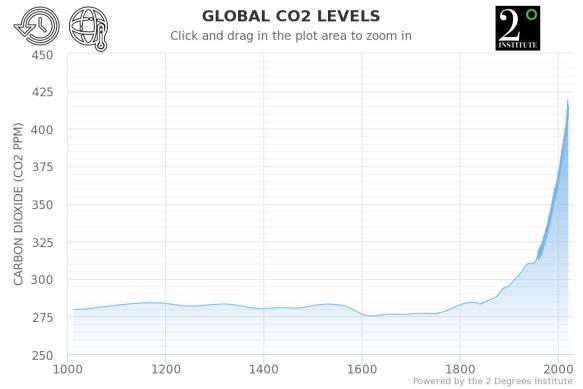
<><><><><><><>