




 <><><><><><><><><><><><><><><><><><><><><><><><><><><><><><><><>
Night and Day, Being and Nonbeing
Matter, energy, space and time: the entirety of physical existence. Einstein unravelled their truth: they are all entwined, a four dimensional yin-yang, the image of gravity. But, what gave him pause that he could never fully overcome was the yin-yang of existence and nonexistence: quantum reality. And that is what we live within and are: matter, energy, space and time, existence and nonexistence, flickering on and off in rhythms seen and unseen, known and unknown, felt and unfelt. And consciousness, like gravity, is manifest through that dazzle while itself untouchable — a void — infused deep within us, the motivating core, the suns of our solar systems of individual being: life.
I step outside my warm bubble of house-air into the cool fresh oceanic night, which sucks my awareness out to the farthest reaches of its fathomless inky blue-black vacuum, punctuated by pinpricks of light beyond the frontiers of experience, whose inverted depths are a dark crystalline silence, the infinitely dissolved horizon past the tenuous haze of our shared breaths with green life lush with the fragrance of August flowers eddying through the living tangle of Earth’s surface in my forested canyon laden with ancient expirations cooled and moistened to sparkling renewal.
This velvety opaque transparency pulses with drones by crickets and unfolds unseeable vistas of distant sound whose tides are brought near, washing resonantly through me and absorbing me into the totality of this timeless sequence of unthinking scintillating instants, pinpricks of existence flashing out of an eternal sea of nonexistence like glints of moonlight on ripples of a four-dimensional ocean, the unbounded immersion.
I breathe in my share of this pregnant unconscious and sense the capture of two or three molecules released millennia ago in the funeral pyre of that great poet’s expended form, its brief journey of genetic transport finished as mine will soon enough be, and I embed that molecular poetry into my blood and sinews until its time for release comes with my organic disintegration into pure fleeting memory. Coyotes howl with bell-like clarity through the dark effulgence, and my moments of eternity come to rest for this night. So, I turn into my house-bubble for sleep.
Dawn fog in the canyon: I am looking at the sun just rise over the crest of the ridge, and light pour through the fog into the canyon, making it glow as it flows up the stream-bed and through the trees along the hillsides, with blue sky above, and birds darting through the panorama framed by my vision, the warmth of the rays descending into my body as I face before it, immersed in a cloud of light, evaporating. A bird chirps. Mist rises. The ground of the forest lights up. Leaves emerge glistening green from their silhouettes. The voices of the forest call to each other, silence fades into the light of day. Rebirth. I am who am once again.
25 August 2019
<><><><><><><>

<><><><><><><><><><><><><><><><><><><><><><><><><><><><><><><><>
Through My Lens, Clearly
For me, the 1950s ended in 1962 with the Cuban Missile Crisis, and the 1960s began in 1959 with the Cuban Revolution. I remember the elation in my family, in New York City’s Upper West Side (136th Street, and Broadway), when the Batista Regime in Cuba collapsed in January 1959; and I remember our dumbstruck terror in October 1962, listening to President John Kennedy speaking on our black-and-white TV, wondering if my grandparents would be radioactively incinerated in Havana before we were similarly dematerialized in New York City, or vice versa.
That is how my political consciousness was born; its coming-of-age and definitive molding was done later by the Vietnam War, and the many insistent demands by my government that I sacrifice myself to it. I escaped by dumb luck, for which I am eternally grateful. With the particular curvature and polish of my own idiosyncratic lens for political consciousness, I have come to resolve images of our collective reality that I sometimes feel a need to project, as here today.
People can’t be changed, they either evolve on their own, or they persist as they are to the death. The best you can do, for the rare few, is tell them the truth if they ask.
We live in a world rich in its diversity of intolerance of independent thought and self-directed living. Expressions of personal independence and creativity are threats to the slavish conformity of the mass of fearful repressed people hiding in their submissiveness to traditional ideologies that give them status in social hierarchies that limit the full human potential of the individual. This maintains, without merit, the elevation of patriarchs and power-hungry mediocrities who clip the wings of the human spirit and direct the enforcement of their systems of mental and physical imprisonment of the masses serving them.
Bigotry is popular because it makes stupid people feel intelligent, and weak people feel strong. President (sic!) Donald Trump’s popularity rests on people’s desire to be bigoted and respected for it. Bigotry will exist as long as there are ignorant people who are fearful. Such bigoted people love fascism because under it they can stay bigoted and be proud of it. Fascist bigots, like Trump, don’t want to hear the truth because they don’t want to be made to feel ashamed. That is why publicly recognized fascist power-seekers always try to silence their critics: first by ignoring them, then by ridiculing them, then by judicial attacks against them, or by veiled calls to their followers to sprout proxies who will make illegal attacks on their critics, and ultimately if they gain dictatorial power they have their critics killed.
Evangelical Christianity is a cult of fear, and for its men also a cult of patriarchy. Politically, it is irrational Republicanism; socially, it is white supremacy and the subjugation of women. Why do such Republican women remain Republican? Because their bigotry, which is fear, is so embedded that it overpowers their self-respect, which is courage. Evangelical Christianity sees Islam as its reflection and its rival, which is why it hates Islam. In practice, their religion is a hate crime. Heraclitus was so perceptive to write, in about 500 BC, that “bigotry is the disease of the religious.”
The problem of race bigotry in America is like the problem of climate change. It is of our making, and we know how to fix it, but we never will. People are too invested in their ignorance for that to ever happen, and afraid if they let it go they will be weak in a changed world.
Arresting climate change would require the universal application of human intelligence, indiscriminate compassion, worldwide solidarity instead of personal selfishness, and thoughtful discipline instead of thoughtless waste. We are doomed. Climate Change is only a problem for the young, bequeathed to them by the old, who won’t notice it anyway because they’re comfortably done, and will be gone soon (geologically speaking).
I probably should not bother writing about the Climate Change Crisis anymore. Everyone everywhere now knows that it is real, and most have felt its first unpleasant effects. So, some Green Energy actions will now happen in response, probably too few, too weak and too late, but at least a start now that the Global Mind has opened to the truth.
Also, I really don’t need to write any more Jeremiads against Republican Party partisans (there are plenty of others to do that nicely), because it is now obvious to everyone everywhere — even the U.S. corporate media (though it puckers their sphincters to mouth it) — that the Republican Party is just a fascist conspiracy to eliminate democracy in the United States of America, and replace it with an authoritarian corporatized xenophobic bigoted Fundamentalist Christian White Supremacy theocratic oligarchy, to drive us all expeditiously to extinction under their self-satisfied obsessively avaricious command. Thieves lie, and liars steal. For them, it is better for humanity to die out badly than for the stupid, bigoted and greedy to be bypassed. Capitalism is fossil-fueled greed with a total lack of imagination, and a bodacious military. Capitalism is the ideology of parasites.
Who built the United States of America into the richest country in world history?: enslaved and exterminated Native Americans, enslaved Africans, dispossessed Mexicans, and exploited European and Asian immigrant laborers. Who produces American wealth today?: the wage-slave descendants of all of these, who only gain a pittance from their harvested labors. What salve are these squeezed working people given for the bruising sacrifices they make of their humanity into the endlessly grinding engines of obsessive greed?: a patriotism deficient in human solidarity but voracious for taxes. But, don’t think of it as taxes, think of it as tithing to the War Religion.
So in my lens’s focus today I find the following: For the world: Capitalism must die for the World to live. For my country: Tribalism is America’s fatal flaw. Resentment, envy and a fanatical sense of entitlement are its corrosive agents. A generational overturning led by socialist youth is its only hope. For myself and every other person: It’s not what happens to you that determines whether you are a success or failure at life, but how you deal with it. As Thucydides quoted Pericles: “Honor is the only thing that does not grow old.”
And now, back to the bread and circuses.
<><><><><><><>
<><><><><><><><><><><><><><><><><><><><><><><><><><><><><><><><>
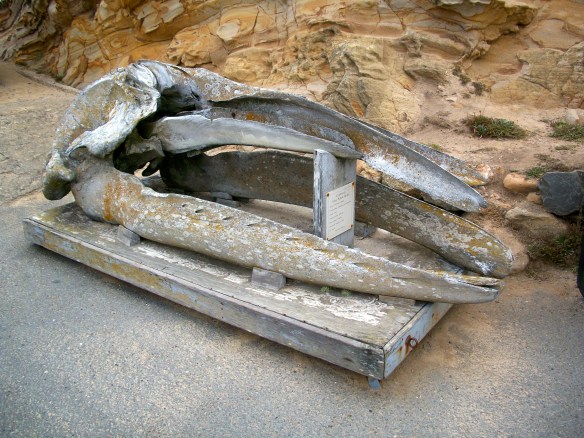
Moby-Dick
The red arm of the doomed American Indian
in his death-gasp
nailed the harassing American Eagle to the cross
at mast-top of the sinking Ship-of-State,
hull stoved-in
by unconquerable purity of majestic Immensity,
the pulse of Nature
that had been so monomaniacally pursued,
a blind raging exterminating profiteering quest
to capture, kill, and boil down its essence
for liquid fuel
burning in that self-annihilating hunt’s engine
only to be quenched out steaming
by the precipitous plunge into cold finality
of eternally billowing oblivion
in whose dark depths Nature ranges free.
One chastened orphaned wanderer
vomited out of the deep illusory unconscious
by random pity,
buoyed uncoffined by lost despair,
drifts beyond prophesy he now knows
will ever be unheeded
and yet fulfilled.
7 August 2019
<><><><><><><>


<><><><><><><>

Round Top crater, tilted 90° to right, and quarried.
<><><><><><><><><><><><><><><><><><><><><><><><><><><><><><><><>
The Volcano Behind Oakland (redux)
I think I have settled on the epitaph for my tombstone: Have Fun and Be Kind. Actually, while I concede the certainty of mortality, I don’t really want a tombstone. I would prefer that my lifeless body be cremated and my bones crushed, so my powdery remains could be scattered at sea, perhaps in Bodega Bay following my father (or further out if the charter boat captain isn’t too stingy about using fuel). Then the gritty grey plume of my exiting ghost would settle out as a thin dusting on the muddy surface of the sea floor, and in time my ashes would get pressed into a thin-banded shale or mudstone of future millennia.
The only uncertainty about human extinction is its timing: Will it occur in the distant future when the sun expands into a Red Giant and consumes the inner planets, or will it be an unnecessarily premature self-inflicted demise by some combination of war (whether radioactive or merely with firearms), environmental exhaustion and climate change? I suspect humanity will select option B, but — through the magical power of denial — conceptualize the experience as victimization by unanticipated natural catastrophes. In any event, I do not find the inevitability of human extinction to be regrettable. Humanity is but one of many simultaneous and transitory expressions of Life On Earth, and this earth is only a minute speck of an unimaginably vast universe that can obviously sprout life. So relax, the earth and the universe will carry on majestically without us; we are as unnecessary to them as the dinosaurs were.
Like the animals and plants at the time of the dinosaurs, the life forms of today may become the coal and petroleum fueling the pottery kilns of future primitives, like the Anasazi, or the industries of future technological societies, if any.
I find the contemplation of geologic history, and the learning about its particulars on those parts of earth’s surface where I circulate, to impart a mental serenity like that gained by viewing vistas from mountaintops, or out in the expanses of the Great Basin and the Colorado Plateau of the American West.
The North American continent moves west across the surface of the globe because of the widening of the Atlantic Ocean caused by the magmatic extrusion of new rock from a linear spreading center that runs down the middle of that ocean basin from the Arctic to the Antarctic.
The western edges of the American continents ride over the eastward-moving heavier tectonic plates supporting the Pacific Ocean, and which lie east of a series of north-south trending spreading centers. The eastern edges of the Pacific Ocean plates colliding into the American continents plunge into the earth, or subduct, to melt under the weight of those continents’ westward advance.
A Pacific spreading center, whose northern end was tilted to the east relative to its southern end, began to subduct under North America 30 million years ago (30 Mya), in what is today Southern California. Faults perpendicular to this spreading center extended westward (with a tilt to the north) from its northern and southern extremities. As this spreading center was overridden by the western edge of North America, it caused that portion of the overlying continent that was west of the buried spreading center to break off and begin sliding to the north, and west. The line of this fracture lengthened as the subduction of the spreading center continued, and this was the origin of the San Andreas Fault (SAF).
The north-south trending SAF lies near the California coast. By 20 Mya, the northern end of the SAF had extended north into Central California. By 10 Mya, the northern end of the SAF was near Monterey Bay, and today it is in Northern California at Cape Mendocino, which is the westernmost extent of the California coast.
The northern end of the SAF is a triple point from which emerges the Mendocino Fault, which runs perpendicular to the SAF and westward out to sea. Slippage along both the SAF and the Mendocino Fault is such that earth on the opposite side of the fault is seen to move to the right. The land just north of the triple point is colliding eastward into North America, and the land (ocean floor) just south of the triple point and west of the SAF is colliding northward into the subduction occurring north of the triple point.
The confluence of tectonic motions at the triple point generates sufficient geologic pressure and heat to cause vigorous seismic activity and volcanism in its vicinity. For over 20 million years, volcanoes have preceded the northward advance of the northern triple point of the SAF. The Neenach Volcano, in Los Angeles County, erupted 23 Mya and was subsequently split by the SAF so that its western half now lies 314 km (195 miles) to the northwest in present day Pinnacles National Park (which is east of the Salinas Valley and 130 km, or 80 miles, south of San Jose). From 10 Mya to 9 Mya, volcanoes erupted in what are today the hills east of the cities of Oakland and Berkeley. About 2.4 Mya, numerous volcanoes were active in the Clear Lake Volcanic Field, which lies north of the counties of Napa and Sonoma. The most recent eruptions in the Clear Lake Volcanic Field occurred about 11,000 years ago around Mount Konocti. Today, the magma chamber beneath the Clear Lake Volcanic Field is exploited to extract geothermal energy by the largest complex of geothermal power plants in the world.
The volcano in my neighborhood is Round Top, which is uphill from the city of Oakland in what is today a public park, the Robert Sibley Volcanic Preserve.
Between 16 Mya and 14 Mya, the San Francisco Bay Area was part of a marine basin a mile deep (1.6 km). The marine sediments of this basin are today lithified in the rocks of the Claremont Formation. The ocean floor of this basin was uplifted, between 14 Mya to 12 Mya, and the sedimentation of this period occurred in shallow water. This seafloor was lifted above sea level some time after 12 Mya, and for 2 million years the land was an alluvial plain accumulating sediments from streams running east from a chain of coastal mountains, which were situated where the San Francisco Peninsula and the Golden Gate Bridge (the entrance to San Francisco Bay) are today. This plain dipped toward the east to meet the shore of an inland sea near the present day towns of Orinda and Lafayette. These terrestrial sediments, from 12 Mya to 10 Mya, were lithified into the rocks of the Orinda Formation.
The Round Top volcano erupted many times between 10 Mya and 9 Mya, spreading thick layers of basalt lava over the layered stream sediments and gravels of the Orinda Formation. The surrounding countryside was a low plain with lakes, so volcanic ash ejected during eruptions would fall into water to settle out in thin, uniform layers, which were subsequently compacted into finely-banded rock. Ash and cinders also fell on dry land, and this too was eventually compacted into rock. Between periods of volcanic activity, sedimentation occurred by the action of streams or in lake bottoms, as in the earlier time of the Orinda Formation. The combination of rocks formed during the million-year period of Round Top’s volcanic activity is called the Moraga Formation.
You can see an impressive cross section of the alternating layers of lava and sedimentary rocks of the Moraga Formation on either side of Highway 24 on the eastern side of the Caldecott Tunnel, which passes through the north-south trending range of low mountains defining the eastern boundary of the San Francisco Bay lowland. These layers have been tilted up nearly to the vertical because of the flexing and faulting of the land due to the tectonic pressure of continental collision. (1)
Since its extinction, the Round Top volcano has been tilted over about ninety degrees, along with the rest of the Moraga Formation, and its interior has been exposed by the combined effects of erosion and quarrying. Today, one can walk up to a cross section of a basalt lava feeder tube (exposed by excavation), which was once deep inside the volcanic cone;
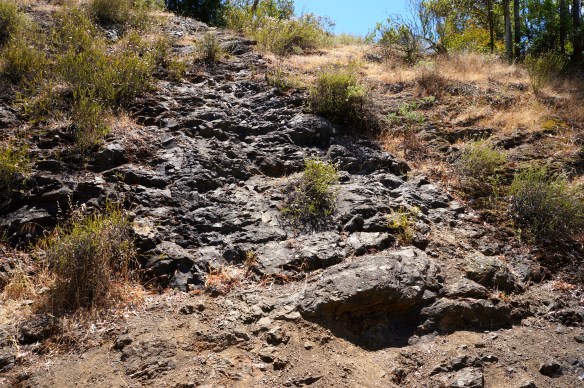
Cross-section view of now horizontal Round Top basalt lava tube.
and one can walk into the tilted crater of the volcano to see lithified layered ash and massive basalt.
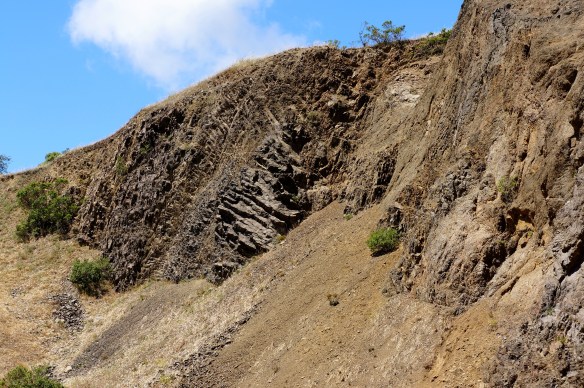
basalt lava flow, and ash
A video about Round Top, which also shows scenes of the countryside in and about Robert Sibley Volcanic Preserve, is posted on the Internet at
This article is not what the English teachers call a “persuasive essay,” as I have no argument to advance, nor any moral to conclude with. I was just rambling on my own, following trails in my mind. But, I will leave you with this, from one future rock to another: have fun and be kind.
Note
(1) For photos of the road-cut at the Caldecott Tunnel (Moraga Formation), see the following web page (and the web links therein):
The route 24 cut, south side
11 August 2013
http://oaklandgeology.wordpress.com/2013/08/11/the-route-24-cut-south-side/
<><><><><><><>
Originally published at:
The Volcano Behind Oakland
12 August 2013
http://www.swans.com/library/art19/mgarci69.html
<><><><><><><>
<><><><><><><><><><><><><><><><><><><><><><><><><><><><><><><><>
American Climate Change Policy: You Don’t Matter
Some weary words spurred by: “Pickin’ and Choosin’ the Winners and Losers of Climate Change” (https://www.counterpunch.org/2019/06/24/pickin-and-choosin-the-winners-and-losers-of-climate-change/).
The pickin’ and the choosin’ of the winners and the losers of Climate Change was all set from the get-go. The Big Money was always going to win because the Big Money always does the pickin’. It’s the American Way. If there was ever any doubt among the blessedly naïve and trusting Demos Americanus about who counts and who doesn’t, then the spectacular publicly-funded deus-ex-machina salvation of the Wall Street Glitterati (WSG) from the financial cataclysm of 2008 should have forever laid to rest all such confusions. You don’t matter (you, because “they” don’t read here).
Nuclear war breaking out? They’re got reservations in the shelters; you’re out to the Big Fry. Ebola Bird Flu Pandemic 2020 racing ‘round the world? They’ve got guaranteed pills and vaccines; you’ve got aspirin, Go-Fund-Me healthcare, and are designated anti-vaxxer by default. Climate Change hurricanes, floods, droughts and crop failures pouncing on you? They’ll stay fat, dumb, happy high-and-dry under Uncle Sam’s caressing wings; you’ll be a pioneer rugged individualist facing off against the sun, with act-of-god cancelled insurance, sucking dried marrow out of bones from drought-kills for your heroic survival (for a month or two).
There is no such thing as Climate Change denial from the Trumpian Monarchy and the Royal Court of WSG’ers, it is all calculated Climate Change delay-ism, stalling propaganda (https://redgreenandblue.org/2019/06/20/trumps-climate-change-denial-red-team-trots-old-debunked-lies/), as Val Eisman remarked to me. In short: premeditated murder (https://manuelgarciajr.com/2017/09/09/climate-change-denial-is-murder/). This has been obvious for decades, but unseen by so many in the Demos Americanus with their touching wishful fantasies of caring and at worst benign bumbling rulers, clouding their persistently innocent eyes.
Saving everybody from the impending catastrophes of Climate Change is a task too gargantuan for accomplishing by individual efforts alone, even if in their simultaneous billions. It requires the complete attention and commitment to, and investment in, by all governments of the Industrialized World operating collectively and cooperatively. It would be the War Against Our Own Fossil-Fueled Frankensteinian Stupidity. But, your caring news media and governments want to reassure you that the time is not quite right to panic ‘ourselves’ into this unrealistic and unwise waste of (“their”) money (on you!), maybe down the road it will get more serious: delayism.
However, the panic to protect the divine right of the Big Money Kleptocracy to stay in the tax-free unearned income black is the foundational original sin of our (really their) capitalist nirvana. So, you can rest assured that the US Treasury printing presses will crank out any uncountable number of trillions of dollars — backed by the full faith and credit of the US military, and your tax offerings — to build whatever physical and socio-economic dikes are necessary to hold back the anticipated disasters to be spun off of Climate Change, and which could otherwise dampen the enthusiasm of WSG’ers in their enjoyment of mindless consumption (what they call “life,” but in the style of Dracula). Saving them is guaranteed, after all they are so few and they own everything anyway so why waste “the money” on who’s already designated waste?, it’s a no-brainer.
What can you do about it? Dream about guillotines, I guess, or watch big-screen TV cartoon super-hero movies and sport championships whose scores you’ll forget by next season; or get drunk if it won’t make you miss work and you have enough rent money; or buy lottery tickets and dream about sitting at the right hand of Ubu Roi hisself. You’re free to choose any of these. Just don’t let your corpse block the entrance to The Club when you go.
<><><><><><><>
American Climate Change Policy: You Don’t Matter
27 June 2019
https://www.counterpunch.org/2019/06/27/american-climate-change-policy-you-dont-matter/
<><><><><><><>

The following article is about fossil fueled (‘fracking’ fueled) global warming climate change. It was written in 2013 and remains completely up to date because nobody has done anything to change the situation — except perhaps to make it worse. This article contains a little bit of science, a little bit of Marxism from John Bellamy Foster, some criticisms of Mr. Foster’s views from me, and one of my better rants on society’s negligence regarding climate change (or, some pointed suggestions for social change). By 2013, I had reached pessimistic conclusions about humanity’s willingness to seriously address global warming, and also about the value of my continuing to write about it. That I do and continue to make positive and “utopian” suggestions for socio-political change is entirely to express my solidarity with today’s youth (I have children), because otherwise I have no faith whatsoever in “the adults.”
<><><><><><><><><><><><><><><><><><><><><><><><><><><><><><><><>
Black Gold, Maximum Entropy (Redux)
20 June 2019 (21 October 2013)
In his extensive article “The Fossil Fuels War” in Monthly Review, John Bellamy Foster writes about the new expansion of oil exploration and production — the demise of Peak Oil — made possible by the development of technology to extract oil from “unconventional” sources, known variously as “shale oil” and “tar sands oil,” and he points to the inevitable consequences on climate. (1)
Those scheduled climatic effects are vividly presented in a new scientific report in which:
Scientists from the University of Hawaii at Manoa calculated that by 2047, plus or minus five years, the average temperatures in each year will be hotter across most parts of the planet than they had been at those locations in any year between 1860 and 2005. To put it another way, for a given geographic area, “the coldest year in the future will be warmer than the hottest year in the past,” said Camilo Mora, the lead scientist on a paper published in the journal Nature. (2)
John Bellamy Foster also notes that there have been recent improvements in renewable energy technologies, whose use could be expanded to replace a portion of the power generation infrastructures based on fossil fuels. However, he is pessimistic that such replacements could form a prompt and complete transformation of national and global power generation systems.
No less remarkable technological developments, however, have arisen at the same time in relation to renewable energies, such as wind and solar, opening up the possibility of a more ecological path of development. Since 2009 solar (photovoltaic) module “prices have fallen off a cliff.” Although still accounting for a tiny percentage of electric-generating capacity in the United States, wind and solar have grown to about 13 percent of total German electricity production in 2012, with total renewables (including hydroelectric and biomass) accounting for about 20 percent. As the energy return on energy investment (EROEI) of fossil fuels has declined due to the depletion of cheap crude-oil supplies, wind and solar have become more competitive – with EROEIs above that of tar-sands oil, and in the case of wind even above conventional oil. Wind and solar, however, represent intermittent, location-specific sources of power that cannot easily cover baseload-power needs. Worse still, a massive conversion of the world’s energy infrastructure to renewables would take decades to accomplish when time is short.
I disagree with this pessimism and believe a massive conversion to renewable energy technologies can be accomplished much more quickly than started in mass media and John Bellamy Foster’s article. I made my case with numerous suggestions, estimates and examples in an article, “The Economic Function Of Energy,” intended to spur positive, creative and practical thinking about such a near-future conversion of energy infrastructure on a national scale. For example, I described a solar-powered system for generating the total electrical power consumed in the United States, which would be publicly owned and thus provide “free” electricity. (3)
Foster notes the foundational motivation of the fossil energy industry as stated by one of its leading CEOs, “my philosophy is to make money.” Concerns over possible environmental damage (from exploration or spills) and climate change (from carbon dioxide and methane emissions) are seen as unfortunate collateral inevitabilities to be minimized as possible, but without delaying extractive operations or seriously diminishing profitability.
Foster gives a good general summary of what is required to make a complete conversion nationally (say for electrical power) from fossil fuels to renewables (solar, wind, hydro), but he sees such a conversion as too monumental a project for our time, while I see it as an exciting and feasible technical challenge, an inspiring project for technophiles that would be liberating for society. Foster writes:
It follows that building an alternative energy infrastructure — without breaking the carbon budget — would require a tectonic shift in the direction of energy conservation and energy efficiency. However, stopping climate change and the destruction of the environment in general requires not just a new, more sustainable technology, greater efficiency, and the opening of channels for green investment and green jobs; it requires an ecological revolution that will alter our entire system of production and consumption, and create new systems geared to substantive equality, and ecological sustainability — a “revolutionary reconstitution of society at large.”
Yes, developing a mass consciousness of energy conservation and energy efficiency in an American society of unthinking wastefulness may indeed seem like a “revolutionary reconstitution of society at large.” But the real revolution here would be in the awakening of greater thought among the masses, to displace the unthinking aspects of behavior that enable wastefulness. That apparent barrier to the energy revolution would dissolve if confronted with forthright and consistent effort by the political leadership. The unappealing aspects of continuing climate change will undoubtedly increase the popularity of the idea of making such a revolutionary transition. As Foster says: “In today’s world, the undermining of the lifeworld of the great majority of the population is occurring in relation to both economy and environment.”
John Bellamy Foster sees the conversion of most power generation infrastructure from a reliance on fossil fuels to renewables as too daunting a technical challenge for the near term, and he believes that worsening climate change will spur the rise of popular movements that could revolutionize society so that it meets the energy conversion challenge in the long term.
We can therefore expect the most radical movements to emerge precisely where economic and ecological crises converge on the lives of the underlying population. Given the nature of capitalism and imperialism and the exigencies of the global environmental crisis, a new, revolutionary environmental proletariat is likely to arise most powerfully and most decisively in the global South.
I believe just the opposite, that the technical challenge is well within present capabilities and has been for many years, but that the conversion to renewables will never occur because most people operate from mental inertia that is programmed to keep them on the rails of the capitalist economics and environmental exploitation we see today.
People everywhere want to replicate and experience the advantages of the colonial powers of the 19th century (e.g., Britain) and the industrial-consumerist powers of the 20th century (e.g., the U.S.A.). This is why China builds huge dams and burns enormous quantities of coal, fatally fouling its air; and why southern Europe and the southern U.S. are flooded with economic refugees from the “global South.”
James Hansen is quoted in Foster’s article saying “It is not an exaggeration to suggest, based on the best available scientific evidence, that burning all fossil fuels could result in the planet being not only ice-free but human-free.”
And this is precisely what will happen, because “my philosophy is to make money” is the end-all-and-be-all everywhere, whether in rich northern capitalist states or the impoverished global south seeking “to develop.”
Foster concludes his article with lyrically wishful Marxist romanticism.
Under these conditions what is needed is a decades-long ecological revolution, in which an emergent humanity will once again, as it has innumerable times before, reinvent itself, transforming its existing relations of production and the entire realm of social existence, in order to generate a restored metabolism with nature and a whole new world of substantive equality as the key to sustainable human development. This is the peculiar “challenge and burden of our historical time.”
There is no objective evidence to suggest this is anything other than a fantasy. Instead, it seems realistic to conclude that humanity’s conceptual and social limitations will lead to its premature extinction sooner than need be the case because of the onset of hostile environmental conditions due to the sun expanding into a red giant. Such a premature extinction would not be a “bad thing” for Planet Earth, which would continue unperturbed without another of the millions of species that have appeared and disappeared during the course of life on Earth. Other forms of life will continue; why should we imagine that humanity is so special that it deserves particular concern as regards continuing to be one of the carriers of life on this planet?
Many people besides archeological scholars have wondered why the Maya people in the southern lowlands of Central America abandoned their splendid stone ceremonial cities and pyramids about 1000 years ago, and which now lie in ruins under jungle vegetation. (4) The basic reason was that the ancient Mayan public dumped the excessive overhead of a top-heavy oppressive and burdensome culture during a time of environmental stress (droughts) so as to better attend to personal survival. Manning wars of rivalry between royal elites did not ultimately satisfy the basic needs of the “proletariate.” They did not so much revolt to establish a new social order as simply walk away into the jungle to disappear from the existing order, letting it collapse from lack of support. If a similar disorganized mass movement of abandonment of the organized economy and socio-political class structure were to take hold for most of the “proletariate” today then one could begin to speculate about the possibilities for the emergence of alternative types of post-capitalist societies, and following that to speculate on a new relation of humanity to the environment and the prospects for an extended period of highly developed human culture on Planet Earth.
Humanity is terminally delirious with fossil fuel fever. “Climate change will proceed unhindered, as will the uninterrupted rush by humanity to exploit all sources of fossil fuels. The moral choice between restraint for the good of all life versus gaining an immediate boost to private power will always be won by the latter.” My conclusion is not what I want, but what I see as the inevitable consequence of what is. (5)
Matthew Auzanneau has written about one example of humanity’s fossil fuel delirium, the necessarily short-lived shale oil boom in North Dakota and the avid involvement of the investment banking firm of Goldman Sachs in it, putting their philosophy into practice “to make money.” I see Auzanneau’s article as support for my gloomy conclusion, and it was the launching point for my concluding rant. (6)
I think that people will overwhelmingly do nothing in the form of restraint on CO2 emissions and yet be frantic about gouging out every ounce of oil and coal they can get to ASAP (e.g., China, North Dakota), to burn it up and drive whatever power and money schemes they are pushing. As a result, I no longer have any enthusiasm for writing about alternative energy systems. Most people simply want to maintain the inertia of their current thinking and economic activity, to maintain their present forms of exploitation (businesses). They do not want any changes to their existing modes of energy waste and financial accumulation (e.g., fracking for domestic-use oil, mining shale oil and coal for export, big engines in oversized truck-like cars for mindless driving, suburbia, capitalism commodifying and discounting the environment), just more of the same so they can “get their share,” especially “before it runs out.” Hurricanes, tornadoes, rising seas, droughts, months-long wildfires, the spread of tropical diseases and parasites to temperate latitudes, none of that matters in comparison to keeping on with getting “more.” We have a quarterly profits expectation, long-term attention-deficit syndrome, infantile hyperactive, selfish spoiled-brat economic mentality. Nobody but nobody wants to be the first person, or in the first class or generation to “make the sacrifice” to “give up the advantages” of our eco-catastrophic ways in order to shift a nation, and humanity, to a sustainable alternative. Planet Earth could care less, it will shrug us off as just one more ephemeral slime mold, and our dust will be ground into the grains of future rocks over which advanced cockroaches will stride, perhaps as rulers of Planet Earth.
Actually, the disintegration we see and can anticipate fits in well with the trend to be expected from the Second Law of Thermodynamics, the relentless increase of entropy — disorder — with the widest dispersal of energy and structure (into lack of structure) as the ultimate end.
Any physical system that can absorb and emit energy, and perform work on other physical systems external to it, is a thermodynamic system (e.g., the combustible gas mixture within a piston engine cylinder). The Second Law of Thermodynamics states that any isolated thermodynamic system must ultimately degrade; such degradation is quantified as an increase in the thermodynamic property of the system called its entropy. Consequently, all real engines convert energy (e.g., heat) to work (e.g., torque) with less than 100% efficiency, perpetual motion machines are impossible, and the entropy of the entire universe relentlessly increases.
The great physicist Ludwig Boltzmann committed suicide (in 1906) while in a state of clinical depression it is said after contemplating the implacable increase of universal entropy, his most penetrating discovery about statistical (many particle) thermodynamic systems. Clearly, he had a strong belief that humanity mattered. Perhaps if he had been able to overcome that misconception he would not have fatally despaired. His gravestone in the Central Cemetery in Vienna is inscribed with his famous formula for the entropy of a statistical thermodynamic system, S = k·Ln(W), where S is the entropy of a thermodynamic system, k is Boltzmann’s constant (1.38065 x 10^-23 joules/degree-Kelvin), Ln is the mathematical function called the natural logarithm, and W is Wahrscheinlichkeit, a German word meaning the number of (unobservable) “ways” in which the (observable) thermodynamic state of a system can be realized by assigning different positions and momenta to the many molecules of that system. (7)
W can be thought of as the number of ways the system can arrange itself microscopically (its multitude of molecular positions and velocities) so as to exhibit a specific set of values of observable macroscopic properties (a thermodynamic state), like: temperature at 70 degrees Celsius, pressure at 101,325 Pascals or equivalently 14.696 pounds per square inch (psi). A thermodynamic state that can only be achieved by any of a small number of possible microscopic arrangements is one of high order and has low entropy. A thermodynamic state that can be achieved with any of a large number of possible microscopic arrangements is one of low order, that is to say of disorder, and has a high entropy. At the inception of the Big Bang, the universe was a point of energy and its entropy was very low. Today, 13.8 billion years later, the universe is an expanse of perhaps 1.3 x 10^23 km that is largely void with a sparse scattering of matter and radiation, and historically maximum entropy.
Here on Earth the black gold rush will eventually burn itself out and bequeath us a state of increased disorder that devoured opportunities for transformation.
Acknowledgment: Gilles d’Aymery brought my attention to Notes 1 and 6, which spurred me to write this article.
Notes
[except for more recent re-postings in 3 and 5, websites were active on 21 October 2013]
1. John Bellamy Foster, “The Fossil Fuels War,” Monthly Review, 2013, Volume 65, Issue 04 (September), http://monthlyreview.org/2013/09/01/fossil-fuels-war
2. Justin Gillis, “By 2047, Coldest Years May Be Warmer Than Hottest in Past, Scientists Say,” The New York Times, October 9, 2013,
http://www.nytimes.com/2013/10/10/science/earth/by-2047-coldest-years-will-be-warmer-than-hottest-in-past.html?_r=0
3. Manuel García, Jr., “The Economic Function Of Energy,”
Swans, 27 February 2012,
http://www.swans.com/library/art18/mgarci41.html
updated re-posting:
Energy For Society In Balance With Nature
8 June 2015
https://manuelgarciajr.com/2015/06/08/energy-for-society-in-balance-with-nature/
4. “Classic Maya Collapse”
http://en.wikipedia.org/wiki/Classic_Maya_collapse
5. Manuel García, Jr., “Winter Reflections, 2012,” Swans, 17 December 2012,
http://www.swans.com/library/art18/mgarci59.html
updated re-posting:
Winter Reflections (recycled)
31 December 2016
https://manuelgarciajr.com/2016/12/31/winter-reflections-recycled/
6. Matthew Auzanneau, “The short future of oil shale boom seen by Goldman Sachs,” October 8, 2013,
http://translate.google.com/translate?hl=en&sl=fr&u=http://petrole.blog.lemonde.fr/2013/10/08/le-court-avenir-du-petrole-de-schiste-vu-par-goldman-sachs/&prev=/search%3Fq%3Dle-court-avenir-du-petrole-de-schiste-vu-par-goldman-sachs
[A Google translation of Matthew Auzanneau’s blog in French, which focuses on oil. This post is about the Goldman Sachs involvement with the shale oil boom in North Dakota.]
7. “Ludwig Boltzmann”
http://en.wikipedia.org/wiki/Ludwig_Boltzmann
<><><><><><><>
Originally published as:
Black Gold, Maximum Entropy
21 October 2013
http://www.swans.com/library/art19/mgarci73.html
<><><><><><><>

<><><><><><><><><><><><><><><><><><><><><><><><><><><><><><><><>
Oil, Population, Temperature, What Causes What?
In statistics, correlation is not proof of causation. Causation between coincidences has to be established by deeper investigation. Three trends that are tightly coincident, between the years 1960 to 2025, are: the increase in global population above its 1953 total of 2.7 billion (2.7B), the accumulated petroleum production since 1900 (in giga-barrels, Gb), and the increase in average global temperature, T, above a baseline of 14.7 degrees Centigrade (T – 14.7C).
No one, except lying hypocritical ideologues, denies that causal links exist between these three trends, but what are they? Let’s explore the possibilities.
P1: Increases in oil production could cause increasing population and global warming.
P2: Increases in population could cause more oil production and global warming.
P3: Increases in global warming could cause increases in population and more oil production.
Possible causal links in P1 are: fossil fuel energy made available through continuing oil production could support human reproductive activity and the increase of existing families, and it could support and expand existing industrial activity that emits carbon dioxide (CO2) and methane (CH4) gases.
Possible causal links in P2 are: the genetically programmed impulse to gather all resources possible in order to reproduce as much as possible could cause the continuation of oil production to garner fossil fuel energy, and it could cause global warming by expanding the mass of CO2 exhaling human life.
Possible causal links in P3 are: the increase in the temperature of the biosphere could cause continuing and expanded human reproductive activity, and the continuing production of oil.
Because the biosphere is not heating up independently of human activity, we can dismiss P3. This dismissal would only be argued against by lying hypocritical ideologues, who are irrelevant to the good of humanity and Planet Earth, so we ignore them and move on.
We are left then with oil production (P1) and population growth (P2) as fundamental drivers of global warming. Still to determine is whether oil production fuels population growth, or population growth spurs oil production, and we can suspect that they amplify each other.
Homo sapiens are one species of life on Planet Earth, and they are also one variety of primates. Since the inception of the species over 2,000 centuries ago, a sole human being without any other support has had little chance of survival, and this was also true of humanity’s precursor primate species.
All living creatures have an instinct to survive, and the strongest outlets for that instinct are: finding food and water, securing shelter and defending territory, and reproducing. Territory is defended because it offers food and water gathering and reproductive opportunities. One strategy for individual survival is to associate in groups that cooperate for mutual survival: families, packs, herds, monkey troops, clans, and human societies. Racism among humans is a degeneration of this survival strategy.
Family is the most reliable — and most genetically linked — association an individual can form to support their survival. This is why the urge to reproduce is innate, and that is why Life on Earth continues.
A larger family provides the individual with more loyal associates for water and food gathering, for defense against predators, and for protection and care when aged and ill. For individual humans, this primitive survival strategy becomes more important the less they have social welfare networks and social welfare societies to rely on.
The purpose of social welfare societies — socialism — is to provide its individuals with sufficient quantities of water, food, shelter and energy to carry on fulfilling lives, without subjecting those individuals to lonely struggles for precarious survival. This is why mortality rates are lowest in highly socialized prosperous societies, and why the consensus of individuals living in them is for low rates of reproduction, even to the point of birth rates below 2.1 per woman, the replacement rate necessary to maintain the existing size of a society’s population. It is entirely logical for individuals living without reliable socialized guarantees of getting sufficient access to water, food, shelter and energy to conduct safe and decent lives, to procreate larger families. This is why population growth is greatest among the poorer people on Earth, whether in the Industrialized Societies, the Developing World, or the impoverished Third World.
Clearly, the single best strategy to slow, and perhaps even reverse global population growth, is to provide a global system of reliable socialized security to completely support individual healthcare for life, obviously including: maternity care; safe birthing; safe abortion; child survival, healthcare, education and launching into “independent” living; elder care; and humane natural and self-willed dying. There is simply less incentive to have more children if more of them are guaranteed to survive and experience full and decent lives, and if the individual has a socially guaranteed protection of their own survival.
So, failure to provide reliable socialized protection for individual survival amplifies the innate urge to procreate, which then fuels a population explosion, whose consequence is continued global warming: because of a continuing and expanded use of fossil fuel energy that is very inequitably controlled and shared out; and because of a larger mass of humanity exhaling carbon dioxide gas (CO2), creating organic wastes that emit methane (CH4), and then these two entering geophysical positive feedback loops that amplify such subsequent emissions.
However, the population explosion alone — which is concentrated among Earth’s darker and poorer people — is not the sole cause of global warming. The continuing and expanded drive by individuals to acquire fossil fuel energy in order to accumulate more personal wealth, more personal power, more social status, and more ego gratification, is the other — and I think predominant — fundamental cause of global warming. As already noted, the control and exploitation of fossil fuel energy is very inequitably shared. Rich and politically powerful countries and individuals have overwhelming control over fossil fuel energy resources, and they are in the best positions to exploit those resources for their own aggrandizement. This is pure capitalism. Those of our fellow homo sapiens primates who are “left out” of wealth society’s fossil-fueled economic positive feedback loop will apply “monkey see, monkey do” in attempted emulation of that fossil-fueled economic growth strategy. This is why there is contention, exploitation and war within poor societies and impoverished populations. The desperate eat each other to claw to the top of their heaps.
So, the production and use of petroleum is driven by the will for selfish gain by rich and poor alike — the rich having much greater advantages in doing so — and by the legitimate needs of individuals and their societies to acquire sufficient energy to sustain their survival and that of their children in safe and decent lives. As population grows so does the need for greater amounts of energy: energy for human development, (1), (2).
Clearly, the single best strategy to slow, and maybe even someday reverse global warming, is to replace fossil fuel energy with solar and “green” energy, whose production and use does not emit CO2, CH4, and other organic “greenhouse” vapors.
While access to greater amounts of heat and electrical energy — whether from green or from fossil fuel sources — can make it easier to accommodate increased human fertility, the presence of reliable, global, equitable socialized protections of individual and family survival, health and well-being will act to limit (and ultimately decrease) population growth, and as a consequence throttle the need for an ever expanding grasp for energy.
So, the entwined trends of a population explosion concentrated among the “have nots,” with a highly inequitable expansion and use of energy — primarily from fossil fuels — controlled by the “haves,” combines to form our current world crisis of: global warming; environmental degradation; biodiversity, habitat and survivability losses; and inequitably distributed socio-economic decay. The cure for this world illness is the combination of a conversion from fossil fuel energy to green energy, along with the establishment of a global system of socialized security for individual and family survival, health and welfare.
The continuation of our globally feverish illness is simply a reflection of the continuation of selfishness and egotism applied on top of the genetically implanted instinct for survival, in our highly inequitable human societies and human civilization. The great barrier to curing this illness is overcoming the resistance to relinquishing the grasping for primitive personal advantage by the weakening and exploitation of others; and replacing it with: individual commitments to ethical living; mutual trust among all people; and economic leveling and universal human welfare as matters of government policy.
The combination of the last three would help to form a world solidarity that is in balance with Nature. This would be a consciously willed evolutionary advance of our species, a victory of frontal lobe cognition over limbic system reactivity. The unwillingness and “inability” to form such a green, world solidarity would be acquiescence to a near-distant, unnatural and unnecessary human extinction.
The cure is as immensely impractical and as trivially easy as all of us homo sapiens simply choosing to consciously change our ways, with trust in each other for fair dealing and mutual protection. Call it green socialism if you like.
Notes
1. Energy For Human Development,
https://manuelgarciajr.com/2011/11/09/energy-for-human-development/
2. Energy For Society In Balance With Nature
https://manuelgarciajr.com/2015/06/08/energy-for-society-in-balance-with-nature/
<><><><><><><>

<><><><><><><><><><><><><><><><><><><><><><><><><><><><><><><><>
Our Globally Warming Civilization
The 150 years of the Industrial Revolution (~1770-1920), with its catastrophic and bloody termination in World War I (1914-1918), had no noticeable effect on the global average temperature, which had hovered around 14.7 degrees Centigrade (C) since antiquity. The human population had taken 200,000 years (more or less) to grow to one billion (1B), in 1804, within the natural and majestic evolution of global climates during those 2000 centuries, (1).

By 1927, the human population had increased to 2B. The 1920s were economic boom years in the Industrialized World (give or take some post WWI German misery, the Russian Revolution, and Chinese civil warfare) with the liquid petroleum replacing the solid coal as the fossil fuel of choice for transportation vehicles; and the explosion in the craving for, and manufacture and use of, internal combustion engines and the automobiles powered by them.
After 1927 the rate of population growth increased from what it had been on average during the previous 123 years (about 8 million per year, ~8M/yr) to an average rate of 29M/yr, to accumulate another 0.7B people in the 26 years up to 1953, when the population was 2.7B. Those 26 years between 1927 and 1953 spanned the crescendo of the Roaring ‘20s, the capitalist economic collapse of 1929, the Great Depression (1929-1942), World War II (1939-1945), the Second Sino-Japanese War (1937-1945), and the Chinese Communist Revolution and Civil War (1946-1949).
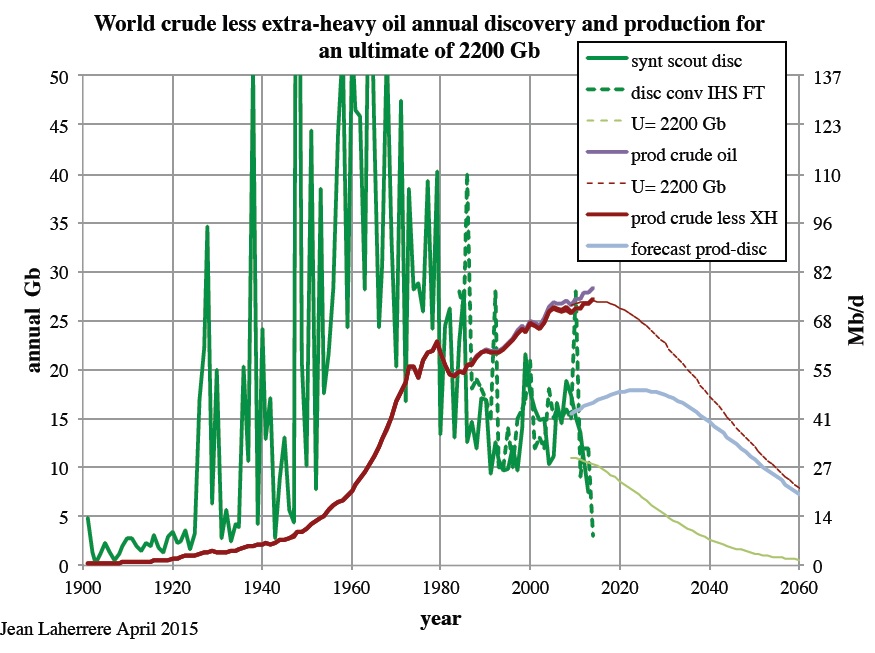
I estimate that the cumulative amount of petroleum produced (pumped out and used up) by 1953 was 98.6 billion barrels (98.6 giga-barrels, 98.6Gb), (2). This implies that since about 1900, when civilization’s use of petroleum as a fuel began in earnest, it consumed 602 giga-GJ (602 x 10^18 Joules) of energy (equivalent to 168 mega-GWh = 168 x 10^9 MWh = 168 giga-mega-watt-hours) to power itself up to 1953, (3).

By 1960, the world’s human population had reached 3B, and the rate of population growth was accelerating (having been about 43M/year during the previous 7 years). From 1960 to the present day, the trend of cumulative production of petroleum, Q, has been proportional to the rising trend of human population, in the ratio of 272 barrels of oil per person (272 b/p).
Specifically, my approximating formula for Q, the accumulated production of oil in giga-barrels (Q, in Gb), given as a function of the population in billions (P, in B) for a given year within the interval 1960 to 2025 is:
Q(year) = [P(year) – 2.7B] x (272 b/p).
This approximation gives an accumulated production up to 2015 (with population 7.35B) of
Q(2015) = 1265Gb, (approximation).
By integrating the actual production rate-per-year curve (the “Hubbert curve” for world production, in GB/yr) given by Laherrere (2), I find the actual accumulated production up to 2015 to be:
Q(2015) = 1258Gb, (actual).
The rate of oil production is now likely at its peak of between 25 Gb/yr to 35 Gb/yr during this 20 year interval between 2005 and 2025, (2),(4). Thereafter, it should drop rapidly since current oil fields have diminishing production, there have been no major oil field discoveries since the 1970s and the frequency of discovery has steadily diminished since then. That means that over half of Earth’s original total reserves, estimated at 2,200Gb (2), have already been extracted. The “end-of-oil” seems destined for the last two decades of the 21st century.

Assuming all that oil was burned, up to the year 2015 (115 years since 1900), civilization would have used 7,674GGJ, (7,674 x 10^18 Joules), equivalent to 2,139GMWh, (2,139 x 10^15 Watt-hours) of energy, derived from that 1258Gb of petroleum, to power itself.
That burning would have released 398,786Gkg (~4 x 10^14 kg = ~400 giga tonnes) of CO2, (5). At present (May 2019) there are about 3,250 giga tonnes of CO2 in the atmosphere, with an average concentration of 415 parts per million by volume (415ppmv), (6). 1228 G tonnes of that CO2 is excess above the pre-industrial amount in the atmosphere. The ~400 G tonnes estimated here as the accumulated emissions from the prior burning of petroleum (up to about 2015) is only about one-third of the excess atmospheric CO2.
There are numerous other processes in our civilization, as well as in the natural world, that cause the emission of carbon-dioxide and its atmospheric retention in excess amounts. The main sources of CO2 emissions are the exhalations from aerobic respiration by all of Earth’s living heterotrophs, decaying plants, and volcanic eruptions. Other sources include: the burning of coal and natural gas, forest and vegetation fires caused naturally and by slash-and-burn agriculture, the bubbling out of CO2 from warming oceans no longer able to dissolve as much of that gas as before, and the massive amount of past and continuing forest clearing that has reduced Earth’s natural system of CO2 uptake — photosynthesis. The cement industry is one of the two largest producers of anthropogenic carbon dioxide, creating up to 5% of worldwide man-made emissions of this gas, of which 50% is from the chemical process and 40% from burning fuel, (7).
Methane (CH4) is a very potent greenhouse gas, being 30 times more effective than CO2 at trapping heat. “For each degree that Earth’s temperature rises, the amount of methane entering the atmosphere from microorganisms dwelling in lake sediment and freshwater wetlands — the primary sources of the gas — will increase several times. As temperatures rise, the relative increase of methane emissions will outpace that of carbon dioxide from these sources.” (8) Other sources of methane emissions are: rotting organic wastes, termite colonies, and bovine flatulence from industrialized agricultural sites. The globally warmed thawing Arctic tundra is now a region of major methane eruptions.
Up until 1974, when the human population had reached 4B, Earth’s climate system had yet to become feverish over the previous 200,000 years of collective human activity. However, at about that time the average global temperature began increasing at a historically unprecedented rate because of civilization’s heated and organic outgassing, a process which continues today as anthropogenic global warming, (9).
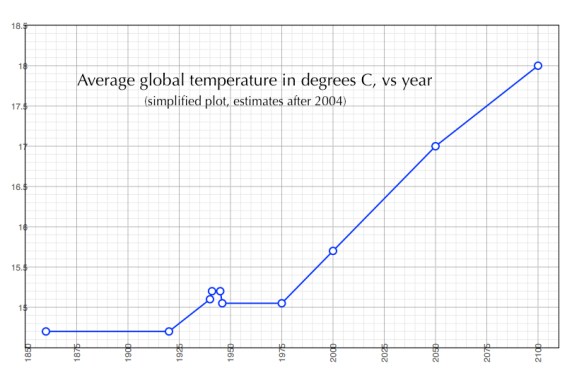
In fact, the date at which collective human activity began to affect and alter Earth’s climate system has now been pinpointed to somewhere between October to December 1965. That date marks the end of the Holocene Epoch of geologic history (which began 11,700 years previously, after the last Ice Age), and the beginning of the Anthropocene Epoch — the epoch of human-affected climate, globally. The physical phenomenon marking this transition is that Carbon-14, a radioactive isotope released during open-air atomic and nuclear bomb explosions between 1945 and 1963, had finally dispersed uniformly around the globe, and become absorbed into tree tissues even in the remotest parts of the world, thus recording that uniformity (10).
Between 1960 and 2025, the three rising trends of: population (P), cumulative oil production (Q), and increase of average global temperature above baseline (T – 14.7C = delta-T), are all uniformly proportional to one another.
Specifically (for years between 1960 and 2025) T, P and Q are related to each other as follows:
[T(year) – 14.7C] = [P(year) – 2.7B]/3.3B = [Q(year)/(900 Gb)],
where the forms above are each equivalent to a temperature difference relative to the baseline of 14.7C (delta-T, in degrees C).
Notice that if T = 15.7C, and P = 6B, and Q = 900 Gb, then the equality above holds, with: 1 = 1 = 1. This particular condition actually occurred during 1999.
During this 65 year interval, a 1 degree C rise in temperature (above 14.7C) is coincident with a 3.3B increase in population (above its 1953 level of 2.7B), which in turn is coincident with a production (and use) of 900Gb of petroleum.
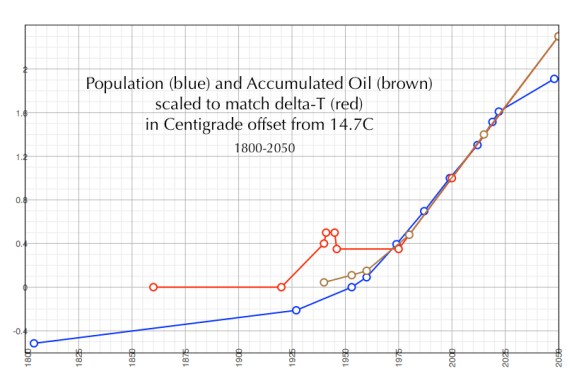
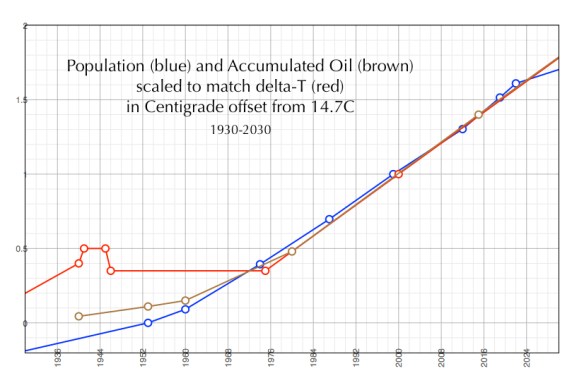
The population is growing from 3B in 1960 to an expected 8B in 2028 during this 68 year interval, with an average population increase of +73.5M/yr. Within these 68 years, and especially during the 55 years from 1970 to 2025, the rising trends of (T – 14.7C), (P – 2.7B)/3.3B, and Q/(900Gb) are in lockstep. This period — with explosive population growth, depletion of over half of the Earth’s petroleum endowment, and with an unprecedented rate of global warming — began in the last year of the Eisenhower Administration, 1960, when John Kennedy was elected US President, and extends right up to the present (and beyond it).
The average global temperature will have climbed up from ~15C to ~16.2C during this interval, a relative rise of 1.4C, and a rise of ~1.5C (delta-T = ~1.5C) above the pre-industrial temperature, defined here as 14.7C (58.46 degrees Fahrenheit). That 1.5C (2.7F) warming above the pre-industrial temperature represents a tremendous amount of heat energy diffused throughout the biosphere, and the deleterious effects of that excess heat are self-evident to all: the altering of climate; the powering of violent weather; the heating and acidifying (with absorbed CO2) of the oceans, sterilizing them of marine life; the melting of glaciers and thawing of tundras; the causing of carbon dioxide and methane to bubble out of solution and frozen capture in the natural world (in a vicious feedback loop); the expansion of disease pathogens and tropical parasites; and the added stresses to both wild and farmed vegetation, and increased desertification, which result in human hunger and desperate migrations of impoverished refugees.
Now, our civilization is starting to suffocate in the lingering heat of its previous exhalations. The singular challenge to our species and to our political economies is what to do, collectively, about global warming. That challenge remains largely unanswered, and tragically denied by too many people .
Notes
1. World population is estimated to have reached one billion for the first time in 1804. It was another 123 years before it reached two billion in 1927, but it took only 33 years to reach three billion in 1960. The global population reached four billion in 1974 (14 years later), five billion in 1987 (13 years later), six billion in 1999 (12 years later), and seven billion in October 2011 (12 years later), according to the United Nations, or in March 2012 (13 years later), according to the United States Census Bureau.
https://en.wikipedia.org/wiki/World_population
World population by year
https://www.worldometers.info/world-population/world-population-by-year/
2. Jean Laherrere, World Crude Oil Production, (brown line), April 2015
https://upload.wikimedia.org/wikipedia/commons/4/46/World_crude_discovery_production_U-2200Gb_LaherrereMar2015.jpg
3. The energy released from combusting 1 barrel of oil is 6.1 giga-joules (6.1 GJ), which equals 1.7 MWh (1.7 mega-watt-hour).
https://en.wikipedia.org/wiki/Barrel_of_oil_equivalent
4. Worldwide, around 92.6 million barrels of oil were produced daily in 2017.
https://www.statista.com/statistics/265203/global-oil-production-since-in-barrels-per-day/
~73 million barrels/day in 1998, rising since.
73 Mb/day = 26.7 Gb/yr (1998)
93 Mb/day = 34.0 Gb/yr (2017)
During 20 years of production (1998-2017) the rate rose 20 Mb/day = +1 MB/day/year
5. Burning one barrel of petroleum can produce between 317kg (realistically) to 433kg (theoretically) of CO2:
Realistic
http://numero57.net/2008/03/20/carbon-dioxide-emissions-per-barrel-of-crude/
Theoretical
https://www.answers.com/Q/How_much_CO2_produced_by_burning_one_barrel_of_oil
Therefore, the CO2 emitted by combusting 1b = 317kg CO2.
6. As of January 2007, the earth’s atmospheric CO2 concentration is about 0.0383% by volume (383 ppmv) or 0.0582% by weight. This represents about 2.996×10^12 tonnes (1 tonne = 1000kg), and is estimated to be 105 ppm (37.77%) above the pre-industrial average (~278 ppmv).
https://micpohling.wordpress.com/2007/03/30/math-how-much-co2-by-weight-in-the-atmosphere/
415 ppmv of atmospheric CO2, as of May 2019
https://en.wikipedia.org/wiki/Carbon_dioxide_in_Earth%27s_atmosphere
Therefore:
(415/383) x 3000 G tonnes = 3,250 G tonnes, (May 2019).
7. Environmental impact of concrete
https://en.wikipedia.org/wiki/Environmental_impact_of_concrete
8. Methane is roughly 30 times more potent than CO2 as a heat-trapping gas
https://www.sciencedaily.com/releases/2014/03/140327111724.htm
9. I first constructed the simplified plot of average global temperature in 2004, using data from public sources. Details about that construction and the data used are given at:
Population, Oil and Global Warming, 31 May 2019 (15 March 2004)
https://manuelgarciajr.com/2019/05/31/population-oil-and-global-warming/
10. The Anthropocene Epoch began sometime between October and December 1965.
https://manuelgarciajr.com/2018/02/23/the-anthropocenes-birthday/
<><><><><><><>

<><><><><><><><><><><><><><><><><><><><><><><><><><><><><><><><>
Too Many People, or Too Much Greed?
During the dark early morning hours of a September 27 a few years after the Second World War, a passenger ship cruising calm South Atlantic waters struck a drifting forgotten mine, was violently breached, and quickly sank before any distress signal could be broadcast. Daylight found 26 survivors massed in, or floating in the sea around, a small lifeboat built for 12. This is the opening scenario to the 1957 British film Abandon Ship! (also called Seven Waves Away, or Seven Days From Now); and is succinctly presented in this brief clip (https://youtu.be/xVm2dbMdXRs).
The weight of those on board along with the weight of the survivors in the water clinging to the sides lowered the boat in the water and put it in grave danger of swamping and capsizing with any wave action, and certainly in the event of a storm. There were only small stores of food and fresh water in the boat, scant medical supplies, no communications gear, no sailing tackle, and only oars. Many of the survivors were injured, weak, frail and old. What were they to do?
They could sit tight and drift to conserve their strength and minimize food consumption, and hope for a chance meeting with a rescue ship before succumbing to their wounds and infections, exposure, thirst and starvation. However, with the first increase of wind and wave action, and any turn in the weather, they would surely all be dumped into the sea and soon drowned.
They could try rowing to the nearest shore, Africa 1,500 miles away, but the bodily energy reserves of the hardy people who would have to provide the propulsion by rowing would be drained away long before reaching land, because of the drag of the total weight of humanity massed about the boat. Also, the boat would still be at risk of swamping should the weather turn for the worse.
The only remaining alternative was to abandon those people least able to contribute to propulsion, so a smaller number of the fittest people would have the water and food stores to themselves, and amount to a lower weight to be transported with a boat that was higher in the water and much more stably seaworthy. But, how many and who would be cast adrift, and who would make those choices?
The officer in charge, Alec Holmes, reluctantly comes to accept the logic of the third alternative. He ensures that he and the seamen under his command are in possession of the sole firearm on board, and sequentially set the weakest among them adrift as their voyage proceeds, as the sick and injured worsen, and as their supplies dwindle. One woman reflects on the cruelty of the powerful in their sacrificing of the weak by saying: “Why are the wicked always so strong?,” and that “an atomic scientist, a brilliant playwright, and a famous former opera singer have been sacrificed to save two ‘apemen’, a racketeer, and a devout coward.”
We could think of this lifeboat as a microcosm of our Planet Earth, and its overcrowding with desperate survivors as representative of a world population explosion facing the combined biological and geophysical catastrophe of collapsing habitability brought on by the global warming climate emergency, and a rapidly shriveling biodiversity.
It took over 200,000 years of human history for the world’s population to reach 1 billion, and only 200 years more to reach 7 billion; world population was estimated to be at 7.7 billion by April 2019.

World population estimates from 1800 to 2100, based on “high”, “medium” and “low” United Nations projections in 2015 and UN historical estimates for pre-1950 data.
[https://en.wikipedia.org/wiki/World_population#/media/File:World_population_v3.svg]
World population is estimated to have reached one billion for the first time in 1804. It was another 123 years before it reached two billion in 1927, but it took only 33 years to reach three billion in 1960. The global population reached four billion in 1974 (14 years later), five billion in 1987 (13 years later), six billion in 1999 (12 years later), and seven billion in October 2011 (12 years later), according to the United Nations, or in March 2012 (13 years later), according to the United States Census Bureau.
I have heard from several of my critics that Earth “needs to” be quickly depopulated down to, say, its 1974 population size of 4 billion, in order to preserve its “carrying capacity” by leaving half of Earth’s area “wild” to both solve our global warming and biodiversity depletion problems, and thus maintain our prosperous nations’ current styles of inequitable capitalist societies within the larger context of a continuing human civilization. Just how this depopulation is to be carried out, and by who, is not mentioned by these critics, hence this essay.
Many factors affect population growth and the magnitude of the Earth’s carrying capacity over time, among them is a positive feedback loop between demographic growth and technological development. Human knowledge (e.g., science) and technological development (e.g., machines, drugs) improve over time and boost human survival, which helps accelerate population growth. Talented individuals, who can devise intellectual and technological improvements, are statistically more likely to arise from and survive to maturity in larger populations living at more advanced levels of development. The intellectual and technological innovations of inventive individuals make it possible to amplify the Earth’s carrying capacity as the population grows, for example by tamping down the incidence and virulence of diseases, and by increasing agricultural yields. However, there is no guarantee that such a positive feedback can cycle forever, and current trends would seem to indicate that this feedback loop is losing its momentum.
What are humanity’s options for forestalling its own extinction at least into the next century? Given human nature, and our many many tribal rivalries, ideologies, fears, superstitions, bigotries, and diversities of moral courage and of moral weakness, what are likely to be the dominant choices for collective actions for societal survival?
We homo sapiens could as a species choose to cooperate globally to simultaneously raise the living standards of the most impoverished — and majority — of Earth’s people, and reformulate our civilization’s manner of energy generation and economic operation, from its highly inequitable feudal capitalism to a highly equalized world eco-socialism: to halt the poisoning of our global environment with waste heat and carbon dioxide from combustion; waste methane from industrialized meat consumption and a melting degradation of the biosphere; and waste chemicals and plastics from industrialized farming and the detritus of industrialized consumerism. In other words, we could unite to share out the Earth equitably while also maximizing the efficiency of the global use of natural resources by quickly reforming our civilization — our methods of finding, extracting and using energy, and the forms and purposes of our economics — so as to be in sustainable balance with natural processes and cycles, all for the purpose of allowing Lifeboat Earth to row or drift for as long as possible with a minimal sacrifice of human decency and human life.
Such a course would obviously include fully subsidized healthcare for everybody, with every form of contraception including abortion on demand, and with all forms of maternity care; also subsidized and universal quality education from preschool through trade schools and university, guaranteed minimum livable income, and fully subsidized elder care and for end-of-life choices. It would be a crime to be a billionaire in such a society, and the capitalism of today — the factional and privatized exploitation of the public — would be extinct since the essence of this society would be the overlapping of relationships of mutual help and consideration on many scales. Capitalism is the ideology of parasites. The people of such an idealized world eco-socialist society would be morally committed individuals who would take it as a given that if human extinction were imminent and unavoidable, they would all share the same fate in solidarity: honor till the end, whenever that would be whether sooner or later.
Human history up to the present suggests that this “all in till the end” type of world socialism is a very unlikely future for us globally, though small isolated pockets of it might develop within the much larger drama of human civilization. While there is always a real chance that a ship at sea would happen upon a lifeboat and rescue its shipwrecked survivors, there is no chance for a rescue of humanity drifting toward extinction aboard Lifeboat Earth, through a massive intervention by fantastically powerful Space Aliens. Our salvation like our damnation is up to us and only us.
So, we can reasonably suppose that the management of Lifeboat Earth will proceed as the wickedness of the powerful in sacrificing the weak to lonesome and fatal abandonment so that the capitalistically fittest can maximize their span of prosperous and even luxuriant survival. Such management of Lifeboat Earth would be (and is) very fractious because greed as a fundamental motivation intrinsically creates dissension, disunity and conflict. Many scales of exclusion would be evident: the impoverishment of a national public and its exclusion from political decision-making by a wealthy and narrowing oligarchy; the oppression by a dominant racial or ethnic population of the weaker ethnic populations and minority-type people it has dominion over; and the exploitation of weaker countries and less-developed economies by strong, advanced and domineering nations. We need only mention the white supremacy domestic policy, and militaristic economic and foreign policy of the United States, the Han supremacy policy being applied by the ruling Chinese on the Uyghurs and in Tibet, the pitiless grinding down of the Palestinians by Zionist Israel, and the migrant streams erupting out of Central America and Africa to escape from starvation and death squads, to stimulate the recollection of numerous other examples of the wickedness of the strong in the management of other regional compartments of Lifeboat Earth. We might even live to see American and European navies shelling refugee ships at sea, and troops of their militarized police summarily executing undocumented aliens breaching their borders, to thwart the arrival of waves of destitute and desperate migrants. Such atrocities would be manifestations of extreme “them or us” end-times panic by the power-clinging wicked.
What can the concerned, morally oriented, largely disorganized and politically marginalized citizens of the world do to help Lifeboat Earth complete its journey — however long or short that may be — in a more humane manner than is occurring today, and certainly than might be its most horrible dénouement? My best and least presumptuous answer is: care enough about the situation to become aware of it, and then do whatever you are willing to do, and have the opportunity to do, to inject greater degrees of awareness, decency and compassion into the small cells of world society that sense your presence. The details of this — whether political, economic, social, intellectual, action-oriented or artistic — depend on the individual, it’s not for me to prescribe.
It is entirely possible that the all-inclusive utopian world of eco-socialist solidarity would have a shorter lifespan than a wicked world for just a few wealthy minorities who pitilessly exclude large segments of humanity, which they disfavor with racial, ethnic and materialistic (anti-poverty) bigotries. If the geophysical gear-train of climate alteration has now been irrevocably set to destroy habitability for humans (and who really knows?), then the eco-socialist world will ultimately fail despite its best efforts. But, it would have been the most enlightened and honorable of possible human civilizations during its lifetime. The wicked world of exclusionary wealthy minorities could extend its lifetime under the same geophysical conditions by culling the human population through combinations of cruel neglect and malicious assault — with no human solidarity and no honor. The partisans for the wicked world of exclusionary wealth justify themselves by claiming “there are too many people,” while the partisans for eco-socialist world solidarity justify themselves by declaring “there is too much greed.” I recognize that the population explosion is a fundamental driver of our combined climate, biodiversity and carrying capacity emergency, and I also agree with the eco-socialists: Earth has too many greedy people.
Today, our Lifeboat Earth is drifting toward becoming a more wicked world of exclusionary survival for exclusionary wealth, but this drift is being resisted by many forms of spirited, morally-based and eco-socially oriented activism. That activism is where the soul and the honor of humanity are to be found.
<><><><><><><>
 manuelgarciajr